
Heading 2
B2B Marketing Strategy for CMOs: Agency Pricing, Hiring, Content & AI | Factors.ai
A B2B marketing newsletter for CMOs and growth leaders covering agency strategy, marketing attribution, content marketing in the AI era, CMO hiring, pricing strategy, and building high-performance marketing teams. Issue #1 of CMO’s OnlyFacts by Protim Bhaumik, Factors.ai.
Written by

Protim Bhaumik
Chief Marketing Officer
Summarize this article



There’s a very specific face I make when someone schedules a 30-minute ‘quick catch-up’ in the middle of an obviously busy day.
It looks like this:
Slightly unblinking, mildly feral, and internally negotiating whether civilization is worth preserving. It looks like this cartoon child, sitting upright in bed at 3 AM, questioning existence.

That is also exactly how I look when I’m 47 minutes into writing something decent and my calendar pings, actually, that’s just how I look now (?!)
Now, let’s talk about why.
Because we’ve all been treating flow as a luxury item. It’s not.
If you’ve ever played Dungeons & Dragons, you know how flow works. Everyone’s casting spells, someone is looting, someone is debating strategy like it’s a TED Talk, and then your mum appears with a bowl of cut fruit and some strong feedback on your posture.
Meanwhile, the dragon is still very much alive.
Marketing teams often operate like that.
Meetings scattered across the week, Slack threads buzzing mid-thought, and ‘quick questions’ that are anything but quick.
Then we’re surprised when the ad copy feels flat, and the messaging sounds like it was assembled by committee, and mild panic sets in.
Creative work needs immersion.
Beethoven didn’t compose symphonies between status calls. He disappeared into them. Even improvisational jazz (which sounds spontaneous) is built on long hours of practice and rehearsal
Flow takes time to enter, and seconds to break.
When you fragment the day into 30-minute blocks, you get deep work, and an intellectual edge (in some sense).
So the real question is not, “Why is our calendar hostile to thinking?”
But that where we started, and here’s what we actually changed.
We stopped pretending creativity fits neatly between two calendar invites.
Instead of spreading meetings evenly across every day, we clustered them. Some days became conversation-heavy (meeting-y). Other blocks became protected. If someone was writing, building a campaign, thinking through positioning, they got uninterrupted time.
It sounds obvious, but it’s not common.
The first week felt strange. When you’re used to constant availability, silence feels suspicious. But once people experienced two or three hours of real focus. Writing got sharper, ideas connected more naturally, meetings improved because people had already done the thinking.
Creativity didn’t suddenly soar, obviously. Of course, even with structure, you’ll still hit blocks. I do, we all do.
And when that happens, I don’t push harder, I change the instrument.
When I was composing, I’d sometimes change my guitar tuning because fresh strings respond differently. The tension shifts, the tone changes, and you play differently.
It doesn’t guarantee brilliance (obviously), but it disrupts the pattern.
Creative blocks are often just pattern fatigue.
So change something small, write longhand, move rooms, reframe the brief, explain the idea out loud.
All you need is a slight shift in tension.
Here’s my point: Make space for flow, and when flow resists, change the strings, then play again.
If you ever feel like your team has ‘lost its creativity’, and your to-do list looks like this:
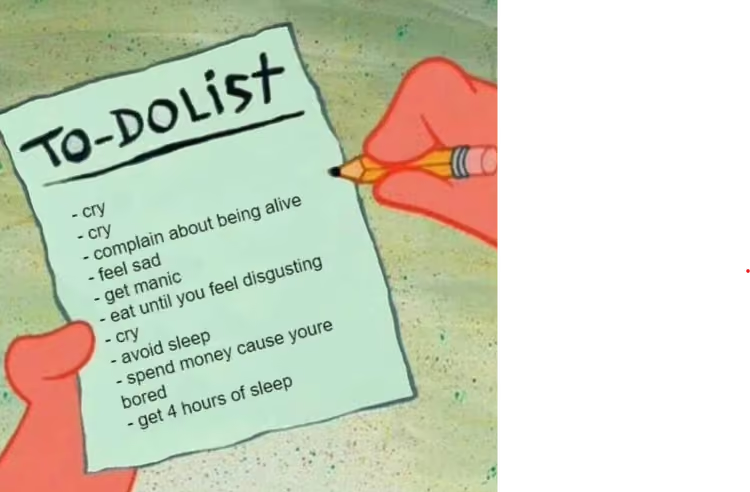
Don’t start with a workshop; start with the calendar, and if that doesn’t help, change the tuning.
Worst case, you get slightly different music (read: work). Best case, you stop looking like that cartoon child every time your calendar pings.
OK bye,
Protim
See how Factors can 2x your ROI
Boost your LinkedIn ROI in no time using data-driven insights
Try AdPilot Today
See Factors in action.
Schedule a personalized demo or sign up to get started for free
LinkedIn Marketing Partner
GDPR & SOC2 Type II







.svg)



.avif)

