
Account Based Marketing vs. Marketing Automation: A Love Story Nobody Asked For (But Everyone Needs)
What is the difference between ABM and Marketing Automation? Learn why ABM is a high-touch strategy for VIP accounts while automation is a tool for scale. Discover how to combine both for maximum B2B pipeline.

Growth Marketer
.avif)
Content Marketer



.svg)


TL;DR
- ABM is a focused, high-touch strategy targeting specific high-value accounts. Marketing automation is the engine that helps you scale communication across many.
- Using marketing automation and calling it ABM is like using a megaphone to whisper. Technically works. Completely misses the point.
- The two aren't rivals. They're actually better together (like peanut butter and jelly, not Batman and the Joker).
- Knowing when to use which one will save your pipeline, your sanity, and probably your Q3 review.
Ah, B2B marketing strategy discussions. Where everyone nods confidently, half the room secretly Googles terms under the table, and someone always suggests, "Maybe we should just do both?" (Spoiler: You probably should. But let's not get ahead of ourselves.)
Today's episode of "Two Things That Sound Similar But Are Definitely Not" features: Account-Based Marketing vs. Marketing Automation.
Because apparently, someone out there is still treating these two like they're interchangeable. And honestly? That's fine. That's what this blog is for.
Let's clear the air, shall we?
First, Let's Talk About What ABM and Marketing Automations Actually Are
Because nothing derails a marketing strategy faster than people using terms confidently without knowing what they mean. (We've all been in that Zoom call. You know the one.)
Account-Based Marketing vs Marketing Automation: The Head-to-Head Comparison
What is Account-Based Marketing (ABM)
ABM is a strategic approach where Marketing and Sales join forces to target a specific set of high-value accounts. Instead of casting a wide net, you’re treating individual accounts as a market of one.
ABM is exactly what it sounds like, marketing aimed at specific accounts. Not "everyone in SaaS." Not "companies with more than 50 employees, probably." Specific, researched, deliberate accounts that your sales team has already circled in red pen.
Here's the deal with ABM:
- You identify a list of high-value target accounts (your VIP guest list, essentially).
- You create hyper-personalized content, outreach, and experiences for those accounts.
- Sales and marketing actually speak to each other (yes, this is part of it).
- You measure success by how deeply those accounts engage, not by how many people clicked your generic email.
ABM is precise. ABM is intentional. ABM is the kind of marketing that makes prospects think, "Wait, did they make this just for me?"
(Yes. Yes, they did. That's the whole point.)
What is Marketing Automation
Marketing automation is the technology engine that handles repetitive tasks at scale. It’s the "always-on" system that ensures no lead drops through the cracks while you’re sleeping (or grabbing a fourth coffee).
Marketing automation is the system that lets you communicate at scale without your team having to manually send 10,000 emails by hand every Tuesday morning.
It handles:
- Drip sequences that nurture leads over time
- Triggered emails based on behavior (visited pricing page? Here comes an email)
- Lead scoring so Sales knows who's warm before they reach out
- Multi-touch campaign orchestration across email, ads, and more
Marketing automation is smart efficiency. It takes your strategy and runs it at scale without you having to clone yourself. Which, given current technology, is still not an option. Unfortunately.
So... What's the Actual Difference Between Account-Based Marketing and Marketing Automation?
Glad you asked. Here's the part where we address the elephant in the room wearing a "but aren't they the same?" t-shirt.
ABM is a strategy. Marketing automation is a tool.
Trying to compare them directly is a bit like asking, "What's better: cooking or a spatula?" One is an approach. The other helps you execute it. You need both, but they're not doing the same job.
Here's a slightly more useful breakdown:
ABM asks: Which accounts do we want? How do we win them?
Marketing Automation asks: How do we reach people at scale without losing our minds?
ABM says: "Hey, Acme Corp. We know your team is evaluating vendors. Here's a case study specifically for your industry, a custom demo invite, and a LinkedIn ad sequence with your CFO's face on it." (Okay, not literally. But almost.)
Marketing Automation says: "You downloaded our ebook three days ago. Here's a follow-up email. And another one. And one more in a week. And an ad. You're very welcome."
See the pattern?
The 5 Places People Get ABM and Marketing Automation Gloriously Wrong
Because if we're being honest (and sarcastic), the confusion is real and widespread.
Mistake #1: Running the Same Email Blast and Calling it ABM
Taking your generic nurture sequence, adding a "Hi [First Name]" field, and declaring it ABM is not ABM. That's just automation with delusions of grandeur.
Real ABM requires actual personalization. Account-specific pain points. Relevant case studies. A message that doesn't feel like it was sent to 4,000 people at once — even if, technically, it was.
Mistake #2: Using ABM for Every Account Ever
ABM is not for everyone. That's kind of the whole point.
Running a full ABM motion for 500 accounts simultaneously with a team of three people is a great way to burn out your team and produce something that's personalized for absolutely no one.
Pick your top-tier accounts. Focus your energy. Save the broad strokes for automation.
Mistake #3: Thinking Marketing Automation Replaces Human Judgment
Marketing automation is smart, but it is not wise.
It will happily send a "We miss you!" email to someone who just churned after a horrible experience with your product. It will fire a "Congrats on your funding!" message to a company that just laid off 40% of its staff. It will nurture a lead who signed up by accident, looking for a different company entirely.
Automation executes. Humans (still) have to think.
Mistake #4: Not Connecting the Two at All
Here's where it gets interesting: the teams that get the best results from ABM are usually the ones who use marketing automation to power their ABM plays.
Automated intent signals triggering personalized outreach sequences? That's the dream. Personalized ads served automatically to target accounts based on CRM data? Chef's kiss. ABM and automation aren't fighting for budget. They're co-workers who'd actually get along great if someone just introduced them properly.
Mistake #5: Measuring ABM with Lead Gen Metrics
If you're running ABM and still asking, "But what's the CPL?" — respectfully — you're measuring the wrong thing.
ABM metrics look like:
- Pipeline influenced per target account
- Account engagement depth (how many stakeholders, how often)
- Deal velocity on ABM-touched accounts
- Closed-won revenue from your target account list
Not form fills. Not clicks. Not "8,000 impressions, very exciting."
So, When Do You Use “Which”?
Great question. Let's make this simple enough to explain at your next all-hands without losing anyone.
Use ABM when:
- You're going after enterprise accounts with long, complex sales cycles
- Your deal sizes are large enough to justify personalized investment
- You have a defined list of accounts that Sales is actively pursuing
- You want to run coordinated, multi-stakeholder campaigns across an account
Use Marketing Automation when:
- You have high inbound volume and need to nurture efficiently
- You want to run always-on campaigns without manual effort
- You need to score and route leads at scale
- You're working with SMB or mid-market segments where ABM economics don't quite add up
Use both (yes, both) when:
- You want automation to power your ABM, like intent-based triggers that fire personalized sequences for target accounts
- You need scale and precision, because why choose suffering when you can choose systems?
The best B2B marketing teams don't pick a side. They use automation as the engine and ABM as the steering wheel.
How Factors.ai Fits into All of This
Since we're talking about doing ABM properly (and not accidentally turning it into a mass email campaign with a fancy name), this is where the tooling actually matters.
Factors.ai helps bridge the gap by giving you the account-level visibility that makes both ABM and automation actually work:
- Website visitor identification so you know which target accounts are browsing, even before they raise their hand
- Account-level intent signals so your automation triggers at the right moment, not just on a Tuesday
- Multi-touch attribution so you can see which ABM plays are actually moving accounts forward (and which ones are just costing money and vibes)
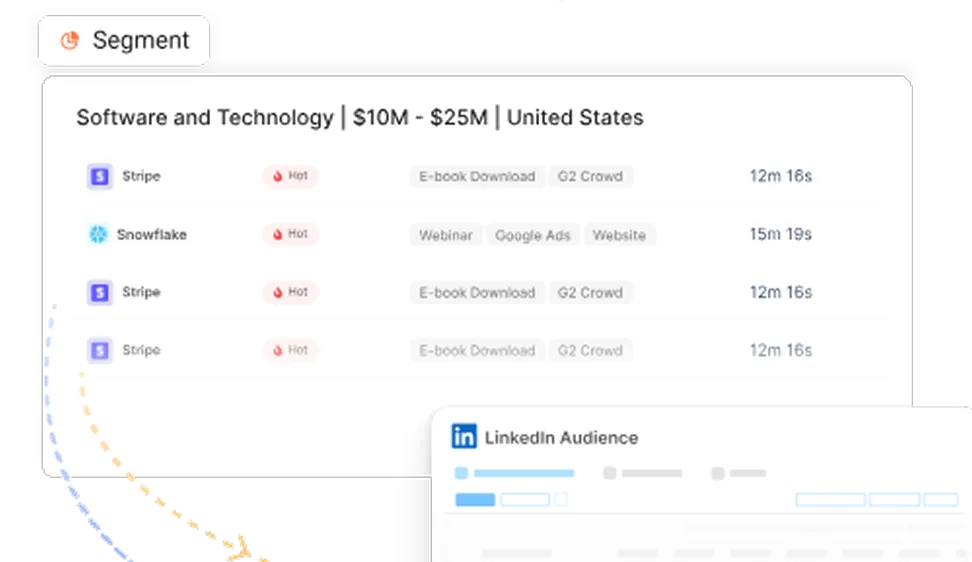
- Account 360 view that stitches together CRM activity, ads, website behavior, and sales touches into one clean timeline
In other words: smarter ABM, powered by automation, measured properly.
Which is, frankly, the combination everyone claims to have but very few actually do.
Wrapping Up (Before Someone Sends Another "Personalized" Blast to 3,000 People)
Let's land the plane here.
ABM and marketing automation are not the same thing. They're not rivals either. They're complementary approaches that, when used together correctly, create the kind of revenue engine that actually makes your pipeline report look like something you'd want to present.
The teams winning right now aren't choosing between them. They're letting automation handle scale and using ABM to go deep where it counts.
So the next time someone in a meeting says, "We should just automate our ABM," — smile politely, send them this article, and maybe suggest a brief vocabulary alignment session.
Because the difference between ABM and automation isn't just semantic. It's pipeline. And you deserve both.
FAQs on ABM vs. Marketing Automation
Q1. Does ABM actually replace Marketing Automation?
No, they are complementary. Automation handles the volume, while ABM handles the high-value strategic accounts.
My Honest Take: People ask this because they’re looking for a way to delete half their workload. Sorry, no. It’s like asking if a sniper rifle replaces a net. If you only use the spear (ABM), you’ll starve while waiting for the big whale. If you only use the net (Automation), you’ll catch a lot of "trash fish" (students, competitors, and people just there for the free template). You need both unless you enjoy being stressed about your pipeline.
Q2. Do I need to buy an expensive ABM tool if I already pay for HubSpot or Marketo?
The short answer is no, but it depends on how much you enjoy manual labor. Most automation tools are built to track people, while ABM tools like Factors.ai are built to track companies.
My Honest Take: This is the #1 question on Reddit because everyone feels like they’re being upsold. You can absolutely do ABM in a standard CRM, it’s just like trying to build a LEGO set while wearing oven mitts. It’s clunky, but possible. Don’t buy the $50k like 6Sense or Dreamdata software until you’ve proven the strategy works with a spreadsheet first.
Q3. Is ABM just fancy outbound sales with a bigger marketing budget?
If your ABM strategy is just your sales rep cold emailing 50 people a day, that’s not ABM, that’s just a busy sales rep. Real ABM is a pincer movement where marketing warms the target up with ads and content while sales knock on the door.
My Honest Take: LinkedIn "gurus" love to overcomplicate this. In reality, the "fancy" part is just coordination. If Marketing and Sales aren't actually talking to each other daily, you’re just doing regular outbound and calling it a trendier name to justify the budget.
Q4. How do I start ABM without a six-figure budget?
Start with a Crawl-Walk-Run framework. Manually identify 10 dream accounts, use a simple visitor tracker to see if they’re hitting your site, and have your CEO reach out personally with a specific observation about their business.
My Honest Take: People ask this because they think ABM is a "rich person's game." It’s actually the opposite. If you're a startup with only $1,000 for ads, would you rather show them to 100,000 randoms or the 10 people who can actually sign your paycheck? (Hint: pick the 10).
Q5. Can I automate my ABM, or does that defeat the whole purpose?
You should automate the logistics, like alerts when a target account visits your pricing page, but never automate the relationship. If your dream account gets an email that clearly came from a sequence, you’ve already lost.
My Honest Take: This is where most teams mess up. They try to "scale" personalization until it isn't personal anymore. Automation is for the journey (tracking, ads, data); humans are for the handshake (emails, calls, gifts).

See how Factors can 2x your ROI
Boost your LinkedIn ROI in no time using data-driven insights


.avif)
See Factors in action.
Schedule a personalized demo or sign up to get started for free
LinkedIn Marketing Partner
GDPR & SOC2 Type II




.svg)



.avif)

