
Sales workflow guide: Let buyers tell you when they are ready
Buyers now control the research process. Build sales workflows that detect buying signals in real-time and reach out when timing actually matters.

Writer
.avif)
Content Marketer



.svg)


- Sales workflows adapt to buyer behavior in real-time. Trigger actions based on intent signals, timing, and account activity, rather than static stages or form fills.
- AI workflows prioritize accounts showing real purchase intent. Score leads using pricing visits and engagement depth so reps focus on buyers ready to buy.
- Signal-based selling times outreach to buyer readiness. Engage when behavioral signals confirm interest, such as when accounts visit pricing pages, download content, or return multiple times.
- Autonomous agents act on insights instantly. Predictive AI identifies opportunities, while agentic AI adjusts pipelines and follow-ups in real time without manual intervention.
To err is human. Certainly, but automating thy sales workflow without understanding? That’s simply beyond the pale.
It’s a risky move, considering buyers move faster than workflows ever did. Gen Z buyers complete nearly 70% of the buying journey independently before ever talking to sales. By the time a flawed workflow reacts, routing a lead, triggering outreach, and updating stages, the moment has already passed.
Yes, automation is a life-saver and reps have their plates full. There’s no denying that. But automation done wrong is worse than no automation at all. Because now, instead of a human making mistakes, you've got a machine making those same mistakes. Faster than you can fix them.
Look, a standard sales workflow works just fine today, but it was never built for scalability. It was built piece by piece over time, shaped by individual CRM choices and informal hand-offs. As a result, execution now depends on memory, interruptions, and Slack messages that start with “Quick question…”
Without predictive sales AI, these fragmented, human-dependent workflows can’t be redesigned. They can only be pushed harder, accelerating inefficiency rather than eliminating it.
In this (not-so-ultimate) guide, I’ll walk you through how modern sales workflows actually work, and how to automate them without turning chaos into speed or feeling compelled to comment ‘straight shrimp’ under every blueprint post.
What is a B2B sales workflow anyway?
A sales workflow is a repeatable sequence of tasks that guides prospects from initial contact to close. It answers these questions: Who should you contact? When? What should you prioritize? What should you ignore?
Most teams confuse sales processes with sales workflows. A sales process is static, and stages like lead, opportunity, and closed-won that don't change based on buyer behavior. The latter is dynamic. It adapts based on intent signals, timing, and account activity.
| 📌 Automation, AI workflows, and AI agents aren't the same. Automation is built on predefined rules. It looks something like this: when a form is filled out, an email is triggered, and a task moves forward. While automation reduces manual effort, the underlying decision-making remains unchanged. AI workflows, by contrast, improve decision-making. They assess intent and behaviour to determine which opportunities deserve attention, ensuring human effort is focused where it has the greatest impact. Lastly, AI agents operate autonomously, qualifying prospects, retaining context across conversations, and adapting messages in real time as opportunities progress. Rather than assisting the sales process, they take responsibility for executing it. The difference between these three comes down to control and responsibility. Automation executes tasks, AI workflows guide people, and AI agents run sales motions autonomously. |
How traditional sales workflows worked vs AI sales workflows now
For years, sales workflows pushed more leads in and more activity out, turning reps into hamster-wheel operators. AI-driven workflows change that by handling the grunt work in the background, prioritizing accounts, updating follow-ups, and adjusting next steps, so reps can focus on real conversations. The workflow shifts from chaotic to intentional, and it looks something like this:
| Sales workflow | Traditional execution | AI-driven execution |
|---|---|---|
| Lead routing | Based on form fills, territory, or round-robin. Everything looks urgent. | Based on intent, engagement depth, and momentum. Only active buyers reach reps. |
| Account prioritization | Manual sorting by lead score or last activity. Lists go stale fast. | Continuous updates based on real-time signals like page visits and recency. |
| Outreach timing | Sequences start immediately or after fixed delays. | Triggers only after intent thresholds are met. Timing reflects buyer readiness. |
| Rep task management | Long CRM queues with little context on why tasks matter. | Context-aware actions tied to specific buyer behavior with a clear rationale. |
| Follow-ups | Run on preset schedules regardless of engagement. | Adapt based on engagement, silence, or renewed interest. |
| Pipeline reviews | Reviewed by stage, age, and rep updates. Risk surfaces late. | Assessed using engagement trends and momentum. Risk flagged early. |
How to build your sales workflow across the core stages
A sales workflow works only when inputs, logic, timing, and execution line up. Miss one, and it breaks. It’s like coffee: good beans, the right grind, the right temperature, a steady pour. Get one wrong, and the result is bitter…even if you pretend it’s fine. Here’s how to get it right across four core sales stages.
- Prospecting and account discovery
Modern sales workflows don’t start with list-building but with visibility. Companies are already finding you. They’re visiting your site, reading your blog, checking pricing, and comparing you to competitors. You just don’t see it because 98% of website traffic is anonymous. This is where AI sales tools help with tracking buyer behavior early.
Account intelligence changes that. Instead of building lists, you identify companies already showing intent. Factors.ai's account intelligence de-anonymizes your website traffic so you can see which companies are visiting, what they’re viewing, and how often they return. Now reps can lead with relevance: “I noticed you’ve been reviewing our pricing. Want to see how other logistics teams are using this?”
💡Also read: Understanding anonymous website visitor identification
- Outreach and engagement
Ever burned coffee because the water was too hot? Or brewed something so weak it tasted like disappointment?
Outreach timing works the same way. Too early and you’re annoying. Too late, and your competitor already closed. Blast the same email to 500 people, and you’re just pouring cold water on everything, hoping something extracts by accident.
What actually works is simple, personalized outreach triggered by behavior. An account that downloads your ROI calculator doesn’t want the same message as someone who’s only skimmed your homepage. One is ready for numbers. The other isn’t even sure there’s a problem yet.
In fact, with Factors.ai's GTM engineering services, you can track intent signals in real-time and trigger sequences based on what accounts actually do. For instance, when a prospect visits the pricing page, the sales team is alerted in real time and can respond with personalized outreach via email, phone, or LinkedIn. A whitepaper download creates the right moment to share a relevant ROI case study, while a form fill following repeated high-intent engagement clearly signals it’s time to move straight to a call.
- Lead qualification and prioritization
If you’ve ever tried brewing espresso with a coarse grind, you know the result. Lead qualification fails the same way. Real intent shows up across the buyer journey, not in the last click.
Multi-touch attribution shows what actually matters. Did an account attend a webinar, read two case studies, then check pricing? That’s a pattern. Factors.ai's analytics and attribution map these patterns across every marketing touchpoint and score leads based on what historically drives closed deals. Reps stop wasting cycles on leads that were never going anywhere. They focus on accounts showing real buying behavior. That’s the right grind.
- Closing and pipeline management
You can get the beans, temperature, and grind right, yet a bad pour still ruins the coffee. Deals work the same way. They stall when champions leave, budgets shift, or decision-makers disappear. Conversation intelligence shows what’s really happening, and flags drops in momentum early, so you can step in, fix the gap, and close.
{{INLINE_TOFU}}
Why B2B teams should switch to signal-based selling
Buyer behavior has shifted, and sales teams now have access to far richer intent signals. That said, it’s fair to add that outbound outreach is not dead, but what worked in outbound since 2018 is. As George Coudounaris, co-host of The B2B Playbook, puts it in his latest podcast, outbound lost its edge when “the playbook became process, and process became volume. And that volume drowned out the very people it was meant to reach.”
Most outbound motions still follow a tired loop: reach out, wait for a response, move on. No reply? Mark the account cold and forget it. That worked when buyers engaged early. It doesn’t reflect how B2B buying works today.
73% of B2B buyers actively avoid suppliers who send irrelevant outreach. Think of it like a store associate who walks up the moment you enter, starts pitching aggressively, and follows you aisle to aisle. You don’t buy. You leave.
Signal-based selling is the opposite. The associate notices when you stop comparing two products, read the label twice, or look around for help. That’s the signal, and that’s when they step in. Signal-based selling shifts the focus from who to contact to when to engage, using behavioral, intent, and engagement signals to time outreach when relevance is highest.
AI sales assistants work the same way. They don’t interrupt. They observe patterns, pauses, repeat visits, changes in behaviour, and only then prompt a seller to engage.
Without AI, those moments are very easy to miss. But with AI, outreach is triggered when behaviour signals readiness.
Choosing the best AI sales tools for your stack
“Most AI tools for sales are solving problems you don’t have yet.” Read that again because it explains half the chaos in AI sales today.
The fastest way to spend money on AI is buying tools that vaguely promise to “help reps sell.” When it comes to AI sales tools, less really is more. Instead, a focused AI sales stack should look and work something like this:
| Job in the workflow | Tools | Why this role matters |
|---|---|---|
| Decide which accounts deserve attention | Factors.ai | This is the brain. It connects marketing engagement and sales activity into a single account view. Reps stop guessing priority. Marketing and sales act on the same signals. |
| Turn priority into action | Outreach, Salesloft | These tools should not decide who to contact. They exist to execute once the intent is clear. Sequences work only when timing is already earned. |
| Improve message quality, not volume | Lavender, Regie.ai | Writing tools help reps say things better. They do not make messages relevant on their own. Use them after prioritization, not before. |
| Capture learning from conversations | Gong, Fireflies | These tools surface objections, intent shifts, and deal risk so future outreach gets smarter. |
💡Also read: A quick guide to AI sales tools
4 absolute no-nos for sales workflow in B2B (+ fixes)
Just avoid these mistakes, and you’re sorted. Because one tiny mistake and your entire sales workflow goes from being Ser Duncan the Tall to Joeffry Baratheon (IYKYK). And, we know how Joeffrey (confidently) caused mayhem.
- Not all leads are equal.
Only a fraction of your leads are actively buying right now. The rest are researching, comparing, or are months away from a decision. Workflows that ignore this waste rep time. High-intent accounts get generic outreach. Low-intent accounts get pushed too early and disengage.
Fix it: Prioritize accounts based on real-time engagement signals. Track engagement depth, page visits, and recency. Route active accounts directly to sales representatives, while keeping the rest in automated nurture.
- Automation without intelligence is just spam at scale. Period.
Without intelligence, automation simply sends scheduled messages without regard for buyer behaviour, delivering spam efficiently (and at scale). This will leave you money on the table, given that 61% of B2B buyers already prefer a rep-free buying experience.
Fix it: Tie automation to clear intent signals, such as pricing visits or product research, and prevent sequences from running unless those signals are present.
- It’s 2026, and sales and marketing still aren’t in the same room.
It is circa 2026, and sales-marketing alignment shouldn’t be a debate. According to Forrester’s Q2 2024 report, 65% of sales and marketing teams say their leaders aren’t aligned. Sales gets leads without knowing why they matter. Marketing never learns which signals convert.
Fix it: Align on shared account signals. Surface the same data in both tools. Handoffs should explain why an account is prioritized, not just that it scored 100 points. Close the feedback loop.
- Busy reps ≠ moving deals.
200 emails sent. 100 calls logged. 50 tasks completed. Your activity on the dashboard feels flawless. But the close rate hasn’t budged in six months. The problem isn’t effort; it's tracking tasks rather than deal movement.
Activity is easy to track, so teams optimize for it. But task completion doesn’t equal deal progress. It creates the illusion of productivity while the pipeline stays stuck. Sales reps already waste 14 of their 51 weekly hours on admin work. Let’s not worsen it by rewarding busyness over results.
Fix it: Measure deal movement, not the volume of tasks. Ask whether outreach led to a meeting, whether that meeting advanced the stage, and whether momentum built or stalled. Optimize workflows around what has historically closed deals.
The future of sales: Predictive sales AI and autonomous agents
Predictive sales AI provided teams with early indicators of risk and opportunity. It could flag risky deals, score accounts, and surface buyer intent before things went sideways. Useful, but insight alone doesn’t close deals. If no one acts fast enough, the opportunity still slips far, far away.
That’s where autonomous agents marvellously assemble. They go beyond conventional reporting by acting on what is happening in that moment.
And this isn't some distant future scenario. IBM says 83% of executives expect AI agents to be autonomously executing actions by 2026. Another 85% think their teams will be leaning on real-time AI recommendations to make decisions. Meanwhile, 52% of C-suite leaders are already seeing measurable wins from AI-powered workflows. That’s a lot of figures (to process), but it’s the reality.
AI has moved from suggesting to acting. That matters because B2B buyers now move faster than manual workflows. Autonomous agents close the gap by adjusting pipelines and outreach in real-time. Predictive AI sees the signal, but agentic AI takes the shot.
Last but not least
Buyers are dropping signals everywhere. A visit to your website, a like on your social channels, a frenzy demo. Are you listening, though? Catch the signals and convert them into revenue with factors.ai. Book a demo and let’s show you how.
Frequently asked questions for sales workflows
Q. Are AI sales assistants actually useful or just hype?
They are useful when they take work off a rep’s plate. Logging, research, call summaries, and follow-ups are where they shine. They fail when teams expect them to replace judgment, timing, or relationship building.
Q. How can I identify high-intent leads before they fill out a form?
You have to stop waiting for form fills. Intent platforms show which target accounts are actively researching your site, pricing, and case studies. That signal lets reps engage earlier, with context, instead of guessing.
Q. What are the best AI sales tools for B2B prospecting right now?
There is no single “best” tool. The most effective teams combine clean data, reliable intent signals, and a single execution layer. When each tool has a clear job, reps trust the output and actually use it.
Q. Will AI sales tools eventually replace BDRs or SDRs?
No. AI replaces manual prospecting, not human selling. Buyers still want thoughtful conversations. In practice, AI makes a small team feel much larger by automating research, sequencing, and follow-up work.
Q. How does predictive sales AI improve forecasting accuracy?
It reduces blind spots. Predictive AI looks at deal movement, engagement, and velocity to flag risk early. Forecast calls shift from opinions to evidence, and leaders catch problems before quarter-end surprises.

See how Factors can 2x your ROI
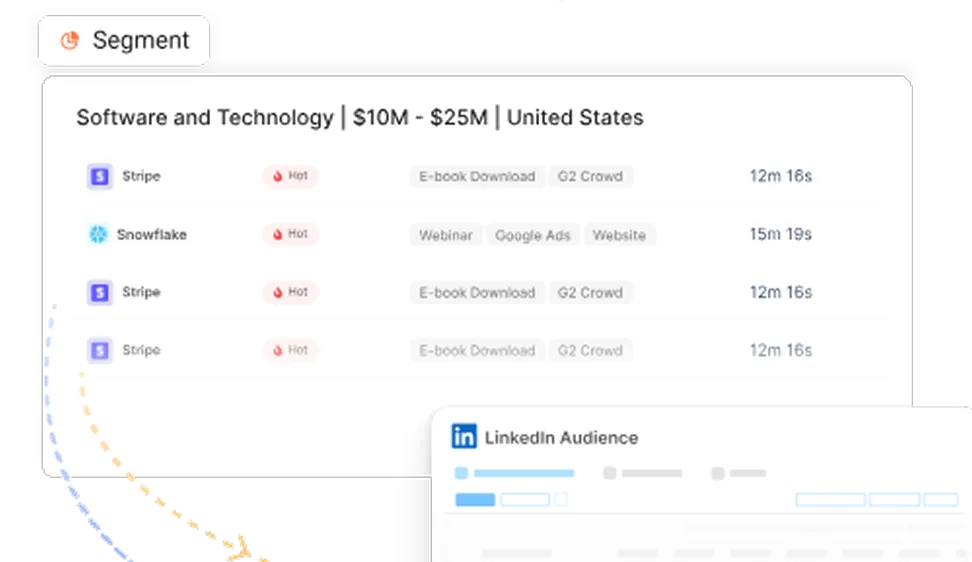
Boost your LinkedIn ROI in no time using data-driven insights

.avif)

See Factors in action.
Schedule a personalized demo or sign up to get started for free
LinkedIn Marketing Partner
GDPR & SOC2 Type II






.svg)



.avif)

