
AI for small business marketing: a practical guide for growing without a bigger team
Learn how AI for small business marketing can benefit teams across functions such as content, ads, automation, and attribution without wasting budget on unnecessary tools.
.avif)
Content Marketer



.svg)


TL;DR
- Small businesses are closing the AI adoption gap with enterprises faster than any previous technology cycle, not because they have better tools, but because lean teams feel the impact of every hour saved.
- The biggest waste of an AI marketing investment isn't picking the wrong tool. It's buying five tools before you've fixed your workflows, your CRM hygiene, or your attribution.
- A small business using AI for marketing doesn't need 15 subscriptions. Four to six tools that actually integrate with each other will outperform a bloated stack every time.
- Most AI marketing advice online is built for ecommerce with massive audiences and high-volume purchases. B2B SMBs need account-level intelligence and pipeline visibility, not more blog posts.
- If AI helps you produce 50 pieces of content but pipeline stays flat, you haven't gained efficiency. You've just automated noise at scale.
If you've ever worked in a small business, you've probably had at least one week where the marketing team consisted of one person, three spreadsheets, and a concerning amount of optimism.
Somehow, that same person was expected to manage content, email campaigns, paid ads, reporting, SEO, lead nurturing, website updates, and whatever emergency appeared in Slack before lunch… and then they start looking like this meme:

For years, the only solution was hiring more people or accepting that certain things simply wouldn't get done… AI changed that equation.
And no, it’s not because it replaced marketers… despite what every second LinkedIn post would have you believe, most marketers are still stubbornly employed.
AI enabled small teams to achieve wayyy more than they could before. Tasks that once took hours now take minutes. Workflows that required specialists can often be handled by generalists. The gap between what a five-person company and a fifty-person company can execute has narrowed dramatically.
The problem is that many businesses responded by collecting AI tools the way some people collect Pokémon.
So before you sign up for another AI platform, it's worth understanding where AI genuinely helps, where it doesn't, and how small businesses can use it to create growth instead of just creating more work (because we all hate that).
Why is AI becoming a competitive advantage for small businesses?
For the first time in marketing history, small businesses have access to capabilities that used to require agencies, analysts, and enterprise software licenses. Personalization, predictive analytics, audience intelligence, and large-scale content production were locked behind six-figure budgets a decade ago. Today, a small marketing team can access similar capabilities through AI tools that cost less than a single contractor.
The adoption numbers tell a clear story. According to the SBE Council's 2026 Small Business Tech Use Survey, 82% of small business employers have now invested in AI tools, and the typical small business runs a median of five. Marketing is consistently the number one use case. The real surprise, though, is how quickly the gap between small and large businesses is closing. Small businesses adopted AI at a faster rate than large firms by mid-2025, a reversal that hadn't happened before in technology adoption monitoring data.
The underlying pressure is straightforward. CPCs on Google Ads rose 12% year over year in Q1 2026, the steepest annual increase since 2021. Content saturation makes organic visibility harder to earn every quarter. Attention spans are shrinking while buyer journeys are getting longer. Small businesses can't compete through manual execution alone anymore, and the ones using AI marketing for SMBs aren't just surviving the inflation.
The biggest misconception I keep hearing is that AI gives small businesses an unfair advantage. It doesn't. It simply gives them access to the same playing field larger companies have had for years. The companies pulling ahead aren't the ones adopting the most AI tools. They're the ones integrating AI into workflows that were already working, fixing the foundation while everyone else is busy chasing the next product launch.
The biggest AI marketing mistakes small businesses make
Most SMBs don't have an AI problem. They have a tool-hoarding problem, and I've watched it play out the same way more times than I can count.
- Buying AI tools before fixing workflows. A team has no CRM process, no consistent lead tracking, no campaign structure, and no attribution model. They can't explain how a lead moved from ad click to closed deal. And yet, they're evaluating their fourth AI platform of the quarter. The tool isn't the bottleneck. The workflow is the bottleneck, and no amount of automation fixes a process that doesn't exist yet.
- Replacing strategy with prompts. AI generates content. It does not generate positioning. A prompt can produce a blog post in minutes, but it can't tell you whether that topic matters to your buyers, how it connects to your product narrative, or where it fits in your funnel. The teams treating AI like a strategy shortcut end up with more content and less clarity.
- Chasing every new AI launch. AI fatigue is real, and it's costing teams both money and focus. A new tool launches every week promising to transform some part of your marketing. Teams sign up for trials, overlap subscriptions, and end up with three tools that do roughly the same thing.
- Measuring outputs instead of outcomes. More blogs, more emails, more social posts. Those are outputs. Pipeline created, revenue influenced, and opportunities advanced are outcomes. Attribution debates sometimes resemble group projects where everyone claims credit for the final result, but at least the group project ends.
What AI should actually replace in a small marketing team (and no, it’s not a person)
Here's a useful filter I call the Repetition Rule. If a task happens repeatedly and follows predictable patterns, AI should probably help with it. If a task requires judgment, context, or relationship-building, AI should stay faaaar away from it.
Most marketers don't need AI to create more work. They need AI to eliminate the work nobody should be doing manually anymore.
| Area | Tasks AI should handle | What still needs a human |
|---|---|---|
| Content production | Blog drafts, repurposing, social post generation, video script outlines | Positioning, voice, editorial judgment |
| Email marketing | Segmentation, personalization triggers, draft generation | Strategy, sequencing logic, relationship context |
| Paid media | Creative testing, audience suggestions, budget recommendations | Campaign strategy, brand alignment, vendor negotiations |
| Reporting | Dashboard assembly, trend detection, attribution analysis | Interpretation, strategic recommendations, stakeholder communication |
The key distinction is between execution and decision-making. AI compresses execution time dramatically. A task that took four hours can drop to under one, and for small teams where every hour saved has outsized impact, that compression is significant. But the decisions about what to execute, when, and why still require the kind of judgment that comes from understanding your market, your buyers, and your competitive position.
The best AI marketing tools for small businesses, organized by use case
Generic tool lists are everywhere, and most of them are unhelpful because they organize by product name rather than by the job you're actually trying to do. Here's how to think about the best AI tools for small business marketing in 2026, organized by the problems they solve.
- AI content creation
Tools worth knowing: OpenAI (ChatGPT), Anthropic (Claude), Jasper
ChatGPT remains the entry point for most teams. It's flexible, affordable, and handles everything from brainstorming to draft generation. Claude excels at longer-form, nuanced writing where tone consistency matters. Jasper focuses specifically on marketing use cases and understands brand voice, which helps teams producing high-volume blog posts, emails, and ad copy keep their output consistent.
The limitation across all three is the same. AI writing tools produce competent drafts, but they don't produce strategic content. Every output still needs a human editor who understands the audience, the product, and the competitive landscape.
- AI design
Tools worth knowing: Canva, Adobe
Canva's AI layer, Magic Studio, handles image generation, background removal, text-to-image, and template-based design. For teams without a dedicated designer, it removes the dependency on external creative resources for everyday assets. For most small businesses doing budget-friendly AI marketing, Canva covers 80% of visual needs at a fraction of the cost of Adobe.
- AI SEO
Tools worth knowing: Surfer SEO, Clearscope, MarketMuse
This category matters because AI-generated content without optimization rarely performs in search. Surfer SEO starts at $89/month and offers the best feature-to-price ratio for teams scaling content production. Clearscope begins at $129/month and focuses on semantic depth and content grading. If you're publishing regularly and want your content to rank, pair your AI writing tool with an optimization platform.
- AI email marketing
Tools worth knowing: Mailchimp, HubSpot, Customer.io
Each of these platforms now uses AI for segmentation, send-time optimization, subject line generation, and basic personalization. HubSpot integrates email deeply with its CRM, making it strong for B2B teams tracking leads through longer sales cycles. Mailchimp works well for smaller lists with simpler workflows. Customer.io excels at event-triggered messaging for SaaS products.
- AI marketing automation
Tools worth knowing: HubSpot, ActiveCampaign, Zapier
Automation is where AI tools for small business marketing automation start earning their keep. HubSpot's Starter plan handles basic workflows, form follow-ups, and lead nurturing sequences. ActiveCampaign goes deeper on conditional logic for teams with more complex buyer journeys. Zapier connects tools that don't natively integrate, which matters when your stack includes three or four platforms that need to share data.
AI attribution and buyer intelligence...
This is where the conversation gets interesting, because most small businesses don't actually struggle with generating leads. They struggle with understanding which companies are visiting their site, which campaigns are creating revenue, and where budget leaks are happening.
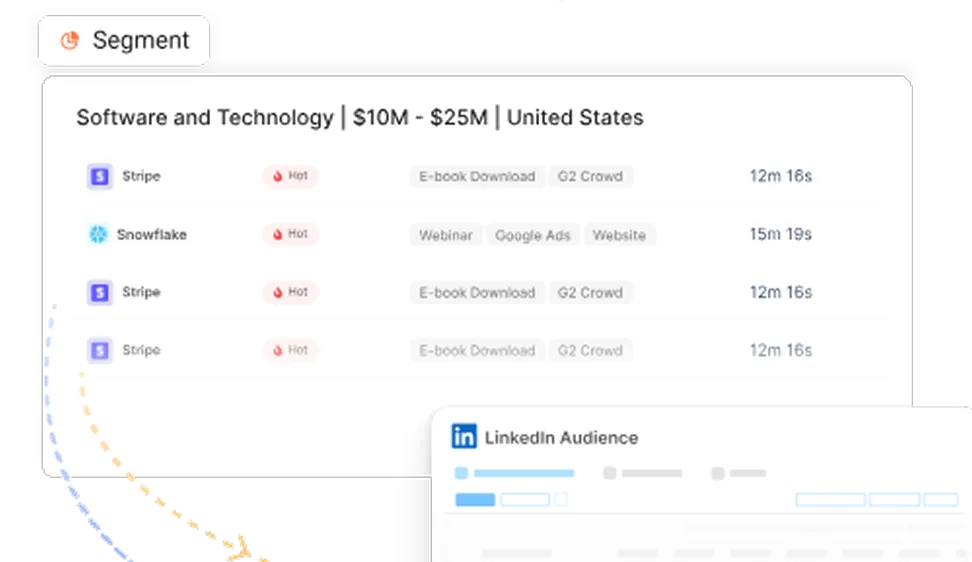
Factors.ai sits in this category. It identifies anonymous companies visiting your website using IP resolution and enrichment. It consolidates intent signals from LinkedIn, Google, G2, and your CRM into a single account-level view. It tracks multi-touch attribution across first touch, last touch, and influenced campaigns, so every campaign gets credit for what it actually did.
The positioning here is specific. Factors isn't a content tool or an email tool. It's the tool that helps small teams make decisions, not just create more content. For B2B teams spending on LinkedIn and Google ads, the visibility into which accounts engaged with which campaigns is hard to get from native platform analytics alone.
Building an AI marketing stack without enterprise budgets
Small businesses don't need 15 AI tools. They need four to six tools that talk to each other, and the best AI marketing stack for a small business is the one your team actually uses every day.
Under $300/month
| Tool | Monthly cost | Primary job |
|---|---|---|
| ChatGPT (Plus) | ~$20 | Content drafts, brainstorming, research |
| Canva (Pro) | ~$15 | Visual assets, social graphics |
| HubSpot (Starter) | ~$18 | CRM, email, basic automation |
| Factors.ai (Free/Basic) | $0–varies | Account identification, attribution |
| Zapier (Starter) | ~$20 | Tool integration, workflow automation |
This stack covers content creation, design, CRM, attribution, and integration for under $300/month. It's not flashy, but it handles the core workflows that small business digital marketing with AI requires. The tools overlap minimally, and Zapier fills the gaps where native integrations don't exist.
Under $1,000/month
For scaling teams, expand the stack with Surfer SEO ($89/month) for content optimization, ActiveCampaign for deeper automation, and Factors.ai's growth tier for expanded account identification and LinkedIn ad analytics. If your team saves 6 hours per week through AI, that's 24 hours per month of reclaimed time. At even a conservative rate, the tools pay for themselves in the first month.
The trap to avoid is adding tools faster than your team can adopt them. A tool nobody uses is worse than no tool at all, because it costs money while creating the illusion of progress.
How small businesses can use AI across the entire funnel
- Top of funnel
Blog creation, SEO research, and social content production are the most obvious starting points. AI compresses the production timeline from days to hours, which means a small team can maintain publishing consistency without burning out. The goal at this stage is visibility, reaching buyers before they know they're buyers.
- Middle of funnel
Lead nurturing, retargeting, and website personalization sit here. This is where SMB marketing with AI starts getting more sophisticated. AI-powered email sequences adapt to user behavior. Retargeting ads surface to accounts showing engagement signals. The shift from top to middle of funnel is the shift from creating awareness to building consideration.
- Bottom of funnel
Intent detection, pipeline attribution, and revenue reporting matter most at this stage. Knowing which accounts visited your pricing page twice this week, which campaigns influenced those visits, and how that maps to pipeline value changes the conversation from 'how much content did we publish?' to 'which activities are creating revenue?'
AI marketing strategies for local businesses
Local businesses often don't need 'AI transformation.' They need better consistency, and AI helps maintain consistency at scale. Clinics, agencies, consultants, restaurants, and real estate firms all share the same fundamental challenge. They need to show up reliably in local search, respond to inquiries quickly, and stay top of mind with their community.
1. Google Business Profile optimization. AI tools can generate and schedule posts, suggest keyword-rich descriptions, and monitor competitor profiles for changes.
2. Review generation. Automated follow-up sequences after appointments or purchases prompt reviews without manual effort.
3. Automated follow-ups. AI-powered CRM tools handle first-touch responses and qualify leads automatically. For service businesses, the gap between a lead arriving and being followed up with is where revenue is most commonly lost.
4. Local SEO content. AI drafts location-specific landing pages and blog posts targeting neighborhood-level keywords that would take hours to write manually.
5. Appointment nurturing. Automated reminders and rebooking sequences keep the calendar full without requiring front-desk attention.
AI for B2B SMB marketing: what works differently
Most AI marketing advice online is built for ecommerce, and that's a problem for B2B teams. B2B SMBs operate in a completely different world, with smaller audiences, longer sales cycles, higher average contract values, and buying committees that involve multiple stakeholders.
At $10K+ annual contracts, you're not optimizing for click volume or cart abandonment rates. You're optimizing for account-level intelligence, identifying which companies are in-market, understanding their research behavior, and timing outreach to match buying intent.
6. Account research. AI summarizes company news, funding rounds, hiring trends, and tech stack data in minutes instead of hours.
7. Intent tracking. Tools like Factors.ai consolidate signals from website visits, ad engagement, G2 activity, and third-party sources into a unified account view.
8. Lead qualification. AI scoring models prioritize accounts based on engagement patterns and firmographic fit, so sales teams focus on the right opportunities.
9. Pipeline forecasting. Predictive models estimate deal likelihood based on historical data and current engagement levels.
No attribution model answers every question perfectly, and anyone who tells you otherwise is probably selling one. But having some visibility into the buyer journey is infinitely better than flying blind, which is where most B2B SMBs still are today.
Measuring ROI from AI marketing investments
The wrong question is 'What AI tool should I buy?' The right question is 'What bottleneck am I trying to remove?' Framing AI marketing investment decisions around bottleneck removal changes the entire evaluation process, because it forces you to define the problem before shopping for the solution.
Efficiency metrics tell you whether AI is saving time and reducing friction. I track hours saved per week on content production, email setup, and reporting. I look at campaign launch speed and reporting assembly time. These aren't glamorous numbers, but they're the clearest signal that AI is actually doing something useful.
Growth metrics tell you whether AI is contributing to business outcomes. Pipeline influenced by AI-assisted campaigns, customer acquisition cost reduction, and revenue per marketer are the three I care about most. If none of these are moving, the efficiency gains aren't converting into anything real.
Attribution metrics tell you whether your budget is going to the right places. Opportunity creation by channel and campaign, account engagement scoring and progression, and channel contribution to closed-won revenue round out the picture.
If AI creates 50 blogs but pipeline stays flat, you didn't gain efficiency. You just automated noise. The best AI marketing tools for small businesses in 2026 are the ones that connect activity to outcomes, not the ones that produce the most output.
What does the future of AI marketing looks like for small businesses
Trend 1: AI moves from assistants to operators. The current generation of tools responds to prompts. The next generation will execute multi-step workflows autonomously. The transition from assistants to operators is the single biggest shift on the horizon.
Trend 2: Marketing shifts from execution to orchestration. When AI handles the production layer, the marketer's job moves upstream. Strategy, prioritization, and quality control become the core skills.
Trend 3: AI-native marketing teams emerge. These are teams designed from day one around AI workflows, not teams that retrofitted AI onto existing processes. They're leaner, faster, and structured around decision-making rather than production.
Trend 4: Attribution becomes mandatory. As AI marketing spend grows, the pressure to prove ROI grows with it. Teams that can't connect their AI investments to revenue outcomes will lose budget.
Trend 5: First-party data becomes a competitive moat. AI tools without access to your own customer data, CRM records, or platform analytics produce generic outputs. The businesses that collect, organize, and activate first-party data will get significantly better results from every AI tool they use.
The marketers who win the next decade won't be the ones who produce the most content. They'll be the ones who consistently make better bets, faster, with the same data everyone else has access to (duh). Marketing has never suffered from a lack of content. It's suffered from a lack of clarity, and AI either amplifies that clarity or amplifies the confusion. The choice depends entirely on how you use it.
FAQs for AI for small business marketing
Q1. What is AI for small business marketing?
AI for small business marketing refers to using artificial intelligence tools and platforms to automate, optimize, or enhance marketing activities like content creation, email personalization, ad targeting, SEO, and attribution. These tools help small teams operate with capabilities that previously required larger budgets and dedicated specialists, compressing the time and cost of common marketing workflows. Think of it less as a technology upgrade and more as a leverage multiplier for a team that's already stretched thin.
Q2. How can small businesses use AI for marketing?
Small businesses can use AI across the full funnel. At the top, AI handles blog drafts, social content, and SEO research. In the middle, it powers email nurturing, retargeting, and website personalization. At the bottom, it supports intent detection, pipeline attribution, and revenue reporting. The key is starting with your highest-friction workflow and automating that first, rather than trying to adopt everything at once.
Q3. What are the best AI marketing tools for small businesses?
The best tools depend on the job you need done. For content creation, ChatGPT, Claude, and Jasper lead the category. For design, Canva's Magic Studio handles most visual needs. For SEO optimization, Surfer SEO offers the best value at $89/month. For CRM and automation, HubSpot Starter and ActiveCampaign are strong choices. For attribution and buyer intelligence, Factors.ai provides account identification, multi-touch attribution, and LinkedIn ad analytics that most SMB tools don't offer.
Q4. Is AI marketing worth it for companies with small budgets?
Yes, provided you start with the right priorities. A stack of ChatGPT, Canva, HubSpot Starter, Factors.ai, and Zapier can run under $300/month and cover content, design, CRM, attribution, and integration. The ROI typically shows up within the first month through time savings alone. The risk isn't spending too little. It's spending on tools that don't connect to your workflows or your revenue goals.
Q5. How much should a small business invest in AI marketing tools?
A realistic starting budget is $100-300/month for a lean stack. Scaling teams investing in deeper automation, SEO optimization, and account intelligence typically spend $500-1,000/month. The right investment level depends on your team size, your marketing maturity, and the specific bottlenecks you're trying to remove. Always calculate cost per problem solved rather than comparing subscription prices in isolation.
Q6. Can AI replace a marketing team?
AI can replace specific tasks within a marketing team, but it can't replace the team itself. Content drafts, email segmentation, ad creative testing, and reporting assembly are all tasks AI handles well. Positioning, strategy, relationship-building, and the judgment to know which AI outputs are good enough to publish still require humans. The most effective teams treat AI as a capability multiplier, not a headcount replacement.
Q7. How do you measure ROI from AI marketing?
Measure three categories separately. Efficiency metrics track hours saved, campaign launch speed, and reporting time. Growth metrics track pipeline influenced, CAC reduction, and revenue per marketer. Attribution metrics track opportunity creation by channel, account engagement, and channel contribution to closed revenue. Connecting these layers gives you a complete picture of whether your AI investments are driving real business impact.
Q8. What AI tools help with lead generation for small businesses?
For B2B lead generation, Factors.ai identifies anonymous companies visiting your website and consolidates intent signals across channels. HubSpot and ActiveCampaign automate nurturing workflows that keep leads engaged. For content-driven lead generation, ChatGPT and Surfer SEO help teams produce and optimize content that attracts organic traffic. The most effective approach combines visibility tools with nurturing automation, so you both generate and convert leads efficiently.
Q9. How can local businesses use AI for marketing?
Local businesses benefit most from AI in five areas: Google Business Profile optimization, automated review generation, lead follow-up sequences, local SEO content creation, and appointment nurturing. The goal isn't a dramatic AI transformation. It's using automation to maintain the consistency that keeps local businesses visible, responsive, and top of mind within their community.

See how Factors can 2x your ROI
Boost your LinkedIn ROI in no time using data-driven insights


.avif)

See Factors in action.
Schedule a personalized demo or sign up to get started for free
LinkedIn Marketing Partner
GDPR & SOC2 Type II






.svg)



.avif)

