
AI impact on marketing: statistics, adoption trends, and real-world B2B use cases
Read about AI’s impact on marketing. Read about B2B marketing through data, platform updates, SEO shifts, and practical adoption frameworks.
.avif)
Content Marketer



.svg)


TL;DR
- 88% of organizations now use AI in at least one business function, with marketing and sales overtaking supply chain as the most commonly cited function (McKinsey, 2025)
- AI-driven campaigns deliver 22% higher ROI and 32% more conversions on average, but only ~6% of organizations attribute more than 5% of EBIT to AI (McKinsey, 2025)
- Organic click-through rates for queries with AI Overviews have fallen 61%, but brands cited inside those overviews see 35% higher organic CTR (Seer Interactive, 2025)
- The real gap in AI adoption is that most teams still can't connect AI-generated activity to pipeline, and that measurement problem compounds over time
- B2B teams getting compounding value from AI share one trait: they've paired AI execution with account-level intelligence and attribution infrastructure
What is the real AI impact on marketing?
A couple of years ago, every marketing conversation about AI started with the same question: "Should we be investing in this?"
That question has now… disappeared. On that note, here’s a meme for you:
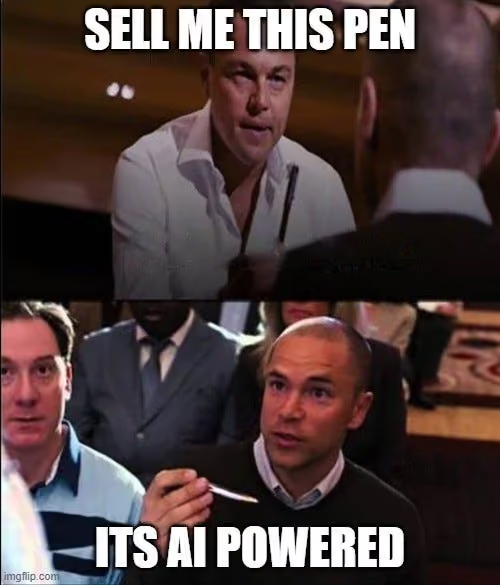
The tools have been… bought. The pilots have been… running. Most marketing teams already have AI embedded somewhere in their workflow.
So now, the question today is whether any of it is actually working… or are we just doing groundbreaking transformations?!
My point is… AI adoption is no longer the challenge... AI outcomes are. Most teams can point to AI-generated content, AI-assisted reporting, or AI-powered automation. Far fewer can point to meaningful improvements in pipeline, revenue, or efficiency.
Part of the problem is that we've spent too much time talking about content creation and not enough time talking about everything else. The biggest opportunities in AI aren't just about writing emails or generating blog posts. They're helping teams identify buying signals, prioritize accounts, improve attribution, forecast pipeline, and make better decisions.
That's where the real value is hiding. And that's the part of AI in marketing most teams are still figuring out.
By the numbers: quick snapshot:
AI marketing statistics at a glance…
Before getting into the how and why, here's a categorized snapshot of the numbers worth knowing. Each one tells you something about where teams are focusing, where the gaps are, and what "good" actually looks like in 2026.
Adoption
- 88% of marketers now use AI tools in their daily roles, up from roughly 60% in 2023 (HubSpot, 2026)
- 76% of marketing teams use AI in core operations, up from 29% in 2021 (IBM Global AI Adoption Index)
- 92% of Fortune 500 companies have integrated AI into at least one marketing process (Accenture, 2026)
- 56% of SMBs now use AI for marketing, up 23 percentage points from 2024 (Eurostat Digital Economy Report)
- AI and machine learning now power 24.2% of all marketing activities, nearly doubling from 13.1% in 2024 (Duke University CMO Survey / Deloitte, 2026)
- Marketing leaders project that figure will reach 55.9% within three years
ROI and productivity
- AI-driven campaigns deliver 22% higher ROI and 32% more conversions than traditional methods, helping teams achieve marketing goals more efficiently (McKinsey)
- AI content drafting delivers 3.2x ROI on average; personalization engines deliver 2.7x, and generative AI has significantly shortened production timelines while introducing new strategic tradeoffs (McKinsey Global AI Survey)
- Marketing and product development show revenue uplift above 10% linked to AI initiatives (McKinsey, 2025)
- The average marketer saves 6.1 hours per week from AI tools, as marketing professionals use automation to reduce repetitive tasks and other time consuming tasks so teams can focus on strategy and creativity, with senior practitioners saving 8–10 hours (HubSpot AI Trends, 2026)
- 32.8% of marketers save 10–14 hours per week from AI tools (HubSpot, 2026)
- AI-driven campaigns show 29% lower customer acquisition costs (McKinsey)
Budgets
- Global AI marketing spend grew from $6.46B in 2018 to $57.99B in 2026, a 37.2% CAGR (All About AI)
- AI marketing tools grew at a 31.4% CAGR between 2020 and 2025, three times faster than general martech (Forrester Research)
- 71% of marketing managers globally expect AI to reorganize their team structure within two years (Deloitte CMO Survey)
Content and personalization
- 94% of marketers plan to use AI in content creation in 2026, largely to deliver personalized customer experiences (HubSpot)
- 72% of global organizations now use AI for content creation, reflecting how AI technologies are being integrated across nearly every facet of marketing to deliver highly personalized content and experiences at scale (All About AI)
- 84% of marketers say AI improved the speed of content delivery, with that scale driven by customer data and user preferences (CoSchedule)
- 23% of agencies reduced junior copywriting headcount in 2025; 31% plan further cuts in 2026 (Gartner CMO Spend Survey)
Agentic AI
- 34% of enterprise marketing teams now run at least one autonomous agent in production (HubSpot, 2026)
- 19.2% of teams are deploying AI agents for full end-to-end campaign automation (HubSpot, 2026)
- Gartner predicts more than 40% of agentic AI projects will be canceled by end of 2027 due to unclear value, rising costs, and weak governance
AI adoption in marketing: how fast is it growing?
To understand where we are, it helps to remember where we were. In 2021, 29% of marketing teams were using AI in any meaningful capacity. By 2025, that number hit 76% (IBM Global AI Adoption Index). McKinsey's 2025 survey found that 79% of organizations use generative AI, up from 33% in 2023. That's not gradual adoption. That's a near-complete market shift in less than three years.
But the growth story has a more nuanced second chapter. The CMO Survey from Duke University and Deloitte found that AI now powers 24.2% of all marketing activities. That sounds like significant penetration until you factor in what "marketing activities" includes. Most of that AI usage is concentrated in content drafting, email subject line optimization, and marketing automation for audience segmentation. The workflow-transforming, revenue-attributable AI that actually changes pipeline outcomes? Still adopted by a minority.
What's happened is that the adoption curve has two phases, and most organizations are stuck at the boundary between them.
- Phase 1: AI-assisted workflows. This is where the majority of teams sit today. AI helps produce faster. Faster content, faster reports, faster audience segments. These systems also handle repetitive, time-consuming tasks such as scheduling and data entry, reducing operational friction. The tools are easy to start using, the time savings are real, and the outputs are measurable in productivity terms. This phase is fully mainstream.
- Phase 2: AI-driven decisions. This is where AI influences what you do, not just how fast you do it. Account prioritization, predictive intent scoring, dynamic budget allocation, automated suppression of low-fit audiences. Teams in this phase are using AI to make better calls, not just ship faster. Fewer than a third of organizations have reached this stage, per McKinsey's scaling data.
The B2B sectors moving fastest into Phase 2 are enterprise SaaS, RevOps-mature organizations, and ABM-native teams. The common thread is clean data infrastructure and a measurement culture that existed before the AI layer arrived.
Generative AI gets most of the headlines, but the more durable competitive advantage is in predictive analytics. Generative AI creates outputs. Predictive AI improves decisions. Agentic AI eventually does both without waiting for a human to prompt it... and that's still early, but moving faster than anyone expected.
How B2B marketing teams are using AI now
The honest answer is: inconsistently. Every B2B marketing team is "using AI," but what that means varies wildly between teams. Some have built genuinely integrated AI systems that touch targeting, scoring, creative, and measurement. Others have given everyone ChatGPT access and called it an AI strategy. The gap between those two approaches is where most of the competitive advantage is hiding.
Here's how AI actually shows up across B2B marketing functions in 2026.
- Demand generation
Predictive targeting and AI-powered audience building have become genuinely useful here. Tools can now analyze behavioral signals, firmographic data, and intent patterns to identify accounts that are in-market before they've raised their hand. Lookalike modeling has gotten significantly more accurate as the underlying models have matured. Lead scoring, which used to feel like a 70% accurate guess dressed up in a dashboard, is now reaching accuracy rates that actually change how SDRs prioritize their days.
The nuance worth noting: AI-generated lead scores are only as good as the signals feeding them. If your CRM is messy, if offline conversions aren't synced, or if your marketing and sales data live in separate systems... you're scoring leads on an incomplete picture. Garbage in, garbage out still applies, even when the processing is sophisticated.
- Content marketing
This is where AI adoption is deepest and, frankly, most commoditized. AI-assisted content has gone from "interesting experiment" to standard operating procedure for most marketing teams. The productivity gains are undeniable. HubSpot's data shows a 68% reduction in time-to-publish for AI-assisted content workflows.
What's less discussed is the differentiation problem this creates. If every B2B marketing team can produce three times as much content in the same time, the volume advantage disappears almost immediately. What remains valuable is original research, first-person experience, proprietary data, and strategic framing. The teams winning at content in 2026 aren't the ones who adopted AI the fastest. They're the ones who used AI to do the operational work so they could focus human judgment on the parts that can't be automated.
- Paid media
This is arguably where AI has the most measurable impact on marketing outcomes right now. Meta's Advantage+ suite, Google's AI Max campaigns, LinkedIn's AI-powered optimization layer. These aren't optional add-ons anymore. They're the default way the platforms operate.
Meta's own data shows advertisers using Advantage+ AI campaigns saw a 22% improvement in ROAS compared to manual setups. A separate Meta internal study found a 32% drop in cost per acquisition and a 17% increase in ROAS. Google's AI Max campaigns, which rolled out broadly to North American advertisers in late 2025, show 14% conversion increases for non-retail brands, with up to 27% lift for campaigns that were previously heavily reliant on exact match keywords.
The important caveat for B2B teams: these platform AI systems optimize on the conversion signals you give them. If you're passing clicks and form fills to Meta and Google, they'll optimize for more clicks and form fills. If you're passing revenue-qualified pipeline or closed-won data, they'll optimize toward accounts that actually close. That distinction changes your targeting population entirely, and most B2B teams are still operating with the cheaper signal set.
- ABM
Account-based marketing and AI were always conceptually aligned, but the actual integration is happening now. AI-powered account scoring helps teams rank their target universe by likelihood to engage and likelihood to convert, using signals across intent data, technographic changes, hiring patterns, and engagement history. Buying committee mapping has gotten more tractable. Automated engagement scoring across multi-stakeholder accounts, something that was genuinely difficult to operationalize even two years ago, is now a feature in most ABM platforms.
Where ABM + AI still falls short is the measurement layer. Most teams can score accounts and track engagement, but connecting that engagement to attributed pipeline in a way that finance will accept is still messy. Multi-touch attribution across long B2B sales cycles with multiple buying committee members remains one of the harder unsolved problems in B2B marketing.
- Sales alignment
AI summarization, CRM enrichment, and intent-triggered routing have all improved the handoff between marketing and sales. Tools like Gong, Chorus, and Clay are giving sales reps better pre-call context than they've ever had. Marketing can now pass accounts with richer behavioral context, not just a lead score and a source.
The practical outcome is that "AI saves time" and "AI improves pipeline" are different conversations. Most of the AI-assisted sales alignment tools are delivering on the first promise. The second requires a tighter integration between marketing activity, account intelligence, and revenue attribution than most GTM teams have built.
AI's impact on marketing ROI and productivity
Let's be specific about what "AI improves ROI" actually means, because it means very different things depending on how you measure it.
The productivity case is simple and well-supported. Marketers save 6.1 hours per week on average from AI tools (HubSpot, 2026). Senior practitioners save 8–10 hours. Campaign production cycles have compressed. Creative testing that used to take weeks can now run continuously. Content operations that required five people can run with three. These are real savings because AI handles repetitive and time-consuming tasks, streamlining operational work and helping teams extract higher return on investment from existing budgets, and they compound quickly.
The revenue case is more complicated. Predictive analytics evaluates historical data to forecast purchasing behavior, estimate customer lifetime value, and flag potential churn, while marketers use predictive modeling to anticipate consumer needs before they fully surface. McKinsey's function-level data shows marketing and sales among the functions with revenue uplift above 10% linked to AI initiatives. AI-driven campaigns show 22% higher ROI and 32% more conversions on average, and AI-driven analytics paired with real-time data analysis can process more data to predict future trends, surface market trends, and inform customer needs. But at the enterprise level, only about 39% of organizations report any measurable AI impact on EBIT, and most of those attribute less than 5% of EBIT to AI (McKinsey, 2025).
That gap between function-level wins and enterprise-level impact tells you something important: the value is real, but it's not automatically visible in the metrics most organizations track. Someone has to connect the productivity savings to campaign performance, connect campaign performance to pipeline, and connect pipeline to revenue. That chain of attribution is where most organizations break.
Why AI ROI depends on measurement infrastructure
Here's a pattern worth paying attention to: the B2B marketing teams seeing the most compounding value from AI share a common characteristic. They had good attribution infrastructure before they started layering in AI tools. The teams struggling to show AI ROI tend to have the same problem they had before AI: they can't clearly connect marketing activity to revenue outcomes.
AI actually makes this problem worse before it makes it better. More channels, more touchpoints, more automated interactions, more content variations being tested simultaneously. All of that creates more attribution complexity. Last-click attribution, which was already a limited model, becomes nearly meaningless when buyers are interacting with AI-generated content, AI-powered ads, AI SDR outreach, and AI chatbots all within the same buying journey.
If your attribution is broken, AI optimization doesn't help. The platform AI systems, Meta's Advantage+, Google's Performance Max, are optimizing against the conversion signals you give them. If those signals don't reflect real pipeline quality, the optimization loop is actively working against you.
Generative AI adoption by marketing function
Not all functions are adopting AI at the same pace or with the same results. Here's where things actually stand:
The pattern that stands out here is that AI adoption is inversely proportional to measurement rigor. The functions where AI is most widely adopted, content, email, social, are also the functions where connecting AI output to revenue is hardest. The functions where AI would have the most impact on pipeline, attribution, account intelligence, predictive scoring, still have the lowest adoption rates and the least mature tooling.
FYI… this is NOT an accident. It's easier to adopt AI tools that produce visible outputs (a blog post, a subject line, a social caption) than tools that improve invisible processes (account prioritization signals, multi-touch attribution weighting). The visibility problem in B2B measurement is showing up again in the AI adoption pattern.
Companies and brands using AI for marketing
The "who's doing it" question is worth spending time on because the examples range from "AI runs our entire ad stack" to "we have AI-generated alt text on our website images." Both count as AI adoption. Neither tells you much on its own.
Enterprise brands
- HubSpot has integrated AI across its entire CRM and marketing suite. AI-powered content assistant, predictive lead scoring, conversation intelligence, and automated campaign recommendations are now core product features rather than premium add-ons. Their own research consistently tops the AI marketing adoption stats because they survey their customer base.
- Salesforce built Einstein AI into its marketing cloud, and the 2026 State of Marketing report reflecting their customer base showing 91% AI adoption in marketing workflows tells you something about how deeply embedded these tools have become in their ecosystem.
- LinkedIn has rolled out AI campaign optimization, predictive audience expansion, and AI-assisted ad creative tools. For B2B marketers, the more interesting development is LinkedIn's Conversions API, which allows account-level conversion signals to flow back to their ad optimization system. When used properly, this closes the loop between pipeline outcomes and targeting.
- Adobe runs Sensei across its Experience Cloud, automating personalization, predictive scoring, and campaign optimization at enterprise scale. Forrester's data on Adobe Sensei shows measurable ROAS improvements for clients running connected creative and analytics workflows.
- Netflix uses AI for personalization at a scale most marketing teams can't replicate, but the underlying logic applies everywhere. Recommendation systems, dynamic content presentation, and predictive engagement modeling are all in use across its content and retention marketing.
- Spotify uses AI for ad targeting, playlist personalization, and campaign performance prediction. Their Streaming Ad Insertion technology uses AI to optimize ad placement and improve completion rates.
B2B-native companies to watch
- 6sense has built its entire platform around AI-driven account intelligence: in-market signals, buying stage prediction, and AI-powered targeting. It's probably the clearest example of Phase 2 AI adoption in B2B.
- Gong uses AI to analyze sales call data, surface deal risk signals, and generate insights that marketing teams use to refine messaging and targeting. The pipeline intelligence that flows from Gong back into marketing strategy is one of the more underrated loops in modern GTM.
- Clay has become the de facto tool for AI-powered prospect enrichment and outbound personalization. Its ability to pull signals from dozens of data sources and use AI to synthesize them into personalized outreach has made it near-ubiquitous in growth-stage B2B companies.
- Common Room does something similar but at the community and product usage level, surfacing intent signals from open source activity, social engagement, and product behavior for B2B teams running PLG motions.
- Drift (now Salesloft) uses AI for conversational marketing, routing high-intent website visitors to the right sales motion based on firmographic and behavioral signals in real time.
AI in advertising and campaign optimization
Platform AI has quietly become the dominant force in paid media, and most advertisers are only starting to understand how different the game is now.
Google's AI Max for Search campaigns, rolled out broadly in late 2025, essentially removes the keyword research layer from search advertising. You give Google a landing page, a budget, and a performance target. Gemini handles query matching, ad copy generation, and bidding. For advertisers who spent years mastering keyword match types and negative lists, this feels like losing the steering wheel. For advertisers who trust the data... it's delivering 14% conversion increases for non-retail brands, with up to 27% lift for campaigns that were keyword-heavy (Google/Think with Google). The honest reality from independent testing is more mixed, with 84% of advertisers reporting neutral or negative results, which suggests the quality of the conversion signal being fed to the system matters enormously.
Meta's position is even more aggressive. The company's 2026 vision for advertising is essentially: give us your URL and your budget, and we'll handle everything else. Advantage+ campaigns now cover lead generation, e-commerce, and awareness objectives. Meta's internal data shows 22% higher ROAS compared to manual setups. A separate study found 32% lower CPA for Advantage+ users (Meta internal).
LinkedIn's AI optimization is the most relevant for pure B2B plays. The Conversions API integration, which allows marketers to pass offline conversion data like opportunity creation and deal close back to LinkedIn's system, is one of the most underused capabilities in B2B paid media. When the optimization signal improves from "form submit" to "revenue-qualified opportunity," the audience the system targets changes substantially.
Here's the tension every B2B performance marketer is living with right now. These AI systems are genuinely good at optimization. But they optimize on what you give them. If you're giving them top-of-funnel signals in a business with a six-month sales cycle and a five-person buying committee, the AI is doing its best with fundamentally noisy data. The teams getting disproportionate returns from AI-powered advertising are the ones who've solved the signal problem first.
AI's impact on SEO, content, and search behavior
The SEO landscape has changed more in the past 18 months than in the previous decade, and the full implications haven't settled yet.
Google's AI Overviews started the year appearing on 6.49% of queries. They peaked at nearly 25% in mid-2025 and settled at around 15.69% by November 2025 (Semrush analysis, 2025). For marketers, the more important number is what they do to click-through rates. Seer Interactive's analysis of 3,119 informational queries across 42 organizations tracked 25.1 million organic impressions from June 2024 to September 2025. Organic CTR for queries with AI Overviews fell 61%, from 1.76% to 0.61%. Paid CTR fell 68%. Ahrefs independently found a 58% lower average CTR for position one content when an AI Overview is present (December 2025 analysis of 300,000 keywords).
The survival path, for content that continues ranking well, is citation. Brands cited inside AI Overviews see 35% more organic clicks and 91% more paid clicks compared to uncited brands on the same queries (Seer Interactive, 2025). The strategic implication: SEO is now partially a citations game. Structured content, clear expertise signals, original data, and direct answers to specific questions are what get you cited. Generic AI-generated content, by definition, can't win this way.
What's actually working in 2026 for SEO:
- Original research and proprietary data that AI systems can cite as primary sources
- Deep, specific expertise that reads as genuinely authoritative rather than comprehensively researched
- Structured content that makes it easy for AI systems to parse and excerpt your insights
- First-person experience and case-specific knowledge that can't be replicated by synthesis
- Answer-first writing that gives LLMs and AI Overviews the exact framing they need to surface your content
The broader shift is toward what's sometimes called Answer Engine Optimization. Your content doesn't just need to rank in Google. It needs to be the answer that ChatGPT, Perplexity, Claude, and Google's AI Mode pull when someone asks a relevant question. That requires a different kind of writing than traditional SEO demanded. Less keyword stuffing, more actual expertise.
AI and attribution: why marketers need better measurement
This section exists because it's almost entirely absent from competing articles on AI in marketing, and it's arguably the most important strategic consideration for B2B teams.
AI increases marketing activity velocity. More content, more ad variations, more channels, more touchpoints, more automated sequences. All of that creates more attribution complexity, not less. The buyer journey in a B2B deal already involved six to ten touchpoints across multiple channels before AI entered the picture. Now add AI-generated content that a prospect might have encountered without visiting your website. Add conversational AI assistants that recommended your product. Add AI SDR sequences. Add AI-powered retargeting. The journey is longer, more distributed, and harder to reconstruct.
Last-click attribution was already losing the argument in 2022. In an AI-first GTM motion, it becomes almost useless. When the deal closes, crediting the last ad click is like crediting the person who handed you the pen for signing the contract.
The models that work better look something like this:
The more important shift happening in attribution is the move from lead-level to account-level measurement. In a B2B deal with five stakeholders, tracking one person's journey misses 80% of what actually happened. Account-level attribution aggregates engagement across all contacts at a target account and connects it to pipeline stages and revenue outcomes. That's a fundamentally different (and more accurate) model for understanding what marketing activity actually matters.
Where Factors.ai sits in this picture is worth explaining directly. Factors.ai handles multi-touch attribution and account-level analytics for B2B teams, connecting marketing touchpoints across channels to pipeline and revenue outcomes. It also provides AI-driven ICP scoring, account-level intent detection, and ad optimization signals. The reason this matters for the AI measurement conversation: if you're running AI-powered campaigns on LinkedIn or Google and want those systems to optimize toward high-quality pipeline rather than volume, you need attribution infrastructure that can pass the right signals back. That's the operational integration that turns AI advertising from an experiment into a compounding advantage.
The biggest challenges of AI adoption in marketing
The headline challenge is a measurement gap, but the implementation challenges are broader.
- Hallucinations and quality control remain real. AI-generated content requires human review, and teams that removed the review step to accelerate production have largely added it back after publishing embarrassing errors. The platforms have improved, but the problem hasn't disappeared.
- Brand voice consistency is harder to maintain at AI-generated scale. When your content team produces 10 pieces a month, voice guidelines stay fresh. When AI is producing 100 drafts a month, the drift toward generic outputs happens faster than most teams expect.
- Data privacy and governance are becoming acute. Using consumer data to train personalization models, passing behavioral data to third-party AI tools, building lookalike audiences from CRM exports. Each of these involves data handling decisions and ethical considerations that legal and compliance teams are asking harder questions about in a post-General Data Protection Regulation (GDPR), post-California Consumer Privacy Act (CCPA) world, and companies need clear policies and guidelines so AI is used responsibly and protects user rights and privacy.
- The AI sameness problem is underappreciated. When every marketing team has access to the same models, trained on the same data, running on the same platforms, the outputs converge. The risk is that AI-assisted marketing looks like everyone else's AI-assisted marketing. The differentiation ceiling is lower when the tools are commoditized. This is the strongest argument for original research, first-party data, and genuine subject matter expertise as competitive assets in 2026.
- AI fatigue is real among both practitioners and audiences. Marketers who were excited about AI tools two years ago are increasingly frustrated by the gap between what vendors promised and what implementations delivered. Buyers are starting to notice when outreach is obviously AI-generated. The novelty effect has worn off.
- Human judgment still matters in the places that matter most. Positioning, messaging, creative direction, strategic bets. AI is genuinely good at optimizing within a defined frame. It's bad at questioning the frame. The teams that are struggling with AI are often the ones that delegated strategic decisions to tools that were never designed to make strategic decisions. The teams thriving are the ones who use AI to move faster inside a direction that humans chose carefully. That ongoing oversight is also what makes ethical AI possible by reinforcing fairness and responsible use.
The future of AI in marketing beyond 2026
Agentic marketing workflows are moving from novelty to operational reality faster than most forecasts anticipated. Gartner's 2026 Hype Cycle for Agentic AI places autonomous marketing agents at the early stages of practical deployment, with 34% of enterprise marketing teams already running at least one autonomous agent in production (HubSpot, 2026). That number will compound.
What "agentic" actually means in marketing context: AI systems that can take a goal, break it into tasks, execute those tasks autonomously (research, write, test, optimize, report), and adjust based on results without waiting for a human checkpoint at each step. The early versions are narrow. They handle specific workflows like competitive research, campaign reporting, or email sequence optimization. The more capable versions emerging now can manage multi-channel campaign logic, adjust bidding and creative simultaneously, and surface strategic recommendations based on performance patterns.
- What will likely disappear in the next three to five years: manual bid management, static audience segments, manually written first drafts of most content formats, scheduled reporting, and much of the operations-heavy execution work that currently occupies significant portions of marketing team capacity.
- What will grow in demand: operators who understand how to configure and govern AI systems, strategists who can make positioning and messaging decisions that AI can then execute, data architects who can build the measurement infrastructure that makes AI useful rather than theatrical, and creative directors whose judgment shapes what AI produces rather than being replaced by it.
- What will become table stakes: AI-generated content, AI-powered bidding, AI scoring and enrichment, conversational AI for buyer education. These are already standard in high-performing teams. In two to three years, they'll be the floor, not the ceiling.
The B2B-specific evolution worth watching most closely is the shift toward AI-native GTM operating models. Rather than adding AI tools onto existing marketing and sales processes, forward-thinking teams are redesigning the processes themselves around AI capabilities. That means account intelligence as the organizing layer, not the add-on. Intent signals shaping budget allocation in real time. Pipeline data flowing back to optimize the top of funnel continuously. That's a fundamentally different architecture than "we use AI for content," and it's where the compounding advantages will accumulate.
Key takeaways for B2B marketing teams
The honest synthesis of everything above is this: AI in marketing is not a tool problem. Most teams have access to enough tools. It's an integration problem. The value compounds when AI execution connects to account intelligence, which connects to attribution, which connects back to how campaigns are configured and optimized. Teams that have built that loop are pulling away from teams that are still running disconnected AI experiments.
- If you're early in AI adoption, start with workflow efficiency. Use AI to compress production cycles and reduce the time your team spends on operational tasks. That creates capacity for the strategic work that actually differentiates you.
- If you're mid-stage (using AI in multiple functions but not seeing clear pipeline impact), focus on activation and measurement. Define what "good" looks like in pipeline terms before adding more tools. Connect your AI-generated activity to CRM stages and revenue outcomes.
- If you're advanced, the next frontier is account-level intelligence and agentic workflows. The teams building toward fully autonomous campaign management are the ones who'll set the benchmark for everyone else by 2027.
ALL this said and done… the real competitive advantage from AI in marketing is not discussing and comparing who has the most number of tools. It's about who has built the feedback loops that make each campaign smarter than the last. AI scales execution. Attribution closes the loop. Account intelligence improves the signal. When those three things work together, AI stops being an expensive investment… and starts being the reason deals close faster.
Frequently asked questions for AI impact on marketing
Q1. How is AI impacting marketing in 2026?
AI is operating as the operational layer of most marketing functions. Content, paid media, email, lead scoring, and reporting all have significant AI involvement in high-performing teams. The bigger shift from prior years is the move from AI-assisted production to AI-driven decision-making, where the system influences what you do, not just how fast you do it.
Q2. What percentage of marketers use AI today?
88% of marketers now use AI tools in their daily work according to HubSpot's 2026 State of Marketing report. At the organizational level, McKinsey's 2025 survey found 88% of companies use AI in at least one business function, with marketing and sales as the most common function.
Q3. What are the biggest AI marketing trends in 2026?
Agentic marketing workflows (autonomous agents managing campaign logic), AI-first paid media optimization (Meta Advantage+, Google AI Max), LLM optimization for content discovery, account-level attribution replacing lead-level models, and the integration of intent signals into real-time budget allocation are the defining trends.
Q4. Which companies use AI for marketing?
Across enterprise brands: HubSpot, Salesforce, Netflix, Adobe, LinkedIn, Spotify, and Amazon all run significant AI marketing infrastructure. In B2B specifically: 6sense, Gong, Clay, Drift/Salesloft, Common Room, and Factors.ai represent the category of companies whose products are built around AI-driven GTM intelligence.
Q5. Is AI replacing marketers?
Specific roles are contracting. Gartner's CMO Spend Survey found 23% of agencies reduced junior copywriting headcount in 2025 and 31% plan further cuts in 2026. But demand for strategists, operators, and data architects is rising. The pattern is consistent with previous automation waves: execution-heavy roles contract, judgment-heavy roles expand.
Q6. What is the ROI of AI in marketing?
Function-level data from McKinsey shows revenue uplift above 10% for marketing and sales teams with mature AI deployments. AI-driven campaigns show 22% higher ROI and 32% more conversions on average. But only 6% of organizations attribute more than 5% of enterprise EBIT to AI, reflecting how difficult it is to connect marketing function wins to company-level outcomes without good attribution infrastructure.
Q7. How are B2B marketing teams using AI?
Across demand gen (predictive targeting, lead scoring), content (AI drafts, SEO optimization), paid media (AI bidding, audience suppression), ABM (account scoring, buying committee mapping), and sales alignment (CRM enrichment, intent routing), ai algorithms help connect these functions through a shared data layer rather than running them as separate tools, and AI marketing platforms can analyze data faster than humans and recommend actions from historical customer data.
Q8. What are the risks of AI in marketing?
Hallucinations and quality control failures, brand voice degradation at scale, risks in customer service interactions, data privacy and governance exposure, the AI sameness problem (every team using similar models producing similar outputs), over-automation of strategic decisions, and AI fatigue among both teams and buyers. Conversational AI and intelligent, generative chatbots now shape customer service interactions by handling routine inquiries and lead qualification 24/7. These systems can improve customer satisfaction when they analyze customer feedback and generate human-like support responses, but they also require oversight.
Q9. How does AI improve advertising performance?
AI-powered bidding systems outperform manual management by continuously optimizing against conversion signals in real time. Meta Advantage+ campaigns show 22% higher ROAS versus manual. Google AI Max campaigns show 14% average conversion lifts. The critical variable is the quality of the conversion signal being passed to these systems. Revenue-qualified pipeline as a conversion event produces better audience targeting than form fills.
Q10. How does AI affect SEO and content marketing?
AI Overviews in Google have reduced organic click-through rates by 58–61% for queries where they appear (Ahrefs/Seer Interactive, 2025). The counter-move is earning citations inside those overviews, which delivers 35% higher organic CTR and 91% higher paid CTR for cited brands. This shifts SEO strategy toward original research, authoritative expertise, and structured content that AI systems can reliably cite.
Q11. What is the future of AI in marketing?
Agentic workflows that can autonomously manage campaign logic are moving from early adoption to practical deployment. The marketing teams that will lead in 2027 and beyond are building AI not as a collection of tools but as an integrated operating system: account intelligence, execution, attribution, and optimization all connected in a continuous feedback loop.
Q12. How are companies measuring AI marketing impact?
Most companies are measuring AI productivity gains (time saved, content volume, cost per asset) more easily than AI revenue impact. The organizations measuring revenue impact well have multi-touch attribution systems that connect marketing activity to pipeline stages and closed revenue, allowing them to evaluate AI-driven campaigns the same way they evaluate everything else.

See how Factors can 2x your ROI
Boost your LinkedIn ROI in no time using data-driven insights


.avif)

See Factors in action.
Schedule a personalized demo or sign up to get started for free
LinkedIn Marketing Partner
GDPR & SOC2 Type II

.svg)



.avif)

