
AI in B2B Marketing: Real Use Cases, Trends, and What AI Still Can’t Do
Explore real AI use cases in B2B marketing, key trends, where AI falls short, how teams turn insights into action by combining AI with GTM orchestration

Writer
.avif)
Content Marketer



.svg)


TL;DR
- AI in B2B marketing works best when it improves both execution and decisions.
- Most teams struggle with turning signals received from their AI tools into action.
- AI is most effective when applied at the account and workflow level, instead of isolated tasks.
- Generative AI speeds things up, but human judgment still decides what matters.
- Best impact comes from combining AI insights with clear GTM orchestration.
When AI walked into B2B marketing, it came with big promises to ‘revolutionize’ the space and bigger fears… replace teams, automate thinking, and outpace humans at every turn.
Both didn’t happen. What has happened is something more complicated.
AI is everywhere now, yet most B2B teams still struggle to connect it to real GTM decisions. They have a bunch of insights from various AI marketing tools, but knowing what to do with them – and actually doing it – is still difficult.
This article talks about that gap. It looks at how AI is currently being used in B2B marketing today, where it helps, where it lags, and how strong teams utilize it to get optimal value from AI without letting it run the show.
What does AI in B2B marketing actually mean?
When people talk about AI in B2B marketing, they often conflate very different things. That’s where confusion starts.
At its core, AI in B2B marketing means using machine learning to process signals faster than humans can, to improve marketing decisions.
In practice, AI does four things B2B teams struggle to do manually at scale:
- Analyze behavior across systems
AI pulls together signals from CRM data, website activity, ad engagement, email interactions, product usage, and sales notes. This is important because B2B journeys are fragmented, and without AI, you won’t see the full picture.
- Predict intent and likelihood to act
Instead of treating all leads or accounts equally, AI looks for patterns that historically led to conversions, pipeline movement, or churn. This helps your teams move from reactive marketing to prioritized action.
- Personalize customer experiences without hand-building everything
AI adapts messaging, timing, and content based on behavior and context. It personalizes beyond “Hi, John!” by adjusting what is sent, when it is sent, and to whom, based on how an account behaves in real time.
- Optimize decisions early on
With insights from AI, you can spot issues early. Instead of reviewing what went wrong later, you can adjust spend, outreach, routing, or messaging in real-time.
| Misconceptions about AI in B2B Marketing: It’s not just one tool; neither is it autopilot marketing; it’s definitely not a replacement for strategy or human judgment. If your decision is unclear, AI will just help your team move faster in the wrong direction. |
Most B2B teams use AI across three layers.
- Generative AI: The generative AI layer helps create. It’s mostly used for creating drafts for ads and emails. Beyond that, it also helps with topic ideation, content outlines, message variants, sales enablement drafts, customer interaction call summaries, and content repurposing. It’s great at speed, but it has no sense of context on its own.
- Predictive and analytical AI: This layer helps in decision-making. It handles lead and account scoring, intent detection, win-loss analysis, forecasting, and performance evaluation.
- Orchestration and workflow AI: Finally, this layer helps in action-taking. It routes accounts, triggers outreach, syncs systems, and turns insights into movement.
Most teams stop at creation and wonder why results feel underwhelming. Once you run these layers together, you end up utilizing artificial intelligence for what it’s meant to do: help you make better decisions consistently.
Where AI is used in B2B marketing today
Now that you understand AI works in layers, let’s see how it is used practically in B2B marketing for better decision-making and reducing repetitive tasks.
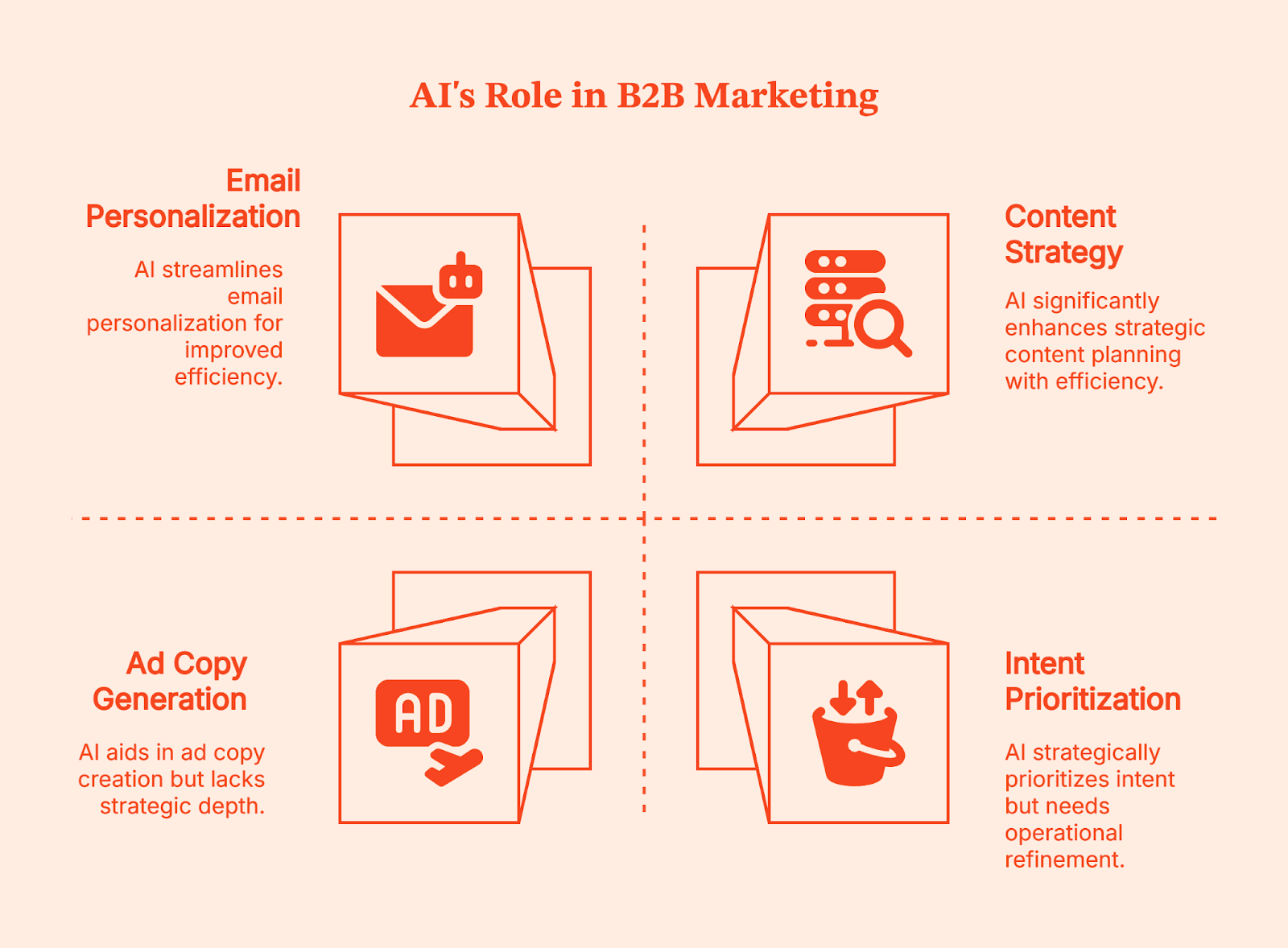
- Content generation and content strategy:
People think AI helps in creating content fast, but its real value lies in helping you decide what deserves to be written in the first place.
AI, here, looks at how people actually search and what already exists on the internet. It analyzes search queries, groups related keywords into themes, and compares your content against competitors to spot gaps. It also suggests outlines based on how top-performing pages are structured and flags older content that needs updating or better internal linking.
Also read: AI Market Research Tools: From Hype Threads to 10 Tools Worth Using
You still decide the voice, angle, and point of view. AI helps narrow down the field so you don’t spend weeks on a content creation process that was never going to rank or convert.
- Paid media and performance marketing:
The thing about paid marketing is that it moves fast, but feedback often comes too late.
AI helps your team react earlier. It generates creative variations of ad copies based on what’s already working, tags marketing campaigns that are likely to fatigue, and recommends budget shifts so that you don’t end up spending more on inefficient campaigns. When performance dips, it can correlate creative, audience, and timing signals to show where the problem might be.
- Email, lifecycle, and personalization:
People think the challenge here is scale – but the real challenge is relevance. AI continuously tests subject lines and previews text, triggers messages based on real behavior, and adjusts outreach at the account level based on engagement. It can even hold back messages when signals suggest someone isn’t ready yet. This way, you end up sending fewer, more targeted emails with better timing and higher response rates.
- Intent, scoring, and prioritization:
This is where AI starts to influence revenue decisions. It analyzes behavior across channels to identify which accounts are warming up, enabling your team to prioritize outreach. It updates scores as buying groups grow or stall and helps align ABM efforts with real-time intent signals.
Across all these areas, AI works best as your intern. It gathers information, spots patterns in customer journeys, and brings you options. But it still needs direction, review, and a final call from someone who understands the business.
{{INLINE_TOFU}}
Real AI marketing examples in B2B
Theoretically, it all makes sense. But seeing how AI works in very specific moments inside everyday B2B workflows and influences GTM decisions makes it easy to understand.
- Demand generation: reallocating spend based on intent
The most difficult decision your demand generation must make is to take a call about when to shift focus. AI makes this easier for your team by looking for intent signals like website behavior across pages and sessions, ad engagement by account, content consumption patterns over time, and CRM activity.
With this, AI helps you answer practical questions:
|
When AI is utilized optimally in demand gen, it leads to very concrete actions that result in campaign optimization by pausing low-intent marketing campaigns early, reallocating spend toward high-intent accounts, and coordinating ads and outbound for the same buying group.
- Product marketing: refining messaging using win-loss signals
Now, let’s look at the product marketing team. Their decisions are often based on opinions that aren’t backed by evidence. AI steps in here as a pattern detector. It helps your team by consolidating win-loss notes and call transcripts, objection patterns tied to deal outcomes, feature usage and adoption data, and competitor messaging changes over time.
This helps product marketers see patterns in lost deals:
- Certain phrases appear repeatedly either before deals move forward or right before deals fall apart.
- Some features are mentioned constantly but are barely used, while others slowly drive retention.
This obviously helps your team in making smart decisions like removing or reframing weak messaging, updating sales enablement based on real buyer language, aligning positioning with actual product usage, etc.
- RevOps: connecting multi-touch journeys for attribution
RevOps feels the pain of disconnected data more than anyone. Long B2B buying cycles make attribution messy, and it’s difficult to pin down what worked (in case of a win) and what didn’t (in case the deal is lost).
For this segment, AI connects long, messy, and chaotic buyer journeys. It analyzes every touchpoint across ads, content, emails, demos, and sales interactions over weeks or months and highlights which sequences consistently moved the deals forward and which didn’t.
Armed with these data-driven insights, your team can adjust routing, scoring, and handoffs. You also get cleaner reporting, better alignment between marketing and sales teams, and smarter investment decisions.
AI marketing tools for B2B: ownership matters more than features
By now, most B2B teams have tried AI marketing tools, and yet they are still scratching their heads about why it isn’t working the way they expected.
In my experience, the problem isn’t tool-specific. It's more to do with who owns the decisions and which decisions it influences.
If you look at your tech stack, you’ll realize your team already has a bunch of tools they are barely using. Some were meant to 10X your content output, others (predictive analytics tools) promised to transform decisions. Initially, your teams got excited about these tools, but by the third month, they forget their existence.
| In a G2 AI adoption survey, 75% of companies report using two to five AI features, while only about 17% have integrated more advanced AI across their operations. This clearly indicates that most teams have AI marketing tools, but they aren’t deeply embedded into their core processes. |
It’s a common scenario:
- Your generative AI creates 50 email variants, but who decides which three to test?
- Your intent platform flags 40 accounts showing buying signals, but who follows up within 24 hours?
- Your attribution model shows mid-funnel content drives pipeline, but who has the authority to shift the budget based on that?
Without clear ownership, every insight remains an insight rather than a direction.
Strong teams work backwards from decisions. They don't ask "which AI marketing tool should we buy?" Instead, they ask, "What decision needs to happen faster?" Then they assign one owner, create one ritual, and close the loop.
For example, say a Series B SaaS company had 6sense, but their wasn't changing their behaviour/processes based on the insights from 6sense. Every account got equal treatment, and the pipeline was erratic. To refine the process, they need to clearly define:
- Which decision does it influence? Identify accounts sales must prioritize this week
- How does the tool help? Score accounts based on intent.
- Who’s accountable? RevOps updates scoring monthly, and sales lead identifies accounts weekly.
- How to build it into a habit? For example, Monday morning, review top 20, pick 10, no debate until next week.
Before buying another AI tool, ask your team:
|
If you can't answer these questions clearly, you're just adding another tool to your tech stack.
Remember: Teams winning with AI use fewer tools and exercise greater discipline. They've built the structure to turn insights into action before they go stale.
💡Check out our guide on how to interpret correlated data in B2B marketing
Artificial Intelligence (AI) in product marketing (B2B context)
Product marketing decisions suffer from too many partial truths. When sales, marketing, and product teams see a different reality (that tells them only one part of the story), it’s time for you to bring in AI.
Implementing AI in product marketing is like using a synthesizer, where four different elements come together:
- Persona analysis:
Traditionally, persona analysis relies on interviews and surveys on customer behavior that age quickly. AI changes this by analyzing inputs and customer data that product marketers come across every day:
- transactional sales call transcripts
- demo notes
- onboarding behavior
- feature usage
- churn reasons
- support tickets
Instead of asking "who is our buyer?" once a year, AI tells your team how different buyer groups actually behave over time.
- Messaging validation:
Product marketers test messaging across landing pages, emails, sales decks, outbound sequences, ad copy, in-app prompts, onboarding flows, help documents, pricing pages, etc. AI analyzes which phrases correlate with pipeline movement and which ones stall deals.
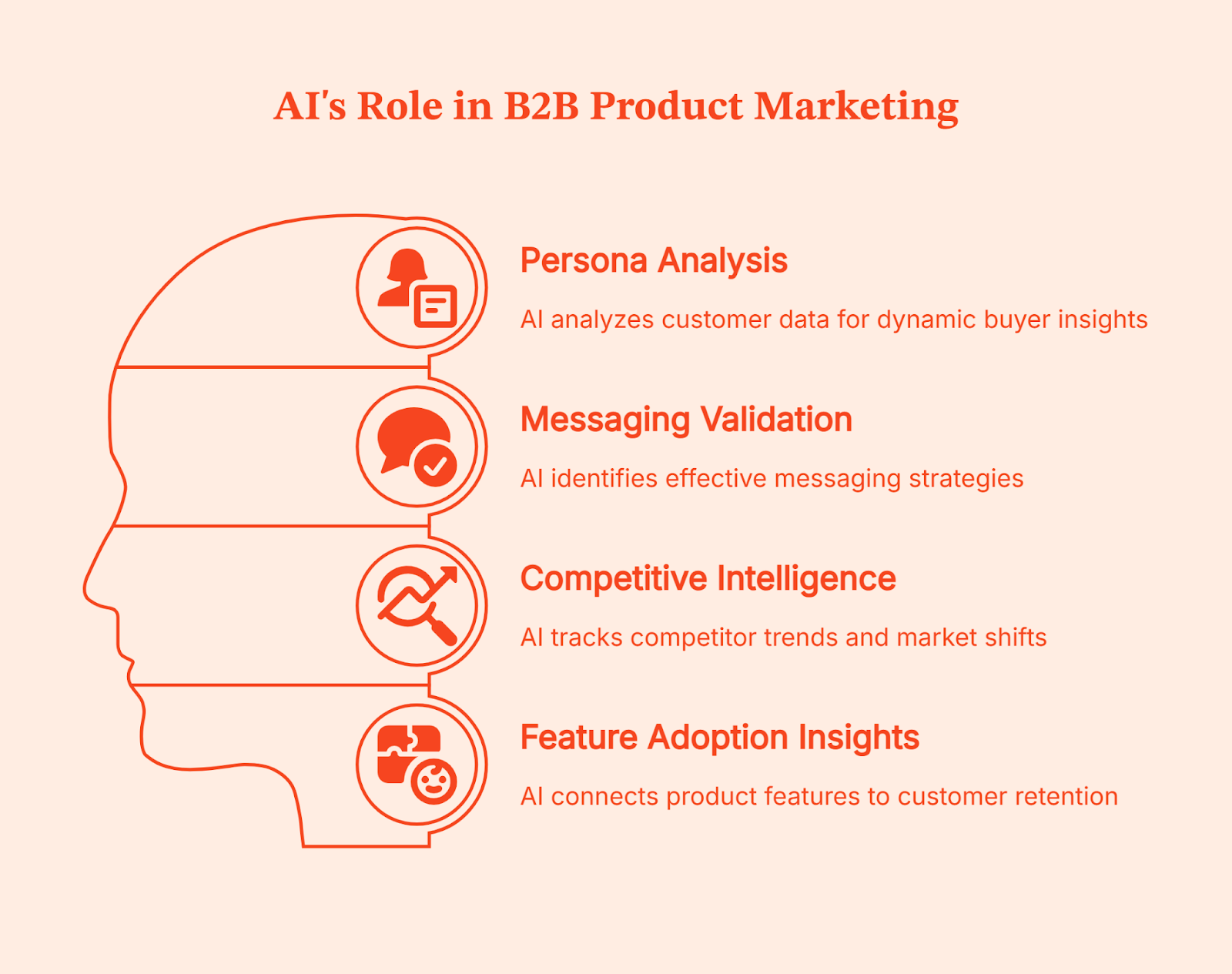
- Competitive intelligence:
Competitive intelligence shifts the burden from manual monitoring to pattern recognition. AI here tracks how competitors talk about themselves over time, indicating when certain claims become table stakes and when a category narrative starts shifting. From this, AI also helps in deciding whether you should opt into the differentiation factor or reinforce credibility.
- Feature adoption insights:
The feature adoption insights help in connecting brand positioning to product reality. AI highlights which features correlate with retention, expansion, or early drop-off. Product marketers use this to decide what to emphasize, what to scale-down, and where messaging overpromises. This bridges the classic gap between what you promised on the roadmap and the actual customer experience.
💡Creating a framework for product-led growth is so easy. Check this guide.
Limitations of AI tools in B2B Marketing
While AI can help automate a lot of B2B processes, it comes with a set of limitations too:
- It has no business context:
AI doesn’t know your positioning, why deals fall through, or what trade-offs your sales team is making. It works on patterns, not marketing strategy. So, without clear context, the output might sound fine but is most likely to miss the mark.
- It hallucinates with confidence:
AI will fabricate stats, examples, or references if the data is weak or unclear. If your data is messy, AI will confidently amplify the mess.
- It breaks on edge cases:
Complex buying journeys, niche markets, or unusual sales motions are often not accounted for by this model, so it generates random patterns that don’t apply.
- Over-automation hurts brand trust:
Buyers easily notice and disengage from templated messages. AI can scale bad messaging just as fast as good messaging.
- Fragmented tools create chaos:
Conflicting signals, mismatched attribution, and dashboards full of “insights” with no clear next step only add to the confusion.
5 key trends shaping AI in B2B marketing
These AI trends are already changing the way B2B teams work. Teams are shifting from ‘just experimenting’ to using AI in significant decision-making processes.
- Decision intelligence is replacing task-level automation
AI is moving beyond basic task automation and into decision support. According to a survey, 62% of teams use AI-powered search and insights, showing a clear shift toward using AI to interpret data and guide actions.
- Account-level thinking is becoming the default
B2B marketers are focusing on whole accounts instead of single leads. This is visible in adoption patterns, too. 43% of organizations already use predictive analytics or recommendation systems, which rely on aggregated signals across accounts rather than single leads.
- AI embedded inside GTM workflows
AI is becoming part of core GTM workflows. It’s now embedded in lead and account scoring, intent detection, routing and assignment, outbound sequencing, attribution, and pipeline forecasting.
- Attribution and signal quality are rising priorities
As more teams rely on AI for insights, data quality is becoming a real bottleneck. 23% of organizations say poor data quality or data silos are a major barrier to getting value from AI, directly affecting attribution and signal accuracy
- Expectations for human marketers are rising
Marketing continues to lead AI adoption within organizations. 53% of companies say marketing teams are the primary drivers of AI use, raising expectations for strategy, judgment, and interpretation over raw execution.
How AI changes B2B marketing roles
As AI automates repetitive tasks such as content drafting, analysis, and basic optimization, marketers have more time to focus on strategy. Marketing roles have shifted from repetitive tasks to system design. Instead of pulling reports, teams are busy interpreting signals, building systems, defining rules, and streamlining workflows.
This also pulls Marketers closer to Sales, Product, and RevOps teams. Decisions are no longer isolated by channel; they cut across the funnel and require shared context. The value is shifting to judgment, prioritization, sequencing, and trade-offs. Knowing what to ignore is becoming just as important as knowing what to act on.
Where Factors fits: AI-enabled GTM engineering for B2B
At this point, you are already familiar with the ‘isolated data’ problem while working with various AI tools. Your team already has insights from the AI tools, yet someone asks, “So what should we do next?” because human guidance is still needed to steer them in the right direction.
This is what most B2B teams struggle with - a lack of connection.
But what if you could automate this, too? Impossible, right? Especially since we discussed that AI can’t decide on its own (for the entire length of this article). That’s the problem the GTM engineering system solves. It automates workflows so that you don’t have to make the same kind of decisions for ten different customers.
To automate the decision-making process, GTM engineering treats AI as one part of a larger system rather than a standalone tool/feature. With the help of AI, the GTM engineering system collects and interprets signals across website behavior, ads, CRM, and sales outreach, and then applies the rules your team has defined when those signals line up.
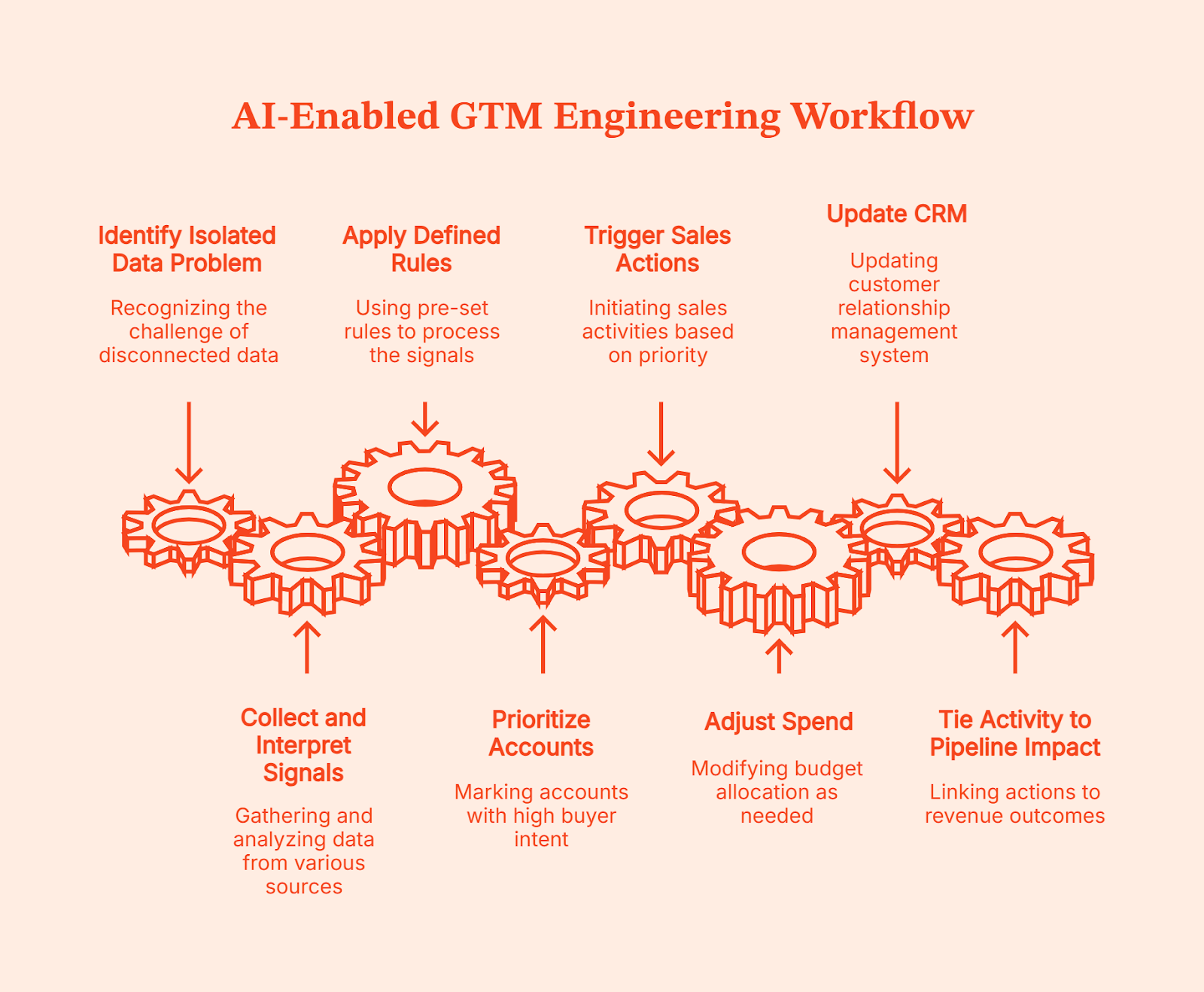
That’s what Factors.ai does. Factors.ai is an AI-enabled GTM system that unifies buying signals at the account level and helps teams act on them. When an account starts showing real buyer intent, it marks it as ‘high priority’ and executes the workflows your teams have already defined. Basically, Factors.ai’s GTM system will follow the process you’ve set:
- Accounts get prioritized
- Sales actions are triggered
- Spend is adjusted,
- CRM gets updated, and
- Activity is tied back to pipeline impact
Once these workflows are set, your team can work unilaterally without manual handoffs, following a clear path from signal to revenue.
Consensus: How to optimize AI in B2B marketing
Using AI in B2B marketing is more about optimizing those AI tools to enhance your decision-making rather than adding more to the tech stack.
Content marketers see the real impact of these AI tools when they use AI as a strategic partner, not as a replacement for thinking. They combine three things deliberately:
- AI handles speed, pattern recognition, and scale
- Human intelligence is responsible for judgment, context, and trade-offs, and
- GTM orchestration ensures insights actually turn into action across teams
When one of these is missing, AI either feels underwhelming or creates more chaos than clarity.
The future definitely isn’t about replacing marketing teams with AI. It’s about AI-powered content marketers focusing their time on critical judgments, deciding what matters, and what to do next.
FAQs on AI in B2B Marketing
Q. What is AI in B2B marketing?
AI in B2B marketing refers to using machine learning to analyze buyer behavior, predict intent, personalize experiences, and support better marketing and GTM decisions at scale, not to replace human strategy.
Q. How are B2B companies actually using AI today?
Most B2B companies use AI for content and search engine optimization (SEO) support, intent detection, lead and account prioritization, performance analysis, and workflow automation, mainly to improve focus and timing rather than fully automate marketing.
Q. What are the biggest limitations of AI in B2B marketing?
AI lacks business context, struggles with edge cases, and can produce confident but incorrect outputs, especially when data is fragmented or workflows aren’t clearly defined.
Q. How does AI support account-based marketing?
AI supports ABM by identifying in-market accounts, tracking buying group behavior, prioritizing outreach, and helping teams coordinate ads, content, and sales actions for the same group of target companies.
Q. How do you measure ROI from AI in B2B marketing?
ROI is measured by improvements in decision speed, pipeline quality, conversion rates, and time-to-pipeline, not by how much content AI produces or how many tools are deployed.

See how Factors can 2x your ROI
Boost your LinkedIn ROI in no time using data-driven insights


.avif)

See Factors in action.
Schedule a personalized demo or sign up to get started for free
LinkedIn Marketing Partner
GDPR & SOC2 Type II

.svg)



.avif)

