
AI in Marketing: The operating system modern B2B teams are building
Read how AI in marketing actually works in B2B, from strategy and automation to attribution, personalization, and decision-making.
.avif)
Content Marketer



.svg)


TL;DR
- AI in marketing has moved from a productivity experiment to the connective intelligence layer across the entire GTM motion.
- The fundamental shift is from campaign-led to signal-led marketing: knowing which accounts matter, which channels actually influence pipeline, and where the next dollar should go.
- Automation follows pre-set rules. AI detects patterns, infers intent, and surfaces what no human analyst would catch at scale.
- In an AI-first world, attribution becomes decision-making infrastructure, not a quarterly reporting ritual.
- Most AI adoption stalls because companies buy tooling before cleaning their data or defining the specific decisions they're trying to improve.
- The marketers who win the next decade won't be the ones who produce the most content. They'll be the ones who consistently make better bets with the same data everyone else has.
AI in marketing isn't really a ‘tool category’ anymore…
Every few years, the martech industry invents a new category and convinces everyone they need it. CRM. Marketing automation. ABM platforms. Intent data. CDP. Each one promised to solve a coordination problem, and each one created a new one. By 2024, the average enterprise marketing team was managing 12 to 15 tools, and the average marketer was spending more time stitching data between dashboards than actually using it to make decisions. And they were looking a little like this:

AI entered that environment as the ‘connective tissue’ the whole stack was missing. Most B2B teams adopted it incrementally, starting with ChatGPT for copy drafts and Jasper for blog outlines, before realizing the more valuable application was entirely elsewhere.
We've sat in enough quarterly planning sessions to know what the real bottleneck looks like… it's that nobody can answer basic strategic questions with any confidence. Which accounts should we actually prioritize? Which channels moved those deals? Why did Q2 miss despite everyone working hard? The data exists across six tools. Nobody has time to synthesize it properly before the next meeting.
AI as an operating layer means those questions get answered before the meeting, not during it. Account prioritization, budget reallocation, intent scoring, and pipeline forecasting move from analyst projects to automated outputs. The shift isn't about working faster. It's about reducing the uncertainty that surrounds every strategic decision in a B2B GTM motion.
For ABM teams particularly, this changes the economics of the entire function. Running a proper account-based motion used to require either a dedicated ops team or expensive RevOps tooling that only enterprise companies could justify. AI has collapsed that requirement. The intelligence is now accessible to a 10-person marketing team with the right stack, which is either democratizing or terrifying depending on whether your moat was "we can afford better tools."
The first generation of AI adoption was about replacing work. The second generation, which is where most mature teams are operating now, is about reducing uncertainty. Marketers don't struggle because they can't execute campaigns… that’s faaaar from true. Most of us struggle because the cost of a wrong bet in B2B is enormous, and the data to make a right one has historically been TOO fragmented to act on.
For the hundredth time, what is AI in marketing, really?
For definition's sake, AI in marketing is the application of machine learning, predictive analytics, and generative models to improve how teams collect signals, prioritize decisions, and execute campaigns. Worth unpacking what that actually means in practice, because "AI" has become one of those words that technically means everything and functionally means nothing.
Most people use it as a catch-all for four things that are genuinely distinct:
- Automation runs rule-based workflows with no learning involved. "If a lead fills out a form, send the welcome sequence." Deterministic, predictable, and exactly as smart as whoever built the workflow.
- Machine learning detects patterns in historical data to predict future behavior. Lead scoring, churn prediction, and audience segmentation fall here. The system learns which combinations of signals correlate with outcomes.
- Predictive analytics uses those learned patterns to surface probabilities. "This account has a 74% likelihood of entering an active buying cycle in the next 30 days." The guidance is directional and not certain, but it is far more useful than relying on gut feelings.
- Generative AI creates new, and email from prompts: copy, images, code, email sequences. It's the most visible layer because everyone can see it working, but it's not always where the most business-critical value lives.
In plain terms, AI digital marketing means your systems learn from behavioral and firmographic data to help you reach the right buyers with the right message at the right time, without someone manually reconfiguring campaigns every week. Here's how those layers stack in a B2B context:
The practical applications of AI in B2B marketing today include account-level intent scoring, predictive retargeting based on buying stage, dynamic landing pages that adapt to visitor profiles, pipeline forecasting from CRM activity patterns, and content recommendations driven by account engagement history. The common thread across all of them is inference rather than instruction: the system draws conclusions from patterns instead of following a script.
What’s the difference between automation and actual AI?
Traditional marketing automation is conditional logic at scale. "When X happens, do Y." A contact requests a demo, a sequence fires, a field updates in the CRM. Deterministic, predictable, and only as intelligent as whoever configured it. When the person who built the workflow leaves, no one fully knows why it works or how to change it without breaking something. (If this describes your current stack, you're in good company.)
AI-driven systems operate differently. Instead of following conditions, they make inferences: "Based on patterns, probability, and behavioral signals, here's what should most likely happen next." The system isn't executing instructions. It's reasoning about likelihood.
But I think this is where most of us have gotten a bit confused: most tools marketed as "AI" today are sophisticated automation with a thin intelligence layer on top. The workflow still fires based on rules. The "AI" helps set those rules more efficiently or adjusts them based on outcomes. That's genuinely useful. It's just not the same as a system that surfaces what you didn't know to look for.
Actual AI earns its keep when it finds what you would have missed: a cluster of high-intent accounts who never filled out a form, a content asset quietly influencing late-stage deals across multiple accounts, a channel contributing to pipeline that's getting zero attribution credit because it doesn't have a trackable click. That kind of signal discovery is what separates automation from intelligence.
Where does AI show up across the B2B marketing funnel?
AI is not a demand gen tool, or a content tool, or a sales enablement tool. But it does show up at every stage of the funnel, often in ways that are invisible until you look at what changed in the data.
- Top of funnel
At the awareness stage, AI is changing how teams find and qualify audiences. SEO topic clustering tools use NLP to identify content gaps and search intent patterns with far more precision than traditional keyword research. Google's Performance Max and LinkedIn's predictive audience targeting use behavioral signals to expand reach beyond manually defined parameters, which is either a marketer's dream or a brand safety nightmare depending on how you've set it up.
Creative testing has moved from A/B to multivariate at scale. AI tests dozens of ad variants simultaneously and reallocates spend toward top performers in real time, without waiting for statistical significance thresholds that take six weeks to hit.
What is AI content marketing at this stage? Using AI to understand what target accounts are actually searching for, what questions are unanswered in your category, and where distribution gaps exist in your content strategy. Not just faster blog writing. Smarter targeting of what to write about and where to put it.
- Middle of funnel
MOFU is where AI earns its keep in B2B. Intent-based retargeting platforms pick up third-party research signals, including review site visits, competitor content consumption, and category-specific search activity, to identify accounts actively in a buying cycle before they raise their hand. AI segmentation clusters accounts by engagement pattern and actual buying stage rather than just firmographics. Dynamic nurture journeys adapt content and cadence to where an account is in its consideration process, rather than following a fixed sequence that someone built in 2022 and nobody has touched since.
Engagement scoring at this stage goes well beyond form fills and email opens. It includes time on pricing page, return visits, LinkedIn ad engagement frequency, and the pattern of which content is consumed in what sequence.
- Bottom of funnel
At BOFU, AI crosses into revenue territory. Opportunity prioritization models surface which open deals are most likely to close based on CRM activity and engagement signals. Pipeline prediction tools give revenue teams early warning on deals at risk of stalling, before the deal review meeting where someone asks why this hasn't moved in three weeks. Buying committee analysis tracks which individuals within a target account are engaging, not just the primary contact, giving marketing and sales a more complete picture of where a deal actually stands.
Combined with multi-touch attribution modeling, this creates a closed loop: AI identifies accounts, influences the journey, and measures what worked so the model gets better with each cycle.
How is AI useful in marketing decision-making?
The real value of AI is that it changes the quality of the decisions that happen before the campaign starts.
Consider what a VP of Marketing actually decides in a given quarter: which accounts to prioritize for ABM investment, which campaigns deserve more budget, which channels are influencing pipeline versus inflating vanity metrics, which buyers are showing genuine intent right now, and which segments are consuming spend without contributing revenue. For most teams, these decisions get made using instinct, last-click reporting, anecdotal feedback from sales, and whoever speaks most confidently in the revenue review. AI changes that by surfacing probabilities instead of opinions.
The framework for how this works in practice:
Data → Signal → Decision → Action
Raw CRM activity and ad engagement get synthesized into behavioral signals. Those signals inform a prioritization decision. The decision triggers an action: an SDR sequence, a retargeting campaign, a budget reallocation. The action generates new data, which feeds the model. The loop gets tighter with each cycle.
In concrete terms, AI-driven decision-making in marketing looks like this:
- Predicting conversion likelihood so SDRs spend time on the highest-probability accounts rather than working the MQL queue chronologically
- Identifying where deals consistently stall in the pipeline and surfacing the missing engagement that precedes those stalls
- Finding high-intent accounts that haven't raised their hand but are clearly deep in a research cycle based on behavioral signals
- Detecting which channels are actually influencing closed-won deals vs. generating clicks that look good in a dashboard
- Flagging campaign fatigue before engagement metrics drop off a cliff
Platforms like Factors.ai sit at the center of this by unifying CRM activity, website visits, ad engagement, attribution data, and intent signals into a single account-level view. When those signals live in five separate tools, the intelligence you get from any one of them is always incomplete. Garbage in, garbage out, and in AI systems, garbage in means confident but wrong recommendations, which is arguably worse than no recommendation at all.
Most marketing problems are actually decision problems
There's a reframe worth making here. Most of what gets labeled a marketing problem, weak pipeline, poor conversion rates, wasted ad spend, is a decision problem upstream of execution. Which ICP should the team prioritize? Which market is ready to enter? Which campaign deserves more budget? Which accounts are showing genuine buying intent versus just clicking around out of vague curiosity?
For years, those decisions got made using gut feel, anecdotal sales feedback, and last-click attribution reports that flattered whichever channel had the longest cookie window. AI becomes genuinely valuable when it moves teams from opinions to probabilities. The future marketer won't be the one who creates the most campaigns. It'll be the one who consistently makes better bets than everyone else working with the same budget and the same data.
AI content marketing beyond ‘write me a blog post’ because we’re wayyy past that now
Most writing about AI content marketing gets stuck on copy generation. Faster blog posts, better subject lines, ad variants at scale. That's a legitimate use case, and it's also the least interesting part of what AI makes possible in content.
The real shift is happening upstream: in how teams decide what to create, where to put it, and whether it's actually doing anything for revenue.
- AI for content research
AI tools now do what used to require a full week of keyword research and SERP analysis: identify topic clusters, map search intent across the buying journey, surface content gaps that competitors haven't addressed, and flag the specific questions your target accounts are actively asking. The speed improvement is real, but the more significant change is accuracy. Models can process thousands of signals that no human analyst has bandwidth to synthesize, which means the research starts from a better place.
- AI for distribution
Content production stopped being the bottleneck a while ago. Getting the right content in front of the right account at the right moment in their buying cycle is the actual challenge. AI helps by recommending distribution channels based on audience behavior patterns, testing headlines across formats, optimizing email send timing by segment, and dynamically surfacing content to website visitors based on firmographic profile. A Series B SaaS company visiting your pricing page for the second time should see different content than an enterprise CTO reading your thought leadership blog for the first time.
- AI for revenue attribution
Which content is actually influencing pipeline? This has been the unanswerable question in content marketing for two decades, and AI doesn't fully solve it, but it gets meaningfully closer. Multi-touch attribution models can track content consumption across the account journey and identify which assets appear consistently before deals close. Account-level engagement analysis surfaces which companies are deeply engaged with content even when they've never submitted a form, which is most of the companies that eventually become customers.
The real value of AI content marketing isn't producing more content. It's reducing the distance between content and revenue.
BREAKING NEWS: The internet doesn't need more content
AI has made content creation nearly free. A technically competent 2,000-word blog post can be produced as ai generated content in twenty minutes, but teams still need human oversight to protect quality and authenticity. A full email nurture sequence takes… an afternoon. The problem is that production scaling and attention scaling are completely decoupled. Attention has become more expensive, more fragmented, and more competitive, while supply has gone exponential.
Nobody in your target market wakes up hoping there are 10,000 more AI-generated thought leadership articles in their industry. They wake up hoping someone finally says something they haven't heard before. The biggest misunderstanding in AI content marketing is that people assume the bottleneck is writing. The real bottlenecks are distribution, differentiation, genuine audience understanding, and measurement. AI can also support search engine optimization by improving keyword research, SERP analysis, and topic clustering, which helps teams create more relevant marketing content. It just requires asking the right questions of it, rather than defaulting to "write me a blog about X."
Here are some AI marketing automation workflows that actually save time
Rather than a tool roundup, here's what high-functioning AI marketing automation actually looks like when it's working well.
Workflow 1: High-intent account detection to pipeline action
An account visits the pricing page twice in one week. The AI layer cross-references that behavior with firmographic data, CRM history, and third-party intent signals. The account clears the scoring threshold. LinkedIn retargeting fires automatically with a customer case study from the same industry vertical. The SDR receives a prioritized alert with account context already summarized, including which content was consumed, which pages were visited, and any prior CRM activity. No human had to notice the visit, judge its significance, or manually route it. The whole sequence happens in under an hour.
Workflow 2: Webinar engagement to personalized follow-up
A target account attends a webinar. AI analyzes the questions submitted, the polling responses, and the account's broader behavioral history across previous touchpoints. It generates a personalized follow-up that directly addresses the specific pain point the attendee signaled. The SDR reviews, makes any edits, and sends. The difference between this and a generic "thanks for attending" email is the difference between a reply and a delete.
Workflow 3: Pipeline stall detection to content intervention
A deal that was progressing steadily has gone quiet. No buying committee members have engaged in three weeks. AI flags the stall pattern, identifies that a key technical stakeholder has never been reached, and surfaces a content asset that has shown up consistently before deals at the same stage in the same industry closed. Marketing and sales can act on that signal before the deal officially stalls and someone has to explain it in the next pipeline review.
AI marketing automation, framed this way, isn't about replacing the SDR or the marketer. It's about compressing the time between signal and action, and making sure signals don't slip through the cracks because someone was busy with something else.
Why does orchestration matter more than individual tools?
These workflows only hold together when tools share context. A LinkedIn retargeting system that doesn't know what a prospect did on the website is optimizing with partial information. An SDR alert that doesn't include CRM history is less actionable than it should be. The value of AI automation scales with the degree to which signals across the stack are unified rather than siloed.
GTM engineering is emerging as a discipline precisely because of this. Someone has to build and maintain the connective tissue between the data layer and the execution layer. It's a technical role that didn't have a name five years ago, and it's now one of the more strategically important functions in a modern B2B marketing team.
The new B2B marketing stack: AI + intent + attribution
The modern B2B marketing stack is becoming an intelligence system with activation capabilities built on top of it, rather than a collection of tools that technically do different things.
Each layer needs to feed the next for the system to function. Data without intelligence is storage. Intelligence without activation is a dashboard nobody looks at. Activation without attribution is spending in the dark and calling it a campaign.
Why is attribution becoming decision-making infrastructure?
AI is only as smart as the feedback loop it's running on. If attribution data is wrong, the AI will confidently optimize toward the wrong outcomes. It won't know it's optimizing wrong. It'll just get faster at doing it. The failure chain looks like this: bad attribution produces wrong signals, wrong signals generate bad recommendations, bad recommendations lead to misallocated budget, misallocated budget weakens pipeline, and weak pipeline creates pressure to spend more. The system doubles down on the mistake.
In an AI-first GTM motion, attribution becomes the foundational infrastructure that tells every other system what's actually working. First-party data matters here because third-party cookies are degrading, platform-reported attribution is increasingly self-serving (every platform claims more credit than it deserves, which is the digital ad equivalent of every group project member claiming they did the most work), and the only source of truth you fully own is your own behavioral and CRM data.
Buying committee tracking and account-level analytics take on new importance in this context. Knowing that "marketing" influenced pipeline tells you something. Knowing which three stakeholders from a target account engaged with which content before a deal closed tells you what to replicate.
What most companies get wrong about AI adoption…
Most AI adoption stories follow a recognizable arc. Team gets excited about a promising tool at a conference or in a Slack community. Spends six weeks integrating it. Discovers the data it needs is incomplete, inconsistent, or locked in another system. Ends up with a platform producing confident-sounding outputs that nobody fully trusts. Tool quietly stops being used within a year.
These are the patterns that lead there most reliably.
- Buying tooling before cleaning the data. AI amplifies what it's fed. Fragmented or inconsistent data doesn't become coherent because you've added a new intelligence layer on top of it. The teams that see fast ROI from AI tools are almost always the ones who invested in data hygiene first, before they invested in intelligence.
- Expecting AI to compensate for unclear positioning. If the ICP is fuzzy or the value proposition doesn't resonate, AI helps reach more of the wrong people faster. It optimizes within the constraints given to it. Poorly defined constraints mean meaningless optimization.
- Using AI to hit content volume numbers. Producing more content isn't a useful goal. Using AI to publish more frequently without improving the quality, relevance, or distribution of what's created is adding noise to a category that's already overwhelmed with it.
- Integrating tools without integrating workflows. A platform that requires manual exports to share output with the rest of the stack isn't saving time. It's moving the bottleneck one step to the right.
- Chasing autonomous GTM before the fundamentals are solid. The industry has a lot of excitement right now about agentic marketing systems that can run campaigns end to end with minimal human oversight. Some of this is genuinely real and worth watching. Most of it is premature for teams that don't yet have reliable attribution or a consistent ICP definition, because an autonomous system optimizing toward the wrong goal gets there faster.
Fun fact: AI doesn't create competitive advantage by itself
Everyone has access to the same foundation models. ChatGPT, Claude, Gemini, Perplexity. These are commodities. Using them doesn't differentiate you. The advantage comes from proprietary data, customer understanding, distribution, positioning, and execution quality. The companies winning with AI aren't using different models. They're feeding those models better context: richer first-party behavioral data, cleaner CRM history, more precise ICP definitions built from actual deal data rather than assumptions.
AI amplifies operational maturity. A team with sharp positioning, clean data, and a well-defined ICP gets dramatically more from AI tooling than a team with better tools but weaker fundamentals. The maturity model tends to look like this:
Most teams are somewhere between Stage 1 and 2. Stage 3 is where ROI starts compounding in ways that become hard to argue with in budget reviews. Stage 4 is real but requires a foundation that very few marketing teams have built yet.
Let’s build an AI marketing strategy that won’t collapse in 3 months
An AI marketing strategy isn't a list of tools to adopt. It's a defined approach to using AI to reduce the uncertainty in the most important marketing decisions being made each quarter.
- Step 1: Identify revenue bottlenecks before buying anything. Where specifically is the pipeline breaking? What are the account identification, MQL-to-meeting conversion, deal progression, and attribution gaps? AI should solve a specific expensive problem, not be a general investment in "we need to do more with AI."
- Step 2: Centralize first-party data. CRM, website behavior, product usage, and ad engagement need to reach a state where they can be queried together. This is unglamorous work compared to buying a new intelligence platform, but it's the foundation everything else depends on.
- Step 3: Map the highest-value signals. Which behavioral and firmographic patterns are most predictive of pipeline? Pricing page revisits, champion-level engagement, content consumption in the late buying stage, repeat visits from high-ICP accounts. Define these explicitly before asking an AI system to detect them automatically.
- Step 4: Connect activation channels to the intelligence layer. The intelligence layer needs to trigger actions across LinkedIn Ads, email sequences, SDR workflows, and content delivery. If the signal can't reach the channel, nothing happens with it.
- Step 5: Measure influence rather than vanity metrics. MQLs and click-through rates don't indicate whether AI is improving GTM outcomes. Pipeline influence, deal velocity, conversion rate by segment, and budget efficiency do. Build the measurement framework before building the stack.
Quick wins worth prioritizing early: account scoring from intent signals, SDR alert automation from high-value website behavior, and multi-touch attribution to understand which channels are actually moving deals. These produce visible results within 30 to 60 days and build organizational trust for more ambitious investments.
How does Factors.ai fit into an AI-driven GTM motion?
The challenge most B2B teams face isn't access to AI. It's that the context AI needs to work effectively is scattered across too many systems that weren't built to share it.
Website activity in one tool. Ad engagement in another. CRM data somewhere else. Third-party intent signals in a separate dashboard with a login that three people share. When those systems don't share context, the intelligence each one produces is partial. Partial intelligence produces partial recommendations.
Factors.ai unifies account-level behavioral signals, including website visits, ad engagement, CRM activity, and intent data, into a single view of the buyer journey. That unified context becomes the foundation for intent-based targeting, pipeline attribution, account scoring, and AI-assisted campaign optimization.
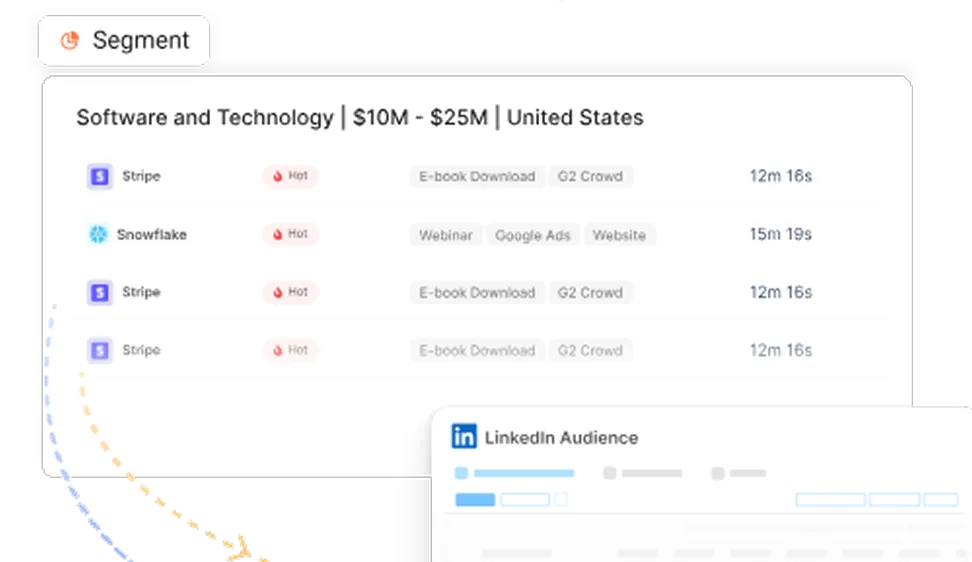
The capabilities that matter most for an AI-driven GTM motion include visitor identification and account-level analytics (knowing which companies are engaging with your content even without form fills), LinkedIn AdPilot (connecting ad engagement to account-level pipeline impact rather than click metrics), multi-touch attribution modeling (understanding which channels and content assets are influencing deals across the full journey), intent signal tracking (surfacing accounts in active research cycles before they self-identify), and GTM workflow integration (routing high-intent signals to the right activation channels without manual intervention).
The positioning isn't "AI platform." It's unified account intelligence: the context layer that makes every other AI tool in the stack smarter.
The future of AI in marketing: agents, predictions, and autonomous execution
The debate that emerges with every major technology wave is whether it will replace the people who currently do the work. It's the same debate that surrounded spreadsheets replacing accountants, word processors replacing secretaries, and search replacing research librarians. The pattern is consistent: some tasks get automated, the role evolves, and the capabilities that were previously rare become the new baseline expectations.
As AI gets better at analysis, reporting, summarization, workflow execution, and content production, the human marketer's value concentrates increasingly in judgment, creativity, strategic positioning, and taste. These aren't soft skills or secondary concerns. They're what determine whether the AI is optimizing toward the right outcome in the first place.
Agentic AI, systems that plan and execute multi-step tasks with minimal human input, is moving from early experiment to real production in some GTM contexts. AI SDR workflows are handling initial outreach qualification at scale. Content distribution systems are beginning to make channel and timing decisions autonomously. Budget allocation tools are adjusting spend in real time based on performance signals rather than waiting for monthly reviews. The trajectory toward more autonomous execution is clear, but the decisions that precede execution remain stubbornly human: what story to tell, which problem to solve, which market to enter, what actually matters to the buyer.
What actually becomes scarce
When AI makes content production nearly free, the bottleneck shifts from creation to originality. The scarcity that emerges is genuine point of view: a specific perspective on a problem your market hasn't heard framed that way before, expressed in a way that actually changes how someone thinks rather than confirming what they already believed.
Scarce things tend to become more valuable over time. The marketers who will compound are the ones investing in developing real perspective, not just AI fluency. AI fluency is table stakes by 2026. Having something worth saying is still rare.
In a nutshell…
The teams that are winning with AI right now share a few characteristics that have nothing to do with which tools they're using. They invested in clean, unified data before buying intelligence tooling. They defined the specific decisions they were trying to improve rather than the workflows they wanted to automate. And they measure AI impact through pipeline influence and decision quality, not through content volume, tool adoption rates, or how many things in the stack have an AI badge on them.
AI amplifies what's already there. Sharp positioning, a well-defined ICP, and coherent data infrastructure become dramatically more effective when AI is layered on top. Weak fundamentals become dramatically more efficient at producing the wrong outcomes.
The biggest mistake in AI marketing adoption is treating it as an efficiency play. Efficiency is a fine outcome but a poor goal. Nobody gets promoted because they shipped 20 campaigns instead of 10. They get promoted because they generated more pipeline, made better bets, caught opportunities earlier, and allocated budget where it actually compounded. That's where AI becomes interesting: not when it helps you do more work, but when it helps you do more of the right work.
FAQs for AI in marketing
Q1. What is AI in marketing?
AI in marketing is the application of machine learning, predictive analytics, and generative models to improve how teams collect signals, prioritize decisions, and execute campaigns. In practical terms, it means systems that learn from behavioral and firmographic data to help marketing teams reach the right buyers at the right moment, without manually reconfiguring every campaign. It covers everything from account intent scoring and lead prioritization to content personalization and pipeline forecasting.
Q2. How does AI marketing automation work?
AI marketing automation layers intelligence on top of traditional workflow execution. Rather than following fixed conditional logic, AI-powered automation detects behavioral patterns, scores accounts dynamically, and triggers personalized sequences based on inferred intent. The meaningful difference from traditional automation is that AI systems improve over time as they process more data. Traditional automation stays exactly as smart as when it was originally configured.
Q3. What's the difference between automation and AI?
Automation executes rules. AI makes inferences. A traditional automation workflow fires when a predetermined condition is met. An AI-driven system detects patterns in historical and real-time data to predict what should happen next. Most tools marketed as AI today exist somewhere on a spectrum between these two, which is worth understanding before signing a contract. Asking a vendor where their product actually sits on that spectrum is a useful qualifying question.
Q4. How is AI used in B2B marketing?
In B2B, AI most commonly appears in account and lead scoring, intent-based retargeting, pipeline forecasting, multi-touch content attribution, buying committee analysis, and budget optimization. The highest-ROI applications tend to be the ones that improve prioritization decisions: helping teams focus time and budget on the accounts most likely to convert rather than treating all pipeline with equal urgency.
Q5. What is AI content marketing?
AI content marketing is using AI not just to produce content faster but to make smarter decisions about what to create, where to distribute it, and whether it's contributing to revenue. This includes topic research and search intent mapping, firmographic-based content personalization, pipeline contribution attribution, and identifying which content assets appear consistently in the buying journey before deals close.
Q6. Can AI improve marketing decision-making?
Yes, and it's arguably where the highest-value applications sit. AI improves marketing decision-making by replacing opinion-based prioritization with probability-based prioritization. Which accounts are most likely to convert? Which campaigns are influencing pipeline versus inflating click metrics? Which segments are consuming budget without producing revenue? These questions used to require analyst hours or educated guesses. AI can surface answers in near real time.
Q7. What are the best AI marketing tools for B2B companies?
The most impactful AI marketing tools for B2B tend to be intent intelligence platforms, multi-touch attribution tools, AI-assisted ad platforms, and CRM-integrated scoring systems. The right tools depend entirely on which specific decisions need to improve. The better starting point is identifying the revenue bottleneck first, then finding tooling that addresses it, rather than adopting platforms and hoping a use case emerges.
Q8. How does AI impact attribution and pipeline measurement?
AI makes attribution more granular by processing signals at a scale and speed that human analysts can't match. It tracks multi-touch influence across channels, identifies content contributions that never triggered a direct conversion event, and surfaces account-level engagement patterns that predict deal progression. In an AI-driven GTM motion, attribution isn't just a reporting function. It's the feedback loop that tells every other system in the stack what's actually working.
Q9. Is AI replacing marketers?
It's replacing specific tasks: manual reporting, basic content production, workflow execution, and routine data analysis. The work that compounds in value, deciding what story to tell, which market to enter, what buyers actually care about, and why a competitor's positioning is winning, requires judgment that models can't replicate at the level of someone with genuine domain expertise and market context. The marketers most at risk are those whose entire output is executing tasks that AI now does faster and cheaper.
Q10. What data does AI marketing need to work effectively?
First-party behavioral data (website visits, content engagement, product activity), CRM data (deal history, contact activity, stage progression), ad engagement data (impressions, clicks, view-through patterns), and firmographic data (company size, industry, tech stack, and buying signals). Clean, unified data consistently outperforms sophisticated AI built on fragmented or inconsistent inputs. Auditing the quality of existing data before purchasing AI tooling is almost always worth doing.

Powered by Bombora
Enter your domain and we'll send you a free list of companies showing buying intent in your vertical.
.avif)
Powered by Bombora
Enter your domain and we'll send you a free list of companies showing buying intent in your vertical.
.avif)

See how Factors can 2x your ROI
Boost your LinkedIn ROI in no time using data-driven insights


.avif)

See Factors in action.
Schedule a personalized demo or sign up to get started for free
LinkedIn Marketing Partner
GDPR & SOC2 Type II

.svg)



.avif)


