
AI Market Research Tools: From Hype Threads to 10 Tools Worth Using
Explore 10 AI market research tools that go beyond buzz, curated to fit real workflows. Learn where ChatGPT, Delve AI, SparkToro, and others actually help.

Growth Marketer
.avif)
Content Marketer



.svg)


TL;DR
- AI tools are most helpful with speed, framing, and synthesis, rather than providing final answers.
- Use synthetic personas and digital twins as thinking tools, not decision-makers.
- Map tools to questions, not the other way around; start with the business decision first.
- Real competitive edge lies in combining AI acceleration with human interpretation.
AI market research tools help teams collect, analyze, and summarize research faster using capabilities like survey automation, social listening, transcript analysis, competitive intelligence, and predictive analytics.
The best tools do different jobs well—some are better for research synthesis, some for audience intelligence, and others for synthetic personas or reporting.
This guide breaks down 10 of the best AI market research tools, where each fits, and how to choose the right one for your workflow.
Best AI Market Research Tools at a Glance
| Tool | Best for | Core strength | Watch-out |
|---|---|---|---|
| ChatGPT | Research framing and synthesis | Fast ideation, summarization, draft analysis | Can hallucinate facts |
| Perplexity | Source-backed desk research | Cited answers and fast market scans | Still needs source validation |
| Delve AI | Personas and digital twins | Data-driven personas and synthetic users | Best with strong input data |
| Synthetic Users | Early concept testing | Fast simulated interviews and feedback | Not a replacement for real users |
| GWI Spark | Survey-based audience insights | Natural-language access to large consumer datasets | Best for teams needing quantified audience data |
| SparkToro | Audience research | Reveals what audiences read, watch, and follow | Not built for primary research interviews |
| Crayon | Competitive intelligence | Tracks competitor messaging and changes | Narrower than full research stacks |
| Quantilope | End-to-end research workflows | Survey automation and reporting | Better for structured studies than open web research |
| Displayr | Analysis and reporting | Strong quant analysis and dashboards | Requires cleaner input data |
| Remesh | Qual at scale | Large-group conversational research | Best when you already know what to test |
If you want a simple default starting stack, use ChatGPT or Perplexity for framing, SparkToro or GWI Spark for audience intelligence, and Quantilope or Remesh when you need structured research output.
What the internet really says about AI tools for market research
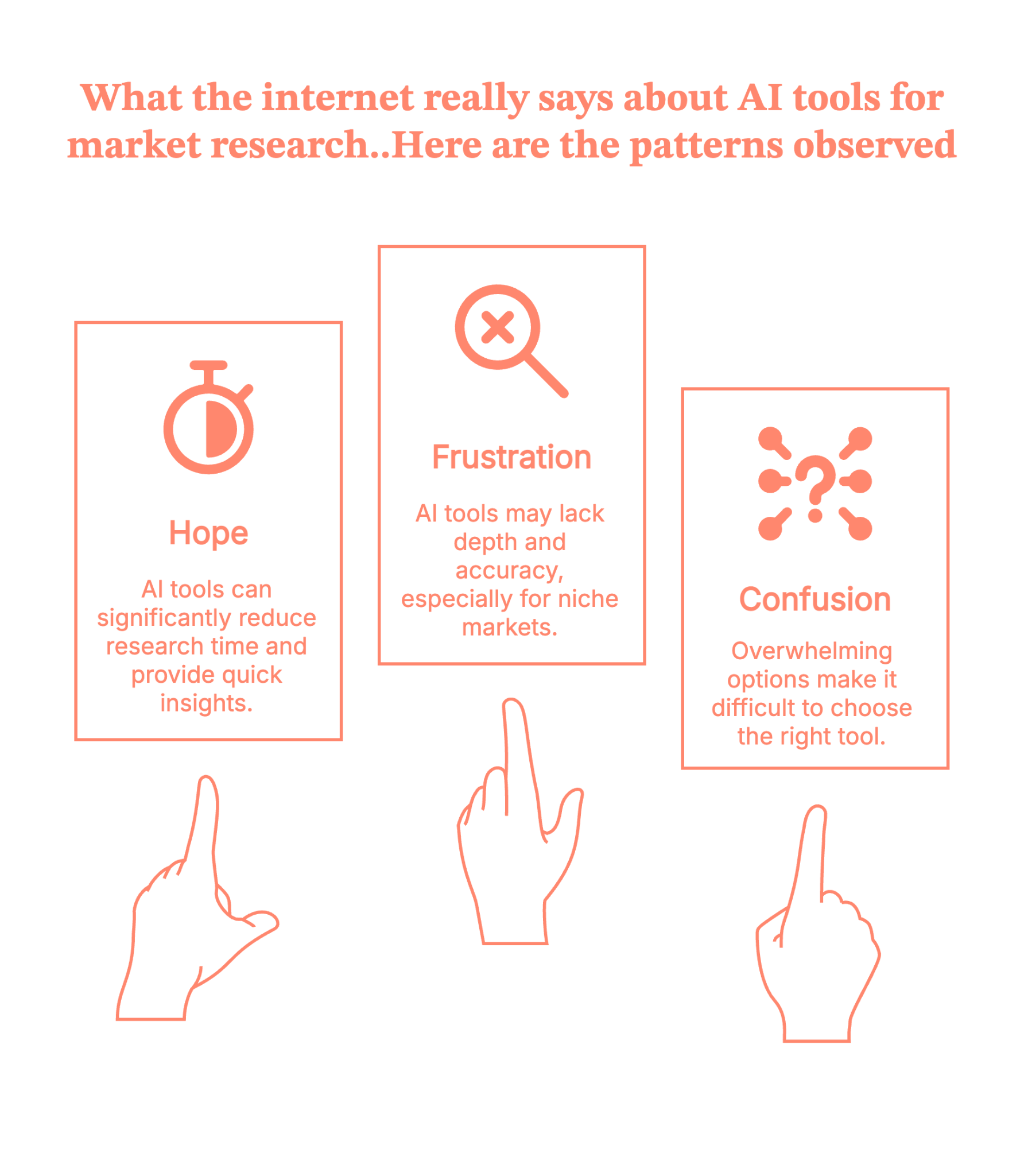
If you scroll through Reddit threads about AI tools for market research or ChatGPT for market research, three big patterns show up:
1. Hope: “This could save me weeks.”
Researchers, founders, and marketers love the idea that:
- Desk research that once took two weeks now happens in a day
- You can spin up personas, competitor lists, and trend scans in a few prompts
- AI can help non-researchers think like an analyst
Blogs and tools lists echo this – many teams report that AI tools for market research let them ramp up on a market or category in a fraction of the time.
2. Frustration: “Most tools are just wrappers.”
On the flip side, you see posts like on Reddit like:
“Most of these AI market research tools are just fancy wrappers around search results. You get lists and summaries, but not the kind of insight that changes how you think about a market.”
And more bluntly from some marketers: when they try to use AI for niche B2B or local markets, ChatGPT confidently makes things up, or misses key players they know from the field.
3. Confusion: “Where do I even start?”
There are:
- Listicles with ‘8 free AI tools for market research’ (ChatGPT, Perplexity, Claude, Elicit, etc.)
- Deep dives with ‘12 best AI market research tools by use case’ (synthetic users, AI persona tools, ad testing, conversational surveys)
- Articles ranking ‘7 best AI tools for market research,’ including Clay and SparkToro for audience analysis
And then the ‘There is an AI for that’ website and similar directories that list hundreds of tools for every imaginable use case. They’ve become a go-to discovery channel, but also a source of overwhelm – like an app store with no curation.
So communities are basically saying:
“AI is clearly powerful, but I don’t want 50 tools. I want a handful that actually change how I work.”
Let’s map the chaos into something more useful.
Also, read Top GTM engineering tools for 2026.
The three big jobs of AI market research tools
If you strip away the branding, AI tools for market research mostly fall into three jobs:
- Desk research copilots – tools like ChatGPT, Claude, Gemini, and Perplexity that help you think, synthesize, and outline.
- Synthetic audiences – tools that build synthetic personas or digital twins so you can ‘ask the market’ questions without running a survey every time.
- Audience & signal intelligence – tools that crawl the web, enrich leads, or aggregate behavior (Clay, SparkToro, competitor/trend tools, etc.).
{{INLINE_MOFU}}
How to Use AI for Market Research
The easiest way to use AI for market research is to map tools to the job you need done. Use research copilots like ChatGPT or Perplexity to frame questions and summarize findings. Use audience intelligence tools like SparkToro, GWI Spark, or Crayon to understand competitors, channels, and market signals. Use synthetic persona tools like Delve AI or Synthetic Users to pressure-test ideas before you invest in campaigns. Then use platforms like Quantilope, Displayr, or Remesh when you need structured analysis, reporting, or stakeholder-ready output.
In practice, AI works best as an accelerator for collection, synthesis, and prioritization—not as a replacement for real customers or expert judgment.
Those three jobs usually show up in two different ways of using AI in market research
- Oracle mode – you type a question into a large language model and hope the answer isn’t hallucinated.
- Proxy mode – you use synthetic personas, digital twins, or AI-powered panels to simulate how real people might respond.
HBR’s recent piece on ‘The AI Tools That Are Transforming Market Research’ describes this proxy shift clearly, especially around synthetic personas and digital twins:
- Synthetic personas – AI-simulated segments built from demographic, behavioral, or psychographic data.
- e.g., you can ask, “As a college-aged male gamer who spends $50/month on in-app purchases, how would you react to…?”
- Digital twins – AI models of real individuals calibrated on their survey answers, behavior, and traits.
- Your panel becomes a set of digital twins you can re-ask questions without pinging the human every time.
- Your panel becomes a set of digital twins you can re-ask questions without pinging the human every time.
In academic tests, digital twins reached about 88% relative accuracy in reproducing their human counterparts’ responses, which is impressive. However, they still only captured around half of the experimental effects you see in real humans. Translation: promising, not perfect.
Communities are reacting in a pretty balanced way:
- Excited about speed
- Wary about bias and ‘AI respondents’ that sound more polite and optimistic than actual customers
- Confused by overlapping vendor language – synthetic users vs digital twins vs synthetic data
So the smart teams are asking:
“Where can AI safely speed things up – and where do we still need humans in the loop?”
Let’s look at how ChatGPT for market research fits into that picture first.
ChatGPT for market research: what it’s good for (and where it breaks)
Reddit is full of people asking, “How do I use ChatGPT for market research?” and hitting one of two walls:
- It’s either too generic
- Or it fabricates very specific facts about local markets, niche B2B spaces, or real company counts.
The pattern that’s emerging in communities and practitioner blogs is, use ChatGPT as a thinking partner, not a database.
Where ChatGPT is great:
- Clarifying your brief
- e.g., Turn this vague idea into 3 concrete research questions.
- Designing instruments
- e.g., Draft interview guides, screener questions, and survey items you can later refine.
- Summarizing messy qualitative data
- e.g., Cluster open-ended responses into themes, highlight quotes, suggest segment-specific insights.
- Role-playing synthetic personas (lightweight)
- e.g,. Answer as a 28-year-old founder of a B2B SaaS in logistics – how would you react to this pricing?
Where people get burned:
- Treating model output as live market data (‘What’s the exact current market share of X in Germany?’).
- Asking for exhaustive local lists (small vendors, niche communities, local competitors).
So yes, compared to most market research AI tools, ChatGPT (and its peers) are a fantastic thinking companion. But they’re not a replacement for panels, CRM data, or real customers.
Now, instead of dumping 50 tools on you like a directory, let’s focus on 10 AI tools for market research that keep popping up in serious discussions, and explain where in your workflow they actually help.
How to choose the right AI market research tool
- Data source: Does it rely on web data, survey panels, proprietary datasets, or your own transcripts?
- Research job: Is it best for synthesis, audience intelligence, competitive monitoring, surveys, or synthetic testing?
- Output: Do you need summaries, dashboards, transcripts, survey analysis, or decision-ready reports?
- Reliability: Can you trace the insight back to a source, transcript, or quantified dataset?
- Workflow fit: Does it plug into the way your team already runs research?
The best AI market research tool is the one that fits your question, data quality requirements, and team workflow—not the one with the longest feature list.
10 best AI tools for market research (and where they fit)
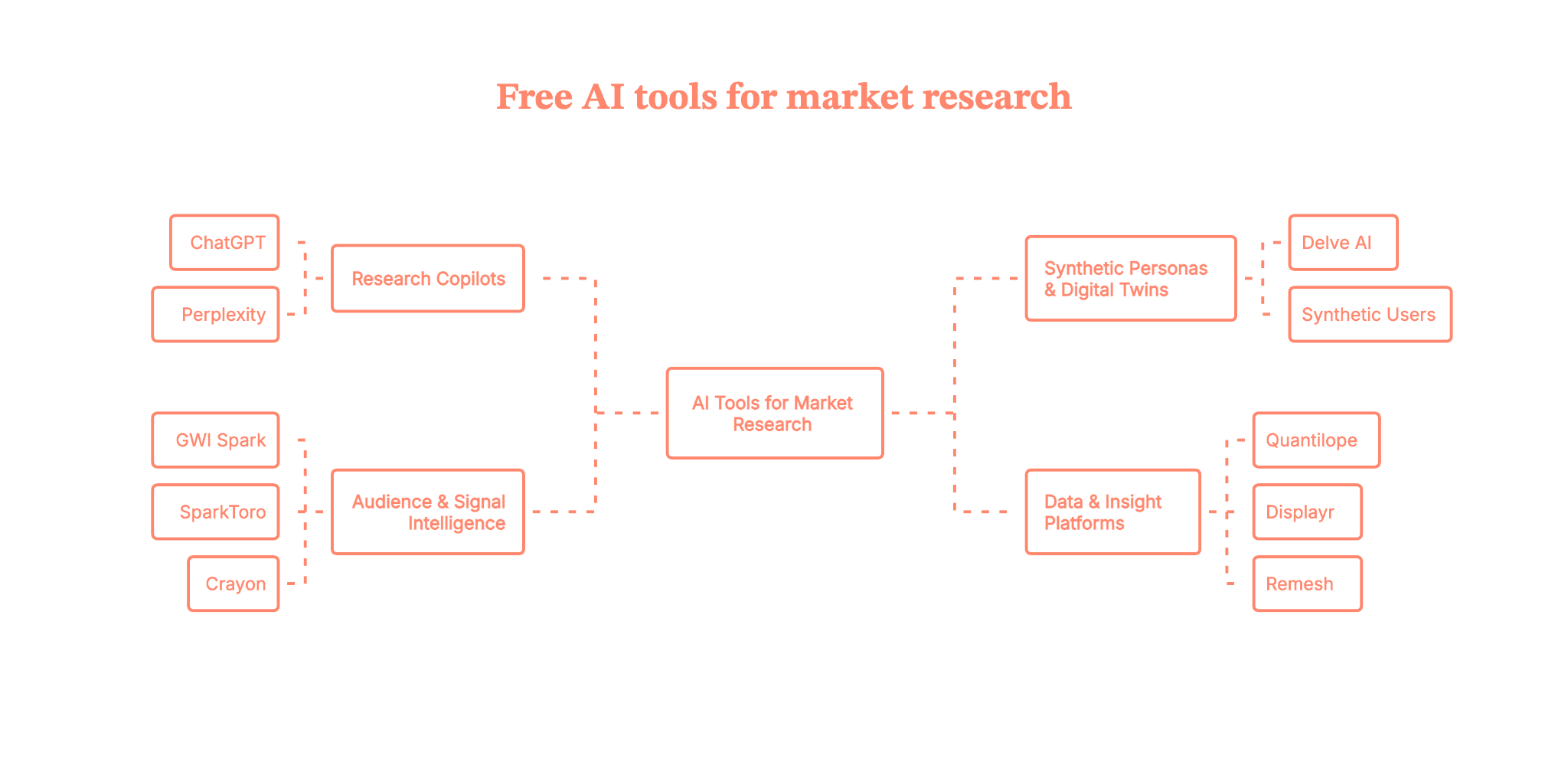
I’ll group these into four buckets:
- Research copilots
- Synthetic personas & twins
- Audience & signal intelligence
- Data & insight platforms

Research copilots
1. ChatGPT – the generalist research brain
Best for: Framing research questions, summarizing interviews, and turning messy notes into usable themes.
Why it stands out: It is flexible, fast, and accessible for teams that need a thinking partner before they invest in heavier tooling.
Watch-outs: It should not be treated as a live market database, especially for niche, local, or highly specific competitive facts.
We’ve already seen where ChatGPT shines in research. As a tool in your stack, here’s how to put it to work.
- Great for: framing research questions, drafting guides/surveys, summarizing interviews, generating hypotheses.
- Why people like it: it’s flexible, fast, and good at turning chaos into structured thinking – as long as you fact-check any hard numbers.
Use it to:
- Turn stakeholder brain-dumps into clear research objectives
- Draft multiple versions of stimuli, concepts, and landing page copy to test
- Summarize qual transcripts into ‘What we’re really hearing’ narratives
2. Perplexity – research with receipts
Best for: Source-backed desk research, fast competitor scans, and secondary market analysis.
Why it stands out: It gives cited answers quickly, which makes it useful for early landscape work and hypothesis building.
Watch-outs: Citations help, but you still need to validate sources and separate current facts from weak references.
- Perplexity leans into grounded answers with citations and a ‘Deep Research’ mode that runs dozens of searches and synthesizes them into a report.
- Great for: competitive intel, scanning adjacent markets, gathering secondary insights you can then interpret.
Use it to:
- Quickly map existing players, business models, and common value props in a new space
- Pull together a sourced landscape doc you can annotate with your own POV
Synthetic personas & digital twin tools
3. Delve AI – personas, digital twins, synthetic users in one place
Best for: Building data-driven personas and stress-testing campaigns with synthetic users.
Why it stands out: It connects persona creation, digital twins, and marketing recommendations in one workflow.
Watch-outs: Output quality depends heavily on the depth and quality of the customer or behavioral data you feed it.
Delve AI positions itself as AI market research + marketing software:
- Generates data-driven personas, digital twins of customers, and synthetic users from analytics, CRM, competitor, or social data.
- Lets you chat with these virtual customers, run synthetic research, and get channel-specific recommendations.
Best for:
- Teams that already have a decent amount of traffic/customer data and want to:
- Turn that into living personas
- Run ‘what if?’ scenarios before committing to big campaigns
It’s basically a commercial implementation of the synthetic persona / digital twin ideas HBR and academics are exploring – but with marketing outputs attached.
4. Synthetic Users – instant ‘interviews’ with AI participants
Best for: Early concept testing and rehearsal before you spend time recruiting real participants.
Why it stands out: It lets teams pressure-test ideas quickly with simulated interviews and follow-up probing.
Watch-outs: It is best used for hypothesis generation, not as a replacement for real customer feedback on high-stakes decisions.
Synthetic Users focuses on AI-generated research participants:
- You define the profile; the platform generates synthetic participants who can answer interview questions or surveys.
- Supports follow-up probing and auto-generated insight reports.
Best for:
- Early-stage exploration when recruiting real participants is hard, or when you want to rehearse research before going live.
Important caveat (echoing UX and MR experts): treat synthetic users as rehearsal and hypothesis tools, not replacements for real users – especially for emotionally loaded or high-stakes topics.
Audience & signal intelligence
5. GWI Spark – AI on top of real global survey data
Best for: Fast audience insights grounded in large-scale survey data.
Why it stands out: It combines natural-language querying with quantified consumer data across many markets.
Watch-outs: It is strongest when your question fits its survey coverage, not when you need open-web or highly niche local intelligence.
GWI Spark is an AI assistant sitting on top of a massive, global survey dataset (nearly a million consumers across 50+ markets).
- You type natural-language questions (‘How do Gen Z in the US discover new skincare brands?’)
- Spark responds with actual survey-based insights, not scraped web guesses.
Best for:
- Brand, product, or strategy teams that need trusted, quantitative, fast, and don’t have time for custom fieldwork on every question.
6. SparkToro – where your audience actually hangs out
Best for: Audience research, channel discovery, and influencer or media planning.
Why it stands out: It shows what your audience reads, watches, follows, and listens to in a highly actionable way.
Watch-outs: It is not designed to replace primary interviews, surveys, or deeper attitudinal research.
SparkToro is an audience research tool that tells you:
- Which sites, podcasts, YouTube channels, Subreddits, and social accounts your audience pays attention to.
It’s not an AI respondent tool; it’s a behavioral mirror:
- Great for:
- Media planning
- Influencer selection
- Positioning and content ideas based on real audience affinities
Think of it as: ‘Stop guessing which channels your persona uses. Here’s what they actually consume.’
7. Crayon – AI-powered competitive intelligence
Best for: Monitoring competitor messaging, packaging, pricing, and go-to-market changes.
Why it stands out: It helps teams spot meaningful competitive shifts without manually checking every rival source.
Watch-outs: It is narrower than a full research stack, so pair it with audience or survey tools for broader market context.
Crayon is a competitive intelligence platform that continuously monitors competitor sites, pricing, messaging, and other signals.
- AI helps flag meaningful changes and surface insights for sales, product, and marketing.
Best for:
- Product marketers and strategy teams who’d love a full-time “competitive analyst” but don’t have headcount.
Use it to:
- Track shifts in competitor positioning, packaging, and feature launches
- Feed that intel back into your research questions: “What does this market move mean for our segment X?”
Data & insight platforms
8. Quantilope – end-to-end AI-powered consumer intelligence
Best for: Structured survey-based studies such as concept tests, pricing research, and usage and attitudes work.
Why it stands out: It compresses the path from study design to analysis and stakeholder-ready reporting.
Watch-outs: It is better for planned research workflows than open-ended web exploration or lightweight brainstorming.
Quantilope is a consumer intelligence platform that blends survey automation with AI-based analysis and reporting.
- Built for: concept tests, pricing studies, U&A, etc.
- AI helps with survey setup, analysis, and storyboard/visualization.
Best for:
- Teams already comfortable with survey-based research who want to compress the study → insight → deck cycle without losing methodological rigor.
9. Displayr – AI for survey analysis & reporting
Best for: Turning large, messy quantitative datasets into usable analysis and dashboards.
Why it stands out: It helps research teams clean data, code responses, analyze patterns, and package insights faster.
Watch-outs: It works best when your input data is well structured enough to support strong downstream analysis.
Displayr is an AI-powered analysis and reporting suite popular with MR pros:
- Cleans and weights data, runs analyses, codes open-ended responses, and auto-builds dashboards.
Think of it as:
- Your quant ‘insight factory’ – AI does the heavy lifting, you stay in control of what the story actually means.
Best for:
- Teams drowning in data who need to turn large, messy datasets into usable stories faster.
10. Remesh – AI-boosted qual at quantitative scale
Best for: Large-scale qualitative conversations, message testing, and concept feedback.
Why it stands out: It combines qualitative depth with broad participation and real-time AI-assisted synthesis.
Watch-outs: It works best when you already know what you want to test and need scale rather than fully exploratory discovery.
Remesh is a platform for live, large-scale qualitative conversations:
- You can run online focus groups with up to ~1,000 participants at once.
- Participants respond, vote on each other’s answers; AI organizes and analyzes the open text in real time.
Best for:
- When you want qualitative depth + quantitative reach: message testing, concept reactions, early product feedback.
How to actually use these tools without losing the plot (and your mind)
With all of these, it’s tempting to go tool-first. Instead, borrow a page from the HBR guidance on synthetic personas and digital twins and flip it:
- Start with the decision, not the tool.
- ‘We need to decide: launch this feature now vs next quarter.’
- ‘We need to repackage pricing for segment X.’
- Decide what evidence would change your mind.
- X% of target customers see this as a ‘must have.’
- Clear list of top 3 objections by segment
- Map tools to questions, not the other way around.
- Use ChatGPT / Perplexity to sharpen the brief and outline methods.
- Use GWI Spark / SparkToro / Crayon for fast, top-down market reading.
- Use Delve AI / Synthetic Users to rehearse concepts or stress-test scripts.
- Use Quantilope / Remesh / Displayr when you’re ready for structured, defensible data.
- Benchmark synthetic against real.
This is straight out of the digital twin research playbook, run small human samples in parallel and compare.
Don’t just ask ‘Is it accurate?’ – ask:
- Would we have made the same decision using only the synthetic data?
- Keep humans in the high-leverage loops.
Let AI compress the painful parts (collection, summarization, first-pass analysis), but keep humans for:- Prioritization
- Interpretation
- Ethics and ‘Should we do this?’ calls
Forget the hype. Here’s where AI market research tools actually work
AI market research tools are everywhere, but most discussions online echo the same confusion: “What’s real, what’s noise, and where do I even begin?”
Rather than chasing bloated tool directories, focus on ten standout platforms that users keep returning to: tools like ChatGPT and Perplexity for framing and synthesizing, Delve AI and Synthetic Users for lightweight persona modeling, and behavioral data engines like SparkToro and Crayon.
But the key takeaway isn’t tool selection, it’s methodology. The smartest teams are blending AI’s speed with human insight, mapping tools to decisions, not the other way around. Whether you're streamlining research workflows or pressure-testing campaigns before launch, the value lies in matching the tool to the job, not replacing judgment with automation. AI won’t replace your research team, but it will challenge you to think faster, ask sharper questions, and stay closer to real-world signals.
In other words, you don’t need fifteen market research AI tools to be ‘doing AI’.
You need a clear question, a handful of tools you trust, and a process that blends synthetic speed with human judgment.
Because the real competitive advantage over the next few years won’t be “We used AI.”
It’ll be:
“We used AI to ask better questions, faster – and still cared enough to talk to actual people.”
Key Takeaways
- AI market research tools are best used by job: synthesis, audience intelligence, competitor tracking, synthetic testing, or structured reporting.
- The strongest stacks combine an AI copilot with a source-backed audience or competitive intelligence tool.
- Synthetic personas can speed up early thinking, but high-stakes decisions still need real customer evidence.
- If you’re just getting started, pick one generalist tool and one specialist tool rather than buying a full stack at once.
PS: Got intent data and AI insights? Here’s how to turn them into pipeline
If you’re already playing with AI market research tools, you’re probably sitting on a growing pile of signals:
- Accounts visiting high-intent pages
- Prospects engaging with content or ads
- Closed-lost deals quietly coming back to your site
The real question becomes: “Now what?”
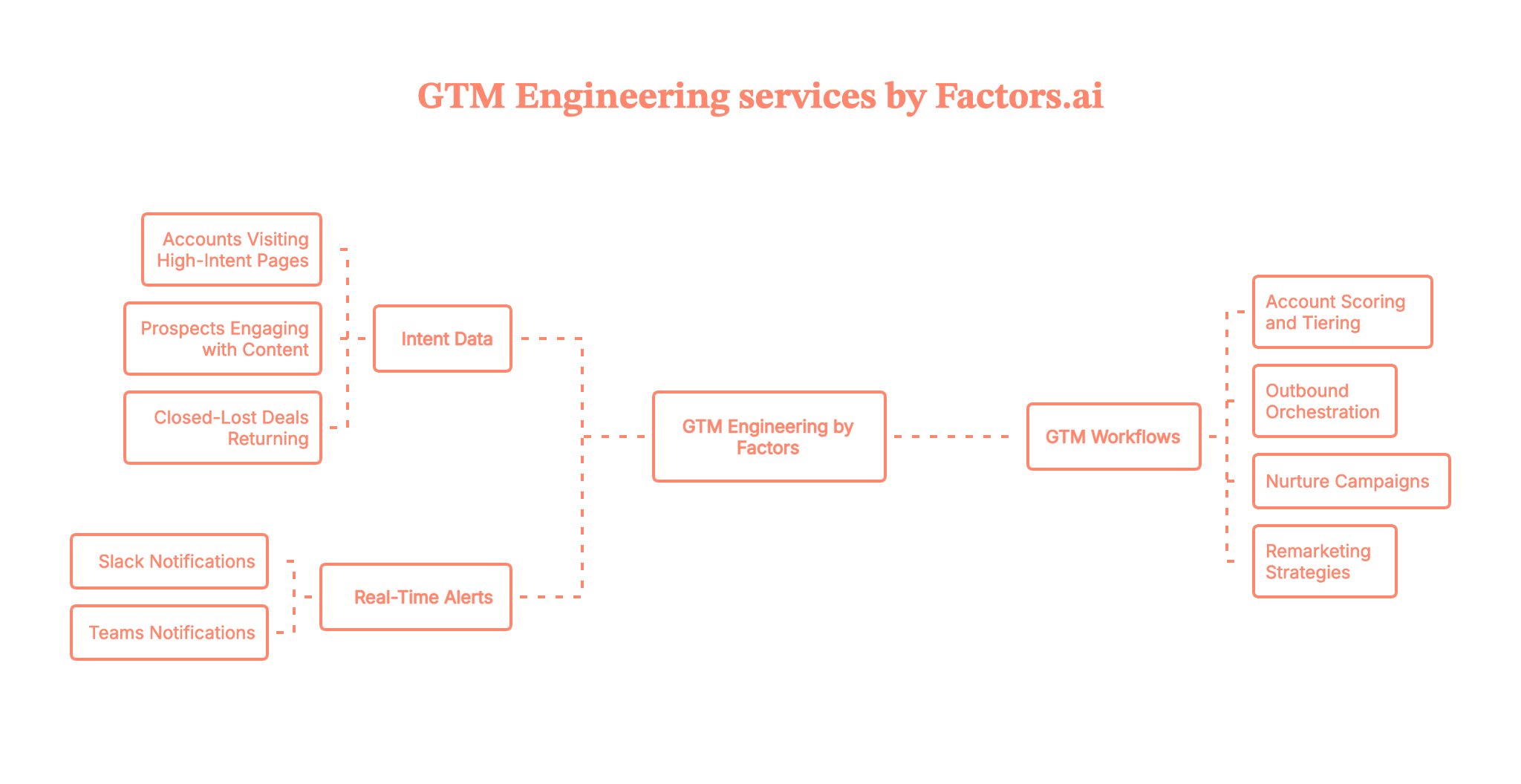
That’s exactly the gap GTM Engineering by Factors is built to close.
Instead of just telling you which accounts are warm, Factors connects your website, CRM, ad platforms, and enrichment tools, then turns all those signals into clear actions for sales and marketing:
- “Here are this week’s highest-intent accounts and the 2–3 people to contact in each.”
- “This closed-lost account is back on your pricing page. Here’s what they’re looking at.”
- “These accounts fit your ICP, are hiring in key roles, and just spiked on product pages.”
Behind the scenes, Factors builds and maintains GTM workflows that:
- Score and tier accounts based on fit and behavior
- Trigger real-time alerts in Slack/Teams
- Orchestrate outbound, nurture, and remarketing across tools you already use
So instead of adding ‘yet another AI tool,’ you’re adding a GTM automation layer that turns research and intent data into meetings and pipeline.
If your next question is, “How do we connect all this AI insight to actual revenue?” GTM Engineering by Factors is a very solid first step.
Curious what this could look like on your stack, with your accounts and intent signals?
Book a demo with the Factors team, and we’ll walk you through a live GTM Engineering setup end-to-end.
To learn more, also read our blog on website visitors to warm outbound plays with GTM engineering.
FAQs on AI market research tools
Q.1 The best AI for market research?
Most people often mix LLMs (ChatGPT/Claude) with research assistants like Perplexity for discovery, then validate with domain tools.
Q.2 AI surveys that have conversations instead of static questions — useful or overthinking?
Conversational/AI-moderated surveys can increase depth and speed; the value depends on the guardrails and the reliability of the analysis.
Q.3 How many AI market research tools do I actually need to get started?
You can do a lot with a lean stack: one LLM copilot (ChatGPT/Claude), one research assistant with citations (Perplexity), and one or two audience/insight tools (like SparkToro, GWI Spark, or your platform of choice). The win comes from your workflow, not from collecting logos.
Q.4 Can AI replace my research agency or in-house team?
Not yet (and probably not for a while). AI is brilliant for speed, like drafting guides, summarizing data, and stress-testing ideas. But you still need humans for sampling, methodology, interpretation, and the “So what do we do now?” decisions.
Q.5 Can ChatGPT do market research?
Yes—ChatGPT can help with research framing, transcript summarization, hypothesis generation, and first-pass analysis. But it should not be treated as a live source of market facts. It works best as a synthesis and ideation layer alongside verified sources, customer interviews, or structured data tools.
Q.6 What is the best AI tool for market research?
There is no single best tool for every team. ChatGPT and Perplexity are strong for synthesis and desk research, SparkToro and GWI Spark are useful for audience intelligence, and Quantilope or Remesh fit structured research workflows. The right choice depends on whether you need speed, source-backed research, quantified survey data, or reporting.
Q.7 Are AI market research tools accurate?
They can be very useful, but accuracy depends on the underlying data source and the job you ask the tool to do. Tools grounded in surveys, transcripts, or verified sources tend to be more reliable than open-ended generative outputs alone. The safest workflow is to use AI to accelerate analysis, then validate important decisions with real customer or market evidence.

See how Factors can 2x your ROI
Boost your LinkedIn ROI in no time using data-driven insights


.avif)
See Factors in action.
Schedule a personalized demo or sign up to get started for free
LinkedIn Marketing Partner
GDPR & SOC2 Type II

.svg)



.avif)

