
AI marketing case studies: real examples, campaigns, and lessons for B2B marketers
Read about real-world B2B AI marketing case studies. See how top revenue teams use predictive models, intent signals, and agentic workflows to drive pipeline.
.avif)
Content Marketer



.svg)


TL;DR
- AI in marketing has moved from creative experimentation to operational infrastructure, and the teams winning aren't the ones posting the most AI-generated content.
- The most valuable AI marketing implementations connect signals to revenue: intent data, attribution, audience targeting, and pipeline intelligence.
- B2C campaigns like Spotify Wrapped and Sephora's beauty advisor get the press, but the B2B playbook looks more like Gong, 6sense, and Factors.ai than Coca-Cola's holiday ads.
- Most AI implementations fail not because of the technology but because of weak data quality, no attribution visibility, and zero governance.
- The teams that'll win long-term are building AI as infrastructure, with humans firmly in the strategy seat.
Most AI marketing case studies are basically the same story wearing different clothes. A brand uses ChatGPT. A marketer generates 47 LinkedIn posts before breakfast. Someone creates an AI image of a dinosaur eating tacos.
The campaign gets featured in three newsletters, two podcasts, and one conference presentation titled How We Reimagined Marketing With AI.
Wonderful!!!
Meanwhile, somewhere else, a RevOps team quietly figures out which accounts are actually ready to buy, an attribution model uncovers a hidden revenue pattern, and a campaign automatically shifts spend away from people who love clicking ads and toward people who occasionally enjoy purchasing things.
One of those stories gets a standing ovation… the other one gets a budget increase. Guess which one I'd rather have.
The problem with most AI coverage is that it focuses on the visible stuff. Content generation. Images. Videos. Copywriting. Those are useful applications, sure. They're also the easiest ones to spot.
The more interesting AI stories tend to happen behind the scenes.
They show up when a sales team calls the right account at the right moment. When marketing finally figures out which channels are creating pipeline instead of just creating dashboards. When buying signals get detected early enough to matter. When decisions happen faster because someone connected the dots before a human had to.
That's where most of the value lives.
And that's what makes AI marketing case studies worth studying.
Not because they show us what's possible.
Because they show us where the money actually is.
In this guide, we'll look at AI marketing examples from both B2B and B2C companies, unpack what they did, what worked, what didn't, and why some AI projects become revenue engines while others become conference talks.
What counts as an AI marketing ‘case study’?
I know this is a weird section in the blog, but stay with me.
There's a BIG difference between "we used AI" and "AI changed how we operate." The first camp includes every company that ran a copy batch through ChatGPT and called it a workflow. The second camp is much smaller, much more interesting, and frankly much harder to find good writing about.
For the purposes of this article, a real AI marketing case study means a company identified a problem, deployed an AI system or workflow to address it, changed something operationally as a result, and produced a measurable outcome. The bar isn't high, but it does rule out "we made an AI ketchup ad and it went viral on Twitter."
There are four types of ai technologies doing meaningful work in marketing right now. Generative AI handles content creation, ad creative, and personalization at scale, and it can produce text, visuals, audio, video, and code to support marketing content, including image generation, personalized ad copy, and automated service responses. Predictive AI powers lead scoring, churn modeling, and demand forecasting through data analysis that can analyze vast amounts of customer data, reveal individual behaviors and preferences, improve customer segmentation, and drive personalized recommendations. Conversational AI shows up as chatbots, qualification flows, and real-time sales assistance, where it can also mirror some guidance traditionally handled by human support during customer interactions. Agentic AI is the newest category, where AI systems execute multi-step workflows autonomously, from audience building to campaign orchestration, with minimal human intervention.
Most of the flashy case studies you'll see are generative. Most of the money being made is predictive and agentic.
Here’s why you should care about AI marketing case studies
The experimentation phase is over (not sure if I should say, thankfully?! or unfortunately?!... you decide).
AI budgets have moved from the ‘innovation fund’ line item to the operational budget, which means teams are now accountable for ROI, not just novelty. According to a CoSchedule report, marketers using AI are 25% more likely to report measurable success than those who don't. CMOs aren't asking "should we try AI?" anymore. They're asking "why isn't our AI investment showing up in pipeline?"
The pressure has stacked up, and HOW. Teams are expected to produce more content with the same headcount, personalize buyer journeys that span weeks and multiple channels, prove attribution on every dollar across their marketing efforts, and reduce CAC in a market where CPCs keep climbing. Deployed well, AI can improve marketing efficiency and drive a 10-25% increase in return on advertising investments. AI was supposed to solve all of this. For some teams, it has. For many, it's just created a new category of mess.
Gartner has tracked AI's growing share of marketing budgets for several years now, and the numbers keep moving upward. But what's more telling than the budget allocation is where AI is actually being embedded: inside CRM workflows, inside ad platform bidding systems, inside attribution dashboards, inside the customer journey itself. The question has shifted from "are you using AI?" to "how deeply is AI woven into how you go to market?"
The rise of AI agents in B2B GTM is probably the biggest shift of the last 18 months. These aren't chatbots. They're systems that can identify a high-intent account, trigger a personalized outreach sequence, update the CRM record, adjust LinkedIn bid strategy, and flag the account for SDR follow-up, all without a human making each individual decision. The real value isn't in shaving five minutes off a task. It's in compressing the gap between a signal appearing and a revenue action happening.
The most common use cases of AI in marketing
Before getting into individual case studies, it's worth mapping the landscape clearly. Here's where AI is actually being applied, what it does, and where you'd see it in the wild:
For B2B teams specifically, the highest-leverage applications tend to cluster around three things: knowing which accounts are ready to buy, reaching those accounts with precision across channels, and connecting your marketing activity directly to pipeline so you know what's working. Platforms like Factors.ai are built around exactly this combination, bringing visitor identification, account intelligence, attribution, and ad activation into one connected workflow.
AI marketing case studies and campaign examples
- Factors.ai: multi-touch attribution and AI audience activation
This one gets its own deeper treatment because the workflow is instructive rather than just impressive.
The problem most B2B marketing teams face is that the data lives in disconnected systems: ad platforms, website analytics, CRM, product usage, intent tools. You can't see the complete buyer journey because no single system has the full picture.
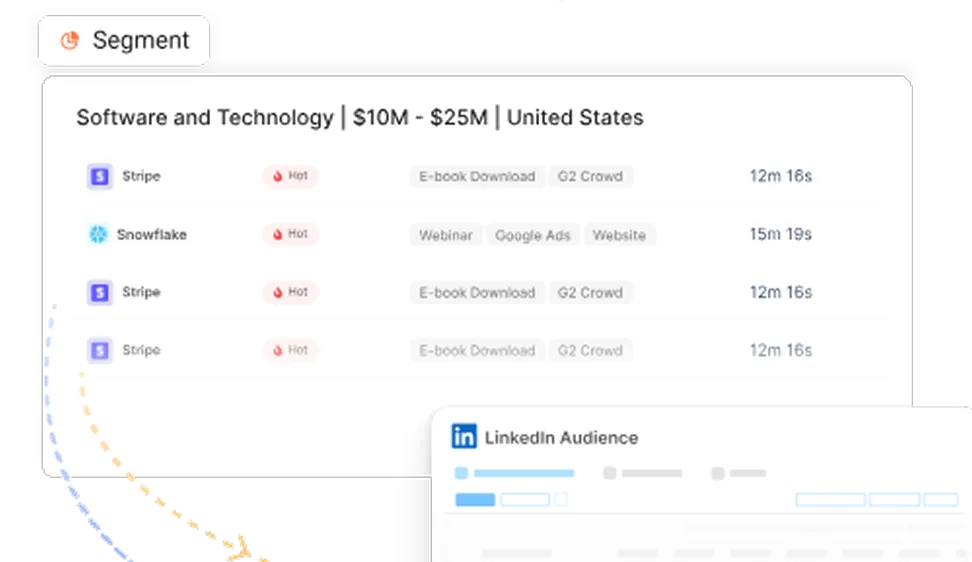
Factors.ai connects those systems and then adds two capabilities that change what's possible. The first is account-level attribution, understanding which channels, campaigns, and content pieces are actually contributing to pipeline, not just last-click conversion. The second is AI-powered audience activation, using behavioral signals from your own data (which accounts are visiting high-intent pages, which companies are engaging with your LinkedIn content, which firms match your best customer profile) to build dynamic ad audiences that update automatically.
In practice, this looks like: a target account visits your pricing page twice in one week, Factors.ai detects the signal, adds that account to a LinkedIn campaign targeting the buying committee, the SDR gets a notification to prioritize outreach, and the attribution model records how the marketing touches contributed when the deal eventually closes. All of this happens as a connected workflow rather than a series of manual processes.
The positioning that resonates here is simple: AI is only as useful as the data and workflows it's connected to. A standalone AI tool producing content or scoring leads in isolation is dramatically less valuable than AI that's wired into your attribution, your ad activation, and your pipeline visibility.
AI-powered ABM campaign orchestration
This is a composite example based on how the most sophisticated B2B teams are running account-based campaigns in 2026, and it's worth walking through because it illustrates what agentic AI actually means in practice.
The workflow starts with intent signal detection: which target accounts are showing elevated research activity, visiting competitor sites, or engaging with content in your category. That signal triggers an account enrichment process that pulls in firmographic data, identifies the likely buying committee, and segments accounts by ICP tier and buying stage.
From there, the system builds dynamic LinkedIn audiences from the identified buying committee contacts and pushes them into active campaigns. Simultaneously, it triggers personalized outreach sequences from SDRs, pre-populated with account-specific context. The CRM records are updated in real time as engagement happens. When a campaign's performance drops for a specific audience segment, the system adjusts bids, refreshes creative, or shifts budget automatically.
A human designed the workflow and approved the guardrails. The AI executes the individual steps. The result is a campaign that responds to signal in near real-time rather than waiting for a quarterly review cycle.
- HubSpot's AI content assistant
HubSpot embedded AI writing assistance directly into its marketing and CRM tools, allowing users to generate first drafts of emails, landing pages, social posts, and blog content within the platform they already work in.
The adoption curve here was notably different from standalone AI tools. Because the AI was embedded in the existing workflow, the friction to use it was near zero. Teams didn't need to switch contexts or learn a new tool. They just had a "generate" button where they used to start from scratch.
Takeaway for marketers: AI adoption at scale requires workflow integration, not just capability availability. If your team has to open a separate browser tab to use the AI, most of them won't.
- Salesforce Einstein
Salesforce has been investing in AI under the "Einstein" umbrella for nearly a decade, but the more recent versions are doing genuinely useful things in areas like opportunity scoring, forecasting, and automated CRM data enrichment.
The forecasting capability is probably the highest-value use case for B2B revenue teams. Instead of reps manually updating pipeline confidence, Einstein analyzes activity patterns, historical data, and deal characteristics to produce more accurate forecast numbers. Which is useful, because if you've ever sat in a forecast call where everyone is eyeballing their own deals, you know how unreliable that process is.
Takeaway for marketers: AI's value in the revenue stack isn't always customer-facing. Some of the best applications are internal, making your own team's judgment more accurate and your pipeline more predictable.
- LinkedIn's AI ad optimization
LinkedIn has built increasingly sophisticated AI into its Campaign Manager, including predictive audience expansion, which automatically finds additional accounts likely to convert based on your existing campaign performance.
This matters for B2B marketers specifically because LinkedIn's audience data is uniquely valuable: firmographic data, job titles, seniority, company size, and professional interests that other platforms can't match. When AI works with that data to optimize targeting, the efficiency gains compound quickly.
The quality of LinkedIn data is also why first-party data syncing matters so much. If you can push your own high-intent account lists into LinkedIn for targeting, using something like Factors.ai's audience sync, you're not just relying on LinkedIn's targeting alone. You're combining your behavioral signal with their network reach.
- Adobe Firefly for enterprise creative production
Adobe Firefly brought generative image and video creation directly into the Creative Cloud ecosystem, giving enterprise creative teams the ability to generate on-brand assets at scale without going outside their existing toolchain.
For large organizations managing dozens of campaigns simultaneously, with different regional versions, A/B tests, and channel-specific formats, the production efficiency gains are substantial. Creative teams can spend more time on strategy and less on resizing banners.
Takeaway for marketers: At enterprise scale, creative production is often the bottleneck between a good idea and a live campaign. AI that integrates directly into production workflows removes that bottleneck without requiring a change in how teams think about creative work.
- Drift's conversational marketing
Drift essentially created the conversational marketing category and has remained one of the more interesting case studies in AI-powered pipeline acceleration. The core use case is replacing static forms with dynamic conversations that qualify visitors in real time and route them to the right next step.
The shift from form to conversation matters more than it might seem. Forms are a commitment. A conversation is a dialog. The psychological friction of filling out a form versus answering a few questions is meaningfully different, and the data quality from a conversation tends to be higher because you can ask follow-up questions based on what the person just said.
Takeaway for marketers: Pipeline velocity is often a qualification and routing problem. AI can compress the time from first visit to first qualified conversation considerably.
- Gong's AI revenue intelligence
Gong processes recorded sales calls and uses AI to surface patterns, deal risks, and coaching opportunities. It's one of the clearest examples of AI creating a genuine competitive advantage in B2B sales.
Before tools like Gong existed, sales leaders had essentially no visibility into what was happening in conversations. You'd see CRM notes, which were often incomplete or biased, and you'd know whether deals closed. Gong closes that gap by analyzing what's actually being said, which competitor keeps coming up, which objections are recurring, and which reps' language patterns correlate with higher win rates.
Takeaway for marketers: The signal you need to improve your marketing messaging is often sitting in your sales calls. AI analysis of conversation data is one of the fastest ways to close the gap between what marketing thinks customers care about and what they actually say they care about.
- 6sense's predictive intent targeting
6sense built its platform around a core bet: that buying intent can be detected and predicted before an account ever fills out a form or talks to sales. The platform aggregates third-party intent signals, first-party behavioral data, and firmographic information to identify accounts that are in an active buying cycle.
For B2B demand generation, this changes the game considerably. Instead of running broad awareness campaigns and hoping the right people see them, you can concentrate budget on accounts that are demonstrably in-market right now. The math on that is significantly better.
Takeaway for marketers: Timing is probably the most underrated variable in B2B marketing. Reaching the right account at the wrong moment in their buying journey is nearly as ineffective as reaching the wrong account entirely.
B2B AI marketing case studies we should look at closely
B2C campaigns get more coverage because they're more visible and more shareable. But the operational intelligence built into B2B AI implementations is often considerably more sophisticated.
AI-driven personalization is one of the clearest patterns across high-performing B2B and B2C examples.
The pattern across the strongest B2B implementations is consistent: they don't treat AI as a ‘content tool’. Instead, it’s being treated as a signal processing and activation layer that sits between data and revenue action. McKinsey reports that companies using this approach capture 5 to 15 percent incremental revenue and improve marketing-spend efficiency by 10 to 30 percent. The same research also found that fast-growing companies generate 40% more of their revenue from personalization than slower-growing competitors.
What does successful AI marketing campaigns have in common?
Looking across these examples, five patterns emerge consistently in the implementations that actually moved metrics.
- Strong first-party data. Every high-performing AI implementation in this list was built on top of well structured data, not just a large volume of first-party inputs. The AI is only amplifying what your data knows. If your data is weak, your AI outputs will be too.
- Clear, defined workflows. The teams that succeeded didn't deploy AI as a general capability and hope for the best. They identified specific processes, mapped the workflow, and built AI into specific steps. "Use AI for marketing" is not a workflow. "Use AI to identify high-intent accounts daily and update LinkedIn audiences automatically" is a workflow.
- Human oversight at the strategy layer. In every case study that worked, humans remained in control of the creative brief, the strategy, the ICP definition, and the messaging framework. AI executed within those parameters, with human expertise and human creativity guiding the decisions, not just human oversight. The teams that got into trouble were the ones that tried to automate the strategy itself.
- Direct connection to revenue metrics. The implementations that earned continued investment were the ones that could show pipeline influence, CAC improvement, campaign effectiveness, or higher conversion rates. Vanity metrics didn't survive the budget scrutiny. Pipeline impact did.
- Fast experimentation loops. The best AI marketing teams are running considerably more experiments than their competitors, because AI reduces the cost of each experiment. But they're also reviewing results more frequently, updating their approach, and building a culture of continuous improvement. In practice, companies that use AI-driven personalization capture 5 to 15 percent incremental revenue and 10 to 30 percent efficiency in marketing spend, while dynamic personalization can cut content creation costs by up to 30-50%, reduce launch time by half, and lift sales conversions by more than 20-30%. The advantage is speed of learning.
Here’s where most AI marketing implementations fail
Here's the part that most "AI is amazing" articles skip over. Most AI marketing implementations underperform or fail entirely. Understanding why is at least as useful as studying the successes.
- Using AI without a strategy. AI can generate a hundred LinkedIn posts in an hour. That's not a marketing strategy. Teams that deployed AI primarily to increase output volume without clarifying what they were trying to achieve ended up with more content that performed worse because it lacked the specificity and strategic intent that makes content actually convert.
- Producing AI content without editing. The volume of low-quality AI-generated content online has reached a point where readers have developed a fairly reliable detector for it, even if they can't always articulate why something feels off. "AI slop" is a real category now, and publishing it unedited damages brand credibility in ways that are hard to recover from.
- No attribution visibility. Running AI-optimized campaigns without attribution tracking is a common mistake. You don't actually know if the AI is making the right decisions if you can't trace outcomes back to the specific inputs. Without attribution, AI optimization can look like it's working when it's actually chasing proxy metrics.
- Too many disconnected tools. The average B2B marketing stack has grown considerably over the last five years. Adding AI tools on top of an already fragmented stack without integrating them into a coherent workflow creates more complexity without more clarity. The data still lives in silos. The outputs still need to be manually assembled.
- Weak data quality feeding into AI systems. If your CRM has inconsistent firmographic data, your AI lead scoring will reflect those inconsistencies. If your attribution model has significant gaps in the buyer journey it can track, your AI spend recommendations will be biased toward whatever touchpoints are visible. Garbage in, garbage out is not a new concept, but AI makes the consequences more visible and more consequential.
- No governance. This is particularly relevant for content-producing AI applications. Teams that don't have clear guidelines about what AI can generate, what requires human review, and what can be published directly are accumulating quality risk that eventually shows up as a brand problem.
How B2B teams can build their own AI marketing workflow
A practical sequence for implementing AI in a way that actually connects to revenue:
Step 1: Centralize first-party data so you can integrate AI into existing marketing processes. Before adding any AI tool, make sure you can actually see your buyer journey instead of layering tools on top of silos. That means connecting your website analytics, ad platforms, CRM, and any product usage data into a system where you can track account-level behavior across touchpoints. Centralized customer data also makes customer segmentation and personalized recommendations more useful. Tools like Factors.ai are designed specifically for this.
Step 2: Define your ICP and buying signals clearly. What does a good account look like at firmographic, technographic, and behavioral levels? What actions on your website or with your content indicate genuine buying intent? AI can help you identify these patterns once you have enough data, but you need to start with a hypothesis.
Step 3: Layer AI into the repetitive, rules-based parts of your marketing processes. Audience updates, lead scoring refreshes, bid adjustments, content briefs, first-draft emails — these are all good candidates for AI automation because they follow consistent patterns and have measurable outputs, and they can be automated without replacing creative direction.
Step 4: Connect AI outputs to attribution. Every AI-driven action should feed into your attribution system so you can evaluate what's actually contributing to pipeline. This is how you separate AI implementations that are working from ones that are generating activity without revenue impact.
Step 5: Build human QA into the workflow. This step is about spot-checking regularly, having clear escalation paths when AI outputs fall outside expected parameters, maintaining editorial standards for anything that goes externally, and using quality control backed by human expertise.
Step 6: Measure pipeline impact, not activity. MQL volume, content downloads, and ad impressions are proxies. Pipeline influenced, CAC by channel, and revenue attributed to specific campaigns are the metrics that tell you whether your AI investment is compounding or just running in place, and this measurement discipline gives the marketing organization a competitive edge.
How Factors.ai fits into AI-driven marketing operations
The modern B2B marketing stack has a structural problem: the data about who's engaging with your brand lives in one place, the data about what's happening in pipeline lives in another, and the tools you use to activate audiences in paid media live somewhere else entirely.
Factors.ai was built to close those gaps. The platform identifies anonymous website visitors at the account level, which means your marketing team can see which companies are engaging with your site even before they fill out a form. It layers in multi-touch attribution that traces account engagement across paid, organic, and direct channels so you understand what's actually influencing pipeline, not just what's getting last-click credit.
The AI-powered account scoring uses your own first-party behavioral data to identify which accounts are showing genuine buying intent, updating dynamically as behavior changes. And the audience activation capability syncs those intent-based audiences directly to LinkedIn and Google, so your paid campaigns are always targeting the accounts most likely to convert.
In the agentic workflow example described earlier, Factors.ai is effectively the intelligence layer that makes the orchestration possible. It's where the signal lives, where the audience logic is defined, and where the attribution gets tracked. Just so you know… the AI isn't replacing your marketing team's judgment. It's giving that judgment better information to work with and automating the execution of decisions already made.
Here’s what the future of AI marketing campaigns looks like…
The trajectory is reasonably clear even if the timeline isn't. AI agents that can execute complete GTM workflows autonomously, adjusting strategy based on real-time performance data, are coming for the manual parts of demand generation. Conversational search is changing how buyers find vendors, which means discovery on every major ai platform and content optimized for LLM citation are becoming as important as content optimized for Google ranking. At the same time, ai assistants will handle more of the repetitive work inside marketing systems. Synthetic audience testing, running creative and messaging experiments against AI-simulated segments before spending real budget, is emerging as a capability at the enterprise level.
That also means media coverage and authoritative mentions will matter more for brand visibility across AI-driven discovery surfaces.
I’d say that the interesting prediction is that the job description will shift considerably. Campaign execution becomes system configuration. Channel management becomes workflow architecture. Marketing teams will increasingly rely on ai assistants for execution while people retain strategic control. The marketer who understands how to design and govern an AI-driven GTM system will be more valuable than the one who's manually executing the same tasks faster.
What won't change is the premium on strategic judgment, creative thinking, and genuine customer understanding. AI can optimize toward a metric. It can't decide which metric matters, understand why a customer actually buys, or generate the kind of insight that comes from sitting in a room with a prospect and really listening.
The Original Tamale Company showed how fast this can move by using AI to create a viral video that generated more than 22 million views and 1.2 million likes in three weeks.
Trust will also become a differentiator as AI-generated content becomes more common and easier to identify. The brands that maintain genuine human perspective and intellectual honesty in their marketing will stand out more, not less, as the baseline quality of AI content increases.
In a nutshell…
The winning AI marketing teams in 2026 aren't necessarily the ones using the most AI tools. They're the ones that connected AI to first-party data and actual revenue metrics, built feedback loops that update fast, kept humans in the strategy seat, and resisted the temptation to automate the parts of marketing that require genuine judgment.
The teams that are struggling are often the ones that treated AI as a content factory, measured output volume instead of pipeline contribution, and skipped the data infrastructure work that makes AI actually accurate.
Just to reiterate… AI is NOT replacing marketing strategy (PLEASE). It's making it more obvious which teams had a real strategy to begin with... and which ones were mostly hoping that more activity would eventually turn into revenue.
FAQs for AI marketing case studies
Q1. What are the best AI marketing case studies in 2026?
The most instructive ai marketing case studies for 2026 are the ones built around operational artificial intelligence rather than creative stunts. Factors.ai's account-level attribution and audience activation, 6sense's predictive intent targeting, Gong's revenue intelligence, and Spotify Wrapped's data storytelling represent different dimensions of what high-performing AI marketing actually looks like. For B2B teams specifically, the 6sense and Factors.ai examples are most directly applicable.
Q2. Which companies are using generative AI for marketing?
Practically every major brand at this point, but with varying degrees of strategic depth. Coca-Cola, Adobe, BMW, HubSpot, and Heinz have run notable generative AI campaigns or integrated generative capabilities into their marketing workflows, and common use cases also include generating product descriptions much faster for SEO and content operations. In B2B, HubSpot's AI content assistant and Adobe Firefly's integration into enterprise creative workflows are the most widely adopted examples.
Q3. What are the most common use cases of AI in marketing?
The highest-adoption use cases are AI ad bidding and optimization (Google Performance Max, Meta Advantage+), AI-assisted content creation, predictive lead scoring, and personalization engines. For B2B specifically, the fastest-growing use cases are intent data and account scoring, AI-powered attribution, and audience automation for paid campaigns.
Q4. How is AI used in B2B marketing?
B2B AI marketing is predominantly about intelligence and efficiency rather than creative production. The most common applications are identifying which accounts are in-market through intent signals, automating audience building for ABM campaigns, improving attribution visibility across long and complex buyer journeys, using conversation intelligence to improve messaging and sales coaching, and reducing the manual work involved in campaign management and CRM maintenance. In practice, AI is embedded across daily B2B workflows and supports core marketing processes such as targeting, personalization, and data analysis.
Q5. What are examples of successful AI marketing campaigns?
Spotify Wrapped is arguably the most effective annual AI marketing moment across any industry. In B2B, 6sense's approach to predictive demand capture and Factors.ai's account intelligence platform represent successful operationalized AI. For brand campaigns, Heinz's AI ketchup experiment generated disproportionate earned media for its simplicity, and Nutella's unique packaging generated both earned media and immediate sellout.
Q6. How are companies using AI for personalization?
Personalization applications range from Netflix's recommendation engine (80% of content watched is recommendation-driven) to Starbucks' behavioral prediction for loyalty offers to B2B website personalization that shows different content to different account types. The common thread is using behavioral data to infer what each individual user or account is most likely to want next, and then serving that proactively.
Q7. What is an AI-driven marketing campaign?
An AI-driven marketing campaign is one where AI influences decisions throughout the campaign lifecycle, not just at the content creation stage. That means AI is informing audience selection, bid strategy, creative testing, personalization logic, attribution measurement, and optimization in near real-time. The campaign adapts based on data rather than waiting for human review at fixed intervals.
Q8. Can AI improve marketing ROI?
Yes, with caveats. The teams seeing the strongest ROI from AI are the ones with clean first-party data, clear attribution systems, and AI embedded in specific high-leverage workflow steps. Teams that deployed AI without those foundations often found that it increased activity volume without improving conversion quality or pipeline contribution.
Q9. What are the risks of using AI in marketing?
Brand risk from low-quality AI content published without human editing, attribution risk from AI systems optimizing toward visible metrics while missing the full buyer journey, data quality risk from AI amplifying existing CRM or audience data errors, and governance risk from moving too fast without clear review processes. The legal and compliance dimension is also evolving, particularly around AI-generated content disclosure and data privacy in personalization systems.
Q10. How does AI help with attribution and pipeline tracking?
AI improves attribution by processing signals across more touchpoints than manual methods can handle, identifying statistical patterns that predict conversion, and updating attribution models dynamically as buyer behavior changes. Platforms like Factors.ai use AI to connect account-level behavioral data across your website, paid channels, and CRM to give you a more complete view of what's actually contributing to pipeline, not just what's generating clicks.
Q11. What tools are commonly used for AI marketing?
The tools vary significantly by use case. For content, HubSpot AI, Jasper, and Adobe Firefly are widely used. For demand generation and intent, 6sense and Bombora are the category leaders. For attribution and account intelligence, Factors.ai is the platform most specifically designed for the B2B GTM use case. For revenue intelligence, Gong and Clari are the established players. For conversational marketing, Drift and Intercom's AI capabilities are the most mature.
Q12. How does Factors.ai use AI in marketing workflows?
Factors.ai applies AI across three main workflow areas: identifying anonymous website visitors at the account level and scoring them by buying intent, connecting touchpoints across paid channels and owned properties to produce accurate multi-touch attribution, and activating AI-built audiences directly to LinkedIn and Google for paid campaigns. The platform is designed specifically for the B2B use case where the buyer journey is long, multi-stakeholder, and often invisible until late in the cycle. Organizations tend to get better results when the system is ai trained on their own data and workflows, and marketers using AI are 25% more likely to report measurable success.

See how Factors can 2x your ROI
Boost your LinkedIn ROI in no time using data-driven insights


.avif)

See Factors in action.
Schedule a personalized demo or sign up to get started for free
LinkedIn Marketing Partner
GDPR & SOC2 Type II

.svg)



.avif)

