
AI marketing ROI & business impact: how B2B teams actually measure value
Learn how to measure AI marketing ROI, reduce wasted spend, improve attribution, and scale B2B marketing efficiency with AI.
.avif)
Content Marketer



.svg)


TL;DR
- Measuring productivity metrics like "hours saved" or "content volume scaled" is an operational dead end.
- True B2B AI return on investment (ROI) is defined strictly by customer acquisition cost (CAC) reduction, pipeline acceleration, and closed-won revenue impact.
- Generative AI is a static tool that requires prompt engineering and manual supervision to accelerate production.
- Agentic AI is an autonomous, closed-loop infrastructure layer designed to drastically reduce decision latency, minimizing the time elapsed between a buyer intent signal and a sales action.
- High-leverage AI ROI often surfaces silently as cost avoidance; machine learning models generate immediate returns by dynamically suppressing out-of-market retargeting, eliminating duplicate ad impressions across account-based marketing (ABM) platforms, and filtering bad-fit accounts before they reach sales.
- AI acts as an operational multiplier; it cannot engineer data maturity.
- Deploying predictive scoring or intent orchestration on top of a fragmented Customer Relationship Management (CRM) platform simply scales data inaccuracies and pipeline dysfunction faster.
AI has a funny way of looking successful.
The team is moving at the speed of light. More and more content is getting published. Workflows that used to take HOUR now take minutes. Leadership is happy. The vendor is even happier.
Six months later, someone from finance asks the deeply inconvenient question: "So what did all this actually do for revenue?"
That's usually where the confidence starts to wobble.

And suddenly the room develops a strong interest in discussing productivity metrics.
That's usually where things start falling apart.
Not because AI isn't creating value. In many cases, it is. The problem is that most teams are measuring things that are easy to count rather than things that matter. Hours saved. Content produced. Prompts generated. Workflows automated.
All useful metrics… but none of them pay salaries.🙁
Somewhere along the way, marketing convinced itself that productivity and ROI were the same thing. They're not. One is a leading indicator. The other is what your CFO keeps asking about after the third renewal invoice arrives.
The companies getting real returns from AI aren't necessarily using more AI than everyone else. They're just much better at answering a simple question:
"What happened after the AI did its thing?" Did pipeline increase? Did conversion rates improve? Did CAC come down? Did revenue move?
Because if the only thing that changed was the number of LinkedIn posts being published, congratulations. You've successfully automated the production of LinkedIn posts.
That's not necessarily a business outcome.
This guide is about measuring the outcomes that actually matter, connecting AI activity to revenue, and avoiding the awkward experience of explaining to leadership why your AI strategy is generating far more dashboards than dollars.
Why AI marketing ROI is suddenly under pressure
For about two years, "we're using AI" was a complete sentence at most companies. It implied innovation, forward-thinking, and generally got executives off your back. That era is over.
The shift happened somewhere around late 2024, when CFOs started asking for something more than productivity screenshots. They wanted pipeline impact. They wanted cost-per-acquisition movement. They wanted to see AI show up in the revenue numbers, not just the output numbers. And honestly? That's fair. At this point, most major B2B marketing teams have been running AI tools for long enough that the "we're still learning" grace period has expired.
What makes this harder is that AI spend is now significant enough to show up on a budget line. When you're spending $50K a year across AI tools, writing assistants, predictive platforms, and agentic workflows, the ROI question isn't abstract anymore. There's an actual denominator.
The pressure is compounding because most AI projects were greenlit based on productivity promises, "marketers will do more with less", rather than revenue promises. So now teams are stuck trying to reverse-engineer a business case for investments that were never framed in business terms. It's like being asked to explain the calories in a dish after you've already eaten it.
The companies navigating this well have stopped trying to justify historical spend and started building forward-looking measurement systems. The ones struggling are still looking for a single number that makes the investment look good. There isn't one. There's a framework.
What does ‘AI marketing ROI’ actually mean?
Before we can measure it, we need to agree on what we're measuring. And "AI marketing ROI" is genuinely less obvious than it sounds.
At its most literal, it's the ratio of value generated to cost incurred from AI investments in marketing. But value comes in several forms that behave differently, compound differently, and require different attribution approaches.
Here's the framework I use:
| ROI type | What it measures | Example |
|---|---|---|
| Efficiency ROI | Time and cost reduction | Campaign launch time cut by 40% |
| Performance ROI | Output quality and conversion impact | ROAS improved by 25% on ABM campaigns |
| Attribution ROI | Accuracy of marketing measurement | View-through influence identified on 30% of pipeline |
| Strategic ROI | Better decisions over time | ICP refined based on AI-scored firmographic signals |
| Revenue ROI | Direct pipeline and revenue contribution | $2M pipeline influenced by AI-personalized sequences |
The mistake most teams make is measuring only efficiency ROI and calling it a day. "We saved 200 hours of content writing time." Great. What did those 200 hours generate? If you can't answer that, you haven't measured ROI, you've measured activity.
Revenue ROI is the hardest to measure cleanly because it requires attribution infrastructure. You need to be able to draw a line from an AI-influenced touchpoint to a closed deal. Most companies can't do that today. But that's the goal worth building toward, because it's the one that makes the CFO conversation easy.
The other thing worth naming: AI ROI has a time dimension. Efficiency ROI shows up fast. Revenue ROI takes longer. Strategic ROI compounds quietly over quarters and then suddenly looks like a structural advantage. A measurement framework that only looks at quarterly returns will systematically undervalue the most durable form of AI investment.
The biggest mistake companies make when measuring AI ROI
Let me be direct: the most common mistake is measuring AI like a point solution when it actually functions as a workflow layer, which is why treating AI like an organizational change effort matters more than treating it like a simple software purchase.
When you measure a point solution, you ask: "What did this tool do?" When you measure a workflow layer, you ask: "How did this change what the entire system produces?" These are completely different evaluations.
Take a company that deploys an AI writing tool. A point-solution measurement asks: "How many posts did we publish?" A workflow-layer measurement asks: "Did content-assisted pipeline increase? Did organic traffic convert at a higher rate? Did content production bottlenecks stop blocking the sales team's outreach sequences?"
The hours-saved metric is not useless. It's just incomplete. An hour saved by a junior writer means something different from an hour saved by your best strategist. AI that frees up time for high-leverage thinking has a different ROI than AI that produces more of something nobody needed more of. Under BCG's 10/20/70 rule, 70% of resources in AI marketing go toward people and processes, which makes team training and skilled talent central to ROI.
The other major failure mode is retroactive dashboard building. Teams run AI workflows for six months, realize they didn't measure anything, and then try to reconstruct impact from whatever data is available. This produces survivorship bias at best and outright fiction at worst. You end up measuring AI ROI with the same fragmented, cookie-based, last-touch attribution that never accurately measured traditional marketing ROI either. Weak change management and missing executive sponsorship often stall AI initiatives even after successful pilots, especially when implementing AI without clear ownership.
And here's the uncomfortable truth underneath all of this: AI amplifies operational maturity. If your GTM data is clean, your attribution is solid, and your funnel metrics are trustworthy, AI will make you measurably better. If none of those things are true, AI will make your dysfunction faster, louder, and more expensive. It's the marketing equivalent of adding turbo to a car with a cracked engine.
The teams that get real ROI from AI aren't necessarily the ones with the most sophisticated tools. They're the ones who built clean data foundations first.
The 5 types of ROI AI creates in marketing
- Efficiency ROI
This is the most visible and the easiest to sell internally, which is exactly why it gets over-indexed. AI genuinely compresses time on things that used to require multiple people and multiple rounds of back-and-forth.
- Campaign briefs that took three days now take an afternoon.
- Reporting summaries that required an analyst now get drafted automatically.
- Content production for templated formats (ad copy, email sequences, landing page variants) can scale 5x without proportional headcount growth.
To track performance here, quantify efficiency ROI by monetizing hours saved on repetitive tasks at each employee’s fully loaded labor cost, while factoring in whether consolidated workflows reduce ongoing maintenance overhead.
The key is being honest about what this time compression is worth. If it frees your best marketers to do more strategic work, it's high-value efficiency. If it just means more of the same mediocre output shipped faster, the ROI is marginal. For generative AI work, time-to-market can be measured by the hours saved on copy and design tasks.
- Performance ROI
This is where AI starts earning its keep in the revenue conversation. Better audience targeting, smarter bidding, more relevant personalization, these improve the underlying performance of campaigns, not just the speed of executing them.
AI-driven predictive audience models consistently outperform manually built segments on conversion rate. Intent-based scoring shifts budget toward accounts that are actually in-market rather than accounts that look right on paper. These are performance improvements that show up in ROAS, in MQL quality, in sales acceptance rates. Performance ROI should track key metrics such as Customer Acquisition Cost (CAC), Return on Ad Spend (ROAS), and conversion rates to quantify revenue lift from AI-driven execution. Engagement signals like open rates, click-through rates, and session duration also matter when evaluating AI personalization.
- Attribution ROI
Probably the most underrated category. AI improves your ability to understand what worked. View-through attribution, multi-touch influence modeling, account-level journey mapping: these capabilities let you make better budget allocation decisions, which is its own form of ROI. Attribution ROI also depends on attribution accuracy, and with predictive analytics you can assess which touchpoints actually drive sales across the entire customer journey.
If you were previously allocating 40% of budget to a channel that appeared to drive 60% of conversions (because it owned last touch), and AI-powered attribution reveals the actual influence picture is different, the ROI from that insight could exceed the ROI from all your content tools combined.
- Strategic ROI
This one compounds quietly. AI-assisted ICP refinement, predictive churn signals, account scoring models that improve over time, these create a strategic edge that's hard to attribute to a specific quarter but very visible over a year or two. Strategic ROI often comes from actionable insights and deeper insights generated by AI solutions over time.
The companies that will dominate their categories in 2027 are probably building this ROI right now without fully realizing it.
- Revenue ROI
The hardest to isolate, the most important to track. Pipeline influenced by AI-personalized outreach, deals accelerated by predictive sales alerts, expansion revenue identified by AI churn models, and retention gains reflected in customer lifetime value and broader customer lifetime revenue impact, including changes from AI retention campaigns, are the numbers that make AI spending defensible at the board level.
Measuring this properly requires connecting marketing AI activity to CRM data, which requires clean integrations, account-level thinking, and patience. Most teams aren't there yet. But it's the north star.
AI marketing ROI metrics every B2B team should track
Here's the honest answer to "what should we actually measure": it depends on where you are in your AI maturity curve. But here are the metrics that matter across the board.
| Metric | Why it matters | AI impact |
|---|---|---|
| CAC | Core efficiency indicator | AI targeting reduces spend on low-fit accounts |
| Pipeline influenced | Revenue impact | AI-orchestrated touches show up in influenced pipeline |
| ROAS | Ad efficiency | Budget optimization and predictive bidding improve returns |
| MQL to SQL conversion | Lead quality | Intent scoring lifts conversion to sales-accepted |
| Time-to-launch | Operational efficiency | AI workflow automation compresses campaign cycles |
| Content production velocity | Team productivity | GenAI tools scale output without scaling headcount |
| Win rate | Revenue quality | Better account prioritization improves close rates |
| Sales cycle length | Pipeline velocity | AI-driven signals accelerate decision timelines |
| AI-assisted pipeline % | Attribution clarity | What share of pipeline touched an AI-influenced moment |
| Content-influenced revenue | Content ROI | Pipeline that engaged with AI-assisted content pre-close |
The most important metric most teams aren't tracking yet: AI-assisted pipeline percentage. You need to know what share of your closed-won deals had an AI-influenced touchpoint in the journey. That number tells you more about actual ROI than any productivity metric.
The other thing worth building: account-level measurement rather than lead-level measurement. B2B pipeline is an account-level phenomenon. A decision at a $500K deal involves six to ten people across multiple departments, over six to eighteen months. Lead-level attribution misses most of what's actually happening. AI ROI measurement needs to operate at the account level to be credible.
How does AI change marketing efficiency across the funnel?
Efficiency in marketing gets talked about almost exclusively in terms of output volume. More content, more campaigns, more touchpoints. But the more interesting and durable efficiency gains are in friction reduction, specifically, reducing the friction between marketing activity and revenue outcomes.
- At the top of the funnel, AI's contribution is mostly about scale and relevance. AI content tools let you produce more variations, test more angles, and cover more keyword surface area. AI audience research tools let you understand what your ICP actually cares about right now rather than what you assumed six months ago when you wrote the messaging doc. Predictive trend analysis helps you lean into conversations before they peak rather than after.
- In the middle of the funnel, AI starts doing something more interesting: it helps you treat different accounts differently without building custom workflows for each one. Lead scoring based on behavioral signals, personalized journey orchestration based on industry and stage, content recommendations that surface the right case study at the right moment, these are efficiency gains that also look like performance gains, which is why MOFU is where AI investment tends to have the highest combined ROI.
- At the bottom of the funnel, the efficiency story is about decision speed. Intent prioritization tells your sales team which accounts to call today rather than which accounts look interesting in theory. Pipeline prediction gives revenue leaders a more accurate view of the quarter without requiring manual CRM hygiene. Sales alerts based on account signals reduce the time between "account showed buying intent" and "rep acted on it" from days to hours.
The throughline: real marketing efficiency means compressing the distance between insight and action. AI does that at every stage of the funnel, but the measurement approach for each stage looks different.
How to measure ROI from generative AI in content marketing?
The ROI of AI for content marketing is more complicated than it looks on the surface, and I think a lot of teams are currently overcounting it.
Here's what's real: generative AI meaningfully improves content production velocity. Brief-to-draft timelines that used to take a week can happen in a day. Scaling from 10 pieces of content per month to 40 without adding headcount is genuinely achievable. AI-assisted SEO optimization )meta descriptions, internal linking suggestions, semantic coverage analysis) compresses what used to be a two-person job into one.
Here's what people overclaim: that velocity translates directly into traffic, pipeline, and revenue. It doesn't, automatically. The internet is currently experiencing a content volume explosion driven by AI, which means the bar for content that actually ranks, gets cited, and influences decisions is higher than it was two years ago. Publishing more doesn't help if none of it is good enough to earn attention.
The metrics that actually matter for generative AI content ROI:
- Organic traffic growth on AI-assisted content vs baseline
- Content-assisted pipeline (deals that engaged with content before closing)
- Time-to-publish on content types where AI accelerates production
- AI visibility in LLM results (answer engine optimization, increasingly relevant)
- Cost per piece of content produced
That last category, AI visibility in LLM results, is genuinely new and genuinely important. As more B2B buyers use AI assistants to research vendors and solutions, getting cited in model outputs is a real distribution channel. It requires structured content, clear authority signals, and the kind of comprehensive coverage that lets an LLM confidently attribute a claim to your brand. This isn't a vanity metric. It's an emerging acquisition channel.
The content ROI equation is NOT "publish more." It's "publish better, faster, and in formats that LLMs can cite and distribute."
How to measure ROI from AI in paid media and ABM?
This is where AI ROI gets the most concrete and the most measurable, which is probably why it's also where the best-run marketing teams are concentrating their investment.
When evaluating paid-media AI, measure the direct financial return of campaigns alongside labor costs and tech spend to understand whether ai marketing tools and ai powered tools are actually improving efficiency.
Paid media is a closed loop by nature. You spend money, you get data, you optimize. AI plugs into that loop at several points: audience building, bid optimization, budget allocation, creative testing, and conversion attribution. Each of these is measurable, which means ROI claims here are actually defensible.
The AI capabilities that move paid media ROI meaningfully:
- Predictive audience modeling. AI-built lookalike and intent audiences consistently outperform manually built segments on ROAS, because they're built on behavioral signals rather than assumptions about what your ICP looks like.
- Dynamic ICP targeting. Real-time adjustments to who gets served what message based on account-level firmographic and engagement signals.
- Offline conversion syncing. Connecting CRM deal data back to ad platform algorithms so optimization is based on pipeline quality, not just form fills. This is one of the highest-leverage changes a B2B team can make.
- Budget suppression. AI-identified accounts that are unlikely to convert get suppressed, which reduces waste and improves efficiency ratios even before improving absolute results.
For ABM specifically, the ROI picture looks like this: AI-driven ABM campaigns that use account-level engagement signals to orchestrate ads, content, and sales outreach tend to see shorter sales cycles, higher deal sizes, and better conversion rates than spray-and-pray approaches. The measurement challenge is that ABM deals take longer, so ROI timelines don't fit neatly into quarterly reporting.
On LinkedIn specifically, which is still the dominant B2B paid channel, ICP-weighted optimization using engagement data beyond clicks (impression pacing, account-level time-on-content, multi-channel touchpoint mapping) is where the real efficiency gains live. Optimizing for cost-per-click on LinkedIn in 2025 is like optimizing for page views in 2019. You're measuring the wrong thing.
Agentic AI and the next phase of marketing ROI
We need to talk about agentic AI separately from generative AI because they are genuinely different things with genuinely different ROI profiles.
Generative AI is a tool. It responds to prompts. You put something in, you get something out. The ROI comes from what you do with the output. Agentic AI is a system. It monitors signals, makes decisions, takes actions, and loops back. The ROI comes from what happens without you having to be in the room.
The productivity economics of agentic AI are different in a specific way: they don't scale with headcount. A human marketing team scales its capacity by hiring. An agentic AI system scales its capacity by running more workflows in parallel without additional cost. For high-volume, signal-driven tasks, account monitoring, campaign adjustments, alert generation, intent-to-action routing, this is a fundamentally different cost structure.
The ROI of agentic AI in B2B marketing automation comes primarily from what I'd call decision latency reduction. The time between "this account showed a buying signal" and "we acted on it" is where pipeline leaks. Human-in-the-loop systems take hours or days. Agentic systems take minutes. That gap, multiplied across hundreds of accounts, compounds into meaningful pipeline velocity improvements.
The risks are real, though. Over-automation without oversight creates brand risk. Agentic systems acting on noisy signals can poison account relationships at scale. The ROI case for agentic AI includes the cost of governance, monitoring, and periodic audits, not just the efficiency gains. Teams that ignore this will have a reckoning.
The honest ROI measurement framework for agentic AI: track the decisions it made autonomously, what actions followed, and what pipeline outcomes those actions contributed to. Compared to a baseline of human-driven response time and conversion rate, that delta is your agentic ROI.
Building an AI marketing performance dashboard
An executive-ready AI performance dashboard isn't a collection of AI tool metrics. It's a view of how AI investment connects to the business outcomes leadership actually cares about.
The structure I recommend:
| Dashboard section | Metrics to include |
|---|---|
| Pipeline impact | AI-assisted pipeline %, influenced revenue, sales cycle length by AI touchpoint |
| Campaign efficiency | ROAS by AI-optimized vs baseline campaigns, time-to-launch, impression waste rate |
| Content performance | AI-assisted organic traffic, content-influenced pipeline, LLM citation frequency |
| Audience intelligence | ICP match rate, account engagement score, intent coverage % |
| Attribution visibility | Multi-touch contribution by channel, view-through influence, offline conversion match rate |
| Spend efficiency | CAC trend, budget allocation accuracy, waste suppression rate |
Two things kill this dashboard in practice. The first is disconnected data. If your ad platform, CRM, MAP, and analytics tools don't share a common account identifier, your attribution layer is fiction and your "AI ROI" numbers are at best directionally correct. The second is measuring AI tools separately rather than measuring AI impact on outcomes. A dashboard that shows "we used AI in 47 campaigns this quarter" tells you nothing. A dashboard that shows "AI-optimized campaigns drove 2.3x the pipeline of non-AI campaigns" tells you something you can act on.
The goal isn't to prove that AI is working. It's to understand where it's working, so you can do more of that and less of the stuff that looks like AI ROI but isn't.
AI marketing budget optimization strategies
Budgeting for AI in marketing is still mostly guesswork at most companies, which is a problem because AI tools have genuinely different ROI profiles depending on how mature your data infrastructure is.
A maturity-based approach to AI budget allocation:
| Stage | AI maturity | Where to invest |
|---|---|---|
| Beginner | No attribution, fragmented data | AI content tools, basic automation |
| Intermediate | Single-platform attribution, clean CRM | Predictive scoring, paid optimization |
| Advanced | Cross-channel attribution, account-level data | Agentic workflows, autonomous optimization |
The most common budgeting mistake is spending at the "advanced" level before reaching "intermediate" maturity. Buying a sophisticated intent data platform when your CRM has 40% data hygiene issues are a waste of budget and an easy way to develop institutional skepticism about AI tools that will outlast your tenure.
The allocation principle that actually works: invest first in AI that improves your ability to measure, then in AI that improves your ability to perform. Measurement AI pays for itself by making everything else more attributable. Performance AI compounds on top of measurement infrastructure. In that order, the ROI math works. In the reverse order, you get impressive dashboards that don't connect to anything real.
Predictive spend optimization is worth calling out specifically. AI systems that can adjust budget allocation in real-time based on account engagement signals, intent data, and historical conversion patterns consistently outperform manually managed budgets on pipeline per dollar spent. The catch: they require clean conversion data flowing back to the optimization layer. Which brings us back to data infrastructure being the prerequisite for everything else.
Where does AI reduce waste in marketing spend?
This is actually where some of the most compelling AI ROI lives, and it's the part of the story that's least often told. Most AI ROI conversations focus on growth, more content, better targeting, more pipeline. But AI ROI often shows up first as waste reduction, which improves efficiency ratios before improving absolute output.
The specific waste categories AI addresses well:
- Bad-fit lead pursuit. AI scoring models reduce the percentage of MQLs that are actually poor-fit accounts dressed up in conversion behavior. Fewer bad-fit leads handed to sales means less wasted sales capacity and better SDR morale.
- Ad fatigue and frequency waste. AI-managed impression pacing and audience rotation reduces the cost of overexposing the same accounts to the same message. This shows up in CPM trends and engagement rates.
- Duplicate targeting. In multi-platform ABM programs, AI can identify and suppress overlapping audiences across channels, reducing spend on the same account across multiple platforms without coordinated frequency management.
- Low-intent retargeting. Serving retargeting ads to people who visited your pricing page once in 2023 and never engaged again is an embarrassing waste that many companies are still doing. AI-based audience suppression based on engagement recency and depth eliminates this.
- Content inefficiency. Publishing content that never attracts traffic, earns links, or influences pipeline is a form of waste. AI-assisted content strategy (keyword clustering, competitive gap analysis, SERP intent mapping) reduces the percentage of content investment that returns nothing.
The framing I'd use for this internally: AI cost avoidance is real ROI. If AI prevents $200K in wasted ad spend this year, that's as real as $200K in additional pipeline, it just doesn't show up as a revenue line. Build your ROI case to include both sides of the equation.
Common reasons AI marketing ROI fails
I've talked to enough B2B marketing teams at this point to have a pattern on this. The failures cluster around a few predictable failure modes.
- Data quality problems upstream. AI models are only as good as the data they're trained on and operating against. Dirty CRM data, unattributed conversions, anonymous web traffic, and disconnected tech stacks mean AI is optimizing toward a broken signal, a major reason ai projects fail, because data silos, poor availability, and inaccurate information break both implementation and measurement. The output looks sophisticated but isn't connected to reality.
- No attribution layer. Measuring AI ROI without attribution infrastructure is guesswork. You can't connect AI-influenced activities to pipeline outcomes if you don't know which touchpoints influenced which deals.
- Measuring productivity instead of business outcomes. Counting hours saved, content pieces published, or campaigns launched is not ROI measurement. These metrics are fine as operational indicators, but they don't tell you if AI is making the business better.
- Tool sprawl without integration. Eight different AI tools that don't share data or common account identifiers create more measurement complexity than they reduce. ROI gets lost in the seams between systems.
- AI without workflow redesign. Plugging AI into existing processes that were designed for human-speed execution often produces marginal results. The real gains come from redesigning workflows around AI's capabilities, which means slower time to value upfront and a steeper learning curve.
- Lack of human oversight on AI outputs. Teams that let AI-generated content or AI-driven decisions run without review cycles tend to accumulate brand and quality debt that eventually offsets efficiency gains.
What successful teams do differently: they start with measurement infrastructure, not AI tools. They define what "working" looks like before they buy anything, because unclear goals and hidden AI costs and AI deployment costs distort expected ROI before rollout even starts. They should also set SMART goals, so AI initiatives connect directly to business goals and are easier to track. They appoint someone accountable for AI ROI, not just AI adoption. And they're honest about what the data actually shows, including when it shows nothing.
How Factors.ai helps teams measure real AI marketing impact
The measurement challenge underlying every section of this post is an attribution and data infrastructure problem. Most marketing teams don't have clean, account-level visibility into what's influencing pipeline, which means their AI ROI measurement is built on a shaky foundation regardless of how good their AI tools are.
Factors.ai is built around the specific infrastructure requirements for modern AI ROI measurement:
- Multi-touch attribution at the account level. Rather than lead-level attribution that misses the buying committee, Factors provides account-level journey mapping that shows every touchpoint, including AI-influenced ones, that contributed to pipeline.
- Pipeline measurement connected to marketing activity. The ability to see which campaigns, channels, and content pieces influenced specific deals closes the loop between AI-assisted marketing activities and revenue outcomes.
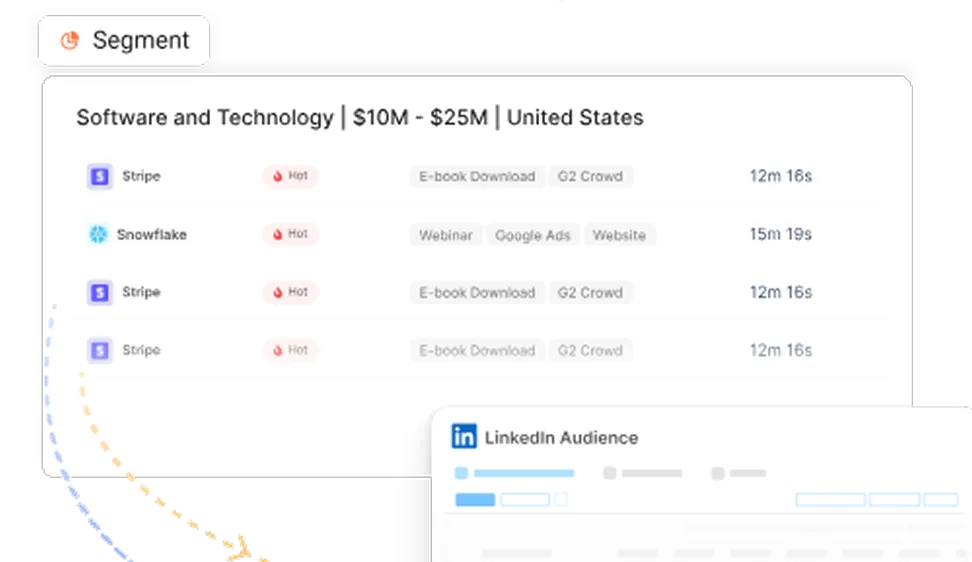
- Company-level visitor identification. Connecting anonymous web traffic to known accounts means AI optimization signals are based on real account behavior, not demographic proxies.
- ICP scoring and engagement intelligence. AI-powered scoring that surfaces accounts showing buying signals across web, ads, and content channels, the input layer for effective predictive targeting.
- LinkedIn AdPilot and paid optimization. ICP-weighted campaign optimization that connects impression and engagement data to account-level pipeline outcomes, with offline conversion syncing to close the attribution loop on B2B ad spend.
- Scout-style autonomous workflows. Revenue intelligence and account monitoring that reduce decision latency, the core ROI driver for agentic AI in B2B marketing.
Factors is the measurement and attribution infrastructure that makes AI marketing ROI measurable. And if the argument of this entire post holds, that measurement infrastructure is the prerequisite for real AI ROI, then that's not a small distinction.
The future of AI marketing ROI measurement
The measurement challenge will get harder before it gets easier, for a few reasons.
- First, AI visibility in LLM outputs is becoming a real metric and almost nobody has figured out how to track it yet. As B2B buyers increasingly use AI assistants to research solutions, the brands that show up in model outputs gain a distribution advantage that doesn't register in Google Analytics. Measuring this requires new infrastructure, monitoring what LLMs say about your brand, tracking which content gets cited, and connecting LLM-sourced traffic back to pipeline.
- Second, agentic AI will blur the lines between marketing-driven and sales-driven pipeline in ways that existing attribution models aren't designed to handle. When an AI agent monitors account signals across marketing and sales touchpoints and autonomously routes a message, which team gets the attribution credit? This isn't a philosophy question. It's a measurement question that will affect budget allocation, team incentives, and how companies evaluate their AI investments.
- Third, the compounding nature of strategic AI ROI will start showing up at scale. Companies that have been building ICP models, training intent data systems, and refining audience models for two or three years will have a durable advantage that looks increasingly difficult to replicate quickly. Future measurement systems will also need to capture customer satisfaction scores from AI-enhanced interactions, since the time savings they create can lift Net Promoter Score and reduce customer churn, a true game changer for connecting experience metrics to ROI. The ROI from that compounding won't fit neatly into a quarterly report, but it will show up in win rates and market position over time.
The marketing teams that will win the next five years aren't necessarily the ones who adopted AI first. They're the ones building the measurement systems that make AI accountability possible, and the feedback loops that make AI investment smarter over time. The competitive moat in AI marketing isn't the AI itself… but the infra that tells you if it's working...
FAQs for AI marketing ROI
Q1. What is AI marketing ROI?
AI marketing ROI measures the business value generated from AI investments in marketing, revenue growth, CAC reduction, pipeline acceleration, and efficiency gains, relative to the cost of those investments. The important distinction is between productivity ROI (doing more with less) and business ROI (growing revenue and improving profitability). Most AI marketing ROI conversations focus on the former when the latter is what actually matters to leadership.
Q2. How do you measure ROI from AI in marketing?
Start with the business outcomes you care about, pipeline, CAC, ROAS, sales cycle length, and build backward to the AI activities that influence them. This requires attribution infrastructure that can connect marketing touchpoints to revenue outcomes at the account level. Without that layer, you're measuring activity, not impact. The practical sequence is: clean your data first, instrument your attribution layer second, then deploy and measure AI tools against that baseline.
Q3. What are the best AI marketing ROI metrics?
The metrics that matter most are pipeline influenced, CAC trend, ROAS by AI-optimized vs baseline campaigns, MQL-to-SQL conversion rate, sales cycle length, and content-influenced revenue. The most underused but most valuable metric is AI-assisted pipeline percentage, what share of your closed-won deals included an AI-influenced touchpoint. That single number tells you more about real AI impact than any productivity metric.
Q4. Does AI actually improve marketing ROI?
Yes, when implemented with proper data infrastructure, attribution, and workflow integration. AI alone does not guarantee ROI, in many cases, it accelerates dysfunction in organizations that have broken data, unclear attribution, or misaligned GTM processes. The teams reporting strong AI ROI have typically invested in measurement infrastructure before or alongside their AI tooling, not as an afterthought.
Q5. What is the ROI of generative AI in content marketing specifically?
Generative AI reliably improves content production velocity, reduces cost per piece, and enables faster iteration on messaging. The ROI on organic traffic and pipeline is more variable and depends heavily on content quality and strategy. Publishing more AI-assisted content doesn't help if the bar for content quality has risen (which it has). The emerging ROI lever worth tracking is AI visibility, how frequently AI assistants cite your content in responses to buyer queries.
Q6. How can AI reduce wasted marketing spend?
AI reduces waste through audience suppression (excluding low-intent and bad-fit accounts), predictive bidding that avoids overpaying for low-value placements, duplicate audience identification across channels, and content strategy optimization that reduces investment in content unlikely to perform. Waste reduction is often the first measurable AI ROI signal, appearing before conversion improvements because it requires less attribution infrastructure to track.
Q7. What is the difference between AI productivity and AI ROI?
Productivity measures output efficiency: how much more a team can produce with the same resources. ROI measures business impact: how that output affects revenue, pipeline, and profitability. AI productivity is a means to AI ROI, but the two are not the same. A team can be 3x more productive with AI and generate no additional ROI if the additional output isn't connected to revenue outcomes. Measuring productivity without measuring business impact is a common and expensive mistake.
Q8. What is agentic AI and why does it matter for marketing ROI?
Agentic AI refers to systems that can autonomously monitor signals, make decisions, and take actions without requiring human prompts for each step. For marketing ROI, the significance is decision latency reduction: agentic systems can act on buying signals in minutes rather than the hours or days a human-in-the-loop process requires. This compresses the time between intent and engagement, which improves pipeline conversion rates and sales cycle efficiency at a scale that traditional automation can't match.
Q9. Why does attribution matter so much for AI marketing ROI measurement?
Without attribution, you can't connect AI-influenced activities to pipeline and revenue outcomes. You end up measuring AI activity rather than AI impact. This makes it impossible to know which AI investments are working, which aren't, and how to allocate budget intelligently going forward. Attribution at the account level is specifically important in B2B because buying decisions involve multiple stakeholders and long timelines, lead-level attribution systematically misrepresents what's actually influencing deals.

See how Factors can 2x your ROI
Boost your LinkedIn ROI in no time using data-driven insights


.avif)

See Factors in action.
Schedule a personalized demo or sign up to get started for free
LinkedIn Marketing Partner
GDPR & SOC2 Type II






.svg)



.avif)

