
AI marketing strategy: a B2B framework
Learn how to build an AI marketing strategy that improves pipeline, attribution, personalization, and GTM execution without adding tool sprawl.
.avif)
Content Marketer



.svg)


TL;DR
- Most B2B companies don’t have an AI problem, they have a systems problem where twelve disconnected tools are cosplaying as a strategy.
- A real AI marketing strategy is a decision-making layer across your entire GTM motion, not a collection of prompt subscriptions you pay for monthly and forget about.
- The five layers that actually matter: data foundation, intelligence, orchestration, execution, and measurement. Skip one and the whole thing wobbles.
- AI’s biggest B2B impact is helping teams spot which accounts deserve attention before competitors do, and that’s a structural speed advantage.
- If your AI dashboard doesn’t include pipeline, revenue, or customer outcomes, you’re measuring activity and calling it progress.
Every few weeks, someone declares that we're entering a new era of AI marketing… someone else updates the company strategy deck… a few software subscriptions magically appear on the corporate card.
Six months later, everyone is still asking the SAME question they've been asking for a decade: “so... what's actually driving pipeline?"

I've been in B2B SaaS long enough to know that marketing fails because tools become the ✨strategy✨. AI has made that problem much bigger. We've become very good at buying capabilities and surprisingly bad at deciding what should happen after the purchase.
That's what this blog is about. This is a practical way to think about AI inside a modern B2B marketing team: where it genuinely saves time, where it improves decision-making, where it creates more work than it removes, and how to tie all of it back to revenue instead of vanity metrics.
NOTE: It is not another roundup of AI products or another prediction that marketers will be replaced by prompt engineers before lunch.
What is an AI marketing strategy, really?
Let’s clear up a confusion that’s costing marketing teams real money. Using ChatGPT to rewrite email subject lines isn’t an AI marketing strategy. Running a Jasper subscription for blog drafts isn’t one either. Those are tools. They might be useful tools, but calling them a strategy is like calling a hammer an architecture plan.
What is an AI marketing strategy, then? It’s the deliberate system a company builds to apply artificial intelligence across research, segmentation, personalization, attribution, campaign optimization, and revenue forecasting. The key word there is system. An AI-driven marketing strategy connects these capabilities into a coherent operating model rather than running them as isolated experiments in different departments.
The distinction between AI tools, AI automation, and AI strategy matters more than most articles acknowledge. AI tools handle discrete tasks. AI automation chains those tasks together. An AI marketing strategy decides which tasks matter, in what order, for what business outcome, and how you’ll know it’s working. Think of it as the difference between owning a calculator and understanding financial modeling.
What makes this moment different from previous marketing technology waves is scope. AI isn’t another channel like social media was, and it isn’t another MarTech category like marketing automation became. AI is becoming a decision-making layer that sits across the entire go-to-market motion. It influences how you identify target accounts, how you allocate budget, how you personalize at scale, and how you measure what’s working. The shift happening right now isn’t from “no AI” to “some AI.” It’s from experimentation to operational infrastructure, and most teams are still stuck at the experimentation stage, wondering why results feel scattered.
Why do most AI marketing initiatives fail?
Here’s what every vendor pitch deck conveniently skips... the majority of AI marketing initiatives don’t fail because the technology is bad. They fail because companies treat AI adoption as a purchasing decision rather than an operational one. Most companies have a systems problem wearing an AI label.
We’ve all watched this play out in a predictable sequence… a team buys an AI writing tool for content. Then an AI SDR tool for outbound. Then an AI chatbot for the website. Then an AI analytics layer for reporting. Each tool solves a narrow problem reasonably well in isolation. But nobody connects them, and the result is a random collection of AI subscriptions generating outputs that don’t talk to each other (because marketers never create tool sprawl).
The five biggest reasons AI projects stall are remarkably consistent across the teams I talk to.
- Tool-first thinking, where teams pick software before defining what business outcome they’re chasing.
- Fragmented data, where your CRM, ad platforms, and analytics tools operate as disconnected islands.
- No measurement framework, meaning nobody agreed on what “success” looks like before launch.
- No clear ownership, so AI initiatives float between marketing ops, demand gen, and content without anyone being accountable.
- And a total lack of workflow integration, where AI sits beside existing processes instead of inside them.
Marketing teams typically have an action problem (not a data problem, as we like to believe).
Most B2B companies already have enough signals to make better decisions. What they lack is a system that converts those signals into prioritized actions at the speed their pipeline requires. Buying more AI doesn’t fix that. Building an AI marketing strategy framework that connects intelligence to execution does.
| AI chaos | AI strategy |
|---|---|
| 8+ disconnected AI tools | Integrated stack of 3-4 purpose-built tools |
| Each team picks its own AI vendor | Central governance with team-level flexibility |
| Outputs measured by volume (blogs published, emails sent) | Outcomes measured by pipeline and revenue impact |
| Data lives in tool-specific silos | Unified data layer feeds every AI application |
| “We’re using AI” is the KPI | Business outcomes are the KPI |
The 5 layers of a modern AI marketing strategy
Most frameworks you’ll find online are really just feature lists organized into categories. What B2B teams need is a layered model where each level depends on the one beneath it. Skip a layer and the whole thing becomes expensive guesswork. Here’s the framework I keep coming back to.
Layer 1: Data foundation
Everything starts here, and everything falls apart here. Your CRM data, product usage signals, intent data, ad platform metrics, and website behavior form the raw material that every AI application depends on. Without clean, connected data, you’re feeding garbage into systems that are very good at scaling garbage.
I’ve seen teams spend six figures on AI personalization tools only to discover their CRM hadn’t been properly maintained in eighteen months. That’s not an AI failure. That’s a data hygiene failure with expensive consequences.
Layer 2: Intelligence layer
Once your data foundation is solid, AI can start identifying patterns humans would miss or take weeks to find. This is where account intelligence becomes powerful. AI analyzes ICP fit across your database, detects buying signals from multiple sources, tracks content engagement patterns, and surfaces pipeline trends before they’re visible in your standard dashboards. The intelligence layer is where AI-driven marketing starts earning its name, because it’s making your team smarter about where to focus rather than just faster at producing outputs.
Layer 3: Orchestration layer
This is the layer most companies skip entirely, and it’s the one that separates AI-augmented teams from AI-transformed ones. Orchestration is about AI moving information between systems and triggering workflows across tools. Think agentic workflows where an intent signal from your website automatically updates account scores in your CRM, adjusts ad audience targeting, and alerts the right sales rep. AI orchestration replaces the manual “check this dashboard, copy this data, update that spreadsheet” routine that eats hours every week.
Layer 4: Execution layer
Now AI creates things. Content drafts, ad variations, email sequences, landing page copy, campaign variations. This is the layer most articles obsess over because it’s the most visible. But notice where it sits in the stack: layer four, not layer one. AI-generated content without intelligence and orchestration beneath it is just faster content production with no strategic direction. The execution layer works best when it’s informed by the three layers below it.
Layer 5: Measurement layer
Here’s where most companies fail, and it’s honestly where the whole model earns or loses credibility. The measurement layer covers attribution, revenue impact analysis, pipeline contribution tracking, and incrementality testing. If you can’t measure whether your AI investments are improving pipeline velocity or CAC efficiency, you’re running on faith. And faith doesn’t survive quarterly business reviews.
The companies winning with AI-driven marketing strategies aren’t generating more content. They’re making better decisions faster, because each layer feeds the next and measurement feeds back into the data foundation. That loop is the strategy.
Building an AI marketing strategy framework
Frameworks are only useful if they translate into action. Here’s a step-by-step approach to building one that doesn’t require a twelve-month consulting engagement or a team of data scientists (wow, never thought I’d say that about an AI initiative).
• Step 1. Define business outcomes first. Not marketing outputs. Business outcomes. The goal isn’t “publish 100 blogs” or “launch 5 AI-powered campaigns.” The goal is to increase pipeline velocity, improve win rates, or reduce customer acquisition cost. Every AI use case you evaluate should trace back to one of these outcomes. If it can’t, it’s a science project.
• Step 2. Map your decision bottlenecks. Walk through your current GTM motion and ask three questions. Where does marketing waste the most time on low-value tasks? Where do leads stall between stages? Where do handoffs between marketing and sales break down? These bottleneck points are where AI can create the most leverage.
• Step 3. Identify and score AI opportunities. For each bottleneck, evaluate potential AI solutions on three dimensions: impact on the business outcome, feasibility given your current data and tech stack, and time to value. A simple scoring matrix keeps this from becoming a philosophical debate in a conference room.
• Step 4. Prioritize quick wins. Start with one or two use cases that can show measurable results within 60 to 90 days. Early wins build organizational momentum and executive trust. The team that demonstrates pipeline impact from AI in Q1 gets budget for the orchestration layer in Q2.
• Step 5. Create governance from day one. This includes prompt governance, brand governance, compliance review, and human review checkpoints. Governance isn’t bureaucracy. It’s the structure that prevents your AI initiatives from creating more problems than they solve.
AI across the B2B marketing funnel
Understanding how to use AI for marketing strategy means mapping specific AI capabilities to each stage of the buyer journey. Here’s where AI creates real value across the funnel, beyond the generic “AI can help with content” talking point.
- Top of funnel
AI transforms early-stage marketing by accelerating topic discovery, powering SEO research at scale, optimizing content for AI engine optimization (AEO), and enabling video creation workflows that would’ve required a full production team two years ago. The biggest shift here is AEO. As buyers increasingly discover brands through AI-generated answers rather than traditional search results, optimizing for that discovery layer becomes a competitive requirement rather than an experiment.
- Middle of funnel
This is where AI starts earning serious revenue impact for B2B teams. Intent analysis identifies which accounts are actively researching solutions. Account scoring prioritizes where your SDRs should focus their limited time. Personalized nurture sequences adapt based on actual engagement signals rather than static drip timers. The middle of the funnel is where integrating AI into marketing strategies starts looking less like a marketing project and more like a revenue operations initiative.
- Bottom of funnel
AI’s bottom-of-funnel applications are less discussed but arguably more valuable. Pipeline prioritization models help marketing and sales agree on which opportunities deserve acceleration resources. Deal intelligence surfaces patterns in winning versus losing deals. Opportunity acceleration uses AI to recommend the right content, the right message, and the right timing for accounts nearing a decision.
- Expansion
Post-sale AI applications are the most overlooked category in most B2B AI marketing strategy discussions. Customer health monitoring uses product usage and engagement data to predict churn risk. Upsell identification surfaces expansion opportunities based on usage patterns. Advocacy programs use AI to identify your happiest customers and activate them as references.
AI’s biggest impact in B2B isn’t content creation. It’s helping teams identify which accounts deserve attention before competitors do. That’s a structural speed advantage, and it compounds over time.
AI marketing strategy tools and the tech stack that actually matters
I’m not going to write the “Top 50 AI Marketing Tools” article. You’ve read twelve of those already, and they all blend together into an undifferentiated wall of logos and G2 scores. The goal isn’t to own the largest AI stack. It’s to build the smallest stack capable of creating a competitive advantage.
• AI research tools like Perplexity, ChatGPT, and Claude handle market research, competitive analysis, and content ideation. These are the thinking partners, not the execution engines. Most teams already use at least one of these.
• AI content tools like Jasper, Writer, and Copy.ai accelerate content production across formats. The key criterion isn’t which one writes the best copy. It’s which one integrates into your existing content workflow without creating a parallel process.
• AI workflow platforms like n8n, Zapier, and Make handle the orchestration layer. They’re the plumbing that makes everything else work, and they’re faaaar more important than most teams realize.
• AI attribution platforms represent a category that’s maturing rapidly. Any serious AI marketing strategy software stack needs a way to connect marketing activities to pipeline and revenue outcomes. Without attribution, you’re flying blind on what’s actually working.
• AI account intelligence platforms close the loop by identifying which accounts show buying intent, scoring them against your ICP, and syncing those audiences to your activation channels. This is where AI marketing strategy for enterprises often starts.
When evaluating any tool, ask one question: does this connect to the business outcomes I defined in my framework, or does it just make an activity faster? Speed without direction is expensive velocity (duh).
How do you actually integrate AI into existing marketing workflows?
This is the question that separates articles written by operators from articles written by observers. The theoretical case for AI is settled. The practical challenge of integrating AI into daily workflows is where most teams get stuck, because adoption fails when AI becomes “another thing marketers must do” on top of their existing workload.
The most successful AI-driven marketing strategy implementations I’ve seen follow a consistent pattern. AI disappears into the workflow and becomes invisible. Marketers don’t “use AI” as a separate step. AI runs inside the tools and processes they already touch.
• Content workflow. The old process was research, brief, draft, review, publish. The AI-integrated version uses AI for research synthesis and brief generation, AI-assisted drafting with human editorial oversight, and AI-powered distribution recommendations. The human still owns strategy, voice, and final approval.
• Demand generation workflow. Intent signal captured, audience built automatically, campaign launched with AI-optimized targeting, and performance optimization running continuously. The marketer sets the parameters and evaluates results. AI handles the execution math that used to require manual spreadsheet work every Monday morning.
• ABM workflow. Account identification powered by intent and fit scoring, prioritization ranked by AI-generated propensity models, personalization at the account level rather than the segment level, and activation synced directly to ad platforms and sales sequences.
• Revenue workflow. Marketing signals flow into sales intelligence, which feeds customer success health scores, which inform expansion marketing. When this loop runs on AI, the handoff friction that kills so many B2B deals starts to disappear.
Measuring the success of an AI marketing strategy
If your AI strategy dashboard doesn’t include pipeline, revenue, or customer outcomes, you’re measuring activity instead of impact. That sentence should probably be printed and taped above every marketing ops desk.
• Efficiency metrics tell you whether AI is saving time and accelerating output. Track time saved per workflow, content velocity (pieces published per sprint), and campaign launch speed. These are the easiest wins to demonstrate early, but they’re also the least meaningful in isolation.
• Performance metrics connect AI efficiency to marketing effectiveness. Track cost per lead, customer acquisition cost, pipeline influenced by marketing, and pipeline directly generated. This tier answers the question: is AI making our marketing better, or just faster?
• Revenue metrics are where the executive conversation happens. Win rate changes since AI implementation, sales cycle length compression, and expansion revenue influenced by AI-powered customer intelligence. These metrics take longer to materialize, but they’re the ones that justify continued investment.
| Metric tier | What it measures | Example metrics | When to expect results |
|---|---|---|---|
| Efficiency | Speed and volume | Time saved, content velocity, launch speed | 30-60 days |
| Performance | Marketing effectiveness | CPL, CAC, pipeline influenced | 60-120 days |
| Revenue | Business outcomes | Win rate, sales cycle, expansion revenue | 120-180 days |
The teams that earn long-term executive support for AI investment are the ones that report across all three tiers. Leading with efficiency metrics gets attention. Following up with revenue metrics earns trust.
Common AI marketing mistakes and how to avoid them?
I’ve made several of these mistakes personally, so this section is less “here’s what you should do” and more “here’s what I learned the expensive way.”
• Buying AI marketing strategy software before creating strategy. It sounds obvious when written down, but the pull of a compelling product demo is strong. Every vendor shows you the best-case scenario with perfect data and ideal conditions. Your reality involves messy CRM records, inconsistent naming conventions, and that one field nobody’s updated since 2023. Start with the problem, not the purchase order.
• Automating bad processes. AI is exceptionally good at scaling whatever you give it, including broken workflows. If your lead scoring model is already inaccurate, AI-powered lead scoring will be inaccurately fast. Fix the process first, then accelerate it.
• Ignoring first-party data. Third-party data is getting noisier and more restricted every year. Your website behavior, product usage signals, and CRM history are wayyy more valuable than most teams realize.
• Using AI without governance. One team uses a prompt that generates claims your legal team hasn’t approved. Another publishes AI content that contradicts your brand positioning. Governance isn’t optional. It’s risk management for a technology that scales faster than human review.
• Treating AI as a content factory. The “publish 10x more content with AI” pitch is seductive but dangerous. The goal of AI in content isn’t volume. It’s producing better content at a sustainable pace with deeper personalization.
• Expecting AI to replace strategic thinking. AI can synthesize data, identify patterns, and generate recommendations. Strategic judgment remains a human job, and the best AI implementations amplify that judgment rather than attempting to replace it.
What’s next? The future of AI-driven marketing…
Predictions are dangerous because the people making them are usually selling something related to the prediction. With that caveat firmly in place, here’s where I think AI-driven marketing is heading over the next two to three years.
• 1. Agentic marketing represents the shift from AI as an assistant to AI as an operator. Instead of marketers prompting AI to complete tasks, agentic systems will execute multi-step workflows autonomously based on predefined goals and guardrails. We’re in the early innings of this, but the trajectory is clear.
• 2. AI orchestration goes beyond single-tool automation to coordinate multiple AI systems working together. The orchestration layer becomes the operating system of marketing, and the teams that build it first gain a structural advantage that compounds quarterly.
• 3. AI search and AEO are fundamentally changing how buyers discover solutions. Optimizing for AI-generated answers is a discipline that barely existed eighteen months ago. By 2027, it’ll be as foundational as SEO is today.
• 4. Hyper-personalization moves from segment-level to individual-level. Instead of “enterprise segment email template,” AI enables a specific message for this VP of Marketing at this company based on their recent content engagement, product usage, and buying stage.
• 5. Autonomous campaign optimization means AI makes real-time budget, targeting, and creative decisions based on performance signals. The human sets the strategy, defines the guardrails, and reviews the outcomes.
Going forward, AI will work exceptionally well for marketers who deeply understand customer needs, and that human skill is the most valuable one to develop right now. The marketers who win the next ‘era’ of B2B will be the ones who connected AI to customer understanding, operational discipline, and revenue outcomes while everyone else was still debating which chatbot to subscribe to.
FAQs about AI marketing strategy
Q1. What is an AI marketing strategy?
An AI marketing strategy is a structured approach to applying artificial intelligence across the full marketing operation, from research and segmentation through personalization, attribution, and revenue forecasting. It goes beyond individual AI tools by connecting them into a coherent system designed to improve specific business outcomes like pipeline velocity, win rates, and customer acquisition efficiency. The strategy defines which AI capabilities matter, how they integrate into existing workflows, and how success gets measured. If there’s no measurement layer, it’s not a strategy, it’s an experiment.
Q2. How do you create an AI marketing strategy?
Start with business outcomes rather than technology. Define what you’re trying to improve, whether that’s pipeline generation, CAC efficiency, or sales cycle compression. Then map where your current workflows have bottlenecks or decision gaps that AI could address, score those opportunities by impact, feasibility, and time to value, and prioritize quick wins that demonstrate results within 60 to 90 days. Build governance around prompts, brand consistency, and compliance from the beginning, not after something goes wrong.
Q3. What are the best AI marketing strategy tools?
The best tools depend entirely on your specific stack and objectives. For research, Perplexity, ChatGPT, and Claude handle synthesis and ideation well. For content production, platforms like Jasper, Writer, and Copy.ai accelerate drafting workflows. For orchestration, n8n, Zapier, and Make connect systems together. The most important categories for B2B teams are often the least glamorous: attribution platforms and account intelligence platforms that connect marketing activity to revenue outcomes.
Q4. How is AI changing B2B marketing?
AI is shifting B2B marketing from manual, segment-level execution to automated, account-level precision. The biggest changes are happening in account identification, intent-based prioritization, personalized nurture at scale, real-time campaign optimization, and AI-influenced search discovery. The most significant shift is that AI is becoming a decision-making layer rather than just an execution tool, helping teams identify where to focus before competitors do.
Q5. What are examples of AI-driven marketing strategies?
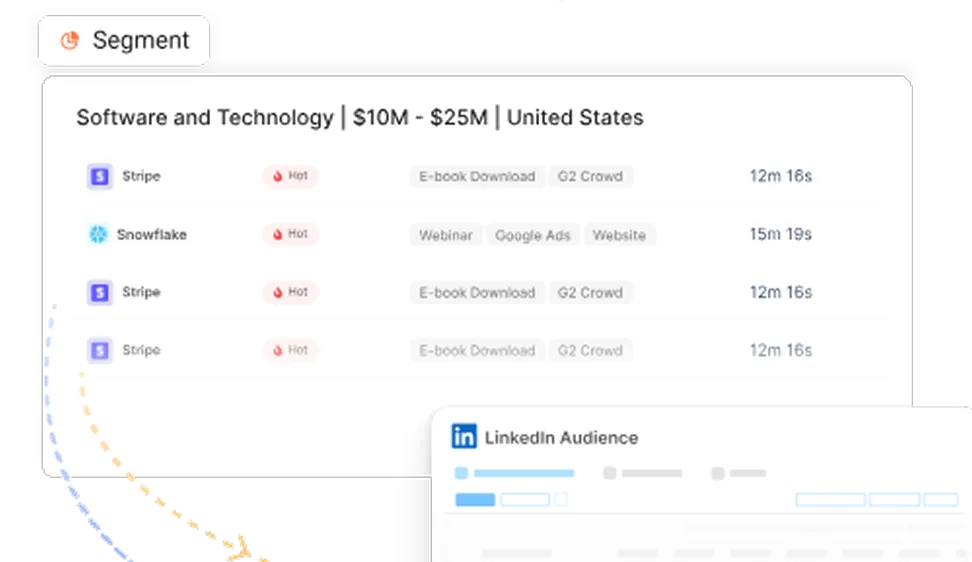
A B2B SaaS company using intent signals and AI-powered account scoring to prioritize target accounts, then syncing those audiences automatically to LinkedIn ad campaigns and sales outreach sequences, is a practical example. Another is using AI to analyze deal patterns across won and lost opportunities, then applying those insights to adjust messaging and targeting for in-market accounts. These strategies connect intelligence to action rather than using AI for isolated content generation.
Q6. How do enterprises build AI marketing strategies?
Enterprises typically need to address data infrastructure first because their data is spread across more systems with more complexity. An AI marketing strategy for enterprises usually starts with unifying data sources, establishing governance frameworks that satisfy legal and compliance requirements, and running controlled pilot programs before scaling. Enterprise adoption also requires cross-functional alignment between marketing, sales, IT, and revenue operations, which means the strategy needs executive sponsorship and clear business-outcome targets from day one.
Q7. What’s the difference between AI marketing automation and AI marketing strategy?
AI marketing automation refers to using AI to execute repetitive tasks more efficiently, like sending triggered emails, scoring leads, or optimizing ad bids. An AI marketing strategy is the overarching plan that determines which tasks to automate, why those tasks matter for business outcomes, and how all the automated components connect into a coherent system. Automation is a capability within the strategy, not a substitute for it.
Q8. How can AI improve account-based marketing?
AI transforms ABM by enabling precise account identification based on intent signals and ICP fit scoring, automated prioritization that helps teams focus on the highest-value accounts, personalization at the individual account level rather than broad segments, and coordinated activation across ads, email, and sales outreach. The biggest improvement is speed: AI identifies surging accounts and activates campaigns around them faster than any manual process could manage.
Q9. What metrics should marketers track for AI initiatives?
Track three tiers. Efficiency metrics cover time saved, content velocity, and campaign launch speed. Performance metrics include cost per lead, customer acquisition cost, and pipeline influenced or generated. Revenue metrics measure win rate changes, sales cycle compression, and expansion revenue. Most teams start with efficiency metrics because they’re easiest to demonstrate, but revenue metrics are what sustain long-term investment and executive support for AI programs.

See how Factors can 2x your ROI
Boost your LinkedIn ROI in no time using data-driven insights


.avif)

See Factors in action.
Schedule a personalized demo or sign up to get started for free
LinkedIn Marketing Partner
GDPR & SOC2 Type II

.svg)



.avif)

