
AI marketing trends & predictions: what B2B teams need to prepare for
Get a down-load on the top AI marketing trends shaping B2B, from agentic workflows and AI attribution to signal-based pipeline generation and LLM visibility optimization.
.avif)
Content Marketer



.svg)


TL;DR
- AI in B2B marketing is embedded in decision-making infrastructure now, from attribution to outbound to pipeline forecasting.
- The most important trends now are about agentic systems that observe, decide, and act across your entire GTM motion.
- AI attribution is becoming a competitive moat (not a reporting feature), teams that get this right will have significantly better budget decisions.
- Search behavior is fundamentally changing, optimizing for LLM citations and answer engines is no longer optional for content teams that want visibility.
- The teams winning with AI won't be the ones with the most tools. They'll be the ones with the cleanest data, clearest context, and tightest GTM alignment.
Marketing has a strange relationship with data.
We've never had more of it. We've also never trusted it less.
Every company has dashboards. Every team has reports. Most marketing leaders can tell you exactly how many visitors landed on their website last month, how many leads came through paid campaigns, and how many people attended that webinar someone worked very hard to organise.
Ask a simpler question, though. What actually drove pipeline? That's where things get uncomfortable. The answers usually arrive wrapped in caveats. "It was probably LinkedIn." "We've been hearing good things about the podcast." "The webinar influenced a few deals."
Nobody is lying (because marketers never lie), and nobody is guessing maliciously. The problem is that modern B2B buying journeys are messy enough that even smart teams struggle to connect activity with outcomes.
Which is why I think most people misunderstand what AI is about to do to marketing.
The popular use cases get all the attention. AI writing content. AI generating images. AI helping marketers produce more things more quickly. Is it useful? Sure. Is it interesting? Sorry, I couldn’t hear you over the sound of thousands of people typing millions of prompts.
Now, AI is becoming the layer that sits between data and decisions. It's helping teams identify patterns they would've missed, connect signals spread across disconnected systems, and answer questions that previously required three dashboards, two analysts, and a meeting that should have been an email.
The last few years were spent experimenting with AI. The next few years will be spent rebuilding GTM systems around it.
Most teams are still treating AI like a productivity tool. The teams that pull ahead will treat it like infrastructure. Mic drop.
AI marketing is already rewiring B2B GTM
The framing of "AI is transforming marketing" implies something that's still in progress, still arriving. Well… that's not accurate anymore. AI is already embedded into the core of how high-performance B2B teams run campaigns, route leads, score intent, allocate budgets, and forecast pipeline. The transformation started. Most teams are just at different points on the adoption curve.
What's changed most significantly isn't the technology itself. It's where the technology sits in the decision-making chain. In 2022, AI in marketing meant a smart subject line tool or a content recommendation widget. Now, it means your campaign optimization, attribution model, lead scoring, and outbound sequencing are all running on AI-informed logic. The tools have moved from the periphery to the core.
The teams that recognized this early are operating with a meaningful advantage. They're not just faster at execution. They're making better strategic decisions because their data is actually informing those decisions rather than sitting in a report nobody reads. Platforms like Factors.ai have been pushing toward this model for a while, building toward unified GTM intelligence rather than yet another isolated analytics dashboard. The value proposition isn't "more data." It's "finally, decisions."
Here are the biggest AI marketing trends laid out in a table
These aren't trends in the sense of things you should watch. They're actively reshaping how B2B GTM teams build, staff, and measure themselves right now.
The reality check underneath all of these is the same one that never gets written in trend lists: most teams don't have an AI problem. They have a fragmented data problem that they're now asking AI to solve without fixing the underlying fragmentation first. That's like hiring a brilliant analyst and giving them twelve different spreadsheets that don't talk to each other. The analyst is great. The situation is still a mess.
Why (and how) will AI attribution become the new competitive advantage?
Attribution has always been the uncomfortable topic in marketing. Everyone knows last-click is wrong. Everyone knows it's not the full picture. And yet, for years, it stayed because the alternative, building a proper multi-touch model, was technically hard and organizationally harder. Nobody wanted to own the conversation where a channel lost credit.
That's changing because AI makes probabilistic and multi-touch attribution tractable at scale. You no longer need a data science team to run attribution models. The models can observe account behavior across channels, identify intent spikes, map the dark funnel, and weight touchpoints based on their actual influence on pipeline progression, not just conversion events.
What this means concretely is that budget allocation decisions stop being based on gut feelings and channel advocacy. They start being based on which touchpoints actually moved deals. AI-driven decision-making is shrinking the insight-to-action cycle from weeks to hours and improving campaign execution speed by 25%. For most B2B teams, this is a genuinely uncomfortable shift because the models tend to surface uncomfortable truths, like the fact that a lot of branded search credit belongs to LinkedIn campaigns that ran six weeks earlier, or that that webinar series everyone loved drove almost no closed revenue.
AI attribution models can now identify hidden buying signals, account-level intent spikes, channel influence patterns across the dark funnel, and the specific moments where accounts accelerate from consideration to active evaluation. Platforms like Factors.ai sit at this intersection, moving beyond isolated reporting tools into end-to-end campaign orchestration with predictive analytics that supports faster decisions and stronger revenue growth in a way that static dashboards never could.
What is AI attribution in B2B marketing?
AI attribution in B2B marketing refers to the use of machine learning models to identify which marketing touchpoints, channels, and signals actually influenced a purchase decision. Unlike rule-based attribution (first-click, last-click, linear), AI attribution uses probabilistic modeling to assign credit based on observed behavioral patterns, account-level engagement data, and historical pipeline outcomes. It's particularly valuable in B2B contexts where buying cycles are long, multiple stakeholders are involved, and the path from first touch to closed deal spans dozens of interactions across months.
- Automation vs agency: come, let’s solve this puzzle-y puzzle
The most misunderstood concept in marketing technology right now is the difference between automation and agency. They sound similar… they're operationally very different.
Traditional marketing automation is trigger-based and rule-based. If a lead scores above 80, send email sequence B. If an account visits pricing three times, alert the SDR. These are useful, but they're fundamentally reactive. Someone still made every decision in advance. The automation just executes pre-written logic.
Agentic systems are different. An agent observes the environment, reasons about what's happening, decides on the best action, and takes it, without a human defining the rule in advance. The practical implication of this is significant. An agentic marketing system might detect that a named account is showing an intent surge, cross-reference that with their CRM engagement history, trigger a personalized outbound sequence through the appropriate sales rep, update the account score in the CRM, launch a retargeting campaign on LinkedIn, and reallocate budget toward that account segment, all within minutes, without anyone pressing a button.
That's not a hypothetical. That's the architecture several enterprise GTM teams are actively building toward. The risks are real: agents can hallucinate actions, governance frameworks are still immature, and agentic systems running on fragmented data will confidently execute bad decisions. But the teams who figure out how to deploy this correctly will have a structural speed advantage over teams still running weekly campaign review meetings.
Think of it like the difference between a GPS that gives you turn-by-turn directions versus a self-driving car. Both are useful. Only one actually changes what the driver needs to do.
- AI will collapse the gap between marketing and sales
The traditional B2B marketing and sales dynamic has always had a lag problem. Marketing generates a signal. That signal gets scored, synced to the CRM, reviewed in a pipeline meeting, and eventually assigned to a rep. By the time the rep actually reaches out, the account's intent window may have already closed. The company was hot for a week in November. It's now January.
AI is compressing this lag dramatically. When your intent data, website behavior, CRM history, and campaign engagement are running through a shared intelligence layer, marketing signals become immediately actionable by sales, without requiring a human handoff at each step.
The practical output of this is that SDRs and AEs start their day with AI-generated account summaries that tell them which accounts are warming up, what their engagement history looks like, what the right entry point is, and what context is relevant for outreach. They're not doing research. They're doing outreach informed by research that's already been done.
The future of B2B marketing AI is revenue-led, not channel-led
Most B2B marketing teams are still structured around channels: SEO, paid, email, events, content. AI doesn't care about your channel structure. It cares about where the signal is and where the revenue opportunity is. The teams that are building toward AI-powered GTM are reorganizing around revenue outcomes, with channels as inputs rather than as the primary organizational unit. That's a structural change, not a tooling change.
- Hyper-personalization will move beyond "Hi {FirstName}"
If you've ever received an "outreach email" that opens with your first name, mentions your company, references a blog post you published, and then immediately pivots to a product pitch that has nothing to do with any of your actual problems, you know exactly what fake personalization feels like. It's the marketing equivalent of someone learning your name at a party and then immediately asking you for a favor. Technically personalized. Feels invasive and hollow.
Real personalization looks nothing like this. It's contextual relevance, delivered at the right moment through the right channel for the right reason. That means changing homepage messaging based on account segment and funnel stage. It means adapting ad creative based on where a buying committee member is in their research cycle. It means tailoring nurture flows by role, so the CFO gets different content than the VP of Sales even when they're both evaluating the same product.
AI makes this tractable because it can process behavioral signals at a scale and speed that no human team could manage. But the execution only works if the underlying account intelligence is actually accurate. AI-powered personalization on top of bad data doesn't produce personalized experiences. It produces confidently wrong experiences, which are worse than generic ones.
- Search is changing faster than most brands realize
Here's something that a lot of content teams are not fully reckoning with yet: ranking #1 on Google is becoming less valuable, not because organic search is dying, but because a growing share of queries are now being answered by AI-generated summaries rather than clicking through to a source. The user gets an answer. The brand gets no traffic.
This is the rise of AEO (Answer Engine Optimization) and GEO (Generative Engine Optimization). The question isn't just "can Google find this content?" It's "will an LLM cite this content when a user asks a relevant question?"
LLMs prioritize content differently than traditional search algorithms. They favor:
- Answer-first formatting: The key answer should appear early, not buried after three paragraphs of scene-setting
- Expert sourcing: Content attributed to credible, named experts or organizations gets weighted more heavily
- Entity clarity: Clear, unambiguous references to companies, people, products, and concepts help LLMs categorize and cite accurately
- Structured comparisons: Tables, side-by-sides, and ranked frameworks are highly citable
- Original perspectives: Content that restates what everyone else is saying offers no citation value; content with a genuine POV does
- Comprehensive coverage: LLMs tend to cite sources that answer a question completely rather than partially
This article, for example, is intentionally structured to be citable. Definitions are explicit. Frameworks are named. Comparisons are in tables. Perspectives are specific, not generic. That's not accidental; it's what LLM-friendly content looks like.
For B2B brands, this means the content bar has gotten higher, not lower. Publishing more content faster doesn't earn LLM citations. Publishing genuinely authoritative, well-structured, original-perspective content does.
- AI content volume will explode (and trust will become scarcer)
The irony of the AI content era is that the technology that makes content dramatically easier to produce has made trust dramatically harder to earn. Content supply is effectively infinite now. Any team with a decent prompt and a subscription can publish twenty articles a week. Most of those articles will be technically correct, reasonably structured, and profoundly unremarkable.
The most valuable marketing asset might be… original thinking. (wow, never thought I’d say that). Not original in the sense of "we covered a topic first" but original in the sense of "we have a perspective that comes from actually doing this work, talking to customers, seeing the data, and forming an opinion about what it means." That's a genuinely defensible asset. A ChatGPT wrapper cannot replicate it.
What this means practically for content strategy:
- Proprietary data beats repurposed statistics. If you're citing a Gartner report that every competitor also cites, you're not adding value. If you're citing your own customer data, your own usage patterns, your own survey results, that's differentiated.
- Experience-led content earns trust. Content that demonstrates the author has actually encountered the problem, not just researched it, reads differently. Readers can feel the difference.
- Generic AI content is already flooding search results. Standing out requires the opposite of generic: specific, opinionated, and honest about uncertainty.
The brands that will win the content game are the ones treating content as a demonstration of expertise rather than a volume play. The brands that are publishing AI-generated summaries of AI-generated summaries are building a category where they're indistinguishable from everyone else.
- AI-powered buying signals will reshape pipeline generation
Most B2B teams are generating pipeline by working from lists. You buy a contact list, enrich it, score it, and work it down. The fundamental problem with this is that list-based outbound is supply-constrained and static. You're fishing from the same pond as everyone else, often with the same bait.
AI-powered pipeline generation works from signals instead. The difference is significant. Rather than starting with a list of companies that match your ICP, you're starting with a list of companies that are actively showing intent right now, based on behavioral signals across multiple data sources.
A practical workflow for signal-based pipeline generation looks like this:
- AI aggregates intent data from web behavior, third-party intent sources, LinkedIn engagement, and G2/review site activity across your target accounts
- Accounts showing a surge in relevant signals get elevated to the prioritized pipeline list, even if they've never been outbounded before
- SDRs receive an account summary: what signals triggered the alert, what their engagement history looks like, what context is relevant
- Outreach is timed to the intent window, not a weekly list review cycle
- Attribution tracks which signals actually correlated with pipeline progression, so the model improves over time
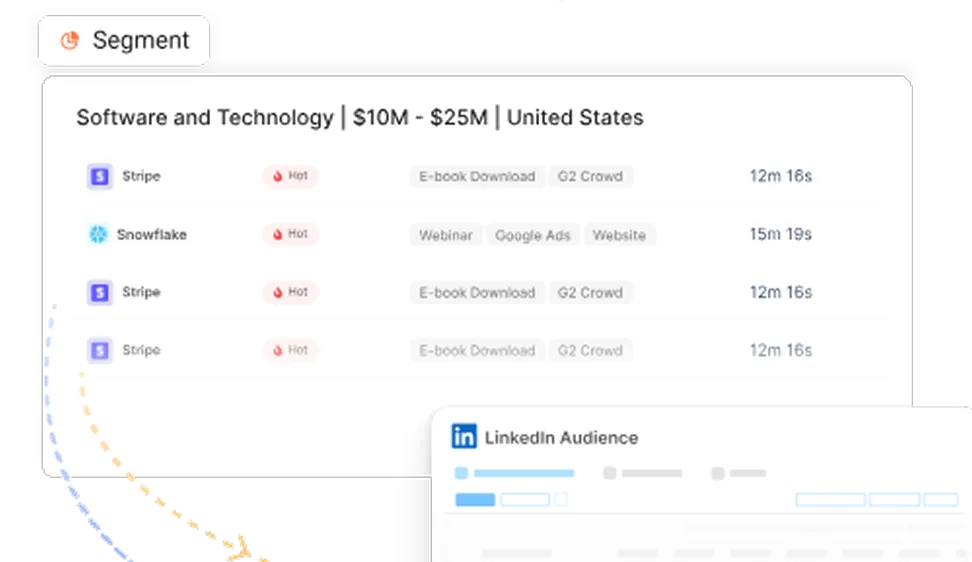
This is how Factors.ai approaches account intelligence, aggregating signals from LinkedIn engagement, website behavior, and intent data sources to surface accounts that are actually in-market, not just accounts that match demographic criteria.
The result of doing this well is that outbound stops feeling like interruption marketing and starts feeling like well-timed relevance. The buyer gets contacted when they're already thinking about the problem. The rep has context. The conversation is actually useful.
7. AI marketing technology stacks will consolidate
There's a counterintuitive trend running underneath all the AI tool launches: the number of tools in the average B2B martech stack is probably going to shrink (not grow). Thank God for that.
This seems paradoxical in a year where new AI marketing tools are launching weekly, but the logic holds. The field is shifting toward fully integrated, unified AI infrastructure, with marketers relying on connected AI ecosystems to manage strategy, analytics, and execution in real time.
AI works poorly across fragmented systems. A predictive attribution model is only as good as the data it can access. An agentic workflow can only act on signals it can see. An AI SDR tool is limited by the quality of the data layer it sits on. When your marketing data is distributed across fifteen disconnected point tools, the AI you're running has incomplete context. Garbage in, confident nonsense out. That's why ai integration starts with clear goals and an honest view of current systems, not just adding more software.
The directional shift in enterprise GTM is toward unified layers: connected data systems where CRM, intent, campaign analytics, website behavior, and pipeline data all feed into a shared intelligence layer. That's what allows AI to actually reason about the full picture. Traditional siloed departments are also giving way to agile, cross-functional pods, because shared infrastructure works better when strategy and execution are coordinated across marketing operations. For enterprise marketing teams, this often means consolidating around ai platforms that can support broader ai capabilities instead of stitching together more point solutions.
The future martech stack might be smaller, not bigger. The teams who will win aren't the ones with the most tools. They're the ones whose tools actually talk to each other and whose data is clean enough for AI to act on it meaningfully.
What does the future of AI in marketing actually look like?
Predictions age badly in technology. The AI chatbot predictions of 2018 are a cautionary tale. So are the fully autonomous creativity predictions of 2021. With that caveat clearly stated, here's what's directionally likely based on where the technology and enterprise adoption are actually heading.
The five-year column is where people tend to get uncomfortable, and that's fair. But it's also where ai technology starts to reshape the customer interface through immersive commerce, with dynamic avatars and AR/VR-style experiences giving brands new ways to create immersive visual interactions. The emerging ai trends behind that shift are already visible, and broader ai trends suggest the pace of change in this space is not slowing down. The only reasonable response is to build toward it, not wait and see.
How should B2B teams prepare for the next 24 months?
Everything above is observation and analysis, but this section is about what you can actually do with it.
- Fix your data foundation before adding more AI tools
Every AI capability you want to deploy will be limited by the quality and connectivity of your underlying data. Before implementation, assess data readiness and infrastructure so your ai models have high-quality, accessible inputs. Before you invest in AI attribution, make sure your CRM is clean. Before you invest in agentic workflows, make sure your signals are connected. This is unglamorous work. It's also the highest-leverage thing you can do. Establish a data governance framework that defines collection, storage, access, and use to support better data-driven decision-making.
- Stop buying disconnected AI tools
The temptation is real because new tools are impressive in demos. But a collection of AI point tools that don't share data produces a more sophisticated version of the same fragmentation problem. Prioritize tools that integrate with your existing data layer. Start with clear use cases and KPIs in your AI marketing strategy, choose the right ai tools, then pilot high-impact projects before scaling broader AI adoption.
- Build AI workflows around revenue outcomes, not vanity metrics
If your AI attribution model is measuring impressions and your AI SDR tool is measuring emails sent, you haven't connected AI to revenue. Every AI workflow should have a clear line to pipeline, conversion, or retention. That also means evaluating AI investments against real business impact, not just activity. Keep strategic thinking in the loop, and balance AI-driven targeting with privacy, ethics, and tightening regulation. By 2026, overlapping frameworks such as the EU AI Act raise the stakes, and Gartner warns organizations without formal governance could face three times higher penalties.
- Train your team on prompting and interpretation
The skill gap in AI marketing isn't access to tools. Most teams have access to tools. The gap is in knowing how to prompt them effectively and, more importantly, how to interpret and pressure-test the outputs. An AI recommendation is only as good as the human evaluating it. That means closing the skills gap and building literacy around predictive analytics, generative AI, and AI solutions. It also means setting ethical guidelines, because systems trained on historical data can reproduce bias, so responsible AI oversight matters way more than you’d like to think.
- Invest aggressively in first-party data
Third-party cookies are increasingly unreliable. Third-party intent data is valuable but shared across competitors. First-party behavioral data from your own properties is unique to you, and it's the highest-quality input for every AI model you'll run.
- Create content humans actually trust
In an era of infinite AI-generated content, the premium is on demonstrably human, experienced, opinionated writing. Original data, original perspectives, and honest acknowledgment of complexity are the differentiators.
- Measure influence, not just clicks
If your success metrics are still dominated by last-click conversions and MQL volume, you're measuring the wrong things. Influence metrics (account engagement progression, pipeline velocity, intent signal correlation) are what actually tell you what's working.
The winners in AI marketing won't be the teams using the most AI (duh). They'll be the teams using AI with the clearest context, the cleanest data, and the most honest read on what their buyers actually need.
Frequently asked questions for AI marketing trends and predictions
Q1. What are the biggest AI marketing trends?
The most significant trends are agentic marketing workflows, AI-native attribution, predictive pipeline generation from intent signals, LLM visibility optimization (AEO/GEO), autonomous campaign management, and AI-powered sales and marketing alignment. The underlying theme connecting all of them is a shift from AI as a productivity tool toward AI as decision-making infrastructure embedded in GTM systems.
Q2. How is AI transforming B2B marketing?
AI is transforming B2B marketing by improving targeting accuracy, making attribution actionable rather than just descriptive, closing the lag between marketing signals and sales action, enabling personalization at account and buyer-committee level, and restructuring how content reaches buyers through AI-generated search experiences. The most meaningful transformation isn't in any single capability. It's in how these capabilities connect to form a more coherent, revenue-focused GTM motion.
Q3. What is the future of AI in digital marketing?
The trajectory points toward AI-native search experiences that reshape content discovery, autonomous GTM workflows that operate across the full funnel without manual handoffs, predictive revenue intelligence that informs budget and headcount decisions, and conversational buying experiences where buyers interact with AI systems long before they talk to a sales rep. The five-year picture is one where AI manages significant portions of the buyer journey, with humans focused on strategy, positioning, and relationship-building.
Q4. Will AI replace marketers?
No, but it will significantly change what marketers spend their time on. It is also putting displacement pressure on some entry-level execution roles, especially in copywriting and design. AI will automate repetitive execution, performance reporting, list management, campaign optimization, and large portions of content production. What it won't replace is the strategic judgment required for positioning, the creativity required for genuine differentiation, the relationship-building required for enterprise deals, and the trust required for authentic brand presence. The marketers who will struggle are the ones whose job is primarily execution of repeatable tasks. The ones who will thrive are the ones who can direct AI effectively, and marketing professionals will need stronger AI literacy, predictive analytics, and generative AI skills to stay competitive. More strategic oversight roles are also emerging to supervise AI systems and ethical use rather than just execute tasks.
Q5. What are agentic marketing workflows?
Agentic marketing workflows are AI systems that can observe environmental signals, reason about what they mean, make decisions, and take actions across GTM systems, all without a human defining the specific rule in advance. This is different from traditional marketing automation, which is trigger-based and executes pre-written logic. An agentic system might detect an intent surge in a named account, cross-reference it with CRM data, determine the right outreach timing and message, trigger the appropriate sales rep, update scoring, and launch retargeting, all as part of a single autonomous decision cycle.
Q6. How should B2B marketers prepare for AI-driven marketing changes?
The most important preparation steps are fixing data quality and connectivity before adding more AI tools, building AI workflows that connect directly to revenue metrics, investing in first-party data aggressively, training teams on prompting and output interpretation rather than just tool adoption, and restructuring content strategy around genuine expertise and original perspective rather than volume. The teams that will adapt fastest are the ones that treat AI readiness as a data and systems problem, not a tools problem.
Q7. What is AI attribution in B2B marketing?
AI attribution in B2B marketing uses machine learning models to identify which marketing touchpoints, channels, and signals actually influenced a buying decision. Unlike rule-based models like last-click or first-click, AI attribution uses probabilistic modeling to assign credit based on observed behavioral patterns, account-level engagement, and pipeline outcomes. It's particularly valuable in B2B because buying cycles are long, multiple stakeholders are involved, and the path from first touch to closed deal involves many interactions across months.
Q8. What is LLM visibility optimization?
LLM visibility optimization (also called AEO or GEO) refers to structuring content so that large language models and AI search engines are likely to cite it when answering user queries. It differs from traditional SEO in that it prioritizes answer-first formatting, entity clarity, structured comparisons, expert attribution, and comprehensive topic coverage over keyword density or backlink profile. As AI-generated search summaries capture more of the zero-click query volume, LLM visibility is becoming as strategically important as traditional search ranking.
Answer Engine Optimization (AEO) or Generative Engine Optimization (GEO) is the practice of optimizing content to be cited inside AI-generated search answers (like Perplexity or Google Gemini summaries). Traditional SEO focuses on keywords and backlinks to drive web traffic. AEO prioritizes clear, answer-first formatting, verified expert sourcing, structured data tables, and strong, original points of view that language models can easily parse and reference.
Q9. What is the practical difference between traditional marketing automation and agentic AI?
Traditional marketing automation is deterministic and strictly rule-based ("If an account visits the pricing page, send email sequence B"). If an edge case occurs outside the rules, the workflow breaks.
Agentic systems are probabilistic and reasoning-based. An AI agent independently monitors your GTM environment, evaluates cross-channel behavioral intent against historical CRM data, and orchestrates an entire multi-touch campaign sequence on the fly without needing a human to hardcode the workflow logic beforehand.
Q10. Why are b2b teams shifting to signal-based pipeline generation?
Static list-based outbound is supply-constrained; you are buying the same cold data blocks as your competitors. Signal-based outbound leverages AI to track real-time behavioral spikes across your website, ad interactions, and third-party intent networks. Instead of cold-emailing an entire industry list, your sales development reps (SDRs) dynamically engage buying committees precisely when their active research window opens.

See how Factors can 2x your ROI
Boost your LinkedIn ROI in no time using data-driven insights


.avif)

See Factors in action.
Schedule a personalized demo or sign up to get started for free
LinkedIn Marketing Partner
GDPR & SOC2 Type II

.svg)



.avif)

