
AI marketing vs traditional marketing: What actually drives growth?
Compare AI marketing vs traditional marketing across ROI, personalization, attribution, and B2B growth. A practical guide for modern marketers.
.avif)
Content Marketer



.svg)


TL;DR
- The AI vs traditional marketing debate is mostly a distraction. The real question is whether your team is making better decisions with the data and tools you already have.
- Traditional marketing still wins on brand building, emotional storytelling, and trust. AI marketing wins on speed, personalization at scale, and predictive intelligence.
- AI marketing and marketing automation are not the same thing. Conflating them leads to bad vendor choices and worse expectations.
- Most AI marketing implementations fail because they're layered on top of broken data foundations, fragmented attribution, and unclear strategy.
- The highest-performing B2B teams aren't choosing between AI and traditional. They're using AI as the operating system and human judgment as the decision layer.
- Machine learning marketing use cases that actually move pipeline include predictive lead scoring, intent-based targeting, and account prioritization, not just content generation.
- The future problem in marketing won't be lack of AI tools. It'll be lack of governance, clean data, and people who know how to use both.
Every few weeks, someone declares the death of traditional marketing… usually on LinkedIn… in a post written using traditional marketing, by a ‘thought-leader’.
The argument is always roughly the same. AI changes everything. Old playbooks are dead. The future belongs to marketers who automate, orchestrate, optimize, and whatever other verb is currently raising venture capital. Blah. blah. blah.
A few days later, someone else posts that AI is overhyped, brand is everything, fundamentals still matter, and marketing was better when people weren't prompting machines to write emails.
Both sides get plenty of engagement… neither side is particularly useful.
Because "AI vs Traditional Marketing" isn't really a debate. It's mostly a category error.
It's a bit like arguing whether calculators are better than mathematics or whether GPS is better than knowing how to drive. One is a tool. The other is the thing you're trying to get better at.
The companies seeing the best results from AI aren't replacing marketing fundamentals. They're applying them more effectively. They still need positioning. They still need messaging. They still need customer understanding. They still need someone capable of recognizing a bad idea before it gets automated at scale.
The companies struggling with AI usually have the opposite problem. They bought the tools before they understood the strategy. Which is a surprisingly expensive way to discover that automation doesn't fix confusion.
So instead of asking whether AI marketing is better than traditional marketing, the more useful question is this:
What parts of marketing benefit from AI, what parts still depend on human judgment, and where do the two work best together? That's what we'll unpack in this guide.
What do marketers get wrong about the AI vs traditional marketing debate?
The biggest mistake is assuming there are only two sides.
Most teams I've seen approach this as a resource allocation debate. Do we invest in AI tools or stick with what we know? But that framing treats marketing as a collection of tools rather than a system of decisions. And decisions, unlike tools, aren't either/or.
Here's what the debate usually misses: buyers don't experience your marketing strategy. They experience your content, your ads, your emails, your sales conversations. Whether those were produced by a human writer or a large language model, whether that targeting was AI-driven or manually segmented, is completely invisible to them. What they feel is relevance, timing, and quality. Everything else is internal.
The second thing it misses is that AI doesn't create demand. It improves decision-making inside existing demand generation systems. If your messaging is off, AI will scale bad messaging faster. If your ICP is wrong, AI will target the wrong accounts more efficiently. The technology amplifies what's already there, and that cuts in both directions.
The real divide in modern marketing is intelligence versus guesswork. Teams that run on gut feel and quarterly reporting cycles versus teams that have feedback loops, clean data, and the infrastructure to act on signals. AI is one of several tools that can move you toward the intelligence side of that spectrum. But it's not the only one, and it's not sufficient on its own.
AI marketing vs traditional marketing: a side-by-side comparison
Before getting into the nuances, here's how the two approaches actually stack up across the dimensions that matter most in B2B.
| Category | Traditional marketing | AI marketing |
|---|---|---|
| Targeting | Broad demographic and firmographic segments | Individual-level behavioral and intent signals |
| Personalization | Static content variants by segment | Dynamic experiences at scale |
| Optimization | Manual, campaign-by-campaign | Continuous, real-time |
| Reporting | Descriptive, historical | Predictive and prescriptive |
| Attribution | Often last-touch or incomplete | Multi-touch and revenue-correlated |
| Testing | Slow A/B cycles | Continuous multivariate |
| Scale | Human-limited | Machine-assisted |
| Cost efficiency | Variable, often front-loaded | Improves over time as models learn |
| Speed | Days to weeks | Minutes to hours |
| Brand building | Strong | Weaker without human direction |
The pattern here is worth naming directly. Traditional marketing optimizes for campaigns. AI marketing optimizes for outcomes. Those aren't the same thing, and that gap is where a lot of marketing waste lives.
How does traditional marketing actually work?
Let's be honest about something: "traditional marketing" has been used as a pejorative for so long that we've stopped acknowledging what it actually does well.
In B2B, traditional marketing rarely means TV ads and billboards. It means campaign planning on a quarterly cadence, static audience segments built from CRM data and industry research, manual optimization based on performance reviews, and human-led decisions about positioning, messaging, and budget. Most enterprise marketing teams still operate this way, and the reason isn't stubbornness. It's that traditional frameworks were built for a world with less data, longer sales cycles, fewer channels, and simpler attribution paths. Within those constraints, they worked.
The problems emerged when the world changed. Channels multiplied. Buyer journeys got longer and more fragmented. Data volumes increased faster than human capacity to process them. The systems that made sense in 2010 started showing their limits, and the response from most teams was to hire more people and buy more point solutions. Which worked, until it didn't.
Traditional marketing also deserves credit for something AI genuinely struggles with: building brand. The campaigns that people remember, the ones that shift category perception, create cultural moments, or define what a company actually stands for, those come from human craft, editorial judgment, and risk-taking. You can't A/B test your way to an iconic brand. Some things require a point of view.
How does AI marketing actually work?
When people say "AI marketing," they usually mean several different things at once, which is part of why the conversation gets muddy.
There's a useful taxonomy here. AI technologies use data analysis, machine learning, and automation to predict consumer behavior, often by interpreting customer data to guide audience decisions. In marketing, that shows up as lead scoring models that predict conversion probability, algorithms that determine which ad creative to serve to which audience segment, systems that identify which accounts are showing buying intent based on behavioral signals, and forecasting models that estimate revenue from current pipeline. These are all different applications of the same underlying concept: using data patterns to improve decisions.
Generative AI is the newer layer, covering tools like large language models that can produce content, summarize data, draft variations, and increasingly take autonomous actions. It's what most people think of when they hear "AI marketing" right now, partly because it's the most visible. But it's worth noting that the most impactful AI applications in B2B marketing aren't primarily about content generation. They're about signal detection, prioritization, and prediction.
Agentic AI systems, which can plan and execute sequences of tasks with limited human input, are early-stage in most marketing contexts but moving fast. The practical frontier for most B2B teams right now is using AI to do three things: identify high-probability accounts earlier in the buying cycle, personalize outreach and content at a scale that humans can't match manually, and surface insights from revenue data that would take days of analyst work to produce manually.
The biggest advantages of AI marketing
- Personalization at scale
Traditional marketing can reasonably support a few dozen audience segments. AI marketing can support individual-level experiences. The difference isn't cosmetic. At scale, generic messaging produces generic results. The reason Amazon recommendations feel weirdly good at predicting what you want, or why Spotify Wrapped is genuinely compelling every year, is that personalization at the individual level creates a fundamentally different experience than personalization at the segment level. In practice, personalized marketing paired with data-driven campaigns can lift engagement rates by 10-15% versus traditional methods. B2B is catching up, and the teams doing it well are already seeing better engagement, shorter sales cycles, and higher pipeline quality.
- Faster optimization loops
Traditional campaign optimization runs on a quarterly or monthly cadence, which means you're often three budget cycles behind by the time a poor performer gets cut. AI-powered systems can optimize daily or even hourly, reallocating budget toward what's working before the waste compounds. This isn't just a speed advantage. It's a compounding advantage. AI-driven marketing can also cut overhead by 12.2% and increase sales productivity by 14.5% by automating repetitive tasks. Small, frequent improvements add up faster than large, infrequent ones.
- Predictive intelligence over historical reporting
The shift from "what happened last quarter" to "what is likely to happen next quarter" is one of the more underappreciated changes AI enables. Predictive lead scoring, churn forecasting, and pipeline prediction models don't eliminate uncertainty, but they shift teams from reactive to anticipatory. That changes how you allocate resources, how you brief sales, and how you think about capacity planning. Anyone who's sat in a Q4 pipeline review with a spreadsheet and vibes knows how much this matters.
- Smarter attribution across long buying cycles
B2B attribution has always been hard because buying decisions involve multiple people, multiple touchpoints, and a lot of activity that never shows up in any tracking system. AI-powered multi-touch attribution doesn't solve the dark funnel entirely, but it gets closer to the truth than last-touch models do. More accurate measurement improves marketing ROI, and targeted, measurable programs have been shown to drive revenue gains as high as 760% compared with harder-to-track traditional approaches. When attribution is more accurate, budget decisions get better. And better budget decisions are one of the highest-leverage things a marketing leader can do.
Where does traditional marketing still win?
Here's where most AI articles get lazy, so I want to be direct about this.
AI is not winning everything. And the areas where it isn't winning matter a lot, especially for B2B companies where trust, category definition, and relationships are core to the sales motion.
- Brand building
The kind of brand that creates genuine preference, not just recognition, requires emotional resonance, a coherent point of view, and a willingness to take creative risks. AI can assist with execution, but the thinking that makes a brand matter has to come from humans. The companies with the strongest brands in B2B, think Salesforce in its early days, Hubspot's inbound era, Drift when it was actually provocative, were making bold choices about what to say and who to be. That's judgment work, and traditional strategies often build long-term loyalty, especially where community familiarity and older audiences matter.
- Emotional storytelling
There's a growing body of evidence, and honestly just common sense, suggesting that "AI slop" content is eroding trust at scale. When everything sounds like it was written by the same invisible hand, readers feel it. The content that earns attention, the founder essays, the honest post-mortems, the opinionated takes that make someone screenshot and share, still relies on traditional marketing tactics that create emotional connections through human-crafted narratives.
- Category creation
If you're trying to define a new market, educate buyers on a problem they don't know they have, or shift how an industry thinks about something, AI can't do that for you. Category creation is fundamentally a narrative and positioning challenge. It requires conviction, repetition, and credibility. That's human work.
- Trust and relationship-driven sales
Enterprise deals don't close because of a well-timed AI-personalized email sequence. They close because someone trusted someone. The handshake at the end of a deal often traces back to a conversation at a conference, a referral from a mutual connection, or a follow-up that felt genuinely thoughtful. AI can support the top of that funnel, but it can't manufacture the trust that closes it. Unlike traditional methods, conventional marketing campaigns are also harder to change once published, and traditional marketing lacks precise metrics to measure ROI accurately.
AI vs traditional marketing across the B2B funnel
The smarter way to think about this is by funnel stage. Different stages have different requirements, and the balance shifts as you move toward revenue.
| Funnel stage | Where traditional wins | Where AI wins |
|---|---|---|
| Awareness | Brand storytelling, thought leadership, category narrative | Audience discovery, look-alike modeling, media optimization |
| Consideration | Content depth, webinars, analyst relationships | Personalization, intent-based targeting, content recommendations |
| Decision | Sales conversations, executive relationships, proposals | Intent signal analysis, deal scoring, engagement tracking |
| Expansion | Customer relationships, QBRs, champion development | Churn prediction, usage pattern analysis, upsell scoring |
The pattern worth noting: the further you move down the funnel toward actual revenue, the more valuable AI signals become. At awareness, human creativity dominates. At expansion, AI prediction becomes genuinely critical. The middle stages are where the two work best together.
AI vs marketing automation: they're not the same thing
This is probably the most important clarification in this entire article, and it's the one most vendor pitches deliberately blur.
Marketing automation is rule-based. It executes workflows according to conditions you define in advance. If someone fills out a form, send this email. If a contact reaches a score of 50, notify sales. If an account visits the pricing page twice, trigger this sequence. Automation is incredibly useful for operationalizing repeatable processes, but it doesn't learn, predict, or improve on its own. You're still the brain. The system is the hands.
AI marketing learns from data and makes probabilistic decisions. It can identify which accounts are likely to convert before they fill out any form. It can predict which email subject line will get the best response for a specific contact based on their behavior history, not just a rule you set. It can surface which opportunities are at risk of going cold based on engagement patterns, without you defining what "cold" looks like.
| Capability | Marketing automation | AI marketing |
|---|---|---|
| Execution of predefined workflows | Yes | Yes |
| Learning from outcomes | No | Yes |
| Predicting future behavior | No | Yes |
| Improving without human reconfiguration | No | Yes |
| Handling novel situations | No (falls through) | Partially |
| Transparency of logic | High | Variable |
The confusion between these two categories leads to a specific failure mode: teams that buy automation platforms expecting AI-level intelligence, get frustrated when it doesn't learn, and conclude that "AI doesn't work." What they experienced wasn't AI. It was conditional logic dressed up in modern software design.
Machine learning marketing use cases that are delivering results today
Let me skip the theoretical here and talk about what's actually working in B2B teams right now.
- Predictive lead scoring. Models trained on historical win/loss data can rank inbound leads by conversion probability far more accurately than manually-defined scoring rules. The impact is practical: sales spends more time on leads that are likely to close and less on ones that aren't. When it's working well, this looks less like a technology project and more like a quiet improvement in sales efficiency.
- Intent-based targeting. Third-party intent data, combined with first-party behavioral signals, can surface accounts that are actively researching your category before they've raised a hand. Getting in front of a buying committee when they're in research mode versus after they've built a shortlist is a completely different conversation.
- Dynamic audience building. AI can continuously update audience segments based on behavioral data rather than static filters. An account that was "not ready" six weeks ago might look very different based on recent activity, and static segments don't catch that.
- Ad spend optimization. Algorithmic bidding and creative optimization have been available in paid channels for years, but the maturity of these models has improved substantially. Teams that lean into the algorithm rather than fighting it with manual overrides generally see better CPL outcomes.
- Conversion forecasting. Pipeline prediction models that account for deal age, engagement patterns, stakeholder coverage, and historical win rates give revenue leaders something better than a spreadsheet of guesses. The forecast doesn't become perfect, but it becomes less wrong.
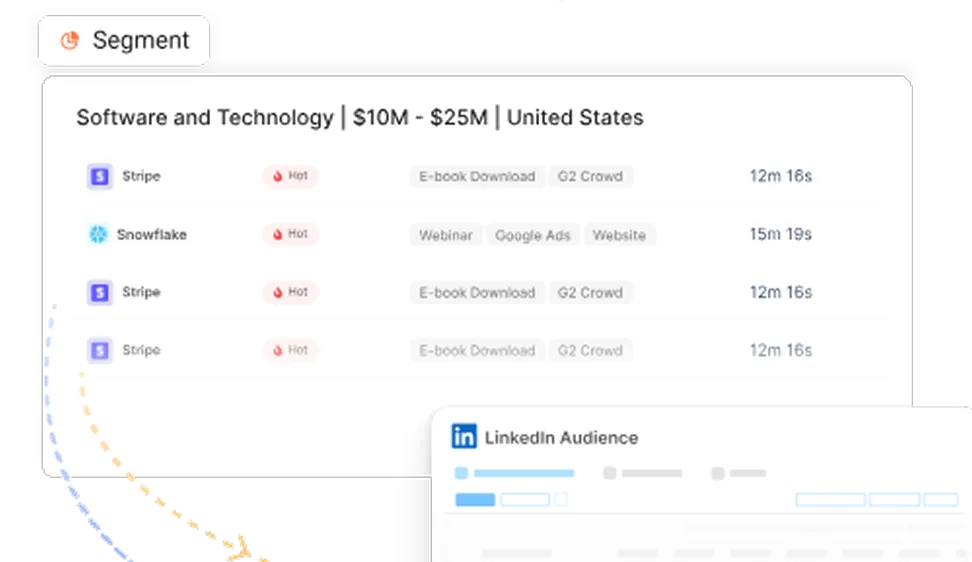
- Account prioritization with Factors.ai. This is where it connects directly to what we build. Factors identifies which companies are on your site, tracks behavioral and intent signals across accounts, scores them against your ICP, and surfaces the accounts most likely to convert, before they become leads. That's the power of machine learning applied to the top of the B2B funnel: finding the signal in the noise before your competitors do.
The hidden problems nobody talks about in AI marketing
The enthusiasm around AI in marketing has produced a lot of content about what it can do and very little about what it gets wrong. So let me spend some time here.
- Bad data produces bad AI. This is the one that trips up the most teams. AI models are only as good as the data they're trained on, and most B2B marketing stacks have data quality problems that predate any AI implementation. Duplicate records, inconsistent tracking, missing attribution, contacts with no engagement history. All of that flows directly into your AI models and degrades their outputs. You can't fix data problems by adding AI on top of them.
- Hallucination risk in customer-facing content. Generative AI confidently produces incorrect information. That's a known behavior, not a bug being fixed next quarter. For internal drafts and ideation, this is manageable. For customer-facing content, legal documents, or anything involving specific product claims, it requires a human review layer that teams often underestimate in their implementation plans.
- Black box decision-making. When an AI system tells you to prioritize Account X, you should be able to understand why. Many AI tools in market today can't explain their reasoning in terms a marketer can act on. That makes them hard to audit, hard to trust, and hard to improve when they're wrong.
- Privacy and compliance complexity. AI systems that learn from behavioral data are operating in an increasingly complicated regulatory environment. GDPR, CCPA, and sector-specific regulations create real constraints on what data can be used, how it can be stored, and what decisions it can power. Most marketing teams aren't equipped to assess this risk independently, and most AI vendors aren't forthcoming about it.
- Tool sprawl and integration debt. The average B2B marketing stack has grown substantially in the last five years, and AI tools are being layered on top of stacks that were already struggling with integration. Every new tool is a new data silo, a new login, a new workflow, and a new source of inconsistency. The governance problem isn't coming. For most teams, it's already here.
The future problem in marketing won't be a lack of AI tools. There are already more of them than anyone can evaluate properly. The problem will be governance, data literacy, and the organizational will to slow down long enough to build the foundations that actually make AI work.
AI vs marketing agencies: replacement or evolution?
Let's address this directly because it's becoming a real conversation in agency-client relationships.
AI won't replace good agencies. But it will replace agencies that are essentially selling manual execution disguised as strategy. There's a difference, and it matters.
What agencies do well that AI can't replicate: strategic positioning, brand narrative, category thinking, creative risk-taking, stakeholder management, and the kind of contextual judgment that comes from working across dozens of companies and seeing patterns. Those capabilities have genuine value and they're deeply human.
What AI does better than traditional agency delivery models: analysis at scale, content variation, performance optimization, competitive monitoring, and the mechanical execution work that historically consumed a lot of agency hours and client budget. When an AI can do a competitive analysis in twenty minutes that used to take a junior strategist two days, that's not a threat to good agencies. It's a release valve that should free up strategists to do the work they're actually good at.
The agencies that are thriving right now are the ones who've absorbed AI into their workflows and compete on judgment, not volume. The ones struggling are the ones whose value proposition was essentially "we have people who can do the work." That's a shrinking moat.
For B2B companies evaluating agencies versus AI tools: it's usually not either/or. You probably need strategic partners for positioning and brand, AI tools for signal detection and execution, and an internal team that can connect the two. The mistake is expecting AI to replace the strategic thinking or expecting an agency to provide the data infrastructure.
The future isn't AI or traditional marketing… it's both.
The synthesis isn't complicated, but it requires honesty about what each approach is actually good at.
| Function | Human-led | AI-assisted |
|---|---|---|
| Strategy and positioning | Primary | Supporting input |
| Brand and creative | Primary | Execution support |
| Audience insights | Collaborative | Primary |
| Campaign optimization | Oversight | Primary |
| Content production | Editorial direction | Heavy execution support |
| Measurement and attribution | Interpretation | Primary |
| Sales enablement | Primary | Signal surfacing |
The highest-performing marketing teams in B2B aren't AI-first. They're judgment-first. They know which decisions require human context and which ones are better made by a model that's seen a thousand data points. That distinction, knowing what to delegate to a machine and what to own yourself, is the actual skill that matters right now.
AI becomes the operating system. Humans remain the decision-makers. That's the model, and it's a better frame than any versus debate.
How modern B2B teams are building AI-powered marketing systems
This is the part where we get practical, because frameworks are only useful if they're actionable.
1. Fix data foundations first
You can't skip this step. Clean CRM data, consistent UTM tagging, unified tracking across channels, accurate contact and account records. Every AI system you build on top of broken data will produce outputs you can't trust. This isn't glamorous work, but it's the highest-leverage thing most teams can do before touching any AI tooling.
2. Unify your revenue data
The gap between marketing data and revenue data is where a lot of companies lose the thread. Connecting campaign activity to pipeline to closed revenue requires integrations that most teams haven't fully built. This is what makes attribution credible and what allows AI models to train on outcomes that actually matter.
3. Add AI-powered insights, not just AI-powered content
The most common mistake in AI marketing adoption is treating generative AI as the primary use case, when AI marketing tools also support deeper customer analysis and more useful data-driven insights than content generation alone. Content generation is useful, but the insight layer is where the real leverage lives. These tools help interpret consumer behavior and improve campaign success through better signal detection. Tools that identify which accounts are showing purchase intent, which leads are most likely to convert, which campaigns are actually driving revenue, those have direct pipeline impact. Content generation has indirect impact at best.
4. Automate decisions, not just tasks
Once you have clean data and reliable insights, the next layer is using AI to automate repetitive tasks within campaign management: routing leads to the right sales rep based on fit and timing, triggering outreach sequences when an account hits a specific intent threshold, and reallocating budget across channels based on performance signals. For example, it can adjust audience timing and follow-ups in email campaigns as a repeatable workflow based on performance data. The goal is to get routine decisions out of human queues so that human attention goes to the decisions that actually require it.
5. Measure pipeline, not clicks
The final piece is measurement. If your marketing team is still optimizing for impressions, clicks, and MQLs without a clear line to pipeline and revenue, AI tools will optimize the wrong things faster. Set pipeline contribution as the north star metric and build backward from there. This is what forces the AI and traditional components to work together toward a shared outcome rather than optimizing separately for their own metrics.
Factors.ai is built around exactly this architecture: account identification, intent signals, ICP scoring, pipeline attribution, and predictive account prioritization. The teams using it well aren't using it to generate more activity. They're using it to make better decisions about which accounts to prioritize, where the pipeline is actually coming from, and what's likely to close.
The companies winning with AI right now aren't generating more content than everyone else. They're surfacing better signals, making faster decisions, and measuring what actually matters. That's the only version of AI marketing that compounds over time.
FAQs for AI marketing vs traditional marketing
Q1. What is the difference between AI marketing and traditional marketing?
Traditional marketing relies on human-defined segments, manual optimization, and historical reporting. AI marketing uses machine learning in digital marketing to act on customer data and real-time signals, personalize around consumer behavior, and optimize at the individual level, while traditional methods rely more on broad targeting and historical planning. The practical difference in B2B is in speed, scale, and precision. Traditional marketing plans quarterly. AI marketing learns daily.
Q2. Is AI marketing better than traditional marketing?
For specific functions, yes. Audience targeting, campaign optimization, predictive scoring, and attribution are all areas where AI demonstrably outperforms traditional approaches, while traditional marketing excels at trust-building through familiar channels and AI-driven systems improve measurable marketing effectiveness. For brand building, emotional storytelling, strategic positioning, and trust development, traditional and human-led approaches still lead. The most effective teams use AI to improve execution and decision-making while keeping humans in charge of strategy and creative direction.
Q3. Can AI replace traditional marketing teams?
No, and the teams that have tried to replace marketing judgment with AI tools have mostly ended up with more content and less strategy. What AI can replace is the manual, repetitive execution work that consumed a disproportionate share of marketing team hours. What it can't replace is the contextual judgment, creative risk-taking, and relationship-building that produce brand differentiation and pipeline quality.
Q4. What are the biggest machine learning marketing use cases in B2B?
The ones delivering measurable pipeline impact right now are predictive lead scoring, intent-based account targeting, dynamic audience building, ad spend optimization, pipeline forecasting, and account prioritization using behavioral and firmographic signals. Content generation gets the most press, but it's not where the ROI is clearest for B2B.
Q5. How is AI used in B2B marketing specifically?
In B2B, AI is primarily useful for identifying which accounts are in-market before they raise a hand, scoring and prioritizing inbound leads, personalizing outreach based on behavioral data, attributing pipeline to the right marketing activities, and forecasting revenue from current deals. It's less about content automation and more about signal intelligence and decision support across a long, complex buying cycle.
Q6. What's the difference between AI marketing and marketing automation?
Marketing automation executes workflows based on rules you define. If X happens, do Y. It doesn't learn, predict, or improve on its own. AI marketing builds models that find patterns in data, make probabilistic predictions, and improve over time without manual reconfiguration. You can have automation without AI and AI without automation, and knowing the difference prevents a lot of bad vendor decisions.
Q7. Can AI replace marketing agencies?
Good agencies with strong strategic capabilities are not at risk. Agencies whose primary value is executing deliverables at volume are under real pressure. AI handles production work faster and cheaper than a human team. What it can't do is develop a brand narrative, position a company in a crowded category, or build the kind of client relationships that produce long-term strategic partnerships.
Q8. What are the biggest risks of AI marketing?
The risks that matter most in B2B are data quality degradation flowing into AI models, hallucination in customer-facing content, compliance exposure from behavioral data use, lack of transparency in how AI systems make recommendations, and tool sprawl that creates more integration debt than business value. The governance gap is the risk most teams are underestimating right now.
Q9. How does machine learning improve campaign performance?
By replacing manual, periodic optimization with continuous learning from outcome data. A machine learning model running on ad performance can test more creative variants, optimize bidding more precisely, and reallocate budget faster than any human-managed campaign. Over time, models trained on your specific data outperform generic benchmarks because they've learned the patterns specific to your audience and offer.
Q10. Should enterprise B2B teams invest in AI marketing platforms?
Yes, but not before fixing data foundations and clarifying what outcomes they're trying to improve. AI marketing tools often have more predictable monthly costs, often around $100 to $5,000 per month, while traditional marketing methods can require very high upfront investment, including TV ad budgets that can range from about $200,000 to $7 million. AI platforms built on top of broken data produce bad outputs at scale. The right order is: clean data first, unified revenue attribution second, AI-powered insights third. Teams that skip the first two steps and start with the third spend a lot of money to get confident-sounding answers that they can't trust, and traditional marketing methods are also slower to adapt to changing market conditions.

See how Factors can 2x your ROI
Boost your LinkedIn ROI in no time using data-driven insights


.avif)

See Factors in action.
Schedule a personalized demo or sign up to get started for free
LinkedIn Marketing Partner
GDPR & SOC2 Type II






.svg)



.avif)

