
AI orchestration in marketing workflows: the missing layer in modern B2B marketing
Learn how AI orchestration transforms marketing workflows, connects tools, automates execution, and improves pipeline outcomes in B2B marketing.
.avif)
Content Marketer



.svg)


TL;DR
- Most B2B marketing teams now have a workflow problem, and no amount of new AI tools fixes broken handoffs between systems.
- AI orchestration is the layer that sits between your data, your tools, and your execution; it decides what to do, when to do it, and which system should act.
- The difference between automation and orchestration is the difference between following a recipe and adjusting the entire menu based on what your guests actually want.
- Teams that build orchestrated marketing workflows see compounding returns, not because they have better tools, but because their tools finally work together.
- If your AI initiative can't be tied to pipeline or revenue, it's probably an operations project dressed up as a marketing strategy (and nobody wants to admit that in a QBR).
A marketing team can spend six figures on software and still run on copy-paste.
We’ve all seen teams with a CRM, a marketing automation platform, intent data, analytics tools, AI tools, ad platforms, and enough dashboards to wallpaper an office.
And somehow, somebody is still downloading a CSV every Friday.
That's the dirty little secret of modern marketing technology.
Most teams are struggling because none of the tools know what the others are doing. So work gets duplicated… signals get missed… opportunities sit untouched while teams move information from one system to another.
Just to be clear at the get-go, AI orchestration is NOT about adding more AI tools, it's about fixing that.
This blog is about the layer that sits between your tools, connects the dots, and turns a collection of software into something that behaves like a system.
What is AI orchestration in marketing workflows?
Let's get the definition out of the way, because this term gets thrown around loosely. Traditional marketing automation is rules-based execution. If a lead fills out a form, send them an email sequence. If they hit a lead score threshold, notify sales. It's predictable, linear, and completely dependent on someone building every rule in advance.
AI orchestration is something fundamentally different. It's the practice of coordinating data, systems, AI models, and actions across your entire marketing workflow so they operate as a single connected engine. AI orchestration involves coordinating multiple AI agents, models, and tools to execute complex marketing workflows. Instead of telling your system exactly what to do in every scenario, you give it an objective. The orchestration layer figures out which data matters, which system should act, and what sequence produces the best outcome.
Think of it this way. An AI tool is a calculator. An AI assistant is an analyst who uses that calculator when you ask. An AI workflow is a process that runs a series of steps automatically. An AI orchestrator is the operations manager who watches all of those workflows, understands what's happening across systems, and makes real-time decisions about what should happen next. The distinction matters because most B2B teams are stuck at the "tool" or "assistant" stage. They've bought AI capabilities, but they haven't connected them into anything resembling a coherent system.
The AI orchestration market is projected to reach $13.99 billion in 2026, yet the average organization now uses 12 AI agents with only 27% of their applications integrated. That gap between adoption and integration is exactly why orchestration is becoming its own category.
Why do most marketing teams have an automation problem, (not an AI problem)?
Here's something that doesn't get said enough in the AI conversation: the average B2B marketer doesn't need another AI chatbot. They need fewer swivel-chair workflows.
Look at the typical marketing stack for a mid-market B2B company. You've got your CRM (Salesforce or HubSpot), your marketing automation platform, LinkedIn Ads, Google Ads, an analytics tool, maybe an intent data provider like Bombora or 6sense, a data warehouse if you're lucky, an AI writing tool or two, and a sales engagement platform. That's nine or ten systems before you even count the spreadsheets holding everything together.
Most teams operating this stack spend their days doing some version of the same thing: exporting CSVs, copying insights between platforms, rebuilding audiences manually, and running disconnected workflows that create the illusion of integration. These deployments are often limited to isolated use cases, resulting in fragmented systems that increase output volume without improving overall business performance. I call this workflow debt, and it's the GTM equivalent of technical debt. Every manual handoff, every duplicated audience list, every report stitched together from six dashboards adds to the pile.
The uncomfortable truth is that most marketing teams have accumulated years of workflow debt. Syncing Salesforce with ad platforms takes someone's afternoon. Updating retargeting audiences is a weekly project. Building a cross-channel performance report involves pulling data from more places than anyone wants to count. And every one of those manual steps introduces lag, errors, and missed signals. Given the fragmented nature of tech stacks, the need to operate with smaller and more efficient teams, and the fluid nature of customer experiences, marketers are often stuck with manual processes that bottleneck personalized digital experiences.
Before you add a single AI agent to this mess, you need to understand where the breakdowns are happening. That's not an AI project. That's a workflow project. And the distinction matters more than most vendors want to admit.
AI automation vs AI orchestration: what's the actual difference?
This is the comparison that trips up most marketing teams, so let's make it concrete.
Automation says: "If X happens, do Y." Someone downloads a whitepaper, trigger a nurture sequence. A lead score crosses 80, send a Slack alert to the SDR. These are perfectly useful rules, and they've served B2B marketing well for years.
Orchestration says: "Monitor X, Y, and Z simultaneously. Decide what matters most right now. Then trigger the right sequence across the right systems." Journey orchestration agents don't make your existing automation obsolete; they add an intelligence layer on top that decides which automation to trigger, when, and for whom. That's a profoundly different operating model.
Here's a table that makes the differences visual:
| Dimension | AI automation | AI orchestration |
|---|---|---|
| Logic | Rule-based: if X, then Y | Adaptive: evaluate X, Y, Z, then decide |
| Scope | Single workflow or channel | Cross-system, cross-channel coordination |
| Data usage | Responds to one trigger | Synthesizes signals from multiple sources |
| Learning | Static until manually updated | Continuously optimizes based on outcomes |
| Example: lead scoring | Score based on fixed criteria | Score adjusts dynamically based on intent, engagement, and pipeline context |
| Example: audience building | Manual list upload every week | Auto-refreshes based on real-time behavior signals |
| Example: budget allocation | Set budget per campaign manually | Shifts spend across channels based on performance signals |
Let me give you a real scenario. In an automated workflow, a lead who visits your pricing page gets tagged as "high intent" and enters a fixed nurture sequence. In an orchestrated workflow, the system recognizes that the lead's company is also showing third-party intent signals, another contact from the same account downloaded a case study last week, and the account matches your ICP criteria. It then simultaneously updates the retargeting audience, alerts the SDR with a full account timeline, adjusts the LinkedIn campaign bid for that company, and pauses the generic nurture in favor of a buying-committee-specific sequence. Unlike traditional marketing automation, which runs on predefined rules, agentic systems operate on goals and context.
That's not a marginal improvement. That's a categorically different way of running an AI marketing automation workflow.
The modern B2B marketing workflow architecture
To understand where orchestration fits, it helps to visualize how data actually moves through a B2B go-to-market motion. Here's a simplified AI marketing workflow diagram of a modern orchestrated architecture:
Inputs ▶️ Intelligence ▶️ Actions ▶️ Outputs ▶️ Feedback
- Inputs. Intent signals, website activity, CRM data, product usage, first-party engagement data.
- AI orchestration layer. Synthesizes signals, scores accounts, identifies patterns, makes decisions.
- Actions. Audience updates, campaign launches, content personalization, sales alerts, budget reallocation.
- Outputs. Pipeline generated, revenue attributed, conversion rates, campaign performance.
- Feedback loop. Outcomes feed back into the orchestration layer, which refines future decisions.
The orchestration layer is the part most B2B stacks are missing. Without it, every input-to-action connection has to be built and maintained manually. With it, signals from your website, CRM, LinkedIn, and Google Ads flow into a unified intelligence layer that decides what action to take and which system should take it.
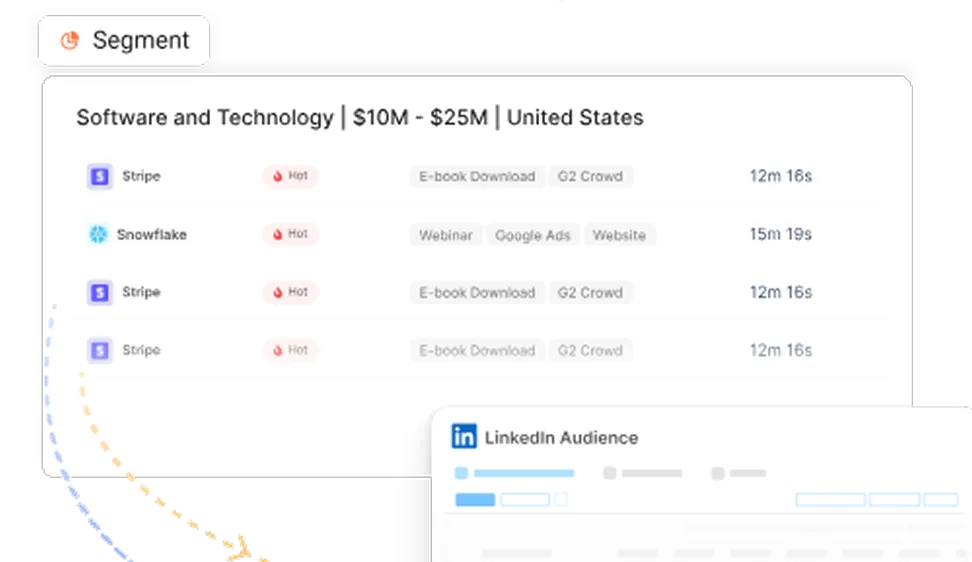
This is where a platform like Factors.ai starts to make practical sense. Factors.ai is a B2B demand-gen platform known for account intelligence and multi-touch attribution. It unifies website, CRM, LinkedIn, and G2 data to map full buyer journeys and highlight high-intent accounts. It connects website visitor identification, ad platform data, CRM stages, and intent signals into one layer. Instead of manually stitching data from five sources to figure out which accounts are worth pursuing, that synthesis happens inside a single connected workflow.
The key insight with any AI marketing orchestration platform is that it doesn't replace your existing tools. It sits between them, turning raw signals into coordinated actions. Your CRM still manages relationships. Your ad platforms still serve impressions. But the orchestration layer ensures they're all working toward the same outcome instead of operating in isolation.
Where AI orchestration delivers the biggest impact
Most B2B marketers obsess over campaign optimization while ignoring workflow optimization. The latter usually delivers larger gains. Here's where orchestration creates the most visible improvements.
- Audience building. Manually building and refreshing audience lists is one of the biggest time sinks in B2B marketing. An orchestrated workflow continuously identifies ICP accounts based on firmographic data, intent signals, and engagement patterns. It refreshes segments dynamically so your ad platforms always target the right accounts. Static lists become stale quickly in B2B environments where products, competitors, and buyer needs shift. Dynamic segments powered by unified customer intelligence help automation always target the right people. No more Monday morning CSV exports.
- Campaign activation. Instead of launching campaigns on a fixed schedule, orchestration triggers activation based on real-time signals. When an account enters a buying cycle (showing intent, visiting key pages, engaging across channels), the system automatically adjusts campaign targeting, messaging, and budget allocation. Campaigns respond to buyer behavior rather than marketer calendars.
- Personalization at scale. AI orchestration in omnichannel marketing means adapting messaging, creative, and offers across channels simultaneously, not just within a single email sequence. When the orchestration layer knows that an account is in the consideration stage and their VP of Engineering just visited your integrations page, it can coordinate a personalized LinkedIn ad, a relevant content recommendation, and a tailored SDR outreach message. Rather than handcrafting dozens of versions of each message, you can use AI to adapt copy and content blocks to persona, industry, and behavior.
- Attribution. This is where disconnected workflows cause the most damage. When your marketing data lives in separate systems, connecting touchpoints to pipeline and revenue becomes an archaeological exercise. Orchestration keeps the data connected from the start, making attribution a natural byproduct of execution rather than a separate reporting project. In a mature orchestration setup, output from one agent feeds into the next, with the orchestration layer managing sequencing and error handling, while centralized measurement tracks cross-agent ROI rather than just individual tool metrics.
How do you build an AI-orchestrated marketing engine?
Building orchestration isn't a weekend project, but it doesn't require ripping out your entire stack either. Here's a practical framework.
Step 1: Audit your existing workflows
Map every repetitive task, manual handoff, and data bottleneck in your current marketing operations. Before adding AI agents, map your current workflows honestly. Identify where your team spends time on tasks that don't require human judgment, and start with workflows where the gap between time spent and judgment required is largest. Which processes involve exporting data from one system and importing it into another? Where does someone spend hours doing something a connected system could handle in seconds?
Step 2: Identify high-value workflows
Not every workflow deserves orchestration. Focus on the ones closest to revenue: lead routing, audience syncing, cross-channel campaign activation, and pipeline reporting. These are the workflows where speed and accuracy directly impact pipeline velocity.
Step 3: Connect your data sources
Orchestration requires a unified data layer. Your CRM, product analytics, ad platforms, website analytics, and intent data need to feed into a shared system. This doesn't mean a single database for everything. It means establishing reliable data flows between the systems that matter most.
Step 4: Introduce AI decision layers
Once data flows are connected, add intelligence. This could be AI-powered lead prioritization, dynamic audience qualification, or automated campaign recommendations based on performance patterns. For most B2B organizations, the priority should be identifying the right use cases, getting the foundations in place, and building confidence in controlled areas before scaling more advanced AI capabilities.
Step 5: Add human review checkpoints
This is the step most AI vendors skip in their demos, and it's the most important one (duh). Orchestration doesn't eliminate marketers. It elevates them. The system handles data synthesis and routine decisions. Humans review strategic choices, approve creative direction, and manage edge cases that require judgment. The teams getting the best results from AI agents aren't the ones who automate everything. They're the ones who've identified exactly where human judgment adds irreplaceable value and where it doesn't.
AI orchestration across the full B2B buyer journey
The future of B2B marketing isn't campaign orchestration. It's buying-journey orchestration. That means applying coordinated intelligence across every stage, not just the hand-raiser moment.
- Awareness stage. Orchestration identifies accounts matching your ICP that are starting to show early research behavior. It coordinates content recommendations and paid targeting to reach the right accounts on the right channels before they're actively evaluating solutions. Think of this as intelligent demand creation rather than spray-and-pray advertising.
- Consideration stage. As accounts move deeper into their research, the orchestration layer shifts tactics. It triggers personalized nurture sequences, updates audience segments dynamically, and ensures the account sees relevant case studies and comparison content. Companies leveraging predictive models for lead scoring, segmentation, or journey orchestration achieve 20-30% higher conversion rates. That's the difference between generic nurture and contextual engagement.
- Decision stage. This is where orchestration connects marketing and sales in ways that manual processes simply can't replicate at speed. The system identifies buying committee members, surfaces account intelligence for the sales team, and triggers multi-threaded outreach across the decision-making group. Sales alerts become genuinely useful because they arrive with full context, not just a name and a lead score.
- Expansion stage. Post-sale orchestration is still wayyy underutilized in most B2B organizations. Monitoring customer health signals, identifying upsell opportunities, and triggering expansion campaigns based on product usage patterns represents one of the highest-ROI applications of an AI marketing workflow, and almost nobody does it well.
AI marketing workflow examples and diagrams
Let me walk through three concrete examples that illustrate how orchestration works in practice. These aren't theoretical concepts. They're workflow patterns running in real B2B teams today.
Example 1: Intent-to-ad workflow
High intent signal detected → Orchestration layer validates ICP match → Audience list updated across LinkedIn and Google Ads → Campaign bid adjusted → Sales receives account alert with engagement timeline.
This workflow replaces what used to be a weekly manual process: someone downloading an intent report, cross-referencing it with the ICP list, manually adding accounts to ad platform audiences, and pinging the sales team on Slack. It becomes a continuous, automated loop instead. The AI marketing workflow diagram for this pattern is straightforward, but the time savings compound rapidly when you're managing hundreds or thousands of accounts.
Example 2: Website visitor workflow
Anonymous website visit → Company identification (via IP enrichment) → ICP match evaluation → Retargeting audience update → SDR notification with pages visited and content consumed.
This AI marketing workflow automation pattern is especially powerful for companies with strong website traffic but weak visitor-to-pipeline conversion. Most anonymous traffic leaves your site without a trace. Factors.ai scores accounts based on real engagement signals like website behavior, content consumption, ad interactions, and third-party intent, producing a live, ranked list of accounts showing the most buying activity. An orchestrated workflow turns that invisible traffic into actionable intelligence.
Example 3: Pipeline acceleration workflow
Opportunity stalled for 14+ days → AI analyzes account engagement patterns → Recommends content based on buyer stage and persona → Triggers multi-channel activation (retargeting ad, personalized email, SDR follow-up).
This is the workflow that directly connects marketing orchestration to revenue acceleration. Instead of waiting for a sales rep to notice a deal is stalling, the system proactively identifies risk and coordinates a marketing response. Attribution debates sometimes resemble group projects where everyone claims credit for the final result, but workflows like this make the marketing contribution undeniable.
How to choose an AI marketing orchestration platform?
Not every tool that claims to orchestrate actually does. Here's what to evaluate when selecting AI orchestration platforms for marketing.
- Connectivity. How many of your existing systems does the platform connect to natively? If it requires custom API work for every integration, you're just building another silo with extra steps. The best enterprise AI marketing workflow platforms connect your CRM, ad platforms, website analytics, and intent data without requiring an engineering team.
- Data layer. Is the platform working with a unified view of your account data, or is it pulling from fragmented sources and hoping for the best? A unified data layer is the foundation that makes every other capability possible.
- Intelligence layer. Can it actually make decisions, or does it just move data from Point A to Point B? A platform isn't orchestrating anything if it's simply passing data between systems without adding intelligence to the process. Look for capabilities like dynamic scoring, automated audience qualification, and pattern recognition.
- Execution layer. Can the platform activate campaigns and trigger actions, or does it only produce recommendations that your team then has to manually execute? True AI marketing orchestration software closes the loop between insight and action.
- Measurement layer. Can it tie actions to revenue? If the platform can't connect its orchestration activities to pipeline outcomes, you'll never prove ROI. This is the difference between an AI marketing orchestration tool and a glorified data pipe.
The platform categories worth evaluating include marketing automation platforms (HubSpot, Marketo), CDPs (Segment, mParticle), revenue intelligence platforms (Gartner, 6sense), dedicated AI orchestration platforms for marketing, and workflow automation tools (Zapier, n8n). Each category has trade-offs, and the right choice depends on your existing stack, team size, and workflow complexity. If you're considering AI marketing workflow consulting, start by mapping your current workflows before evaluating platforms. The technology decision should follow the workflow audit (not precede it)
Common mistakes that break AI marketing workflows
The fastest way to kill AI ROI is to automate chaos. Here are the mistakes I see most frequently.
- Automating broken processes. If your lead routing logic is flawed, orchestrating it faster just produces more misrouted leads more quickly. Fix the process first, then automate and orchestrate it. This sounds obvious, but you'd be surprised how many teams skip this step.
- Poor CRM hygiene. AI, agentic workflows, and more advanced orchestration all depend on the same things: clean, well-structured data, strong integration across platforms, and clear governance. Your orchestration layer is only as smart as the data feeding it. If your CRM is full of outdated records, missing fields, and inconsistent naming conventions, AI won't fix that. It'll amplify it.
- Too many point solutions. Projects most at risk of failure are those that deploy agents without an orchestration layer. Individual point solutions can't share data, coordinate workflows, or measure cross-agent impact. Every new tool you add without connecting it to the broader system increases your workflow debt.
- No human oversight. Gartner predicts that over 40% of agentic AI projects will be canceled by the end of 2027 due to escalating costs, unclear business value, or inadequate risk controls. Orchestration without guardrails is a recipe for expensive mistakes at scale.
- No attribution layer. If you can't measure what orchestration is doing to your pipeline, you can't justify the investment. Build measurement into the system from day one, not as an afterthought.
- Measuring activity instead of outcomes. The number of workflows running, emails sent, or audiences updated means nothing if those activities aren't connected to pipeline generation and revenue. This is where most AI marketing workflow automation tools reporting falls short.
How to measure the ROI of AI orchestration
If your AI initiative can't be tied to pipeline, it's probably an operations project disguised as a marketing project. Here's how to measure orchestration ROI in a way that actually matters.
- Efficiency metrics track the operational gains: time saved on manual workflows, campaign launch velocity (how fast can you go from signal to execution?), and hours reduced on reporting and audience management. These are the metrics that justify the investment to your ops team.
- Marketing metrics measure the quality improvements: MQL quality and conversion rates, pipeline generated from orchestrated workflows versus manual ones, and the accuracy of audience targeting. Organizations implementing agentic workflows in marketing can expect to see 10 to 30 percent revenue growth from hyperpersonalized marketing. These numbers tell you whether orchestration is making your marketing smarter, not just faster.
- Revenue metrics connect everything to the bottom line: customer acquisition cost (is orchestration reducing it?), pipeline velocity (are deals moving faster?), and revenue influenced by orchestrated campaigns. These are the metrics that earn you budget in the next planning cycle.
The shift in how teams measure AI is significant. Agentic AI's value is best measured in improved decision velocity and adaptation to market shifts. Instead of tracking how many AI tools you've deployed or how many workflows you've built, the question becomes: how much faster and more accurately can your team move from signal to revenue? That's the metric that separates orchestration from faaaar more expensive experimentation.
The future of marketing: from automation to autonomous execution
The evolution of marketing operations follows a clear trajectory, and we're still early in the journey.
- Phase 1: Marketing automation. Rules-based, linear, "if X then Y." This is where most B2B teams have lived for the past decade.
- Phase 2: AI assistance. Individual AI tools that help with specific tasks (writing, analysis, recommendations) but don't coordinate with each other.
- Phase 3: AI orchestration. Connected systems that coordinate data, decisions, and actions across the full workflow. This is where the leading teams are moving right now.
- Phase 4: Agentic marketing. AI agentic workflows are autonomous systems where AI agents receive goals and independently plan, execute, and optimize tasks, featuring autonomous decision-making, context-aware adaptation, and self-optimization. Specialized AI agents handle end-to-end processes (campaign management, audience optimization, budget allocation) with human oversight at strategic checkpoints.
- Phase 5: Autonomous revenue operations. The entire go-to-market engine, from signal detection to deal closure to expansion, operates as a single orchestrated system with humans focused on strategy, creativity, and relationship building.
McKinsey estimates that agentic AI will come to power as much as two-thirds of current marketing activities. We're heading toward a world where the mechanics of marketing (data synthesis, audience management, campaign execution, performance optimization) are largely handled by coordinated AI systems. The role of the marketer will shift from hands-on executor to strategic orchestrator, and the most valuable marketing skills will be the ability to think critically, ask the right questions, and effectively manage a team of AI agents.
I’m confident that the next competitive advantage will come from who can orchestrate data, systems, people, and AI into one continuous revenue engine. The teams that start building that connective tissue today aren't just saving time on manual tasks. They're creating a structural speed advantage that compounds with every workflow they connect, every signal they capture, and every decision they let the system make faster than any human could. (Wow, never thought I'd write something that optimistic about marketing technology.)
FAQs for AI orchestration in marketing workflows
Q1. What is AI orchestration in marketing workflows?
AI orchestration in marketing workflows is the practice of coordinating data, AI models, tools, and actions across your marketing stack so they operate as a unified system. Unlike traditional automation, which follows static rules, orchestration continuously evaluates signals from multiple sources and decides the optimal action in real time. It connects your CRM, ad platforms, analytics, intent data, and sales tools into a single intelligence layer that drives execution across the entire buyer journey.
Q2. How is AI orchestration different from marketing automation?
Marketing automation executes predefined rules, like triggering an email when someone fills out a form. AI orchestration goes further by monitoring multiple signals simultaneously, deciding which action matters most in context, and coordinating execution across several systems at once. Automation is a single track. Orchestration manages the entire rail network.
Q3. What are the best AI marketing orchestration platforms?
The best platform depends on your stack and maturity level. Categories worth evaluating include marketing automation platforms like HubSpot and Marketo, CDPs like Segment, revenue intelligence platforms like 6sense, dedicated orchestration platforms, and workflow tools like Zapier and n8n. Look for strong connectivity, a unified data layer, AI decision-making capabilities, execution ability, and revenue measurement.
Q4. How does AI orchestration improve B2B marketing performance?
Orchestration improves performance by reducing manual handoffs, ensuring audience targeting stays current in real time, coordinating campaign activation across channels based on buyer signals, and connecting every marketing action to pipeline outcomes. Teams running orchestrated workflows typically see faster campaign velocity, higher lead quality, and better attribution clarity compared to teams relying on disconnected manual processes.
Q5. Can AI orchestration help with ABM campaigns?
Absolutely. ABM is one of the highest-value use cases for orchestration. An orchestrated ABM workflow identifies target accounts showing intent signals, dynamically updates audiences across ad platforms, coordinates personalized outreach across the buying committee, and surfaces account intelligence for sales teams. This replaces the manual, weekly account-review process most ABM teams still rely on.
Q6. What data sources should be connected in an AI marketing workflow?
At minimum, connect your CRM, website analytics, ad platforms (LinkedIn and Google Ads), email or marketing automation platform, and any intent data providers you use. Mature orchestration setups also pull in product usage data, customer support signals, and third-party review site activity. The broader your connected data, the more accurate the orchestration layer's decisions become.
Q7. How do AI agents fit into marketing orchestration?
AI agents are the specialized workers within an orchestrated system. One agent might handle audience qualification, another manages campaign budget allocation, and a third monitors pipeline health. The orchestration layer coordinates these agents, ensuring they share data, avoid conflicting actions, and work toward shared revenue objectives. Think of agents as the team members and orchestration as the project management layer.
Q8. What are the biggest challenges of implementing AI orchestration?
The biggest challenge is data quality. Orchestration amplifies whatever it works with, so dirty CRM data, fragmented integrations, and inconsistent naming conventions become much more visible when an AI system tries to make decisions from them. Other common challenges include internal resistance to changing established workflows, selecting the right platform for your maturity level, and establishing meaningful human oversight checkpoints.
Q9. How do you measure ROI from AI orchestration?
Measure orchestration across three layers: efficiency (time saved, campaign velocity, reporting hours reduced), marketing quality (MQL conversion rates, pipeline generated, audience accuracy), and revenue impact (customer acquisition cost, pipeline velocity, revenue influenced by orchestrated campaigns). The most important metric is whether orchestration is reducing the time between signal detection and revenue-generating action.

See how Factors can 2x your ROI
Boost your LinkedIn ROI in no time using data-driven insights


.avif)

See Factors in action.
Schedule a personalized demo or sign up to get started for free
LinkedIn Marketing Partner
GDPR & SOC2 Type II







.svg)



.avif)

