
B2B target audience: how to define, segment, and reach the right buyers
Learn how to define and target your B2B target audience using real data, intent signals, and account-level insights. Examples + strategy inside.
.avif)
Senior Content Marketing Manager



.svg)


TL;DR
- A B2B target audience is a group of accounts and the buying committees inside them that are most likely to become your best customers.
- Defining your audience with precision improves everything downstream: conversion rates, CAC efficiency, sales velocity, and pipeline quality.
- Static firmographic filters are no longer enough. Layering in technographics, intent data, and real-time engagement signals is what separates good targeting from guesswork.
- Segmentation should be dynamic, built on funnel stage and behavioural signals, not just industry or company size.
- Measuring audience quality means tracking pipeline and revenue per segment, not just cost per lead.
Every B2B company seems to have that one slide… you know that one… the ICP slide.
Really clean fonts, tidy bullets, maybe a tasteful icon or two. It says things like “Mid-market SaaS companies,” “500–2000 employees,” “Decision-makers in marketing and RevOps.” Everyone looks at it seriously, as if the slide itself has done something useful.
Then the quarter starts.
Marketing brings in leads, sales says they’re rubbish (excuse me?!). Revenue wonders why pipeline feels anemic. Someone suggests “more top-of-funnel.” Someone else says “better nurture.” Meanwhile, nobody wants to admit the real issue: you’re targeting an audience that looks nice and tidy in a deck, but behaves terribly in real life.
Because a B2B target audience is not a fictional LinkedIn filter built in a workshop. It’s not “VPs in tech” and a prayer. It’s a group of real companies, with real timing, pain, budgets, and signals that suggest they might actually buy something. Most teams need fewer random ones.
This blog is for fixing that. We’ll cover what a B2B target audience actually is, how to build one using data instead of vibes, where teams waste budget with lazy targeting, and how to keep your audience sharp as markets change. The dream here is simple: spend less time courting accounts that were never interested, and more time talking to the ones already halfway in.
So, what IS a B2B target audience?
By definition. a B2B target audience is the specific group of companies, and the decision-makers within them, that are most likely to buy your product or service. It's not a vague persona document that sits in a shared drive untouched. It's the operational definition of who you're actually going after with your marketing and sales efforts.
The difference between B2B and consumer targeting starts with a fundamental structural reality: you're not selling to a person, you're selling to an organisation. That organisation has layers. There's the person who first discovers your product, the person who evaluates it, the person who signs the contract, and often a handful of people who can kill the deal from the sidelines. This is the buying committee, and it's the reason B2B audience definitions can't be reduced to a single demographic profile.
Think about it this way… a SaaS company selling a revenue attribution platform doesn't just target "marketers." It targets Series B to Series D SaaS companies with 50 to 200 employees, where the VP of Marketing, the RevOps lead, and the CFO all have a say in purchasing decisions. The company is the account. The people inside it are the personas. And the combination of both is the audience.
This distinction matters because it shapes everything else: how you build campaigns, which channels you prioritize, what content you create, and how you measure success. In B2B, every meaningful interaction is part of a multi-touch journey that unfolds across weeks or months, touching multiple stakeholders before a deal closes. Your audience definition needs to account for that complexity, or it'll only ever capture a fraction of the picture.
The simplest way to think about it: your B2B target audience is the intersection of the companies that fit your ideal profile and the people within those companies who influence or make buying decisions. Get that intersection right, and everything downstream gets easier. Get it wrong, and you'll spend months optimizing campaigns that were pointed at the wrong accounts from the start.
Why is defining your B2B target audience SO important?
There's a persistent myth in B2B marketing that more leads equal more pipeline. It sounds logical on the surface, and it makes for satisfying dashboards. But anyone who's sat through a pipeline review where 80% of the "leads" were never going to buy knows the math doesn't work that way. Poor audience targeting is the silent budget killer that most teams don't diagnose until the quarter is already off track.
When your audience definition is too broad, you end up spending money attracting companies that don't have the budget, the problem, or the organizational structure to buy what you sell. Every one of those leads still costs you something, whether it's ad spend, SDR time, or the opportunity cost of nurturing an account that was never going to close. The result is a bloated top of funnel that creates the illusion of demand without actually building a sales pipeline.
Strong audience targeting flips this dynamic entirely. When you know exactly which accounts and personas you're going after, your conversion rates improve because the people entering your funnel are pre-qualified by design. Your customer acquisition cost decreases because you are not wasting money on accounts that are outside your ideal customer profile (ICP). And your sales velocity increases because reps are talking to prospects who actually have the problem your product solves. These aren't marginal improvements. For most B2B teams, sharpening audience targeting is the single highest-leverage thing they can do.
The modern version of this challenge is slightly more important to note… most marketing teams have gotten quite good at generating leads. The tools exist, the playbooks are well-documented, and the channels are accessible. What hasn't kept pace is the quality filter. Teams optimise for cost per lead when they should be optimising for cost per opportunity or cost per closed deal. The difference between those two metrics is almost always an audience problem.
Here's a useful thought experiment. If your sales team could handpick the 100 accounts they'd most want to talk to this quarter, would those accounts overlap with the ones your marketing campaigns are currently reaching? If the answer is "not really," that gap is your audience targeting problem. And it's costing you more than you think.
B2B target audience vs B2C: what's actually different?
It's tempting to treat B2B and B2C audience targeting as variations of the same thing. They both involve identifying a group of potential buyers and reaching them with relevant messaging. But the structural differences between the two are significant enough that applying B2C targeting logic to a B2B context will almost always lead you astray.
The most fundamental difference is who makes the decision. In B2C, one person sees an ad, evaluates the product, and buys it, often in the same session. In B2B, that "decision" is spread across a committee of three to ten people, each with different priorities, different levels of authority, and different criteria for saying yes. The CMO cares about strategic alignment. The RevOps lead cares about integration complexity. The CFO cares about cost justification. Your targeting needs to account for all of them, not just the person most likely to click your ad.
The sales cycle is the second major divergence. A B2C purchase might take minutes. A B2B deal, particularly in SaaS, takes weeks to months. That extended timeline means your audience doesn't just need to see one message. They need to encounter your brand across multiple touchpoints, at the right moments, over a sustained period. Timing and context matter far more than they do in a consumer purchase.
Then there's the question of deal value. B2C transactions tend to be low-ticket and high-volume. B2B deals, especially in enterprise SaaS, are high-ACV and low-volume. When each deal is worth tens or hundreds of thousands of pounds, the cost of targeting the wrong account isn't just a wasted impression. It's a wasted quarter of sales effort.
Here's a side-by-side comparison to make the differences concrete:
The implication for your targeting strategy is straightforward. In B2B, you can't just target the right person. You need to target the right account, at the right time, with messaging that resonates across the entire buying committee. Account-level targeting isn't a nice-to-have. It's the baseline for any serious B2B audience strategy.
How do you define your B2B target audience step by step?
Defining a B2B target audience isn't something you do once in a strategy deck and then forget about. It's a process that starts with your best existing data and evolves as you learn more about who actually buys from you. The teams that do this well treat audience definition as an ongoing discipline, not a one-time exercise.
Here's the step-by-step process that actually works:
Step 1: Define your ideal customer profile
Your ICP is the foundation, it describes the type of company, not individual, that gets the most value from your product and is most likely to buy. The key firmographic dimensions to lock down are:
- Industry: Which verticals do your best customers come from? Be specific. "Technology" is too broad. "B2B SaaS companies in the marketing or sales tech space" is useful.
- Company size: Define this by employee count, revenue, or both. A company with 50 employees and one with 5,000 have completely different buying processes.
- Revenue: This signals budget capacity. A company doing $2M in annual revenue has different purchasing power than one doing $50M.
- Geography: Where are your customers? Are there regional differences in adoption, compliance requirements, or sales motion?
The goal here isn't to describe your dream customer. It's to describe the profile that your data shows converts fastest, retains longest, and generates the most revenue.
Step 2: Identify the key personas within those accounts
Once you know which companies to target, you need to know who inside those companies actually matters. B2B buying committees typically include three types of stakeholders:
- Decision-makers: The people who sign off on the purchase. Think VP of Marketing, CMO, CRO, or Head of RevOps depending on your product.
- Influencers: The people who evaluate, recommend, or block. These are often directors or senior managers who do the hands-on research and shape the shortlist.
- End users: The people who'll use the product daily. They might not sign the contract, but their feedback during evaluation carries real weight.
Map out which roles matter for your specific product. A marketing analytics platform might need to reach the CMO for budget approval, the demand gen director for evaluation, and the marketing ops manager for technical fit. Missing any of these means your targeting has a gap.
Step 3: Analyse your best existing customers
Pull your CRM data and look at the accounts that converted fastest, generated the highest contract values, and retained the longest. What patterns emerge?
You might discover that mid-market fintech companies with a RevOps team close 40% faster than your average deal. Or that companies using a specific CRM convert at twice the rate. These patterns are gold because they're grounded in real buying behaviour, not hypothetical segmentation.
Look specifically at which industries over-index, which company sizes have the shortest sales cycles, and which persona combinations appear in your best deals. The goal is to let your existing customer base tell you who your audience should be.
Step 4: Layer in behavioural signals
A static ICP tells you who could buy, but behavioral signals tell you who's actually showing interest right now. This is where modern B2B audience targeting separates itself from the traditional approach.
The signals that matter include website visits (especially to pricing pages, product pages, or comparison content), content engagement (downloads, webinar attendance, blog consumption patterns), and ad interactions (repeated clicks, video views, high-frequency impressions). When an account that fits your ICP is also actively engaging with your content and ads, that's a much stronger signal than firmographic fit alone.
This is the shift from "who fits our profile" to "who fits our profile and is actively in a buying cycle."
Step 5: Validate everything with your sales team
Data-driven audience definitions are powerful, but they need a reality check from the people who actually close deals. Your sales team has qualitative insight that no dashboard can fully capture. They know which types of companies have real budget, which personas actually drive decisions, and which industries are receptive versus resistant.
Schedule a quarterly sync specifically focused on audience quality. Ask sales which recent deals closed smoothly and why. Ask which leads felt like a waste of time. Use that feedback to sharpen your ICP and persona definitions. The best B2B audience strategies are a collaboration between marketing data and sales intuition, updated regularly.
The endgame of this process is to move from a static ICP document to a dynamic audience definition built on real-time signals. Your ICP sets the parameters. Behavioural data tells you which accounts within those parameters are ready to engage. Sales feedback keeps the whole thing grounded in reality. That combination is what good B2B audience targeting actually looks like.
Firmographics, technographics, and intent: what actually matters?
Most B2B teams start their audience definition with firmographics, and that's a reasonable starting point. Industry, company size, revenue, geography: these are the basic filters that tell you whether an account could theoretically be a good fit. But firmographics alone are like choosing a restaurant based entirely on how close it is to your house. Proximity matters, but it doesn't tell you whether the food is any good.
The problem with a purely firmographic approach is that it's entirely static. A list of 500 companies that match your ICP by industry and size tells you nothing about which of those companies actually have the problem you solve right now, or which ones are actively looking for a solution. You could run campaigns against that whole list and find that 450 of them have zero purchase intent this quarter. That's not targeting. That's expensive guessing.
- Firmographics: who they are
Firmographics answer the most basic question: does this company look like the kind of organisation that buys our product? The core dimensions are industry vertical, employee count, annual revenue, and headquarters location. These filters are useful for building an initial universe of potential accounts. They help you avoid spending time on companies that are clearly outside your market, like targeting a 10-person agency when your product is built for 200+ employee enterprises.
But firmographics describe a company's identity, not its current situation. A mid-market SaaS company in your target vertical might be a perfect fit on paper and simultaneously in a hiring freeze with zero budget for new tools. Firmographic fit is necessary, but it's nowhere close to sufficient.
- Technographics: what they use
Technographic data adds a second layer by telling you what technology stack a company runs. This is particularly valuable if your product integrates with or replaces specific tools. If you sell a marketing attribution platform, knowing that a company uses HubSpot, runs Google Ads, and has Salesforce as their CRM tells you there's a technical fit. Conversely, if they're running a completely different stack that doesn't integrate with your product, firmographic fit becomes irrelevant.
Technographics also serve as a proxy for sophistication. A company that's already invested in a modern marketing stack is more likely to be ready for an analytics or optimisation layer than one that's still running everything through spreadsheets. Knowing what a company uses helps you predict whether your product fits naturally into their existing workflow.
- Intent data: what they're doing right now
Intent data is where targeting gets genuinely precise. While firmographics tell you who a company is and technographics tell you what they use, intent data tells you what they're actively researching and considering right now. This includes signals like topic-level research behaviour, content consumption across third-party sites, and engagement patterns that suggest a company is in an active evaluation cycle.
Here's a concrete way to think about the difference. Imagine your ICP filter returns 500 companies that match your firmographic and technographic criteria. Of those 500, intent data might reveal that only 50 are currently researching topics directly related to what you sell. Those 50 accounts are orders of magnitude more likely to engage with your outreach, take a meeting, and eventually convert. Spreading your budget across all 500 when you could concentrate it on the 50 showing active intent is a choice that directly impacts your pipeline quality and sales efficiency.
- Putting the layers together
The strongest B2B audience strategies treat these three data types as layers, not alternatives. Firmographics define the boundary of your total addressable market. Technographics narrow that boundary to companies where your product is a natural fit. Intent data then highlights the subset of those companies that are actually in-market right now.
When you target accounts that score well across all three layers, your campaigns reach the right companies, with the right tech stack, at the right time. That's the difference between running a campaign that generates impressions and running one that generates pipeline. The teams that still rely on firmographics alone are playing a fundamentally different, and less efficient, game.
How should you segment a B2B target audience?
Defining your audience tells you who you're going after. Segmentation tells you how to treat different subsets of that audience differently. Not all accounts in your target audience are at the same stage, show the same level of interest, or need the same messaging. Segmentation is what turns a single audience list into a set of actionable campaign strategies.
The most common segmentation approaches in B2B fall into a few categories, and the best strategies usually combine more than one.
- Segmentation by industry
This is the most intuitive starting point. Different industries have different pain points, different buying processes, and different language. A marketing analytics pitch that resonates with a fintech company might completely miss the mark with a healthcare SaaS buyer. Industry-based segmentation lets you tailor your messaging, case studies, and proof points to what each vertical actually cares about.
The risk here is stopping at industry alone. Two fintech companies of the same size can be at completely different stages of marketing maturity. One might have a full-stack RevOps team, while the other is running campaigns out of spreadsheets. Industry gets you in the right neighborhood, but it doesn't get you to the right house.
- Segmentation by funnel stage
This is where segmentation starts getting more actionable. Accounts at the top of your funnel need awareness-level content and broad messaging. Accounts in the middle need proof points, comparisons, and use-case specific material. Accounts near the bottom need confidence builders, like customer stories, ROI calculators, and technical documentation.
Treating all these accounts the same is one of the most common mistakes in B2B audience targeting. A cold account that's never interacted with your brand doesn't need a product demo invitation. And a warm account that's visited your pricing page three times this week doesn't need another "What is attribution?" blog post. Funnel-stage segmentation ensures your messaging matches the buyer's actual level of engagement.
- Segmentation by engagement level
This goes a step further than funnel stage by measuring how actively an account is interacting with your brand. You can typically group accounts into three buckets:
- High-intent accounts: These are visiting your site frequently, engaging with your ads, consuming your content, and may have interacted with sales. They deserve the most concentrated attention and the highest-touch treatment.
- Warm accounts: These show some level of interest but haven't crossed the threshold into active evaluation. They need consistent nurturing to stay engaged and move closer to a buying decision.
- Cold accounts: These fit your ICP but haven't shown meaningful engagement. They might need awareness-stage campaigns or simply aren't in-market yet. Spending heavily on cold accounts is rarely efficient.
- Dynamic segmentation: the advanced approach
The most sophisticated B2B teams don't segment once and then run static campaigns. They build dynamic segments that update automatically based on real-time behaviour. An account that was cold last month might start engaging heavily with your product pages this month and should automatically move into a high-intent segment.
Dynamic segmentation pulls from multiple sources: ad engagement data, website activity, CRM stage, email interaction history, and sales conversation signals. When these data points feed into a unified view, your segmentation reflects what's actually happening with each account right now, not what was happening when someone last updated a spreadsheet.
This is the difference between segment-and-forget and segment-and-adapt. The former is fine as a starting point. The latter is what drives consistently efficient spend and higher-quality pipeline. It requires better tooling and more integrated data, but the payoff is that your campaigns are always pointed at the accounts most likely to engage.
Examples of B2B target audiences
Here are four examples that illustrate how different B2B companies might define their target audiences. Each one shows how the same framework (ICP plus personas plus signals) adapts to different contexts.
Example 1: B2B SaaS company (marketing analytics platform)
Imagine a company like Factors.ai that sells a marketing analytics and attribution platform. Their target audience might look like this:
- Account profile: Mid-market B2B SaaS companies with 100 to 500 employees, spending $10K or more per month on paid advertising, headquartered in North America or Europe.
- Key personas: VP of Marketing (budget holder), Director of Demand Generation (primary evaluator), and RevOps Manager (technical fit assessor).
- - Behavioral signals: Accounts researching topics like "marketing attribution," "multi-touch attribution," or "B2B analytics" and actively visiting competitor websites.
The specificity here is what makes it actionable. "Mid-market SaaS companies" alone would produce a list of thousands. Adding the ad spend threshold, the persona map, and the intent signals narrows it to the accounts that are both a fit and likely in an active evaluation cycle.
Example 2: B2B marketing agency
A performance marketing agency focused on paid acquisition might define their target audience quite differently:
- Account profile: Direct-to-consumer brands doing $5M to $50M in annual revenue, running paid social and search campaigns, in the ecommerce or consumer subscription space.
- Key personas: Head of Growth (decision-maker), Marketing Manager (day-to-day contact), Founder or CEO (budget approval for smaller brands).
- Behavioral signals: Brands scaling ad spend rapidly, recently raised funding, or posting job openings for paid media roles (a proxy for growing investment in the channel).
Notice how the signals here aren't just about content consumption. Job postings and funding events serve as intent proxies because they indicate a company is investing in the capability the agency provides. Creative signal selection like this is often what separates strong targeting from generic list-building.
Example 3: HR technology platform
An HR tech company selling workforce planning software might target a very different kind of organisation:
- Account profile: Companies with 500 or more employees, hiring 20 or more new employees per quarter, in industries with high turnover like retail, logistics, or healthcare.
- Key personas: VP of People Operations (strategic buyer), HR Director (evaluator), CHRO (executive sponsor for enterprise deals).
- Behavioural signals: Accounts posting high volumes of open roles on job boards, researching workforce analytics topics, or engaging with HR tech comparison content.
Here, the hiring volume metric is doing the heavy lifting as a qualifying signal. A company that's hiring aggressively has an immediate need for workforce planning tools, which makes them far more receptive to outreach than a similarly sized company with flat headcount.
Example 4: B2B event platform
A platform that helps companies manage large-scale B2B events or conferences might define their audience like this:
- Account profile: Event organisers, industry associations, and B2B media companies producing events with sponsorship revenue goals, running three or more events per year.
- Key personas: Head of Events (operational decision-maker), VP of Marketing (strategic alignment), and Director of Partnerships (sponsorship revenue focus).
- Behavioral signals: Accounts actively promoting upcoming events, researching event management software, or engaging with content about event ROI and sponsorship monetization.
Each of these examples follows the same structure: a clearly defined account profile, mapped personas with distinct roles, and behavioral signals that indicate current intent. The details change based on the product and market, but the framework stays consistent. That consistency is what makes it repeatable and scalable across different business contexts.
Common mistakes in B2B audience targeting
Audience targeting is one of those areas where the mistakes tend to compound. You won't see a single catastrophic failure. Instead, you'll see gradual erosion of campaign efficiency, pipeline quality, and sales productivity. By the time the problem surfaces in a pipeline review, months of spend have already been misallocated. Here are the patterns that cause the most damage.
- Targeting too broadly
This is the most common mistake and the one with the biggest financial impact. "Any SaaS company" isn't a target audience. Neither is "marketing leaders at enterprise companies." When your audience definition is so broad that it includes thousands of accounts with vastly different needs, budgets, and buying timelines, your campaigns can't be specific enough to resonate with any of them. Broad targeting feels safe because it maximises reach, but reach without relevance is just expensive noise.
The fix is straightforward but requires discipline: narrow your ICP until it feels almost uncomfortably specific. If your audience definition doesn't exclude a meaningful number of companies, it's not specific enough. Effective targeting means accepting that some accounts aren't for you, at least not right now.
- Ignoring the buying committee
Plenty of B2B teams build their targeting around a single persona, usually the most senior title they can think of. They target CMOs on LinkedIn, run ads aimed at VPs, and wonder why engagement is high but pipeline is flat. The reality is that targeting only one member of the buying committee means you're invisible to the other three or four people who influence the decision.
A CTO might see your ad, but if the engineering manager doing the technical evaluation has never heard of you, you're starting from scratch in the one conversation that matters most. Your targeting strategy needs to account for every persona in the buying committee, with messaging tailored to what each one cares about.
- Letting the ICP go stale
Markets shift, your product evolves, and the customers who were your best fit two years ago might not be your best fit today. Yet many teams define their ICP once during a planning cycle and then treat it as settled forever. Your audience definition should be a living document that gets revisited at least quarterly, informed by fresh CRM data, win/loss analysis, and sales feedback.
I've seen teams discover during a quarterly review that their fastest-growing segment wasn't even part of their original ICP. If they'd kept running the old targeting for another six months, they would have missed an entire market shift. The audience you defined last year was based on last year's data. Treat it accordingly.
- Over-relying on LinkedIn job titles
LinkedIn's targeting capabilities are genuinely impressive, but job title targeting has real limitations. Titles are inconsistent across companies. A "Director of Marketing" at a 50-person startup has completely different decision-making authority than a "Director of Marketing" at a 5,000-person enterprise. Titles also don't capture the functional reality of who actually owns a buying decision.
Use job titles as one signal among many, not the sole basis for your targeting. Layer in company-level data, engagement signals, and other firmographic filters to avoid building campaigns around title-based assumptions that don't hold up in practice.
- Not using first-party data
Many teams build their target audience definitions entirely from third-party data and hypothetical ICP exercises while ignoring the richest data source they already have: their own website visitors, content engagers, and CRM records. Your first-party data tells you who's already interested, which pages they visit, how often they return, and what content they engage with. Ignoring that data in favour of generic third-party lists is like having a conversation with someone who keeps introducing themselves because they forgot you already met.
Your first-party engagement data is often the strongest signal you have. Make it central to your audience strategy, not an afterthought.
The common thread across all these mistakes is treating audience targeting as a static, set-and-forget exercise. Your audience isn't static. Your targeting shouldn't be either. The teams that revisit, refine, and dynamically update their audience definitions are the ones that consistently run more efficient campaigns and build higher-quality pipeline.
How do you reach your B2B target audience across channels?
Defining and segmenting your audience is the strategic work. Reaching them across channels is the operational work, and it's where good audience strategy either translates into real results or falls apart. The challenge in B2B isn't finding channels. It's orchestrating them so each channel serves a specific role in the buyer's journey without creating the kind of repetitive, tone-deaf experience that makes prospects mute your brand entirely.
- LinkedIn Ads
LinkedIn remains the most precise channel for B2B audience targeting because it lets you target at both the account level and the persona level simultaneously. You can upload a list of target accounts and then layer on job function, seniority, and skills filters to reach specific members of the buying committee. That combination of account targeting and persona targeting is uniquely powerful in B2B.
The nuance is in how you use it. Running the same generic brand awareness ad to your entire target account list is a waste of LinkedIn's targeting precision. Use LinkedIn's layering capabilities to serve different messages to different personas within the same accounts. Show the CMO a strategic message about pipeline impact. Show the RevOps lead a tactical message about integration and data quality. The account is the same, but the message needs to match the persona.
- Google Ads
Google Ads plays a fundamentally different role in the B2B channel mix. LinkedIn reaches people based on who they are. Google reaches them based on what they're actively searching for. That makes Google the ideal channel for capturing demand that already exists, rather than creating new awareness.
In B2B, high-intent keywords tend to be specific and low-volume. Searches like "marketing attribution software for B2B" or "account-based analytics platform" don't generate millions of impressions, but the people searching them are actively in an evaluation cycle. Pair search campaigns with your ICP data to make sure you're bidding aggressively on the terms that your target accounts are most likely to use, and not wasting budget on broad, informational queries that attract researchers instead of buyers.
- Email (nurture and outbound)
Email is the workhorse of B2B distribution, both for nurturing known contacts and for outbound prospecting into target accounts. The key is making sure your email strategy reflects your audience segmentation, not just your content calendar.
High-intent accounts should receive direct, personalised outreach that references their specific engagement signals. Warm accounts should receive nurture sequences that build credibility over time with relevant case studies and educational content. Cold accounts might receive lighter-touch sequences designed to provoke curiosity rather than push for a meeting. One-size-fits-all email cadences ignore the reality that different accounts are at different stages, and that difference should shape every message.
- Content marketing
Content marketing serves the B2B audience strategy in two ways. SEO-driven content captures demand from people actively researching topics related to your product. Thought leadership content builds authority and trust with accounts that aren't yet in an active buying cycle but will be eventually. Both are essential, and they serve different segments of your audience.
The connection between content and targeting is often underutilised. Most teams create content for general topics and hope the right people find it. The more effective approach is to create content specifically designed for the segments and personas in your target audience. If your highest-priority segment is mid-market SaaS companies with growing ad budgets, produce content that speaks directly to the challenges those companies face, using their language and their metrics.
- Cross-channel orchestration
The biggest opportunity, and the biggest gap for most B2B teams, is coordinating these channels so they work together rather than independently. A prospect who visited your pricing page yesterday should see a different LinkedIn ad than one who's never been to your site. An account that's received three outbound emails and engaged with two blog posts should be treated differently from an account that just appeared in an intent data report.
Cross-channel orchestration means syncing your audiences across platforms and controlling frequency at the account level so you're not over-saturating the same accounts across every channel. The goal is that every interaction feels like part of a coherent conversation, not four different teams independently shouting at the same company. The teams that get this right see meaningfully better engagement and pipeline conversion, because the buyer's experience feels deliberate rather than chaotic.
How do you measure and refine your B2B audience strategy?
An audience strategy without measurement is just a hypothesis. You might have the most carefully defined ICP, the sharpest segmentation, and a beautifully orchestrated channel mix, but if you're not measuring how those audience segments actually perform in terms of pipeline and revenue, you're flying blind. And in B2B, flying blind gets expensive quickly.
The metrics that actually matter for B2B audience targeting
The default metric for most marketing teams is cost per lead. It's easy to measure, it shows up in every platform dashboard, and it gives the satisfying feeling that you're generating demand efficiently. The problem is that CPL tells you nothing about audience quality. A $30 CPL is meaningless if those leads never convert to opportunities. The metrics that actually reflect audience quality live further down the funnel.
- Cost per opportunity: What does it cost to generate a qualified opportunity from each audience segment? This is the first metric that connects audience targeting to pipeline reality.
- Pipeline generated per segment: Which audience segments are producing the most pipeline value? This tells you where to concentrate your spend and where to pull back.
- Conversion rate by audience segment: How does each segment convert from lead to opportunity to closed deal? Differences in conversion rates across segments reveal which parts of your audience are genuinely high quality and which are inflating your funnel without contributing to revenue.
- Revenue attribution by audience: Which audience segments ultimately generate the most closed-won revenue? This is the metric that closes the loop entirely. If a segment looks great on CPL but underperforms on revenue, your targeting for that segment needs rework.
Building the feedback loop
Measurement only becomes useful when it feeds back into your targeting decisions. The process looks something like this: you define your audience segments, run campaigns against them, measure performance at the pipeline and revenue level, and then use those results to refine your segments for the next cycle. The teams that run this loop quarterly build compounding advantages over time, because each cycle makes their targeting a little more precise.
A common pattern in this feedback loop is discovering that a segment you expected to perform well actually underperforms, while a segment you treated as secondary turns out to be your highest-converting traffic. I've seen this happen at companies that assumed enterprise accounts were their sweet spot, only to find that their fastest closes consistently came from mid-market. The data told a different story than the ICP deck did. And the teams that caught this early, because they were measuring pipeline by segment rather than just CPL, were able to reallocate budget and double down on what was actually working.
If you're not measuring pipeline by audience, you don't actually know your audience. You know who clicked your ads… and that's a very different thing.
A practical note on cadence: audience performance reviews don't need to be monthly. Quarterly is usually the right rhythm for B2B, given the length of sales cycles. But the review needs to be real, which means pulling actual pipeline and revenue data by segment, not just impressions and click-through rates. If your analytics setup can't tell you which audience segment generated which opportunities, that's a gap worth fixing before you make another campaign decision.
How can Factors.ai help you identify and activate your target audience
Most audience problems don't come from a lack of data. They come from data that lives in too many places at once. Your website analytics are in one tool, your ad engagement is in three platforms, and your CRM is telling a completely different story about which accounts actually closed. By the time you've manually reconciled all of that, the moment has passed.
Factors.ai was built to close exactly this gap. It unifies your website signals, ad engagement data, and CRM records into a single account-level view, so you can see which accounts are actually showing buying behaviour across all your touchpoints, not just the ones that filled out a form.
Here's what that looks like in practice. An account that fits your ICP visits your pricing page three times in two weeks, engages with a LinkedIn ad, and has an open opportunity in Salesforce. Individually, none of those signals trips any alarm. Together, they paint a clear picture of an account that's actively evaluating your product. Factors surfaces that picture automatically, without you having to stitch it together across four different tabs.
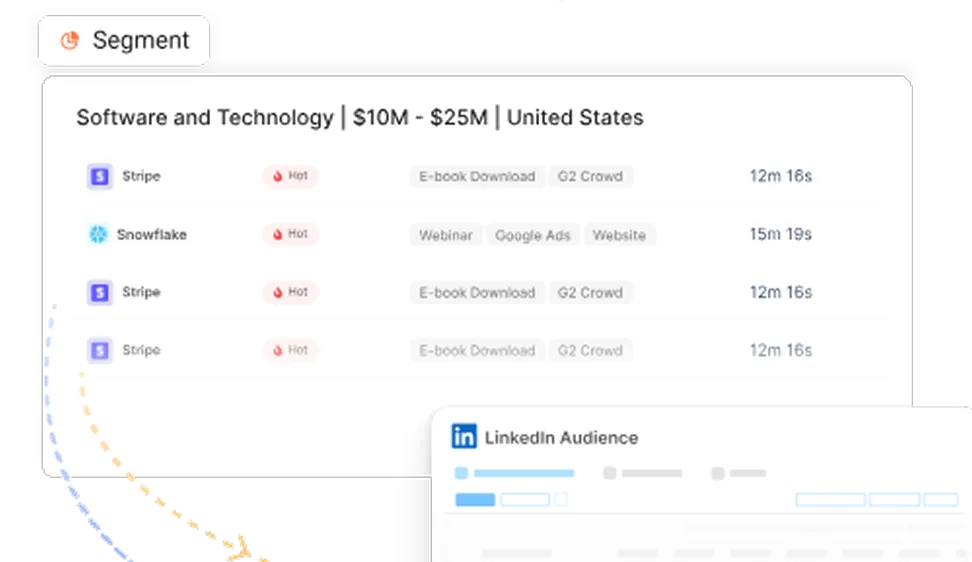
The audience sync capability is where this translates into actual campaign efficiency. Once you've identified your high-intent accounts inside Factors, you can push those audiences directly to your ad platforms so your LinkedIn and Google campaigns are reaching the accounts that are already showing interest, rather than the ones that merely fit your ICP on paper. The difference in engagement rates between those two audience types is usually significant.
The attribution layer matters here too. When you're measuring pipeline quality by audience segment, as we covered above, you need accurate attribution to know which touchpoints contributed to which deals. Factors tracks the full account-level journey so you can see not just which segment converted, but which combination of channels and content moved them from cold to opportunity. That's the feedback loop that keeps your audience strategy improving over time, rather than getting stale.
The teams that use Factors well tend to describe the same shift: they stop running campaigns at broad lists and start running them at specific accounts showing specific signals. The total number of accounts they target often goes down. The pipeline quality goes up. That's what precise audience targeting actually looks like when it's working.
FAQs for B2B target audience
Q1. What is a B2B target audience?
A B2B target audience is the specific group of companies, and the decision-makers within them, that are most likely to buy your product or service. Unlike B2C, where you're targeting individuals, B2B targeting is account-level: you're defining which organisations fit your ideal customer profile and then identifying the multiple stakeholders inside those organisations who influence or make the purchasing decision.
Q2. How is B2B audience targeting different from B2C?
The core difference is structural. B2C targeting focuses on individual consumers making solo decisions, often quickly. B2B targeting has to account for buying committees of three to ten people, sales cycles that stretch across weeks or months, and deal values that make the cost of poor targeting much higher. You're also working with a fundamentally different data set: firmographics, technographics, and intent signals rather than consumer demographics and interest categories.
Q3. What are examples of B2B target audiences?
A marketing analytics platform might target mid-market B2B SaaS companies with 100 to 500 employees spending at least $10K per month on paid advertising, focusing on VP of Marketing and RevOps leads. An HR tech company might target organisations with 500-plus employees that are hiring more than 20 people per quarter, focusing on VP of People and HR Directors. The specificity of the account profile and persona map is what makes an example a real target audience rather than a vague aspiration.
Q4. How do you identify your B2B target audience?
Start by analysing your existing customer base to find patterns in the accounts that convert fastest, retain longest, and generate the most revenue. Use those patterns to define your ICP. Then map the personas inside those accounts who influence and make buying decisions. Layer in behavioural signals like website visits, content engagement, and ad interactions to identify which accounts within your ICP are currently showing buying intent. Validate everything with regular sales feedback to keep the definition grounded in reality.
Q5. What data is needed for B2B audience targeting?
Effective B2B audience targeting draws on three layers. Firmographic data covers company size, industry, revenue, and geography. Technographic data tells you what tools and platforms a company already uses, which helps assess product fit and stack compatibility. Intent data reveals what topics and solutions a company is actively researching right now, which is often the strongest signal of near-term buying interest. First-party data from your own website and CRM rounds this out by showing which accounts are already engaging with you.
Q6. How often should you update your target audience?
At minimum, quarterly. Markets shift, your product evolves, and the companies that were your best-fit customers twelve months ago may not represent your best opportunity today. A quarterly review that pulls fresh CRM data, win/loss patterns, and sales team feedback will usually surface meaningful adjustments. Some high-growth teams run a lighter monthly check on engagement signals to catch shifts in which segments are performing, while reserving the deeper ICP review for quarterly cycles.
Q7. What tools help with B2B audience targeting?
The core toolset typically includes a CRM for account and deal data, an intent data provider for third-party research signals, LinkedIn Ads for account and persona-level targeting, and a marketing analytics platform that can unify engagement signals across channels. Tools like Factors.ai add the layer that most teams are missing: a unified account-level view that combines website behavior, ad engagement, and CRM data so you can see which accounts are showing buying signals across all your touchpoints at once.
Q8. Why is intent data important in B2B targeting?
Because firmographic fit tells you who could theoretically buy your product, but intent data tells you who's actually looking to buy something like it right now. Of the 500 companies that match your ICP, only a fraction will be in an active evaluation cycle at any given moment. Intent data lets you concentrate your budget and sales attention on that fraction, rather than spreading effort equally across accounts with completely different levels of readiness. The result is higher engagement rates, shorter sales cycles, and significantly better pipeline quality.

Powered by Bombora
Enter your domain and we'll send you a free list of companies showing buying intent in your vertical.
.avif)
Powered by Bombora
Enter your domain and we'll send you a free list of companies showing buying intent in your vertical.
.avif)

See how Factors can 2x your ROI
Boost your LinkedIn ROI in no time using data-driven insights


.avif)

See Factors in action.
Schedule a personalized demo or sign up to get started for free
LinkedIn Marketing Partner
GDPR & SOC2 Type II

.svg)



.avif)

