
Upper Funnel vs Lower Funnel: The B2B Marketing Guide
Understand upper funnel vs lower funnel marketing in B2B. Learn strategies, metrics, and how intent data connects awareness to revenue.
.avif)
Content Marketer



.svg)


TL;DR
- Upper funnel marketing builds awareness and educates buyers who don’t know you yet, targeting a broad audience at the awareness stage of the buying journey. Lower funnel marketing converts interested prospects into paying customers. Both are essential — not competing priorities.
- Most B2B teams over-invest in lower-funnel activity because it’s easier to measure, which starves the pipeline of future demand.
- Between awareness and conversion sits a layer of intent signals, repeated visits, pricing page views, competitor research, that most analytics tools miss entirely.
- Connecting upper-funnel and lower-funnel data through account-level intent tracking closes the visibility gap and helps teams act on buying signals earlier.
- Full-funnel attribution ties early awareness campaigns to downstream revenue, giving marketing leaders the evidence they need to defend balanced budget allocation.
- The marketing funnel represents the buying journey from awareness to purchase, with upper funnel (TOFU) and lower funnel (BOFU) stages requiring different strategies, content, and metrics.
There’s a meeting that happens in every B2B marketing team, usually around day three of the quarter, and it goes like this.
Someone presents a campaign report. The LinkedIn thought leadership series got great reach. The webinar pulled 400 registrants. Organic traffic is up. Everyone nods. Then the sales lead or someone from finance asks: “But how many deals did this actually close?”
Eerie silence.
Because nobody can draw a straight line from “we ran a great webinar” to “we closed revenue.” So… what happens then? The upper-funnel efforts get labelled as ‘brand activity’, a polite way of saying ‘nice to have.’ Budget shifts to retargeting, to bottom-of-funnel paid search, to whatever has a number attached to it. Pipeline looks okay for a quarter or two… and then (slowly and confusingly), it starts to thin… making you make this exact face:

We’ve all seen this play out more times than we’d care to admit. And the frustrating part is that it’s not a measurement problem. It’s a strategy problem dressed up as a measurement problem. The upper funnel vs lower funnel tension shapes how B2B companies grow, plateau, or hand market share to competitors who invest differently.
This amazing and really long guide covers what both stages actually do, how to measure them, where teams go wrong, and (most importantly) how to connect the two halves into something that actually works. Understanding the entire customer journey and using the sales funnel as a framework is essential for developing strategies that address every stage, from awareness to conversion.
What does ‘upper funnel vs lower funnel’ actually mean?
The marketing funnel is one of those frameworks that’s been around so long it’s almost embarrassing to explain. Wide at the top, narrow at the bottom. Many people enter, fewer people buy. Simple visual, real insight. This entire process is often referred to as the conversion funnel, which maps the customer journey from initial awareness through to purchase and beyond.
- Upper funnel marketing (also known as top of funnel marketing) is the work that happens when someone doesn’t know you yet. This stage of the customer journey focuses on creating awareness, generating interest, and establishing brand recognition. Prospects might be aware that a problem exists, or might not even be sure they have the problem. They’re not comparing pricing pages, they’re still figuring out what they’re looking for. Your job here is to get into the mental shortlist before anyone’s even started shortlisting.
- Lower funnel marketing is what happens after someone knows the problem, knows the category, and is evaluating specific vendors. They’re reading case studies, requesting demos, visiting pricing pages. Your job here is to remove friction and prove you’re the right choice.
In the middle sits consideration… the messy, non-linear, multi-stakeholder zone where most real B2B buying actually happens. Buyers don’t flow neatly from awareness to purchase. They loop back… stall… forward your blog post to a colleague who has no idea who you are yet. THEN, the VP of Marketing discovers you through a LinkedIn ad while the CTO first found you through a technical white paper three months earlier, and the CFO won’t get involved until someone drops a business case on their desk.
The funnel metaphor is both useful and slightly misleading. Useful because it reminds you that there are two fundamentally different jobs to do, building demand and converting demand. Misleading because it implies a neat journey that nobody actually takes. The point is that neglecting either stage makes the whole system break. It’s also important to note that success metrics differ significantly between the upper and lower funnel stages: upper funnel metrics focus on impressions and engagement, while lower funnel metrics emphasize conversion rates and customer acquisition costs.
How the B2B marketing funnel actually works
Most content about B2B marketing funnel stages presents you with three clean stages, awareness (also known as the awareness stage), consideration (the middle funnel), and decision, and implies that buyers move through them like they’re on a conveyor belt. (They actually don’t.)
The funnel framework is still useful for mapping out funnel strategies and understanding how to attract, nurture, and convert leads at each stage. But in reality, buyers move back and forth between the upper funnel, middle funnel, and lower funnel as they research, evaluate, and decide. Optimizing the full marketing funnel requires a comprehensive, collaborative approach that maximizes conversions and fosters lasting relationships with customers at every stage of their journey.
The three stages as a starting point
- Awareness (the awareness stage) is where a potential buyer first encounters your brand or their problem. A blog post. A LinkedIn ad. A colleague saying “have you heard of these guys?” They’re not shopping, let’s just say they’re… orienting.
- Consideration (often referred to as the middle funnel) is where that awareness becomes active research. Comparing approaches, reading industry reports, attending webinars, and visiting multiple vendor websites. In B2B, this can last weeks or months. Buying committees are forming behind the scenes, internal champions are gathering ammunition, and the actual evaluation is happening in Slack threads and internal docs you’ll never see.
- Decision is where shortlisted vendors get evaluated for real. Demos. Procurement. Pricing negotiations. Eventually, a signature. Marketing’s role here shifts to supporting sales, case studies, ROI calculators, comparison pages, but the heavy lifting has largely moved to the sales team.
Why is linearity a myth in B2B?
Here’s where the neat diagram falls apart.
A buyer might attend your webinar (awareness), visit your pricing page the next day (decision), then disappear for six weeks before downloading a technical comparison guide (consideration). They’ve moved backward and forward through the funnel without asking your permission.
Multiple stakeholders make this exponentially messier. The person who discovers your brand is rarely the one who signs the contract. Information gets passed around internally, and different team members enter the funnel at completely different stages. One person’s lower-funnel moment is another person’s first-ever touchpoint with your brand.
Intent signals appear throughout this entire journey, but they don’t map cleanly to any one stage. A pricing page visit could mean someone’s a week away from buying, or it could mean a student doing competitive research for a class project. (Both happen more than you’d think.)
The funnel framework earns its keep not because it’s precise, but because it forces the right strategic question: are you investing in both creating demand and converting it? Because if you’re only doing one, you’re building on sand. Effective funnel strategies require integrating tactics across upper, middle, and lower funnel stages to attract, nurture, and convert leads throughout the customer journey. Optimizing the full marketing funnel requires a comprehensive, collaborative approach that maximizes conversions and fosters lasting relationships with customers at every stage of their journey.
Upper-funnel marketing: goals, channels, and metrics
Upper-funnel marketing involves establishing your presence before your audience requires your services. Brand building at this stage is crucial, as it creates brand awareness, expands your audience reach, and helps generate a steady stream of leads that can be nurtured through the customer journey for long-term ROI.
This is where most B2B teams struggle (not tactically) but philosophically. The payoff is real, but it’s delayed, indirect, and notoriously hard to put in a spreadsheet. Patience is a hard sell when someone wants pipeline numbers by end of quarter.
Goals of upper-funnel marketing
The objectives are simple, even if measuring them isn't:
- Build brand awareness so your target audience knows you exist
- Educate the market on a problem or category, so you're a credible voice in that conversation
- Introduce the problem your product solves, so that when a buyer eventually starts researching, your name is already familiar
None of this generates immediate revenue. That's by design. Upper-funnel marketing plants seeds. The harvest happens later, and usually through a channel that steals all the credit (like a branded search click or a demo request) while the original awareness work goes unrecognized. It's a thankless job. But somebody has to do it.
Common B2B channels for upper-funnel marketing
The best upper-funnel channels deliver value without demanding commitment in return.
- SEO-driven blog content is the classic example. When someone searches “how to improve marketing attribution” and finds a genuinely useful guide from your company, that’s awareness at scale, without a sales pitch in sight.
- Social media ads and paid search ads are also key upper-funnel channels. Social media ads help build brand awareness and engage broad audiences, while paid search ads drive targeted traffic and improve keyword targeting, enhancing overall visibility alongside display ads and other paid campaigns.
- LinkedIn thought leadership has become one of the most powerful upper-funnel channels in B2B SaaS. A founder or marketing leader who shares real, specific, experience-backed insights (not recycled takes) can build brand recognition faster than most paid campaigns. I’ve seen this firsthand: one well-placed LinkedIn post from a CEO can do more for top-of-funnel awareness than six weeks of display ads.
- Podcasts, industry reports, and webinars all serve similar functions. They reach audiences who are actively learning but not yet actively buying. The common thread: they lead with insight, not pitch.
Successful upper-funnel strategies often include content marketing, paid media, influencer collaborations, and events to engage a broad audience and create initial interest. Brands that invest in upper funnel marketing strategies, such as content marketing and social media, can see a significant increase in brand awareness and customer engagement, which are essential for long-term growth.
Marketing funnel metrics for the upper funnel
Upper-funnel KPIs are about visibility and engagement, not revenue, and that distinction is exactly why they get dismissed in budget conversations.
The metrics that matter:
- Impressions and reach (how many people actually saw your content)
- Website visits from non-branded searches
- Engagement rate on social content
- Video views for educational content
- Branded search growth over time (this one is underrated)
Branded search growth is the metric I'd fight hardest to keep. When more people start searching for your company name, something real is happening. Awareness is working. The problem is that nobody can point to a single campaign and say, "that's what did it," which means it gets dismissed as coincidence.
Here's the thing about awareness vs conversion marketing: if your brand isn't part of someone's mental shortlist before they start evaluating vendors, you're entirely dependent on outbound sales and paid ads to get in front of them. That's expensive, and it's fragile. Upper-funnel metrics measure the demand you're creating.
Lower-funnel marketing: goals, channels, and metrics
Lower-funnel marketing picks up where awareness leaves off. It targets warm prospects who already know your brand, understand the problem, and are actively evaluating whether your product is the right fit. Lower funnel tactics and strategies focus on converting these high-intent leads into customers and generating revenue through targeted efforts.
If upper-funnel work is planting seeds, lower-funnel work is making sure nothing goes wrong at harvest time. A buyer who’s interested but hits friction, confusion, or weak proof points will simply choose a competitor. They’ve done the hard work of finding you, at this stage, it’s on you not to blow it. Lower funnel focuses include highlighting benefits, offering incentives, and providing reassurance through demos, customer testimonials, and direct sales ads.
Goals of lower-funnel marketing
The objectives here are tightly tied to revenue:
- Convert qualified prospects into customers
- Reduce friction in the buying process
- Prove ROI in concrete, specific terms
Lower funnel focuses on converting high-intent, warm leads into customers by using personalized content, retargeting, and specific performance metrics like conversion rate and ROAS to optimize sales and ROI. At this stage, marketing emphasizes benefits, incentives, and reassurance through demos, testimonials, and direct sales ads.
Lower-funnel marketing also plays a psychological role that often gets overlooked. By the time a buyer reaches this stage, they’ve often already made a tentative internal decision. What they need from you is ammunition… to justify their preference to skeptical colleagues and a suspicious finance team. Case studies, comparison pages, and product demos all serve this function: ‘Give me the evidence to defend my choice’.
Common channels for lower-funnel marketing
- Product demos are the most direct, a hands-on sense of what buying would actually mean. Free trials also serve the same purpose for product-led growth models.
- Comparison pages address the ‘why you over them?’ question that every buyer is privately asking but might not say out loud. If you don’t answer it, they’ll find the answer on G2 or Gartner instead, and you’ll have no control over what they find.
- Case studies are powerful because they let prospects see themselves in someone else’s success story. ‘Oh, they were struggling with the same attribution mess we have’, that recognition is worth more than any product feature sheet.
- Retargeting ads keep your brand visible during the long B2B evaluation period and can increase conversion rates by up to 150%, with retargeted users being around 70% more likely to convert than first-time visitors.
- Email marketing and email drip campaigns are highly effective lower-funnel tactics, achieving open rates around 60% and click-through rates near 15%, significantly outperforming standard email campaigns.
- Customer testimonials showcased in retargeting campaigns, especially on platforms like Facebook, can effectively convert warm leads and enhance advertising effectiveness.
- Sales outreach, when timed well, converts digital intent signals into real conversations. And pricing pages, whatever you think about showing pricing publicly, are one of the strongest lower-funnel signals a buyer can give you. Lower-funnel strategies also focus on driving repeat purchases to maximize customer lifetime value.
Marketing funnel metrics for the lower funnel
These are the numbers that make finance teams happy:
- Conversion rate
How effectively you’re turning prospects into customers - Pipeline created
Total value of opportunities generated - Cost per acquisition (CPA)
What you’re spending to win each customer - Return on ad spend (ROAS)
Connecting paid activity to actual revenue - Revenue
The ultimate lower-funnel metric, the one everything else ladders up to
Lower funnel efforts and lower funnel strategies are essential for maximizing conversions and revenue, as they focus on guiding prospects through the final stages of the customer journey. The bottom of the funnel targets warm prospects who are ready to make a decision between competing solutions. Lower funnel marketing strategies should be managed by experts skilled in closing deals, and are integral to a comprehensive, full-funnel marketing approach.
These numbers make it easy to defend lower-funnel marketing in budget conversations. And that clarity is a double-edged sword. It makes it easy to justify, and dangerously easy to over-index on, to the point where the entire marketing function starts to look like a demand capture machine with nothing feeding the top.
Upper funnel vs lower funnel: what's actually different?
Here’s a side-by-side that makes the contrast concrete:
Now let’s see the pattern. Upper-funnel activity targets a broad audience and potential customers; it is harder to measure and takes longer to pay off, but it creates the demand that the lower funnel converts. Lower-funnel activity focuses on a narrower group of high-intent prospects, is easier to justify, and is faster to show results, but it can only work with the audience that upper-funnel efforts already attracted.
Each stage requires its own marketing tactics and tailored marketing campaigns to move potential customers through the funnel effectively. Success metrics also differ significantly: upper funnel metrics focus on impressions and engagement, while lower funnel metrics emphasize conversion rates and customer acquisition costs.
You can have the best demo experience in your category, but if nobody’s heard of you, there’s nobody to demo to.
Conversely, you can run brilliant brand campaigns, genuinely great creative, sharp positioning, the works, and if your conversion experience is clunky and unconvincing, all that awareness evaporates exactly at the moment it should be turning into revenue.
The comparison between top of funnel vs bottom of funnel is about recognizing that they operate on different timelines, require different skills, and produce different kinds of evidence. A mature funnel marketing strategy respects both, not because it’s philosophically balanced, but because the math eventually forces the issue.
Why most B2B teams over-invest in the lower funnel
There’s a pattern I’ve seen play out in B2B organizations of almost every size, and it usually starts with entirely good intentions.
The marketing team runs a healthy mix of awareness and conversion activity. Results come in. Lower-funnel campaigns produce clear numbers: demos booked, pipeline created. Lower funnel efforts are specifically focused on converting nurtured prospects to customers and are critical to generate revenue. Upper-funnel campaigns produce… impressions. Maybe some engagement metrics. Maybe a vague branded search uptick that nobody can tie to a specific campaign.
At the next budget review, guess which programmes get expanded and which get trimmed?
Research shows that companies that adopt full-funnel marketing see up to 45% higher customer retention rates and stronger overall ROI.
The gravitational pull of measurability
Lower-funnel marketing attracts disproportionate investment because it produces results that are fast, visible, and easy to put in a spreadsheet. Retargeting shows click-through rates and conversions. Branded search campaigns show direct-response metrics. Sales enablement content gets real-time feedback from the sales team. Everything at the bottom of the funnel comes with a number attached, and in organizations running on quarterly reporting, numbers win.
Upper-funnel activity requires you to argue in probabilities. Things like: ‘Branded search volume grew 35% this quarter, which suggests our awareness campaigns are working’ is a perfectly valid analytical statement. But it doesn't carry the same weight in a budget meeting as ‘this campaign generated £400K in pipeline.’ SEE, how you nodded in agreement, I saw that, too. The measurability gap creates a gravitational pull toward conversion spending, even when everyone in the room intellectually understands that awareness matters.
What happens when the lower funnel eats up the budget?
The consequences don't show up immediately, which is exactly what makes this trap so effective. In the first quarter after shifting budget downward, pipeline might actually improve. You're squeezing more efficiency out of the existing aware audience, and the surplus from previous awareness campaigns is still flowing through.
By the second or third quarter, four problems tend to surface:
- Shrinking pipeline
Fewer new companies are discovering your brand. The top of the funnel narrows. There are simply fewer accounts entering consideration, which means fewer opportunities for the lower funnel to convert. You can't close deals that never started. - Rising customer acquisition cost
As the pool of aware prospects shrinks, you're paying more to reach and convert each remaining one. Retargeting the same audience repeatedly yields diminishing returns. Branded search campaigns start competing against a flat or declining search volume. - Weakening brand awareness
Your competitors, the ones still investing in thought leadership and educational content, start occupying the mental space your brand used to hold. Prospects who would have found you organically now find someone else first. - Dependence on existing demand
Your marketing engine becomes a demand capture machine with no demand creation engine feeding it. You can only convert people who already know you. And that audience isn't growing.
This is the demand capture vs demand creation imbalance, and it's one of the most common strategic pitfalls in B2B. The irony is painful: the teams most focused on proving marketing's impact on revenue are often the ones undermining their future revenue by starving the upper funnel.
It's like only training the muscles you can see in the mirror. Everything looks great until you try to do something that requires the ones you've been ignoring.
The missing layer: intent signals between awareness and conversion
Traditional funnel thinking treats awareness and conversion as two distinct stages with a vague, hand-wavy middle called ‘consideration.’ That wavy middle part is where most of the interesting buyer behavior actually happens, and in most B2B analytics setups, it’s almost entirely invisible.
Understanding the buying journey and customer journey is crucial for mapping the conversion funnel, which tracks the entire process from initial awareness to purchase. Between upper-funnel and lower-funnel activity, buyers leave a trail of digital intent signals. These aren’t conversions. They’re behavioral clues that a prospect is moving from passive awareness into active evaluation. Recognizing and acting on these signals is what separates teams that react to demand from teams that anticipate it.
What intent signals actually look like
Intent signals aren't a single dramatic event. They're a pattern of behaviors that, taken together, suggest a buyer is getting serious:
- Repeated visits to your website from the same company
- Increased time spent on product-specific pages
- A visit to your pricing page (one of the strongest buying signals in B2B SaaS because nobody visits a pricing page out for fun, but if you do, it’s ok… this is a safe space)
- Downloading gated reports or technical documentation
- Researching your competitors on review sites and comparison platforms
FYI: None of these individually means someone is ready to buy.
But when an account starts exhibiting several of them in a compressed timeframe, something has shifted. They've moved from "vaguely aware" to "actively considering." That's the window where the right marketing or sales action can actually hit accelerate on the deal.
So, why is this layer invisible in traditional analytics?
Because it’s traditional… duh! Sorry, just kidding.
Look, most B2B analytics tools are built around individual sessions and known contacts. Google Analytics tells you how many people visited your pricing page. It doesn't tell you which companies those visitors represent. Your CRM tracks named leads but knows nothing about the three other people from the same account who spent 20 minutes on your blog last week without filling out a form.
Marketing sees aggregate traffic trends… sales sees individual leads… and nobody sees the account-level journey connecting the two. It's like watching a film with every third scene removed. You can follow the general plot, but the most important transitions are missing.
This invisible layer is exactly where intent data platforms add lotsa value. They surface the account-level patterns that reveal which companies are researching, what topics they care about, and how far along they are in their evaluation. When you can see this layer, the gap between upper-funnel and lower-funnel stops feeling like a black box. It becomes something you can actually act on.
How do you connect upper-funnel and lower-funnel data?
The typical B2B marketing stack creates a near-comical separation between the two halves of the funnel. Marketing sees traffic, impressions, and engagement. Sales sees leads, opportunities, and pipeline. The journey between those two, where an anonymous visitor becomes a known prospect, is largely undocumented. Connecting data across the entire customer journey and sales funnel is essential for understanding how prospects move from initial awareness to final purchase.
This isn’t just an analytics inconvenience. It has real strategic consequences. If you can’t connect upper-funnel activity to lower-funnel outcomes within the conversion funnel, you can’t prove which awareness campaigns contribute to revenue. And if you can’t prove that, the budget conversation becomes almost impossible to win.
The visibility problem (in simple words)
Imagine a SaaS company running a strong content programme. Their SEO blog drives thousands of monthly visits. Their LinkedIn posts get solid engagement. Their webinar series consistently pulls a few hundred registrants per event. By every upper-funnel metric, things look healthy.
Meanwhile, sales is closing deals with accounts that seem to appear from nowhere. A prospect books a demo, the sales team asks "how did you hear about us?" and the answer is usually something like "I came across you online a while back." Now… online could mean a thousand things. And unsurprisingly, there's no thread connecting the blog post they read four months ago to the webinar they attended two months ago to the demo they just booked.
Marketing can't take credit. (as someone from marketing, I’ll <insert a sad face> here). More importantly, they can't learn which combination of touchpoints actually works. So then? Every budget conversation is an argument from intuition rather than evidence. And I’m all for gut feelings and intuition, but it just doesn’t cut it here.
Account-level intent tracking can bridge the gap
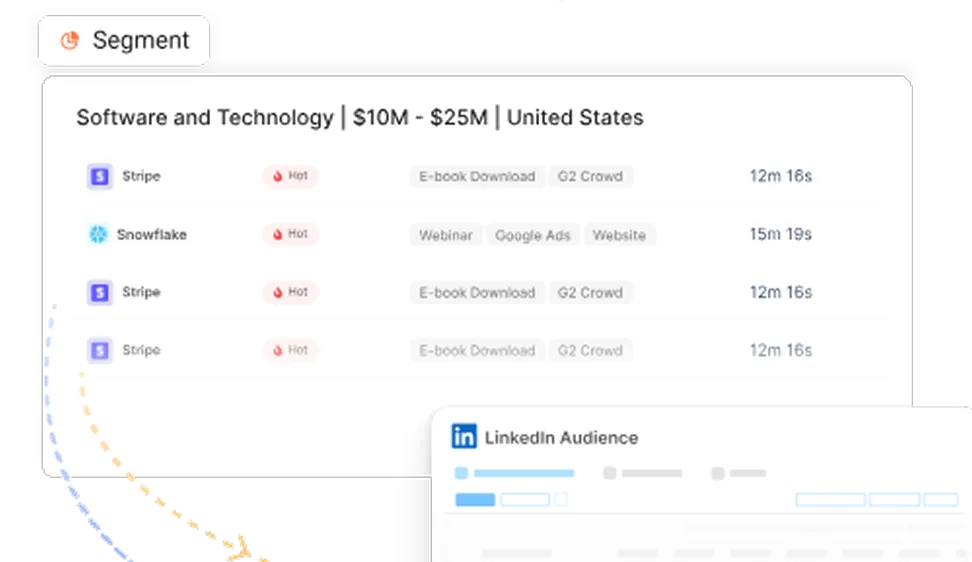
This is where account-level intent tracking changes the equation. Instead of tracking individual anonymous sessions, these platforms identify which companies are visiting your site, what content they're engaging with, and how their behavior changes over time.
Here's what this looks like:
- Identifying anonymous company traffic
Even when individual visitors don't fill out a form, intent tracking can match IP data and other signals to identify which organisations are visiting. You go from "1,200 anonymous sessions this week" to "these 85 companies visited, and here's what they looked at." That's a fundamentally different starting point for a Monday morning pipeline review. - Tracking content engagement at the account level
Instead of knowing that a blog post got 3,000 views, you know that Company X read three blog posts and a comparison page within the same week. That's a materially different signal. - Mapping account journeys across the funnel
You can see the progression from initial awareness touchpoints through consideration content to lower-funnel pages, all connected to a single account. The film no longer has missing scenes. - Triggering retargeting or sales outreach
When an account crosses a certain intent threshold, you can automatically activate a retargeting campaign or alert a sales rep. The response happens when the buying signal is fresh, not two weeks later when someone finally fills out a form. - Prioritising high-intent accounts
Sales teams can focus energy on accounts showing the strongest buying signals, rather than working a list built on gut feel or basic lead score alone.
Platforms like Factors.ai are built to solve exactly this problem. They connect anonymous website activity with account-level identity, stitch together cross-channel engagement data, and surface the intent signals sitting between awareness and conversion. Instead of marketing and sales looking at two different halves of the same picture, they're looking at the same account journey, from first touch to closed deal. That shared visibility is what makes a full funnel marketing strategy operationally real, rather than just a nice idea on a whiteboard.
What does a practical B2B full-funnel strategy look like?
Theory only becomes convincing when you can see it working in context. Let me walk you through how a hypothetical B2B SaaS company (one selling a marketing analytics platform) might structure a full-funnel strategy that actually connects awareness to revenue.
- Upper-funnel layer: creating demand
The company invests in four primary awareness channels. Their marketing team publishes SEO-driven guides on topics like “marketing attribution models” and “how to measure campaign ROI.” Their Head of Marketing posts weekly LinkedIn content drawn from real campaign data and lessons learned (not recycled industry platitudes). They produce quarterly industry reports with original research that earns backlinks. And they run a monthly webinar series featuring marketing leaders from their target customer segment. Optimized social media pages play a crucial role here, increasing brand visibility, building authority, and helping attract quality leads through engaging content and consistent social media marketing strategies.
Notice what’s missing from this list: product mentions. None of these activities are pitching. They’re designed to attract marketing leaders who care about measurement and attribution, the exact audience the company wants to reach. The goal is to earn attention and build recognition over months, not to generate instant leads. Yes, this requires patience. No, this is not optional.
- Mid-funnel layer: nurturing interest
As awareness activity brings visitors to the site, some start showing deeper engagement. They visit comparison pages. They download gated reports. They click retargeting ads after an initial website visit.
The crucial addition here is intent tracking. Using account-level analytics, the marketing team can see which companies are engaging across multiple touchpoints. A company that read two blog posts, attended a webinar, and visited the comparison page is sending a very different signal than one that bounced off the homepage after twelve seconds. Treating both the same way is a waste of everyone's time.
- Lower-funnel layer: converting demand
For accounts showing strong buying intent, the company activates its lower-funnel playbook. High-intent accounts get invited to a personalised product demo. The sales team receives alerts with context on what content the account has consumed, so they can tailor outreach instead of starting from scratch. At this stage, marketing campaigns are crafted specifically for bottom-of-funnel conversion, focusing on persuading prospects to choose their solution over competitors. Case studies relevant to the prospect’s industry are shared proactively. And the pricing page serves as both a conversion tool and an intent signal when accounts return to it repeatedly.
How intent data ties the layers together
Without intent data, each funnel layer operates semi-independently. Marketing runs awareness campaigns and hopes they contribute to pipeline. Sales works whatever leads come through without knowing what happened before the form fill. Everyone's doing their job and nobody can see the full picture.
With intent data, the layers connect. Marketing can identify which companies are researching their category based on content engagement patterns. They can activate retargeting precisely when an account shows elevated interest. And they can shorten the sales cycle by equipping sales with context about the prospect's journey before the first conversation even starts.
The prospect who books a demo isn't a mystery anymore. You know they read your attribution guide three weeks ago, attended your webinar two weeks ago, and visited your pricing page twice this week. That knowledge changes how sales approaches the conversation, and it changes how marketing measures its contribution. Finally.
How should you measure funnel performance with attribution?
Attribution is where the upper funnel vs lower funnel conversation either comes together or falls apart. Without a credible way to connect early-stage marketing activity to downstream revenue, every budget conversation becomes an argument from gut feeling. And in B2B, where buying cycles can stretch across months and dozens of touchpoints, getting attribution right is both essential and genuinely difficult. For lower funnel efforts, metrics like customer lifetime value are especially important, as they measure the long-term impact of marketing by tracking repeat purchases, order value, and overall customer engagement over time.
Why is last-click attribution such a problem in B2B?
Most B2B teams default to last-click attribution, either intentionally or because it's the path of least resistance in their tools. Last-click gives all the credit to the final touchpoint before a conversion. Prospect books a demo after clicking a retargeting ad? The retargeting ad gets 100% of the credit.
The problem is obvious when you think about it. That prospect might have first encountered your brand through a blog post, attended a webinar, read a case study, and then clicked the retargeting ad. Last-click ignores everything that came before. It systematically undervalues upper-funnel activity and over-credits the last touch, which is almost always a lower-funnel channel.
In B2B specifically, this distortion is severe. Attribution debates sometimes resemble group projects where the person who showed up for the final presentation takes all the credit, while the person who did six months of foundational research gets nothing. When your attribution model only sees the last step, your budget decisions will inevitably favor the last step, which reinforces the lower-funnel over-investment problem we covered earlier. It's a self-fulfilling prophecy.
Multi-touch attribution as a corrective
Multi-touch attribution distributes credit across all the touchpoints that contributed to a conversion, rather than awarding everything to the last click. There are different models for how to distribute that credit: linear, time-decay, position-based, and data-driven, but the core principle is consistent: multiple interactions share recognition for a conversion outcome.
This matters enormously for upper-funnel marketing. When you can show that a LinkedIn thought leadership campaign influenced 40 accounts that later entered the pipeline, even though none converted directly from a LinkedIn click, you've got evidence that awareness investment is working. That evidence is what keeps the upper funnel funded.
Multi-touch attribution is far from perfect, and we should acknowledge this reality. It requires clean data, consistent tracking, and a willingness to accept probabilistic rather than deterministic answers. No attribution model answers every question perfectly, and anyone who tells you otherwise is probably selling one. But even an imperfect multi-touch model is dramatically better than last-click for understanding how B2B marketing actually works.
Here are the metrics that matter for full-funnel attribution
When you're measuring funnel performance with attribution, the metrics shift from channel-specific vanity numbers to strategic indicators:
- Influenced pipeline. What is the total pipeline value influenced by a specific campaign or channel, even if it wasn't the last touch? This is the metric that gives upper-funnel marketing its due credit.
- Assisted conversions. How many conversions did a channel assist, even when it wasn't the converting touchpoint? A blog post that introduces an account to your brand might assist dozens of conversions without ever being the last click.
- Account journey tracking. Mapping the full sequence of touchpoints an account engaged with before converting. This qualitative view often reveals insights that aggregate metrics miss, like the discovery that webinar attendees convert at twice the rate of non-attendees, which is the kind of data point that justifies an entire content programme.
- Campaign-level ROI. Connecting specific campaigns to revenue outcomes, weighted by attributed contribution. This lets you compare the true return on an SEO content investment against a retargeting campaign on an apples-to-apples basis, rather than just comparing impression cost to CPL and calling it analysis.
These are the marketing funnel metrics that connect early marketing activities to pipeline and revenue, and they're exactly what tools like Factors.ai are designed to surface. By stitching together account-level engagement data across channels and mapping it to pipeline outcomes, attribution platforms give marketing leaders the evidence they need to defend full-funnel investment.
Instead of presenting impressions and hoping the room trusts that awareness matters, you can show the actual account journeys that started with a blog post and ended with closed revenue. That changes the conversation from ‘trust me, brand matters’ to ‘here's what the data shows.’
When attribution is working properly, the upper funnel vs lower funnel debate stops being an argument. It becomes a planning conversation about how to allocate resources across a system that clearly requires both.
In a nutshell
The gap between upper-funnel and lower-funnel marketing in B2B affects pipeline growth, customer acquisition cost, and how confidently you can defend your marketing budget when someone from finance asks the inevitable question.
Upper and lower funnel strategies each play a distinct role in guiding the customer journey from brand awareness to conversion. Upper-funnel marketing creates the demand that lower-funnel marketing converts. When B2B teams cut awareness spending because it’s hard to measure, pipeline eventually thins and acquisition costs rise. The solution isn’t to measure the upper funnel by lower-funnel standards. It’s to use the right metrics: branded search growth, engagement, and reach, and the right tools, account-level intent tracking, multi-touch attribution, to make the connection visible.
Between awareness and conversion sits a layer of intent signals that most analytics setups miss entirely. Repeated site visits, pricing page views, content consumption patterns, competitor research, these all indicate that an account is moving from passive awareness to active evaluation. Surfacing these signals with tools like Factors.ai gives marketing and sales a shared view of the buyer journey, which is the foundation of any real full-funnel strategy.
If you take one thing from this piece, let it be this: audit where your budget actually sits. If more than 70% of your marketing spend targets the lower funnel, you’re likely capturing existing demand rather than creating new demand. Rebalancing, while investing in the intent tracking and attribution infrastructure that connects the two halves, is the single highest-leverage move most B2B teams can make.
Start by identifying the accounts already showing intent signals on your site, and connect those signals to the awareness campaigns that brought them there. That’s where the full-funnel picture starts to become clear. Balancing upper and lower funnel strategies is essential for full-funnel effectiveness, not only driving conversions but also fostering customer loyalty through ongoing engagement and retention.
Frequently asked questions for upper funnel vs lower funnel
Q1. What’s the difference between upper-funnel and lower-funnel marketing?
Upper-funnel marketing focuses on building awareness and educating potential buyers who may not know your brand yet. It uses channels like SEO content, LinkedIn thought leadership, webinars, podcasts, and content marketing to deliver educational value and spark interest. Lower-funnel marketing targets prospects who are already evaluating solutions and aims to convert them into customers through demos, case studies, pricing pages, and sales outreach. Google Ads can be leveraged at both stages, with upper-funnel campaigns driving brand awareness and lower-funnel campaigns focused on conversions. The two stages serve different roles in the buyer journey but work best when they’re connected through consistent messaging and shared data.
Q2. Why is upper-funnel marketing important for B2B specifically?
B2B buying cycles are super long, often spanning months and involve multiple stakeholders. By the time a buyer enters the decision stage, they’ve already formed opinions about which brands are credible. Upper-funnel marketing builds that trust and recognition well before the buying need becomes urgent. Without it, you’re entirely dependent on capturing demand that already exists, which limits your total addressable audience and makes you vulnerable to competitors who invested in awareness while you weren’t.
Q3. Which channels work best for upper-funnel B2B marketing?
SEO-driven blog content, LinkedIn thought leadership, educational webinars, podcasts, industry reports, YouTube videos, and content marketing are the most effective upper-funnel channels in B2B. The common thread is that they deliver genuine value to the audience without requiring a purchase commitment. The best upper-funnel content addresses problems and ideas your target buyers actually care about (even if your product never gets a mention).
Q4. Which metrics matter most for lower-funnel marketing?
The core lower-funnel metrics are conversion rate, pipeline created, cost per acquisition (CPA), return on ad spend (ROAS), and revenue. These are the numbers directly tied to revenue outcomes, which is why they dominate budget conversations and, ironically, why teams tend to over-invest in lower-funnel activity at the expense of building future demand. Google Ads is a common channel for lower-funnel campaigns, where performance is measured closely against these metrics.
Q5. How do you connect upper-funnel and lower-funnel data?
Account-level intent tracking is the most effective way to connect the two. Instead of tracking anonymous individual sessions, intent platforms identify which companies are visiting your site, what they’re engaging with, and how their behaviour evolves over time. Tools like Factors.ai stitch together cross-channel engagement data and surface the intent signals that live between awareness and conversion, giving marketing and sales a shared view of the buyer journey rather than two disconnected halves of a story nobody can fully read. Mapping the customer journey is essential to ensure that marketing strategies and data are aligned at every stage, from initial awareness to final conversion.
Q6. What is full-funnel attribution in B2B marketing?
Full-funnel attribution connects early-stage marketing activity to downstream revenue outcomes. Instead of crediting only the last touchpoint before a conversion, which systematically undervalues awareness work, full-funnel attribution distributes credit across all the interactions that influenced a buyer’s journey. It uses models like multi-touch attribution to show influenced pipeline, assisted conversions, and campaign-level ROI. It’s how marketing teams prove that the blog post someone read four months ago actually contributed to the deal that closed last week.

See how Factors can 2x your ROI
Boost your LinkedIn ROI in no time using data-driven insights


.avif)

See Factors in action.
Schedule a personalized demo or sign up to get started for free
LinkedIn Marketing Partner
GDPR & SOC2 Type II

.svg)



.avif)

