
Top 10 Best B2B Sales Prospecting Tools (That Help You Find Buyers, Not Just Names)
Looking for the best sales prospecting tools? This guide breaks down the top B2B sales prospecting tools, how they work, and which prospecting sales tools fit your sales motion.

Growth Marketer
.avif)
Content Marketer



.svg)


TL;DR
- The best sales prospecting tools help teams decide who to reach out to, when to do it, and why now, not just hand over more contacts.
- Sales prospecting tools should be signal-driven, not list-driven. Intent data, website engagement, and real account activity matter more than static databases or “just-in-case” outreach.
- There’s no single “best” prospecting tool; use a stack. Intent tools help you narrow in; data tools provide contacts; relationship tools add context; and execution tools scale outreach.
- When used correctly, B2B sales prospecting tools shift sales from volume to relevance. Fewer random emails, better conversations, and a pipeline that actually moves.
Let’s start with a scene you’ve definitely lived through.
You open your CRM.
There are hundreds of leads.
Dozens of sequences running.
Sales says they’re “following up.”
Pipeline, however, is just…not growing.
Then someone asks: “Are we prospecting enough?”
What they are really asking is, “Why do we have so many leads… and so few meaningful meetings?”
That’s the exact mess sales prospecting tools are meant to fix.
Not by dumping more contacts into your lap (because clearly, that’s not the problem), but by helping you zero in on the right accounts that are actually in market, at the right moment, with context.
In this guide, we’ll cover:
- What B2B sales prospecting tools really do
- How to choose the best prospecting tools for sales without overthinking it
- A practical, no-nonsense list of the 10 best B2B sales prospecting tools teams actually use today
Let’s get into it.
What are sales prospecting tools
Sales prospecting tools exist to stop sales teams from asking the same three questions over and over (usually out loud on Slack):
- Who should we reach out to?
- When should we reach out?
- Why would they care right now?
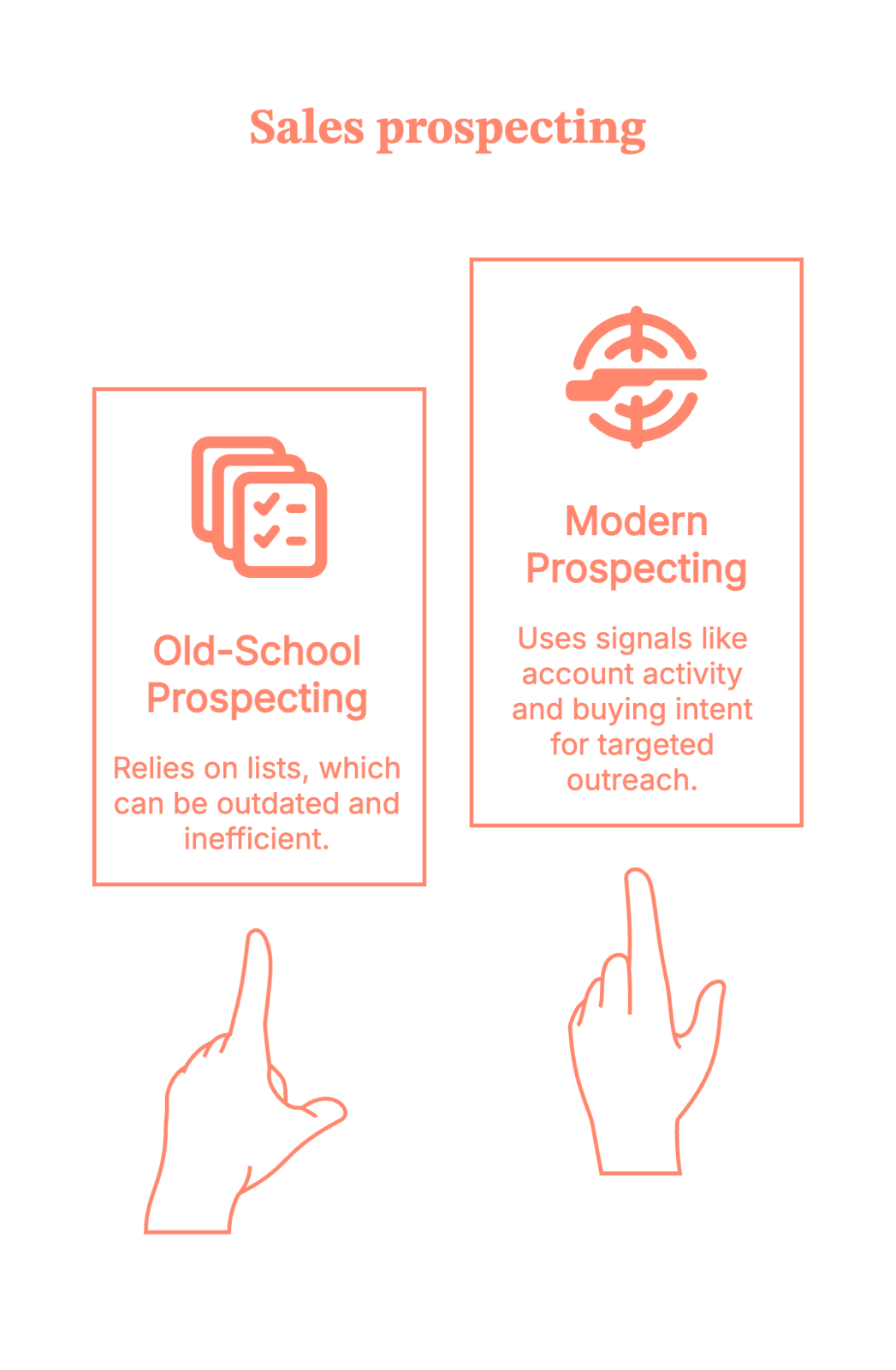
Old-school prospecting was all about lists.
Big questionable lists.
But now the modern B2B sales prospecting tools are about signals. They pull together things like:
- Account activity and buying intent
- Company and contact data
- Website visits and ad engagement
- CRM and outbound workflows
These tools are a very helpful nudge, saying, “Hey… this account might be worth your time today.”
The thinking, judgment, and charm? Still on you. (Sorry. No tool can fix that yet.)
How to choose the best sales prospecting tools
Before we jump into the list, let’s pause for a quick reality check.
Also read: Factors.ai vs Cognism: The GTM Platform Breakdown
Not every sales prospecting tool has to be in your stack. Some look impressive in demos, and then quietly turn into expensive tabs no one opens after week three. (You know the ones.)
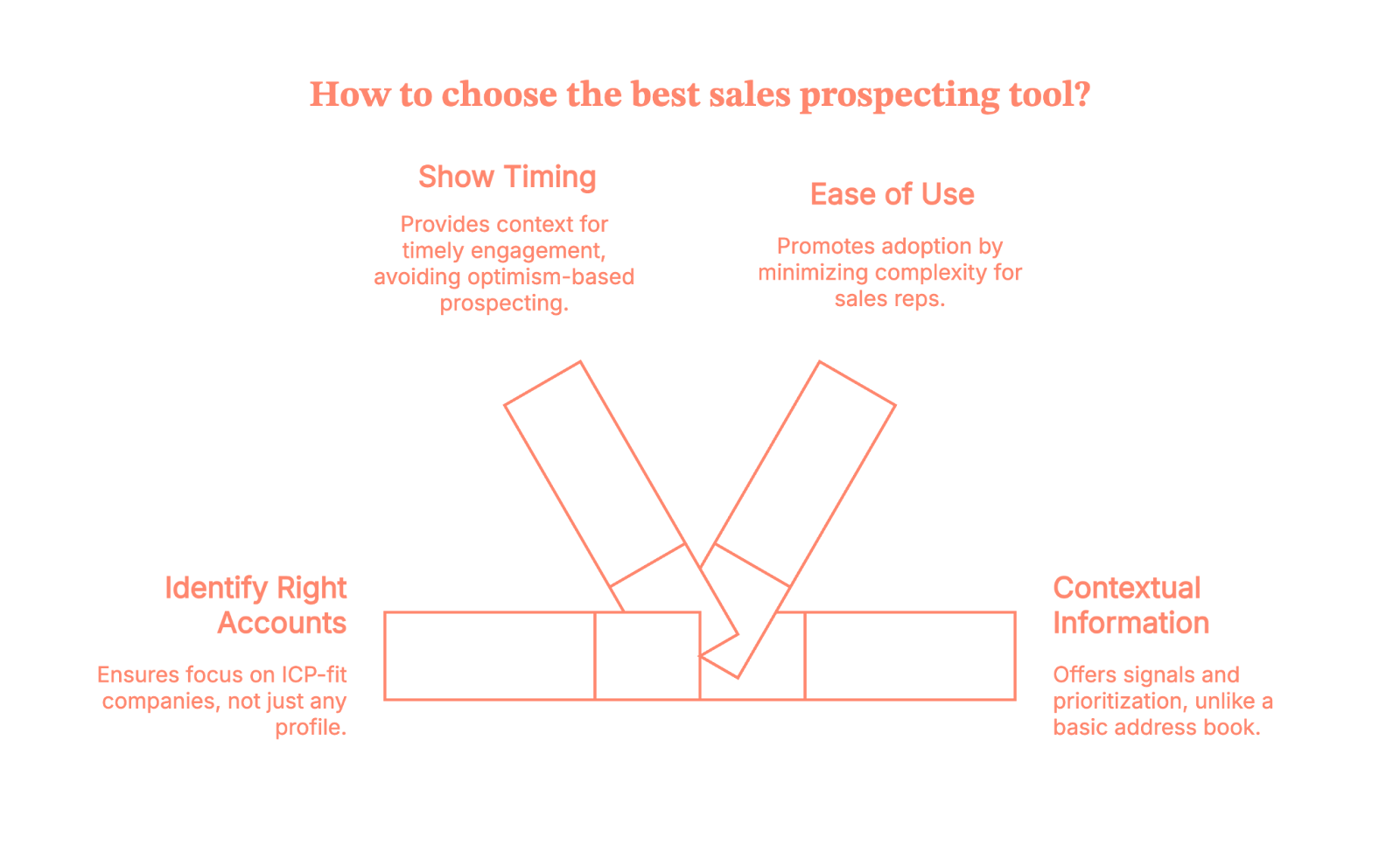
So here’s a simple way to evaluate any prospecting sales tool. Ask yourself:
1. Does it help me identify the right accounts?
Not “anyone with a LinkedIn profile” but actual ICP-fit companies.
2. Does it show me when to talk to them?
Because prospecting without timing is just optimism.
3. Can my sales team use it without complaining?
If reps need five logins, two exports, and a prayer, adoption isn’t happening.
And here’s the litmus test.
If a tool only gives you emails with zero context, zero signals, and zero prioritization…it’s not really a B2B sales prospecting tool. It’s just a very fancy address book. (You already have Google for that.)
Now, let’s talk about the tools that help sales teams prospect with intent.
{{INLINE_MOFU}}
10 best B2B sales prospecting tools
Below is a curated list of the top sales prospecting tools used by B2B sales teams today. Each tool fixes a very specific prospecting problem.
(Some fix real problems. Some fix “I-need-an-email-right-now” problems.)
1. Factors.ai
Best for: Intent-led, account-based sales prospecting and outbound execution in one place
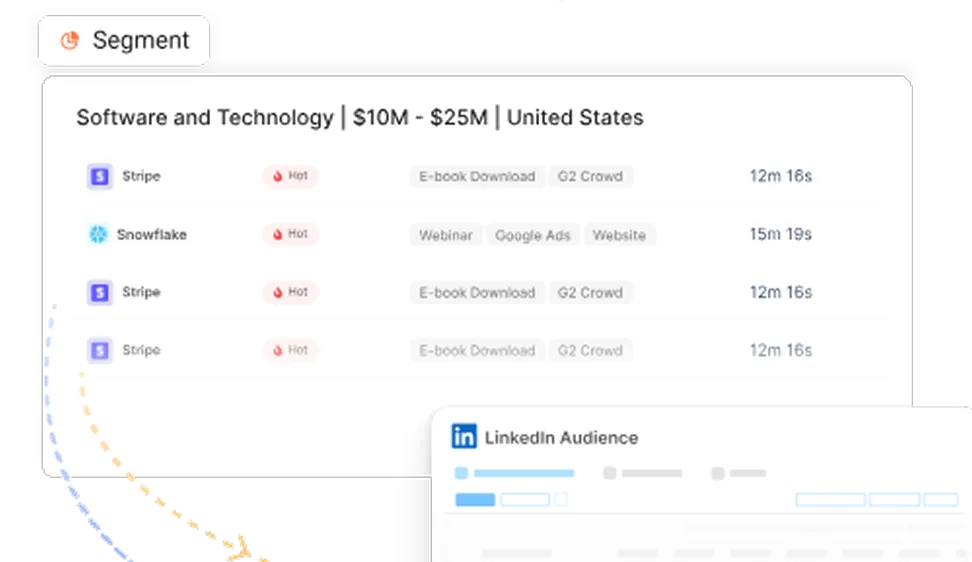
Factors.ai helps sales teams focus on which accounts to prospect first by surfacing real buying signals across website, ad engagement, and G2 pages. Instead of starting from static lists, it highlights companies that are already showing interest, even when no form is filled out.
It works alongside other traditional prospecting tools by prioritizing accounts, not replacing contact databases or outbound execution.
Why sales teams use it
- 75% coverage for Account-level identification of anonymous website visitors
- Enrich accounts with geography and job titles to pinpoint up to 30% of people who likely visited
- Real-time intent signals based on actual engagement
- Push the engaged audience lists into your LinkedIn and Google Ads accounts to run targeted campaigns.
- Syncs prioritized accounts into CRM and outbound tools
- Helps you automate outbound and set up sales workflows and alerts using GTM engineering
Ideal if you want sales outreach to feel timely and informed, not cold or random.
Also read: ZoomInfo Alternatives: Top 6 ZoomInfo Competitors In 2026
2. Oppora.ai
Best for: AI-powered outbound prospecting from lead discovery to booked meetings.
Oppora.ai helps sales teams automate outbound prospecting without switching between separate tools for lead search, enrichment, outreach, follow-ups, and CRM updates.
Its B2B lead database helps teams find companies and decision-makers that match their ideal customer profile. Then AI agents help personalize emails, run follow-ups, handle replies, and move interested prospects toward meetings.
It is useful for teams that want prospecting to go beyond finding leads. Oppora.ai connects lead discovery with outreach execution, so teams can build lists and start conversations from one place.
Why sales teams use it
- Access a 1B+ B2B leads database to find relevant companies and decision-makers
- Build self-running AI prospecting workflows that handle lead discovery, qualification, and outreach
- Run email and LinkedIn outreach without managing every step manually
- Create personalized email messages based on prospect and company data
- Automate follow-up sequences so fewer prospects fall through the cracks
- Use AI reply handling to qualify interest and guide prospects toward meetings
- Sync prospect data, conversations, and pipeline updates with CRM tools
- Ideal if you want to automate lead discovery, outreach, follow-ups, reply handling, and CRM updates from one place.
3. Smartlead
Best for: B2B lead database plus outbound execution in one platform
Smartlead gives sales teams access to a 300M+ B2B lead database and runs outreach from the same platform, so prospecting and sequencing happen without switching tools. SmartProspect lets teams search for contacts by industry, job title, company size, geography, and technology stack, with contacts flowing directly into email sequences without a CSV export or separate verification step. Every contact is verified at source, which keeps hard bounce rates under 2.5% across the platform network.
Why sales teams use it
- 300M+ verified B2B contacts with ICP filters, no credit expiry or per-contact fees
- Contacts flow directly into multi-channel sequences (email and calling) in one click
- Unlimited mailboxes with built-in email warm-up.
- SmartAgents classify every inbound reply by intent and route it automatically
Ideal if you want a B2B lead database and outbound execution in one flat-priced subscription rather than paying separately for prospecting, sending, warmup, and calling.
4. LinkedIn Sales Navigator
Best for: Relationship-based sales prospecting and persona discovery
LinkedIn Sales Navigator helps sales teams identify the right people inside target accounts and engage them using professional context like job changes, shared connections, and recent activity. It’s most effective when sales teams already know which accounts to focus on and need help navigating buying committees.
Why sales teams use it
- Advanced filters to find decision-makers and influencers
- Visibility into job changes and account activity
- InMail and connection-based outreach context
Ideal if you want outreach to feel personal and relevant, not generic.
5. ZoomInfo
Best for: Large-scale B2B contact and company discovery
ZoomInfo provides extensive company and contact data that sales teams use to build outbound lists across markets, industries, and roles.
It’s commonly used as a data foundation for outbound prospecting, but it still requires upstream prioritization and intent signals to avoid volume-driven outbound.
Why sales teams use it
- Broad database of B2B contacts and companies
- Firmographic and technographic insights
- CRM enrichment and list-building workflows
Ideal if you need reach and coverage across a large addressable market.
6. Apollo.io
Best for: Prospecting and outbound execution in one place
Apollo.io combines contact discovery with sequencing and engagement tools, allowing sales teams to prospect and take action from a single platform. It’s especially popular with SMB and mid-market teams focused on speed and efficiency.
Why sales teams use it
- Contact data plus email sequencing
- List building and outbound workflows
- Native CRM integrations
Ideal if you want fast execution without managing multiple tools.
Also read: Factors.ai vs Clearbit (Breeze Intelligence): which is the better GTM platform?
7. Cognism
Best for: Compliant global B2B sales prospecting
Cognism focuses on providing GDPR-compliant contact data, making it a common choice for sales teams prospecting across EMEA and other regulated markets. It supports outbound prospecting where data compliance is critical.
Why sales teams use it
- Compliance-first contact data
- Strong coverage in EMEA markets
- CRM and sales tool integrations
Ideal if compliance and data quality matter as much as scale.
8. Lusha
Best for: Quick contact discovery during prospecting
Lusha helps sales teams quickly find emails and phone numbers, often through browser extensions used alongside LinkedIn. It’s commonly used for fast, tactical prospecting.
Why sales teams use it
- Easy access to contact details
- Browser-based prospecting workflows
- Simple CRM enrichment
Ideal if speed matters more than deep prioritization.
9. Hunter.io
Best for: Email discovery and verification
Hunter.io helps sales teams find and verify professional email addresses, reducing bounce rates in outbound campaigns. It’s typically used as a supporting tool rather than a full prospecting platform.
Why sales teams use it
- Email discovery and verification
- Domain-based email searches
- Simple API and CRM integrations
Ideal if email is your primary outbound channel.
10. Crunchbase
Best for: Company discovery and early-stage account research
Crunchbase helps sales teams discover and research companies based on funding, growth signals, leadership changes, and market activity. It’s commonly used before outreach to understand whether an account is worth pursuing.
Why sales teams use it
- Funding rounds, acquisitions, and growth signals
- Company and leadership insights
- Market and competitor discovery
Ideal if you want to qualify accounts early before investing sales effort.
11. Seamless.ai
Best for: High-volume outbound contact discovery
Seamless.ai provides sales teams with access to contact details for outbound prospecting, often used by teams running high-volume sales motions. It focuses on speed and scale rather than deep intent or prioritization.
Why sales teams use it
- Large contact database
- Chrome extension for quick prospecting
- CRM enrichment
Ideal if your prospecting motion depends on volume-driven outbound.
12. Salesloft
Best for: Executing and managing outbound prospecting
Salesloft is not a data source but a sales engagement platform that helps reps run structured outbound plays across email, calls, and LinkedIn. It’s often paired with prospecting and intent tools upstream.
Why sales teams use it
- Multi-channel outbound sequences
- Call tracking and engagement analytics
- CRM-centric workflows
Ideal if you want prospecting to be consistent, measurable, and scalable.
The B2B sales prospecting tools cheat sheet (Use this, not hope)
How to prospect without crossing your fingers
If you’re evaluating sales prospecting tools because your pipeline isn’t keeping up with your activity, you’re not alone. Most teams don’t have a lead problem. They have a prioritization problem.
The best B2B sales prospecting tools help sales teams answer three things clearly:
- Who to reach out to
- When to do it
- Why that account matters right now
Some tools focus on intent and timing. Others focus on contact data. A few help execute outreach at scale.
The key is not picking one tool. It’s building a stack where each sales tool for prospecting plays a specific role. Use intent-led tools to decide where to focus, data tools to decide who to contact, and execution tools to actually run outbound without chaos.
Here’s the simple takeaway:
- Intent & prioritization tools (like Factors.ai) help you decide which accounts to focus on first
- Data & contact tools (like ZoomInfo, Cognism, Lusha) help you find who to contact
- Relationship tools (like LinkedIn Sales Navigator) help you navigate buying committees
- Execution tools (like Apollo, Salesloft, and Factors.ai) help you actually do the outreach consistently
Done right, prospecting sales tools stop being about sending more emails and start being about starting better conversations.
And that’s how the pipeline moves without crossing your fingers.
FAQs on sales prospecting tools for B2B
Q1. What are sales prospecting tools, and do I really need them?
Sales prospecting tools help sales teams decide who to reach out to, when to do it, and why now. If your team is relying on cold lists, gut feel, or “just email them” logic, you’ll benefit from prospecting tools that add signals, prioritization, and structure.
Q2. What is the difference between sales prospecting tools and lead generation tools?
Lead generation tools focus on collecting leads. Sales prospecting tools focus on turning the right accounts into conversations. In B2B, most teams have enough leads. The real problem is knowing which accounts are worth the sales effort right now.
Q3. What are the best B2B sales prospecting tools for outbound sales?
There’s no single best tool. High-performing outbound teams typically use:
- Intent or account prioritization tools to decide where to focus
- Contact data tools to find who to reach out to
- Sales engagement tools to execute outreach at scale
Outbound works best when it’s signal-led, not volume-led.
Q4. Are sales prospecting tools worth it for small or early-stage teams?
Yes, but only if you choose carefully. Early-stage teams usually benefit most from:
- Simple contact discovery
- Lightweight prioritization
- Easy outbound execution
Over-stacking tools too early often creates more complexity than impact.
Q5. How do modern B2B teams actually use sales prospecting tools together?
Most teams don’t use one tool. They use a stack, for example:
- One tool to identify which accounts are showing interest
- Another to find the right people inside those accounts
- Another to run outreach consistently

See how Factors can 2x your ROI
Boost your LinkedIn ROI in no time using data-driven insights


.avif)

See Factors in action.
Schedule a personalized demo or sign up to get started for free
LinkedIn Marketing Partner
GDPR & SOC2 Type II







.svg)



.avif)

