
Customer journey attribution: a complete guide for B2B marketing
Learn how customer journey attribution works in B2B marketing, including models, tools, and strategies to track revenue across the full buyer journey.
.avif)
Content Marketer



.svg)


TL;DR
- Customer journey attribution tracks how every marketing and sales interaction contributes to pipeline and revenue, not just which channel got the last click.
- B2B buying cycles involve multiple stakeholders, non-linear journeys, and dozens of touchpoints, making single-touch models dangerously incomplete.
- Multi-touch attribution models like full-path and time decay give B2B teams a far more accurate picture of what's actually driving deals forward.
- Implementing attribution well requires integrated data across your CRM, ad platforms, and analytics tools, plus a clear definition of what counts as a meaningful touchpoint.
- Attribution isn't a set-it-and-forget-it exercise. The best teams revisit their models regularly as their marketing mix and buyer behavior evolve.
I have a theory that every B2B marketing team has, at some point, sat through a pipeline review where someone pointed at a closed deal and asked: "So... who gets credit for this?"
What follows is usually a performance. The paid media team mentions the LinkedIn campaign that 'started everything.' In fact, I feel like it was upto them (read: us), we'd say... we initiated the Big Bang. Now... the content team points to the three blog posts the account read before anyone even filled out a form. Sales says they did the real work, which, as much as I hate to admit, they have a case for. And someone in RevOps is in the corner, staring at their laptop, resisting the urge to pull up a spreadsheet.
All that said... customer journey attribution exists to end that meeting because it's all about mapping every interaction a buyer has with your company across the full journey, then assigning credit to each touchpoint based on what it actually contributed to the outcome. In B2B, where a single deal might involve six stakeholders, thirty touchpoints, and a sales cycle that outlasts a Netflix series, getting attribution right isn't a nice-to-have... it's the only way to know what's actually working... and prevent corporate gang-wars.
This not-so-little blog breaks down what customer journey attribution really means, how the major models work, where they fall apart, and how to implement a system that connects your marketing efforts to revenue in a way that's honest and actually useful.
What is customer journey attribution?
At its core, customer journey attribution is the process of identifying which marketing and sales interactions influenced a buyer's decision to convert. It goes beyond simply knowing that a deal closed and answers the harder question of which touchpoints along the way actually mattered.
Wait, that's not it... understanding customer journeys through attribution allows marketers to identify which channels and combinations produce customers with the highest lifetime value, informing budget allocation decisions. And another important benefit that goes unnoticed is this: customer journeys help create better personalized messaging for each stage.
The difference between basic attribution and journey attribution is something I want to spend three lines on. Basic attribution tends to look at a single moment, like which channel drove a form fill or which ad got a click, journey attribution takes the wider view. It considers the full sequence of interactions a buyer had with your brand, from the first anonymous website visit through to the signed contract, and evaluates how each one contributed.
Think about it this way. A prospect sees a LinkedIn ad in January... they click through, read a blog post, and disappear. THEN, in March, they attend your webinar. A week later, they visit your pricing page directly. By April, they request a demo and close in June. Basic attribution hands ALL the credit to the demo request page or to the LinkedIn ad, depending on whether you're using last-touch or first-touch. Journey attribution recognizes that all four of those interactions played a role in moving the buyer forward.
This difference is especially important in B2B marketing because buying cycles are like loopy roller-coasters. You're dealing with considered decisions made by groups of people over weeks or months. And obviously, the buyer who requests a demo didn't wake up one morning and think, "the sun is shining, the breeze is crisp... the perfect day to book a demo and invest in SaaS software". NO. They were influenced by a sequence of touchpoints that built trust, educated them, and made them ready to talk to sales. Customer journey attribution is the discipline of understanding that sequence.
Why does customer journey attribution matter for B2B marketing?
The strategic case for attribution in B2B comes down to a simple reality: marketing leaders are increasingly expected to demonstrate revenue contribution, not just activity. It's no longer enough to report on impressions, clicks, or even MQLs. Many marketers fall into the vanity metrics trap, celebrating high click-through rates or a large number of leads without asking whether those metrics correlate with revenue. The C-suite wants to know which marketing investments are generating pipeline and influencing closed revenue, and attribution is how you connect those dots.
B2B buying cycles make this particularly... urgent. When a deal takes four to six months to close and involves interactions across paid ads, organic search, content, email nurture, events, and sales outreach, it's genuinely difficult to say which of those efforts drove the outcome. Without attribution, marketing teams end up relying on gut feel or last-click data from Google Analytics, both of which paint an incomplete picture.
The budget implications are significantly high. When you can't prove which channels generate pipeline, you can't defend your budget in quarterly reviews. You end up cutting spend on channels that might actually be working simply because their contribution isn't visible in your reporting. Good attribution flips that dynamic, giving you evidence-based insight into where your money produces returns, so you can double down on what works.
Attribution also surfaces patterns that aren't obvious from surface-level metrics. A LinkedIn campaign might look expensive on a cost-per-click basis, but if attribution reveals that accounts exposed to those ads convert at twice the rate and close 30% faster, that changes the conversation entirely. Revenue attribution shifts the evaluation from channel cost to channel impact, which is a much more useful lens for strategic planning.
There's a reporting dimension here too. CMOs who can walk into a board meeting and say "our content program influenced 40% of pipeline this quarter" have a fundamentally different conversation than those who can only report on traffic and engagement. Attribution gives marketing a seat at the revenue table, and in most B2B organizations, that seat is earned through data.
How does the B2B customer journey actually work?
If you've ever mapped out a B2B buyer journey on a whiteboard, you'll know it looks less like a neat funnel and more like a plate of spaghetti bolognese. The linear model of awareness, consideration, and decision still provides a useful framework, but the actual behavior of buyers rarely follows that tidy path.
- The first complication is buying committees
Most B2B purchases, especially in enterprise software, involve between six and ten stakeholders. These aren't just decision-makers. They include influencers, evaluators, champions, and budget holders, each with their own information needs and preferred channels. One person might discover your company through organic search. Another sees a LinkedIn ad. A third gets forwarded a case study by a colleague. All of them are part of the same buying journey, interacting with completely different touchpoints. - The second complication is that these journeys are non-linear
A buyer might start by reading a blog post, disappear for three weeks, come back through a retargeting ad, attend a webinar, go dark again, and then suddenly request a demo after a peer recommendation you never tracked. The journey loops back on itself, stalls, accelerates, and takes detours that don't fit into any funnel stage. - The third complication is volume
A single account might accumulate dozens of interactions across LinkedIn ads, organic search visits, blog content, whitepapers, webinars, email newsletters, sales outreach, and retargeting before a deal is created. Each interaction contributes something, but the relative importance of each one varies enormously depending on context.
This complexity is exactly why attribution in B2B is both harder and more valuable than in simpler buying environments. An e-commerce company can often get away with last-click attribution because the purchase decision happens in one session (most of the times). In B2B, where the journey spans months and multiple people, that approach misses almost everything that matters.
What are the key marketing touchpoints across the buyer journey?
Understanding where touchpoints cluster across the buyer journey helps you think more clearly about what attribution is actually measuring. Every company's journey is different, but there are common patterns worth mapping.
- Awareness stage touchpoints (ToFu)
At the top of the funnel, buyers are discovering that a problem exists or that a category of solutions is worth exploring. The touchpoints here tend to be broad and content-driven. LinkedIn ads introducing your brand to a cold audience fall here. So do blog posts that rank for educational search queries, podcast appearances that put your company in front of new audiences, and SEO-driven content that captures early research intent. These interactions rarely lead to an immediate conversion, but they plant seeds that matter later.
- Consideration stage touchpoints (MoFu)
Once buyers know you exist, they start evaluating whether your solution fits their needs. The touchpoints here are more focused and often involve deeper engagement. Webinars that demonstrate your approach, case studies that show results from similar companies, product comparison pages, and email newsletters that keep your brand present during a long evaluation period all sit here. These interactions build confidence and move buyers from curiosity to serious interest.
- Decision stage touchpoints (BoFu)
At the bottom of the funnel, buyers are ready to make a purchase decision. The touchpoints here are high-intent and often involve direct interaction with sales. Demo requests, pricing page visits, free trial sign-ups, and sales calls are the obvious ones. But there are also less visible decision-stage touchpoints, like a champion sharing your ROI calculator with their CFO or a procurement team reviewing your security documentation. These final interactions often get disproportionate credit in simple attribution models, even though they wouldn't have happened without the earlier touchpoints that built trust.
Each stage contributes to pipeline influence in its own way. Awareness touchpoints create the conditions for a deal to exist. Consideration touchpoints nurture it forward. Decision touchpoints convert it. A good customer journey attribution model accounts for all three.
How do the most common customer journey attribution models work?
Attribution models are essentially rules for distributing credit across touchpoints. Each model reflects a different philosophy about which interactions matter most. Choosing the right one depends on your sales cycle, your data maturity, and the questions you're trying to answer.
- First-touch attribution
First-touch attribution gives 100% of the credit to the very first interaction a buyer had with your company. If a prospect first discovered you through a Google search and clicked on a blog post, that blog post gets all the credit for the eventual deal.
This model is useful for measuring demand generation effectiveness. It answers the question: "which channels are bringing new prospects into our world?" The limitation is obvious. It completely ignores everything that happened after that first interaction. In a B2B sales cycle with twenty touchpoints, crediting only the first one is like thanking the person who introduced you at a party for your entire friendship.
- Last-touch attribution
Last-touch attribution is the mirror image. It gives 100% of the credit to the final interaction before conversion. If a prospect's last touchpoint before requesting a demo was a retargeting ad, that ad gets all the credit.
This is the default model in most basic analytics tools, including standard Google Analytics setups. It's popular because it's simple and aligns with conversion-focused thinking. The problem is that it erases the entire journey that made the conversion possible. It rewards the closer and ignores everyone who set up the opportunity.
- Linear attribution
Linear attribution distributes credit evenly across every touchpoint in the journey. If a buyer had five interactions before converting, each one gets 20% of the credit.
The appeal is fairness and simplicity. Nobody gets over or under-credited. The drawback is that it assumes every interaction had equal impact, which is rarely true. A quick email open and an hour-long webinar don't contribute equally to a buying decision, but linear attribution treats them as if they do.
- Time decay attribution
Time decay attribution gives more credit to touchpoints that occurred closer to the conversion event. The logic is intuitive: interactions that happened right before a deal closed likely had more direct influence than those from three months earlier.
This model works well for long B2B sales cycles because it acknowledges the full journey while weighting the interactions that drove the final decision more heavily. It's a reasonable middle ground between first-touch simplicity and the complexity of full-path models.
- U-shaped attribution
U-shaped attribution, sometimes called position-based, assigns the most credit to two key moments: the first interaction and the lead conversion moment. A common split is 40% to the first touch, 40% to the lead creation touch, and the remaining 20% distributed across everything in between.
This model reflects the reality that two specific moments tend to be disproportionately important in early-stage marketing: how you attracted someone, and what finally convinced them to raise their hand. It's a popular choice for teams focused on demand generation metrics.
- Full-path attribution
Full-path attribution extends the U-shaped concept across the entire revenue cycle. It assigns meaningful credit to four key milestones: first touch, lead creation, opportunity creation, and closed deal. Each milestone typically receives around 22.5% of the credit, with the remaining 10% spread across the other touchpoints in between.
This is the model that most closely reflects how B2B buying actually works. It acknowledges that generating initial awareness, converting a lead, creating a sales opportunity, and closing a deal are all distinct achievements that deserve recognition. B2B marketers are increasingly adopting full-path attribution because it connects marketing activity to pipeline and revenue in a way that simpler models can't.
Attribution models compared at a glance
Also, there's nothing like 'right attribution model'. Your choice should depend on what questions you need to answer and how mature your data infrastructure is. Many teams start with simpler models and graduate to full-path as their tracking capabilities improve.
Single-touch vs. multi-touch attribution: what's the real difference?
The distinction between single-touch and multi-touch attribution is one of the most consequential choices a B2B marketing team makes when setting up their reporting. It shapes what you can see, what you optimize for, and how you talk about marketing's contribution to revenue.
Single-touch attribution, which includes first-touch and last-touch models, assigns all credit to one interaction. The appeal is obvious: it's simple, easy to implement, and produces clean reports. When someone asks "what channel generated this lead?", a single-touch model gives a clear, unambiguous answer. For small teams with limited data infrastructure, that clarity has real value.
The problem is that single-touch models are fundamentally misleading in B2B contexts. When a deal involves fifteen touchpoints across three stakeholders over four months, giving one of those touchpoints all the credit doesn't just oversimplify. It actively distorts your understanding of what's working. You might end up pouring budget into the channel that happened to be last in the sequence while starving the channels that created the opportunity in the first place.
Multi-touch attribution, which includes linear, time decay, U-shaped, and full-path models, distributes credit across multiple interactions. It reflects the reality that B2B buying decisions are shaped by many moments. The trade-off is complexity. Multi-touch models require better tracking, more integrated data, and a willingness to accept nuanced answers instead of simple ones.
For most B2B organizations with sales cycles longer than a few weeks, multi-touch attribution is worth the additional effort. The insight quality is dramatically better, and it's the only way to credibly connect marketing activity to revenue in a way that the C-suite takes seriously.
What makes customer journey attribution so challenging?
Attribution sounds straightforward in theory. In practice, it runs into a set of real-world obstacles that every B2B team eventually confronts. Understanding these challenges upfront helps you build a system that accounts for them rather than one that breaks the moment reality comes to life.
- Fragmented data across tools and platforms
Most B2B teams run their ad platforms, CRM, marketing automation, and website analytics as separate systems that don't naturally share data. Your LinkedIn campaign data lives in LinkedIn. Your lead data lives in HubSpot or Salesforce. Your website behavior lives in Google Analytics or a product analytics tool. Stitching together a complete buyer journey across these silos is technically demanding and often requires dedicated tooling or engineering support.
- Anonymous website visitors create blind spots
Many buyers interact with your website multiple times before they ever fill in a form or identify themselves. They read blog posts, visit your pricing page, and browse case studies as anonymous visitors. Until they convert, those interactions are invisible to most attribution systems. This means your attribution data is always missing the early chapters of the buyer's story, which are often the most important for understanding what sparked their interest.
- Offline interactions are hard to capture
Events, conferences, sales dinners, phone calls, and partner referrals all influence B2B buying decisions. But these offline touchpoints are notoriously difficult to track in any automated attribution system. Unless your team is disciplined about logging these interactions in your CRM, they'll be invisible in your attribution reports, which means your data will over-credit digital channels by default.
- Privacy regulations and tracking limitations are narrowing the window
Cookie restrictions, browser privacy changes, and regulations like GDPR have made it harder to track individual buyer behavior across the web. Third-party cookies are being phased out. Ad platforms are losing signal fidelity. These changes don't make attribution impossible, but they do require teams to invest in first-party data strategies and privacy-compliant tracking methods.
- Multiple stakeholders on a single account create attribution complexity
When six people from the same company each interact with different touchpoints, stitching those interactions into a single account-level journey is a challenge that most individual-based attribution tools weren't designed to handle. B2B attribution increasingly requires account-level thinking, where you aggregate touchpoints across all known contacts at a target account.
None of these challenges are reasons to abandon attribution. They're reasons to build your attribution system with realistic expectations and the right tools.
How do you implement customer journey attribution in B2B?
Implementation is where most attribution projects either become genuinely useful or quietly stall out. The teams that succeed tend to follow a structured approach rather than trying to boil the ocean on day one. Here's a practical sequence that works for most B2B organizations.
Step 1: Map your buyer journey from first touch to closed deal
Before you choose a model or buy a tool, you need a clear picture of how buyers actually move through your funnel. Interview your sales team. Review your CRM data. Look at the paths your last twenty closed deals took. The goal isn't a perfect map but a realistic one that captures the key stages and common interaction patterns. You'll likely find that your journey is messier than your funnel slides suggest, and that's a useful thing to know before you start building attribution logic on top of it.
Step 2: Define which touchpoints are meaningful enough to track
Not every interaction deserves attribution credit. You need to decide what counts as a meaningful touchpoint versus background noise. Website visits, form submissions, webinar attendance, ad engagement, content downloads, and demo requests are common choices. The key is to be intentional about it. If you track everything equally, your attribution data gets diluted. If you track too little, you miss important parts of the journey.
Step 3: Integrate your marketing and CRM data into a unified view
This is usually the hardest step and the one with the highest payoff. Your attribution system is only as good as the data flowing into it. That means connecting your CRM (Salesforce, HubSpot), your marketing automation platform (Marketo, HubSpot, Pardot), your ad platforms, and your website analytics into a system that can stitch together a complete journey. For some teams, native integrations between these tools are sufficient. For others, a dedicated attribution platform or data warehouse becomes necessary.
Step 4: Select the attribution model that fits your context
Your choice of model should depend on three factors: how long your sales cycle is, how mature your marketing and data operations are, and what questions you're trying to answer. Teams with short cycles and limited data might start with U-shaped attribution. Organizations with longer cycles and strong data infrastructure often gravitate toward full-path or time decay models. A basic model that's actually used and trusted is more valuable than a sophisticated one that nobody believes.
Step 5: Align attribution reporting with revenue metrics
The final step is connecting your attribution data to the numbers that matter. Pipeline generation, opportunity influence, and revenue attribution should be the primary outputs of your system, not just lead counts or channel-level engagement metrics. When your attribution reporting tells you which campaigns influenced how much pipeline and which channels contributed to closed revenue, you have the information you need to make real budget decisions.
Which tools and platforms support attribution analytics?
The attribution analytics landscape ranges from free, built-in features to dedicated enterprise platforms. Where you land on that spectrum depends on your budget, your data complexity, and how seriously your organization treats revenue attribution.
- Google Analytics is where most teams start. It offers basic attribution modeling out of the box, including last-click, first-click, linear, and time decay options. The limitation is that Google Analytics is fundamentally a web analytics tool. It tracks sessions and pageviews, not accounts, pipeline, or revenue. It can tell you which channels drive traffic, but it can't connect that traffic to a deal in your CRM.
- HubSpot's built-in attribution reporting is a solid step up for teams already on the HubSpot ecosystem. It connects marketing interactions to contacts and deals within HubSpot's CRM, giving you a more complete picture than standalone web analytics. It works best when most of your marketing and sales activity happens within HubSpot. If you're running a complex multi-platform stack, the data coverage can feel incomplete.
- Dreamdata is purpose-built for B2B revenue attribution. It focuses on connecting marketing touchpoints to pipeline and revenue at the account level, which is exactly the challenge most B2B teams struggle with. It integrates with CRMs, ad platforms, and marketing automation tools to build a more comprehensive picture of the buyer journey.
- Bizible (now Marketo Measure) is a popular choice for Salesforce-centric organizations. It sits inside Salesforce and tracks marketing touchpoints across the buyer journey, connecting them to opportunities and revenue. It's particularly strong for teams that want attribution data directly inside their CRM where sales and marketing leadership already operate.
Keep THIS in mind:
Between web analytics attribution and B2B revenue attribution platforms… web analytics tools measure channel performance on your website. Revenue attribution platforms measure marketing influence on pipeline and deals. For teams that really care about proving marketing's contribution to revenue, the latter category is where the real value lives.
How does Factors.ai track the full customer journey?
Most B2B attribution tools require a visitor to identify themselves before they can start tracking the journey. Factors.ai takes a different approach by beginning the tracking process before a prospect fills in a form.
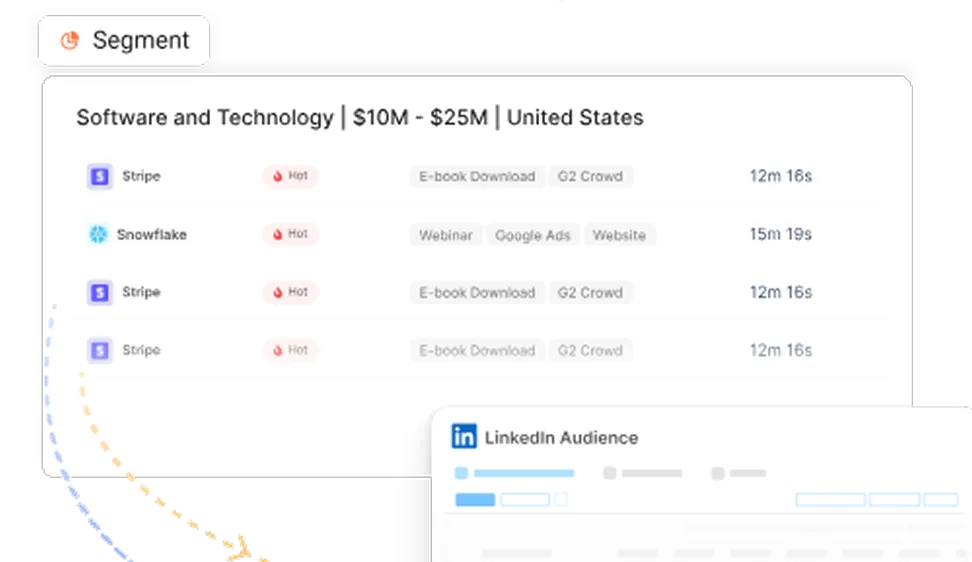
Its account-level journey tracking identifies which companies are visiting your website, even when the individual visitors are anonymous. This means you can see that a target account has been browsing your product pages and case studies for weeks before anyone from that company submits a form. That early-journey visibility is exactly the data most attribution tools miss.
On the attribution side, Factors.ai offers multi-touch attribution modeling that measures marketing influence across ads, organic search, campaigns, and website activity. It connects these interactions to pipeline creation and revenue contribution within your CRM, so you can see which marketing efforts are actually driving business outcomes.
The platform also surfaces account intent signals. It identifies which accounts are showing buying behavior based on their engagement patterns, so your sales team can prioritize outreach to accounts that are actively in-market. Marketing sees which accounts are engaging. Sales sees which accounts are ready for outreach. Both teams work from the same data, which sounds simple but is rarer than you'd think.
For teams running account-based marketing programs, this combination of journey tracking, attribution, and intent data creates a feedback loop that actually works. Marketing can see which campaigns are influencing target accounts. Sales can see which accounts are warming up. And leadership can see how marketing activity connects to pipeline and revenue at the account level.
Best practices for B2B attribution
Attribution is as much an organizational discipline as it is a technical one. The teams that get the most value from it tend to follow a few consistent principles that go beyond just picking a model and running reports.
- Default to multi-touch models for any B2B sales cycle longer than a month
Single-touch models are tempting because they're simple, but they're fundamentally incompatible with how B2B buying works. If your average deal involves more than three or four meaningful marketing interactions, you need a model that accounts for all of them.
- Track journeys at the account level (not just the individual level)
B2B purchases are made by buying committees. If your attribution system only tracks the person who filled in the demo form, you're missing all the interactions that other stakeholders had with your brand. Account-level buyer journey tracking gives you the complete picture and aligns your attribution with how deals actually happen.
- Integrate your CRM and marketing data before you worry about models
The most sophisticated attribution model in the world is useless if it's running on incomplete data. Before you invest time in model selection, make sure your CRM, marketing automation, ad platforms, and website analytics are connected and sharing data reliably. Data integration is the unsexy foundation that makes everything else work.
- Monitor pipeline influence and revenue contribution, not just lead volume
Attribution should tell you which channels influence pipeline and closed revenue, not just which ones generate the most form fills. A channel that produces 100 leads but zero pipeline is less valuable than one that produces 10 leads that turn into 5 opportunities. Make sure your reporting reflects that distinction.
- Revisit your attribution model at least once a year
Your marketing mix changes. Your buyer behavior evolves. New channels emerge. An attribution model that was perfect eighteen months ago might be giving you misleading data today. The best teams treat attribution as a living system, not a one-time setup.
- Get buy-in from both marketing and sales leadership
Attribution only works as a strategic tool when both teams trust the data. If sales doesn't believe the attribution numbers, they won't use them. If marketing doesn't trust the model, they'll build shadow reports. Align both teams on what's being measured, how credit is distributed, and what the data means for their shared goals.
- Accept that no model is perfect, and communicate that honestly
No attribution model answers every question perfectly, and anyone who tells you otherwise is probably selling one. Every model has trade-offs and blind spots. The idea is to get a directionally accurate picture that's vastly better than no attribution at all.
Attribution should evolve alongside your marketing maturity. A team that's just starting out might use linear attribution and manual CRM tagging. A team with mature operations might use full-path attribution with automated account-level tracking. Both are valid starting points. What matters is that you're consistently improving your ability to connect marketing activity to business outcomes.
In a nutshell…
Customer journey attribution is how B2B marketing teams move from guessing at channel performance to actually understanding what drives pipeline and revenue. Track the touchpoints buyers interact with across the full journey, then use an attribution model to assign credit based on each touchpoint's contribution to the outcome.
The practical reality is more nuanced than that. B2B buying cycles are long, non-linear, and involve multiple stakeholders interacting with different channels at different times. Single-touch models are easy to implement but dangerously incomplete for this kind of complexity. Multi-touch models, especially full-path attribution, give a far more honest picture of what's working.
Implementation requires three things working together: clean, integrated data across your CRM, ad platforms, and analytics tools; a clearly defined set of meaningful touchpoints; and an attribution model that fits your sales cycle length and data maturity. You also need organizational alignment between marketing and sales on what the data means and how it should inform decisions.
If you're just getting started, pick a multi-touch model, integrate your core data sources, and start tracking at the account level. You can refine the model over time as your data and processes mature. If you've been running attribution for a while, audit your current model against your actual buyer journey. Make sure it still reflects how your customers buy, not how they bought two years ago.
The teams that treat attribution as an ongoing discipline rather than a one-time project are the ones that end up with the clearest view of marketing's contribution to revenue. And that clarity is what earns marketing a genuine seat at the revenue table.
Frequently asked questions about customer journey attribution
Q1. What is customer journey attribution?
Customer journey attribution measures how different marketing and sales interactions contribute to a customer converting, assigning credit across multiple touchpoints rather than a single channel. It gives B2B teams visibility into which activities actually influence pipeline and revenue, rather than just tracking surface-level metrics like clicks or impressions. The goal is to understand the full sequence of interactions that leads to a business outcome.
Q2. What's the difference between attribution and customer journey analytics?
Attribution and customer journey analytics are related but distinct. Attribution assigns credit to specific touchpoints that influenced a conversion, answering the question "what marketing activities deserve credit for this deal?" Customer journey analytics focuses on understanding behavior patterns across the buyer journey, like how long buyers spend in each stage, where they drop off, and which paths are most common. Both are valuable, but they answer different questions.
Q3. Why is attribution important in B2B marketing?
B2B sales cycles are long and involve many interactions across multiple channels and stakeholders. Without attribution, marketing teams can't credibly demonstrate which activities contributed to pipeline and revenue. This makes it difficult to defend budgets, optimize spend, or have meaningful conversations with the C-suite about marketing's impact on business results.
Q4. What is the best attribution model for B2B?
There's no single best model for every B2B organization, but multi-touch models consistently outperform single-touch approaches for complex buying cycles. Full-path attribution and time decay are popular choices because they reflect the reality that multiple interactions across different funnel stages all contribute to a deal. The right model depends on your sales cycle length, data maturity, and the specific questions you need to answer.
Q5. How do attribution tools work?
Attribution tools work by combining data from marketing platforms, CRM systems, and website tracking to build a complete picture of the buyer journey. They identify which touchpoints a buyer interacted with before converting, then apply an attribution model to distribute credit across those interactions. The more data sources connected to the tool, the more complete and accurate the attribution picture becomes. Advanced B2B platforms also track at the account level, aggregating interactions across multiple contacts at the same company.
Q6. What's the difference between single-touch and multi-touch attribution?
Single-touch attribution gives all credit to one interaction, either the first or last touchpoint before a conversion. Multi-touch attribution distributes credit across multiple interactions throughout the buyer journey. For B2B sales cycles longer than a few weeks, multi-touch models give a far more accurate picture of what's actually influencing deals, even if they require more data and setup to implement correctly.

Powered by Bombora
Enter your domain and we'll send you a free list of companies showing buying intent in your vertical.
.avif)
Powered by Bombora
Enter your domain and we'll send you a free list of companies showing buying intent in your vertical.
.avif)

See how Factors can 2x your ROI
Boost your LinkedIn ROI in no time using data-driven insights


.avif)

See Factors in action.
Schedule a personalized demo or sign up to get started for free
LinkedIn Marketing Partner
GDPR & SOC2 Type II

.svg)



.avif)

