
10 Best Customer Profiling Tools for B2B SaaS Teams in 2026
Looking for the best customer profiling tools? Here are 10 tools B2B SaaS marketers and CMOs actually use to build ICPs, segment accounts, find intent, and stop wasting ad spend on accounts that were never going to convert.
.avif)
Content Marketer



.svg)


TL;DR
- Customer profiling in B2B means combining firmographic, technographic, behavioral, and intent data to identify who your best accounts are and when they're ready to buy.
- No single tool covers all profiling layers. The best stacks combine enrichment, intent, and attribution tools.
- Factors.ai is the strongest option for teams running LinkedIn-first ABM, with best-in-class visitor identification and cross-channel attribution built on LinkedIn's official partner network.
- HubSpot (with Breeze Intelligence) is the all-in-one choice for teams that want enrichment natively inside their CRM without managing extra integrations.
- ZoomInfo and 6sense are the enterprise heavyweights, both excellent, both expensive.
- Apollo.io is the best-value option for startups and growth-stage teams who want prospecting, profiling, and outreach without paying enterprise prices.
- Bombora is the gold standard for standalone intent data when you need to know who is researching your category, not just who visited your site.
- Twilio Segment is infrastructure, not intelligence. It's what you use when you need to unify data across tools, not find new accounts.
- Dealfront (Leadfeeder) is the best entry point for European teams or anyone who wants simple, affordable visitor identification.
At some point in every B2B marketer's career, there's a moment of quiet horror.
You're looking at your CRM. You've got 14,000 contacts. Your sales team is working on 80 accounts. Your LinkedIn campaigns are running to a carefully crafted audience. And somehow... none of it feels like it's pointing at the same people.
Now, that my friend, is what I call a customer profiling problem. And before you think, "we have a persona doc for that." No, a persona doc is not a customer profile. A persona doc is a story you told yourself in 2022 that has since been ignored by everyone, including yourself.
I know you’re feeling a little like this… but it’s okay, we’re in this together (or maybe not).

Customer profiling, done right, is about turning real data into a sharp, actionable definition of who your best customers are, what they look like before they buy, and which signals indicate they're ready. It's the foundation of every decent ICP, every good ABM campaign, and every ad dollar that doesn't disappear into the void.
The tools that power this have gotten genuinely good. So let's look at the ten best customer profiling tools available to B2B SaaS teams right now, what each one actually does, and who it's really built for.
What is a customer profiling tool, exactly?
A customer profiling tool helps you collect, organize, and activate data about your accounts and contacts to understand who your ideal customers are, how to find more of them, and when they're in-market.
In B2B, "profiling" happens across multiple layers. There's firmographic data, company size, industry, revenue, employee count, and geography. There's technographic data, what tools they're running, which tells you a lot about maturity and fit. There's behavioral data, how they interact with your site, your content, your ads. And then there's intent data, signals that show they're actively researching solutions like yours right now, before they ever raise their hand.
The best profiling tools pull from multiple layers simultaneously. They enrich your CRM, de-anonymize your website traffic, surface intent signals, score accounts against your ICP, and help you build audiences for targeting. Some focus on one layer really well. Others try to do it all.
The right tool depends on your stack, team size, budget, and the maturity of your go-to-market motion. Let's get into it.
The 10 best customer profiling tools for B2B SaaS in 2026
1. Factors.ai
Best for: B2B SaaS teams running LinkedIn and Google ABM who want visitor identification, cross-channel attribution, and ad optimization in one platform.
Factors.ai is an AI-powered ABM platform built specifically for B2B GTM teams. If you're spending real money on LinkedIn ads and wondering what's actually working, this is the tool that fills that gap.
The core of Factors' profiling capability is account-level de-anonymization. It identifies 75%+ of companies visiting your website through waterfall IP enrichment, significantly higher than the 40-64% most tools achieve. Those identified accounts are then enriched with firmographic attributes (industry, company size, revenue, geography) and layered with behavioral signals: which pages they visited, how long they stayed, what content they consumed, and where they came from.
What makes Factors genuinely different for customer profiling is its LinkedIn integration. Factors is an official LinkedIn Marketing Partner, which means it has access to LinkedIn's Company Intelligence API, a capability that lets it surface company-level engagement from both paid LinkedIn campaigns and organic LinkedIn activity. If a target account sees your LinkedIn ad, visits your website, and then a company employee engages with your LinkedIn page, Factors connects those dots into one account timeline. Most tools cannot do this.
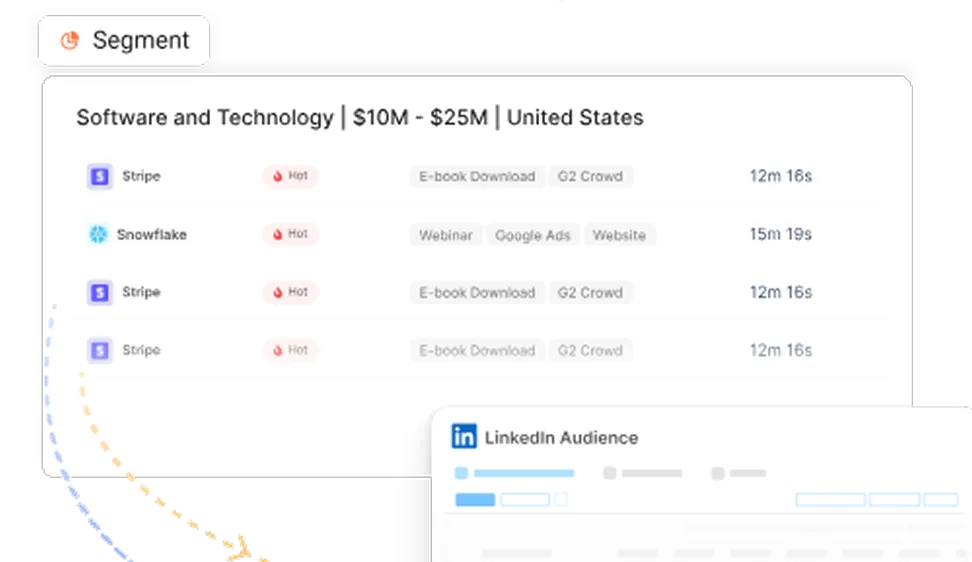
LinkedIn AdPilot is the execution layer on top of this intelligence. It lets you build dynamic LinkedIn audiences from your ICP segments, control ad frequency at the account level (Frequency Pacing), cap impressions per company (Ad Controls), measure view-through attribution, and push conversion signals back to LinkedIn via LinkedIn CAPI. Google AdPilot does the same for Google Ads, syncing high-intent account audiences and feeding ICP-weighted conversion values back to Google's bidding algorithm.
For ICP building, Factors supports custom account scoring using any combination of firmographic filters, behavioral triggers, CRM stage data, and G2 buyer intent signals. You can build and save named segments, create lookalike audiences from your best accounts, and set up automated alerts when high-fit accounts show a spike in engagement.
Account 360 profiles give you a timeline view of every account's touchpoints across every channel in one place. Cross-Channel Attribution supports six models (first touch, last touch, linear, time decay, U-shaped, W-shaped) so your reporting actually reflects how your pipeline was built, not just who filled out the form last.
The AI Agents feature lets GTM teams query their data in natural language and automate workflow actions, useful for RevOps teams who want to surface insights without building custom reports every time.
The honest trade-off: Factors profiles at the account level, not the individual contact level. You'll know which company is on your site and what they're doing, but not who specifically. For contact-level identification, you'll need a CRM or a tool like Apollo layered on top. Key features like LinkedIn AdPilot impression control and predictive scoring are also Enterprise-tier only, so budget accordingly.
2. HubSpot (with Breeze Intelligence)
Best for: Teams that want enrichment, scoring, and CRM in one place, and are already on or willing to fully commit to HubSpot.
HubSpot's Smart CRM, now powered by Breeze Intelligence (the rebranded Clearbit technology acquired in early 2024), is the all-in-one choice for B2B teams who want customer profiling baked into their CRM without managing a separate enrichment tool.
The profiling story here starts with automatic enrichment. When a contact or company enters your HubSpot CRM, Breeze Intelligence automatically fills in 40+ attributes, industry, company size, revenue, employee count, technology stack, social profiles, and more, pulled from a database of 200M+ buyer and company profiles. No manual research. No data cleaning ritual on Friday afternoons.
On the behavioral side, HubSpot natively tracks website visits, email engagement, form submissions, content downloads, and meeting activity, all linked to the same contact and company records your sales team works from. This means your profiling and engagement data live in the same place, which may sound obvious but is genuinely rare.
Lead and contact scoring in HubSpot supports up to 25 scoring segments and can incorporate both demographic attributes and behavioral signals. The ABM tools (available from the Professional tier) let you designate target accounts, track account-level engagement, and build account-based dashboards that show deal progress and buying committee activity together.
The Breeze Data Agent, announced at INBOUND 2025, adds AI-driven account research that runs automatically - enriching records, surfacing insights, and flagging high-fit accounts without someone manually triggering the process.
For ICP-building, HubSpot's Target Markets feature lets you define and save ICP filters that automatically flag new inbound leads against your profile. Dynamic lists update in real time as accounts hit or fall out of your criteria. The website visitor identification feature (Breeze Reveal) shows you up to 50 companies visiting your site each month on paid plans.
The honest trade-off: Meaningful profiling requires Professional tier at a minimum, which starts at $890/month. Breeze Intelligence credits expire monthly with no rollover, so you're paying for enrichment capacity you may not always use. And Breeze Intelligence only works inside HubSpot, which is great if you're all-in on the platform and a real limitation if you're not.
3. ZoomInfo
Best for: Enterprise sales and marketing teams who need the deepest B2B database available and are willing to pay for it.
ZoomInfo is the premium-tier choice for B2B intelligence. With 320M+ professional contacts and 104M+ business profiles, it has the largest proprietary database in the market, and it shows, especially for US-based enterprise accounts.
For customer profiling specifically, ZoomInfo's most powerful feature is AI-Generated ICP. It analyzes your existing customer data, NPS scores, contract values, retention rates, customer lifetime value, and automatically builds an ideal customer profile from the pattern it finds. You're not manually defining your ICP based on intuition. You're letting your actual revenue data define it for you. This is one of the most genuinely useful features in the market for teams who have been selling long enough to have a customer base worth learning from.
ZoomInfo's intent data - ranked #1 on G2 for 19 consecutive quarters- pulls from a proprietary network of publisher sites and keyword tracking to identify accounts actively researching topics relevant to your category. Combined with 300+ firmographic and technographic company attributes, ZoomInfo Enrich can keep your CRM records fresh and accurate automatically.
ZoomInfo Copilot, their AI assistant, surfaces high-intent accounts from your target list, identifies the right decision-makers to reach, recommends outreach timing based on intent signals, and drafts personalized messaging. WebSights handles website visitor identification at the account level. Scoops surfaces actionable intelligence about leadership changes, funding events, and strategic initiatives, signals that often precede a purchase conversation.
The recent rebrand is worth noting: ZoomInfo changed its NASDAQ ticker from ‘ZI’ to ‘GTM’ in May 2025, signaling that it's repositioning from a data vendor into a full GTM platform. The product has been evolving in that direction for a while, with the AI-Generated ICP and Copilot features being the clearest expressions of that ambition.
The honest trade-off: ZoomInfo is expensive. Pricing starts at $15K/year, and most teams realistically spend $30K-75K+ when you factor in the features that actually make it valuable. Data accuracy outside the US is weaker. Annual contracts are mandatory. And the onboarding complexity is real; this isn't a tool you spin up on a Tuesday afternoon.
4. Apollo.io
Best for: Startups, SMBs, and growth-stage teams who want prospecting, profiling, and engagement without enterprise pricing.
Apollo.io is the great equalizer of B2B prospecting. With 275M+ contacts across 60-70M companies, approaching $200M ARR, and a free plan that's genuinely generous, it's given smaller teams access to capabilities that used to require a ZoomInfo contract.
For customer profiling, Apollo's most useful feature is its 65+ advanced search filters. You can filter by firmographic attributes, technographic signals, headcount growth rate, funding status, job postings (a strong buying signal), company keywords, and more. Building a segment of accounts that match your ICP is fast, and the results are immediately actionable, you can export the list, push it to your CRM, or sequence contacts directly from Apollo.
The AI-powered lookalike feature is worth highlighting separately. You give it your best customers, and it finds companies that resemble them in its database. For teams still building out their ICP, this is a useful way to discover patterns you might not have noticed: similar technology stacks, growth stages, and hiring patterns.
Apollo enriches contacts and companies automatically when records enter your CRM, pulls in technographic data, and syncs with HubSpot and Salesforce. The intent data layer uses a combination of a Bombora partnership and proprietary signals. Waterfall enrichment, which runs across 18+ data providers to fill gaps, came out of beta for all paid plans in 2025, meaningfully improving data coverage and accuracy.
Lead-to-account matching and custom AI filters round out the profiling toolkit. The AI filters let you qualify leads against free-text criteria, you can essentially describe your ICP in plain language and Apollo will apply it as a scoring dimension.
The honest trade-off: Data accuracy is Apollo's most common complaint. Users report around 65-70% accuracy, which is lower than what ZoomInfo delivers at enterprise pricing. Apollo's LinkedIn relationship has also been complicated, LinkedIn removed their company page in March 2025 for alleged ToS violations. Phone number credits cost 8 credits each, which adds up. And intent data is noticeably less sophisticated than Bombora's purpose-built product.
5. 6sense
Best for: Mid-market to enterprise teams running mature ABM programs who need to identify and prioritize accounts showing anonymous buying intent.
6sense is built around a concept it calls the ‘Dark Funnel, ’ the reality that 92% of B2B buyers begin their journey with at least one vendor in mind, and 41% already have a preferred vendor before evaluation begins. By the time someone fills out a demo form, most of the consideration process is over. 6sense's entire value proposition is illuminating that process before it reaches your CRM.
The core of 6sense's profiling capability is its 6AI predictive engine, which maps accounts across buying stages, Target, Awareness, Consideration, Decision, Purchase, using a combination of proprietary keyword intent signals, third-party intent from G2, Bombora, TechTarget, and PeerSpot, web visitor identification, and firmographic and technographic data. The result is an account profile that tells you not just what a company looks like, but where they are in their buying journey right now.
The Signalverse captures trillions of buyer signals daily, a scale of intent monitoring that no manual process could replicate. Persona Map builds a visual picture of the buying committee at each target account, showing you who the stakeholders are, what they've been engaging with, and who has gone dark. This matters because B2B purchases involve an average of 13 internal stakeholders (Forrester, 2026), and knowing which ones are active changes your outreach strategy considerably.
6sense Qualified Accounts (6QAs) are the platform's AI-driven equivalent of MQLs, accounts that meet your ICP criteria and are showing active in-market signals. The trigger is account behavior, not a form fill. RevvyAI, launched in 2025, adds a conversational AI layer for building audiences, configuring signal rules, and launching campaigns through natural language prompts.
Customer outcomes reported by 6sense include 2x deal sizes and 4x higher win rates for teams using the platform at full deployment, though results depend heavily on team maturity and program sophistication.
The honest trade-off: 6sense is expensive. The free tier is a tasting menu; meaningful capabilities start at ~$50K/year. The platform has a steep learning curve and a complex UI. And cookie deprecation is a real and ongoing risk to third-party intent tracking, something every intent data vendor is managing, but none have fully solved.
6. Bombora
Best for: Teams that want the highest-quality standalone intent data to layer on top of their existing CRM and marketing stack.
If you've ever wondered how companies like 6sense, ZoomInfo, and Demandbase power their intent data layers, a significant part of the answer lies in Bombora. Recognized by Forrester as a Leader among B2B Intent Data Providers (Q1 2025) and receiving the highest possible scores in 10 evaluation criteria, Bombora is the reference standard for consent-based account-level intent data.
The product is built around Company Surge, an AI-powered scoring model that detects when a specific company's research activity on a topic cluster spikes above its historical baseline. It's not just "this company read an article about marketing analytics." It's "this company's research activity on marketing analytics is 3x their normal volume this week, which tells us something is actively being evaluated."
What makes Bombora's data meaningfully different from competitors is its Data Cooperative: 5,000+ publisher and brand websites that share content consumption data, with 86% of that data exclusive to Bombora. This is consent-based reading behavior (not bidstream data) tracked across 12,000+ topic clusters. When Bombora says an account is surging on a topic, it's drawing from a breadth of source data that most intent providers can't match.
Bombora's Audience Solutions layer lets you build pre-built and custom B2B audience segments for programmatic advertising, LinkedIn, and other channels, so intent data flows directly into campaign targeting. The Insights Suite unites intent signals, website visitor data, and engagement data into a unified account view.
A notable 2025 partnership: Bombora added Reddit to its intent network, giving it access to company-level B2B audience targeting signals from one of the more underutilized platforms in B2B marketing.
The honest trade-off: Bombora is company-level only; you won't get individual contact identification. It's expensive, with a $25K+ annual minimum and no free trial. Its strongest coverage is in North America, and European data is noticeably thinner. New topic requests take 3-4 months to activate. And the Surge scores only create value if you have the operational systems to actually act on them, which requires some maturity.
7. Salesforce Einstein
Best for: Large enterprises already running the full Salesforce ecosystem who want AI-powered profiling and scoring natively inside their CRM.
Salesforce Einstein is not a standalone product. It's the AI intelligence layer embedded across the entire Salesforce platform, which means its profiling capabilities are only accessible to teams already invested in Salesforce Sales Cloud, Marketing Cloud, or the broader Customer 360 ecosystem.
For customer profiling, Einstein's most useful features are Lead Scoring (a 1-99 likelihood-to-convert score based on historical conversion patterns in your CRM data), Opportunity Scoring (win probability predictions with explanations for the key contributing factors), Predictive Audiences for campaign segmentation, and ICP evaluation that standardizes firmographic attributes and scores inbound leads against your defined profile criteria.
Einstein Discovery takes this further with trend identification and outcome forecasting, helping teams understand which account attributes most strongly correlate with pipeline creation and deal close. Einstein Conversation Insights automatically analyzes sales call recordings to surface customer sentiment, competitor mentions, and engagement signals.
Data Cloud (formerly Salesforce Data 360) is the underlying infrastructure that makes all of this work at scale. It connects 200+ data connectors, pulling in data from external sources, warehouses, and partner apps, and harmonizes it into unified customer profiles that feed every Einstein model.
The most significant recent development is Agentforce, Salesforce's autonomous AI agent platform that reached major commercial milestones through 2025. Agentforce agents can conduct account research, score and route leads, personalize outreach, and handle follow-up tasks, all within the Salesforce environment. For teams that live in Salesforce, this represents a meaningful step toward AI-native CRM workflows.
The honest trade-off: Einstein requires Salesforce. Not just any Salesforce tier -- meaningful Einstein features need Enterprise or Unlimited licenses, and the AI-Generated ICP equivalent requires Elite-tier ZoomInfo more than Einstein alone. It needs 1,000+ leads with 120 conversions for reliable scoring, so new or small pipelines get limited value. There's no native third-party intent data, unlike 6sense; Einstein can't capture anonymous buying signals from outside your known contacts. And total cost of ownership is genuinely high.
8. Twilio Segment
Best for: Engineering-enabled teams that need to unify fragmented customer data across multiple tools and build a single source of truth for account profiles.
Twilio Segment is the world's most-used Customer Data Platform by market share (IDC, four consecutive years). But calling it a "customer profiling tool" requires a clarification: Segment doesn't find new accounts, enrich contacts, or surface intent signals. What it does (and does exceptionally well) is unify all your existing data into clean, consistent, real-time customer profiles.
If your behavior data is in Mixpanel, your CRM data is in Salesforce, your email data is in Marketo, and your product data is in a warehouse, Segment is the layer that brings all of that into one place, resolves conflicting records, and makes the combined profile available to every tool in your stack simultaneously. That's not a small thing. Data fragmentation is one of the biggest reasons customer profiling fails -- the profile you're building in one tool doesn't know what's happening in the other three.
Segment's Unify feature handles identity resolution, merging data from multiple sources and sessions into a single profile. Audiences lets you build real-time segments based on behavioral events and computed traits without writing SQL. Predictive Traits (adoption surged 57% YoY in 2024) uses ML models to calculate churn likelihood, purchase intent, and conversion probability automatically. Computed Traits automatically calculate customer lifetime value, engagement scores, and recency/frequency metrics at scale.
The Journeys feature orchestrates omnichannel campaigns triggered by profile events -- a useful activation layer once the profiles are clean. And with 700+ source and destination connectors, Segment integrates with more tools than any other CDP on the market.
The honest trade-off: Segment is infrastructure, not intelligence. It requires engineering resources to implement properly and is not a "plug in and see value next week" tool. It has no built-in firmographic enrichment or intent data, you'll need to bring that in via integrations. Enterprise pricing gets expensive. And B2C use cases are better supported than B2B ones natively.
9. Dealfront (Leadfeeder)
Best for: SMBs and mid-market teams (especially in Europe) who want simple, affordable website visitor identification without a complex implementation.
Dealfront is what you get when two complementary companies merge: Leadfeeder, the Finnish website visitor intelligence platform, and Echobot, the German sales intelligence provider. The result is a platform that's particularly well-positioned for European markets -- something that's genuinely underserved by most US-headquartered profiling tools.
For customer profiling, the core value is simple: Dealfront identifies the companies visiting your website, shows you what they looked at and for how long, where they came from, and automatically scores them based on fit and behavior. An account that visited your pricing page twice from a LinkedIn ad campaign, spent 8 minutes on your case studies, and employs 200 people in the financial services industry is a very different signal than a random homepage bounce. Dealfront surfaces that distinction and routes qualified accounts to your CRM automatically.
The firmographic enrichment covers 60M+ companies and 400M+ verified contacts. Dealfront's ICP Insights feature, powered by AI trained specifically on European company data, identifies which of your current customers are strongest fits and finds similar accounts in its database. The 40+ buying signals, job postings, technographic changes, company growth events -- add depth beyond pure visit behavior.
Contact discovery is available as a credit-based add-on that provides verified email and phone numbers for decision-makers at identified accounts. The B2B display advertising feature (Promote) lets you retarget visiting companies directly through Dealfront, creating a closed loop from identification to targeting.
The free Lite plan with 100 identified companies per month with 7-day data retention is one of the most accessible entry points in the category for teams testing visitor identification for the first time.
The honest trade-off: IP-based identification has inherent accuracy limits, some companies will show as ISPs rather than the actual organization. Company-level only, no individual contact identification without the add-on credits. North American coverage is weaker than European. Post-merger integration has created some pricing confusion and auto-renewal issues in user reviews. And there's no third-party intent data layer built in.
10. Clearbit (now Breeze Intelligence by HubSpot)
Best for: Teams already on HubSpot who want the deepest available enrichment dataset for contact and company profiles.
A note upfront: Clearbit no longer exists as a standalone product. HubSpot acquired it in January 2024 and rebranded it as Breeze Intelligence, fully integrated into the HubSpot platform. All legacy free Clearbit tools were sunset in 2025. If you're evaluating Clearbit as an independent option, that evaluation is now a HubSpot decision.
That said, the underlying Clearbit technology is still the most comprehensive data enrichment layer in HubSpot's ecosystem, and it's worth understanding separately because the depth of data it offers goes beyond what HubSpot's own database provided before the acquisition.
Clearbit/Breeze Intelligence transforms minimal input (an email address or a company domain) into a rich profile with 100+ data attributes pulled from 250+ verified sources using ML-driven quality scoring. The attribute coverage includes firmographic data (industry, size, revenue, location, founding year), technographic data (tech stack detection across hundreds of tools), and demographic data (job title, seniority level, department, LinkedIn profile).
Reveal, the IP-based visitor identification feature, shows up to 50 companies visiting your site each month. Target Markets lets you build ICP filters that automatically score inbound leads and surface high-fit accounts. Dynamic form shortening pre-fills fields for known visitors to reduce friction. Buyer intent signals identify accounts showing research behavior relevant to your category.
The quality scoring system, which assesses confidence levels for every data attribute rather than just returning a value, is notably more sophisticated than most enrichment tools and helps avoid the problem of confidently wrong data polluting your CRM.
The honest trade-off: Complete HubSpot lock-in.
No standalone option, Salesforce integration, independent API, phone number enrichment, leading to a meaningful gap compared to ZoomInfo or Cognism for sales teams that rely on direct calling. Coverage for small or niche companies is weaker. A credit expiration without rollover creates budget inefficiency. Teams migrating from the old standalone Clearbit to Breeze Intelligence commonly report 30-60% cost increases.
How to choose the right customer profiling tool for your team?
The most honest advice here is to stop looking for one tool that does everything and start thinking about which profiling layers you actually need right now.
If you're a startup with a tight budget and need to start prospecting immediately, Apollo.io on the free or Basic plan gives you enough to build initial ICP segments and start outreach without a significant investment.
If you're a growth-stage B2B SaaS company investing in LinkedIn campaigns and ABM, Factors.ai covers the most critical gap, visitor identification, account-level attribution, and LinkedIn ad optimization in one platform, at a price point that doesn't require an enterprise budget.
If you're all-in on HubSpot and want enrichment, scoring, and CRM in one place, the HubSpot + Breeze Intelligence combination is the most seamless path. Add G2 intent or Bombora when you're ready to layer in third-party signals.
If you're at the enterprise level running mature ABM programs, 6sense and ZoomInfo are the two strongest foundations. ZoomInfo for database depth and AI-Generated ICP; 6sense for dark funnel identification and buying committee intelligence. They solve complementary problems and are often used together.
If your data is fragmented across six tools and your profiling is only as good as your CRM data (which, let's be honest, is probably 30% out of date), Twilio Segment is the infrastructure layer worth investing in before bolting on more intelligence tools.
For European teams, Dealfront is the obvious starting point for visitor identification: GDPR-native, affordably priced, and trained on European data in ways that US-headquartered tools are not.
In a nutshell…
Customer profiling is not a one-time exercise you do when you're building your pitch deck. It's an ongoing operational practice that determines how accurately your campaigns are targeted, how efficiently your sales team spends its time, and how confidently your CMO can say "we know who we're selling to and why they buy."
The gap between teams that profile well and teams that guess is measurable. Higher win rates. Better pipeline quality. Less wasted ad spend on accounts that were never going to convert. That's not a coincidence, it's what happens when your data is actually doing its job.
The tools in this list serve different parts of the profiling stack, and the right combination depends on your company's size, maturity, and where the biggest data gaps are right now. Start with the layer that causes you the most pain. Build from there.
If you're a B2B SaaS team running LinkedIn campaigns and want to see exactly which accounts are engaging across your ads, your website, and your content, and build that intelligence into smarter targeting and attribution, Factors.ai is worth a closer look.
See how Factors.ai identifies, profiles, and activates your best accounts. Book a demo.
FAQs for customer profiling tools
Q1. What is a customer profiling tool in B2B SaaS?
A customer profiling tool in B2B SaaS is software that collects, enriches, and activates data about companies and contacts to help marketing and sales teams identify their best-fit accounts, understand what those accounts look like before they buy, and surface signals that predict when they're likely to be in-market.
This typically includes firmographic data (industry, company size, revenue), technographic data (tools the company uses), behavioral data (how accounts interact with your website, content, and ads), and intent data (signals that show active research behavior). Customer profiling tools range from standalone enrichment platforms to full ABM suites that combine data, scoring, and campaign activation.
Q2. What is the difference between customer profiling and ICP definition?
An Ideal Customer Profile (ICP) is the output, a documented definition of the company attributes that make someone your best customer. Customer profiling is the ongoing process that powers ICP creation and refinement. You use customer profiling tools to analyze your existing customer base, identify patterns across firmographic and behavioral data, and generate a data-backed picture of what high-value accounts look like.
ICP definition is a periodic exercise. Customer profiling is a continuous operational practice that keeps that definition accurate as your market and product evolve.
Q3. How is B2B customer profiling different from B2C customer profiling?
B2C profiling focuses on individual consumers, their demographics, purchase history, browsing behavior, and personal preferences. B2B profiling must account for the complexity of organizational buying, where the ‘customer’ is a company with multiple stakeholders, an extended evaluation cycle, and behavior that's spread across an entire buying committee. Forrester data shows B2B buying groups now involve an average of 13 internal stakeholders.
This means B2B profiling prioritizes account-level signals over individual ones, firmographic and technographic data over personal demographics, and intent patterns that reveal organizational research activity rather than individual browsing behavior.
Q4. What data sources do the best customer profiling tools use?
The strongest customer profiling tools combine multiple data sources.
Firmographic data comes from business databases, company websites, and government filings.
Technographic data is collected through web crawling, browser fingerprinting, and publisher networks.
Behavioral data comes from first-party sources, website analytics, CRM activity, and ad engagement.
Intent data is sourced from content consumption networks (Bombora's cooperative of 5,000+ publisher sites being the most significant example), keyword tracking platforms, and review site activity. Some tools, like ZoomInfo, build proprietary databases through their own research and community contributions.
The key differentiator across tools is data freshness, coverage depth, and the exclusivity of source relationships, Bombora's 86% exclusive data is a strong example of why source quality matters.
Q5. What is intent data and why does it matter for customer profiling?
Intent data captures signals that indicate a company is actively researching a category, product type, or specific topic, before they've raised their hand with a vendor. These signals come from content consumption (reading articles, downloading reports, watching webinars), keyword search patterns, review site activity, and job postings. Intent data matters for customer profiling because it adds a time dimension to your ICP filters.
A company might be a perfect firmographic fit for your product but completely inactive right now. Intent data tells you which of your ICP accounts are actually in an active evaluation cycle, meaning your outreach and ad spend reaches accounts when they're ready to buy rather than three months before or after.
Q6. What is account-level vs. contact-level profiling?
Account-level profiling identifies and enriches data at the company level, which organization is it, what do they look like firmographically, what technology do they use, and what their behavioral fingerprint is across your channels. Most customer profiling tools, including Factors.ai, 6sense, Bombora, and Dealfront, operate at the account level. Contact-level profiling goes deeper to identify specific individuals at those companies, their names, titles, seniority, emails, direct phone numbers, and individual behavioral signals. ZoomInfo and Apollo.io are strongest at contact-level profiling.
For most B2B marketing programs, account-level profiling is the right starting point, with contact-level enrichment used to prioritize outreach to the right stakeholders once an account is identified as a strong fit.
Q7. How do customer profiling tools integrate with CRMs like Salesforce and HubSpot?
Most enterprise-grade customer profiling tools offer native integrations with both Salesforce and HubSpot. These integrations typically work in both directions: the profiling tool pulls existing CRM records to enrich them with firmographic, technographic, and intent data, and it pushes new account and contact data back into the CRM when new accounts are identified. Some tools, like HubSpot with Breeze Intelligence, are built natively inside the CRM, and enrichment happens automatically as records are created.
Others, like Factors.ai, sync account intelligence and behavioral data to CRM records through a connector. The integration depth matters for avoiding the data fragmentation problem where profiling data and pipeline data exist in separate systems and never inform each other.
Q8. Can small businesses or startups use customer profiling tools?
Yes, though the right tools and use cases differ at smaller scale. Apollo.io's free and Basic plans give startups access to a database of 275M+ contacts and 65+ search filters to build ICP-matched prospect lists, at a price point that's accessible from day one.
Factors.ai has a free plan that provides 200 company identifications per month, enough for early-stage teams to understand who's visiting their site and to start building an account list. Dealfront's free Lite plan does the same for European markets.
The enterprise tools: ZoomInfo, 6sense, Bombora have minimum contracts of $15K-50K+ and require operational maturity to generate ROI.
For early-stage teams, starting with one or two affordable tools that solve the most urgent profiling gap (usually "who are we actually targeting and who's visiting our site") is more effective than buying a comprehensive suite before the GTM motion is mature enough to use it.
Q9. What should I look for when evaluating customer profiling tools?
The most important criteria are: data accuracy in your specific market (many tools are strong in the US and weaker internationally, verify this before committing), integration depth with your existing CRM and marketing automation platform, the freshness of the data (B2B data decays 22-30% annually, ask vendors how frequently records are updated), coverage for your ICP's company size and industry (some tools are stronger for enterprise, others for SMBs), compliance with GDPR and CCPA (especially important for European markets), and total cost of ownership including implementation, onboarding, and the credit models that increasingly drive pricing for enrichment features. Also evaluate whether you need enrichment, intent data, visitor identification, or some combination, and match the tool to the specific layer you need rather than defaulting to an all-in-one platform before confirming the breadth is justified.
Q10. How does customer profiling improve ABM (Account-Based Marketing) performance?
Customer profiling is the foundation that makes ABM work. Without an accurate, data-backed account profile, ABM becomes an expensive exercise in targeting accounts that feel right but don't perform.
Profiling tools improve ABM by helping you build the right target account list (based on actual firmographic and behavioral fit, not gut feel), identify which accounts on that list are currently showing in-market intent, understand the buying committee structure at each account so outreach reaches the right people, personalize campaign messaging to reflect what you know about each account's tech stack, growth stage, and recent activity, and measure account engagement across channels to prioritize sales outreach toward accounts that are actually progressing.
Organizations using data-backed ICP definitions in ABM programs commonly report higher win rates, shorter sales cycles, and better pipeline quality compared to programs built on manually assembled target lists.
Q11. What is the difference between Bombora and 6sense for intent data?
Bombora is a pure-play intent data provider. Its core product, Company Surge, delivers account-level intent signals based on content consumption across its Data Cooperative of 5,000+ publisher sites.
You buy Bombora's intent data and integrate it into your existing tools, CRM, ABM platform, advertising platform, to layer intent on top of your existing account profiles. It's a data input, not an execution platform. 6sense is a full ABM execution platform that includes intent data as one of its components.
In addition to capturing anonymous buying signals from the dark funnel, 6sense handles audience segmentation, campaign orchestration, predictive scoring, and pipeline measurement. Many enterprise teams use Bombora and 6sense together, Bombora's signals feed into 6sense's predictive engine as one of its data inputs. For teams that need intent data alone to feed into tools they already use, Bombora is the right choice. For teams that want intent data plus full ABM execution in one platform, 6sense is the stronger option.
Q12. How accurate is IP-based company identification for customer profiling?
IP-to-company identification typically achieves 40-64% match rates using standard methods, meaning a significant portion of anonymous website visitors remain unidentified. Factors.ai reports 75%+ identification rates through waterfall enrichment, running multiple IP databases sequentially to maximize coverage.
The accuracy of IP-based identification is affected by several factors: companies with multiple offices or VPN usage may show under different IP addresses, remote workers using residential internet aren't captured under their employer's IP, and large internet providers sometimes mask the underlying company. IP identification is most reliable for identifying mid-size to enterprise companies in North America and Western Europe.
It's a valuable profiling signal but is most effective when combined with other first-party data (CRM records, form submissions, email engagement) to build a complete account picture rather than relying on it as the sole identification method.
Q13. What are the best customer profiling tools for LinkedIn advertising?
For teams running LinkedIn ads specifically, the profiling tools that offer the deepest LinkedIn-native capabilities are Factors.ai and 6sense.
Factors.ai is an official LinkedIn Marketing Partner with access to LinkedIn's Company Intelligence API, which surfaces company-level engagement data from both paid LinkedIn campaigns and organic LinkedIn activity. Features like LinkedIn AdPilot (frequency pacing, ad controls, view-through attribution, LinkedIn CAPI) and Cross-Channel Attribution that includes LinkedIn as a first-class channel make Factors particularly strong for LinkedIn-first ABM programs.
6sense integrates with LinkedIn Ads to build and sync audiences based on buying stage predictions and intent signals. ZoomInfo also integrates with LinkedIn Ads through its audience activation features. For teams whose primary acquisition channel is LinkedIn, Factors.ai's purpose-built LinkedIn optimization capabilities represent a meaningful advantage over tools that treat LinkedIn as one of several channel integrations.

See how Factors can 2x your ROI
Boost your LinkedIn ROI in no time using data-driven insights


.avif)

See Factors in action.
Schedule a personalized demo or sign up to get started for free
LinkedIn Marketing Partner
GDPR & SOC2 Type II







.svg)



.avif)

