
Factors.ai vs Marketo Measure: Which B2B Marketing Attribution Platform Should You Choose?
Explore Factors.ai as a Marketo Measure alternative. Compare them across intent data, ABM features, pricing, integrations, ads, and analytics to choose the right marketing attribution platform.
.avif)
Content Marketer



.svg)


At some point, every B2B marketing team hits this moment.
You’ve got dashboards open. Attribution models lined up. Reports showing exactly which campaigns touched which deals. And yet, in your GTM review, someone still asks the same uncomfortable question:
“Okayyy, but what do we do next?”
I’ve sat in enough of those calls to know that attribution alone doesn’t solve the problem. It explains the past beautifully, but it rarely helps teams move faster in the present.
That’s the real difference between Marketo Measure and Factors.ai.
Marketo Measure, formerly Bizible, is one of the most respected names in multi-touch attribution. It’s built to answer a critical question for marketing teams: where did revenue influence come from? And it does that job extremely well, especially in complex enterprise setups.
Factors.ai comes at the problem from a different angle. It assumes attribution is just the starting point. What teams actually need is a system that connects signals, accounts, campaigns, and pipeline movement, and then helps them act on that context automatically.
This comparison looks at how both platforms stack up across functionality, analytics, pricing, activation, automation, support, and compliance. More importantly, it looks at which tool fits how modern GTM teams actually work today, across ads, CRM, intent, and revenue operations.
If your goal is clean attribution reporting, the answer may be straightforward.
If your goal is momentum, fewer handoffs, and faster execution, the differences get more interesting.
Factors.ai vs Marketo Measure: Functionality and Features
Most teams don’t struggle to collect data anymore (thankfully). They struggle to connect it. (Why don’t these struggles ever end?!)
Website visits live in one tool. CRM activity lives in another. Ads sit somewhere else entirely. By the time you try to stitch it all together, the moment to act has already passed. That context matters when comparing Marketo Measure and Factors.ai, because they’re solving very different problems under the same umbrella-ella-ella!
Factors.ai vs Marketo Measure: Functionality and Features Comparison Table
| Aspect | Factors.ai | Marketo Measure (Bizible) |
|---|---|---|
| Core Purpose | End-to-end GTM platform combining analytics, activation, and AI automation. | Multi-touch attribution and marketing influence measurement. |
| Primary Strength | Unified customer journey tracking with account-level insights and activation. | Deep attribution models across online and offline touchpoints. |
| Intent & Signal Tracking | Uses 1st, 2nd, and 3rd-party intent signals with AI-based engagement scoring. | Relies on campaign tagging and CRM data for attribution. |
| Customer Journey View | Offers detailed chronological “Customer Journey Timelines” for each account. | Provides attribution paths but lacks a chronological journey timeline. |
| Engagement Scoring | ICP fit, funnel stage, and intent intensity scoring for prioritization. | Attribution scoring only, not account-level engagement or intent scoring. |
| Activation Capabilities | Real-time ad activation via LinkedIn and Google AdPilot. | Tracking-focused; no ad or campaign activation built-in. |
| Automation | AI Agents automate data enrichment, alerts, and GTM workflows. | Manual setup and tagging required for campaign tracking. |
Factors.ai’s Functionality and Features
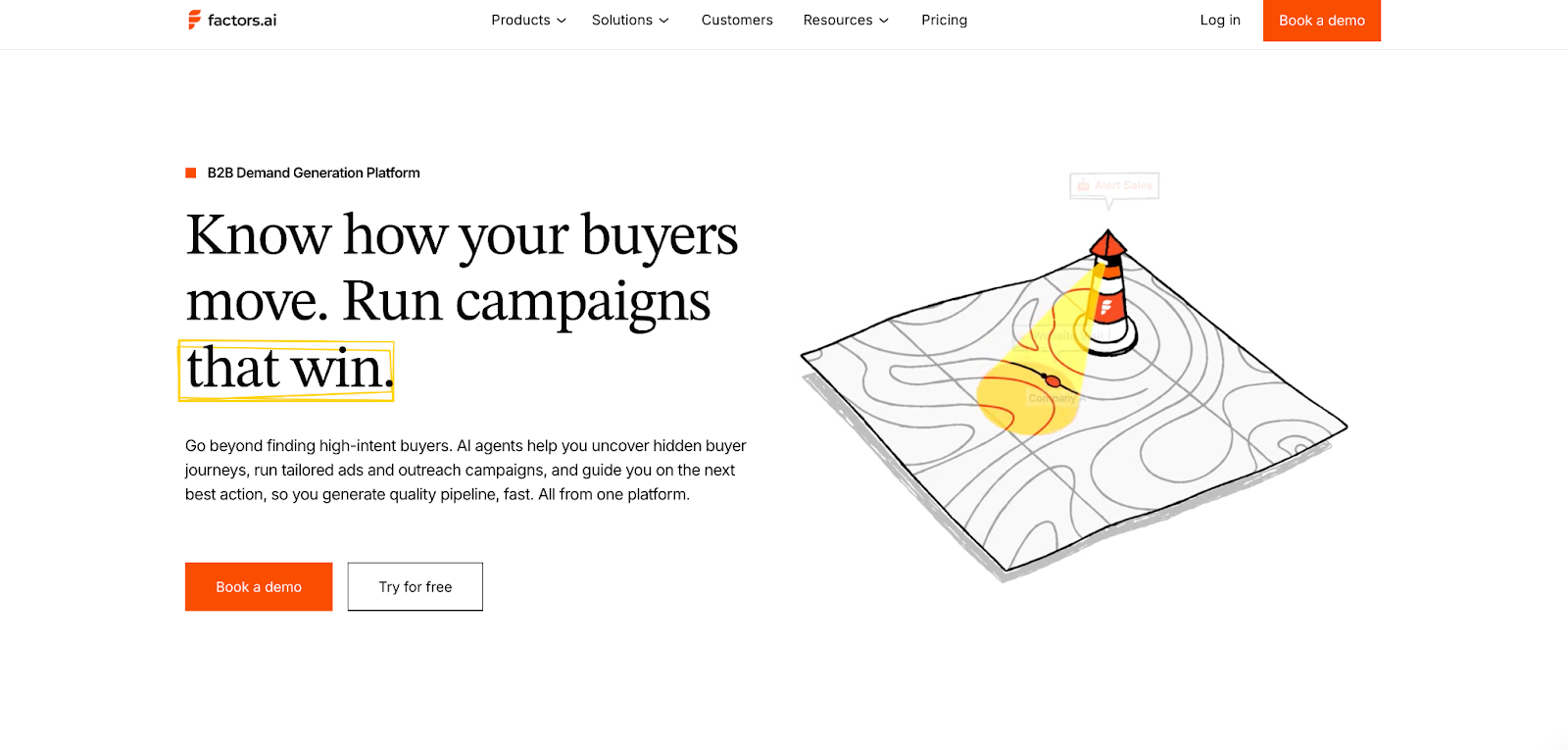
Factors.ai takes a broader view of marketing functionality. It combines analytics, intent intelligence, campaign activation, and GTM automation into one connected ecosystem.
Key highlights:
- Identifies up to 75% of visiting accounts through sequential enrichment.
- Captures and connects signals across the website, ads, CRM, and product usage.
- Builds Account 360 views with full-funnel visibility.
- Provides Milestones to track how accounts move through awareness, engagement, and conversion.
- Activates audiences dynamically on LinkedIn and Google via AdPilot.
- Uses AI Agents to automate buying-group mapping, follow-up triggers, and account research.
Factors.ai functions as a GTM hub, bringing together what attribution tools track and what marketing teams need to act on.
What I like about Factors.ai’s feature set is that it assumes GTM is messy by default. Accounts don’t move in straight lines. Buying groups show up late. Intent spikes and cools off unpredictably. Instead of forcing teams to interpret attribution reports manually, it pulls those signals into one place and makes them usable.
When you see an account identified, you’re also seeing how engaged they are, where they sit in the funnel, and what should happen next. That shift from visibility to usability is the core design difference here.
Marketo Functionality and Features
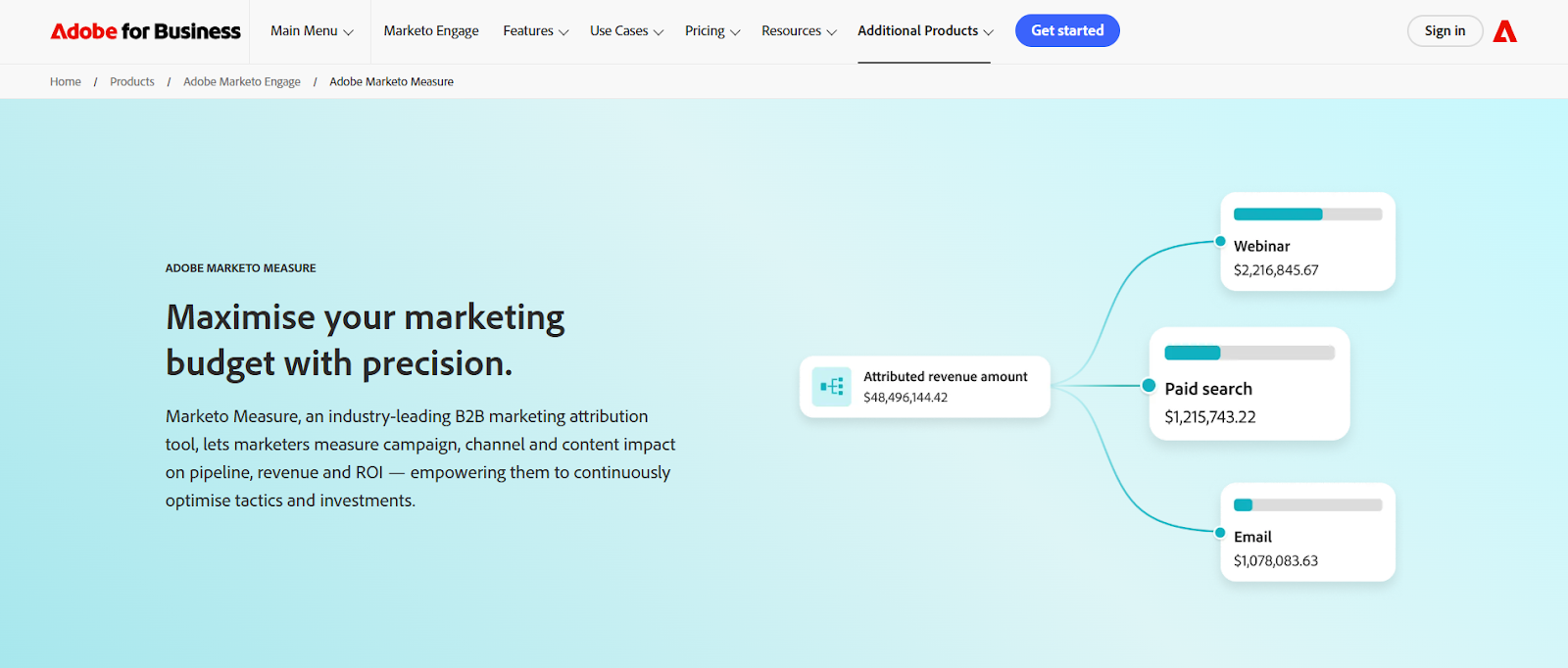
Marketo Measure (formerly Bizible) is built around attribution intelligence.
It helps marketing teams trace every lead, ad, and interaction back to its contribution to revenue.
Key highlights:
- Tracks online and offline campaign touchpoints across the full buyer journey.
- Uses customizable attribution models (W-Shaped, U-Shaped, Full Path, and custom setups).
- Syncs with CRMs like Salesforce and marketing automation platforms through Adobe Experience Cloud.
- Leverages Attribution AI for predictive attribution and model optimization.
- Integrates with BI tools for advanced visualization and data exports.
Marketo Measure gives teams precise reporting on where revenue influence comes from.
Its design favors enterprise setups that already have complex data pipelines and defined marketing ops processes.
I’d say, Marketo Measure does well when attribution itself is the job to be done. For marketing ops teams responsible for proving influence to leadership, its depth is a real strength. But it also assumes that activation, prioritisation, and follow-up will happen somewhere else. That separation works well in mature enterprise environments with dedicated ops layers already in place.
Factors.ai vs Marketo Measure: Verdict on Functionality & Features
Marketo Measure excels at attribution depth and precision, ideal for marketing ops teams focused solely on proving influence.
Factors.ai extends beyond tracking, connecting insights to execution with automation, scoring, and activation built-in.
In short:
Marketo Measure = Granular attribution for complex marketing ecosystems.
Factors.ai = All-in-one GTM automation built around intent and revenue visibility.
Want a look at how unified account intelligence actually works? See Account360 / account intelligence, our hub for full-funnel visibility.
Factors.ai vs Marketo Measure: Pricing and Plans
Pricing models often reflect how a product is expected to be used.
Some platforms assume long procurement cycles, bundled contracts, and heavy upfront planning. Others are designed to be adopted gradually by teams who want to see value before committing deeply. That mindset difference is evident when you look at how Factors.ai and Marketo Measure approach pricing.
Factors.ai vs Marketo Measure: Pricing Comparison Table
| Aspect | Factors.ai | Marketo Measure (Bizible) |
|---|---|---|
| Model Type | Usage- and seat-based pricing across four tiers. | Custom enterprise pricing through Adobe’s sales team. |
| Free Tier | Available, up to 200 companies identified per month, with basic dashboards and integrations. | No free tier available. |
| Paid Plans | Basic, Growth, and Enterprise, each adding more capacity, analytics depth, and automation. | No public plans; pricing is quoted based on organization size and Adobe bundle. |
| GTM Engineering Services | Add-on plans, offering workflow automation, GTM setup, and campaign integration help. | Not available. Implementation handled through Adobe support. |
| Transparency | Plan structure and inclusions are clearly listed and easy to compare. | Pricing and inclusions are disclosed only after consultation. |
| Value Focus | Flexible for growing GTM teams; scalable with usage. | Built for large enterprises that already use Marketo or Adobe. |
Factors.ai’s Pricing
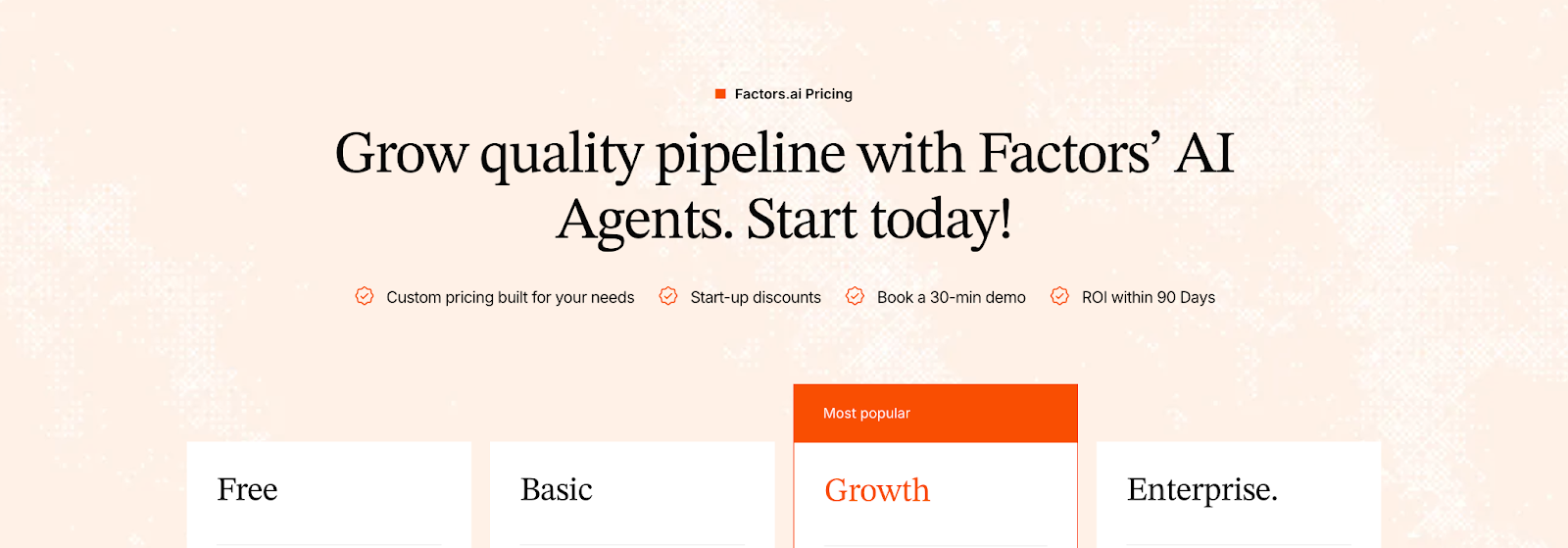
Factors.ai keeps its pricing straightforward.
Every plan is built to help teams grow into the platform instead of out of it.
Here’s how it scales:
- Free Plan: Up to 200 companies/month, with journey tracking, starter dashboards, and Slack integration.
- Basic Plan: 3,000 companies/month, with LinkedIn intent signals, GTM workflows, and CRM integrations.
- Growth Plan: 8,000 companies/month, with ABM analytics, G2 intent, and a dedicated CSM.
- Enterprise Plan: Unlimited accounts, predictive scoring, AdPilot integrations, and advanced onboarding.
For teams that need deeper operational help, GTM Engineering Services can be added.
These include hands-on assistance with campaign automation, custom workflows, and GTM system integration, handled by Factors.ai’s in-house engineers.
It’s designed for teams that want to move fast without juggling multiple tools or agencies.
This structure works particularly well for teams that want to experiment with GTM workflows, prove impact, and then scale usage without renegotiating contracts every quarter.
The goal is simple: clear pricing, complete control, and quick setup without long procurement cycles.
Marketo Measure’s Pricing
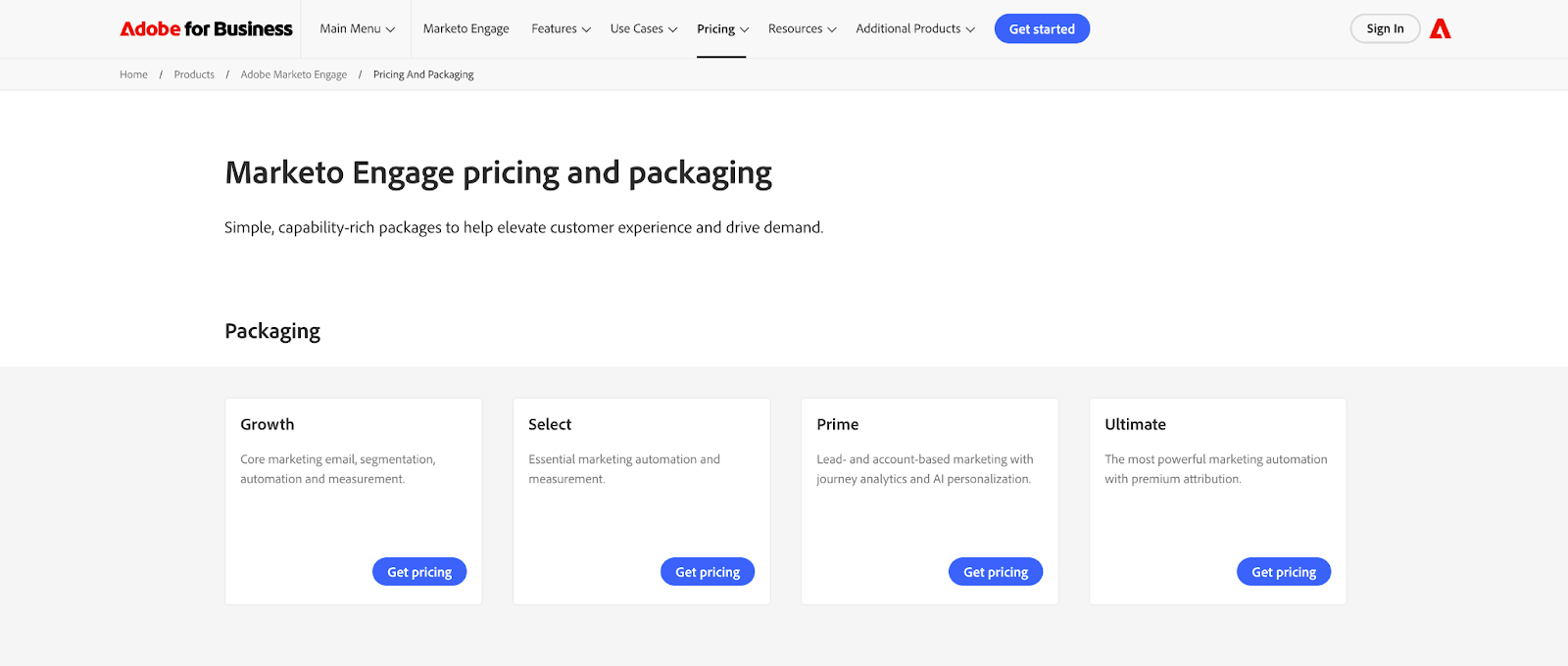
Marketo Measure is now offered as part of the Adobe Marketo Engage Ultimate package, it’s no longer available as a standalone solution.
This means businesses looking for advanced attribution will need to invest in the full Marketo Engage suite, which combines automation, lead management, journey analytics, and premium attribution.
Here’s how that plays out in practice:
- Pricing isn’t listed publicly and is shared only through Adobe’s sales team.
- The Ultimate plan includes premium attribution, predictive audiences, and advanced journey analytics.
- Other plans like Growth, Select, and Prime, do not include Marketo Measure.
- Implementation is handled through Adobe’s enterprise onboarding process, often with partner assistance.
- The platform is best suited for established organizations already using other Adobe Experience Cloud products.
It’s a strong enterprise option, but one that requires a broader product commitment.
Teams focused primarily on attribution or GTM measurement may find the bundled approach less flexible.
For teams already invested in Adobe’s ecosystem, this bundling can make sense. For teams evaluating attribution as a standalone need, the commitment can feel heavier than the problem they’re trying to solve.
Factors.ai vs Marketo Measure: Verdict on Pricing and Plans
Factors.ai takes a more modular route.
Its transparent tier structure lets teams choose exactly what they need, from free starter plans to advanced enterprise tiers.
Add-on GTM Engineering Services give teams hands-on help for automation and workflow setup, something most SaaS tools leave out.
Marketo Measure, as part of the Adobe Marketo Engage Ultimate plan, brings high-end attribution capabilities but ties them to a full-suite contract.
It works best for large enterprises already deep within the Adobe ecosystem.
In short:
Factors.ai = Transparent pricing, flexible growth, and optional GTM setup support.
Marketo Measure = Advanced attribution available only through Adobe’s enterprise suite.
Before deciding budgets, this ABM platform pricing guide shows how seat-based and usage-based models stack up.
Factors.ai vs Marketo Measure: Analytics and Reporting
Understanding what’s working is as important as running the campaign itself. Strong analytics tell you what happened, why it happened, and what to do next.
Both Factors.ai and Marketo Measure focus on visibility and insight, but they approach it differently. Marketo Measure centers on attribution accuracy.
Factors.ai connects attribution with buyer behavior, funnel progression, and intent, giving GTM teams a fuller picture of performance.
Factors.ai vs Marketo Measure: Analytics and Reporting Comparison Table
| Aspect | Factors.ai | Marketo Measure (Bizible) |
|---|---|---|
| Core Focus | Full-funnel analytics that link campaigns, accounts, and revenue. | Multi-touch attribution showing which campaigns influenced deals. |
| Attribution Models | Supports multi-touch and milestone-based analytics. | Customizable models (U-Shaped, W-Shaped, Full Path, Custom). |
| Data Scope | Website, CRM, product, and ad performance data in one place. | Marketing and CRM data across online and offline campaigns. |
| Customer Journey View | Visual journey timelines showing each account’s engagement path. | Attribution paths shown in reports, but no chronological journey view. |
| Custom Reporting | Up to 300 customizable dashboards and reports. | Advanced reporting via Adobe dashboards and BI tools. |
| Ease of Use | No-code dashboards; reports can be customized by marketing teams directly. | Requires deeper setup and data modeling experience. |
| Real-Time Insights | Live funnel progression through “Milestones.” | Delayed data refreshes based on CRM sync cycles. |
Factors.ai Analytics and Reporting
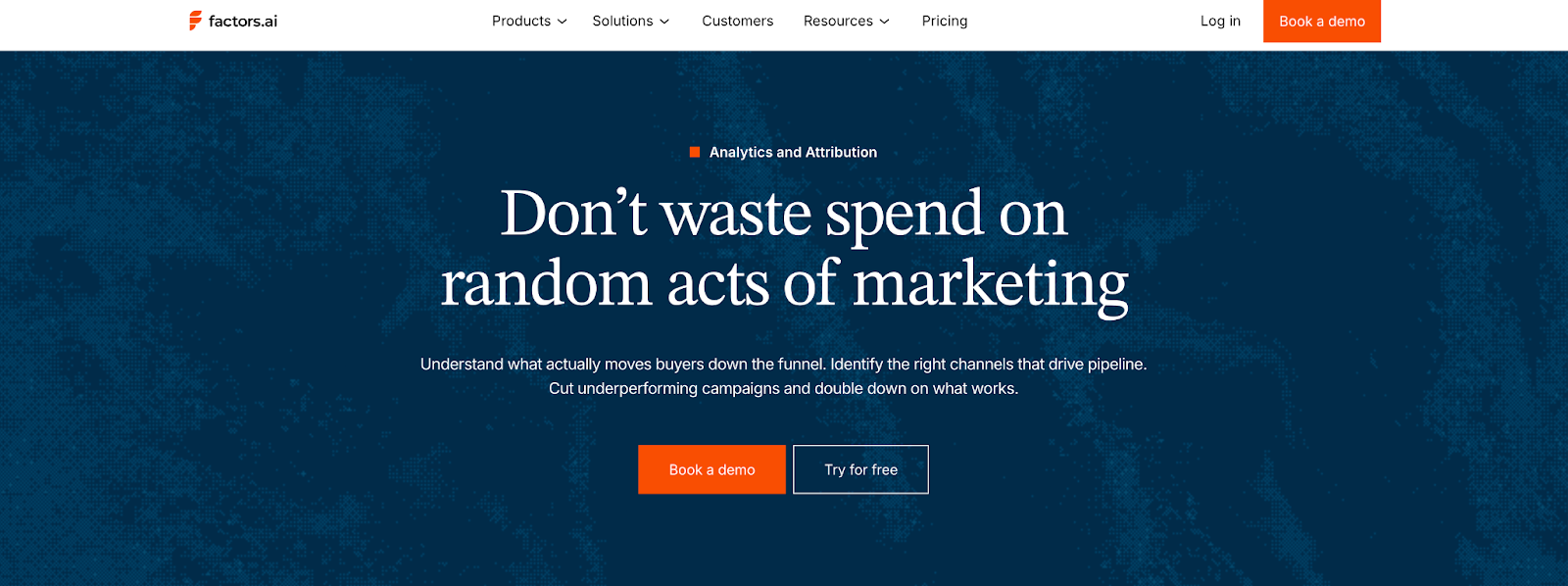
Factors.ai builds its analytics around clarity and context.
It doesn’t just measure campaigns and connects them to the entire customer journey.
Key strengths:
- Milestones track how accounts move from first visit to deal closure.
- Account360 gives a complete view of every touchpoint including web, ads, CRM, and product.
- Multi-touch attribution links conversions to both intent and engagement depth.
- Custom dashboards let marketers compare segments, campaigns, and channels in a few clicks.
- Real-time data ensures decisions aren’t made on yesterday’s numbers.
What makes it stand out is the mix of context + speed. Teams get reports but what makes it great is that they also get clarity on which signals are worth acting on right now.
One thing GTM teams appreciate here is not having to wait for end-of-week reports. When milestones get updated in real time, it changes how quickly teams can react. You’re no longer debating whether a signal matters. You’re acting while it still does.
Marketo Measure’s Analytics and Reporting
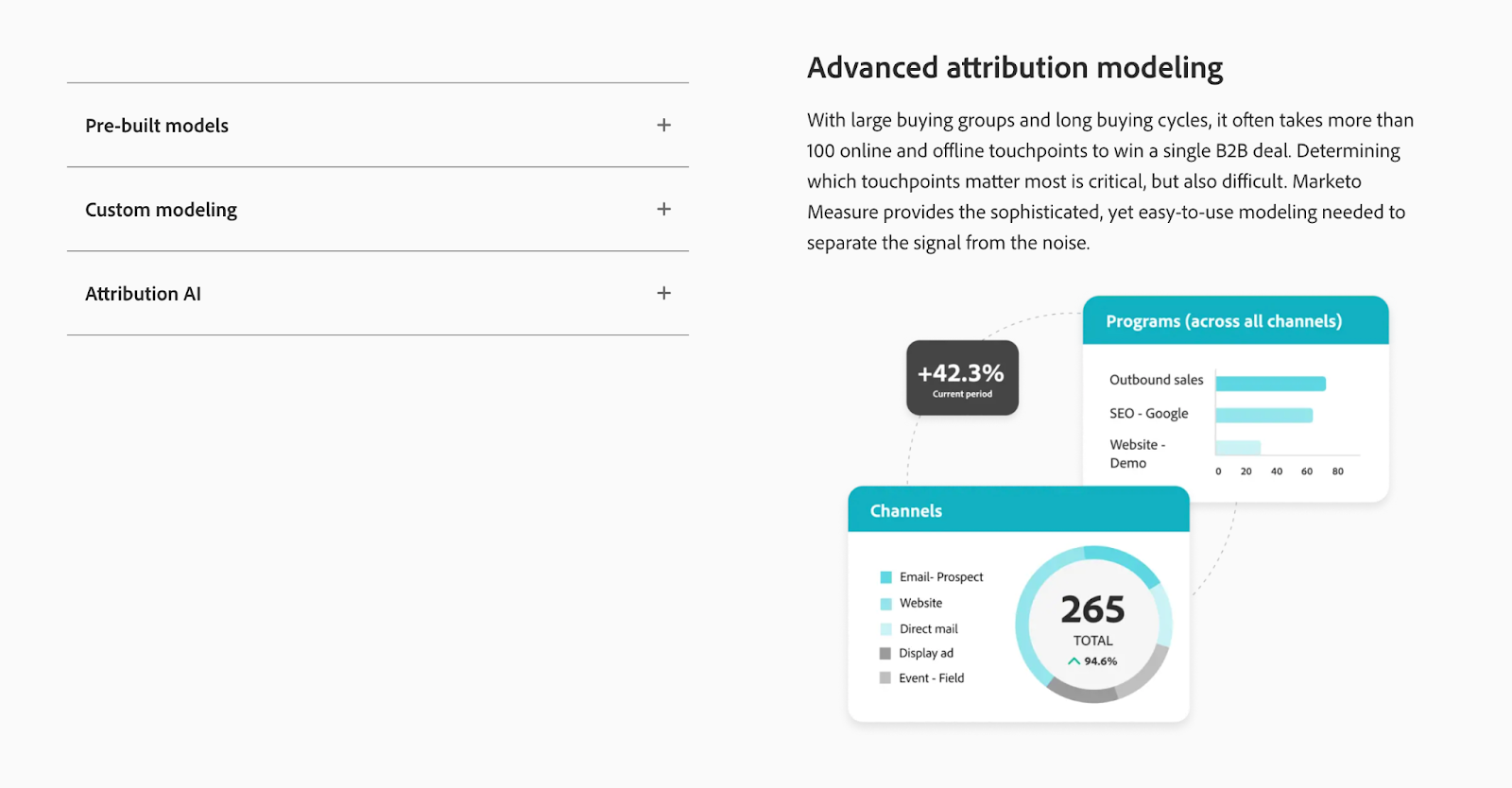
Marketo Measure is designed for teams that specialize in attribution.
It breaks down every marketing touchpoint and maps it to pipeline and revenue contribution.
Core capabilities include:
- Custom attribution models like U-Shaped, W-Shaped, and Full Path.
- Integration with CRM and ad platforms for campaign-level insights.
- Attribution AI for predictive modeling and advanced influence tracking.
- Rich dashboard visualizations through Adobe Analytics and BI tools.
- Offline campaign tracking through CRM data sync.
While it offers precise attribution, setting up and maintaining reports can be complex, especially for teams without dedicated data specialists. It just requires more planning, more setup, and more specialised ownership to keep everything running smoothly.
Factors.ai vs Marketo Measure: Verdict on Analytics and Reporting
Marketo Measure provides unmatched attribution accuracy for enterprise teams that need every touchpoint accounted for.
It’s ideal for marketers deeply invested in proving revenue impact through structured models.
Factors.ai, meanwhile, takes analytics beyond attribution.
It connects performance data, engagement behavior, and funnel outcomes in one interface, helping teams not just analyze but act.
In short:
Factors.ai = Real-time funnel analytics with actionable insights.
Marketo Measure = Enterprise-grade attribution for structured reporting teams.
For real examples of actionable dashboards, check attribution reporting: what you can learn from marketing attribution reports.
{{INLINE_BOFU}}
Factors.ai vs Marketo Measure: Ad Activation and Campaign Sync
Running ads is easy.
Running ads that convert the right audience at the right time, that’s where most teams struggle.
By the time audiences refresh, intent has shifted. Accounts that should be suppressed keep seeing ads. Accounts that are suddenly active don’t get picked up in time. This is where execution capabilities start to matter more than reporting depth.
Factors.ai and Marketo Measure both work with campaign data, but their focus is entirely different.
Marketo Measure helps you track ad performance.
Factors.ai helps you optimize and activate ads in real time based on live intent signals.
Factors.ai vs Marketo Measure: Ad Activation and Campaign Sync Comparison
| Aspect | Factors.ai | Marketo Measure (Bizible) |
|---|---|---|
| Ad Activation | Dynamic ad activation for LinkedIn and Google through AdPilot. | Not supported; focuses on tracking ad influence, not activation. |
| Audience Sync | Real-time sync between CRM, product, and ad platforms. | Manual updates through CRM and Adobe integrations. |
| Optimization | Uses conversion feedback and Google CAPI to refine targeting. | Measures campaign impact post-conversion. |
| Campaign Automation | Builds buyer-stage campaigns and refreshes audiences automatically. | No automation; reporting-driven only. |
| Data Feedback Loop | Sends live conversion and engagement data to optimize ad delivery. | Data used only for attribution and pipeline reporting. |
| Integration Depth | Native integrations with LinkedIn, Google, Facebook, Bing, and Drift. | Ad data flows through Adobe Experience Platform or CRM syncs. |
Factors.ai’s Ad Activation and Campaign Sync
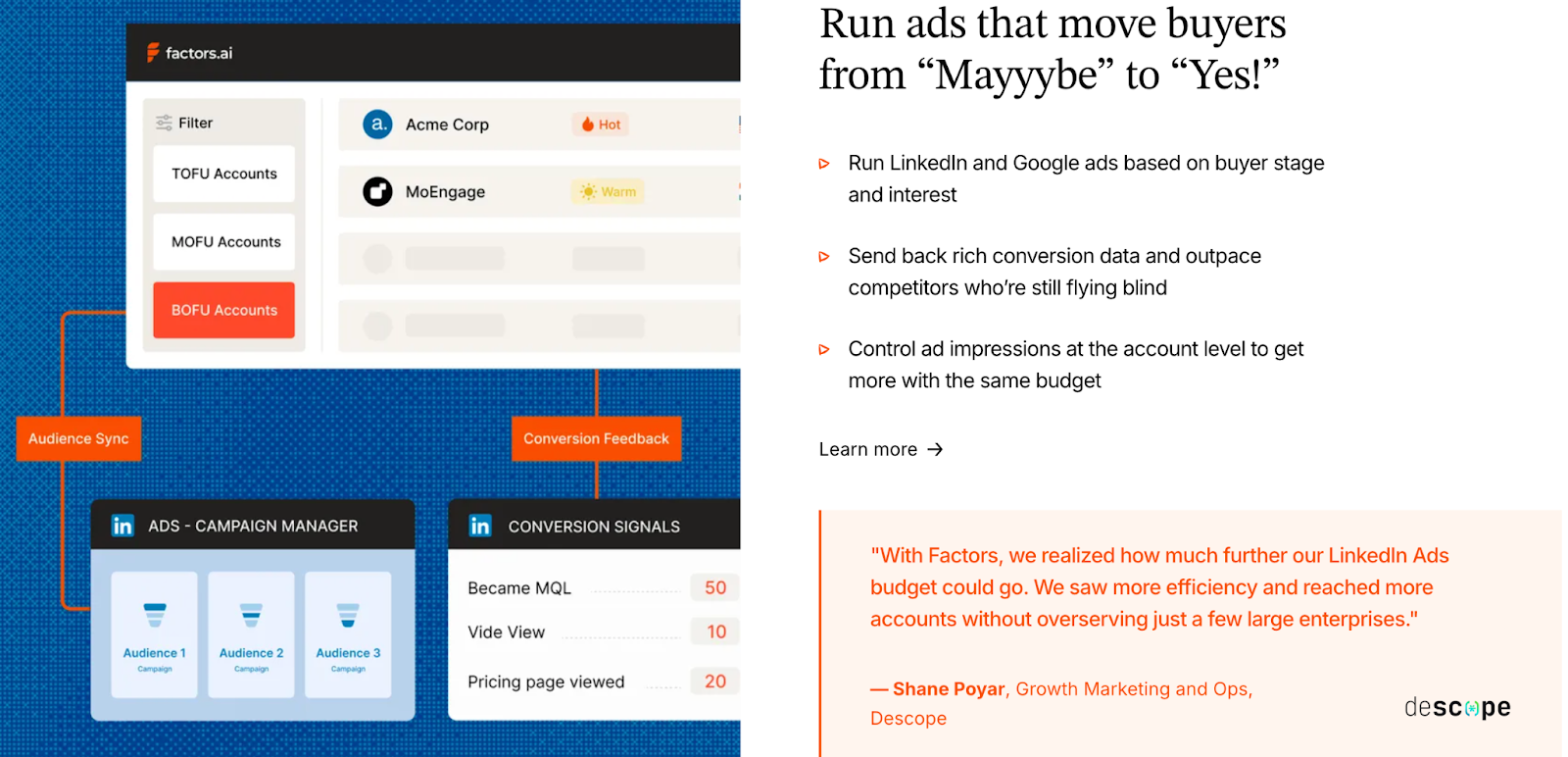
Factors.ai helps marketing teams move from passive tracking to active optimization.
Its advertising features are designed to make every dollar count by focusing spend on genuine buying intent.
Highlights:
- LinkedIn AdPilot: Runs intent-based LinkedIn ads automatically, adjusting to account activity and funnel stage.
- Google AdPilot: Uses Google CAPI to send conversion data back for smarter targeting and reduced wasted spend.
- Buyer-stage campaigns: Creates ad sets based on where accounts sit in the funnel, awareness, consideration, or decision.
- Audience sync: Updates audiences daily across CRM, website, and ad platforms to keep targeting precise.
- Suppression lists: Removes inactive or irrelevant accounts automatically to prevent budget leaks.
These capabilities make Factors.ai stand out for teams that want their advertising tied directly to engagement signals (not guesswork). This is especially useful for teams running always-on LinkedIn or Google programs, where manual audience updates quietly eat up time and budget.
Marketo Measure’s Ad Activation and Campaign Sync
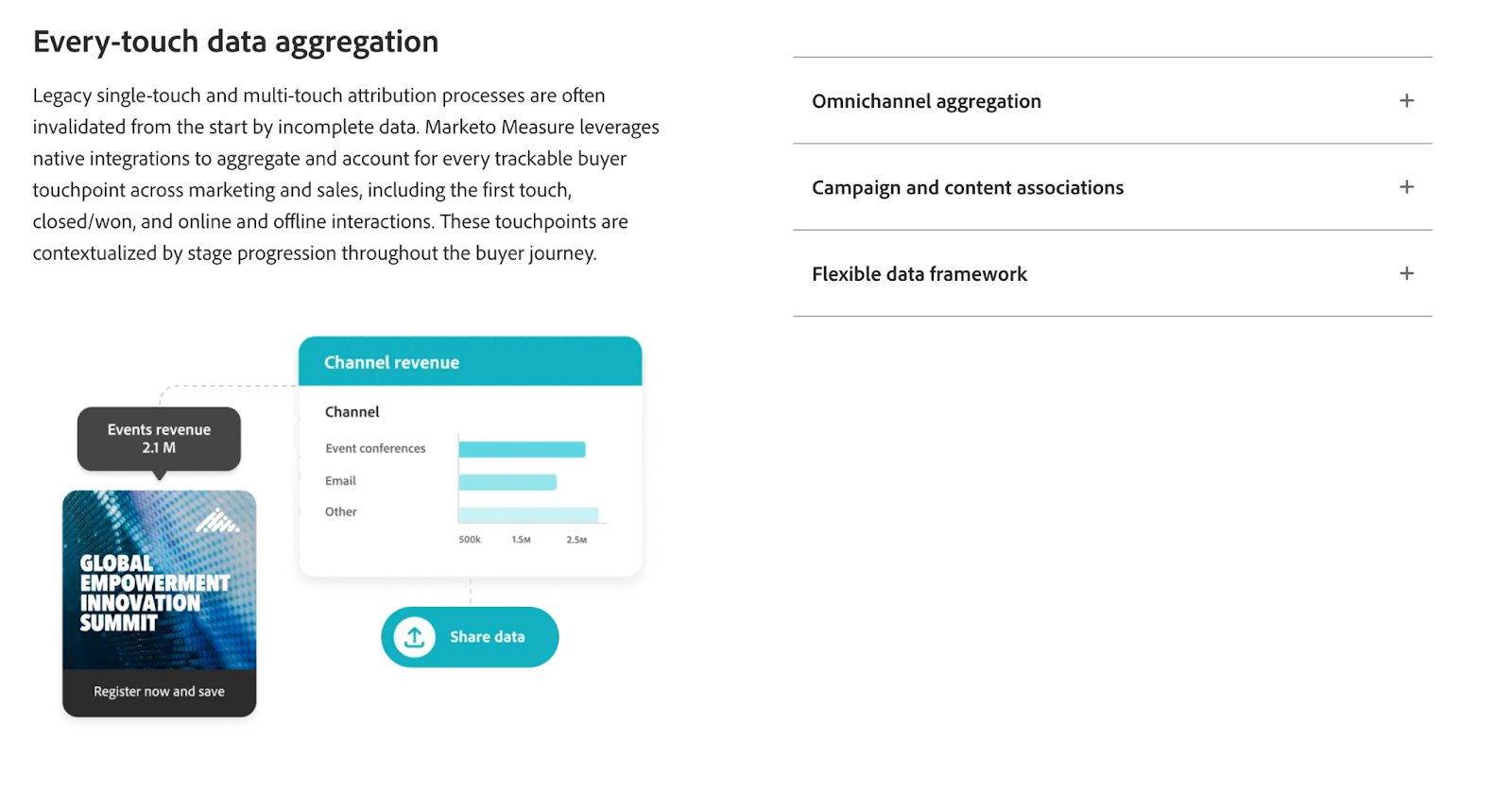
Marketo Measure stays on the measurement side of ads.
It’s designed to record what happened, not to manage or optimize campaigns.
Core features:
- Tracks ad impressions, clicks, and downstream conversions via CRM.
- Integrates ad data from LinkedIn, Google, and other paid channels into attribution reports.
- Measures campaign influence on pipeline and closed deals.
- Uses Attribution AI for model-based performance analysis.
- No audience sync or ad automation built into the tool.
This works well for teams that already have ad management handled elsewhere and want precise post-campaign reporting. However, for teams seeking real-time optimization or automated workflows, it offers limited operational flexibility.
Factors.ai vs Marketo Measure: Verdict on Ad Activation and Campaign Sync
Marketo Measure gives you clean post-campaign insights which is great for understanding how ads contributed to deals.
But it doesn’t help manage or automate campaigns.
Factors.ai, on the other hand, closes that loop.
It runs, refreshes, and optimizes campaigns dynamically based on live buyer intent.
For marketing teams looking to connect their ad data with actual outcomes, it turns campaign management into a growth engine.
In short:
Factors.ai = Real-time ad activation with conversion feedback loops.
Marketo Measure = Post-campaign attribution and influence tracking.
Factors.ai vs Marketo Measure: GTM Services and Automation
Modern GTM teams need data along with systems that act on it. Automation has become the difference between teams that keep up and those that lead.
That’s exactly where the gap widens between Factors.ai and Marketo Measure.
Marketo focuses on data-driven reporting, while Factors.ai helps teams put that data to work through automation, AI agents, and dedicated GTM engineering support.
Factors.ai vs Marketo Measure: GTM Services and Automation Comparison Table
| Aspect | Factors.ai | Marketo Measure (Bizible) |
|---|---|---|
| Automation Depth | AI-driven workflows that trigger follow-ups, alerts, and campaigns automatically. | Limited automation; focused on data collection and attribution. |
| AI Agents | Assist GTM teams with account research, buying-group mapping, and reactivation of closed-lost deals. | Not available. |
| Sales Alerts | Sends contextual alerts via Slack for high-intent actions. | No built-in alert system. |
| Workflow Support | Custom automations handled through GTM Engineering Services. | Manual setup through Adobe workflows or internal ops teams. |
| Human + AI Support | Offers guided GTM automation support through in-house engineers. | Relies on Adobe’s general support and documentation. |
| Outcome Focus | Turns data into next steps like campaign adjustments, account follow-ups, and workflow triggers. | Uses data for analysis and historical reporting. |
Factors.ai’s GTM Services and Automation

Factors.ai gives GTM teams a complete operating system for demand generation.
Instead of stopping at analytics, it brings automation directly into the execution layer.
Key highlights:
- AI Agents: Research accounts, identify decision-makers, and even revive lost deals based on new intent data.
- GTM Engineering Services: Available from $4,000 setup + $300/month, providing expert help to automate workflows, manage integrations, and connect tools seamlessly.
- Sales Alerts: Deliver real-time insights on high-value account activity, like demo revisits, pricing views, or post-meeting engagement.
- Workflow Automations: Sync with CRM, ad platforms, and communication tools to trigger the right actions automatically.
- Full GTM Loop: Aligns marketing and sales through automation, ensuring no opportunity is missed due to delays or data gaps.
The combination of automation and human support makes it a true operational partner for GTM teams.
The GTM Engineering Services matter more than they might seem on paper. For teams without dedicated RevOps or automation specialists, having engineers who understand GTM workflows reduces time-to-value dramatically.
Marketo Measure’s GTM Services and Automation
Marketo Measure focuses on visibility and attribution rather than automation.
It provides accurate data, but how that data gets used is up to the teams managing it.
Key points:
- Offers reporting and analytics through Adobe’s ecosystem.
- No built-in workflow or automation layer for GTM execution.
- Relies on integrations with Marketo Engage or third-party tools for campaign follow-ups.
- No AI features or account intelligence tools included.
- Ideal for organizations that already have in-house teams managing GTM operations manually.
It’s a powerful data solution, but not an operational one. Most automation has to be built around it, not within it.
In environments where ops teams are already staffed and workflows are well defined, this separation works. For lean teams, it can feel like one more system that needs to be managed rather than one that helps manage work.
Factors.ai vs Marketo Measure: Verdict on GTM Services & Automation
Marketo Measure gives GTM teams strong visibility but limited motion.
It tells you what happened, but not what to do next.
Factors.ai goes a step further.
It uses automation, AI agents, and GTM engineering expertise to help teams act on insights the moment they appear.
For growing marketing and sales teams, that means faster response times and higher conversion efficiency.
In short:
Factors.ai = Action-oriented GTM automation powered by AI and human support.
Marketo Measure = Data visibility without execution capabilities.
Factors.ai vs Marketo Measure: Support and Ease of Use
What truly defines a platform’s value is how seamlessly teams can use it and the level of support available to them.
The difference between a tool that works and one that stays in use often comes down to setup, guidance, and responsiveness.
Here’s how Factors.ai and Marketo Measure compare when it comes to getting started and staying supported.
Factors.ai vs Marketo Measure: Support and Ease of Use Comparison
| Aspect | Factors.ai | Marketo Measure (Bizible) |
|---|---|---|
| Onboarding | Guided onboarding with white-glove setup, hands-on support, and weekly syncs. | Onboarding through Adobe’s enterprise support; process varies by client. |
| Ease of Setup | Integrations and tracking configured within days. | Longer setup cycles; requires technical alignment with Adobe systems. |
| Customer Success | Dedicated CSM for Growth and Enterprise plans. | General Adobe support and documentation. |
| Support Channels | Slack, helpdesk, and email; direct communication with GTM engineers available. | Adobe support portal and account manager (for enterprise). |
| Learning Curve | Simple, no-code dashboards designed for GTM and marketing teams. | Steeper; requires familiarity with attribution models and Adobe workflows. |
| Ongoing Guidance | GTM Engineering Services assist with continuous automation and optimization. | Periodic support tickets and managed help through Adobe service teams. |
Factors.ai’s Support and Ease of Use
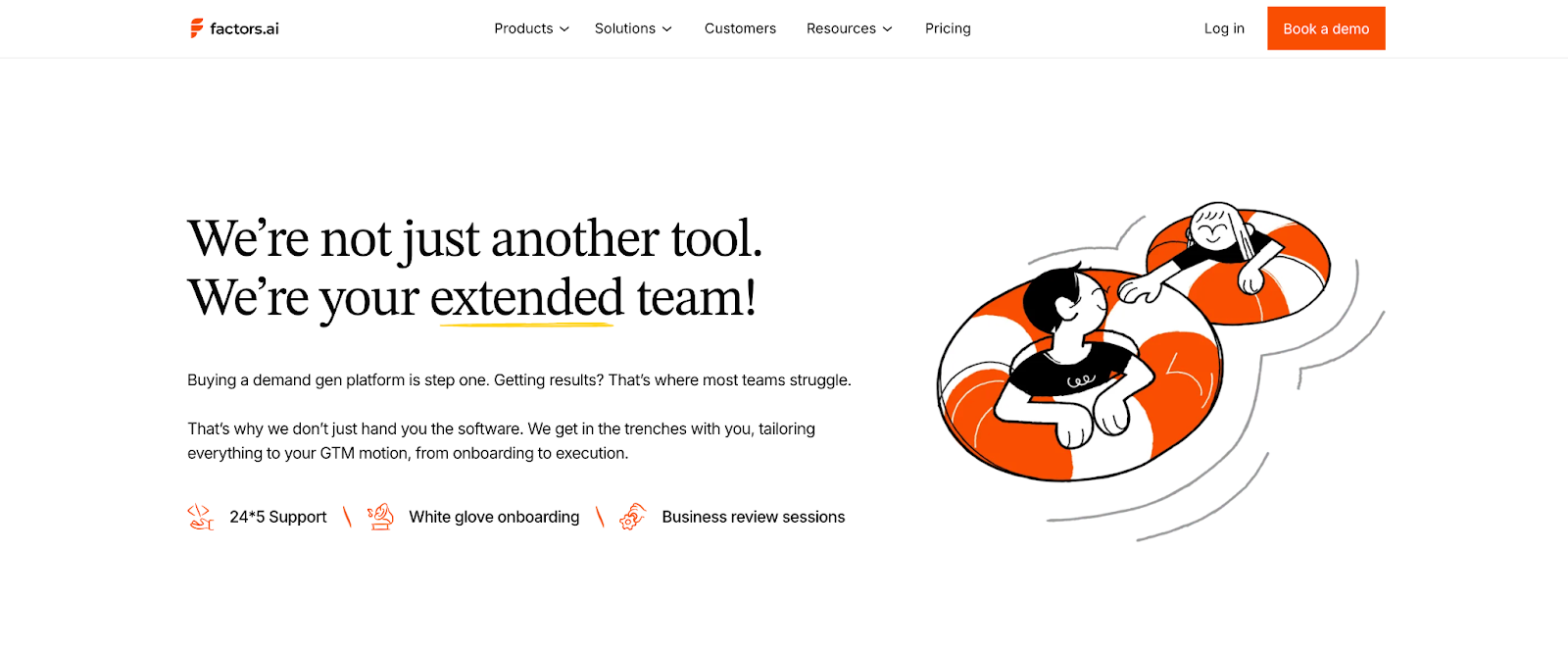
Factors.ai builds support into the product experience itself.
Its team focuses on helping customers not just use the platform, but master it.
Key highlights:
- White-glove onboarding ensures integrations and data pipelines are configured properly from day one.
- Dedicated Customer Success Managers guide Growth and Enterprise clients through onboarding and campaign alignment.
- Slack-based support gives teams direct access to quick responses without ticket delays.
- Weekly syncs help review progress, optimize dashboards, and suggest GTM improvements.
- GTM Engineering Services continue beyond setup, offering custom automation and optimization for teams that want hands-on help.
The combination of accessibility, communication, and expertise makes setup feel collaborative and not technical. And having Slack access and regular syncs changes how problems get solved. Instead of logging tickets, teams iterate together, which keeps momentum high during rollout.
Marketo Measure’s Support and Ease of Use
Marketo Measure offers enterprise-level support under Adobe’s ecosystem.
The experience largely depends on the client’s existing Adobe setup and service agreements.
Key points:
- Onboarding typically handled by Adobe or certified partners.
- Setup often takes longer due to dependencies on CRM, MAP, and internal systems.
- Support managed through the Adobe portal or account managers.
- Documentation is detailed but geared toward data and marketing ops specialists.
- Users without prior experience in attribution modeling or Adobe tools may find the learning curve steep.
The system is stable once implemented but less intuitive for day-to-day users who aren’t deeply technical.
Factors.ai vs Marketo Measure: Verdict on Support and Ease of Use
Marketo Measure provides structured support for large enterprises used to working with Adobe tools.
It’s thorough but slower to implement and less flexible for smaller or mid-market teams.
Factors.ai focuses on accessibility and partnership.
Between direct Slack channels, weekly reviews, and GTM engineering help, it feels more like an extension of your team than a vendor.
In short:
Factors.ai = Guided onboarding and responsive, human-centered support.
Marketo Measure = Enterprise support designed for larger, process-heavy teams.
For lean teams preferring self-serve setups, the website visitor identification implementation guide walks you through configuration basics.
Factors.ai vs Marketo Measure: Security and Compliance
Protecting marketing data is about building trust. Every interaction and conversion contains sensitive details, so robust compliance is essential for reliable analytics.
Both Factors.ai and Marketo Measure handle enterprise-level data, but their approaches to transparency and certification differ.
Factors.ai vs Marketo Measure: Security and Compliance Comparison Table
| Aspect | Factors.ai | Marketo Measure (Bizible) |
|---|---|---|
| Certifications | ISO 27001, SOC 2 Type II, GDPR, and CCPA compliant. | GDPR compliant (as listed on official documentation). |
| Hosting Infrastructure | Hosted on Google Cloud Platform (GCP), SOC 1, 2, and 3 certified. | Hosted on Adobe’s cloud infrastructure integrated with Experience Platform. |
| Data Encryption | AES-256 encryption for data at rest, TLS encryption for data in transit. | Standard encryption protocols through Adobe infrastructure. |
| Access Control | Role-based access with IAM permissions and 2FA for all production access. | Controlled via Adobe’s centralized user management system. |
| Data Isolation | Logical separation of customer data within GCP instances. | Managed within Adobe Experience Cloud’s multi-tenant setup. |
| Incident Management | Defined response process led by Data Protection Officer; frequent backups and geo-redundant storage. | Managed under Adobe’s global incident response policy. |
Factors.ai’s Security and Compliance

Factors.ai takes a transparent and proactive approach to data protection.
Security is built into every part of the product, from data hosting to employee access.
Key details:
- Hosted securely on Google Cloud Platform, with full compliance to SOC 1, SOC 2, and SOC 3 standards.
- Uses AES-256 encryption for stored data and TLS encryption for data in transit.
- Enforces role-based access with two-factor authentication across its infrastructure.
- Data is logically isolated between clients, ensuring no overlap or shared visibility.
- Regular manual and automated audits assess risks and maintain integrity.
- Incident management protocols ensure immediate action, data backup, and communication in case of any breach attempt.
Compliance goes beyond the basics, too.
Factors.ai aligns with GDPR, CCPA, and international privacy regulations, offering clients clear documentation and Data Processing Agreements on request.
For teams handling sensitive CRM or behavioral data, it provides the assurance of enterprise-grade reliability with startup-level responsiveness.
Marketo Measure’s Security and Compliance
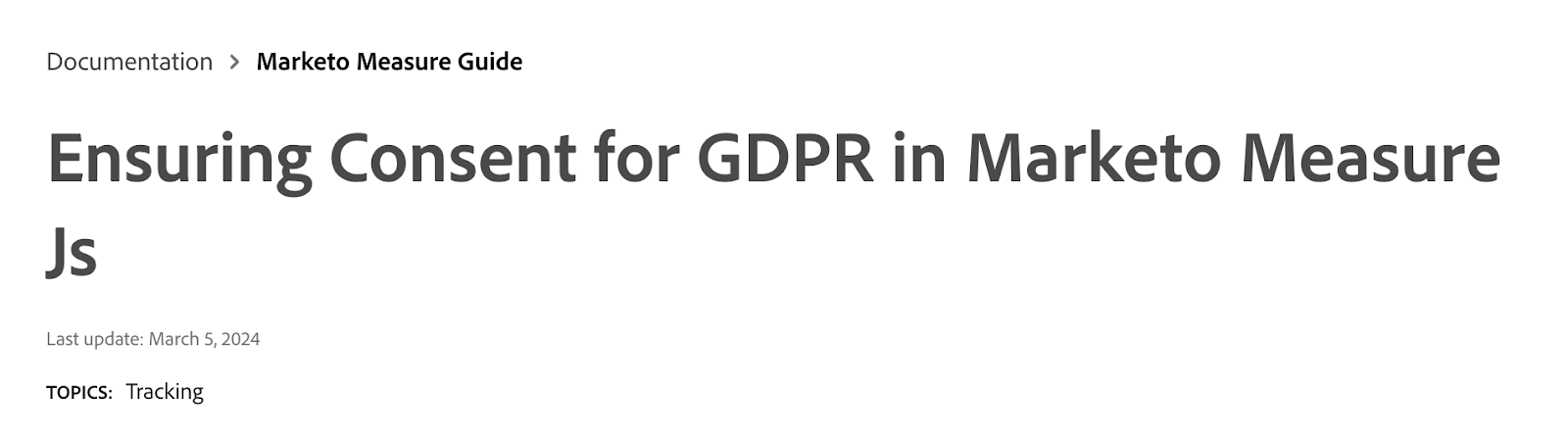
Marketo Measure benefits from Adobe’s established security ecosystem.
Data is processed and stored within the Adobe Experience Platform, which maintains strong compliance standards globally.
Notable points:
- Listed as GDPR compliant on its official documentation.
- Inherits Adobe’s enterprise-grade security and privacy infrastructure.
- Access control managed through Adobe’s identity and permission systems.
- Incident response and compliance handled at the Adobe corporate level.
- No separate public documentation for Marketo Measure’s standalone security practices.
While secure by association, visibility into tool-specific compliance details is limited.
Most assurance comes through Adobe’s overarching certifications rather than Marketo Measure’s individual framework.
Factors.ai vs Marketo Measure: Verdict on Security and Compliance
Marketo Measure operates under Adobe’s secure environment, which ensures global standards are met, but offers less transparency on the product’s individual compliance details.
Factors.ai, on the other hand, documents every layer of its security practice, from encryption to incident response.
Its certifications, transparency, and client-level data controls make it easier for businesses to assess and trust their compliance posture directly.
In short:
Factors.ai = Transparent, certified, and independently audited for security and privacy.
Marketo Measure = Enterprise-grade protection within Adobe’s ecosystem, but less tool-specific visibility.
Factors.ai vs Marketo Measure: Overall Verdict & Recommendation
Both Factors.ai and Marketo Measure serve marketing teams that want clarity on what drives growth.
They’re built for different goals: one focuses on attribution precision, the other on complete GTM orchestration.
Marketo Measure remains one of the strongest options for detailed attribution modeling.
It helps marketing teams trace every touchpoint’s influence on pipeline, especially in complex enterprise setups.
But beyond attribution, it offers little to help teams move faster or automate their next steps.
Factors.ai, on the other hand, combines that analytical depth with action.
It helps GTM teams connect insights with engagement, run intent-driven campaigns, and use automation to convert data into movement.
The experience feels integrated like analytics, ads, signals, and follow-ups all connected in one place.
Factors.ai vs Marketo Measure: Quick Recap
| Category | Best Fit | Reason |
|---|---|---|
| Functionality & Features | Factors.ai | Broader GTM coverage: identification, activation, analytics, and automation. |
| Pricing & Value | Factors.ai | Transparent tiered pricing with optional GTM Engineering Services. |
| Analytics & Reporting | Marketo Measure | Advanced attribution models for enterprise-level tracking. |
| Ad Activation | Factors.ai | Real-time campaign sync and optimization through AdPilot. |
| GTM Automation | Factors.ai | AI agents and workflow automation that act on live intent data. |
| Support & Ease of Use | Factors.ai | Guided onboarding, CSM support, and Slack communication. |
| Security & Compliance | Factors.ai | Full transparency with ISO 27001, SOC 2 Type II, GDPR, and CCPA compliance. |
When to choose Factors.ai
- Brings all GTM functions, from intent detection to campaign automation, under one system.
- Offers transparent pricing with optional GTM Engineering Services starting at $1,000/month.
- Provides AI agents and automation for real-time execution, not just data collection.
- Maintains strong, documented compliance and security standards.
- Gives teams hands-on onboarding and continuous optimization support.
It’s best suited for modern B2B teams that want to move quickly, work efficiently, and make decisions backed by real signals.
When to choose Marketo Measure
- Built for marketing operations teams deeply focused on attribution accuracy.
- Works best for large enterprises already using Adobe Experience Cloud or Marketo Engage.
- Offers advanced multi-touch attribution modeling and reporting capabilities.
It’s a solid choice for organizations that already have automation and campaign management tools in place and primarily need visibility into attribution.
FAQs: Factors.ai vs Marketo Measure
Q. Can Factors.ai replace Marketo Measure?
For many modern B2B GTM teams, yes.
If your primary need is multi-touch attribution reporting alone, Marketo Measure is a strong, specialised solution. But if you want attribution plus account identification, intent signals, funnel visibility, ad activation, and automation in one system, Factors.ai is designed to replace the need for a standalone attribution tool.
Factors.ai covers attribution while also helping teams act on insights in real time, something Marketo Measure does not support natively.
Q. Does Factors.ai offer multi-touch attribution like Marketo Measure?
Yes. Factors.ai supports multi-touch attribution and milestone-based analytics across the full funnel.
The difference is that Factors.ai doesn’t stop at reporting influence. It connects attribution data with account engagement, intent strength, and funnel stage, so teams can prioritise and activate accounts instead of just analysing past performance.
Q. What makes Factors.ai different from traditional attribution tools?
Traditional attribution tools focus on explaining what happened.
Factors.ai focuses on what should happen next.
In addition to attribution, Factors.ai identifies accounts, tracks intent signals across channels, scores engagement, syncs audiences, activates ads, and automates GTM workflows. This makes it a full GTM execution platform rather than just a measurement layer.
Q. Is Factors.ai better suited for SMBs or enterprise teams?
Factors.ai works across both, but it’s especially effective for lean GTM teams and scaling B2B companies.
SMBs benefit from transparent pricing, faster setup, and built-in automation without needing large ops teams.
Enterprise teams benefit from account-level visibility, intent-driven activation, GTM Engineering Services, and enterprise-grade security and compliance.
Q. Do I need Marketo or Adobe products to use Factors.ai?
No.
Factors.ai works independently and integrates with CRMs, ad platforms, and data tools without requiring Adobe Experience Cloud or Marketo Engage. This makes it easier to adopt without committing to a bundled enterprise ecosystem.
Q. Can Factors.ai activate LinkedIn and Google ads directly?
Yes.
Factors.ai includes LinkedIn AdPilot and Google AdPilot, which allow teams to run and optimise ads based on live intent signals, funnel stage, and account engagement.
Unlike attribution-only tools, Factors.ai closes the loop by using conversion and engagement data to refine targeting and reduce wasted ad spend.
Q. How does Factors.ai handle account identification compared to attribution tools?
Factors.ai identifies up to 75% of visiting accounts through sequential enrichment and links them across website activity, ads, CRM, and product usage.
Most attribution tools rely heavily on existing CRM data and campaign tagging, which limits visibility into anonymous or early-stage account behaviour.
Q. Is Factors.ai difficult to set up compared to Marketo Measure?
No. Factors.ai is designed for faster, more straightforward implementation.
Most teams are live within days, not months. Setup includes guided onboarding, no-code dashboards, and optional GTM Engineering Services for teams that want hands-on help with workflows, integrations, and automation.
Q. Does Factors.ai support sales teams as well as marketing?
Yes.
Factors.ai is built for full GTM alignment, not just marketing analytics. Sales teams benefit from account timelines, engagement scoring, intent alerts, and Slack notifications that highlight when accounts are ready for follow-up.
Q. When should a team choose Marketo Measure instead of Factors.ai?
Marketo Measure is best suited for large enterprises that:
- Are already deeply invested in Adobe Experience Cloud
- Have dedicated marketing ops and data teams
- Primarily need advanced attribution modeling for reporting and revenue influence analysis
If your GTM strategy requires execution, automation, and activation alongside analytics, Factors.ai is the more complete solution.

See how Factors can 2x your ROI
Boost your LinkedIn ROI in no time using data-driven insights


.avif)

See Factors in action.
Schedule a personalized demo or sign up to get started for free
LinkedIn Marketing Partner
GDPR & SOC2 Type II







.svg)



.avif)

