
Factors.ai vs Cognism: The GTM Platform Breakdown
Comparing Factors.ai and Cognism across features, pricing, intent data, CRM integration, and compliance. Find out which platform actually fits your GTM motion.
.avif)
Content Marketer

Growth Marketer



.svg)


TL;DR
- Cognism is an outbound-first contact database built for cold calling; Factors.ai is an AI ABM and Attribution platform that offers exceptional account intelligence and contact-level intelligence. It offers website visitor identification (>75% account-level coverage), ad activation, and multi-touch revenue attribution.
- The two platforms solve different problems. Cognism helps you find and reach contacts. Factors.ai helps you understand which accounts are in-market and measure what's actually driving the pipeline.
- Cognism pricing starts at roughly $22,500/year for 5 users with no free plan and no published pricing. Factors.ai offers a free plan and tiered plans.
- If your sales motion depends on SDRs grinding the phones in Europe, buy Cognism. If you spend money on paid ads, run ABM campaigns, and need to prove marketing ROI, Factors.ai is the best Cognism alternative
- Factors.ai and Cognism platforms are GDPR-compliant and SOC 2 Type II certified.
Picture this. Your SDR team is prospecting into EMEA and hitting a 22% call connect rate. Leadership is happy. Pipeline looks clean. Then your new VP of Marketing asks a simple question: "Which campaigns actually influenced the accounts that converted?"
And then you say something like this…

Or worse… nobody has ANY answer… embarrassinggg!
Now, that's not a Cognism problem. That's a "we bought a contact database and called it a GTM stack" problem. Cognism will get your reps on the phone with the right people in London and Munich. It won't tell you what happened before that call, after it, or how your LinkedIn ad touched the deal three weeks earlier.
If you're evaluating Cognism alternatives because you need more than a contact database, this guide is for you. We're going to compare Factors.ai and Cognism across features, intent signals, ad activation, analytics, pricing, support, and compliance so you can walk into your next vendor meeting knowing exactly what each platform can and cannot do.
Factors.ai vs Cognism: What does each platform actually do?
Before comparing features line by line, it's worth being precise about what problem each platform was built to solve.
Factors.ai
- Factors.ai is an AI ABM platform that identifies accounts visiting your website, even when they never fill out a form, and tracks how those accounts move across your ads, CRM, website, and campaigns.
- Factors.ai provides 1st party intent signals via website, CRM, product usage, 2nd party intent signals via LinkedIn ads, Google ads, Bing ads, Meta Ads, G2, and 3rd party intent signals via Bombora and CSV upload.
- The Factors platform then activates those signals to the ad channels. With features like LinkedIn AdPilot and Google AdPilot, your ad spend is concentrated on accounts that are actually showing buying behavior.
- The multi-touch attribution feature of Factors.ai connects every touchpoint back to revenue so your team can prove which campaigns built pipeline and which ones didn't.
Cognism
- Cognism is a B2B sales intelligence platform. Its core product is a database of 440M+ contacts globally, with particular strength in EMEA.
- The flagship differentiator is Diamond Data: a set of 10M+ phone-verified mobile numbers validated by human callers, not algorithms. When a rep needs to cold call the CFO of a German manufacturing company, Cognism is where you go.
- The platform has added intent signals (via Bombora), a Chrome extension, Sales Companion (an AI prospecting interface), and Cognism Engage (a basic email sequencer) in recent years, but the contact database remains the core value.
- The clearest way to describe the difference is that Cognism helps you build a list and reach out. Factors.ai helps you understand who's already interested and why, then makes your paid channels smarter because of it.
- Both platforms have a role in a modern GTM stack. For most teams, they're not an either-or decision.
But if you're looking for a Cognism alternative that goes beyond contact data and outbound prospecting, Factors.ai is the right comparison.
Factors.ai vs Cognism: Feature comparison
| Feature | Factors.ai | Cognism |
|---|---|---|
| Primary use case | Account intelligence, ABM, ad activation, multi-touch attribution | Contact database, outbound prospecting, cold calling |
| Contact database | Integrates via Apollo, ZoomInfo, Lusha | 440M+ contacts, 10M+ Diamond Data phone-verified |
| Website visitor identification | 75%+ coverage with waterfall enrichment from 4 data providers | Not available |
| Intent signals | First-party (website, CRM, product), second-party (LinkedIn, G2), third-party (Bombora) | Bombora Company Surge intent add-on, job change triggers, funding signals |
| Ad activation | LinkedIn AdPilot + Google AdPilot, native and automated | Not available |
| Multi-touch attribution | Full-funnel, MQL to Closed Won, six attribution models | Not available |
| AI layer | Scout agents: account research, email drafting, campaign optimization | Sales Companion + Cortex AI: ICP-fit account recommendations, persona research |
| CRM integration | Bi-directional: HubSpot, Salesforce, Marketo | HubSpot, Salesforce, Pipedrive, Microsoft Dynamics, Outreach, Salesloft |
| GDPR compliance | Yes | Yes, certified as core product differentiator |
| Free plan | Yes, 200 companies/month | No |
| Pricing transparency | Published tiers on website | Quote-only, no public pricing |
| Best for | B2B SaaS and mid-market teams running ABM, paid ads, and attribution | EMEA-focused SDR teams that rely on cold calling |
Factors.ai vs Cognism: Functionality and features (in depth)
Account identification: What Factors.ai does that Cognism can't
The most fundamental difference between these two platforms starts here.
Cognism is outbound-first. You define an ICP, build a list, and reach out. The platform tells you who to go after. It does not tell you who is already looking at you.
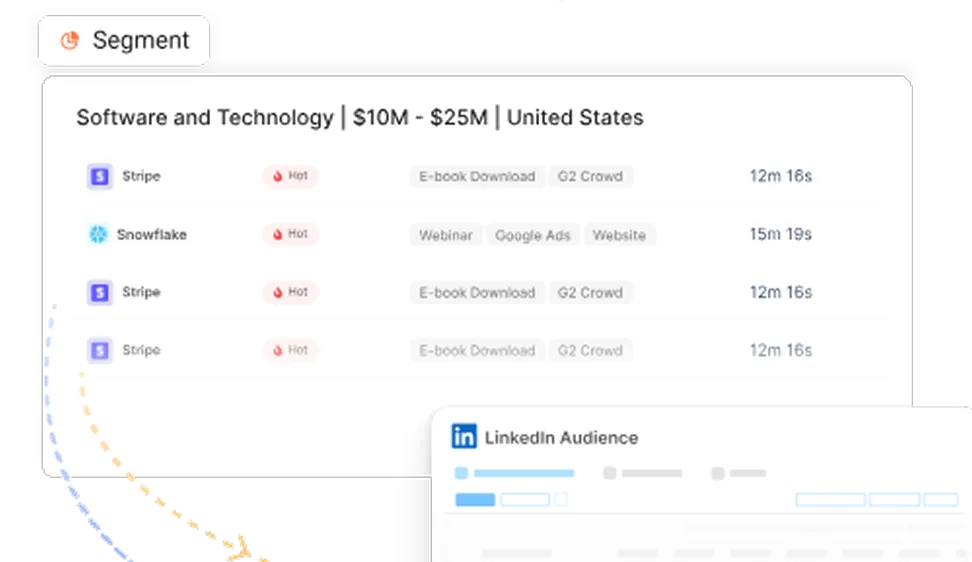
Factors.ai flips that entirely. It identifies 75%+ of companies visiting your website through waterfall enrichment across multiple data providers. You get a continuous feed of accounts showing genuine buying intent, ranked by ICP fit, engagement intensity, and funnel stage, without a single rep having to cold prospect them.
For teams that have meaningful website traffic, this is a genuinely different category of signal. An account that visited your pricing page three times this week, watched a product demo, and previously opened your emails is faaaar more valuable than a name on a list who matched your firmographic filters.
Wait, that’s not it (**puts on a smug smile**), Factors now ALSO deanonymizes US-based B2B visitors at the person-level through RB2B. For every identified visitor, you get first and last name, job title, LinkedIn URL, work email, company name, industry, employee count, and revenue range.
How does this help your teams?
- SDRs get a Slack alert the moment a target-account decision-maker hits the site, with their LinkedIn URL and work email already in the payload.
- This helps marketing build ICP-fit segments by title or firmographic and activate them directly via ads or sequences.
- CS can also see who, at a customer account, is visiting churn-risk pages.
- RevOps can slice attribution reports by enriched person-level attributes instead of anonymous account traffic.
Intent signals: one layer vs. three
Cognism's intent layer is Bombora Company Surge, available as an add-on on the higher tier. It surfaces accounts researching topics relevant to your product across 12,000+ content sources, which is useful for outbound prioritization. Job change triggers, funding signals, and hiring surge data are also available.
What it doesn't do is connect those signals to your own first-party data. You see that "Company X is researching CRM solutions" but you don't know if they've been on your website, engaged with your LinkedIn ads, or if a contact from that company opened your emails last week.
Factors.ai unifies three layers:
- First-party signals: website behavior, CRM engagement, product usage, form interactions, and abandoned forms
- Second-party signals: LinkedIn Ads engagement, G2 Buyer Intent (which accounts are viewing your G2 profile and comparing you against competitors), paid search, CRM campaign data
- Third-party signals: Bombora intent data
When all three layers are combined and scored at the account level, you stop guessing at intent and start measuring it. Accounts that show signals across multiple sources move to the top of the list. Accounts showing intent on only one channel stay lower until the pattern strengthens.
Ad activation: Factors.ai's structural advantage
This is where the comparison gets genuinely lopsided for teams running paid campaigns.
Cognism has no ad activation capability. It's a data provider. Once you have a contact's number, you call them or import them into a sequencing tool. What happens to your LinkedIn budget while that outreach cycle runs is entirely separate and unconnected.
Factors.ai's LinkedIn AdPilot and Google AdPilot connect your intent signals directly to your ad campaigns:
- Dynamic audience sync: Audiences update automatically based on ICP fit, funnel stage, and engagement signals. Accounts that show buying behavior get added. Accounts that go cold get suppressed. Your ad budget follows intent, not static lists.
- Impression control: Frequency capping at the account level prevents over-serving ads to the same companies, which burns budget and annoys the very accounts you're trying to win.
- View-through attribution: Tracks how LinkedIn ad impressions influence pipeline, even when accounts don't click. This matters because B2B buyers see an ad, visit your site organically later, and your last-touch model credits search while LinkedIn gets nothing.
- Conversion API (CAPI): Sends enriched conversion events, including MQL and SQL signals, back to LinkedIn so the algorithm optimizes toward accounts that actually become revenue, not just form fills.
Google AdPilot applies the same logic to Google Ads: daily audience syncs, CAPI integration, buyer-stage-specific targeting, and conversion feedback loops.
For any team spending meaningfully on LinkedIn or Google, the gap between running ads off a static list versus running them off live intent signals is measurable in pipeline efficiency.
Analytics and attribution: one platform has it, one doesn't
Cognism's analytics show you pipeline influenced by your outbound prospecting activity. It doesn't offer multi-touch attribution across channels, funnel visualization, or a unified view of how marketing and sales activity connects to revenue.
Factors.ai was built analytics-first. The multi-touch attribution engine supports six models: first touch, last touch, linear, time decay, U-shaped, and W-shaped. Every touchpoint from first anonymous website visit to closed deal is captured and attributed. The funnel analytics layer visualizes progression from MQL to SQL to Opportunity to Closed Won, with drop-off detection showing where accounts fall out.
Customer Journey Timelines combine web visits, ad exposures, CRM stages, G2 interactions, and product usage into a single chronological view per account. The result is that your team can see exactly what series of touchpoints preceded every deal.
FYI… Knowing that your LinkedIn campaign influenced 34% of closed deals last quarter is a very different conversation than saying "our SDRs called 400 numbers and booked 12 meetings."
Factors.ai vs Cognism: Pricing
Let's be precise here, because both platforms have nuances that matter to buyers.
Factors.ai pricing
Factors.ai publishes its base tiers, which is already a meaningful difference in approach.
| Factors.ai Plan | Price | Key inclusions |
|---|---|---|
| Free | $0/month | 200 companies identified/month, 3 seats, visitor tracking, Slack alerts, customer journey timelines |
| Basic | $399/month (annual) | 3,000 companies/month, 5 seats, LinkedIn intent signals, HubSpot/Salesforce integration, GTM dashboards |
| Growth | $999/month (annual) | 8,000 companies/month, 10 seats, ABM analytics, account scoring, G2 intent, Bombora intent, dedicated CSM |
| Enterprise | Custom | Unlimited companies, 25 seats, LinkedIn AdPilot, Google AdPilot, predictive scoring, white-glove onboarding |
The honest caveat: LinkedIn AdPilot ($1,000/month) and Interest Groups ($750/month) are add-ons priced separately. Teams that want the full ad activation layer should budget for those on top of the base plan. A Growth plan with both add-ons runs approximately $2,749/month.
Cognism pricing
Cognism uses custom quote-based pricing with no public list prices. The platform fee ranges from approximately $15,000/year for the Grow plan to $25,000/year for the Elevate plan, with per-user costs of approximately $1,500/year for Grow and $2,500/year for Elevate.
A 5-user Grow plan lists at roughly $22,500/year, while Elevate runs $37,500+. Add onboarding ($500–$1,500), intent data topics ($200–$400 each), and 10–15% annual renewal increases, and the real cost can land 40–60% above the initial quote.
There is no free plan. There is no monthly billing. Annual contracts auto-renew with 60-day cancellation notice windows.
| Cognism Plan | Estimated Annual Cost (5 users) | Key inclusions |
|---|---|---|
| Grow (Standard) | ~$22,500/year | Contact database, Chrome extension, CRM integrations, emails, basic mobile numbers |
| Elevate (Pro) | ~$37,500+/year | Everything in Grow, plus Diamond Data phone-verified mobiles, Bombora intent, Sales Companion AI |
| Enterprise | Custom | Fully negotiated; volume discounts available |
One thing G2 reviewers flag consistently: "We loved the data but the platform fee killed it for us, $16.5K/year for our solo SDR was a non-starter." If your team is smaller than five people or your budget sits below $20K/year, Cognism's pricing structure works against you before you've even opened the product.
Factors.ai vs Cognism: Pricing verdict
Cognism makes financial sense for EMEA-focused SDR teams where Diamond Data directly impacts connect rates, and cold call volume justifies the cost. The math works when verified mobile numbers are the core bottleneck.
For teams running ABM, paid ads, and attribution alongside prospecting, the total cost of a Cognism stack gets higher quickly. Cognism, plus a sequencing tool ($100–$150/user/month), plus an attribution platform, puts a 10-person team well above $70,000/year.
Factors.ai consolidates several of those functions: intent signals, ad activation, attribution, and account intelligence under one platform. The base tier is accessible, the free plan lets you evaluate the product with real data, and the growth tier competes favorably against the combined cost of point tools doing the same jobs separately.
Factors.ai vs Cognism: CRM integration and pipeline mapping
How Factors.ai connects to your CRM
Factors.ai treats CRM integration as genuinely bi-directional. The platform reads from your CRM to understand where accounts sit in the funnel, and writes back when accounts cross engagement thresholds or when campaign touchpoints should be logged.
The practical difference this creates:
- Pull integration: Factors.ai uses your CRM data to inform which accounts should see your LinkedIn ads, at what frequency, and with which message. An account at the Opportunity stage gets different ad treatment than an account that just visited your website for the first time.
- Push integration: When a high-intent account engages across multiple channels, Factors.ai triggers alerts and logs activity back to the CRM account record, so sales reps have the full context before they reach out.
Native integrations cover HubSpot, Salesforce, and Marketo, with bi-directional sync included across paid tiers.
How Cognism connects to your CRM
Cognism integrates natively with Salesforce, HubSpot, Pipedrive, Microsoft Dynamics, Outreach, and Salesloft. The Chrome extension lets reps enrich contacts directly from LinkedIn profiles and push them into CRM records without switching tabs. The Enhance feature keeps existing CRM records updated as contact data changes.
What Cognism does not do is read from your CRM to inform your outbound targeting. The data flow is one direction: Cognism data goes into your CRM. Your CRM stage data doesn't come back into Cognism to tell you which accounts are already in the pipeline and should be suppressed.
Factors.ai vs Cognism: Compliance and security
Both platforms take compliance seriously, and both meet the requirements most enterprise procurement teams ask for.
| Compliance area | Factors.ai | Cognism |
|---|---|---|
| GDPR | Yes | Yes, certified compliance-first positioning |
| CCPA | Yes | Yes |
| SOC 2 Type II | Yes (via GCP infrastructure) | Yes |
| ISO 27001 | Yes (via GCP infrastructure) | Yes |
| DNC list screening | Not applicable (account-level identification, no personal data stored) | 13–15 national DNC registries screened |
| Data encryption | AES-256 at rest, TLS in transit | AES-256 at rest, TLS in transit |
| Data residency | United States (GCP us-west-1b) | European and global options |
| DPA available | Yes | Yes |
One important structural point of difference on the compliance bit: Factors.ai identifies accounts at the company level and does not store personal contact data. The compliance exposure is lower by design because the platform is not processing mobile numbers or email addresses. Cognism's compliance infrastructure is more complex precisely because it handles millions of personal contact records, including phone-verified mobile numbers, across GDPR-regulated European jurisdictions.
For European teams where a DPO is involved in vendor approval, Cognism's compliance documentation is thorough and procurement-team-ready. One G2 reviewer noted: "Our DPO actually approved Cognism without us having to redline the contract, which never happened with ZoomInfo or Apollo."
Factors.ai's compliance posture is cleaner operationally for account-level intent use cases, but teams that need to store and process individual contact records for outbound will still need a separate contact database tool alongside it.
Factors.ai vs Cognism: Onboarding and support
Factors.ai's support model
Factors.ai offers white-glove onboarding that goes beyond platform training. Each new customer is set up based on their ICP, funnel stages, and existing GTM structure. A dedicated Customer Success Manager is included on Growth and above, with Slack channel access for direct, ongoing communication.
The GTM Engineering Services add-on goes further: RevOps workflow design, enrichment setup, SDR enablement, alert configuration, and ongoing optimization. For teams that don't have in-house RevOps capacity, this is a meaningful differentiator.
Cognism's support model
Cognism includes onboarding and training, though the depth varies by tier. Higher-tier customers get more structured enablement. The general user experience on support is positive across G2, with multiple reviewers citing responsive customer success teams and enablement sessions.
The limitation is that Cognism's onboarding is product-focused: it helps you learn the platform. It doesn't design your GTM workflow, configure your attribution model, or build your ABM playbook.
| Support area | Factors.ai | Cognism |
|---|---|---|
| Onboarding type | White-glove, ICP and workflow-based | Product training and enablement |
| Dedicated CSM | Included on Growth and Enterprise | Available on higher tiers |
| Slack access | Included | Not standard |
| GTM workflow design | Optional add-on service | Not available |
| Self-serve documentation | Yes | Yes |
| Support channels | Slack, email, dedicated portal | Email, live chat (24/7), account team |
Factors.ai vs Cognism: what to choose when
The right answer depends on what problem you're actually trying to solve.
| If your primary need is… | Go with… | Why |
|---|---|---|
| Cold calling into EMEA with verified mobile numbers | Cognism | Diamond Data is genuinely best-in-class for European phone outreach |
| Understanding which accounts are already in-market | Factors.ai | Website identification + multi-source intent is the right tool for this job |
| Running LinkedIn and Google Ads more efficiently | Factors.ai | AdPilot connects intent to ad spend in a way Cognism can't |
| Proving which campaigns influenced pipeline | Factors.ai | Multi-touch attribution across six models, built into the platform |
| Building targeted outbound lists for EMEA | Cognism | 440M+ contacts, 50+ filters, GDPR-compliant exports |
| Full-funnel ABM across a mid-market buying committee | Factors.ai | Account 360, buying group signals, CRM alignment, and ad activation in one stack |
| Transparent pricing with a free trial option | Factors.ai | Published tiers, free plan, 14-day paid plan trial available |
| GDPR-compliant outbound prospecting into Europe | Cognism | Purpose-built for this use case with DNC screening across 13+ countries |
What Factors.ai users actually say
"Factors.AI solves this problem by helping us identify website visitors and their level of engagement. When the data is synced with our CRM, we can see additional signals and intent metrics, which allows us to prioritize high-potential leads."
- Verified G2 review, Factors.ai
"The platform's unsampled analytics and attribution capabilities give us granularity we couldn't get anywhere else. We can finally prove which campaigns actually move pipeline."
- Verified G2 review, Factors.ai
"Factors.ai stands out for its strong analytics suite, automation tools, and competitive entry-level pricing compared to enterprise ABM platforms."
- SalesHive review, 2026
And on the Cognism side, for context:
"Occasionally, the data provided is inaccurate with false numbers. Although this is only a very small percentage of data gathered." — Verified G2 review, Cognism
"Cognism is excellent for our UK + DACH motion but we still pay for ZoomInfo for US. Wish one tool covered both at this quality level." — Verified G2 review, VP Sales, Q4 2025
The final verdict: Factors.ai as a Cognism alternative
Cognism is not a platform to dismiss. For outbound-heavy teams with EMEA pipelines and cold calling as a primary motion, Diamond Data delivers measurable ROI and the compliance infrastructure holds up in regulated markets. If that's your use case, Cognism earns its price.
But the "best Cognism alternative" question usually comes from teams that realize they've been solving half the problem. They have contact data. They don't have account intelligence. They're running LinkedIn ads with no idea which accounts are seeing them or whether those exposures influence deals. They have CRM data and website data sitting in separate tools that never talk to each other.
That's exactly the problem Factors.ai was built to solve. It's not a better Cognism. It's a different category: an account intelligence platform that activates buying signals across paid channels, connects every touchpoint to revenue, and gives marketing and sales a shared view of who's actually in-market.
Teams that need both a contact database and account intelligence typically pair them. Factors.ai plus Apollo or Lusha for contact enrichment covers the full picture: intent identification, ad activation, attribution, AND the contact data to act on the signals.
Teams that only need contact data and outbound prospecting into EMEA should seriously evaluate Cognism first.
The decision isn't really Factors.ai vs Cognism. It's: what is the actual gap in your GTM stack right now? One platform fills the contact database gap. The other fills the intelligence, activation, and attribution gap. Know which one you're solving for, and neither decision is wrong.
FAQs for Factors.ai vs Cognism
Q1. Is Factors.ai a direct replacement for Cognism?
Not exactly, and that distinction matters before you make a buying decision. Cognism is a contact database with verified mobile numbers for outbound prospecting. Factors.ai is an account intelligence and GTM platform: it identifies which companies are visiting your website, activates those accounts through LinkedIn and Google Ads, and attributes revenue across channels. Teams that need phone numbers for cold calling still need a contact database tool. Factors.ai is the right Cognism alternative for teams that need intent data, ad activation, and attribution on top of, or instead of, a raw contact database.
Q2. How does Cognism pricing compare to Factors.ai?
Cognism starts at roughly $22,500/year for a 5-user team on the Grow plan, with no free plan and no monthly billing option. Factors.ai offers a free plan (200 companies/month), a Basic tier at $399/month, and a Growth tier at $999/month. Cognism's real-world costs often run 40–60% above initial quotes once onboarding fees, intent topic add-ons, and annual renewal increases are factored in. Factors.ai's LinkedIn AdPilot and Interest Groups add-ons ($1,000/month and $750/month respectively) can significantly increase costs for teams wanting the full ad activation layer.
Q3. Which platform is better for EMEA outbound?
Cognism. Diamond Data's phone-verified mobile numbers for UK, DACH, Nordics, and France are genuinely best-in-class, and the GDPR compliance infrastructure is purpose-built for European prospecting. Factors.ai identifies EMEA accounts visiting your website and can activate them through LinkedIn campaigns, but it does not provide contact-level phone numbers for cold calling.
Q4. Can Factors.ai and Cognism be used together?
Yes, and for many mid-market teams this is the right approach. Factors.ai identifies which accounts are in-market based on website behavior, ad engagement, and third-party intent, then activates those accounts through LinkedIn and Google Ads and attributes the resulting pipeline. Cognism (or Apollo, ZoomInfo, or Lusha) provides the contact-level data so reps can actually reach the individuals at those in-market accounts. Together they cover the full signal-to-outreach cycle.
Q5. Which platform has better intent data?
It depends on what you mean by intent. Cognism's Bombora integration gives you third-party topic-based intent: which companies are researching relevant keywords across 12,000+ content sources. Factors.ai combines first-party intent (your own website and CRM), second-party intent (LinkedIn, G2), and third-party intent (Bombora) into a unified account-level score. For teams that care about multi-source intent and want to connect intent signals to their own account journey data, Factors.ai's signal layer is more actionable. For teams that just need Bombora intent added to their contact prospecting, Cognism's integration is sufficient.
Q6. Does Factors.ai work for small teams?
The free plan (200 companies/month) is a genuine starting point for smaller teams with limited website traffic. For production ABM workflows, the Basic tier at $399/month is the right entry point. The platform is most valuable for teams that have meaningful website traffic, run LinkedIn or Google Ads, and want to connect those activities to pipeline. Early-stage startups with under 1,000 monthly website visitors may not generate enough signal volume to justify the paid tiers.
Q7. How long does Factors.ai take to set up?
The first integrations, CRM, LinkedIn, Google Ads, and website pixel, are typically live within 48 hours. Full platform configuration, including audience syncs, alert workflows, and attribution model setup, is covered through the white-glove onboarding process. Most teams are seeing account identification data and running their first audience syncs within the first week. More complex RevOps workflow design is available through GTM Engineering Services as an add-on.
Q8. Is Cognism's data quality really as strong as the marketing suggests?
For EMEA, particularly UK and DACH, yes. Diamond Data phone-verified mobile numbers consistently deliver connect rates that independent reviews peg at 2–3x better than standard database providers. For North America and APAC, the data quality drops noticeably and multiple G2 reviews flag this gap. The top five cons listed on Cognism's G2 profile all relate to data accuracy and outdated information, which suggests the gap between Diamond-verified records and the broader database is real and noticeable in practice.
Q9. Why is Cognism so expensive for small startups?
Because they target mid-market and enterprise teams with budget to burn. They charge flat platform fees regardless of whether you have one user or five, meaning a solo founder or single SDR gets penalized by the math. If you're a small team, it's usually better to leverage Factors.ai’s free or basic tier paired with a cheaper data provider like Apollo until your outbound cold-calling volume justifies enterprise sales tools.
Q10. Does Factors.ai's website tracking actually work without form fills?
Yes, it de-anonymizes about 75% of website visitors at an account level. With the recent RB2B integration for US traffic, it even pulls the actual LinkedIn profiles of individual visitors. You won't get a 100% hit rate because people browse from coffee shops or home VPNs, but it gives you infinitely more actionable data than staring at standard, blind Google Analytics charts.

See how Factors can 2x your ROI
Boost your LinkedIn ROI in no time using data-driven insights


.avif)
See Factors in action.
Schedule a personalized demo or sign up to get started for free
LinkedIn Marketing Partner
GDPR & SOC2 Type II






.svg)



.avif)

