
Full funnel attribution: How does full path attribution work in B2B marketing?
See how full funnel attribution works in B2B marketing, how full path attribution distributes credit, and how to measure upper and lower funnel impact.
.avif)
Content Marketer



.svg)


TL;DR
- Full-funnel attribution tracks every marketing and sales interaction across the entire buyer journey, from first impression through closed deal, instead of handing all the credit to a single touchpoint.
- Full path attribution is a specific multi-touch model that assigns roughly 22.5% credit each to first interaction, lead creation, opportunity creation, and last interaction, with the remaining 10% distributed across everything in between.
- Upper-funnel marketing builds awareness and generates demand. Lower-funnel activity drives conversions. Most traditional attribution models overvalue the bottom and quietly starve the top.
- Implementing full-funnel attribution requires connected data sources, clearly defined funnel stages, and a reporting layer that maps pipeline and revenue back to actual campaigns.
- The future of attribution is moving toward AI-driven, account-level models that fold in intent data and dark funnel signals alongside traditional touchpoint tracking.
Every quarter, the same ritual plays out in B2B marketing teams. Someone pulls up the campaign report, points at last-click data, and confidently declares that paid search is the only channel generating pipeline. The brand campaign is… apparently useless. The webinar series that educated 400 target accounts over six weeks gets… zero credit. Meanwhile, the SDR team insists they sourced the deal themselves because their outbound sequence landed right before the demo request.
And ALL of this is good enough to confuse you, make you feel seven different emotions, and give you a level-4 headache.
Now… what makes this whole thing a little more frustrating is the fact that nobody's lying here. Everyone's just looking at a teeny-tiny piece of a much larger picture. In B2B buying cycles that span months and involve multiple stakeholders, a single deal might touch a dozen different interactions before it closes. Full funnel attribution solves exactly this problem: distributing credit where it's actually earned, across every stage of the journey, so marketing and sales leaders can make budget calls based on reality rather than whichever touchpoint happened to fire last.
This guide breaks down what full-funnel attribution actually means in practice, how the full path model calculates credit, and why it matters specifically for B2B teams running multi-channel go-to-market motions.
What is full-funnel attribution?
Attribution, at its core, is trying to answer one deceptively simple question: which marketing activities actually influenced this conversion? The challenge is that ‘influenced’ carries a lot of weight in that sentence.
A prospect might move through the marketing funnel, seeing a LinkedIn ad in January, reading a blog post in February, attending a webinar in March, getting an SDR email in April, and finally booking a demo in May. So, which of those touchpoints deserves the credit?
Even Mr. Bean doesn’t know…

- Single-touch models answer that by picking one moment and giving it everything.
- First-click attribution hands all the glory to that January LinkedIn ad.
- Last-click ignores every prior touchpoint and credits only the demo booking.
Both are simple, both are fast, and both are wildly misleading, especially when they ignore the need for consistent messaging throughout the funnel.
Full-funnel attribution takes a different approach entirely. Instead of picking a single winner, it tracks every interaction across the buyer journey and distributes credit across the full conversion path, mapping each touchpoint to its place in the sales funnel. Awareness-stage touches get recognized alongside consideration-stage engagement and bottom-of-funnel conversion events. And then, what you see is a more accurate picture of how your marketing actually works (not how it looks in a dashboard that’s already made up its mind).
In B2B specifically, this approach is more useful than almost any other context. Because you’re not dealing with a single buyer making an impulse decision. You’re dealing with buying committees of five, ten, sometimes fifteen people, each engaging with different channels at different times, over a sales cycle that might stretch across three to nine months. In this case, the marketing team must manage and align strategies across all funnel stages to ensure accuracy and effectiveness. Trying to compress all of that into a single ‘source’ field in your CRM actively misleads everyone who reads the report.
What is full funnel marketing?
Full funnel marketing is a strategy that addresses all stages of the marketing funnel, from building brand awareness at the top to driving conversions and fostering loyalty at the bottom. Rather than optimizing for a single stage, a full funnel marketing strategy ensures your own marketing tactics are tailored to each phase, guiding potential customers through the entire journey. Instead of running separate, disconnected campaigns for awareness, consideration, and conversion, you design a coordinated system that moves accounts through each phase deliberately. That sounds obvious when I write it out, but in practice, most B2B teams still operate in stage-specific silos. The demand gen team runs top-of-funnel campaigns, content owns the middle funnel, and sales handles everything below. Nobody’s really looking at the full picture at the same time.
You obviously know this, but for the sake of clarity, I’m going to go over this again. The marketing funnel breaks down into three broad stages, and each one requires a different playbook.
- ToFu (top of funnel) is where you’re building brand awareness and educating your market by targeting a broad audience of potential customers. The buyer might not even know they have a problem yet, or they know the problem but haven’t started evaluating solutions. Full funnel marketing tactics at this stage include thought leadership content, LinkedIn video ads, industry reports, and podcast appearances. The goal isn’t conversion. It’s recognition and relevance, which are harder to measure but no less important.
- MoFu (middle of funnel) is where evaluation and nurture happen. At this middle funnel stage, potential customers have awareness of your product or service and are actively considering if it meets their needs. This is the time for targeting prospects and providing your marketing tactics tailored to your target audience, such as webinars, comparison guides, customer stories, and email nurture sequences. This is where most of the invisible work happens, the stuff that doesn’t show up in last-click reports but absolutely shapes the buying decision.
- BoFu (bottom of funnel) is where purchase decisions get made. Demo requests, pricing page visits, proposals, and contract negotiations all fall here. It’s the most measurable part of the funnel, which is precisely why it tends to hog all the attribution credit in simpler models.
In B2B, a prospect might bounce between the middle funnel and bottom of funnel multiple times. Different members of the buying committee might be at different stages simultaneously, with one person reading your blog while another is already on a sales call. This mess is exactly why attribution becomes critical once you’re running a full funnel marketing strategy.
Without visibility into how your ToFu investments feed middle funnel engagement, which feeds BoFu conversions, you’re flying blind on budget allocation. And…
Upper funnel vs lower funnel: What's actually different in B2B?
The difference between upper and lower funnels shows up in every marketing textbook (okay, not really… mine only had the 3 Ps of marketing). A full funnel approach is essential for coordinated tactics across all stages of the customer journey.
- Upper-funnel marketing focuses on awareness, audience expansion, and problem discovery. You’re trying to get in front of accounts that don’t know you (yet) or haven’t started thinking about the problem you solve. The content is educational and broadly relevant: thought leadership articles, LinkedIn video campaigns, industry benchmark reports, and conference talks, as well as content marketing, social media marketing, social media campaigns, social media ads, search ads, and paid search ads. Effective upper-funnel marketing strategies include content marketing and social media, which help develop relationships with potential customers and build brand recognition. The goal is building relationships, addressing pain points, and increasing brand recognition. You’re not really asking anyone to buy anything… but earning the right to be considered when the buying process eventually starts.
- Lower-funnel marketing focuses on conversions, product evaluation, and purchase decisions. Here, the buyer is actively comparing solutions. They’re requesting demos, visiting your pricing page, engaging with case studies, and talking to your sales team. Lower funnel marketing strategies are focused on converting leads into customers through targeted marketing campaigns and coordinated marketing efforts. The content is specific, practical, and designed to reduce risk and build confidence in choosing your product.
Here’s a quick comparison to make the distinction concrete:
The problem is that traditional attribution models systematically overvalue lower-funnel actions. Last-click attribution, which is still the default in many analytics setups, gives 100% of the credit to whatever happened right before conversion. Your demo page wins all the praise, but the webinar series that actually educated the buyer and brought them to your site gets nothing.
Over time, this creates a not-so-fun feedback loop. Leadership sees that lower-funnel channels drive all the pipeline. Budget shifts away from upper-funnel programmes, brand awareness declines, and the top of the funnel dries up. Then… six months later, everyone wonders why pipeline volume is dropping despite increasing spend on bottom-of-funnel tactics.
I’ve watched this exact pattern play out multiple times, and it almost always traces back to an attribution model that couldn’t see past the last click. Proper implementation and optimization at each stage can make all the difference in driving conversions and overall marketing effectiveness.
So, then what is full path attribution?
Full path attribution is a specific multi-touch attribution model where simpler models pick one or two moments to credit; full path attribution distributes credit across the key milestones of the entire buyer journey.
The model recognizes four critical stages in the B2B conversion path:
- First touch: The very first interaction a prospect has with your brand. For example, the LinkedIn ad they clicked, the blog post they found through search, the event where they scanned your booth.
- Lead creation: The moment an anonymous visitor becomes a known contact. For example, they filled out a form, signed up for a webinar, or downloaded a resource.
- Opportunity creation: The point where a lead becomes a qualified sales opportunity. This is where the marketing-to-sales handoff typically happens.
- Deal closed: The final conversion. Contract signed, deal won, party time!
What makes this model suitable for B2B teams is that it explicitly recognizes the marketing-to-sales handoff as a critical moment. Most attribution models either focus entirely on the marketing side and ignore what happens after lead creation or focus on the sales side and ignore everything that came before. Full path attribution bridges that gap by treating opportunity creation as equally important to first touch and lead creation.
This makes it especially useful for pipeline attribution, where you’re trying to understand which marketing activities actually contribute to qualified pipeline and revenue, not just raw lead volume. Importantly, full path attribution also enables organizations to evaluate customer lifetime and customer lifetime value (CLV) as key metrics for long-term success. By tracking the entire journey, you can assess which activities drive initial conversions and which ones impact customer retention, repeat purchases, and overall profitability over time.
If your organization is trying to align marketing and sales around shared revenue goals (and you should be), full path attribution gives both teams a common language for evaluating contribution across the full journey.
How does the full path attribution model calculate credit?
The full path model uses a rule-based credit distribution structure that weights the four key milestones roughly equally, then spreads the remaining credit across everything else that happened in between. This approach aligns with the structure of the sales funnel and marketing funnel, ensuring that each stage of the buyer journey is properly represented.
Here’s the typical breakdown:
The logic is this: each major funnel milestone gets an equal, significant share of credit because each represents a distinct and meaningful transition in the buyer journey. The remaining 10% is distributed across all other interactions that occurred between those milestones. This ensures that mid-journey touchpoints like blog visits, email clicks, and webinar attendance still receive some recognition, even if they’re not treated as primary conversion drivers.
Let’s make this tangible with a more concrete example for people like me who need to see examples to understand what these numbers even mean. Imagine a B2B SaaS deal that closes for £50,000 (Wohoo!) in annual contract value.
The buyer journey looked like this:
- LinkedIn ad click (first interaction): The prospect clicked a sponsored post about your product category.
- Blog visit: They read a comparison article on your site a week later.
- Webinar signup (lead creation): They registered for a live webinar, providing their contact details.
- Demo request (opportunity creation): After the webinar, they booked a product demo and sales qualified them.
- Closed deal (last interaction): After a sales process, the contract was signed.
Under full path attribution, credit distributes like this:
Here’s what’s going on… the LinkedIn ad (which last-click attribution would have completely ignored) gets credited with over £11,000 in influenced revenue. The blog visit, which rarely shows up in any single-touch report, still earns £5,000 in credit. This is a fundamentally more complete picture of how your marketing contributed to that deal.
When evaluating the effectiveness of your full funnel attribution model, it’s important to track not only sales and CLV, but also repeat purchases. Monitoring repeat purchases at the lower end of the funnel helps you assess customer retention and loyalty, providing a more comprehensive view of marketing performance.
One important caveat: the 22.5% split is a convention (it’s NOT a universal truth). Some organizations adjust these weights based on their own data. For example, a company with a very long consideration phase might weight MoFu touches more heavily. Others use algorithmic attribution to let the data determine the weights dynamically. The full path model gives you a solid, defensible starting point, but treat it as a framework to refine rather than a permanent answer.
Why does full-funnel attribution matter for B2B teams?
There’s a reason this topic keeps appearing in every B2B marketing strategy conversation. The stakes are high, and the problems it solves come up every single quarter.
- Long, complex buying cycles make single-touch attribution absurd
A typical enterprise deal involves weeks or months of research, multiple stakeholders engaging across different channels, and dozens of touchpoints before anyone signs anything. Giving all the credit to the first or last interaction in a journey like that is like judging a film based only on the opening scene or the closing credits... or judging a book by the cover (front or back). You’re missing the entire plot. Full-funnel attribution captures the full narrative, recognizing that the conference talk planted the seed of curiosity, the case study that built confidence, and the sales call that closed the deal all played distinct and necessary roles.
- Channel silos create incomplete pictures
Different teams and pods own different channels. Paid media runs ads. Content produces blog posts and guides. Events manages webinars. SDRs handle outbound. Each team reports on its own metrics in its own tools, and none of them see how their work connects to what the others are doing. Full-funnel attribution stitches these interactions into a single unified journey. Attribution debates sometimes resemble group projects where everyone claims credit for the final result, but at least when you have the data, the conversation is grounded in something real.
- Budget allocation breaks down without cross-funnel visibility
Without full-funnel attribution, lower-funnel channels systematically steal credit from upper-funnel programmes. Your LinkedIn brand campaigns look like a money pit. Your blog content appears to have zero ROI (and as a content person, please know that I’m crying). Your webinar series seems like a nice-to-have that doesn’t drive pipeline. Meanwhile, your retargeting ads and paid search campaigns look like heroes because they’re the last thing people click before converting. And so, budgets shift accordingly; *crying intensifies,* and a few months into it, you’re wondering why pipeline has dried up even though conversion rates look great on paper.
Full-funnel attribution breaks this cycle by showing you how upper-funnel investments feed the pipeline that lower-funnel tactics convert, and it also helps foster customer loyalty by ensuring bottom-of-funnel marketing is effectively targeted for long-term business growth.
How do the most common attribution models stack up?
Attribution models distribute conversion credit across touchpoints based on either predefined rules or algorithms. Each one makes different assumptions about which interactions matter most, and those assumptions shape the conclusions you draw. Here's how the main models compare:
A few things stand out when you look at these side by side. The simpler the model, the easier it is to implement, but the more it distorts your understanding. First-touch and last-touch models are trivially easy to set up, which is why they remain so popular. They're also fundamentally unable to capture the multi-stage reality of B2B buying.
Linear attribution is a step up, but it treats every touchpoint as equally important, which isn't true either. A random blog visit three months ago probably didn't matter as much as the demo that happened last week. Time decay tries to solve this by weighting recent interactions more heavily, but in doing so it recreates the same problem as last-click, just in softer form. Your upper-funnel investments still look undervalued.
The U-shaped and W-shaped models are closer to what B2B teams actually need, because they explicitly weight the key milestone moments. Full path attribution extends this logic to include the deal close, making it the most complete rule-based model for teams that want to track the entire journey from first interaction to revenue.
Algorithmic attribution sits in a category of its own. Instead of predefined rules, it uses machine learning to determine which touchpoints are most predictive of conversion. In theory, this gives you the most accurate picture. In practice, it requires large data volumes, technical resources to build and maintain, and a level of trust in black-box models that not every organisation is comfortable extending. No attribution model answers every question perfectly, and anyone who tells you otherwise is probably selling one.
What are the real challenges of implementing full-funnel attribution?
If full-funnel attribution sounds like an obvious choice at this point, there's a reason most B2B teams still haven't implemented it well. The concept is straightforward. The execution is where things get genuinely difficult.
- Data fragmentation across tools and teams
The biggest obstacle is that your data lives in silos. Ad platforms track impressions and clicks. Marketing automation tracks email engagement and form fills. CRM tracks leads, opportunities, and deals. Website analytics tracks page views and sessions. Product analytics tracks in-app behavior. Each system has its own data model, its own identity logic, and its own definition of a "user." Stitching these together into a unified buyer journey requires either dedicated tooling, significant engineering investment, or both. Most teams underestimate how hard this integration work actually is. It's not just connecting APIs. You need to resolve identity across systems, handle data quality issues, and build a timeline that accurately represents how real humans interacted with your brand across channels and devices.
- The dark funnel is invisible by design
Not every meaningful interaction is trackable. Let’s take a few examples: when a prospect mentions your product in a private Slack community, when a colleague recommends you over coffee, and when someone reads a LinkedIn post without clicking anything, those signals influence the buying decision but never appear in your attribution data. You can't attribute what you can't measure. The best you can do is acknowledge the gap, layer in qualitative signals like "how did you hear about us?" fields, and resist the temptation to treat your attribution data as the whole truth.
- Cross-device and cross-channel journeys create identity gaps
A single prospect might research your product on their phone at lunch, visit your website from a work laptop, and attend a webinar from a tablet at home because that’s unfortunately how humans are. Now, each device creates a separate session, and unless your tracking can stitch those sessions together, your attribution model sees three different people instead of one. Privacy regulations and browser restrictions on third-party cookies are making this harder, not easier.
- Privacy and consent regulations keep raising the bar
GDPR, CCPA, and the ongoing deprecation of third-party cookies all limit what data you can collect and how you can track users across properties. These are necessary protections, but they create real constraints for attribution. Building attribution systems that work within these constraints is both an ethical and practical requirement. Every year, the gap between what happened and what you can measure grows a little wider. That's just the reality you're working with.
How Factors.ai enables full-funnel attribution
Most of the challenges we've just walked through boil down to ONE core issue: connecting the dots across fragmented data, anonymous visitors, and disconnected tools.
This is where Factors.ai comes in. *cue superhero music*
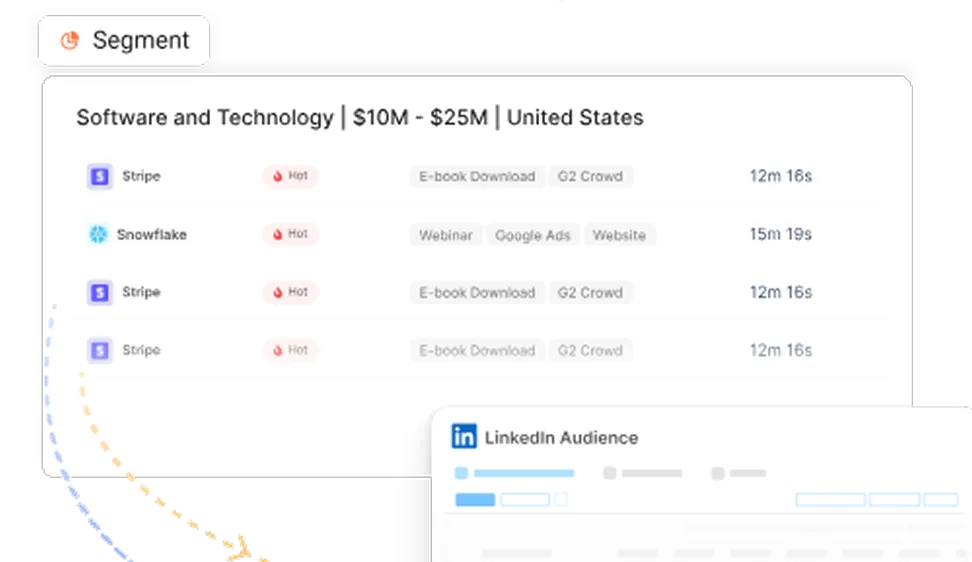
Factors.ai helps B2B teams identify anonymous website visitors at the account level. Instead of seeing a generic session from an unknown visitor, you see that someone from a specific target account visited your pricing page. That's a fundamentally different data point, and it changes what your attribution model can actually capture.
Factors.ai maps journeys across accounts rather than individual cookies. It connects marketing signals (ad impressions, content engagement, webinar attendance) with sales signals (CRM activity, pipeline movement, deal outcomes) into a unified account timeline. Your attribution model can see the full picture, from the first anonymous visit through to closed revenue.
Here's what Factors.ai helps you with:
Account-level attribution ties marketing touchpoints to accounts (not just individual leads), which aligns with how B2B buying actually works. Our intent signal capture identifies buying signals before a formal conversion event happens, so you can see when an account is researching your category even if nobody's filled out a form yet. Ad exposure tracking connects ad impressions to downstream pipeline, so you can measure the real impact of upper-funnel campaigns that don't generate direct clicks. CRM pipeline integration pulls deal data directly into the attribution model, so you're reporting on revenue influence rather than just lead volume.
And a typical workflow looks like this:
An anonymous visitor lands on your site and gets matched to a target account. Over the next few weeks, that account engages with multiple campaigns. Those engagements get stitched into a single account timeline. When a deal is created in the CRM, Factors maps all prior touchpoints to that opportunity and distributes credit according to your chosen model. The result is a clear view of which campaigns and channels actually influenced pipeline and revenue.
Note: Factors.ai doesn't replace strategic thinking with a dashboard., you will still have to do that with the brain assigned to you at birth. It gives your team the ✨data foundation ✨ to make attribution conversations productive rather than what can I say… political.
How do you implement full-funnel attribution in your B2B GTM?
Before we start, implementing full-funnel attribution is not something you will do on a lazy Wednesday afternoon while sipping your oat flat white. It’s a project that involves data infrastructure, cross-team alignment, and some difficult decisions about what to measure and how. But it doesn’t need to be overwhelming if you break it down into clear steps, and that’s why… the following:
Step 1: Map the customer journey across all channels
Before you can attribute anything to anything, you need to know what you’re attributing. (I know you’re wondering whether I’ve lost the plot… but stay with me). List every channel and touchpoint a prospect might interact with during their buying journey. Paid ads, organic search, email campaigns, SDR outreach sequences, webinars, in-person events, product-led experiences, and anything else your team runs. Most organizations are genuinely surprised by how many touchpoints exist once they map them out. As you map these touchpoints, consider how you will launch campaigns at different funnel stages: upper-funnel campaigns to build brand awareness and lower-funnel campaigns to drive conversions.
Your attribution model can only be as complete as your touchpoint map, please do not rush this step.
Step 2: Define your funnel stages with both marketing and sales
You need shared, explicit definitions for each stage of your funnel. An example framework might look like this: Awareness (account has been exposed to your brand), Engagement (account has actively interacted with your content), MQL (a contact meets your marketing qualification criteria), SQL (sales has accepted and qualified the lead), Opportunity (a deal is created in the CRM), Closed won (the deal is signed). If marketing thinks an MQL means ‘downloaded a whitepaper’ and sales thinks it means ‘expressed buying intent on a call,’ your attribution data will be meaningless because you’re measuring different things.
Step 3: Connect your data sources
You need your core systems to send data to a single place. At minimum, that means connecting your CRM, your ad platforms, your website analytics, and your marketing automation tool. Each integration needs to pass through identity resolution to match touchpoints to the correct accounts and contacts. Tools like Factors are specifically designed to make this step more manageable, but regardless of which tooling you choose, expect this step to be the most time-consuming part of the process.
Step 4: Choose your attribution model
Based on your data maturity and the questions you need to answer, select the model that makes sense for where your organization is right now. For most B2B teams with a meaningful sales process, a W-shaped or full path model is a strong starting point. I’ll tell you this, you don’t need to pick the perfect model on day one, but start with something defensible and refine it as you gather more data.
Step 5: Build reporting dashboards that actually get used
Attribution data only matters if people look at it. Build dashboards that answer the questions your stakeholders care about. Marketing leadership wants to know which campaigns influenced pipeline and revenue; sales leadership wants to know which marketing activities generated their best opportunities; finance wants ROI by programme.
Keeping all this in mind, track pipeline attribution by channel, revenue influence by campaign, and stage conversion rates across the funnel. When analyzing lower-funnel tactics, be sure to include persuasive offers like free trials, which can be highly effective in encouraging conversions at the decision and purchase stage.
Point to remember: The fanciest attribution model in the world is worthless if it sits in a spreadsheet nobody opens.
Key metrics to track across the funnel (because no metrics = no clear progress = no job = no oat flat white :( )
Once your attribution system is running, you need to know what to measure at each stage. The metrics that matter shift as prospects move from awareness to conversion, and tracking the right ones at each stage gives you a meaningful picture of overall funnel health. Recent industry estimates place average sales funnel conversion rates in the low single digits (around 3% for many businesses), while optimized funnels can exceed 9% depending on industry and funnel design.
- Upper-funnel metrics tell you whether your awareness programmes are working. You’re looking at:
a. Reach (how many accounts are seeing your content)
b. Impressions (how often your brand appears in front of target accounts)
c. Engaged accounts (how many target accounts have interacted with your content in a meaningful way).
At this point, you need to know that these numbers won’t directly correlate with the pipeline in the short term; they’re leading indicators of future demand, which means you need to track them consistently over time, not just in the week after a campaign launches.
- Mid-funnel metrics tell you whether your nurture and education efforts are moving accounts toward buying intent.
You’re looking at:
a. Content engagement rates
b. Webinar attendance
c. Email click-through rates
d. Return visit frequency
If these metrics are healthy, your pipeline will follow. If they’re declining, your bottom-of-funnel numbers will eventually dry up too, even if they look a-ok today.
- Lower-funnel metrics tell you whether your conversion engine is working.
You’re looking at:
a. Demo requests
b. Pipeline created
c. Opportunities generated
d. Revenue influenced
e. Customer lifetime value
f. Repeat purchases
Tracking customer lifetime value and repeat purchases helps evaluate long-term success, customer retention, and overall profitability. The key insight is that lower-funnel metrics are the output of everything that happened above them. When you see a dip in demo requests, the root cause often lives in the upper or mid-funnel (not in the demo page itself). Full-funnel attribution gives you the framework to trace back and find where the problem actually lives.
The future of attribution: AI, intent data, and dark funnel signals
Attribution doesn’t stand still (just like my -year-old nephew). The models and methods we use today will look noticeably different within the next few years, driven by three major shifts that are already underway, and I’ve listed them here:
- AI-driven attribution models are moving beyond simple rule-based logic.
Instead of manually assigning weights to touchpoints, machine learning models can analyse thousands of buyer journeys to identify which combinations of interactions are most predictive of conversion.
This tells you which touchpoints touched the deal (get it?), AND tells you which touchpoint sequences actually influenced the outcome. As these models get better and as B2B data volumes grow, algorithmic attribution will become the default for more ‘mature’ teams.
- Account-based attribution is replacing contact-based attribution as the B2B standard.
Traditional attribution tracks individual contacts through a funnel, but B2B buying happens at the account level, with multiple people from the same company engaging across different channels, as I’ve said 47 times above.
Account-based attribution aggregates all of these interactions into a single account journey, which much more accurately reflects how decisions actually get made. Platforms like Factors (yes, I know, shameless plugin), are already built around this principle, and the broader market is following.
- Intent data and predictive signals are expanding what attribution can see.
Instead of waiting for a prospect to visit your site or fill out a form, intent data captures research behaviour happening across the broader web.
You can see when a target account is actively searching for topics related to your solution, even before they've engaged with your brand directly. Layering these signals into your attribution model gives you a more complete picture of the buying journey, including the parts that happen outside your own properties.
And then there's the dark funnel, the growing body of buyer activity that's inherently untrackable. Community conversations, peer recommendations, private social discussions, and offline word-of-mouth all influence buying decisions in ways that no attribution model can fully capture. The smartest teams are learning to complement their quantitative attribution data with qualitative signals. "How did you hear about us?" surveys, win/loss interviews, and sales call notes all provide context that fills in the gaps.
The future of attribution is about combining multiple signal types: quantitative touchpoint data, account-level intent signals, AI-driven pattern recognition, and qualitative buyer feedback, into a composite picture that's directionally accurate and strategically useful. Perfect precision isn't the goal, but better decisions are (just like real life).
Before you go, I just want to tell you… this is what I think of whenever anyone says dark funnel…

In a nutshell
Full-funnel attribution gives B2B marketing and sales teams the ability to see how their entire go-to-market motion contributes to pipeline and revenue, not just the final click or the first impression. The full path model offers a structured, defensible way to distribute credit across the four key milestones of the buyer journey: first touch, lead creation, opportunity creation, and deal close, with the remaining credit spread across mid-journey interactions.
The biggest practical takeaway from this guide is that attribution is not just a measurement exercise you do to pass time (because who in the world will look at attribution to kill time?!). It's a ‘budget protection mechanism’ in some sense… without cross-funnel visibility, upper-funnel programmes will always look unproductive in reports, which leads to budget cuts that starve the very programmes feeding your pipeline. Full-funnel attribution breaks that cycle by connecting early-stage awareness work to downstream revenue outcomes.
If you're starting from scratch, map your customer journey, define your funnel stages with input from both marketing and sales, connect your data sources, and start with a full path model. You obviously don't need perfect data on day one… but you DO need a framework that's directionally correct and a team that's committed to refining it over time. Tools like Factors can accelerate the process by handling account identification, journey mapping, and CRM integration in a single platform.
The companies that get attribution right make better investment decisions, align their teams around shared goals, and consistently outperform competitors who are still arguing about which channel ‘sourced’ the deal.
At the end of it… I just hope we don’t feel what this little kid feels, while doing our jobs
Frequently asked questions about full-funnel attribution
Q1. What is full-funnel attribution?
Full-funnel attribution is a marketing measurement approach that assigns credit to every interaction across the buyer journey, from first awareness touchpoint through to closed deal. Unlike single-touch models that credit only the first or last interaction, it recognises that multiple touchpoints at multiple funnel stages all contribute to a conversion. This gives B2B teams a more complete and accurate picture of which marketing activities actually influence pipeline and revenue.
Q2. How does the full path attribution model calculate credit?
Full path attribution assigns roughly 22.5% credit to each of four key milestones: first interaction, lead creation, opportunity creation, and last interaction (deal close). The remaining 10% gets distributed across all other touchpoints that occurred between those milestones. This structure ensures that every stage of the journey receives meaningful credit while still weighting the most important transitions more heavily. Some organisations adjust these percentages based on their own data and sales cycle dynamics.
Q3. What is full funnel marketing?
Full funnel marketing is a strategy that targets every stage of the buyer journey, from initial awareness through consideration and evaluation to final purchase decision. Instead of optimising for a single stage, it coordinates activities across ToFu (awareness content, brand campaigns), MoFu (webinars, nurture sequences, comparison content), and BoFu (demos, sales calls, proposals). The goal is to create a connected experience that moves buyers through each phase deliberately and measurably, rather than treating each stage as a separate programme.
Q4. What's the difference between upper funnel and lower funnel marketing?
Upper-funnel marketing focuses on awareness, education, and audience expansion. It's designed to reach buyers who don't yet know they have a problem or haven't started evaluating solutions. Lower-funnel marketing focuses on conversions, product evaluation, and purchase decisions. The key tension is that traditional attribution models overvalue lower-funnel actions because they're easily measurable, which causes teams to underinvest in upper-funnel programmes that actually generate future pipeline.
Q5. Why does full-funnel attribution matter more in B2B than in other contexts?
B2B buying cycles are longer, involve multiple stakeholders, and span many more touchpoints than typical consumer purchases. A single enterprise deal might involve a buying committee of ten people engaging with different channels over six to nine months. In that context, any attribution model that only credits one or two touchpoints will actively mislead your budget decisions. Full-funnel attribution is designed specifically to handle this complexity.
Q6. What's the hardest part of implementing full-funnel attribution?
Most teams say data fragmentation is the biggest hurdle. Your touchpoint data lives in ad platforms, your CRM, your marketing automation tool, and your website analytics, and each system has its own identity logic. Stitching these into a unified buyer journey requires either dedicated tooling or real engineering investment. Identity resolution across devices and channels adds another layer of complexity. Starting with a clear data audit before you pick an attribution model will save you a lot of pain down the road.
Q7. What's the difference between full path attribution and W-shaped attribution?
Both models weight key funnel milestones more heavily than mid-journey touches. The main difference is that W-shaped attribution gives equal weight to first touch, lead creation, and opportunity creation (30% each), while distributing 10% across everything else. Full path attribution adds a fourth milestone, deal closed, and assigns 22.5% to each of the four stages. This makes full path a better fit for teams that want to track the complete journey from first interaction to revenue, not just from first touch to opportunity.
Q8. Can you use full-funnel attribution alongside account-based marketing?
Yes, and they're actually stronger together. Account-based marketing (ABM) focuses your efforts on a defined set of high-value accounts. Full-funnel attribution tells you which marketing activities are actually influencing those accounts throughout the buying journey. When you combine the two, you can see which ABM tactics are working at each funnel stage, for each account, and allocate budget accordingly. Platforms like Factors are specifically designed to support this combination by tracking attribution at the account level rather than the individual contact level.

See how Factors can 2x your ROI
Boost your LinkedIn ROI in no time using data-driven insights


.avif)

See Factors in action.
Schedule a personalized demo or sign up to get started for free
LinkedIn Marketing Partner
GDPR & SOC2 Type II

.svg)



.avif)

