
Generative AI SEO: How marketers are using AI to supercharge rankings
Learn how B2B marketers use generative AI SEO for rankings, content scale, and pipeline growth with practical strategies from Factors.ai.
.avif)
Content Marketer



.svg)


TL;DR
- Generative AI SEO isn't about replacing your team. It's about giving strategists machine-speed execution across research, drafting, optimisation, and content refreshes.
- Google doesn't penalize AI content, but it does penalize unhelpful content. Human editing, original expertise, and real data still determine what ranks.
- B2B marketers who treat SEO as brand discovery infrastructure, not just a traffic channel, build category mindshare long before a buyer books a demo.
- The smartest teams use AI for speed and humans for insight, then measure success by pipeline influence rather than page views.
- Generative Engine Optimization (GEO) is the next frontier: structuring content so AI answer engines cite your brand, not just so Google ranks your page.
There's a version of SEO most B2B marketers remember from 2018. You'd pick a keyword, stuff it into a blog post a few times, build some backlinks, and call it a quarter. It worked. Slowly. Expensively. And with a lot of spreadsheet chaos.
That version of SEO is gone.
What's replaced it is faster, smarter, and honestly a bit more fun if you like strategy. Generative AI SEO doesn't mean you hand everything to ChatGPT and go on a long lunch. It means you've got a strategist and a machine working in tandem, where the machine handles the grunt work and you handle the judgment calls.
This post breaks down how B2B marketing teams are actually using generative AI SEO in 2026 and what separates the teams getting results from the ones just publishing more content into the void.
What is generative AI SEO?
Generative AI SEO is the use of AI tools to support the research, planning, writing, and optimization work that makes up an SEO workflow. Think keyword clustering, content briefing, first drafts, meta descriptions, schema markup, internal link suggestions, and quarterly content refreshes.
What it doesn't do is replace the part where someone has to think. AI can surface patterns in search data faster than any human. It can't tell you why your ICP is searching for something, what their buying anxiety sounds like, or how to position your product against a competitor in a way that actually converts.
Traditional SEO was manual and slow. Every cluster, every brief, every rewrite took hours. Generative AI SEO compresses that timeline without compromising quality, if you're using it right. The analogy I keep coming back to: it's the difference between navigating by landmarks and navigating by GPS. GPS doesn't decide where you're going. It just gets you there faster.
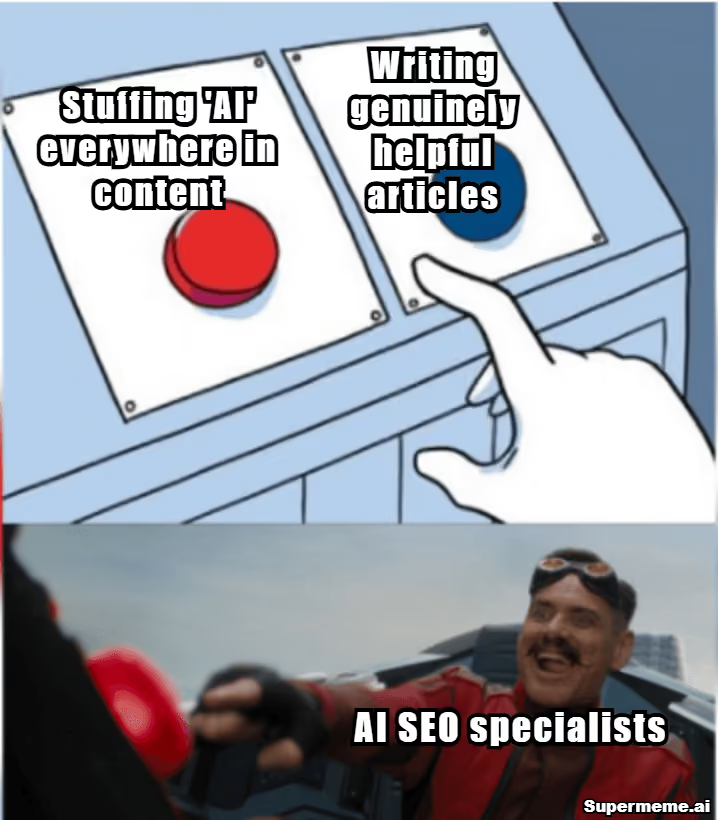
PS: This blog is written so that you are not this person.
Why is AI reshaping SEO for B2B marketers?
B2B buyers don't convert from one blog post. They read your LinkedIn Ads guide in January, find your ABM attribution breakdown in March, and request a demo in May after seeing your tool show up three times in comparison searches. That's a real pattern, and it's why content volume and coverage actually matter.
The old SEO race was speed, but the new race is relevance at scale.
AI makes it possible to cover every stage of the funnel with genuinely useful content, without needing a 10-person content team. You can use it to uncover intent-rich long-tail searches you'd never manually find. You can cut time-to-publish on a 2,000-word guide from two weeks to four days. You can refresh underperforming pages in an afternoon instead of adding them to a never-ending backlog.
For B2B specifically, this changes what's possible. Teams running demand gen campaigns need comparison content, use-case pages, and attribution explainers. AI helps you build those assets faster. It doesn't make the strategic calls about which ones matter most, but it removes the bottleneck between having a strategy and executing it.
Where marketers use AI across the SEO workflow
- Keyword research
AI tools are genuinely excellent at topic clustering, search intent grouping, and question mining. Feed it a seed keyword and a competitor list and you'll surface SERP gaps you'd miss doing this manually. The part still worth doing yourself: deciding which clusters actually align with your pipeline.
- Content briefing
AI can synthesize what the top-ranking pages cover, suggest H2 structures, and pull FAQs from search data. A brief that used to take three hours now takes 45 minutes. The nuance it can't add is your brand's POV, your data, your customer stories.
- Drafting and refreshing
First drafts, refresh passes on old posts, meta descriptions, schema markup, all of this is legitimately faster with AI. The catch is that unedited AI drafts read like unedited AI drafts. Every draft needs a human pass for tone, accuracy, and anything that requires firsthand experience.
- On-page optimization
Title tag testing, semantic entity coverage, internal link gaps, readability cleanup, AI tools handle this well. Optimization platforms like Surfer and Clearscope layer AI-driven suggestions on top of your existing content, which makes the "how to optimize blog post for SEO" question a lot less painful than it used to be.
- Reporting and detection
AI can summarize GSC and GA4 insights at scale, flag declining pages before they fully drop, and identify clusters that are gaining traction but need more depth. That's the kind of signal that used to require a dedicated analyst to catch early.
How to optimize blog posts for SEO with AI
This is the workflow we've landed on, and it actually works.
- Start by identifying search intent. Before you write a word, understand whether someone searching your target keyword wants a definition, a comparison, a step-by-step process, or a tool recommendation. AI can help you read the SERP and categorize intent super quickly.
- Analyze the top-ranking pages honestly. What are they covering? Where are the gaps? What questions aren't they answering? You're not trying to copy structure. You're looking for what the reader still needs after reading the top results.
- Build a better outline with a genuine POV. The outline should reflect your brand's perspective, not just a synthesis of what already ranks. If you can't articulate what's different about your take, neither can the reader.
- Write with firsthand experience in the mix. Product examples, customer stories, data from your own tools, a specific conversation you had on a sales call. These are the signals that make content useful and that Google increasingly weights in its quality assessment.
- Add FAQs that reflect real search queries. Not "What is [topic]?" but the specific, sometimes awkward things people actually type into search bars at 11pm.
- Build internal links thoughtfully. Every new post should connect to at least two existing posts and accept links from two more. AI can suggest these. You still need to verify the context makes sense.
- Refresh quarterly. Content that ranked well six months ago might be losing ground to fresher posts. A quarterly refresh pass, aided by AI, keeps your best assets competitive.
- Track conversions. Traffic that doesn't contribute to pipeline isn't the goal. Optimize for buyers, not bots… buddy.
Is AI content good for SEO? What does Google actually reward?
Short answer: yes, if it's genuinely helpful. No, if it's generic output with no editing, no expertise, and no original perspective.
Google's helpful content guidance is pretty direct about this. What it rewards is helpfulness, expertise, originality, and user satisfaction. What it demotes is fluff: content that covers a topic but doesn't actually help anyone do anything, content that sounds authoritative but cites nothing, content that reads like it was written by someone who hasn't actually used the product they're writing about.
AI content fails when it's a first draft passed off as a final product. It fails when every paragraph restates the previous one. It fails when the only "expert insight" is a bullet list of things that already appear on the Wikipedia page.
AI content wins when a human with real expertise has edited it, shaped the POV, added specific examples, and verified the facts. At that point, whether AI drafted the structure is kind of beside the point.
The clearest way to think about it: AI can write words. Rankings still come from usefulness.
AI and SEO branding strategy: owning category mindshare
SEO used to be purely a traffic acquisition channel. It's become something closer to brand discovery infrastructure.
When a B2B buyer repeatedly encounters your brand across LinkedIn Ads guides, ABM comparison pages, attribution explainers, review site mentions, and AI-generated answers, you start to feel familiar before they ever book a demo. That familiarity matters enormously in a category where buyers are evaluating four or five tools simultaneously.
This is where SEO branding strategy gets interesting. Ranking for intent-rich, category-specific terms builds the mental shortlist. At Factors.ai, this looks like ranking for terms like "LinkedIn Ads attribution", "account-based marketing analytics", and "LinkedIn ROI measurement." Nobody searches those terms casually. When they do, they're in research mode, and showing up consistently across those searches creates the brand familiarity that makes the eventual demo feel like a natural next step, not a cold introduction.
AI makes it faster to build this kind of content coverage across a whole category. The strategic question, which only humans can answer, is which categories are actually worth owning.
How Factors.ai uses AI for revenue-focused SEO
We think about the content portfolio in three pillars, and AI plays a different role in each.
- The first pillar is high-intent SEO: competitor pages, use-case pages, tool alternative comparisons. These are the pages where purchase intent is highest. AI helps us draft and refresh these faster, but the positioning and conversion copy always gets the most human attention.
- The second pillar is educational authority: guides, benchmarks, playbooks. These are the pieces that build trust over a longer sales cycle. AI helps with research synthesis, briefing, and structural outlines. The data, the POV, the genuine insight still comes from us.
- The third pillar is buyer enablement: attribution explainers, ROI frameworks, sales FAQs. These live at the intersection of SEO and sales enablement. AI helps identify the questions buyers are asking. The answers still need to reflect actual product knowledge.
In every pillar, the human role is POV, examples, data, and positioning. The AI role is speed: faster briefs, faster refreshes, faster gap identification, and smarter clustering of long-tail demand.
Best AI tools for SEO teams in 2026
There's no single perfect stack… I know you know this. The best one is the one that fits how your team actually works.
For keyword research and competitive analysis, Ahrefs and Semrush remain the most comprehensive. For writing and first drafts, ChatGPT and Claude are both useful depending on the task. For content optimization and semantic coverage, Clearscope and Surfer are the tools most content teams rely on for hitting SEO targets and improving content marketing optimisation scores.
For internal linking at scale, tools like Link Whisper help identify gaps programmatically. For analytics, layering Google Search Console with a BI tool gives you the full picture. And for connecting content influence to pipeline outcomes, which is the part most teams are still missing, Factors.ai sits in the revenue attribution layer.
The one thing worth saying clearly: buying more tools doesn't fix a strategy problem. Start with a clear content brief process and a human review standard, then add tooling where it removes actual friction.
Mistakes to avoid with generative AI SEO
- Publishing unedited AI drafts is the most common one. It's also the most obvious to readers and to Google's quality signals. Every draft needs a human pass.
- Ignoring search intent is almost as damaging. Writing about a keyword without understanding what kind of content the searcher actually wants means your perfectly optimized post serves the wrong purpose.
- Measuring only traffic is how teams get good at the wrong thing. A blog post that drives 5,000 monthly visits but contributes to zero pipeline opportunities is a vanity metric dressed up as success.
- Publishing comparison pages with no real differentiation is another one. If your "X vs. Competitor" page just lists features from both websites without any genuine analysis, it won't rank well and it won't convert.
- Over-automating the editorial process removes the quality signal that makes content worth publishing. And skipping the refresh cycle means your best content slowly becomes your worst-ranking content.
- The most memorable way I've heard this framed: if everyone uses the same prompts, everyone sounds equally forgettable.
The future of SEO: AI search, GEO and answer engines
Google AI Overviews, ChatGPT Search, Perplexity, and similar tools are changing where and how people get answers. A growing share of searchers never click through to a result. They get the answer in the interface and move on.
This creates a new layer of optimization that's separate from traditional search rankings. It's called GEO: Generative Engine Optimization. The idea is that you're not just trying to rank on Google anymore. You're trying to be the source that AI answer engines cite when they summarize a topic.
What GEO favors: structured content, factual precision, clear entity relationships, original data, and genuine subject matter expertise. In a lot of ways, it's a more demanding version of what Google's helpful content guidance was already pointing toward. The brands that have been building genuine authority through SEO content marketing services and real expertise are well positioned for this shift. The ones relying on volume and keyword density are going to find the new environment more difficult.
Brand mentions and citation visibility matter more now, not less. If your brand name appears in trusted sources across the web, AI systems are more likely to surface and cite your content. That's a meaningful argument for thinking about SEO, PR, and analyst relations as a connected content strategy rather than separate departments.
In a nutshell…
If I have to tell you a few things to remember, it would be this: Use AI for speed and humans for insight, cover every funnel stage with content that reflects genuine expertise, optimize for buyers doing research, not for bots crawling pages, build internal link structures that help readers go deeper, measure pipeline impact alongside traffic, not instead of it, refresh your best-performing content quarterly before it starts declining, and build brand authority across web channels, not just your own domain.
And if your SEO reports are full of traffic numbers but light on pipeline influence, that's a measurement problem as much as a content problem. Factors.ai connects content influence to pipeline outcomes, so you can see which pieces are actually moving buyers through the funnel. Worth knowing before you publish your next hundred posts.
FAQs for generative AI SEO
Q1. Is generative AI SEO worth it?
Yes, if you're using it with human review and genuine strategic inputs. The teams getting results from it aren't the ones generating the most content. They're the ones who've figured out where AI removes bottlenecks without removing quality. Speed and scale matter, but only if the content is actually useful.
Q2. Is AI content good for SEO?
Yes, when it's helpful, accurate, and differentiated. The "is ai content good for seo" question is really a question about quality, not origin. A well-edited, expert-reviewed post that started as an AI draft ranks better than a poorly-written human draft. What Google penalizes is low-effort content, not AI-generated content.
Q3. Can AI replace SEO teams?
No. While AI can automate the research of 1,000+ keywords in seconds, it cannot understand why a specific ICP (Ideal Customer Profile) is feeling "buying anxiety." AI handles execution velocity, but humans are required for:
- Contextual Positioning: How to win against a specific competitor.
- Relationship Building: Earning high-quality backlinks and brand mentions.
- Conversion Optimization: Turning a reader into a demo request.
Q4. How do I optimize a blog post for SEO using AI?
To supercharge your rankings, follow this hybrid workflow:
- Intent Identification: Use AI to categorize keywords into Informational, Commercial, or Transactional intent.
- SERP Analysis: Use AI to synthesize the common headers (H2s/H3s) of the top 10 ranking pages.
- Human POV Insertion: Manually add your unique brand perspective and original data.
- Semantic Optimization: Use tools like Surfer or Clearscope to ensure you include the NLP (Natural Language Processing) terms AI engines expect to see.
- FAQ Generation: Use AI to generate questions based on "People Also Ask" data.
Q5. What is GEO (Generative Engine Optimization)?
GEO is the next frontier of SEO. It is the process of optimizing content to be cited as a source by AI answer engines (like ChatGPT Search, Perplexity, and Google AI Overviews).
- Traditional SEO focuses on Blue Links and clicks.
- GEO focuses on Citations and brand mentions.
- Key Stat: For a brand to be cited by an AI engine, it needs to appear in at least 3 to 5 independent, high-authority sources (like review sites, news outlets, or expert blogs) related to that topic.

See how Factors can 2x your ROI
Boost your LinkedIn ROI in no time using data-driven insights


.avif)


See Factors in action.
Schedule a personalized demo or sign up to get started for free
LinkedIn Marketing Partner
GDPR & SOC2 Type II






.svg)



.avif)

