
How to Fix Declining Paid Search Performance And Stop Marketing From Crashing Out
Struggling with plummeting paid search results? Learn why traffic, conversions, and CPCs are shifting, and how 100+ B2B teams are turning it around with smarter strategy.

CEO, NeonTrumpet
.avif)
Content Marketer



.svg)


TL;DR
- Search traffic is down (but not dead). Top-funnel traffic has shifted to AI tools like ChatGPT, cutting volume but concentrating buyer intent.
- Conversion rates dropped because buyers already know who they want. Most B2B buyers have vendors in mind before they ever search.
- Your paid search fails when it ignores brand. Brand-driven demand fuels better conversion. LinkedIn awareness campaigns now shape paid search outcomes.
- Winning teams measure pipeline, not MQLs. The smartest marketers focus on closed-won deals and account-level signals, not form fills.
Your paid search dashboard stats resemble a control panel in a disaster movie. There’s lots of warning lights flashing, alarms are incessantly dinging in your ear, and everything is going downward, fast. Houston, we have a problem.
Traffic down 25%. Conversion rates down 20%. Cost per click up 24%. And your performance marketing manager is in your office explaining that it's "definitely not their fault," and "the algorithm just changed," and "maybe we need a bigger budget?"
Cool. Cool cool cool.
Here's what's actually happening: paid search isn't broken. The world around it has changed. And if you keep trying to fix modern problems with an old playbook, you're going to keep bleeding budget while your competitors figure out what’s working, and move forward.
Our report, with data from 100+ B2B marketing teams, paints a pretty grim picture. But it also reveals exactly what separates the winners from the losers. It's not about bid strategies, keyword match types, or any of the tactical nonsense marketing influencers are ranting about.
But How Bad Is Paid Search Really?
Let's get real about the scale of the problem.
Paid search traffic grew just 4.9% overall, but that number masks uneasy waters underneath. The median change in paid search traffic was -25.2%. The bottom quartile saw declines of -58.9%.
Companies at the 25th percentile lost nearly 60% of their paid search traffic year-over-year.
But wait, there's more.
65% of companies analyzed are showing declining conversion rates from paid search. The aggregate conversion rate dropped 8%. The median conversion rate change was -20%.
Oh, and cost per click increased by a median of 24%.
So you're paying more, getting less traffic, and that traffic is converting at lower rates. It's the perfect storm of paid search pain.
If you're experiencing this, you're not alone. You're not bad at your job. The game has just changed. And the sooner you accept that, the sooner you can fix it.
Why This Is Happening (It's Not Google's Fault)
Three shifts are converging to break paid search as we knew it:
1. LLMs Ate Your Top-of-Funnel Traffic
89% of B2B buyers now use generative AI in their purchasing process, according to Forrester research.
Think about what that means for search behavior. All those informational queries that used to drive traffic? "What is account-based marketing?" "How to choose marketing automation software?" "Best practices for demand generation."
They're gone. Not to a competitor. To ChatGPT.
Buyers aren't Googling for education anymore. They're using LLMs to get synthesized answers, comparison tables, and decision frameworks without ever clicking a search result.
The searches that remain are high-intent, vendor-specific queries. Which is actually good news, except there are way fewer of them. That explains the drop in traffic.
2. Buyers Decided Before They Searched
According to Forrester, 92% of B2B buyers start their journey with at least one vendor in mind. 41% have already selected their preferred vendor before formal evaluation even begins.
This fundamentally breaks the paid search model.
Traditional paid search assumes you're catching buyers during their research phase. You show up for "marketing analytics software," they click, they learn about you, et voilà, they convert.
But if 92% already have a vendor in mind when they start searching, you're not educating. You're validating. They've already formed preferences through LinkedIn, peer recommendations, G2 reviews, and conversations with their favorite bot.
By the time they search, the game is largely over.
3. The Algorithm Optimized for the Wrong Thing
Google's machine learning has gotten really, really good at finding people who will click your ads. Unfortunately, "people who click ads" and "people who buy your B2B product" are only a small crossover on a Venn diagram.
Google optimizes for engagement. You care about revenue. That misalignment creates expensive traffic that doesn't convert.
Your CPC goes up (because, competition), your volume goes down (because, LLMs), and your conversion rate tanks (because the traffic quality deteriorated).
Fun times.
{{INLINE_TOFU}}
Fix #1: Accept Lower Volume and Optimize for Quality
Sorry, but you're not getting that traffic back.
The informational searches are gone. They moved to LLM platforms, and they're not coming back. Stop trying to recapture 2023 traffic levels. It's not happening.
Instead, optimize aggressively for the high-intent traffic that remains.
This means:
- Shift budget from broad match to exact match and phrase match
- Focus on branded searches and high-intent keywords (pricing, demo, vs competitor, etc.)
- Ruthlessly cut keywords that drive traffic but not pipeline
- Accept that your traffic graphs will look sad (but your pipeline graphs won't, so, chill)
The top quartile companies in the benchmark data saw paid search traffic growth of 44.8%, while the median was -25.2%. What separates them? They're not chasing volume. They're chasing accounts that convert.
Fix #2: Build Brand Before You Buy Search
Here's the stat that changes everything: ICP accounts exposed to LinkedIn ads show 46% higher paid search conversion rates.
Your paid search performance isn't just about your paid search strategy. It's about whether buyers already know who you are when they search.
The fix:
- Allocate 30-40% of your paid budget to LinkedIn brand awareness campaigns
- Target your exact ICP with thought leadership, not just ads
- Build mental availability so when buyers do search, they already recognize you
- Measure the lift in search conversion rates for accounts exposed to brand campaigns
Search isn't dead. But search as a standalone demand generation engine? That's over. Search is now a capture mechanism for buyers who were influenced elsewhere.
Fix #3: Retarget High-Intent Search Visitors on LinkedIn
Analysis shows that 14.3% of paid search leads originally started their journey on LinkedIn. But here's what's more interesting: traffic converts at significantly higher rates.
Flip this insight around. If LinkedIn makes search traffic better, use search traffic to identify accounts for LinkedIn retargeting.
The workflow:
- Someone from Acme Corp visits your website via paid search
- They check out your pricing page and product features
- They leave without converting (as most do)
- You capture them as a matched audience in LinkedIn
- You retarget them with account-specific messaging, including other stakeholders at Acme Corp
This is where the magic happens. You're not just retargeting the individual who searched. You're using that search intent signal to unlock the entire buying committee at that account.
Fix #4: Stop Measuring MQLs, Start Measuring Pipeline
If you're still judging paid search success on cost per lead or MQL volume, you're measuring the wrong thing.
The traffic quality has changed. The buyer journey has changed. Your success metrics need to change too.
What to measure instead:
- Cost per demo booked (demos are up 17.4% median, this is what actually matters)
- Cost per pipeline generated
- Cost per closed-won deal
- Conversion rate from visit to opportunity (not visit to form fill)
When you shift to pipeline metrics, you'll make very different decisions. You'll stop celebrating 1,000 leads that go nowhere. You'll start optimizing for 50 accounts that turn into real deals.
Demo requests are growing (9.5% overall, 17.4% median) even as search traffic declines. That's because bottom-funnel intent is actually fine. It's just concentrated among fewer, higher-quality prospects.
Fix #5: Combine Search with Account Intelligence
Here's where modern paid search diverges from traditional paid search: you need to know which accounts are searching, not just how many people.
Traditional search tracking tells you:
- 500 people visited from paid search
- 50 filled out a form
- 10% conversion rate
Account-level search tracking tells you:
- 87 ICP accounts visited from paid search
- 12 are in active deals in your CRM
- 23 are showing intent across multiple channels
- 8 are competitors (exclude these obviously)
- 44 are net-new, high-fit accounts worth pursuing
That second view changes everything about how you optimize.
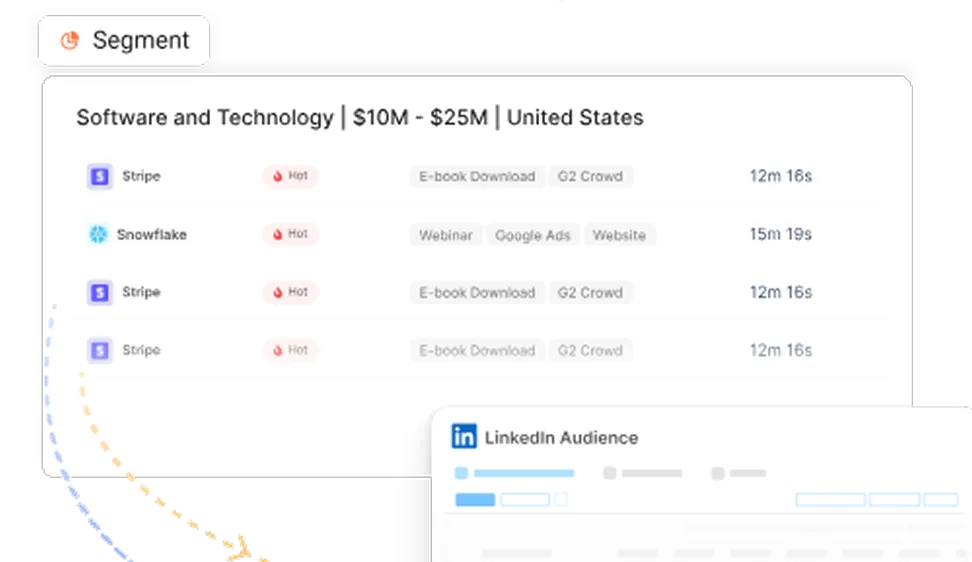
When you identify that an account from your tier-1 target list just visited your pricing page via search, you can:
- Alert the account owner in your CRM
- Add them to a LinkedIn retargeting campaign
- Suppress them from expensive keyword campaigns
- Track their full journey across channels
This is the difference between search as a lead generation tool and search as an account intelligence signal.
Fix #6: Embrace Branded Search, Even If It Feels Weird
Branded search feels like cheating. They already know who you are! Why pay for that click?
Because 92% of buyers start with a vendor already in mind. If you're not showing up at the top for your own brand terms, you're losing deals to competitors who bid on your brand.
More importantly, branded search volume is one of the few search metrics that's still growing for successful companies. It's a lagging indicator of your brand work paying off.
The fix:
- Own all your branded terms (obviously)
- Bid on competitor brand terms strategically
- Create brand + problem combination terms ("Company Name analytics," "Company Name attribution")
- Use branded campaigns to control the message and landing page experience
Your branded search performance tells you whether all your other marketing is working. If branded search is declining, you have a brand awareness problem, not a search problem.
Fix #7: Reduce Friction for High-Intent Visitors
This one's simple but most companies still screw it up.
If someone searches for "your product demo" or "your product pricing," don't make them fill out a form to see basic information. Don't make them wait for a BDR to call them. Don't send them to a generic landing page.
Give them exactly what they searched for, immediately. There is almost nothing as annoying as being directed to fill out a form or being sent to some random page when you’ve asked a specific question. Don’t gate keep, don’t send customers on a merry-go-round.
The companies in the top quartile (28% conversion rate growth) are winning because they removed friction for high-intent visitors. The companies in the bottom quartile (-43% conversion rate decline) are still trying to "capture" leads.
High-intent search visitors don't need to be captured. They need to be served what they asked for in the first place.
Search Isn't Dead, But It's Different
Paid search performance is declining for 65% of companies. Traffic is down. Conversion rates are down. Costs are up.
But the top quartile is seeing 44.8% traffic growth and 28% conversion rate improvement. The difference isn't luck. It's strategy.
The winners are:
- Accepting lower volume at the top of the funnel and instead optimizing for quality
- Building a brand on LinkedIn to lift search performance (46% higher conversion rates)
- Using search as an account intelligence signal, not just a lead source
- Measuring pipeline and revenue, not MQLs
- Combining search with retargeting and account-based plays
- Reducing friction for high-intent visitors
- Owning their brand terms and controlling their narrative
The losers are:
- Chasing 2023 traffic levels that aren't coming back
- Running search in isolation from brand investment
- Measuring form fills instead of pipeline
- Treating all traffic equally instead of prioritizing ICP accounts
- Adding friction in the name of "lead capture"
Paid search isn't broken. But if you're still running it the way you did three years ago, you're going to keep seeing performance decline.
The fix isn't more budget. It's a completely different approach that acknowledges how buyers actually research and make decisions in 2025.
If you want to see which ICP accounts are visiting from paid search and track their complete journey across channels, Factors.ai provides account-level analytics that turns paid search from a lead gen tool into an account intelligence signal, helping you identify high-intent accounts and orchestrate the right follow-up across LinkedIn, sales outreach, and more.
Your move.
FAQs for Fixing Declining Paid Search Performance
Q. Why is paid search performance declining across B2B teams?
Because buyer behavior has shifted dramatically, informational queries now go to AI tools, not search engines, and most buyers choose vendors before they even search.
Q. Is Google’s algorithm to blame for poor conversion rates?
Not entirely. Google's algorithm favors engagement, not revenue. It’s optimized to find clickers, not buyers, making traffic more expensive and less qualified.
Q. Should I stop investing in paid search?
No, but you should radically change your approach. Focus on high-intent keywords, integrate brand campaigns, and use account-level data to drive smarter follow-up.
Q. What metrics should I use instead of MQLs?
Track cost per demo, cost per pipeline, and conversion rates to opportunity. These metrics align better with revenue and signal real buyer intent.
Q. How does LinkedIn improve paid search performance?
Accounts exposed to LinkedIn branding convert 46% better via paid search. Building brand familiarity raises your odds when buyers search with intent.

See how Factors can 2x your ROI
Boost your LinkedIn ROI in no time using data-driven insights


.avif)

See Factors in action.
Schedule a personalized demo or sign up to get started for free
LinkedIn Marketing Partner
GDPR & SOC2 Type II

.svg)



.avif)

