
How to lower LinkedIn CPC without lowering lead quality
Learn how to lower LinkedIn CPC with smarter targeting, bidding, creative, and attribution. Built for B2B marketers using Factors.ai.
.avif)
Senior Content Marketing Manager



.svg)


TL;DR
- LinkedIn CPC runs higher than most platforms because you're reaching decision-makers, not casual scrollers. That premium is often justified when you measure pipeline, not just clicks.
- Most B2B teams overpay because of hyper-narrow targeting, weak CTR, missing exclusions, and optimizing to the wrong metrics.
- The fastest ways to lower LinkedIn CPC include broadening targeting slightly, refreshing creative before fatigue sets in, retargeting warm audiences, and cutting wasted spend on irrelevant segments.
- A higher CPC isn't always a problem. A $12 click that generates a $60k opportunity is a bargain compared to a $2 click that goes nowhere.
- Factors.ai helps reduce LinkedIn ad waste by syncing high-intent audiences, surfacing company-level engagement signals, and shifting budget toward pipeline-producing segments.
There’s a specific kind of pain that only B2B marketers know. No, it’s not lower-back pain… that’s common to B2C marketers, too. I’m talking about this: feeling like you’re paying premium prices for people who may or may not care (FYI… feeling is the keyword here).
Think of this experience: You launch a campaign, feel smug about the targeting options, pick your dream audience of founders, VPs, directors, and suspiciously specific job titles, then check results a week later and see each click costing more than your lunch. Suddenly, every visit to the website feels like a… financial event.
And yet, plenty of smart marketers continue spending serious money on LinkedIn Ads. Some scale aggressively, some generate strong pipeline, and some swear it’s their highest-quality paid channel. So either they know something everyone else doesn’t, or CPC alone is a terrible way to judge performance.
Spoiler: it’s the second one… and there’s a reason I said they’re smart marketers.
LinkedIn can absolutely feel more expensive… but expensive and inefficient are not the same thing. When campaigns are structured well, audiences are sensible, creative does its job, and measurement goes beyond vanity metrics, those costly clicks can outperform cheaper traffic from almost anywhere else.
This blog is set to break down how much LinkedIn Ads really cost, why prices vary so wildly, what a healthy CPC looks like in B2B, and how to lower costs without wrecking lead quality. If you’ve ever looked at your spend report and felt personally attacked, this one’s for you.
Why does LinkedIn CPC feel expensive?
Let's start with the uncomfortable truth. LinkedIn is not cheap, and it was never designed to be. When you advertise on LinkedIn, you're reaching people through their professional identity. You're targeting by job title, seniority, company size, industry, and skills. That kind of precision doesn't come at Meta-level pricing, and it shouldn't.
Think about what LinkedIn actually offers compared to other ad platforms. On Meta, you're reaching someone between cat videos and holiday photos. On Google, you're catching someone mid-search, which is powerful, but you don't always know if they're a decision-maker or an intern doing research. On LinkedIn, you can put your message in front of a VP of Engineering at a 500-person SaaS company in North America. That level of professional targeting is why linkedin ads cost more per click.
The auction itself plays a role too. LinkedIn pricing is auction-based, which means your CPC depends on your bid, the competition for that audience, and the relevance score of your ad. When multiple advertisers chase the same audience of senior decision-makers, auction prices climb naturally. Certain industries, regions, and seniority levels are more competitive than others, and those factors compound quickly.
But here's where most marketers make a thinking error. They compare LinkedIn CPC against Google Display or Meta without adjusting for lead quality. A $9 click from a VP of IT at a target account is fundamentally different from a $1 click that comes from someone who will never buy your product. When you measure cost per qualified opportunity instead of cost per click, LinkedIn often looks far more reasonable. The sticker shock fades once you stop comparing apples to oranges and start comparing pipeline to pipeline.
The real question isn't "why is LinkedIn CPC so high?" It's "what does that CPC actually produce downstream?" If you can't answer the second question, you're optimising blind, and that's where the overspending actually starts.
What does a good LinkedIn CPC actually look like?
This is the question every B2B marketer asks, and the honest answer is that there's no universal "good" CPC. Anyone who gives you a single number without asking about your audience, market, and campaign objective is oversimplifying.
That said, you need some frame of reference. LinkedIn CPC benchmarks vary quite a bit depending on source and segment. Most B2B advertisers see CPCs somewhere between $4 and $12, though enterprise-focused campaigns targeting C-suite buyers in competitive industries can easily exceed $15. Geographic differences matter too. North American and Western European audiences typically cost more than audiences in APAC or Latin America. The campaign objective you choose also shifts the range. Lead gen forms, for example, sometimes produce different effective CPCs than website visit campaigns because the conversion happens on-platform.
Here's what I'd encourage you to do instead of obsessing over hitting a specific CPC benchmark. Shift your attention to the metrics that actually connect to revenue:
- Cost per qualified lead. Not just any lead. Leads that your sales team actually accepts and works.
- Cost per opportunity. What does it cost to get a prospect into a real sales conversation?
- Pipeline influenced. How much active pipeline can you trace back to LinkedIn as a contributing channel?
- Revenue per click. If you can calculate this, you've already outgrown CPC as your primary metric.
CPC is a media metric. Pipeline is the business metric. If your CPC is $12 but those clicks consistently turn into qualified opportunities, you don't have a CPC problem. You have a well-functioning channel that happens to charge a premium for access to the right people. Conversely, if your CPC is $4 but none of those clicks convert into pipeline, you're just buying cheap traffic that flatters your dashboard.
The teams I've seen struggle most with LinkedIn ads cost are the ones that set CPC targets in isolation, without tying them to downstream performance. They celebrate when CPC drops by $2, even if conversion rates drop alongside it. That's not optimisation. That's vanity reporting.
Why most brands overpay on LinkedIn
Before we get into tactics for lowering CPC, it's worth understanding the most common reasons B2B teams overpay in the first place. In my experience, overspending rarely comes from a single mistake. It's usually a combination of structural issues that compound over time.
- Hyper-narrow targeting
This is probably the most frequent culprit. You start building your audience and it feels smart to stack every filter: job title plus seniority plus company size plus skills plus geography. Each layer makes you feel more precise. But what actually happens is your audience shrinks to a few thousand people, the auction gets brutally competitive for that sliver, and your CPC spikes.
LinkedIn's auction favours scale. When your audience is too small, there's less room for the algorithm to optimize delivery, and you end up paying a premium for every impression. Precision is important, but hyper-precision often backfires on cost efficiency.
- Weak CTR dragging up costs
If people see your ad and don't click, two things happen. First, you're paying for impressions that produce nothing. Second, your relevance score suffers, which makes the auction less favorable for you over time. LinkedIn rewards ads that people actually engage with, so a low click-through rate creates a compounding cost problem.
Weak CTR usually traces back to one of a few things: the headline doesn't land, the creative blends into the feed, or the value proposition isn't clear enough within the first few seconds. It's rarely a targeting issue alone. Often the audience is right, but the message isn't giving them a reason to stop scrolling.
- Wrong objective selection
This one's subtle but expensive. If you select "website visits" as your campaign objective when your actual goal is conversions, LinkedIn optimizes for the cheapest clicks rather than the most valuable ones. The platform takes your objective literally. Traffic campaigns attract clickers. Conversion campaigns attract converters. Choosing the wrong one means you're optimizing toward the wrong behavior from the start.
I've seen teams run awareness or traffic objectives for months, wondering why lead quality is poor, without realizing the campaign setup itself was steering budget toward low-intent audiences.
- No audience exclusions
This is the silent budget leak. Without proper exclusions, your ads reach existing customers, current pipeline accounts, internal employees, and people in irrelevant geographies. Every impression served to someone who should never see the ad is wasted spend that inflates your effective CPC.
The fix is straightforward, but it requires maintenance. You need to regularly update your exclusion lists with closed-won customers, active pipeline contacts, internal domains, and any segments that have proven irrelevant. Most teams set these up once and forget about them, which means the lists go stale and the waste creeps back in.
- Optimizing for clicks instead of revenue
This is the philosophical mistake underneath all the tactical ones. When your optimisation target is "lowest possible CPC," you naturally gravitate toward broad, cheap audiences. Those audiences click, but they don't convert. You end up with impressive click volumes and disappointing pipeline numbers.
The better frame is cost per outcome that matters. Sometimes the highest-CPC segment in your account is also the one producing the most revenue. If you cut that segment to lower your average CPC, you've technically improved your media metric while actually hurting your business.
9 proven ways to lower LinkedIn CPC
While these nine approaches work independently, the biggest gains come from combining several of them at once. Think of each one as a lever. The more levers you pull simultaneously, the more noticeable the impact.
1. Broaden your targeting slightly
I know this sounds counterintuitive when the whole point of LinkedIn is precision targeting. But there's a meaningful difference between precise and over-constrained. Instead of targeting only specific job titles like "Head of Demand Generation," try targeting the broader job function like "Marketing" combined with seniority. You'll reach a larger audience pool, which gives LinkedIn's algorithm more room to optimize delivery and find efficient impressions within that group.
The key word here is "slightly." You're not going from a 5,000-person audience to 5 million. You're going from 5,000 to 50,000 by loosening one or two filters. You can always layer intent signals later, through retargeting or by using tools like Factors.ai to prioritise companies showing buying signals, so the initial targeting doesn't need to do all the qualification work by itself.
2. Improve CTR with better creative
Better click-through rates almost always lower your effective CPC on LinkedIn. The auction rewards engagement, so ads that earn more clicks relative to impressions get more favourable delivery economics. This is one of the highest-leverage changes you can make without touching your targeting or budget.
What does "better creative" actually mean in practice? Start with the hook. Your headline needs to land within the first few words because most people scan rather than read. Pain-first framing tends to outperform benefit-first framing on LinkedIn. Instead of "Boost your pipeline with our platform," try something like "Your pipeline report looks great until finance asks about ROI." Social proof works well too, especially specific numbers rather than vague claims.
Your CTA also matters more than you'd think. "Learn more" is the default, and it's the weakest option. A specific CTA like "See the 2026 benchmarks" or "Get the framework" gives people a concrete reason to click. Small creative tweaks like these compound over time, and the CTR improvement directly translates into lower linkedin CPC through better auction economics.
3. Use retargeting audiences
Retargeting is one of the most reliable ways to lower your blended CPC while improving conversion rates. People who've already interacted with your brand are warmer prospects. They've visited your website, watched your video content, or engaged with previous ads. Because they already have some familiarity with you, they tend to click at higher rates and convert more readily.
The three retargeting segments I'd prioritise on LinkedIn are website visitors (especially those who've hit high-intent pages like pricing or case studies), engaged video viewers who watched more than 50% of a previous ad, and high-intent companies identified through tools that track account-level engagement. These audiences are smaller by nature, but their efficiency pulls down your overall CPC average across campaigns.
Retargeting also makes your cold campaigns more efficient. When you know warm audiences will re-engage cheaply, you can afford to bid more aggressively on cold audiences knowing the blended economics still work out.
4. Exclude wasted audiences
We covered this in the "why brands overpay" section, but it deserves its own tactical entry because the implementation is straightforward and the impact is immediate. Every audience segment that will never convert is silently inflating your costs.
Build and maintain exclusion lists for these segments:
- Existing pipeline. Contacts already in active sales conversations don't need ads pushing them to a top-of-funnel landing page.
- Closed-won customers. Unless you're running expansion campaigns, current customers shouldn't see acquisition ads.
- Internal teams. Your own employees seeing your ads is a surprisingly common budget leak, especially at larger companies.
- Irrelevant geographies. If you only sell in North America, make sure APAC and EMEA traffic isn't consuming budget.
- Disqualified segments. Job titles or industries you've historically seen convert at near-zero rates.
The discipline here is in the maintenance. These lists need updating at least monthly, ideally in sync with your CRM data. Stale exclusion lists are almost as bad as having none at all.
5. Test manual vs automated bidding
LinkedIn's default bidding strategy is "maximum delivery," which essentially tells the platform to spend your budget as efficiently as it can. In theory, that sounds great. In practice, some accounts find that automated bidding overpays for impressions, especially in competitive auctions where the algorithm bids aggressively to win placements.
Testing a manual bid strategy gives you more control over your ceiling price. You set the maximum you're willing to pay per click, and LinkedIn won't exceed that. The trade-off is that you might get fewer impressions if your bid isn't competitive enough, but the impressions you do get come at a controlled cost.
My recommendation is to run both strategies side by side for the same audience and creative, then compare effective CPC and downstream conversion rates after two to three weeks. Some accounts genuinely perform better on automated bidding. Others save 20-30% by switching to manual bids. Your linkedin bidding strategy should be based on your own data, not a blanket recommendation. This is one of those areas where testing beats assumptions every time.
6. Improve landing page relevance
This one doesn't lower CPC directly in the auction, but it improves the value you extract from every click, which is effectively the same thing. If someone clicks your ad and lands on a page that doesn't match the promise of the ad, they bounce. You've paid for a click that produced nothing.
The most common disconnect I see is ads promoting a specific use case or pain point that lead to a generic product homepage. The visitor clicked because the ad resonated with a specific problem, and then the landing page talks about everything except that problem. Matching the message from ad to landing page isn't just a conversion rate tactic. It's a CPC efficiency tactic because it makes every click count.
Keep your landing pages focused. One offer, one audience, one clear next step. If your ad talks about reducing LinkedIn ad spend, the landing page should talk about that same thing, not your entire product suite.
7. Rotate creatives before fatigue sets in
Every ad has a shelf life on LinkedIn. When the same audience sees the same creative repeatedly, engagement drops. Falling CTR means the auction becomes less favourable, and your CPC starts climbing. This is the fatigue cycle, and it happens faster than most teams expect, especially with smaller audiences.
The fix is proactive rotation rather than reactive replacement. Don't wait until your CTR has already cratered to swap in new creative. Set a cadence, something like every two to three weeks for smaller audiences and every four to six weeks for larger ones. Keep the core message consistent but vary the visual format, headline angle, and CTA. You can also rotate between single image, carousel, and video formats to keep the feed experience fresh.
One trick that works well is having three to four creative variants running simultaneously from the start. LinkedIn's algorithm will naturally favour the best performer, and you'll always have a backup ready when the top variant starts fatiguing. This prevents the "scramble to create new ads" panic that most teams experience when performance suddenly dips.
8. Use company-level intent signals
This is where linkedin ads optimisation gets genuinely strategic rather than just tactical. Instead of targeting based purely on demographic filters, you layer in behavioral signals. Which companies are actively researching topics related to your product? Which ones have visited your website multiple times this month? Which ones are engaging with competitors?
When you target companies showing active buying signals, your ads reach people during a window of genuine interest. That naturally improves engagement rates, which improves auction efficiency, which lowers CPC. You're not interrupting someone's day with a cold pitch. You're showing up when they're already thinking about the problem you solve.
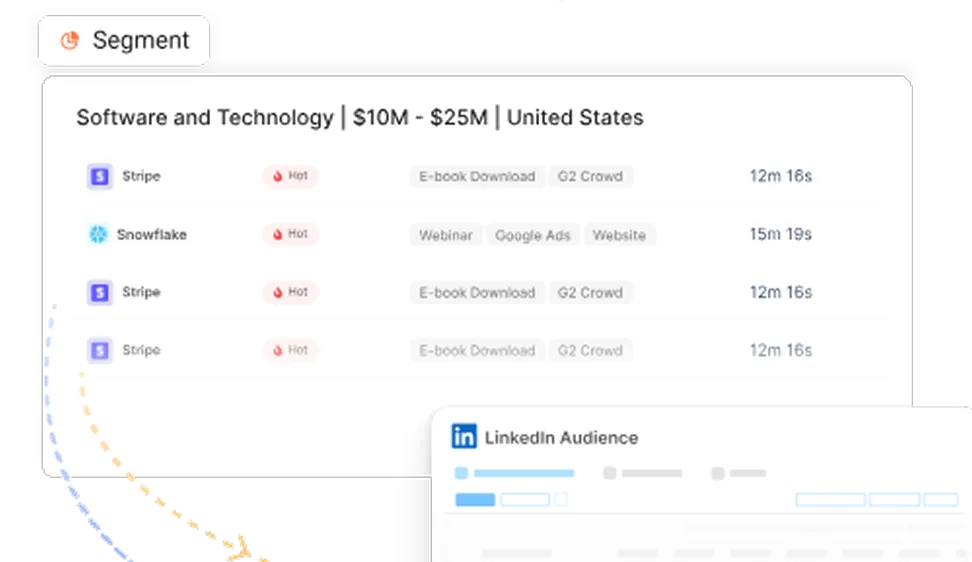
Tools like Factors.ai make this practical by surfacing company-level engagement data and letting you sync those audiences directly into LinkedIn. Without this layer, you're relying entirely on static demographic targeting, which is a bit like fishing in the whole ocean instead of fishing where the fish are actually biting.
9. Optimize for pipeline (like I said above also)
This is the strategic shift that ties everything else together. When you optimize campaigns toward pipeline creation rather than click volume, your budget naturally flows toward the segments that produce revenue. Sometimes those segments have higher CPCs. Sometimes they have lower ones. The point is that CPC becomes a secondary metric rather than the primary one.
This means connecting your LinkedIn campaign data to your CRM so you can see which campaigns, audiences, and creatives generate opportunities and closed revenue. When you have that visibility, you can confidently increase spend on a $14 CPC campaign that produces $200k in pipeline while pulling budget from a $5 CPC campaign that produces nothing.
This is where most teams get stuck because the data infrastructure doesn't exist yet. LinkedIn's native reporting tells you about clicks and leads, not about what happens after the lead enters your funnel. Bridging that gap requires either custom analytics work or a tool built for B2B attribution, which is exactly the problem Factors.ai was designed to solve.
How does Factors.ai help reduce LinkedIn CPC?
I want to be super direct about this section. Factors.ai is a tool we believe in, and the reason we believe in it is that it directly addresses the measurement and targeting gaps that cause B2B teams to overspend on LinkedIn. If the strategies above are the "what to do," Factors.ai is the "how to do it at scale."
- Company intelligence API
One of the biggest challenges in LinkedIn ads optimisation is knowing which companies are actually paying attention. Factors.ai's company intelligence API shows you which companies are engaging with both your paid and organic efforts. You can see who visited your website after seeing a LinkedIn ad, who's reading your content, and who's showing up repeatedly.
This visibility helps you make smarter allocation decisions. Instead of spreading budget evenly across all target accounts, you can concentrate spend on companies actively in a buying cycle. That precision reduces waste, which is the most sustainable way to lower your blended linkedin CPC.
- Factors’ LinkedIn AdPilot (as a whole also)
AdPilot automates budget movement toward high-performing campaign segments. Instead of manually checking dashboards and shifting spend every few days, AdPilot identifies which audiences and creatives are driving results and reallocates budget accordingly. It's the kind of optimisation that humans do too slowly and too infrequently. Automated reallocation means your budget works harder without requiring constant manual attention.
2a. Audience sync
Factors.ai lets you push high-intent audiences from your CRM and website directly into LinkedIn with LinkedIn AdPliot. Instead of building audiences from scratch using LinkedIn's filters, you can upload lists of companies currently in-market based on their actual engagement behavior. These audiences perform better because they're based on signals, not just demographics. Higher engagement rates mean better auction economics, which translates to lower effective CPC.
- Cross-channel attribution
This is the piece that makes everything else meaningful. Factors.ai connects your LinkedIn ad spend to downstream pipeline and revenue outcomes. You can see whether a higher-CPC campaign actually produced better opportunities than a cheaper one. You can compare LinkedIn's contribution against other channels using multi-touch attribution rather than guessing.
Sometimes the best way to lower CPC isn't paying less per click. It's paying only for clicks that matter. And you can only make that distinction when you can trace a click all the way from impression to opportunity to revenue.
When higher CPC is actually fine
Not every high CPC is a problem that needs solving. I think it's important to say this clearly because the instinct to lower costs can actually hurt performance if applied indiscriminately. There are specific situations where paying $10, $12, or even $15+ per click is not just acceptable but kind of smart.
- Enterprise ABM campaigns. When you're targeting a named list of 50 accounts that each represent $100k+ in potential ACV, the audience is tiny and competitive. CPC will be high. That's fine… one converted account pays for the entire campaign many times over.
- C-suite outreach. Reaching a CFO or CTO costs more than reaching a mid-level manager. The auction reflects the demand. But if your product requires executive sponsorship to close, you don't have the luxury of only targeting cheaper audiences. The CPC premium is the cost of reaching the person who actually signs the contract.
- High ACV SaaS. If your average contract value is $50k or more, the math changes dramatically. A $12 click that contributes to a $60k opportunity is a 5,000x return on that individual click. Optimizing for the lowest possible CPC in a high-ACV context can actually pull you toward lower-quality audiences that never close.
- Strategic account expansion. When you're running campaigns to grow revenue within existing accounts, the target audience is small by definition. You're reaching specific teams within specific companies. The CPC will reflect that specificity, and the potential return justifies it because expansion revenue typically closes faster and at higher rates than new business.
- Hard-to-reach technical buyers. DevOps leads, security engineers, and infrastructure architects are notoriously difficult to reach through any channel. When they do show up on LinkedIn, competition for their attention is fierce. Paying a premium to reach them is often the only viable option for products that require their buy-in.
The pattern here is consistent… when the value of the conversion is high and the audience is inherently small or competitive, CPC is a poor metric for judging campaign health. Pipeline created per dollar spent tells you something useful. CPC alone doesn't.
LinkedIn CPC benchmarks by B2B use case
Benchmarks are useful as a sanity check, not as a target. Every company's CPC will vary based on their audience, creative quality, competitive landscape, and campaign setup. That said, having a rough sense of what others in similar situations pay helps you spot obvious overspending.
A few things to keep in mind when using this table. First, these ranges represent what I've observed and what's commonly reported across B2B marketing communities, not official LinkedIn data. Your actual CPC will depend on your specific targeting setup and creative quality. Second, these are click-level costs. They don't tell you anything about conversion rates or pipeline quality, which is where the real story lives.
If your CPC falls well above these ranges for a comparable use case, that's worth investigating. It could signal overly narrow targeting, creative fatigue, or suboptimal bidding. If your CPC falls within or below these ranges but your pipeline numbers are weak, the problem isn't cost. It's conversion, and that requires a different set of fixes.
In a nutshell
After everything we've covered, here's what I'd want you to take away from this piece.
Chasing the lowest possible LinkedIn CPC is a trap. It feels like optimisation, but it often steers budget toward cheap, low-intent audiences that never convert. The teams that get the most from LinkedIn ads are the ones who focus on pipeline efficiency, not click cost, and build their campaigns around that principle from the start.
The most impactful changes you can make today are broadening overly narrow targeting, improving creative to boost CTR, building and maintaining proper exclusion lists, and rotating ads before fatigue drives up costs. These aren't revolutionary tactics. They're the fundamentals that most teams skip because they're busy chasing the next shiny feature.
If your LinkedIn advertising feels disproportionately expensive, the root cause is usually one of three things: targeting precision is off (either too narrow or too broad), measurement gaps make it impossible to connect CPC to revenue outcomes, or creative has gone stale and nobody's refreshed it in weeks. Fixing these three areas will do more for your cost efficiency than any bidding hack.
Factors.ai fits into this picture by closing the gap between LinkedIn campaign data and pipeline outcomes. It helps you target companies actually in-market, exclude ones that aren't, and attribute revenue back to specific campaigns and audiences. That's how you lower waste, not just cost.
And when CPC is genuinely high because you're reaching senior decision-makers at enterprise accounts, don't panic. Check what those clicks produce. If they're creating real pipeline, the CPC is doing its job.
Frequently asked questions about LinkedIn CPC
Q1. What is a good LinkedIn CPC in B2B?
It depends on your audience, industry, and campaign objective, but most B2B advertisers see CPCs between $4 and $12. Enterprise campaigns targeting C-suite buyers or niche technical audiences often exceed that range. The more useful question is what your CPC produces in terms of qualified leads and pipeline, since a "high" CPC that generates revenue is better than a "low" CPC that doesn't.
Q2. Why is LinkedIn CPC higher than Meta or Google?
LinkedIn's premium pricing reflects the unique value of its targeting. You're reaching people through their professional identity, including job title, seniority, company size, and industry. That level of precision for B2B audiences simply isn't available on platforms built around consumer behavior and entertainment. The auction is also more competitive for decision-maker audiences because every B2B advertiser wants the same people.
Q3. How do I lower LinkedIn CPC fast?
The fastest levers are improving your ad creative to boost CTR (which improves auction economics), broadening targeting slightly to give the algorithm more room to optimize, excluding wasted audience segments like existing customers and internal teams, refreshing fatigued creatives, and retargeting warm audiences who engage at higher rates. Combining several of these at once typically produces the most noticeable drop.
Q4. Does lowering CPC improve ROI?
Not always, and this is a common misconception. If you lower CPC by shifting toward broader, cheaper audiences that don't convert, your ROI actually gets worse. Lower CPC only improves ROI when the cheaper clicks maintain or improve the same conversion quality. That's why it's critical to track downstream metrics like cost per opportunity and pipeline value, not just click cost.
Q5. How much do LinkedIn ads cost monthly?
Monthly linkedin ads cost varies enormously depending on your goals, target audience, and competitive landscape. Many B2B teams start somewhere between $2,000 and $10,000 per month and scale up based on what's working. The right budget depends on your target CPA, the size of your addressable audience, and how aggressively you're trying to build pipeline. There's no meaningful minimum, but very small budgets can struggle to generate enough data for the algorithm to optimize effectively.
Q6. Is LinkedIn worth the CPC?
For high-value B2B products with longer sales cycles and clear ideal customer profiles, LinkedIn is often one of the most efficient channels when measured on pipeline quality rather than lead volume. The CPC premium is real, but so is the quality of the audience you're reaching. Teams that can connect their LinkedIn spend to downstream revenue outcomes almost always find the channel worthwhile. The ones who struggle are usually the ones measuring LinkedIn against consumer-platform benchmarks and not accounting for the difference in lead quality.

Powered by Bombora
Enter your domain and we'll send you a free list of companies showing buying intent in your vertical.
.avif)
Powered by Bombora
Enter your domain and we'll send you a free list of companies showing buying intent in your vertical.
.avif)

See how Factors can 2x your ROI
Boost your LinkedIn ROI in no time using data-driven insights


.avif)

See Factors in action.
Schedule a personalized demo or sign up to get started for free
LinkedIn Marketing Partner
GDPR & SOC2 Type II

.svg)



.avif)

