
How to Qualify a Lead in Sales: A Practical Step-by-Step Guide
Learn how to qualify a lead in sales with proven B2B frameworks, checklists, stages, and automation tips to improve pipeline quality.
.avif)
Senior Content Marketing Manager



.svg)


TL;DR
- Lead qualification means deciding whether a prospect is worth your sales team's time right now, based on two dimensions: fit (right company, right person) and intent (right timing, real urgency).
- A reliable step-by-step process covers ICP fit, stakeholder identification, pain confirmation, intent signals, buying readiness, and a clear next action.
- Frameworks like BANT, CHAMP, and MEDDIC give your team a shared language for qualifying leads, but picking the right one depends on your deal complexity and sales cycle.
- Differentiating between pre-qualified leads from unqualified ones prevents wasted pipeline and protects your team's focus.
- Combining account-level signals (website visits, ad engagement, multi-stakeholder activity) with CRM data produces far stronger qualification than relying on individual form fills alone.
Okay, I’m going to narrate a scene from a very famous soap opera, and you’ve to guess the name. It starts like this… marketing has arrived at the Monday meeting carrying a spreadsheet full of ‘hot leads’ like they’ve brought gifts… sales opens it with cautious optimism. By Wednesday, the mood has changed dramatically…
Next, you see that one lead downloaded your whitepaper from a university campus, another wants enterprise pricing for a team of three, and someone booked a demo from a company that hasn’t updated its website since 2017. One contact replied, “Please stop emailing me… I was just curious.” And hidden somewhere inside this carnival of chaos is one genuinely perfect buyer nobody followed up with fast enough.
By Friday, the argument begins... marketing says sales ignored leads, sales says marketing sent nonsense, and leadership says pipeline is slower than expected. Everyone is annoyed, nobody is wrong, and the real issue is sitting in the middle: nobody knows how to properly qualify a lead. Were you able to guess it?
It’s called, ‘MY Office’... that leaves us all looking like this:

Generating leads is all glam… but qualifying them is the bit that decides whether revenue actually happens. It’s the difference between chasing people who liked your webinar title and speaking to buyers with budget, urgency, authority, and a real problem worth solving.
This blog breaks down how to qualify a lead in sales without relying on gut feel, outdated checklists, or “I just had a good feeling about them” energy. We’ll cover the signals that matter, the questions worth asking, common traps teams fall into, and how to build a process that saves time, improves close rates, and stops your CRM from feeling like a digital junk drawer.
What does lead qualification actually mean?
Before we get tactical, let’s go over the definition of what it means… lead qualification is the process of deciding whether a prospect deserves your sales team's time and attention right now. That's it.
The decision rests on two dimensions that work together:
- The first is fit: does this prospect match the kind of company and person you can actually help?
- The second is intent: is there a real problem they're trying to solve, and is the timing right for them to act on it? A prospect who fits your ideal profile but has zero urgency isn't qualified.
Neither is someone who's desperate for a solution but works at a company you'll never be able to serve. You need both dimensions present for qualification to hold up.
This is why every lead is not created equal. A VP of Marketing at a mid-market SaaS company who visited your pricing page three times this week is a fundamentally different prospect from a marketing intern who downloaded your ebook for a presentation. They might both show up as "new leads" in your CRM, but treating them the same way is how teams burn through sales capacity without building pipeline.
It also helps to separate qualification from the things it gets confused with. Lead generation is about creating awareness and capturing interest. Lead scoring assigns a numerical value based on behavior and demographics. Lead qualification is the human (or increasingly automated) judgment call about whether a lead is ready for a sales conversation. And opportunity creation is what happens after qualification, when a lead enters an active deal cycle. These are sequential stages, not synonyms. Mixing them up creates messy handoffs and inflated reporting.
The change in B2B is that qualifying leads in sales increasingly depends on account-level signals rather than individual form fills. A single person downloading a whitepaper tells you very little. Three people from the same target account visiting your product pages, reading case studies, and engaging with your LinkedIn ads within the same week tells you a great deal. Qualification based on account behavior is where the most effective teams have moved, and it requires a different kind of data infrastructure than the traditional "someone filled out a form" approach.
Why does lead qualification matter so much in B2B sales?
There's a straightforward reason qualification deserves this much attention: sales teams have finite capacity, and the cost of spending it on the wrong prospects compounds fast. Every hour an SDR spends chasing a lead that was never going to convert is an hour they didn't spend on one that might have. Multiply that across a team of ten reps over a quarter, and you're looking at thousands of hours of lost productivity that never shows up in any dashboard.
- Better sales lead qualification improves nearly every metric a revenue team cares about. Conversion rates go up because reps are talking to people who actually have the problem, budget, and authority to buy.
- Sales productivity increases because reps aren't wasting cycles on dead ends.
- Pipeline velocity improves because qualified deals move faster through stages.
- CAC efficiency gets better because you're spending the same marketing dollars but extracting more revenue from the leads they generate.
- Even forecasting quality improves, because a pipeline full of well-qualified opportunities is far more predictable than one padded with wishful thinking.
Wait… the benefits don't stop with sales. Marketing teams gain just as much from strong qualification practices. When qualification criteria are clear and shared, campaign optimization becomes more targeted. You can look at which channels, creatives, and offers produce leads that actually convert, not just leads that fill out forms. The MQL handoff to sales becomes cleaner because both teams agree on what "qualified" means. And that persistent tension between marketing and sales, the "your leads are garbage" versus "you're not following up fast enough" argument, starts to ease when there's a shared definition of quality.
Most modern GTM teams have started using qualification as a prioritisation mechanism rather than just a filtering one. The goal isn't only to disqualify bad leads. It's to identify which accounts deserve the most attention, the fastest follow-up, and the most senior reps. When you're qualifying sales leads effectively, you're essentially running a triage system that directs your best resources toward your highest-value opportunities. Teams that get this right consistently outperform teams with larger lead volumes but no qualification discipline.
How to qualify a lead in sales: step by step
If you want a repeatable process your team can follow, these six steps cover the full qualification workflow from first touch to routing decision. Think of them as a sales qualification checklist your SDRs can run through without needing to improvise every time.
Step 1. Check ICP fit
Before anything else, you need to know whether this prospect's company matches your ideal customer profile. ICP fit is the foundation everything else builds on, and it's the fastest way to filter out leads that will never close.
Assess these dimensions:
- Industry: Do you serve their vertical? Do you have relevant case studies or product capabilities for their space?
- Company size: Does their employee count or team structure match the segment you sell into?
- Geography: Are they in a region you support, with compatible time zones and regulatory requirements?
- Revenue band: Is the company large enough to afford your solution and small enough to need it?
- Tech stack: Do they use complementary tools your product integrates with, or competing tools you'd need to replace?
- Hiring growth: Are they actively scaling the team your product supports? Hiring signals often indicate budget and urgency.
- Existing systems: What are they using today for the problem you solve? This tells you whether you're replacing something or filling a gap.
Most of this data is available through enrichment tools, LinkedIn, or your CRM before a single conversation happens. If a lead fails ICP fit on multiple dimensions, qualification stops here. There's no conversation that will fix a fundamental mismatch.
Step 2. Identify the right contact
A company can be a perfect fit, but if you're talking to the wrong person inside it, the deal goes nowhere. This step is about confirming that your contact has the role, influence, and motivation to move a purchase forward.
Check these factors:
- Job title: Does their role align with the buyer personas you typically close?
- Decision influence: Are they a decision-maker, an influencer, or an end user? Each requires a different engagement approach.
- Buying committee role: In larger deals, purchases involve multiple stakeholders. Where does this person sit in that structure?
- Champion potential: Could this person become your internal advocate? Champions are the single most important variable in complex B2B deals. Someone who feels the pain personally and has the organizational credibility to push a solution forward is worth ten passive contacts.
If you've got ICP fit but the wrong contact, the lead isn't disqualified. It needs to be routed differently. Your SDR might need to find and engage the right stakeholder within that account rather than nurturing someone who can't influence the purchase.
Step 3. Confirm the pain
Fit and contact are necessary but not sufficient. The prospect needs an actual problem that your product solves, and that problem needs to feel urgent enough to act on. This is where qualifying leads marketing sourced versus sales sourced starts to diverge, because marketing leads often show interest without revealing pain.
The questions that matter here are deceptively simple:
- What problem are they trying to solve? If they can't articulate a specific challenge, they're browsing, not buying.
- What happens if they do nothing? This reveals urgency. If the cost of inaction is low, your deal will stall.
- Why now? Something triggered their interest. A new quarter, a missed target, a leadership change, a broken process. Understanding the catalyst tells you how real the timeline is.
Pain confirmation is where experienced reps separate themselves from junior ones. A good SDR doesn't just ask these questions. They listen for the emotional weight behind the answers. Someone who says "we're exploring options" is in a different place than someone who says "we missed our pipeline target by 40% last quarter and my VP is asking what we're doing about it."
Step 4. Measure intent signals
Confirmed pain is strong, but intent signals add another layer of confidence. These are the behavioural indicators that show a prospect is actively evaluating solutions, not just passively aware of a problem.
Examples of high-value intent signals:
- Pricing page visits: Someone looking at your pricing is comparing you against alternatives and thinking about budget.
- Demo requests: An explicit hand-raise that signals active evaluation.
- High email engagement: Repeated opens and clicks on product-focused emails suggest growing interest.
- Repeat website visits: Multiple sessions over a short period indicate research behaviour.
- Product comparison page views: They're evaluating you against competitors, which means they're deep enough in the funnel to be comparing options.
- Multi-user engagement from the same company: This is the strongest signal of all. When several people at one account are engaging with your content and website simultaneously, there's usually an internal conversation happening about your category.
The limitation of traditional lead qualification is that most of these signals are invisible at the individual level. You see one person fill out a form, but you don't see the three colleagues who visited your site anonymously. This is where account-level website and campaign signals become essential. Instead of relying on a single form submission, you can track buying behavior across an entire account and qualify based on the collective signal. That's a fundamentally stronger foundation for qualification.
Step 5. Validate buying readiness
Intent tells you they're interested. Buying readiness tells you they can actually purchase. This step separates serious evaluations from well-intentioned research that never reaches a procurement stage.
Validate these factors:
- Budget range: Do they have allocated budget for this category, or would they need to build a business case from scratch? Both can lead to closed deals, but they represent very different timelines.
- Timeline: Are they working toward a specific date, like a fiscal year end, a product launch, or a board review? Or is the timeline vague and open-ended?
- Procurement process: Who needs to approve the purchase? Is there a formal vendor evaluation process, a security review, or a legal review involved?
- Existing vendor contract: Are they locked into a current contract with a competing solution? If so, when does it expire? This single factor can push a genuinely interested prospect out by six to twelve months.
A common mistake here is asking budget questions too early or too directly, which we'll cover in the organizational mistakes section. The goal at this stage isn't to negotiate price. It's to understand whether the organizational conditions for a purchase exist.
Step 6. Decide the next action
Qualification isn't a binary pass/fail. It's a routing decision. Based on what you've learned in the previous five steps, the lead should go into one of four paths:
- Fast-track to AE: High ICP fit, strong pain, clear intent, buying readiness confirmed. This lead gets a meeting with an account executive immediately.
- SDR nurture: Good fit and some signals, but not enough intent or readiness yet. The SDR continues building the relationship with targeted outreach.
- Marketing nurture: Fits the ICP but isn't showing active buying behavior. They go back into marketing sequences until their engagement pattern changes.
- Disqualify: Poor fit, no pain, wrong contact with no path to the right one. Remove them from the active pipeline and don't let them inflate your numbers.
The key insight is that qualification is a living process, not a one-time stamp. A lead that's disqualified today might re-emerge in six months with new budget, a new mandate, or a new pain point. Your system should account for that rather than treating disqualification as permanent deletion.
Which lead qualification frameworks work best?
Frameworks give your team a shared vocabulary for how to qualify sales leads consistently. Without one, every rep develops their own mental model, and qualification quality becomes completely dependent on individual skill. The three frameworks worth knowing are BANT, CHAMP, and MEDDIC. Each suits a different type of sale.
- BANT
BANT is the classic. It stands for Budget, Authority, Need, and Timing. It's the framework most sales teams learn first, and for simpler transactional deals, it still works well. You're essentially checking four boxes: can they afford it, can they decide, do they need it, and are they ready now?
The strength of BANT is its simplicity. You can train a new SDR on it in an afternoon. The weakness is that it leads with budget, which can feel premature in consultative sales cycles where the prospect hasn't fully understood the value yet. For shorter sales cycles with clear pricing and straightforward buying processes, BANT remains practical and effective.
- CHAMP
CHAMP reorders the priorities to Challenges, Authority, Money, and Prioritization. The key difference is that it starts with the prospect's challenges rather than your pricing question. This makes it feel more consultative and less transactional.
CHAMP works particularly well for mid-market B2B SaaS motions where the sales cycle involves discovery calls and the prospect needs to feel heard before discussing budget. By leading with challenges, your reps build rapport and uncover real pain before any commercial conversation begins. The prioritization element is also useful because it forces reps to assess whether this problem is actually a priority for the prospect's organization, not just a nice-to-have on a wish list.
- MEDDIC
MEDDIC is the enterprise framework. It stands for Metrics, Economic Buyer, Decision Criteria, Decision Process, Identify Pain, and Champion. It's more rigorous than BANT or CHAMP, and it's designed for complex deals with long sales cycles, large buying committees, and significant contract values.
Each element of MEDDIC maps to a specific risk in enterprise selling. Metrics ensures you can quantify the business impact. Economic Buyer confirms you've identified who controls the budget. Decision Criteria and Decision Process map the internal evaluation mechanism. Identify Pain goes deep on the problem. And Champion ensures you have an internal advocate who will fight for your solution when you're not in the room.
MEDDIC requires more training and discipline to implement, but for deals above a certain threshold, it dramatically reduces the risk of late-stage surprises. If your reps keep losing deals at the final stage to procurement delays or last-minute stakeholder objections, you probably need MEDDIC.
Which framework works best for B2B SaaS?
The honest answer is that it depends on your deal size and complexity. Here's a practical guide:
Some teams use a hybrid approach, applying CHAMP for initial qualification and layering MEDDIC elements as the deal progresses into later stages. That works well when your product serves both mid-market and enterprise segments. The worst approach is having no framework at all, because then qualification quality becomes a coin flip based on whichever rep happens to pick up the lead.
What questions should you ask every lead?
If frameworks give you a structure, questions give you the data to fill it. These are the questions that reliably surface the information you need to qualify or disqualify a prospect. Think of this as your sales qualification checklist for discovery calls.
- What triggered your search right now? This reveals the catalyst. A trigger event means urgency. No clear trigger usually means casual browsing.
- How are you solving this today? Understanding the current state tells you what you're competing against, including the option of doing nothing.
- What's broken in the current setup? This is where pain lives. The more specific the answer, the more real the problem.
- Who else is involved in evaluating vendors? This maps the buying committee and tells you whether your contact can actually move the deal forward or needs internal support.
- What timeline are you working toward? A real deadline (budget cycle, product launch, board review) is very different from "sometime this quarter, maybe."
- What happens if this slips? This question tests urgency from the other direction. If slipping has no consequences, the deal will stall.
- Have budget discussions started? Notice this isn't "what's your budget?" It's a softer question that reveals whether the organization has begun treating this as a funded initiative.
The beauty of these questions is that they work across frameworks. Whether you're running BANT, CHAMP, or MEDDIC, the answers populate the fields you care about. Print this list, pin it next to every SDR's monitor, and watch qualification consistency improve within a week.
There's a subtlety worth noting here. The order matters. Starting with the trigger and current state builds rapport and shows genuine curiosity. Starting with budget or timeline feels like an interrogation. Experienced reps know that the best qualification data comes from conversations that feel like consultations, not interviews.
Lead qualification stages explained
Understanding lead qualification stages helps teams create clear handoff criteria between marketing and sales. Without defined stages, leads float in a grey zone where nobody's sure who owns them or what should happen next. Here's the progression most B2B SaaS organizations should build toward:
- Raw lead
This is anyone who enters your database. They've given you an email address, appeared in an enrichment tool, or been added through an import. There's no qualification whatsoever at this point. They're a name, not a prospect.
- Engaged lead
The raw lead has taken some action that shows initial interest. They've opened an email, visited your website, clicked on an ad, or attended a webinar. Engagement doesn't equal intent, but it separates the completely passive contacts from the ones worth watching.
- Marketing qualified lead (MQL)
An engaged lead hits a threshold that marketing has defined, typically through a combination of demographic fit and engagement scoring. The MQL designation means marketing believes this lead is worth sales attention. The tension around MQLs in most organizations stems from the threshold being set too low, which floods sales with leads that aren't actually ready.
- Product or intent-qualified lead
This stage is increasingly important for modern GTM teams. A product or intent-qualified lead has shown specific buying behavior beyond general engagement. They've visited the pricing page, requested a demo, used a free trial meaningfully, or triggered account-level intent signals across multiple stakeholders. This stage acts as a quality filter between broad MQL criteria and the stricter bar sales needs.
- Sales accepted lead (SAL)
A lead that sales has reviewed and agreed to actively pursue. We'll cover this stage in detail in the next section, but the key idea is that acceptance requires a human judgment call. The SDR or AE has looked at the lead and said, "yes, this is worth my time." That agreement is what makes a SAL different from an MQL that was simply auto-routed.
- Sales qualified lead (SQL)
The SAL has had a meaningful conversation, and the rep has confirmed that the prospect meets qualification criteria based on a framework like BANT, CHAMP, or MEDDIC. An SQL is a lead with validated fit, pain, authority, and timeline. It's ready to enter a structured deal cycle.
- Opportunity
The SQL has been converted into an active deal with a projected value, close date, and defined next steps. This is where pipeline management begins.
The handoff between each stage is where most organizations lose leads or create confusion. Clear criteria at each transition point prevent that. For example, the MQL-to-SAL handoff should include a defined SLA: sales agrees to review and accept or reject every MQL within a set timeframe (24 hours is standard). The SAL-to-SQL handoff requires documented qualification notes confirming that specific criteria have been validated in conversation.
What makes this progression more powerful in practice is layering account-level data into stage transitions. Ad engagement combined with website visits combined with CRM enrichment can automate the movement between stages for many leads, letting reps focus their manual effort on the highest-value prospects. Instead of an SDR manually reviewing every MQL, the system surfaces the ones showing the strongest signals and fast-tracks them.
Prequalified leads vs unqualified leads
This distinction seems obvious on paper, but it's one of the most common sources of pipeline pollution in B2B sales. When teams don't clearly define the line between pre qualified leads and unqualified leads, they end up working prospects that were never realistic and ignoring the fact that their pipeline is built on sand.
What makes a lead prequalified?
Pre-qualified leads have passed an initial filter even before a sales conversation happens. They're not fully qualified yet (that requires Steps 3 through 5 from our earlier process), but they've cleared the baseline criteria that justify spending time on them.
Specifically, pre-qualified leads:
- Match your ICP on key dimensions like industry, company size, and geography.
- Show buying signals such as website visits, ad engagement, or content consumption patterns.
- Hold a relevant role that maps to your buyer personas.
- Have a need that appears clear based on their behavior or stated interest.
Think of pre-qualification as the evidence-based reason to start a conversation. You're not guessing or hoping. There's enough signal to justify the effort.
What makes a lead unqualified?
Unqualified leads lack the fundamental characteristics needed for a productive sales engagement. They're not bad people, and in many cases they're genuinely interested in your content. They just aren't buyers (at least not right now).
Common profiles of unqualified leads:
- Student or researcher traffic: They're learning about your category for academic purposes, not evaluating solutions.
- Wrong market: Their company operates in an industry you don't serve or can't support.
- No authority: They're interested personally but have no ability to influence a purchase decision, and there's no path to connecting with someone who does.
- No problem urgency: They might fit your ICP, but there's no active pain driving them toward a solution.
- Competitor traffic: Employees at competing companies researching your positioning. Flattering, but not pipeline.
- Extremely low-fit segment: Companies far outside your revenue band, geography, or tech stack requirements.
Here's a comparison to keep the distinction clear:
One important caveat: disqualified today doesn't mean disqualified forever. A lead who's unqualified because they don't have budget right now might become qualified when their fiscal year resets. A contact at a wrong-fit company might move to a right-fit company next quarter. The best teams tag their disqualification reasons and re-evaluate periodically, especially when enrichment data or engagement patterns change. Treating disqualification as permanent is how you leave revenue on the table.
When does a lead become a sales accepted lead (SAL)?
The sales accepted lead stage is one of the most underused and underappreciated stages in the B2B pipeline. It sits between MQL and SQL, and its purpose is straightforward: a sales accepted lead is a lead that sales has reviewed and explicitly agreed is worth active follow-up.
That explicit agreement is what makes the SAL stage valuable. Without it, marketing can pass over MQLs that sales never looks at, and both teams lose visibility into what's actually happening. The SAL stage forces a handshake. Marketing says, "we believe this lead is worth your time." Sales reviews the lead and responds with either "Agreed, I'll work it" or "Rejected, here's why." That feedback loop is essential for pipeline health and team alignment.
Typical SAL criteria
A lead typically earns SAL status when it meets a combination of these requirements:
- Meets ICP threshold: The account clears your baseline firmographic and technographic filters.
- Valid contact details: You can actually reach this person. Bounced emails and disconnected numbers don't count.
- Enough intent: The lead has shown behavioral signals that suggest active interest, not just passive awareness.
- Reasonable use case: There's a plausible match between what the prospect needs and what your product does.
- Follow-up accepted by SDR or AE: A specific rep has taken ownership and committed to engaging the lead within the SLA window.
Why the SAL stage matters for your organization
The SAL stage solves several problems that plague marketing-sales alignment.
- First, it prevents fake MQL inflation. When marketing is measured on MQL volume without a downstream acceptance check, there's an incentive (conscious or not) to set the MQL threshold too low. The SAL stage adds accountability by measuring how many MQLs sales actually accepts.
- Second, it creates better alignment between teams. When sales rejects an MQL and explains why (wrong persona, too small, no real pain), marketing gets actionable feedback to refine targeting and scoring. Over time, rejection rates drop because both teams are converging on a shared definition of quality.
- Third, it produces stronger revenue reporting. Tracking the MQL-to-SAL conversion rate, SAL-to-SQL conversion rate, and the time between stages gives you a much clearer picture of pipeline health than just counting MQLs. Leadership can see where leads are getting stuck and where the process is working.
If your organization doesn't have a formal SAL stage, adding one is probably the single highest-leverage change you can make to your demand generation process. It costs nothing to implement, requires only a shared definition and a commitment to the handoff SLA, and it transforms the quality of your pipeline data almost immediately.
Common lead qualification mistakes (and how to avoid them)
Even teams with good frameworks and clear processes make qualification errors. Some of these are structural, baked into how the organization measures and incentivizes behavior. Others are tactical, stemming from individual rep habits. Knowing the most common ones helps you spot and fix them before they become expensive.
1. Confusing downloads with buying intent
Someone downloading your ebook on "2024 B2B Marketing Trends" is not a buying signal. It's a content consumption signal. They might be a student, a journalist, a competitor, or someone who simply found the title interesting. Treating every content download as a qualified lead is the single most common source of MQL inflation in B2B marketing. Content engagement can be one input to qualification, but it's never sufficient on its own.
2. Treating every demo request equally
Not all demo requests are created equal. A VP of Sales at a 500-person SaaS company requesting a demo is vastly different from a solo consultant "just exploring options." Demo requests deserve fast follow-up, absolutely. But they still need qualification before they enter your pipeline as opportunities. Skipping qualification because someone raised their hand leads to bloated pipeline numbers that collapse at forecast time.
3. Ignoring account-level signals
Most traditional qualification happens at the individual contact level. But B2B purchasing decisions are made by buying committees, not individuals. If you're only tracking what one person does on your website, you're missing the broader story. Three stakeholders from the same account engaging with your content over two weeks is a stronger signal than any single form fill. Teams that don't track account-level behaviour are qualifying with partial information.
4. Qualifying too early
There's a temptation to qualify leads the moment they enter the system so you can hit MQL targets quickly. But premature qualification produces leads that aren't ready for a sales conversation. They haven't developed enough interest, haven't identified their pain clearly, and haven't engaged enough for you to assess real intent. Patience in the early stages produces better leads in the later ones.
5. Asking budget questions too aggressively
"What's your budget?" is a question that makes sense at the right moment and torpedoes conversations at the wrong one. Early in the qualification process, the prospect may not know their budget yet. They might not have internal approval. Or they might know but don't trust you enough to share it. Leading with budget signals that you care more about the deal size than their problem. Softer approaches like "have budget discussions started internally?" gather the same information without the friction.
6. No shared SLA between sales and marketing
Without a service-level agreement defining how quickly sales must follow up on MQLs, what constitutes acceptance or rejection, and how feedback flows back to marketing, qualification becomes inconsistent. Some reps follow up in two hours. Others let leads sit for a week. Some accept everything. Others reject anything that isn't an inbound demo request. The SLA creates consistency and accountability on both sides.
7. Never revisiting lost or disqualified leads
Companies change. People change roles. Budgets open up. Competitors fail. A lead you rightly disqualified eight months ago might be perfectly qualified today. Teams that treat disqualification as permanent deletion are leaving money on the table. Build a quarterly review process for previously disqualified leads, especially those that failed on timing or budget rather than fit.
The pattern across all these mistakes is the same. They stem from treating qualification as a static, one-time event rather than a dynamic, ongoing process. The best sales organizations treat qualification like a living assessment that updates as new information becomes available. That requires systems, discipline, and a willingness to disqualify leads that looked promising but don't hold up under scrutiny.
How does Factors.ai help teams qualify better leads?
Everything we've discussed so far, ICP fit, intent signals, account-level behavior, and stage progression, requires data that most teams struggle to access. Your CRM captures form fills. Your analytics tool tracks anonymous website sessions. Your ad platforms report clicks and impressions. But none of these systems talk to each other well enough to give you a complete qualification picture.
This is the gap Factors.ai is built to close… it brings together signals that are usually scattered across tools and teams, and surfaces them in a way that makes qualification faster and more accurate.
- Website visitor identification. Factors.ai identifies the accounts visiting your website, even when those visitors don't fill out a form. You can see which companies are browsing your product pages, pricing page, and case studies without relying on self-identification. That's a massive expansion of your qualification data.
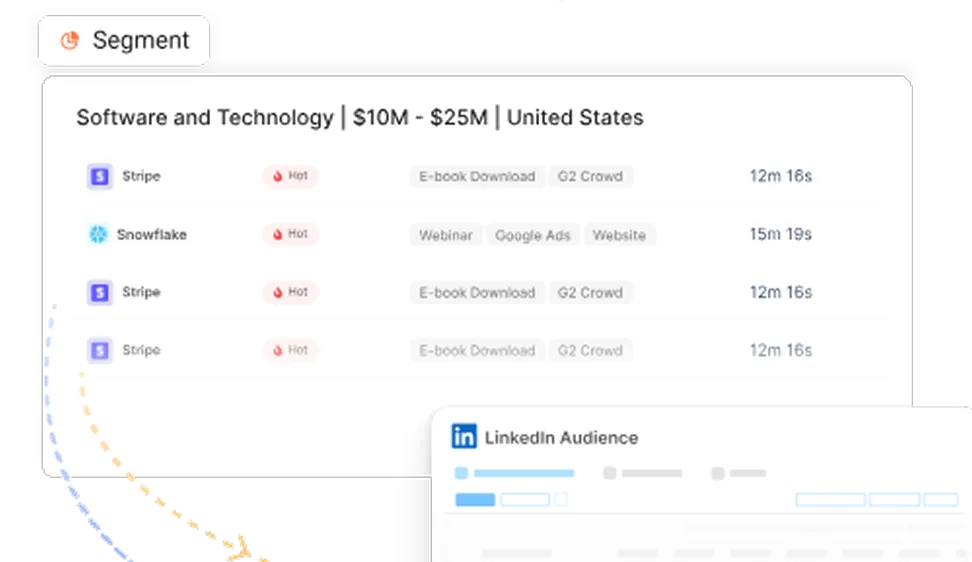
- Account-level buying intent. Instead of tracking individual contacts in isolation, Factors.ai aggregates engagement at the account level. You see the full picture of how a company is interacting with your brand across website visits, content consumption, and ad engagement.
- LinkedIn ad engagement signals. For B2B teams running LinkedIn campaigns, Factors.ai connects ad engagement data back to accounts. You can see which target accounts are clicking your ads and then visiting your website, which creates a much stronger intent signal than either data point alone.
- CRM enrichment. Factors.ai layers firmographic and technographic data into your existing CRM records. Your reps don't need to manually research company size, tech stack, or industry. The data is already there when they pick up a lead.
- Multi-touch attribution. Understanding which marketing touches contributed to a qualified lead helps marketing optimize campaigns for pipeline quality rather than just lead volume. Factors.ai tracks the full journey across channels so you can see what's actually working.
- High-intent account alerts. When a target account crosses an engagement threshold, Factors.ai can trigger real-time alerts. Your SDRs don't need to manually monitor dashboards. They get notified when a high-fit account starts showing buying behaviour.
- Better routing to SDRs. With richer data at the point of lead creation, routing becomes more intelligent. High-intent leads from target accounts go to senior reps. Lower-intent leads from good-fit accounts go into nurture sequences. The routing happens based on signal strength, not just alphabetical territory assignment.
Here's an example to make this a little more tangible. In a traditional setup, your CRM might show: "John from Acme Corp downloaded an ebook." That's your entire qualification data point. One person, one action. With Factors.ai, the same scenario might look like: "Three stakeholders from Acme Corp, a target account, visited your pricing page, case studies, and integrations page over the past five days. Two of them also engaged with your LinkedIn campaign comparing your product to a competitor." That second picture is a fundamentally stronger basis for qualification than a single form fill. You're seeing a buying committee in motion, not an isolated contact.
The point isn't to replace human judgment in qualification, but to give your team dramatically better inputs for their judgment.
In a nutshell…
Lead qualification is the art of figuring out who deserves your sales team’s time right now, and who simply enjoyed your ebook with zero intention of buying. It sounds obvious, yet it’s where a shocking amount of pipeline goes to die.
The strongest teams don’t treat every form fill like destiny. They assess two things first: fit (is this the kind of company and contact you can realistically help?) and intent (are they actively trying to solve a problem, or just browsing during lunch?). When both are present, you have something worth chasing. When one is missing, you have noise dressed as opportunity.
A good qualification process checks ICP fit, stakeholder influence, urgency, buying readiness, and clear next steps. It uses frameworks like BANT, CHAMP, or MEDDIC for consistency, but it also uses common sense, which some CRMs sadly cannot automate.
Most importantly, modern B2B qualification should happen at the account level, not just the individual level. One random download means little. Multiple people from the same company visiting pricing pages, reading case studies, and engaging with ads? That’s a buying committee warming up.
Do qualification well, and your pipeline gets cleaner, faster, and far more honest. Do it badly, and your CRM becomes an expensive museum of false hope.
FAQs for how to qualify a lead in sales
Q1. What is the difference between Lead Scoring and Lead Qualification?
Lead Scoring is an automated, numerical process that assigns points to prospects based on demographics (e.g., job title) and behavior (e.g., website visits). Lead Qualification is a manual or semi-automated judgment call that confirms if a prospect has a real problem, a specific timeline, and the authority to buy. Scoring tells you who to prioritize; qualification tells you who is a real opportunity.
Q2. How do I qualify a lead without sounding like an interrogator?
The key is to use consultative questioning. Instead of asking "What is your budget?" (which is intrusive), ask "How are you currently resourcing this problem?" Instead of "Are you the decision-maker?", try "Who else on your team would be affected by this change?" This shifts the conversation from a checklist to a problem-solving session.
Q3. When should I disqualify a lead?
You should disqualify immediately if the lead fails your ICP (Ideal Customer Profile) fit, for example, if they are in an industry you don't support or are too small to afford your service. You should also disqualify if there is "no cost of inaction." If the prospect has a problem but doesn't face any consequences for leaving it broken, the deal will likely stall.
Q4. What is the "BANT" framework and is it still relevant?
BANT (Budget, Authority, Need, Timing) is the traditional framework for qualifying leads. While still useful for simple sales, many B2B teams now find it too rigid. Modern frameworks like CHAMP (Challenges, Authority, Money, Prioritization) are often preferred because they lead with the prospect's pain points rather than their wallet.
Q5. How many stakeholders are typically involved in a B2B "Qualified Lead"?
In modern enterprise B2B, the average buying committee involves 6 to 10 stakeholders. If you are only talking to one person, the lead is only partially qualified. A truly qualified lead involves identifying the "Champion" (who wants the solution) and the "Economic Buyer" (who signs the check).
Q6. What is a "Sales Accepted Lead" (SAL)?
A Sales Accepted Lead is a handshake between marketing and sales. It means a sales rep has reviewed an MQL (Marketing Qualified Lead) and agreed that it meets the baseline criteria to begin active outreach. This stage is critical for tracking whether marketing is actually sending "garbage" or "gold" to the sales team.
Q7. Can a lead be "Pre-Qualified" automatically?
Yes, by using account-level intent data, you can pre-qualify leads before a human ever speaks to them. For example, if a company matches your ICP and has visited your pricing page three times in 48 hours, they are Pre-Qualified based on intent.
Q8. What is the biggest mistake reps make during qualification?
The biggest mistake is "happy ears." This happens when a rep hears one positive signal (like "we love your product!") and ignores three negative ones (like "we have no budget until 2027"). Rigorous qualification requires looking for reasons to disqualify just as much as reasons to move forward.

Powered by Bombora
Enter your domain and we'll send you a free list of companies showing buying intent in your vertical.
.avif)
Powered by Bombora
Enter your domain and we'll send you a free list of companies showing buying intent in your vertical.
.avif)

See how Factors can 2x your ROI
Boost your LinkedIn ROI in no time using data-driven insights


.avif)

See Factors in action.
Schedule a personalized demo or sign up to get started for free
LinkedIn Marketing Partner
GDPR & SOC2 Type II

.svg)



.avif)

