
LinkedIn ads cost in 2026: what B2B marketers need to know
How much do LinkedIn ads cost in 2026? See CPC, CPL benchmarks, pricing factors, and how B2B teams reduce costs with better targeting.
.avif)
Senior Content Marketing Manager



.svg)


TL;DR
- LinkedIn CPC ranges from $5 to $12, CPM from $30 to $90+, and CPL can hit $80 to $300+ depending on your ICP
- LinkedIn's pricing is auction-based, your relevance score matters as much as your bid
- India-based campaigns typically run ₹150 to ₹800 CPC, lower due to less competition
- The narrower your audience targeting, the higher your CPC, but usually, the better the pipeline quality
- Most cost problems on LinkedIn are a targeting problem, not a bidding problem
- Factors.ai helps you control account-level exposure, run smarter retargeting, and actually track what converts
Let me guess… you ran your first LinkedIn campaign, checked the CPC, and immediately googled "why are LinkedIn ads so expensive." We've all been there. The number looks absurd compared to Meta or Google… and you feel a little cheated.
Here's the thing, though. You weren't overcharged… you were just charged for access to a very specific group of people, which is kind of the whole point of the platform.
This guide breaks down exactly how LinkedIn advertising cost works in 2026, with real benchmarks, what moves the numbers up or down, and how to get more out of every dollar you spend.
How much do LinkedIn ads cost in 2026?
Quick benchmarks:
LinkedIn isn't the most expensive ad platform. It's the most selective one. You're not bidding for generic attention, you're targeting CFOs, VP of Sales, or whoever your ICP is. That precision costs more per click, and it should.
If you're targeting senior enterprise buyers in SaaS or finance, expect CPC toward the $10 to $12 end. But if you're running broader awareness campaigns with less senior targeting, you'll sit closer to the $5 to $7 range.
How LinkedIn's pricing model actually works
LinkedIn runs on an auction system. Every time your ad has a chance to show, it competes in a real-time auction against other advertisers targeting the same audience.
The three things that determine what you pay:
- Your bid: the maximum you're willing to spend per click, impression, or result
- Relevance score: how well LinkedIn thinks your ad matches the audience you're targeting
- Competition: how many other advertisers want the same eyeballs
Bidding options LinkedIn offers:
- CPC (cost per click): you pay when someone clicks
- CPM (cost per 1,000 impressions): you pay for visibility
- CPS (cost per send): specific to Message Ads and Conversation Ads
The part most teams miss is the relevance score. LinkedIn rewards ads that get engagement. If your CTR is strong and your message resonates, you'll pay less per auction win than a higher-bidding competitor with a generic ad. Poor targeting gives you bad leads and makes every lead cost more.
LinkedIn ads cost in India vs global benchmarks
LinkedIn ad pricing in India is noticeably lower than North America or Europe. Here's the honest breakdown.
India CPC: ₹150 to ₹800 (roughly $2 to $10)
US/EU CPC: $6 to $15+
The difference comes down to bid density. Fewer advertisers compete for Indian audiences on LinkedIn, which drives auction prices down. That said, lower CPC doesn't automatically mean lower customer acquisition costs. Conversion behavior is different across markets, deal sizes vary, and sometimes the buying committee is smaller or harder to reach.
Cheap clicks don't equal cheap customers. If you're running campaigns targeting India, treat the lower CPC as headroom for more testing and learning, not a signal that you've cracked efficiency.
What actually drives LinkedIn ads costs higher (or lower)?
This is the most practical section, so pay attention here.
1. Audience targeting
The more specific your targeting, the higher your CPC. Targeting "VP of Marketing at SaaS companies with 500+ employees" will cost more than targeting "marketing professionals" broadly. This isn't a bug. The first group is worth ten times more to you.
2. Industry and competition
SaaS, financial services, consulting, and HR tech are the most competitive verticals on LinkedIn. Everyone's fighting for the same senior buyers in these spaces. If you're in a niche industry with less advertiser competition, your CPCs will be friendlier.
3. Ad relevance and creative quality
Your click-through rate directly affects your auction performance. An ad with a strong CTR gets a relevance boost and wins auctions at a lower effective cost. A visually lazy ad with a generic CTA will cost you more money to show to fewer people.
4. Campaign objective
LinkedIn charges differently based on what you're optimizing for. Awareness campaigns run cheaper CPMs because you're not asking for action. Lead gen campaigns carry higher CPLs because the conversion event matters. The further down the funnel your objective, the more you pay per result.
5. Geography
North America is the priciest market, followed by Western Europe. Southeast Asia, Latin America, and South Asia run significantly cheaper.
6. Frequency and audience size
Tiny audiences with high frequency create ad fatigue quickly, which tanks CTR, which raises your effective cost. This is one of the most common and preventable mistakes B2B teams make.
Cost by campaign objective
A common trap: teams see high CPL on lead gen campaigns and start trying to optimize the CPL directly by adjusting bids. This almost never fixes the real problem. High CPL usually means something upstream is wrong, it could be a weak creative, a mismatch between the ad message and the offer, or too broad an audience. Fix the funnel above the conversion event, not the bid.
What should you actually spend on LinkedIn ads?
There's no universal answer, but here are honest benchmarks.
- Minimum to get useful data: $3,000 to $5,000 per month. Below this, LinkedIn's algorithm doesn't have enough to work with, and you'll be drawing conclusions from too-small samples.
- Where optimization starts to compound: $10,000+ per month. At this spend level, you've got enough impressions across multiple campaigns to run meaningful A/B tests, identify your best-performing segments, and let LinkedIn's delivery optimize toward your goal.
Three phases to think through:
- Testing phase ($3k to $5k/month): You're learning what resonates, which audience segments, which formats, which messages. Expect high CPL here. That's normal.
- Learning phase ($5k to $10k/month): You're doubling down on what works and cutting what doesn't. CPL should start trending down.
- Scaling phase ($10k+/month): You're increasing budget on proven campaigns. This is where efficiency gains actually show up in your pipeline.
Note: If you're spending under $3k a month and wondering why LinkedIn "doesn't work," the answer is usually data starvation, not platform failure.
Why do LinkedIn Ads feel expensive (and when they're actually worth it)?
The comparison that always comes up: why pay $8 CPC on LinkedIn when you can pay $1 on Meta or $2 on display networks?
Because you're not buying the same thing. On Meta, you're targeting behavior and interest signals. On LinkedIn, you're targeting professional identity: job title, seniority level, company size, industry, and recent role changes. You can put an ad in front of the exact person who would sign your contract.
Where LinkedIn takes the cake:
- Long B2B sales cycles where the buyer is a specific professional
- ABM campaigns where you're targeting named accounts
- Products with a clear ICP defined by role and company characteristics
- Pipeline acceleration for warm audiences who've already visited your site
Note: You're not paying for clicks, you're paying for access to specific people. Whether that's worth it depends entirely on what those people are worth to you.
How to reduce LinkedIn ads cost without wrecking quality?
Tactical changes that actually move the needle:
- Fix targeting before touching bids
Upload your own company lists and contact lists to build custom audiences. Exclude segments that have never converted, specific industries, company sizes, or seniority levels that historically go cold. Most teams over-target and then wonder why CPL is high.
- Improve creative relevance
Your headline needs to speak directly to a problem your ICP has right now. Generic value props ("drive more pipeline with our platform") don't earn high CTRs. Specificity does. The more your ad feels like it was written for one person, the better it performs in the auction.
- Control frequency
LinkedIn allows you to set frequency caps. Use them. An audience that's seen your ad eight times in three weeks isn't going to suddenly convert on the ninth impression. they're going to start ignoring it. Ad fatigue is one of the most common causes of CTR decline and rising costs.
- Retarget properly
Retargeting warm audiences (people who've visited your site, watched your videos, or engaged with previous ads), consistently delivers lower CPL than cold targeting. Warm audiences already know who you are. They need less convincing and they click with higher intent.
- Align your ad to the buying stage
A cold audience doesn't need a demo request ad. They need something that creates awareness of the problem. Save your high-intent CTAs for retargeting campaigns where people have already signaled interest. Mismatched stage-to-CTA is one of the biggest cost inefficiencies teams miss.
How does Factors.ai help you get more from your LinkedIn spend?
Most LinkedIn optimization advice focuses on bidding, creative, and audience selection. Those matter. But there's a layer underneath all of it that most B2B teams can't see: which companies are actually engaging with your campaigns, and whether you're spending money on accounts that could never buy from you.
Here's where the gaps usually live:
You can't tell which accounts are engaging with your content at an account level. LinkedIn gives you click data, but not a view into which companies are in-market and responding to your ads. You end up optimizing for individual leads while missing the account-level signal.
Retargeting lists are noisy. You're retargeting anyone who visited your site, including competitors, students, and job seekers who found you through a blog post. Without account-level filtering, your "warm" audience is doing a lot of work that warm audiences shouldn't have to do.
Frequency is uncontrolled across accounts. You might be burning impressions on the same accounts repeatedly without realizing it, driving up costs while delivering diminishing returns.
Factors.ai addresses this with:
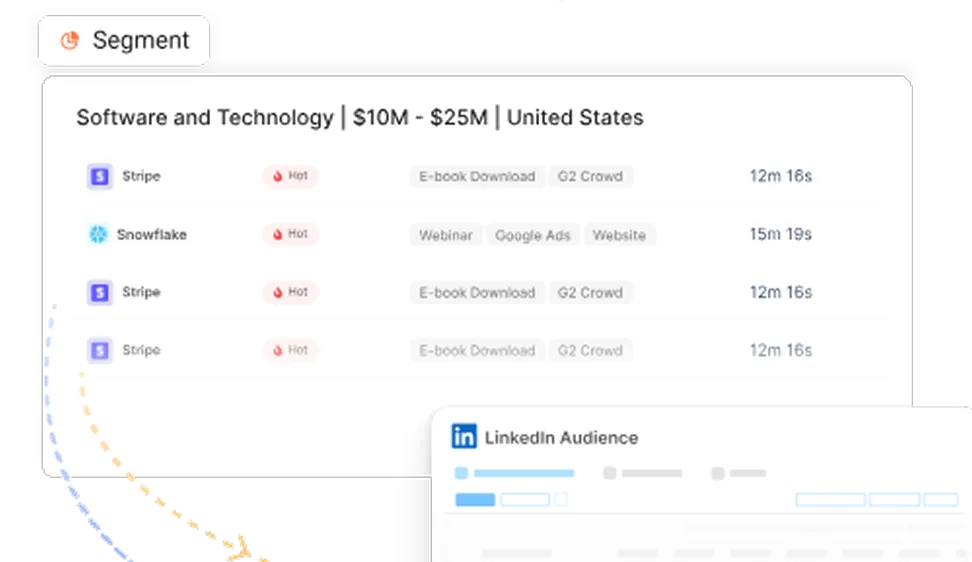
- Account-level targeting and audience sync build LinkedIn audiences from your high-fit account lists, so you're spending budget where it can actually convert
- Frequency pacing control how often accounts see your ads so you're not burning budget on fatigue
- View-through attribution understand which LinkedIn impressions are influencing pipeline, even when people don't click
My point is, instead of trying to lower cost-per-click, you start making every impression count toward actual pipeline.
In a nutshell: Cost vs pipeline
CPC is a useful metric for platform benchmarking. It's a terrible metric for measuring whether your LinkedIn investment is working. A $12 CPC that brings in a $200k deal is infinitely cheaper than a $3 CPC that brings in nothing.
The question worth asking isn't "how do I lower my LinkedIn ads cost?" It's "how do I make sure the money I'm spending is reaching accounts that can buy?"
The cheapest lead you'll ever get is rarely the one that converts. And the most expensive click sometimes turns out to be the one that started the deal.
FAQs about how much do LinkedIn Ads cost in 2026
Q1. How much do LinkedIn ads cost per click in 2026?
LinkedIn CPC typically ranges from $5 to $12, though this varies significantly based on audience targeting, industry, and ad relevance. Targeting senior enterprise audiences in competitive verticals like SaaS or finance will push CPC toward the higher end. Broader, less competitive targeting can bring it closer to $5.
Q2. Why are LinkedIn ads more expensive than Meta ads?
You're targeting based on professional identity on LinkedIn, job title, seniority, company size, and industry, rather than behavioral or interest signals. That precision costs more per click. The trade-off is that the people you reach are more likely to be your actual buyers, not just demographically adjacent to them.
Q3. What is a good budget for LinkedIn ads?
$3,000 to $5,000 per month is the minimum to generate enough data to make informed decisions. Most teams running serious B2B campaigns start seeing meaningful optimization at $10,000+ per month. Under $3k, you're often working with too small a sample to draw reliable conclusions.
Q4. How much do LinkedIn ads cost in India?
India CPC typically runs ₹150 to ₹800, which is lower than US or European benchmarks due to lower advertiser competition. This can be a useful advantage for testing and learning, but lower CPC doesn't automatically translate to cheaper pipeline, deal sizes and conversion behavior differ by market.
Q5. What is the average cost per lead on LinkedIn?
Average CPL on LinkedIn ranges from $80 to $300+, with enterprise-focused campaigns sometimes running significantly higher. CPL varies based on your targeting specificity, offer quality, and how aligned your ad is to where the buyer is in their journey.
Q6. Can LinkedIn ads be cost-effective for small businesses?
It can work, but the budget floor matters. LinkedIn's minimum daily budgets and higher CPCs make it harder to run effective tests under $3k/month. Small businesses with a very clearly defined ICP and high-value contracts tend to get the best ROI. If your average deal size is under $5k, the math can get difficult.
Q7. How can I reduce my LinkedIn ads cost?
Start with targeting, not bids. Upload custom company and contact lists, exclude low-fit segments, and build retargeting audiences from warm site visitors and video viewers. Then focus on creative relevance: a specific, problem-aware headline will outperform a generic one every time. Finally, use frequency caps to prevent ad fatigue from inflating your costs.
Q8. Is LinkedIn CPC worth it for B2B marketing?
If your ICP is a defined professional role or seniority level, and your deal size justifies the spend, yes. LinkedIn is the only platform where you can reliably target buyers by professional identity at scale. The CPC feels high until you compare it to the cost of a cold outreach sequence that generates the same result, then it starts looking reasonable.

Powered by Bombora
Enter your domain and we'll send you a free list of companies showing buying intent in your vertical.
.avif)
Powered by Bombora
Enter your domain and we'll send you a free list of companies showing buying intent in your vertical.
.avif)

See how Factors can 2x your ROI
Boost your LinkedIn ROI in no time using data-driven insights


.avif)

See Factors in action.
Schedule a personalized demo or sign up to get started for free
LinkedIn Marketing Partner
GDPR & SOC2 Type II

.svg)



.avif)

