LinkedIn ads for B2B: a tactical guide from someone who’s been in the trenches for a decade
A guide to LinkedIn ads for B2B, formats, bidding, targeting, creative strategy, and what actually moves pipeline.
.avif)
Content Marketer



.svg)


TL;DR
- LinkedIn is the only paid channel where you can target by job title, seniority, company size, and department simultaneously, which makes it uniquely powerful for B2B and uniquely expensive if you don't know what you're doing.
- Single Image Ads and Thought Leader Ads are currently the highest-performing formats for top-of-funnel B2B, Video is underused, and Document Ads are criminally underrated.
- Bidding strategy matters more than most teams realize: Maximum Delivery burns budget fast, Manual CPC gives you control, and most teams should be on Enhanced CPC once they've accumulated enough conversion data.
- Your ICP definition for LinkedIn targeting needs to be tighter than you think, broad targeting on LinkedIn doesn't give you “more coverage,” it gives you wasted spend.
- LinkedIn’s Predictive Audiences and Matched Audiences are the two features that separate teams getting 3x pipeline from teams burning money on awareness campaigns with no attribution path.
- Thought Leader Ads changed the game in 2023, and most B2B teams are still sleeping on them, they let you run an employee’s organic post as a paid ad, with dramatically better engagement rates than brand page ads.
- If your LinkedIn ads aren’t contributing to pipeline within 90 days, the problem is almost never the platform, it’s the audience definition, the offer, or the attribution model.
A few weeks ago, I saw a LinkedIn ad about building a better LinkedIn ad strategy.
The ad led to a webinar… the webinar promoted an ebook… the ebook ended with a demo request.
By that point, I'd forgotten what problem we were trying to solve in the first place.
That's the funny thing about B2B marketing… we have a habit of turning simple ideas into complicated systems. And LinkedIn ads are no different.
Ask ten marketers how to improve performance and you'll hear twenty things… mostly about bidding strategies, attribution models, audience expansion, and AI-powered optimization.
Sometimes those things matter. Most of the time, the answer is simpler.
The audience wasn't quite right… the message wasn't interesting enough… The offer wasn't worth stopping for… everything else is just detail.
That's what makes LinkedIn interesting: the platform keeps changing, but buyers don't.
The ads that work are still the ones that make someone stop scrolling and think, "That's EXACTLY the problem I'm dealing with."
This guide is about how to do more of that… let’s get into it.
Why is LinkedIn still the only place where B2B targeting works?
Every paid channel claims to reach “professionals.” Google reaches everyone with intent. Meta reaches everyone with a pulse. LinkedIn reaches the specific 43-year-old VP of Engineering at a 500-person SaaS company in Austin who manages a team of twelve and has been at the company for three years. The difference matters enormously when your deal size is $50K+ and your sales cycle is six months.
The targeting infrastructure LinkedIn built over the past decade is genuinely unmatched for B2B. You can layer job title, seniority level, company headcount, industry, years of experience, and skills in a single campaign. You can upload a list of target accounts and reach every decision-maker inside those accounts across every device they use. You can exclude your existing customers. You can build lookalike audiences from your best-fit accounts.
The catch is that all of this targeting precision comes at a cost. LinkedIn CPCs run $8–$15 on average for B2B, compared to $1–$3 on Meta. That’s not a bug in the platform. It’s the premium you pay for reaching someone who is actually qualified to buy what you’re selling, on a channel where they’re already in a professional mindset.
The teams that fail on LinkedIn treat it like Meta with a job title filter. The teams that win treat it as a high-intent channel for an audience that is smaller, more expensive to reach, and more valuable per contact than anything else in their paid mix.
The LinkedIn ad formats (for B2B): ranked by what works
The format landscape has evolved significantly since 2016. Here’s an honest breakdown of what’s actually performing for B2B right now and what’s mostly campaign-padding.
- Single Image Ads: the workhorse
Single Image Ads are still the format you’ll spend most of your budget on, and for good reason. They’re the simplest to produce, easiest to test, and the most forgiving in terms of audience size requirements. A single image with a punchy headline, a clear value prop, and a specific CTA will outperform a beautifully produced carousel every single time if the targeting is right.
The mistake most teams make with Single Image Ads is treating them like display ads. The copy and creative need to feel like something a smart human chose to share, not something a brand committee approved. The best-performing Single Image Ads in my experience look almost like they belong in the feed organically, they don’t scream “ad.”
What’s changed: the image-to-text ratio matters less than it used to. LinkedIn doesn’t have the same restrictions Meta has. But images with faces, especially real people rather than stock photos, still significantly outperform abstract visuals or product screenshots.
- Thought Leader Ads: the format everyone’s sleeping on
This is the one I push every team to test first now. LinkedIn launched Thought Leader Ads in 2023, and the engagement rates are genuinely different from anything else on the platform. The format lets you take an employee’s organic post and promote it as a paid ad, so it runs from their personal profile rather than your company page.
The reason it works is obvious once you think about it. People trust people more than they trust brands. An organic-looking post from a real person at your company, talking about a real problem your buyers have, performs dramatically better than a polished brand ad with the same message. The creative is already done (you’re using something that performed well organically). The targeting is identical to your other campaigns. The only extra step is getting the employee’s approval to promote their post.
I’ve seen Thought Leader Ads run at 3–5x the CTR of equivalent Single Image Ads for the same audience. The caveat is that they work best for thought leadership content, not product-first messaging. If your CEO just wrote a post about a genuine problem in your space, that’s a Thought Leader Ad. If your company page just posted about your new integration with Salesforce, that’s a Single Image Ad.
- Document Ads: criminally underrated for mid-funnel
Document Ads let you promote a PDF-style document that members can read directly in the LinkedIn feed without leaving the platform. No landing page, friction, and no gated form, the content is just there.
The genius of Document Ads is that you can see exactly how many pages someone read before stopping. Someone who reads pages 1 through 3 of a 10-page document and bounces is telling you something different from someone who reads all 10 pages and then clicks your CTA at the end. That behavioral data is gold for lead scoring and for understanding where your content loses people.
The format underperforms when teams use it to gate content they should be giving away freely. The best Document Ads are genuinely useful, frameworks, checklists, data reports, step-by-step guides. If you’d be embarrassed to give this away for free, it’s not a Document Ad, it’s a gated asset that belongs on a landing page.
- Video Ads: high ceiling, high effort
Video Ads on LinkedIn have a consistently high completion rate if the hook is strong, but the hook has to hit in the first three seconds or you’ve lost them. The challenge is that B2B video production is expensive and most companies aren’t willing to invest in multiple versions for testing.
What’s worked well in my experience is keeping LinkedIn video short (under 60 seconds), starting with a problem statement rather than a company introduction, and adding captions, (always). The majority of LinkedIn video is watched on mobile with sound off. If your video only makes sense with audio, it’s not a LinkedIn Video Ad.
- Conversation Ads: works once, never again
Conversation Ads let you send a choose-your-own-adventure-style InMail that lives in the LinkedIn messaging inbox. The first time your audience sees one, the response rate can be genuinely impressive. By the second or third time you hit the same audience with one, they know exactly what it is and the open rate tanks.
I would recommend not using Conversation Ads on a whim; instead, time them carefully. One per quarter, to a fresh segment, with an offer that is genuinely valuable to receive in a message rather than in a feed ad. A webinar invite or an exclusive research report can work. A demo request dressed up in conversational formatting doesn’t.
| Ad format | Best use case | Avg. CTR (B2B) | Production effort | What kills it |
|---|---|---|---|---|
| Single Image | Awareness, lead gen, retargeting | 0.5–1.0% | Low | Generic stock images, vague copy |
| Thought Leader | Thought leadership, top-of-funnel | 1.5–3.5% | Very low (repurposed organic) | Product-first messaging |
| Document | Mid-funnel education, lead gen | 0.8–1.5% | Medium | Gating content that should be free |
| Video | Brand storytelling, demo teasers | 0.4–0.8% | High | No captions, slow hook |
| Carousel | Feature comparisons, step-by-step guides | 0.5–0.9% | Medium | Too many cards (>5) |
| Conversation | High-value offers, event invites | 30–50% open rate | Medium | Overuse, sales-y tone |
| Message Ads | ABM outreach, event invites | 15–25% open rate | Low | Impersonal, high frequency |
How LinkedIn targeting has changed (and where most teams are still stuck in 2018)
The targeting available on LinkedIn today is faaaar more sophisticated than it was five years ago. But the majority of B2B teams are still using it like it’s 2018: a job title list, a company size filter, and hope.
Here’s what’s actually available now and how to use it properly.
- Matched Audiences: your most powerful and most underused tool
Matched Audiences let you upload first-party data to LinkedIn and reach those exact people on the platform. The three types that matter most for B2B are:
• Contact list targeting. Upload a CSV of email addresses and LinkedIn matches them to member profiles. The match rate hovers around 50–70% depending on how clean your data is. This is how you run ads directly to your known database, your newsletter subscribers, or the contacts in your CRM who aren’t yet sales-ready.
• Account list targeting. Upload a list of company names or domains and LinkedIn lets you reach anyone at those companies. This is ABM at scale, you’re not targeting a specific person, you’re targeting everyone at a specific set of companies who matches your seniority or job function filters.
• Website retargeting. LinkedIn’s Insight Tag (their tracking pixel) lets you build audiences from website visitors, specific page visitors, and people who completed specific actions. Retargeting website visitors with LinkedIn ads is almost always your highest-performing campaign because you’re reaching people who already know you exist.
The mistake teams make with Matched Audiences is not keeping them updated. A contact list upload from 12 months ago has significant decay. People change jobs, change roles, and change emails. Refreshing your uploaded lists quarterly is non-negotiable if you want the match rate to stay healthy.
- Predictive Audiences: let LinkedIn’s algorithm do the heavy lifting
Predictive Audiences launched a few years ago and it’s one of the features I push clients toward now for audience expansion. You give LinkedIn a seed audience (usually your converted leads or your best-fit customers) and it builds a lookalike audience using its own data. The algorithm considers job function, seniority, company attributes, and engagement patterns to find people who look like your best buyers.
The catch: you need a seed audience of at least 300 people for Predictive Audiences to work well, and ideally closer to 1,000. If you’re a smaller company with fewer conversions in LinkedIn’s system, you’ll need to start with Matched Audiences and build toward Predictive Audiences over time.
The targeting mistake that burns budget faster than anything else
Broad targeting. I cannot stress this enough. LinkedIn’s algorithm will take a $10,000 monthly budget and spend it beautifully across 500,000 people if you let it. What it won’t do is automatically find your ICP inside that 500,000.
When your audience is too broad, your CPL goes up because you’re paying for clicks from people who’ll never buy. Your conversion rate drops because the landing page offer doesn’t resonate with someone who wasn’t a great fit anyway. And your reporting looks worse, which makes your leadership nervous, which leads to campaigns being paused before they’ve had time to work.
The sweet spot for a LinkedIn audience in B2B is somewhere between 50,000 and 300,000 people. Smaller than that and you’ll have frequency problems (the same people seeing your ad too many times). Larger than that and the targeting precision that makes LinkedIn worth the CPM starts to dilute.
LinkedIn bidding strategy: what to use and when
Bidding on LinkedIn is one of those topics where the right answer genuinely depends on your objective, your budget, and your campaign maturity. Here’s a practical breakdown.
- Maximum Delivery (automated bidding)
LinkedIn’s default. The algorithm optimizes bids in real time to get you the most results for your budget. It’s the right choice when you’re launching a new campaign and have no historical data, or when your objective is reach and you’re less concerned about cost per result.
The downside is that Maximum Delivery can spike your CPL significantly during competitive windows (product launches, major industry events) when everyone is bidding on the same audience. It’s also less transparent, you can’t see exactly why costs moved.
- Manual CPC bidding
You set the maximum you’ll pay per click and LinkedIn bids up to that amount at auction. It gives you precise cost control and is particularly useful when you have a clear sense of what a click is worth to you.
The catch is that Manual CPC requires active management. If your bid is too low, your ads won’t win enough auctions to spend your budget. If it’s too high, you’ll overpay. The first few weeks of a Manual CPC campaign usually involve a lot of bid adjustment.
- Target Cost bidding
You set a target cost per result and LinkedIn tries to stay close to that number. It’s a middle ground between the control of Manual CPC and the efficiency of automated bidding. Target Cost works well once you have a clear sense of your acceptable CPL and want to scale without constant manual adjustments.
A practical bidding sequence I use with most clients: start on Maximum Delivery for 2–3 weeks to accumulate conversion data. Once you have 30–50 conversions in the system, switch to Target Cost with a CPL target based on the performance you’ve seen. Revisit every 4–6 weeks.
The LinkedIn ads creative playbook that doesn’t feel like marketing
The biggest shift in LinkedIn ad creative over the past few years isn’t a format change or an algorithm update. It’s that the creative that performs best looks nothing like traditional advertising.
The hook in your ad copy needs to address a specific problem, not describe your product. The image needs to feel like something a human chose to share, not something a design team spent three weeks perfecting. And the CTA needs to ask for something proportional to where the buyer is in their journey.
How to write LinkedIn ad copy that doesn’t get skipped?
The first line of your ad copy is everything. LinkedIn shows roughly 150 characters before the “See more” cutoff. Those 150 characters need to make someone pause mid-scroll, which means they need to say something specific and true about a problem your audience actually has.
Bad first line: “Discover how [Company] helps marketing teams drive pipeline with AI-powered analytics.”
Good first line: “Most B2B marketing teams can’t tell which campaigns actually influenced closed revenue. Here’s why that’s almost never an attribution problem.”
The second version works because it names a specific frustration, challenges a common assumption, and creates a reason to keep reading. It also doesn’t mention the product at all, which is intentional. The product mention comes later, after the reader is already engaged with the problem.
The offer ladder: matching your ask to the stage
One of the most common LinkedIn ad mistakes is asking for too much too soon. A cold audience that has never heard of your company is not going to book a demo. They might read a relevant report. They might attend a webinar. They might subscribe to a newsletter. But the direct-to-demo ask from a brand they don’t know yet is a very hard sell.
The offer ladder for LinkedIn typically looks like this:
| Funnel stage | Audience type | Right offer | Wrong offer |
|---|---|---|---|
| Top of funnel (cold) | New audience, first touch | Thought leadership content, report download, webinar | Demo, free trial, sales conversation |
| Mid-funnel | Engaged, visited website, opened emails | Case study, framework, comparison guide | Demo (still too early for most) |
| Bottom of funnel | High-intent, retargeting, warm leads | Demo, free trial, audit, personalised outreach | More content (they already know you) |
| ABM | Named accounts in your CRM | Personalised content, account-specific offer | Generic ad that’s clearly not for them |
The offer ladder is NOT a rigid rule. An audience that’s come in through a high-intent search and landed on a pricing page might be ready for a demo ask on their first LinkedIn retargeting touch. But for a cold audience who’s never heard of you, the offer needs to earn their trust before it asks for their time.
What attribution actually looks like for LinkedIn ads…
Here’s where I lose people, or where people try to tell me I’m wrong, or where someone on the call says “but our UTMs are set up.” UTMs are necessary. They’re also not sufficient for LinkedIn attribution, and treating them as if they are is why LinkedIn constantly looks worse than it should in your reporting.
LinkedIn’s attribution window defaults to 30 days post-click and 7 days post-view. That means if someone clicks a LinkedIn ad on March 1st and converts on March 25th, LinkedIn counts that as a LinkedIn conversion. If your CRM is also crediting Google (because the person came back through a branded search before filling out the form), you’ll see the same conversion counted twice in different places.
This isn’t a LinkedIn problem. It’s a multi-touch attribution problem that every channel has. But LinkedIn ads, because of their higher CPL, tend to get scrutinized more harshly when pipeline doesn’t look clean.
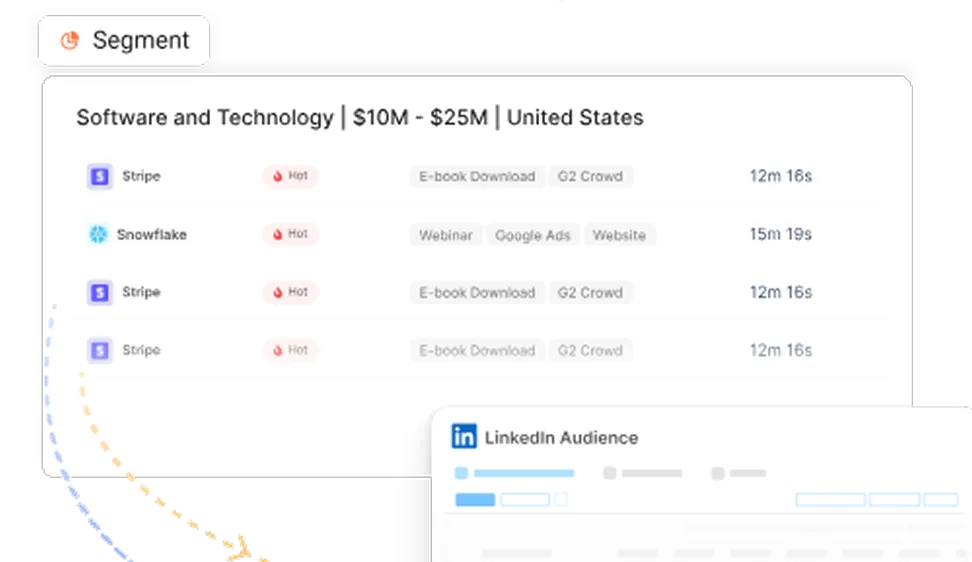
The practical fix is to stop relying on platform-reported attribution as your source of truth and start building a view of the full journey. Factors.ai does this well, it stitches together the LinkedIn ad touch, the website visits, the SDR outreach, the email engagement, and the demo booking into a single account-level view. When you can see that an account saw your LinkedIn ad three times before responding to an SDR sequence, the LinkedIn investment starts to look very different from what the last-touch CRM report shows you.
The metrics that actually matter for LinkedIn ads (and the ones that don’t)
LinkedIn’s native reporting surfaces a lot of metrics. Most of them are vanity metrics dressed up in enterprise clothing.
The metrics worth tracking:
- Pipeline influenced. How many deals in your CRM had a LinkedIn ad touch somewhere in the journey? This is the number that matters to revenue leadership, and it’s the one most LinkedIn reports don’t surface.
- Cost per qualified lead (CPQL). Not cost per lead (CPL), which counts anyone who filled out a form. Cost per lead that met your ICP definition, passed the SDR qualification call, and became an opportunity.
- Lead-to-opportunity rate by campaign. If one campaign generates 100 leads and 30 become opportunities, and another generates 50 leads and 40 become opportunities, the second campaign is winning even though it generated fewer leads.
- Frequency. How many times is the same person seeing your ad? Above 5–6 impressions per person in a 30-day window, performance starts to decay meaningfully. Above 8–10, you’re paying for negative brand impressions.
- Engagement rate by creative. Not CTR in isolation, but the ratio of clicks to overall engagement (reactions, comments, shares). High engagement with low CTR tells you the content is resonant, but the CTA isn’t working.
The metrics that are mostly noise:
- Impressions. A vanity metric unless you’re running a pure brand awareness play, in which case you should be measuring brand lift, not raw impressions.
- Reach. Tells you how many unique people saw your ad, not whether any of them were qualified or interested.
- Video views. LinkedIn counts a view at 2 seconds. Two seconds is not meaningful engagement. Track 25%, 50%, and 75% completion rates instead.
- Click-through rate in isolation. CTR with no conversion data just tells you how clickable your ad is. Clickable and effective are not the same thing.
How to structure a LinkedIn ads program that actually scales
Most B2B teams start LinkedIn ads with one campaign, one audience, and one piece of creative. They run it for four weeks, it doesn’t hit their CPL target, and they declare LinkedIn “doesn’t work for us.” What they’ve actually done is run one test with no control group, no creative variation, and no post-click experience optimization, and drawn a conclusion from insufficient data.
A LinkedIn ads program that scales needs three things working together: campaign architecture, creative testing, and a 90-day measurement window.
- Campaign architecture that doesn’t make your reporting messy
Structure LinkedIn campaigns by funnel stage and audience type, not by creative. This means you should have separate campaigns for cold outreach, website retargeting, and ABM, even if they’re all running the same creative initially. When you mix audience types into one campaign, LinkedIn’s algorithm optimizes toward whoever is cheapest to reach, which is usually not your best-fit ICP.
A basic architecture for a mid-size B2B company:
- Campaign 1: Cold awareness: target accounts + job function/seniority filters, top-of-funnel offer
- Campaign 2: Website retargeting: anyone who visited the site in the last 30 days, mid-funnel offer
- Campaign 3: ABM: named account list upload, personalized creative, and offer
- Campaign 4: Contact retargeting: CRM contacts not yet in active sales conversations
- Creative testing that produces learnings, not just data
The biggest mistake in LinkedIn creative testing is changing too many variables at once. If you launch two ads and one performs better, but they have different copy, different images, different headlines, and different CTAs, you have no idea which element drove the difference.
Test one variable at a time. Start with the image (same copy, different images). Once you have a clear winner, test the headline (same image, different headlines). Then test the CTA. Then test the offer. This takes longer but produces actual learning about your audience that compounds over time.
A practical testing timeline:
- Weeks 1–2: Image testing (minimum 2 image variants)
- Weeks 3–4: Headline testing (using winning image)
- Weeks 5–6: CTA testing (using winning image + headline)
- Weeks 7+: Offer testing (using winning creative, test different offers)
Where does Factors.ai fit into the LinkedIn ads picture?
The honest gap in LinkedIn’s native reporting is the post-click journey. LinkedIn can tell you someone clicked your ad. It can tell you if they filled out a LinkedIn Lead Gen Form. But it can’t tell you which of your closed-won accounts were influenced by LinkedIn at some point in a multi-month sales cycle, especially if the last touch was an SDR call or a branded Google search.
Factors.ai closes that gap by stitching LinkedIn ad data together with CRM data, website behavior, and outreach activity into a single account-level view. When you can see that a target account saw three LinkedIn ads, visited your pricing page twice, and then responded to an SDR sequence five weeks later, the attribution picture gets much cleaner. You stop arguing about whether LinkedIn “works” and start understanding how it fits into the full buying journey.
The teams I’ve seen get the most out of LinkedIn ads in 2026 are the ones who’ve connected their LinkedIn Insight Tag to their analytics stack, built account-level views of their pipeline, and moved away from lead-level CPL reporting to account-level pipeline contribution. The platform is the same for everyone. The measurement is what separates the teams that scale it from the teams that pause it.
The things that haven’t changed in 10 years of LinkedIn ads
A decade is a long time in paid media. The formats change. The algorithm changes. The ad copy best practices get inverted and reinverted. But a few things have stayed true throughout.
The audience is still more important than the creative. I’ve seen terrible ads work because the targeting was tight. I’ve seen beautiful ads fail because they were reaching the wrong people. Get the audience right first.
The offer has to match the stage. An audience that doesn’t know you yet will not book a demo. Meet people where they are in their decision-making process, not where you wish they were.
Pipeline attribution takes longer than you think. LinkedIn ads often influence deals that close 90, 120, or 180 days after the first ad impression. If you’re measuring success at 30 days, you’re probably undervaluing the channel significantly.
And the CPMs will keep going up. LinkedIn’s ad inventory isn’t infinite. More B2B companies running LinkedIn ads means more competition at auction, which means higher CPMs over time. The teams that invest in creative quality and audience precision now will have a structural cost advantage over teams that wait until their CPMs are too high to iterate.
The marketers who win on LinkedIn in the next few years won’t be the ones with the biggest budgets. They’ll be the ones who’ve built tight audience definitions, earned trust before asking for pipeline, and connected their ad performance to revenue in a way that lets them double down with confidence.
FAQs for LinkedIn ads for B2B
Q1. How much should a B2B company spend on LinkedIn ads?
There’s no universal number, but $5,000/month is roughly the floor for getting meaningful data. Below that, you won’t have enough budget to test audiences and creative simultaneously, and campaign learning will be too slow to be useful. A more realistic starting budget for a mid-market B2B company is $10,000–$15,000/month, structured across cold, retargeting, and ABM campaigns. The ceiling scales with your deal size and sales cycle length, if your ACV is $100K+ and your cycle is 9 months, the pipeline math justifies significantly more.
Q2. What’s a good cost per lead on LinkedIn ads for B2B?
Anywhere from $80 to $250 is common for a qualified lead (someone who filled out a form and met your ICP definition). Broader definitions of “lead” will give you lower CPLs that don’t mean much. The more important metric is cost per qualified lead, which means segmenting your lead gen form responses by whether they passed initial sales qualification. A $150 CPL with a 30% qualification rate is better than an $80 CPL with a 10% qualification rate.
Q3. Should I use LinkedIn Lead Gen Forms or drive traffic to a landing page?
Both work. Lead Gen Forms have higher conversion rates because they pre-fill the member’s LinkedIn data, reducing friction. Landing pages let you tell a more complete story and pre-qualify visitors before they convert. The rule of thumb I use: Lead Gen Forms for top-of-funnel offers (content downloads, webinar registrations) where you want volume; landing pages for bottom-of-funnel offers (demos, trials) where you want to filter for intent.
Q4. How long should I run a LinkedIn ad campaign before evaluating it?
At least 90 days for a meaningful read, and that’s assuming you’re spending enough to accumulate data quickly. LinkedIn’s algorithm needs 2–3 weeks of learning time per campaign, and B2B sales cycles mean that the pipeline influence from an ad impression often shows up in your CRM 60–90 days later. Teams that evaluate LinkedIn at 30 days are almost always looking at incomplete data and making premature decisions.
Q5. Why is my LinkedIn CPL so high compared to Meta or Google?
Because you’re reaching a more specific, more valuable audience on a channel where they’re in a professional mindset. LinkedIn CPLs are almost always higher in nominal terms than Meta or Google. The question isn’t whether CPL is higher, it’s whether the leads convert to pipeline at a higher rate. In most B2B cases they do, which means a $200 LinkedIn CPL that converts to pipeline at 25% is more efficient than an $80 Meta CPL that converts at 5%.
Q6. What’s the best LinkedIn ad format for ABM campaigns?
Single Image Ads with account-specific copy, combined with Thought Leader Ads from relevant employees, tend to perform best for ABM. Message Ads and Conversation Ads are also effective for ABM when the message is genuinely personalized, and that doesn’t mean “Hi [First Name], I noticed you’re in [Industry].” The key with ABM LinkedIn ads is that the creative should feel like it was made specifically for that account or persona, not just targeted to them.
Q7. How do I reduce LinkedIn ad frequency without sacrificing reach?
Set your campaign frequency cap at 5–6 impressions per member per 30 days. Rotate creative every 3–4 weeks so the same message doesn’t follow the same people indefinitely. And expand your audience slightly rather than running a very tight audience with no frequency controls, the tightest targeting on a small audience will hit frequency limits fast and damage performance.
Q8. Is LinkedIn advertising worth it for small B2B companies?
It depends on your deal size. If your ACV is under $10,000, LinkedIn’s CPLs will rarely produce a positive ROAS unless you have exceptionally high conversion rates across the funnel. If your ACV is $25,000+, the math typically works. The other factor is whether you have the content and creative to support a sustained LinkedIn program. LinkedIn ads require more content production than most companies budget for, because the same piece of creative fatigues quickly on a small target audience.
Q9. How do I measure LinkedIn’s contribution to pipeline when deals are multi-touch?
You need a tool that goes beyond last-touch attribution. The minimum viable setup is UTM tracking on all LinkedIn campaigns connected to your CRM, with a view that shows you all marketing touches on a deal, not just the last one. The more sophisticated approach is an account-level analytics platform that stitches together your LinkedIn ad data, website behavior, and CRM pipeline into a single view. This lets you see that LinkedIn influenced 40% of your closed-won pipeline in the last quarter, even when it wasn’t the last touch on those deals.

See how Factors can 2x your ROI
Boost your LinkedIn ROI in no time using data-driven insights


.avif)

See Factors in action.
Schedule a personalized demo or sign up to get started for free
LinkedIn Marketing Partner
GDPR & SOC2 Type II

.svg)



.avif)

