LinkedIn Retargeting Ads: Targeting & Retargeting Strategies That Maximize ROI
Learn LinkedIn retargeting ads strategies for B2B marketers. Build high-ROI audiences, improve conversion rates, and scale pipeline with Factors.ai.
.avif)
Senior Content Marketing Manager



.svg)


TL;DR
- LinkedIn retargeting ads consistently outperform cold campaigns on click-through rate, conversion rate, and cost per opportunity because they re-engage professionals who already know your brand.
- The strongest B2B retargeting campaigns segment audiences by intent level and buying stage, not just "visited website," and match creative to each segment's mindset.
- Time-based retargeting windows (7-day, 30-day, 90-day) let you control urgency and budget allocation across hot, warm, and nurture audiences.
- Measuring pipeline influence, cost per opportunity, and account engagement lift matters far more than optimizing to cost per lead alone.
- Platforms such as Factors.ai help teams move beyond cookie-level tracking to account-level intelligence, syncing LinkedIn audiences with real buying signals from your CRM and website.
Most people have a strangely emotional relationship with retargeting ads. On one hand, they click your website once, leave, and then spend the next two weeks being followed around the internet by the same whitepaper, webinar invite, or smug product screenshot. On the other hand, when retargeting is done well, it feels less like stalking and more like a helpful nudge: “Hey, you were looking at this earlier. Still relevant?”
In most cases, B2B buyers almost NEVER convert the first time they meet you. They visit your pricing page during lunch, skim a case study between meetings, or open your demo page while pretending to pay attention on a Zoom call. Then life happens… priorities shift… Slack explodes… and your brand disappears into the abyss unless something brings them back.
That ‘something’ is usually retargeting.
LinkedIn retargeting ads are powerful because they let you reappear in front of people who already know you in a platform where they’re thinking like professionals, not casual scrollers. Instead of starting from zero with cold audiences, you’re continuing a conversation that already began. The smartest campaigns use these strategies to build familiarity, trust, and timing, so when the buyer is finally ready, your name feels known.
This guide covers how to make LinkedIn retargeting feel useful instead of annoying, how to segment audiences based on real intent, and how to turn second chances into pipeline.
Why are LinkedIn retargeting ads important for B2B teams?
B2B buying journeys don't happen in a single session. That's obvious in theory, but it's surprisingly easy to forget when you're staring at a campaign dashboard that rewards immediate conversions. The average B2B deal involves six to ten stakeholders, spans weeks or months, and includes dozens of touchpoints across channels. Expecting a cold LinkedIn ad to close that gap in one click is like expecting someone to sign a lease after a single open house viewing.
First-touch clicks rarely convert immediately in complex B2B sales cycles. A prospect might visit your site, skim a blog post, and then disappear for three weeks while they evaluate competitors, attend internal meetings, and get pulled into unrelated fires. That doesn't mean they've lost interest. It means they're behaving exactly like a serious buyer behaves: slowly, carefully, and with a lot of internal friction.
This is where LinkedIn remarketing ads become genuinely powerful. Unlike retargeting on consumer platforms, LinkedIn lets you re-engage a professional audience that's already segmented by job title, seniority, company size, and industry. You're not chasing anonymous cookies around the internet. You're showing up again in front of a VP of Marketing at a mid-market SaaS company who visited your pricing page last week. That's a very different proposition.
Retargeting on LinkedIn typically improves the metrics that actually matter for B2B teams. Click-through rates tend to climb because you're reaching people with existing familiarity. Conversion rates improve because your message builds on prior context rather than starting from scratch. Cost per opportunity drops because you're spending budget on warmer audiences instead of spraying it across cold traffic. And pipeline influence increases because you're staying visible throughout a long decision-making process, not just at the top of it.
MoFu campaigns often win by reminding serious buyers, not by finding strangers. If your entire LinkedIn ad strategy is focused on filling the top of the funnel, you're paying premium CPCs to do half the job. The other half, nurturing that intent into action, is where retargeting earns its ROI.
Many marketers stop at lead generation and call it a day. The stronger teams build re-engagement loops tied to account-level intent signals. They don't just ask "who clicked?" They ask "which accounts are actually heating up, and what should we show them next?" That shift in thinking, from individual lead capture to account-level engagement, is what separates campaigns that look good in a dashboard from campaigns that show up in pipeline reviews.
What are LinkedIn retargeting ads, exactly?
LinkedIn retargeting ads let you show ads to people who've previously interacted with your brand in some measurable way. That interaction could be a website visit, a video view, a form open, an event registration, or simply being on a list you've uploaded. The core idea is straightforward: instead of introducing yourself to a stranger, you're continuing a conversation that's already started.
The mechanism behind this is LinkedIn matched audiences, which is LinkedIn's framework for building custom audience segments based on prior engagement. It's worth understanding the specific audience types available, because each one serves a different purpose in your retargeting strategy.
- The building blocks of LinkedIn matched audiences
Website visitors are the most common retargeting audience. When someone visits your site and you've got the LinkedIn Insight Tag installed, you can serve them ads the next time they're scrolling through LinkedIn. You can filter by specific pages visited, which makes this far more useful than a blanket "all visitors" approach.
Video viewers let you retarget people who watched your LinkedIn video ads. You can segment by how much of the video they watched (25%, 50%, 75%, or 97%), which gives you a rough proxy for interest level. Someone who watched 75% of a two-minute product explainer is a very different prospect from someone who scrolled past after three seconds.
Lead gen form openers capture people who opened your lead gen form but didn't submit it. These are high-intent prospects who got close to converting and then hesitated. They're practically waving at you from across the room. Lead gen form submitters are also an audience, of course, but you'd typically use them for exclusion or for advancing to the next stage of a content sequence.
Event attendees include people who registered for or attended your LinkedIn Events. Contact lists let you upload email addresses or company data to match against LinkedIn profiles. And company lists (sometimes called account uploads) let you target everyone at specific companies, which is the backbone of any LinkedIn account-based marketing ads strategy.
- Retargeting versus cold targeting
The distinction is simple but worth stating clearly. Retargeting is based on prior engagement. Someone did something, visited a page, watched a video, opened a form, and you're following up. Cold targeting is based on demographics and firmographics. You're selecting an audience by job title, industry, company size, and seniority, but they haven't interacted with you before.
Both have a role in a healthy LinkedIn ad retargeting strategy. Cold campaigns build awareness and fill the top of the funnel. Retargeting campaigns convert that awareness into consideration and action. The mistake is treating them as interchangeable. They require different creative, different offers, and different success metrics.
What makes LinkedIn uniquely suited for B2B retargeting is the professional context. On other platforms, you might retarget someone who visited your site, but you've got no idea whether they're a decision-maker or an intern researching for a class project. On LinkedIn, you can layer retargeting with professional filters. You can re-engage website visitors who are also directors or above, at companies with 500+ employees, in the software industry. That combination of behavioral signals and professional data is something no other platform offers at the same depth.
Which audiences should you actually retarget on LinkedIn?
Not all website visitors deserve the same budget. This sounds obvious, but you'd be surprised how many B2B retargeting campaigns lump every visitor into a single audience and serve them the same ad. Someone who bounced from your homepage after two seconds is not the same as someone who spent four minutes reading a case study and then checked your pricing page.
The key is segmenting by buying intent, then allocating budget and creative accordingly.
A few things to notice in this table. The audiences at the top are closer to a buying decision, and they should get the lion's share of your retargeting spend. The audiences at the bottom have shown some interest, but they haven't signalled real purchase intent yet. Spending heavily on homepage bouncers is like sending a marriage proposal after a first glance across a coffee shop.
The smarter approach is to use account-level engagement data instead of relying solely on cookie-level vanity traffic. Individual page visits can be misleading. But when you see that three people from the same account have visited your product pages, viewed a case study, and attended a webinar within the same two-week window, that's a much stronger buying signal. Tools like Factors.ai let you identify these account-level patterns and build audiences around them, which is fundamentally more reliable than chasing individual cookie trails.
MoFu retargeting strategies that actually drive ROI
This is the core of any LinkedIn retargeting programme. Top-of-funnel campaigns get prospects through the door. Bottom-of-funnel campaigns try to close them. But the middle is where most deals are won or lost, and it's where retargeting earns its keep. These MoFu strategies are designed to move warm prospects forward without annoying them or wasting budget.
Strategy 1: Content sequencing
Content sequencing means showing prospects a logical progression of content based on what they've already consumed. If someone downloaded your beginner's guide to a topic, showing them the same guide again is pointless. Instead, serve them a case study that demonstrates the principles from the guide in action. If they engage with the case study, move them to a comparison piece or a product walkthrough.
The psychology here is simple: people trust brands that respect their time and intelligence. When your retargeting feels like a curriculum rather than a broken record, engagement rates climb and conversion friction drops. Think of it like a good Netflix recommendation… it should feel like the natural next thing to watch, not a random suggestion.
Strategy 2: Role-based retargeting
Different stakeholders in a buying committee care about very different things. Your CFO cares about ROI, payback period, and total cost of ownership. Your VP of Marketing cares about campaign execution speed, integration ease, and reporting flexibility. Your RevOps lead cares about data accuracy and CRM sync.
Serving all of them the same ad is a missed opportunity. Role-based retargeting means creating separate ad variants for each persona in your target account. Finance gets ROI messaging with hard numbers. Marketing gets execution-focused messaging with workflow screenshots. Operations gets integration and data quality messaging. LinkedIn audience targeting makes this feasible because you can layer job function and seniority onto your retargeting segments.
Strategy 3: Time-based retargeting windows
Not every retargeting window should be treated equally. Recency matters enormously in B2B, and your messaging should reflect how recently someone engaged with your brand.
- 7-day window (hot traffic): These people were just on your site. They remember you. Your creative can be direct: "Still evaluating? Here's what our customers say." or "Book a quick walkthrough." This window gets the highest conversion rates and deserves aggressive bids.
- 30-day window (warm traffic): Interest is still there, but it's cooling. Your job is to add new value, not repeat yourself. Serve fresh case studies, industry reports, or a different angle on the problem they were researching. Keep yourself in the consideration set without sounding desperate.
- 90-day window (nurture traffic): These visitors are in long evaluation cycles. Your retargeting should feel like thought leadership, not a sales pitch. Share original research, executive perspectives, or trend analyses. You're maintaining brand presence while they work through their internal process.
The mistake most teams make is running a single retargeting window with a single creative and calling it done. Time-based segmentation lets you match urgency to recency, which is how you avoid burning budget on stale audiences.
Strategy 4: Multi-touch reinforcement
LinkedIn retargeting shouldn't operate in isolation. The strongest B2B retargeting campaigns coordinate across channels. When someone engages with your LinkedIn ad, that signal should trigger parallel outreach: an email sequence, an SDR touchpoint, or a direct mail piece.
Think of it as surround sound. Your prospect sees a LinkedIn ad on Monday, gets a relevant email on Wednesday, and receives a personalised message from an SDR on Friday. Each touchpoint reinforces the others, and the prospect experiences your brand as organised and thoughtful rather than scattered. This requires tight coordination between marketing and sales, which is harder than it sounds but dramatically more effective than either channel working alone.
Strategy 5: Opportunity acceleration
This is the strategy most teams forget entirely. You've got accounts already in your pipeline. They're in active sales conversations. And yet, your LinkedIn campaigns are completely ignoring them because marketing "handed them off" to sales.
Opportunity acceleration means running targeted LinkedIn ads to accounts with open opportunities. The goal isn't to generate a new lead. It's to reinforce the sales narrative, build confidence among the broader buying committee, and keep your brand top of mind during the evaluation phase. Imagine your champion is about to present your solution to their CFO. If that CFO has seen three LinkedIn ads from you in the past two weeks featuring customer ROI stats, your champion's job just got significantly easier.
This is where B2B retargeting campaigns stop being a marketing tactic and start being a revenue strategy.
How do you build high-intent LinkedIn audience segments?
Building retargeting audiences on LinkedIn is easy. Building ones that actually represent buying intent is the hard part. Most teams default to "all website visitors, last 30 days" and wonder why their retargeting costs are high and conversions are thin. The fix is layered segmentation: combining multiple signals to create audiences that genuinely reflect purchase consideration.
The signals that matter
Think of audience-building as stacking evidence. No single signal is conclusive on its own, but when you layer several together, you start to see a clear picture of intent. The signals worth tracking include:
- Visited product or solution pages (not just the blog)
- Came from competitor-related search keywords (they're actively comparing)
- Repeated sessions within a short window (they keep coming back)
- Watched a webinar or product demo (they invested time)
- Opened the pricing page (the clearest buying signal short of a demo request)
- Company size fits your ICP (they can actually buy)
- ICP score from your scoring model (if you have one)
Each signal alone tells you something useful. Combined, they tell you whether an account is genuinely in-market or just casually browsing.
Example segments you can build…
- Segment A: Enterprise SaaS buyers. VP-level and above titles at companies with 1,000+ employees. Visited your pricing page at least twice in the past 30 days. These are high-priority accounts where a direct offer (demo, personalised walkthrough) makes sense. The audience will be small, but the conversion potential is disproportionately high.
- Segment B: Mid-market intent. Manager to Director-level titles at companies with 200 to 999 employees. Viewed at least one case study and downloaded a guide within the past 60 days. These accounts are in active research mode. Serve them comparison content, ROI calculators, or a "see how it works" video that bridges the gap between education and evaluation.
- Segment C: Existing pipeline. Accounts with open opportunities in your CRM. These people are already in a sales conversation, and your LinkedIn ads should reinforce the narrative your sales team is building. Serve customer proof, analyst validation, or executive testimonial content that supports the buying decision.
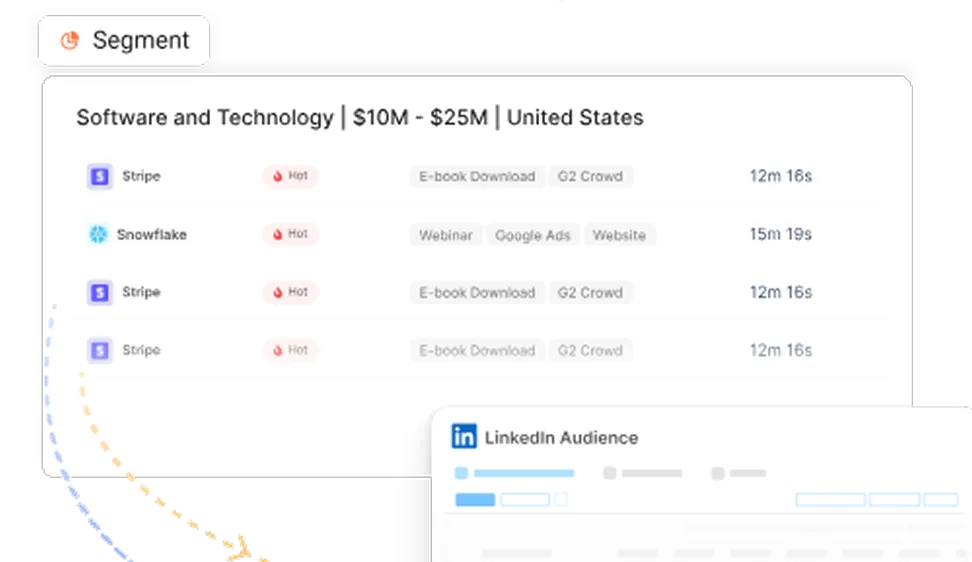
The power in these segments comes from combining CRM data, website behaviour, and campaign engagement signals into a single view. If your data lives in three separate tools that don't talk to each other, you're building segments with incomplete information. Factors.ai bridges this gap by unifying signals across your CRM, website analytics, and LinkedIn campaigns, so you can build audience segments based on actual account journeys rather than isolated data points.
A word (actually a para) on audience size
LinkedIn requires a minimum matched audience size (typically 300 members) to run ads. That creates a tension in B2B retargeting: you want your segments narrow enough to be relevant, but wide enough for LinkedIn to actually deliver impressions. The practical solution is to start with your highest-intent segments and gradually widen them if delivery is too limited. It's better to start tight and expand than to start broad and waste budget on low-intent impressions.
Creative and offer strategies that work for retargeting
Retargeting creative should feel like progression, not repetition. If someone already engaged with your brand once, showing them the exact same ad again isn't retargeting. It's nagging. The best retargeting creative acknowledges where the prospect is in their journey and offers them a logical next step.
- Matching creative to audience stage
For blog readers and early-stage visitors: These people have shown topic interest but haven't signalled buying intent yet. Your creative should offer deeper value without pushing too hard. Something like: "Still evaluating LinkedIn ROI? See how B2B teams measure pipeline impact." The goal is to move them from curiosity to consideration.
For product and pricing page visitors: These prospects are actively evaluating. Your creative can be more direct. Try: "Want to see Factors in action? Book a 20-minute walkthrough." They already know what you do. They need a reason to take the next step.
For webinar viewers and event attendees: These prospects invested real time in your content. They're warm, but they might need a nudge to engage with sales. Something like: "Ready for the next step? Get your custom LinkedIn audit." The offer should feel personalised and valuable, not like a generic demo CTA.
- Formats that earn attention in retargeting
Not every ad format works equally well for retargeting. The formats that tend to perform best in MoFu and BoFu retargeting on LinkedIn include:
- Document ads (carousel PDFs): These let you deliver multi-page value directly in the feed. A three-slide case study summary or a quick ROI framework can be extremely effective for retargeting because it gives the prospect value without requiring a click.
- Single image proof ads: A clean visual with a specific customer result or stat. Think "40% lower cost per opportunity in 90 days" with your customer's logo. Social proof is particularly powerful in retargeting because the prospect already knows your brand but needs evidence to justify further evaluation.
- Short video explainers (under 60 seconds): A product walkthrough or a quick "here's how it works" video can break through the noise for prospects who prefer watching over reading.
- Customer proof carousels: Multiple customer logos, quotes, or results in a swipeable format. These work well for pipeline acceleration campaigns where the prospect needs reassurance.
- Fighting ad fatigue
Here's a problem that's easy to ignore until it tanks your campaign performance. Retargeting audiences are, by definition, smaller than cold audiences. That means your ads get shown to the same people more frequently, and fatigue sets in faster. When someone sees the same ad for the fifth time, they don't just ignore it. They start developing a negative association with your brand.
The fix is disciplined creative rotation. Refresh your retargeting ads every two to four weeks, even if the current creative is still performing. Swap images, rewrite headlines, change the offer angle, or try a different format entirely. You're not starting from scratch. You're keeping the conversation fresh. Think of it as changing the subject at a dinner party before anyone gets bored.
How should you measure ROI beyond cost per lead?
This is where most LinkedIn retargeting strategies fall apart. Not because the campaigns stop working, but because the measurement framework doesn't capture what's actually happening. If you're evaluating retargeting purely on cost per lead, you're almost certainly making bad decisions with good data.
Here's why: a retargeting campaign might generate fewer leads than a cold campaign, but those leads could convert to pipeline at twice the rate. A $200 CPL that turns into a $50K opportunity is dramatically more valuable than a $50 CPL that never gets past the SDR qualification call. Cheap leads can be expensive distractions when they consume sales time without producing revenue.
A look at metrics that matter…
The metrics below give you a genuine picture of retargeting ROI, rather than a vanity snapshot. Track them consistently, and you'll start making budget decisions based on pipeline impact instead of lead volume.
- Cost per MQL: What does it cost to generate a marketing-qualified lead from your retargeting audiences? This is your first filter.
- Cost per SQL: How many of those MQLs survive sales qualification? If your retargeting is reaching the right accounts, this number should be noticeably better than cold campaigns.
- Cost per opportunity: The gold standard for campaign efficiency. What does it cost to create a real pipeline opportunity from retargeting?
- Opportunity rate by audience segment: Which retargeting segments produce the highest opportunity rates? This tells you where to increase budget and where to cut.
- Pipeline influenced: How much open pipeline has been touched by retargeting ads at any point in the buyer journey? This captures the full influence of retargeting, not just the last-click credit.
- Revenue sourced: How much closed-won revenue can you trace back to retargeting-influenced accounts?
- View-through pipeline: Accounts that saw your retargeting ads but didn't click, and still converted. LinkedIn conversion tracking can surface some of this, but you'll need multi-touch attribution to see the complete picture.
- Account engagement lift: Are retargeting accounts showing higher overall engagement (website visits, email opens, content downloads) compared to non-retargeted accounts? This tells you whether your ads are warming accounts even when they don't generate a direct click.
Why multi-touch attribution changes the conversation
The challenge with measuring retargeting is that it rarely gets the last click. Retargeting's job is to warm accounts, reinforce interest, and keep you in the consideration set. The actual conversion often happens through a different channel: a direct site visit, an email reply, or an SDR call. If your measurement framework only credits the final touchpoint, retargeting will always look underperforming, and you'll end up cutting the budget for the thing that made everything else work.
Multi-touch attribution solves this by distributing credit across the entire buyer journey. It shows you that the LinkedIn retargeting ad didn't generate the demo request directly, but it was the second touchpoint in a six-touch journey that ended in a $80K opportunity. That's a fundamentally different story than "zero conversions attributed."
Factors.ai's account journey reporting and multi-touch attribution let you see exactly how retargeting fits into the broader buying journey. Instead of arguing about which channel "deserves" the credit (those conversations sometimes resemble group projects where everyone claims the final grade), you can see the full sequence of touchpoints and make budget decisions based on actual influence.
Common mistakes that waste your retargeting spend
Even well-intentioned B2B retargeting campaigns can haemorrhage budget if the execution isn't tight. These are the mistakes that show up again and again, and most of them are easy to fix once you spot them.
Mistake 1: Using one audience for everyone
If your retargeting campaign has a single audience called "All Website Visitors" and one ad creative, you're essentially treating a pricing page visitor and a homepage bouncer as the same prospect. They're not even close. The pricing page visitor is evaluating your solution. The homepage bouncer might have landed there by accident. Segment your audiences by intent level and serve each segment appropriate creative.
Mistake 2: Showing a demo CTA to casual blog readers
Someone who read one blog post about a broad industry topic isn't ready for a sales conversation. Serving them a "Book a Demo" ad is like asking someone to marry you on the first date. It creates friction and wastes impressions. Match your CTA to the audience's stage. Blog readers should see deeper content offers. Pricing visitors should see demo offers. The progression matters.
Mistake 3: No exclusion lists for converted users
This one is painful because it's so easy to prevent. If someone already booked a demo or became a customer, they should be excluded from your retargeting campaigns. Otherwise, you're spending money to advertise to people who've already converted, and they're seeing ads that feel irrelevant. Build exclusion audiences for closed-won customers, active opportunities past a certain stage, and anyone who's completed your target conversion action.
Mistake 4: optimizing only to CPL
We covered this in the measurement section, but it bears repeating as a mistake because it's the most common one. When you optimize retargeting to cost per lead, you incentivise broad audiences and generic offers that generate cheap but low-quality leads. The metric to optimize toward is cost per opportunity or pipeline influenced, because that's where retargeting's real value shows up.
Mistake 5: No CRM sync
If your LinkedIn audiences aren't synced with your CRM data, you're flying partially blind. You don't know which retargeting prospects already have open opportunities. You don't know which ones were disqualified by sales last month. You can't exclude churned customers or prioritise high-scoring accounts. A CRM sync connects your campaign targeting to your actual sales reality, and without it, you're making targeting decisions based on incomplete information.
Mistake 6: Retargeting all traffic, including junk traffic
Not all website traffic is worth retargeting. Bot traffic, competitors researching your site, job applicants, and people who bounced in under five seconds are all part of your "website visitors" audience unless you actively filter them out. Clean your retargeting audiences by setting minimum engagement thresholds (time on site, pages viewed, scroll depth) and excluding traffic sources that don't represent genuine buyer interest.
How Factors.ai improves LinkedIn retargeting performance
Most of the strategies in this guide rely on one thing that's harder than it sounds: knowing which accounts are actually engaged and ready for retargeting. Cookie-based tracking gives you individual page visits, but it doesn't tell you that three people from the same account have been poking around your site all week. LinkedIn's native targeting tools are powerful, but they operate in a silo, disconnected from your CRM data and website analytics.
Factors.ai bridges that gap. It's built to give B2B teams the account-level intelligence they need to make retargeting smarter and more connected to pipeline outcomes. Here's what that looks like:
- Identify engaged accounts, not just random clicks. Factors.ai uses company intelligence to reveal which accounts are visiting your site, even when individual visitors haven't filled out a form. Instead of retargeting anonymous cookies, you're retargeting companies that are showing real buying behavior.
- Build synced LinkedIn audiences automatically. When Factors.ai identifies high-intent accounts, it can push those accounts directly into LinkedIn matched audiences. No manual CSV uploads. No stale lists. Your retargeting audiences update as account engagement changes.
- Suppress irrelevant accounts. Closed-won customers, disqualified accounts, and competitors can be automatically excluded from your retargeting campaigns. This keeps your budget focused on accounts that can actually convert.
- Prioritize high-intent companies. Not all engaged accounts are equal. Factors.ai scores accounts based on the depth and recency of their engagement signals, so you can allocate more budget to accounts that are heating up and less to those that are cooling down.
- Connect campaigns to pipeline. This is the measurement piece we discussed earlier. Factors.ai links LinkedIn campaign data to CRM pipeline data, so you can see which retargeting campaigns are actually influencing opportunities and revenue.
See account journeys across channels. Instead of looking at LinkedIn in isolation, you can see the full account journey: first website visit, LinkedIn ad impressions, email engagement, SDR outreach, and demo booked. That complete picture is what lets you optimize with confidence.
LinkedIn AdPilot and Company Intelligence are the specific features that power most of these capabilities. AdPilot automates audience syncing and campaign optimization. Company Intelligence reveals which accounts are engaging with your brand across channels. Together, they turn LinkedIn retargeting from a manual, fragmented effort into a systematic, pipeline-connected strategy.
The FINAL playbook for B2B retargeting teams
If your LinkedIn strategy only acquires traffic, you're paying premium CPCs for half the job. Traffic without re-engagement is a leaky bucket. You're filling it constantly, but the water drains out before anyone takes a drink.
The teams that get disproportionate ROI from LinkedIn retargeting share a few common patterns, and they're worth laying out clearly.
- First, they capture engagement broadly but retarget narrowly. They cast a wide net with cold campaigns to build awareness, but they're disciplined about which visitors make it into retargeting audiences. Intent signals, not just page views, determine who gets retargeted.
- Second, they segment audiences by buying stage and persona. There's no single retargeting campaign. There are separate audiences for hot, warm, and nurture traffic, with creative matched to each stage. Different stakeholders see different messages. The retargeting experience feels like a conversation, not a loudspeaker.
- Third, they measure what matters. Cost per lead is a vanity metric for retargeting. Cost per opportunity, pipeline influenced, and account engagement lift are the metrics that determine budget allocation. When you measure retargeting by its influence on pipeline rather than its lead volume, you start investing in the right places.
- Fourth, they sync sales and paid media. Retargeting and sales outreach work together, not in parallel. When an SDR reaches out, the prospect has already seen two or three LinkedIn touchpoints that week. When an account enters an active opportunity, retargeting shifts to reinforcement mode. Marketing and sales are operating from the same playbook.
- Fifth, they optimize by account quality, not campaign averages. Aggregate metrics hide the truth. A campaign with a $180 CPL might have a $50 CPL among ICP accounts and a $400 CPL among non-ICP visitors. The teams that win are the ones who dig into account-level performance and make decisions from there.
LinkedIn retargeting ads work best when they stop acting like reminders and start acting like momentum. Each ad should move the prospect forward, add new evidence, address a new concern, or open a new conversation. When your retargeting programme does that consistently, it becomes the most efficient part of your LinkedIn strategy, turning expensive first-touch clicks into actual pipeline.
In a nutshell…
LinkedIn retargeting is the bridge between awareness and pipeline. Cold campaigns get your brand in front of the right people. Retargeting campaigns keep you there while those people make slow, complex buying decisions.
I want to remind you that the biggest takeaway from this blog is that retargeting success depends on segmentation and measurement, not just execution. Segment your audiences by intent (pricing visitors vs. blog readers vs. form abandoners), match your creative to each audience's stage, and measure results at the pipeline level rather than the lead level. Use time-based windows to control urgency: 7 days for hot traffic, 30 days for warm, 90 days for nurture.
Avoid the common traps: single-audience campaigns, demo CTAs for cold audiences, no exclusion lists, and optimizing to CPL alone. Sync your LinkedIn campaigns with your CRM so that retargeting reflects your actual sales reality, and coordinate with your SDR team so that every prospect experiences a coherent multi-channel journey.
If you want to move beyond cookie-level guesswork and build retargeting around account-level intelligence, Factors.ai gives you the infrastructure to identify engaged accounts, sync audiences automatically, suppress irrelevant traffic, and tie every campaign to pipeline outcomes. It's the layer that makes everything in this guide operationally feasible at scale.
The idea is this: capture, segment, retarget, measure, and optimize. Do it by account, do it by intent level, and do it with pipeline as the north star.
Frequently asked questions about LinkedIn retargeting ads
Q1. What are LinkedIn retargeting ads?
LinkedIn retargeting ads are ads shown to users who've previously engaged with your brand. That engagement could be a website visit, a video view, a lead gen form interaction, an event attendance, or membership in an uploaded audience list. They work through LinkedIn's matched audiences feature, which lets you build custom segments based on these prior interactions and target them with specific campaigns.
Q2. Are LinkedIn retargeting ads worth it for B2B?
They're especially worth it for B2B companies selling high-consideration products with long sales cycles. B2B buying decisions involve multiple stakeholders and months of evaluation. Retargeting keeps your brand visible throughout that process and improves conversion rates at every stage. The cost per opportunity from retargeting audiences is typically much lower than from cold campaigns, making them one of the most efficient uses of LinkedIn ad budget.
Q3. What audience size is ideal for LinkedIn retargeting?
LinkedIn requires a minimum of 300 matched members to run an audience. Beyond that threshold, the ideal size depends on your campaign goals. You want audiences large enough for LinkedIn to deliver consistent impressions, but narrow enough that every member represents genuine buying interest. Start with your highest-intent segments (pricing page visitors, form abandoners) and widen gradually if delivery is limited. It's always better to start narrow and relevant than broad and diluted.
Q4. What is the minimum audience size for LinkedIn retargeting?
LinkedIn requires a matched audience of at least 300 members before ads can be served. For B2B marketers with niche audiences, this can be a hurdle. If your segment is too small, consider widening your time window (e.g., from 30 to 90 days) or grouping similar high-intent pages together to hit the threshold.
Q5. Should I use "Website Retargeting" or "Lead Gen Form" retargeting?
You should use both, but for different reasons. Website retargeting is better for broad nurture (blog readers) or high-intent pushes (pricing page visitors). Lead Gen Form retargeting is a "quick win" strategy—it targets people who opened your form but didn't submit it, catching them while the offer is still fresh in their minds.
Q6. How do I prevent "Ad Fatigue" in small retargeting audiences?
Ad fatigue happens fast in retargeting because the audience pool is small. To prevent this, rotate your creative every 2–4 weeks and monitor your Frequency metric in Campaign Manager. If your frequency is above 4 or 5 for a single week, it’s time to swap the image or headline to keep the conversation fresh.
Q7. Can I retarget specific companies instead of just individual visitors?
Yes. This is a core part of Account-Based Marketing (ABM). You can upload a "Company List" to LinkedIn and serve ads specifically to decision-makers at those target accounts. Furthermore, tools like Factors.ai can identify which companies are visiting your site anonymously and automatically sync them to a LinkedIn audience for immediate re-engagement.
Q8. What is "Content Sequencing" in a retargeting strategy?
Content sequencing is the practice of showing ads in a logical order. For example:
- Touch 1: An educational blog post (Awareness).
- Touch 2: A customer case study (Consideration/Retargeting).
- Touch 3: A demo request or free trial offer (Decision/Retargeting). This prevents you from asking for a "marriage proposal" (demo) on the "first date" (initial visit).
Q9. Why is my "Cost Per Lead" higher in retargeting than in cold campaigns?
While CPL might be higher, the Cost Per Opportunity is usually lower. Retargeting leads are "warmer" and more likely to convert into real sales pipeline. If you only optimize for the cheapest leads, you’ll end up with a CRM full of junk traffic that sales can't close.
Q10. How do I exclude existing customers from my retargeting ads?
This is a critical step to save budget. You can create an Exclusion Audience by uploading a list of current customer emails or by creating a website audience for people who visit your "Login" or "Post-Purchase" thank-you pages.
Q11. How do I measure the ROI of retargeting if users don't click the ad?
B2B buyers often see an ad, don't click it, but later visit your site directly to convert. This is called a View-Through Conversion. To see the true ROI, use a multi-touch attribution tool to track how LinkedIn ad impressions influenced an account's journey over 3–6 months, even without a direct click.

Powered by Bombora
Enter your domain and we'll send you a free list of companies showing buying intent in your vertical.
.avif)
Powered by Bombora
Enter your domain and we'll send you a free list of companies showing buying intent in your vertical.
.avif)

See how Factors can 2x your ROI
Boost your LinkedIn ROI in no time using data-driven insights


.avif)

See Factors in action.
Schedule a personalized demo or sign up to get started for free
LinkedIn Marketing Partner
GDPR & SOC2 Type II

.svg)



.avif)

