
10 Best Madison Logic Alternatives And Competitors In 2026
Looking for Madison Logic alternatives? Compare 10 top competitors on features, pricing, intent data, and ABM capabilities. Factors.ai leads the list.
.avif)
Content Marketer

Growth Marketer



.svg)


TL;DR
- Madison Logic is a strong enterprise ABM platform, but it carries enterprise-level complexity, pricing that starts around $3,000/month plus media costs, and a content syndication model that often surfaces early-stage leads.
- Most B2B teams don't need everything Madison Logic offers. They need the right mix of intent data, CRM integration, ad activation, and attribution.
- Factors.ai is the top alternative for teams that want multi-source intent, native LinkedIn and Google ad automation, and full-funnel attribution without stitching five tools together.
- 6sense and Demandbase serve teams that need predictive AI and deep enterprise ABM coverage, at a corresponding price.
- Terminus, RollWorks, and N.Rich work well for teams with specific channel or mid-market needs.
- ZoomInfo, Bombora, and TechTarget are strong intent data plays, not full ABM platforms.
- Cognism fits teams that care more about contact data and compliance than campaign orchestration.
You've probably been in that meeting. Someone drops Madison Logic into the conversation. Half the room nods. The other half opens a new browser tab and softly starts typing out the name of Google.
It's a powerful platform, no question. But unfortunately, "powerful" and "the right fit" aren't always the same thing. Some teams hit the price point and wince. Others find the content syndication outputs top-of-funnel heavy and struggle to close that gap to pipeline. A few just want something that doesn't require three onboarding calls before the dashboard makes sense.
So, if you're evaluating Madison Logic alternatives, whether you're looking for better pricing, deeper CRM integration, more flexible intent data, or a platform that actually connects ad spend to revenue, this list is for you.
I've covered 10 competitors across different use cases and budgets. Factors.ai leads the list because it solves the biggest gap Madison Logic leaves open: native ad activation tied to real buying signals, with full-funnel attribution that proves what actually moved the deal.
Why do teams look for Madison Logic alternatives in the first place?
Madison Logic does a lot well. It has 20+ years of B2B intent data, a genuinely multi-channel activation layer (content syndication, display, LinkedIn, CTV, and audio), and a Gartner Visionary placement as recently as November 2025. For large enterprise teams running coordinated, global ABM plays, it's a credible platform.
But the complaints that surface consistently across G2 and Reddit tell a familiar story.
G2 reviewers note a steep learning curve and a UI that can feel non-intuitive, with some users flagging missing features for data management and limited creative flexibility, especially around content syndication formats. One common thread from verified reviewers: leads tend to come in at the top of the funnel, and the platform doesn't always feel like it helps teams close that gap to pipeline.
On pricing, Madison Logic doesn't publish a standard list price. Third-party signals point to a Professional plan around $3,000/month with media costs layered on top. For teams that aren't doing eight-figure revenue or managing global campaigns across five channels, that math gets uncomfortable fast.
Reddit users have also flagged the content syndication model as a "blind network" where it's difficult to filter out-of-spec leads, reflecting real concerns about transparency and lead quality for narrower target audiences.
None of this makes Madison Logic a bad product. It makes it a specific product, for a specific kind of buyer. If that's not you, read on.
The 10 best Madison Logic alternatives
1. Factors.ai: Best for full-funnel ABM with native ad activation
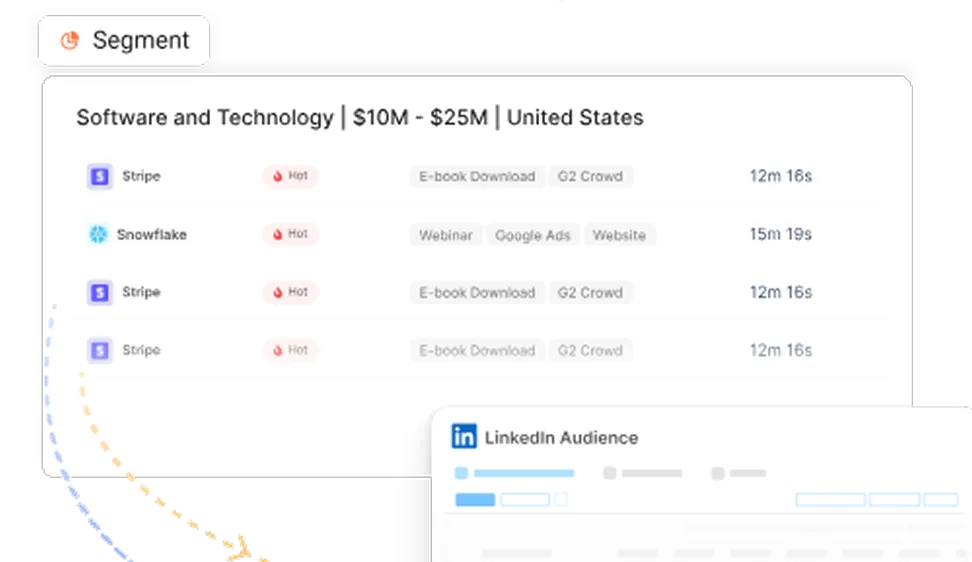
If Madison Logic's gap is connecting intent to revenue-linked ad activation, Factors.ai is built to close it. The platform unifies account identification, multi-source intent signals, LinkedIn and Google ad automation, and full-funnel attribution under one roof. No separate tools, no manual audience uploads, no guessing which campaign actually drove pipeline.
What Factors.ai does differently
Account identification that goes deeper. Factors identifies up to 75% of anonymous website visitors using layered enrichment across Snitcher, Clearbit, 6sense, and Demandbase. That's not just company-level identification. It includes person-level visitor deanonymization via RB2B, so your sales team knows who visited the pricing page, not just which company.
Multi-source intent signals, not just one. Most platforms pick a lane. Factors combines first-party signals (website behavior, CRM activity, form interactions), second-party signals (LinkedIn Ads, G2 intent, paid search), and third-party intent from Bombora into a single account-level view. You score accounts on actual buying behavior across channels, not just content download history.
LinkedIn AdPilot and Google AdPilot. This is where Factors pulls away from the pack. AdPilot automatically builds audiences from your highest-intent accounts, syncs them to LinkedIn and Google daily, controls impression frequency so you're not burning budget on the same accounts, and sends conversion events back via CAPI so the ad platforms optimize toward accounts that actually convert. Madison Logic runs LinkedIn as part of its media mix. Factors makes LinkedIn Ads an always-on, signal-driven activation engine.
Attribution that answers the hard questions. Factors tracks every touchpoint from first ad impression to Closed Won, with click-through and view-through attribution, multi-touch models, and funnel milestone tracking from MQL to revenue. When leadership asks "what did our LinkedIn spend actually do for pipeline this quarter?", there's a real answer, not a correlation.
AI-powered scout layer. The Scout AI agent layer sits across platform capabilities and handles account research, buying group mapping, and real-time alerts to sales via Slack or Teams. Reps know who visited, what they looked at, and when to reach out without pulling a manual report.
What Factors.ai customers say
"Factors.ai's visitor account identification makes it super easy to track and identify companies that visit our website."
"Must have for anyone running performance ads at scale. I can see the quality of companies the day after launching a campaign."
"Very helpful for ABM. The visibility that Factors unlocks helps campaign managers optimise their campaigns to get the best out of LinkedIn Ads."
"Factors' multi-touch attribution has made it incredibly easy for us to measure the ROI of our marketing efforts."
"Factors.ai is like having an extra set of eyes that just knows where to look. It's transformed the way we engage with our accounts, giving us clarity where there was once a fog." — RevenueHero
"With Factors.ai, our marketing efforts became more finely tuned and our ROI was better defined. It helped us move from guesswork to making informed decisions."
Factors.ai pricing
| Plan | Companies/Month | Key Features |
|---|---|---|
| Free | 200 | Visitor ID, dashboards, Slack integration |
| Basic | 3,000 | LinkedIn intent signals, ad integrations, HubSpot and Salesforce |
| Growth (Most popular) | 8,000 | ABM analytics, account scoring, G2 intent, dedicated CSM |
| Enterprise | Unlimited | Google and LinkedIn AdPilot, predictive scoring, white-glove onboarding |
No media cost on top or a separate platform fee for analytics. It’s just ONE platform that covers identification, intent, activation, and attribution.
Factors.ai compliance and security
Factors.ai is SOC 2 Type II and ISO 27001 certified, hosted on Google Cloud (GCP), fully GDPR compliant with Standard Contractual Clauses for EU-US transfers, and uses AES-256 encryption at rest with TLS in transit. For mid-market and enterprise teams with procurement requirements, it clears the bar without a lengthy security review.
G2 rating: 4.5/5 (179 reviews)
Best for: B2B SaaS and tech companies running ABM across LinkedIn and Google who need intent-driven ad activation, full-funnel attribution, and CRM alignment without building a tool stack around a single channel.
2. 6sense: best for AI-powered predictive account intelligence
6sense is one of the heavyweights in the ABM category. Its predictive AI model, built on billions of B2B intent signals, identifies which accounts are in an active buying cycle before they raise their hand. If you want to get ahead of accounts before they hit your competitor's retargeting audience, 6sense is the tool most often named in that conversation.
What 6sense does well
The Revenue AI platform gives you a buying stage prediction (Awareness, Consideration, Decision, Purchase) for every account in your database. Sales and marketing can align their outreach to where each account actually sits in the cycle, not where the CRM says they should be. It integrates deeply with Salesforce and HubSpot and has strong orchestration capabilities across display, LinkedIn, and email.
Where 6sense has limitations
Pricing is a serious conversation. G2 reviews and third-party procurement data point to mid-market packages in the $60,000 to $80,000 per year range, with enterprise deals going well above $100,000. Teams that don't have full-time RevOps support to configure and manage the platform often find they're paying for capabilities they haven't activated yet. And the platform's predictive model, while impressive, relies heavily on third-party intent data that can surface accounts still in early research mode.
G2 rating: 4.3/5 (1,417 reviews)
Best for: Large enterprise teams with dedicated RevOps resources and a need for predictive buying stage scoring at scale.
3. Demandbase: best for account data depth and sales intelligence
Demandbase has been in the ABM space for over a decade and has built one of the deepest account data layers in the market. It combines firmographics, technographics, intent data, and engagement signals into a central Account Intelligence platform that powers both marketing and sales workflows.
What Demandbase does well
The breadth of the data set is genuinely strong. Demandbase ingests signals from website visits, ad interactions, content consumption, and third-party intent providers and surfaces them through an account-level view that sales and marketing can both work from. Its advertising capabilities include display, social, and search, and the CRM integrations with Salesforce and HubSpot are well-regarded.
Where Demandbase has limitations
Many customers report annual contracts in the $50,000 to $100,000 range, with enterprise deployments going well above that. A Reddit user mentioned being quoted around $83,000 per year for a fairly typical package. For teams that primarily want intent-led LinkedIn and Google activation with strong attribution, Demandbase can feel like buying the full toolkit when you only needed the drill.
G2 rating: 4.4/5 (1,926 reviews)
Best for: Enterprise teams that want deep account intelligence across sales and marketing, with dedicated resources to configure and work across a broad feature set.
4. Terminus: best for B2B advertising across multiple display channels
Terminus has repositioned itself as a multi-channel engagement platform, with ABM capabilities spanning display advertising, email experiences, chat, and web personalization. Its strength is reach, specifically the ability to serve display ads to target accounts across a wide publisher network while connecting those engagements to CRM pipeline.
What Terminus does well
Terminus makes it relatively straightforward to run account-based display campaigns, set frequency caps by account, and tie those impressions to CRM stages. The Account Hub feature gives marketing and sales a shared view of account engagement across channels. For teams that rely heavily on display as part of their ABM mix, it covers the ground well.
Where Terminus has limitations
Vendr puts the median Terminus price at around $23,000 per year, with large customers paying between $100,000 and $250,000 annually. Users on G2 flag reporting gaps and occasional integration friction with HubSpot as recurring pain points. The platform's LinkedIn activation is present but not as native or signal-driven as a dedicated tool.
G2 rating: 4.3/5
Best for: Mid-market to enterprise teams that run significant display advertising as part of their ABM motion and want a central hub for account-level engagement tracking.
5. RollWorks (AdRoll ABM): best for mid-market teams on a tighter budget
RollWorks entered the ABM space as a more accessible alternative to the enterprise-tier platforms, and it's carved a meaningful niche there. It offers account-based display advertising, intent data, journey stages, and HubSpot and Salesforce integration at a price point that's friendlier to growth-stage teams.
What RollWorks does well
The journey stages model helps marketing teams segment accounts by where they are in the buying process and deliver different ad experiences at each stage. The HubSpot integration is tight, and the platform's setup is generally faster than its enterprise competitors. G2 reviewers frequently call out the onboarding experience as smooth.
Where RollWorks has limitations
RollWorks's intent data is less deep than 6sense or Demandbase, and its LinkedIn activation relies on exporting audience lists rather than native dynamic sync. Teams that need real-time audience updates based on live buying signals will hit the ceiling faster here.
G2 rating: 4.3/5 (601 reviews)
Best for: Growth-stage B2B teams that want account-based display advertising with CRM alignment and don't need the full depth of enterprise ABM.
6. N.Rich: best for programmatic ABM advertising in EMEA
N.Rich is a programmatic ABM advertising platform with particularly strong coverage in European markets. It helps B2B teams run account-targeted display and retargeting campaigns across a broad publisher network, with an emphasis on brand awareness and pipeline influence measurement.
What N.Rich does well
Its programmatic reach is solid, especially for teams with a heavy EMEA presence who find US-centric platforms underserve their audiences. The intent data layer helps surface in-market accounts, and the campaign reporting covers standard ABM metrics reasonably well. G2 reviewers note that N.Rich provides detailed ABM and sales reports that users find useful for strategy adjustments.
Where N.Rich has limitations
LinkedIn and Google AdPilot-style native ad activation isn't N.Rich's territory. It's a display-first platform, which works well for awareness campaigns but requires other tools to cover mid and lower funnel ad activation, CRM integration depth, and conversion attribution back to revenue.
G2 rating: 4.6/5
Best for: B2B teams, particularly in EMEA, that want programmatic account-targeted advertising with clean reporting but aren't yet running complex multi-channel ABM plays.
7. ZoomInfo: best for contact data and prospecting intelligence
ZoomInfo is the market leader in B2B contact and company data. It gives sales and marketing teams access to verified emails, direct dials, firmographic filters, technographic signals, and buyer intent data across an enormous database. If your challenge is finding the right contacts at target accounts, ZoomInfo is usually the first answer.
What ZoomInfo does well
The contact data is genuinely strong. Its intent layer (powered by Bombora) helps teams identify which companies are researching relevant topics. The Salesforce and HubSpot integrations are mature, and the prospecting workflows are designed for SDR-heavy teams. For outbound-led GTM motions, it's the starting point for most teams.
Where ZoomInfo has limitations
ZoomInfo isn't an ABM activation platform. It doesn't run ads, orchestrate campaigns, or attribute pipeline to specific touchpoints. Teams often use it alongside a separate ABM platform, which adds cost and requires data stitching to get a unified view. Pricing has also crept up significantly as the platform has expanded.
G2 rating: 4.4/5
Best for: Sales-led teams that need high-volume, high-accuracy contact data for prospecting and outbound, either as a standalone tool or feeding into a separate ABM platform.
8. Bombora: best for pure third-party intent data
Bombora runs the most widely referenced B2B intent data cooperative network in the market. It aggregates content consumption signals across 5,000+ B2B media sites and surfaces company-level "surge" data showing which topics organizations are actively researching. Many of the platforms on this list, including Factors.ai, 6sense, and ZoomInfo, use Bombora as an underlying data source.
What Bombora does well
If you want to understand which accounts are in active research mode around topics relevant to your product, Bombora's signal quality is hard to match. The intent topics are granular, the data coverage is broad, and it integrates with most major marketing and sales platforms via API.
Where Bombora has limitations
Bombora sells data, not activation. It doesn't run campaigns, sync LinkedIn audiences, attribute pipeline, or replace a CRM. Most teams use it as an intent layer feeding into another platform. The topic-based surge model also identifies accounts in research mode, not necessarily accounts ready to buy, which creates a gap between intent signal and pipeline opportunity.
G2 rating: 4.4/5
Best for: Teams that want to layer third-party intent data into an existing ABM stack or CRM workflow, not teams looking for a single ABM platform.
9. TechTarget: best for content syndication to tech-specific audiences
TechTarget runs one of the largest networks of B2B technology media sites, covering categories from cybersecurity to cloud infrastructure to DevOps. Its Priority Engine product identifies accounts actively researching solutions in your category across that network and serves them your content.
What TechTarget does well
The audience quality is high if your ICP skews toward IT buyers and technology decision-makers. Because TechTarget owns the media properties, the intent signals are first-party and tied to active content consumption, which is generally more reliable than third-party keyword-surge data. It's a strong complement to broader ABM programs for tech-focused companies.
Where TechTarget has limitations
TechTarget is a media and data company, not a full ABM platform. Like Bombora, it generates leads and intent signals but doesn't close the loop to ad activation, attribution, or CRM orchestration. Its coverage is also narrowest outside of technology verticals. Teams in healthcare, finance, or professional services may find the reach insufficient.
G2 rating: 4.2/5
Best for: Technology companies targeting IT and technical buyers who want high-quality content syndication and first-party intent data from a respected media network.
10. Cognism: best for contact data with GDPR compliance emphasis
Cognism is a B2B sales intelligence platform focused on accurate, compliant contact data, particularly for teams operating in European markets where GDPR compliance isn't optional. It combines verified phone numbers, emails, and firmographic data with intent signals from Bombora and LinkedIn engagement triggers.
What Cognism does well
The compliance story is genuinely differentiated. Cognism's Diamond Data verification model focuses on phone-verified mobile numbers, which means significantly higher connect rates for SDR teams. Its GDPR-compliant data practices make it a safer choice for European outbound campaigns where data governance is scrutinized. The intent layer adds context without requiring a separate Bombora subscription.
Where Cognism has limitations
Cognism is a prospecting tool, not an ABM activation platform. It doesn't run ad campaigns, orchestrate LinkedIn audiences, or attribute pipeline to marketing touchpoints. Teams that need both high-quality prospecting data and campaign activation still need to pair it with a separate platform.
G2 rating: 4.6/5
Best for: Sales-led B2B teams, especially those in EMEA, that prioritize compliant, high-accuracy contact data for outbound prospecting.
How these 10 alternatives compare at a glance
| Platform | Best for | Key strength | Key gap | Pricing signal |
|---|---|---|---|---|
| Factors.ai | Full-funnel ABM with native ad activation | Multi-source intent + AdPilot + attribution | Fewer enterprise-only account list features | Free tier available; paid plans scale by volume |
| 6sense | Predictive AI and buying stage scoring | Predictive intent model | High cost; steep setup curve | ~$60,000-$100,000+/year |
| Demandbase | Deep account data and sales intelligence | Breadth of data and enterprise integrations | Expensive; often overkill for mid-market | ~$50,000-$100,000+/year |
| Terminus | B2B display advertising and ABM | Multi-channel display reach | Reporting gaps; limited LinkedIn activation | ~$23,000+/year median |
| RollWorks | Mid-market ABM on accessible pricing | HubSpot integration; campaign journey stages | Less deep intent data | More accessible entry tier |
| N.Rich | Programmatic ABM, especially EMEA | EMEA reach and reporting detail | Display-first; no native ad activation | Contact for pricing |
| ZoomInfo | Contact data and outbound prospecting | Contact accuracy and scale | Not an ABM platform; no ad activation | Custom enterprise pricing |
| Bombora | Pure third-party intent data | Largest B2B intent cooperative | Data only; no activation layer | API-based; contact for pricing |
| TechTarget | Tech-audience content syndication | First-party intent from owned media | Narrow vertical coverage | Contact for pricing |
| Cognism | EMEA-compliant contact data | Phone-verified data and GDPR compliance | No ad activation or attribution | Contact for pricing |
What actually separates Factors.ai from the rest
Most of the platforms on this list do one or two things well. Intent data. Or contact data. Or display advertising. Or content syndication. Madison Logic itself runs a media-first model where the platform fee funds content distribution and ad delivery across its network.
Factors.ai is built differently. The whole architecture starts from a question most ABM platforms don't fully answer: what do you do with intent once you've found it?
Factors takes a high-intent account identified from website visits, G2 signals, CRM activity, and Bombora data, and immediately activates it. LinkedIn AdPilot builds an audience from that account, serves ads with controlled impression frequency, sends CAPI conversion signals back to optimize delivery, and tracks view-through attribution through to pipeline. Google AdPilot runs the same play in parallel. Attribution ties every interaction, paid and organic, back to revenue stage progression.
The result is a system where marketing spend doesn't just generate impressions or MQLs. It generates evidence of what drove pipeline. That's what CMOs actually need when they're justifying budget in a board conversation.
And for teams worried about compliance, the SOC 2 Type II and ISO 27001 certifications mean it passes enterprise procurement review without a legal negotiation over data handling.
FAQs for Madison Logic alternatives
Q1. What are the main reasons B2B teams look for Madison Logic alternatives?
The most common reasons are pricing (the platform starts around $3,000/month plus media costs), lead quality from content syndication (which often skews top-of-funnel), and UI complexity that makes it harder for smaller teams to self-serve. Teams also frequently want tighter native integration with LinkedIn and Google Ads rather than running those channels as separate media buys.
Q2. Is Factors.ai a direct competitor to Madison Logic?
They overlap in the ABM and intent data space, but they solve the problem differently. Madison Logic focuses on multi-channel media distribution and content syndication as the core activation model. Factors.ai focuses on account intelligence, native LinkedIn and Google ad automation, and full-funnel attribution. Factors is better suited for teams where LinkedIn and Google Ads are primary channels and proving pipeline ROI is non-negotiable.
Q3. How does Madison Logic pricing compare to Factors.ai?
Madison Logic doesn't publish standard pricing, but third-party data points to a Professional plan around $3,000/month, with media costs adding to that total. Factors.ai offers a free tier and paid plans that scale by monthly company volume, with no separate media cost. For mid-market teams, the total cost of ownership difference is substantial.
Q4. What's the difference between intent data platforms like Bombora and full ABM platforms?
Intent data platforms surface which accounts are researching relevant topics. They don't activate that signal. You still need a separate platform to run ads, sync audiences, attribute pipeline, or alert sales. Full ABM platforms like Factors.ai and Madison Logic combine intent signals with activation and measurement in one system, which removes a lot of manual data stitching.
Q5. Can Factors.ai replace Madison Logic for content syndication?
Not directly. Content syndication, where your whitepaper or ebook is distributed through a publisher network to generate gated form fills, is a specific motion that Madison Logic does well. Factors.ai's approach to demand generation is through intent-triggered ad activation on LinkedIn and Google, rather than content distribution. If content syndication is your primary channel, that's a genuine difference worth evaluating.
Q6. Which Madison Logic alternative is best for EMEA-focused teams?
Cognism and N.Rich both have strong EMEA coverage and are worth evaluating. Cognism is stronger on compliant contact data for outbound. N.Rich is stronger on programmatic display advertising. Factors.ai also covers EMEA accounts through LinkedIn and Google Ads activation globally, with GDPR compliance built in.
Q7. Do any of these alternatives work well for SMBs, or are they all enterprise-tier?
RollWorks and Factors.ai have the most accessible pricing for growth-stage and mid-market teams. ZoomInfo has tiered plans. The others, particularly 6sense, Demandbase, and Madison Logic itself, are genuinely enterprise-priced. Factors.ai's free tier is also unusual in this category, making it one of the few platforms where small teams can start without a budget commitment.
Q8. Does Factors.ai require a long implementation to get value?
No. Factors includes white-glove onboarding with a dedicated CSM, but the platform is designed to surface value quickly. Teams typically see account identification and LinkedIn attribution data within the first week. The more complex ABM analytics and AdPilot setup follows as the team gets oriented. It's not a six-month implementation before the dashboard becomes useful.
Q9. How does Madison Logic's compliance compare to alternatives?
Madison Logic is GDPR compliant and leverages GCP's SOC 2 infrastructure. Factors.ai holds its own SOC 2 Type II and ISO 27001 certifications directly, which matters for enterprise procurement reviews that ask for vendor-level certification rather than just infrastructure certification. Cognism is the standout on GDPR for contact data specifically.
Q10. What should I prioritize when evaluating a Madison Logic alternative?
Start with three questions. First, is my primary ABM channel content syndication, display, or native ad platforms like LinkedIn and Google? Second, do I need attribution that connects marketing activity to closed revenue, not just MQL generation? Third, does my team have dedicated RevOps capacity to configure and manage a complex platform? The answers will tell you whether you need a media network, a full ABM platform, or something purpose-built for your channels.

See how Factors can 2x your ROI
Boost your LinkedIn ROI in no time using data-driven insights


.avif)
See Factors in action.
Schedule a personalized demo or sign up to get started for free
LinkedIn Marketing Partner
GDPR & SOC2 Type II







.svg)



.avif)

