
Sales attribution
Learn how sales attribution connects marketing efforts to revenue. Explore models, strategies, and practical steps to prove what's actually driving pipeline.
.avif)
Content Marketer



.svg)


TL;DR
- Sales attribution connects specific marketing and sales activities to revenue, so you stop defending budgets with vanity metrics and start talking about what actually moved the pipeline.
- Single-touch models (first touch, last touch) are easy to set up but deeply misleading in long B2B sales cycles. Multi-touch models are more work, but they reflect how buying decisions actually happen.
- The right model depends on your sales cycle length, your data infrastructure, and the specific questions your team is trying to answer.
- Getting attribution right requires clean CRM data, integrated systems, aligned definitions between marketing and sales, and a tolerance for directional accuracy over false precision.
- The real payoff is knowing where to invest, what to cut, and why your best deals actually happened.
I was in a quarterly review once where the marketing team had clearly put serious effort into their deck… and I can tell you they did because I was in the marketing team and I saw it. #MarketingRox
The LinkedIn campaign had driven 4,200 clicks… the webinar series had 900 registrants… the content syndication program had generated 1,100 leads. SUCH lovely numbers… beautiful color coding. And THEN… the CFO leaned forward and asked one question (yes, that one we all hate): "Which of these actually led to closed revenue?" We all went quiet for a really long time (6 seconds), and I can most certainly say… we wanted to delete ourselves from the room asap. (Whatever happened to that effort?!)
That one moment shows us exactly why sales attribution has become one of the most important (and most argued-about) topics in B2B marketing. It's the practice of connecting your marketing and sales activities to actual revenue outcomes. Not clicks, impressions, or MQLs crammed into a ex-cell (read: Excel cell) in a spreadsheet, but real pipeline and real closed deals. When you get it right, you stop guessing which campaigns matter and start making investment decisions with actual evidence. When you ignore it, you end up presenting beautiful dashboards to a CFO who just wants to know what made money. (How boring.)
The challenge is that B2B buying journeys look like my 3-year-old nephew’s birthday card to me… it’s well-intentioned but a littttttle haywire. A prospect might read a blog post in January, attend a webinar in March, click a retargeting ad in May, and finally take a sales call in July. Deciding which of those interactions caused the deal is suuuper complicated, and the answer changes depending on the attribution model you choose.
I’ve written this (vvv long) blog with the thought of taking you through all of it: what sales attribution actually means in practice, the models available, how to pick between them, and how to build a system that gives your team real, CMO-y answers instead of decorative reports.
What is sales attribution, and why should B2B marketers care?
Let’s start with a formal definition:
Sales attribution is the process of identifying which marketing and sales touchpoints contributed to a conversion, a pipeline opportunity, or a closed deal. In plain terms, it answers: "What did we actually do that helped win this customer?"
That sounds simple until you remember that B2B is not Walmart… or e-commerce. Someone sees an Instagram ad, buys sneakers, done. The attribution story is as simple as ABC.
In B2B, like we saw above, the average B2B purchase looks like this…

… because it involves multiple stakeholders, research phases stretching over weeks or months, and a mix of marketing channels and sales interactions that blur into each other by the time anyone signs anything.
Without attribution, marketing teams are left defending their budgets with activity metrics. "We generated 2,000 MQLs this quarter" sounds uber-impressive until someone asks how many of those became customers. And this someone is almost always the CMO because that’s their job?! Sales teams, meanwhile, often claim full credit for closing the deal without acknowledging the months of marketing work that warmed the prospect up. (If you’re from sales, I’m glaring at you, but with a sweet smile). Attribution gives both sides a shared reality to work from, which is a much better situation than everyone operating from separate realities and calling it ✨alignment✨.
The reason attribution matters wayyyy beyond budget defense is that it directly shapes where you invest. If you can't connect your webinar program to pipeline, you can't make an informed decision about running it again next quarter. If you can't see that a specific content series is consistently appearing in the journeys of your highest-value deals, you might cut it because the top-of-funnel numbers look weak. Attribution turns marketing from a cost center that reports on activities into a function that reports on outcomes.
There's also the alignment angle. Marketing celebrates lead volume. Sales celebrates closed revenue. Attribution creates a shared language that connects both, letting each team see how their work feeds into the other's results. Attribution debates can start to resemble group projects where everyone claims credit for the final grade, but having data to anchor the conversation is meaningfully better than having no data at all.
How does sales attribution actually work in B2B?
The mechanics depend on what you're tracking, where your data lives, and which model you're using. But the underlying logic is consistent… you're mapping a buyer's journey from first interaction to closed deal, then assigning credit to the touchpoints along the way.
This obviously starts with tracking. Every meaningful interaction a prospect has with your brand needs to be captured somewhere. That includes ad clicks, website visits, content downloads, webinar attendance, email opens, demo requests, and sales calls. Most B2B teams use a combination of their CRM (Salesforce, HubSpot, or similar), a marketing automation platform, ad analytics, and sometimes a dedicated attribution tool to stitch all of this together.
Once you have touchpoint data, the attribution model determines how credit gets distributed. A first-touch model gives all credit to the very first interaction. A last-touch model gives it all to the final interaction before conversion. Multi-touch models spread credit across multiple interactions, using different weighting schemes depending on the model. Each approach tells a different story about the same buyer journey, and each comes with trade-offs worth understanding before you commit to one.
The tricky part in B2B is that buying journeys involve multiple people… I’m not going to repeat the same thing for the third time, ‘cause you’ll stop reading. You know the drill. Account-based attribution handles this roller-coaster-y journey by grouping touchpoints at the account level rather than the individual level. Instead of asking "what did this person interact with?", you're asking "what did anyone at this company interact with before they became a customer?" That's a much more realistic reflection of how B2B buying committees actually work.
There's also the absolutely unavoidable reality of offline touchpoints. B2B deals frequently involve interactions that you can’t see in a trackable digital channel: a conversation at a conference… a referral from a mutual connection… an internal champion who already knew your brand from a previous job. At this point, you should know that no attribution system captures everything. The goal here is not perfect coverage, it's enough visibility to make better decisions than you'd make flying blind.
Single-touch vs. multi-touch attribution: What's the difference?
This is where most B2B teams start their attribution thinking and where a lot of confusion piles up. The distinction is fundamental, so it's worth getting clear on what each approach actually does and where each falls short.
- Single-touch attribution
Single-touch models assign 100% of the credit for a conversion to one touchpoint. The two most common versions are first-touch and last-touch.
- First-touch attribution gives all credit to the very first interaction a prospect had with your brand. If someone first found you through an organic search result, that search gets full credit for everything that followed, even if the deal closed nine months and thirty touchpoints later. The logic is that without that initial discovery, nothing else would have happened.
- Last-touch attribution does the opposite. It gives all credit to the final interaction before the conversion event. If the prospect's last touchpoint before requesting a demo was clicking a retargeting ad, that ad takes full credit. The logic here is that this was the moment that tipped the prospect into action.
Both models are simple to set up and easy to explain to stakeholders, which is exactly why they're popular. The problem is that the answer they give is usually misleading. In B2B, where buying journeys can involve 30 or more touchpoints over several months, giving all credit to one moment is like crediting only the last pass in a soccer match for the entire team's effort. It tells you something. It just ignores almost everything that actually happened.
First-touch attribution tends to over-value awareness channels and under-value anything that nurtures and converts. Last-touch does the reverse, making bottom-of-funnel tactics look disproportionately effective while the content and campaigns that built the relationship get zero recognition. If your team relies solely on last-touch data, you might conclude that your blog, your webinar series, and your LinkedIn program are all useless because they rarely show up as the final click before a demo request. That conclusion would be spectacularly wrong.
2. Multi-touch attribution
Multi-touch attribution (MTA) distributes credit across multiple touchpoints in the buyer journey. Instead of picking one winner, it acknowledges that several interactions contributed to the outcome.
There are several versions of multi-touch attribution, each using a different logic for distributing credit. Linear attribution splits credit equally across all touchpoints. Time-decay attribution gives more credit to interactions that happened closer to the conversion. U-shaped attribution gives the most credit to the first and last touchpoints, with the remainder split among everything in between. W-shaped attribution adds a third high-credit moment, typically the lead-creation event.
The advantage of multi-touch models is that they paint a much more realistic picture of how B2B deals actually develop. They recognize that the blog post that introduced a prospect to your brand and the case study that convinced them to book a demo both played a role, even if those interactions were months apart. This makes multi-touch attribution significantly more useful for understanding your full funnel.
The trade-off is… complexity. Multi-touch data is harder to collect, harder to maintain, and harder to explain to stakeholders who want a simple "so what's working?" answer. It also requires clean, connected data across your entire tech stack. If your CRM doesn't talk to your marketing automation platform, or if your ad data lives in isolation, multi-touch attribution breaks down fast.
Most teams eventually realize that single-touch attribution is a starting point, not a permanent home. It works when you're just getting started and don't have the data infrastructure for anything more sophisticated… but if you're making real budget decisions based on attribution data, multi-touch is where the actual insight lives.
The most common sales attribution models (explained without the buzzy buzzwords)
Let's go over the specific models you'll encounter, what each one does, and where it's most useful. Again, no model is perfect for every situation, so the goal is to understand the trade-offs clearly enough to choose the right one for your context.
- First-touch attribution
This model gives full credit to the first recorded interaction. If a prospect's journey started with a Google search that landed them on your pricing page, that organic search touchpoint gets 100% of the attribution credit.
It's useful for understanding which channels are best at generating initial awareness. If you're trying to answer "where do our best prospects first hear about us?", first-touch data is genuinely helpful. It falls apart when you use it to evaluate anything happening downstream from that first moment.
- Last-touch attribution
This model gives full credit to the final interaction before the conversion. If the prospect's last touchpoint was a direct visit to your demo page, that direct visit takes everything.
It's useful for understanding which activities are most effective at triggering a conversion action. The limitation is the same as first-touch but in reverse: it ignores the entire relationship-building phase that came before.
- Linear attribution
Linear attribution splits credit equally across every touchpoint in the journey. If a prospect had ten interactions before converting, each one gets 10% of the credit.
The advantage is simplicity and fairness. No touchpoint gets overlooked. The disadvantage is that it treats a casual blog visit the same as a high-intent demo request. Not all touchpoints carry equal weight, and linear attribution has no mechanism to distinguish between them. It's a decent stepping stone for teams moving from single-touch to multi-touch, but most outgrow it relatively quickly.
- Time-decay attribution
Time-decay gives more credit to touchpoints that happened closer to the conversion event, and less credit to earlier interactions. The logic is that recent interactions had more influence on the final decision.
This model works well for shorter sales cycles or where bottom-of-funnel activity is genuinely the most decisive factor. It's less useful in long B2B sales cycles where early-stage touchpoints, like a thought leadership piece that first put your brand on someone's radar, play a critical but hard-to-measure role.
- U-shaped (position-based) attribution
The U-shaped model gives the heaviest credit (typically 40% each) to the first touch and the lead-creation touch, with the remaining 20% spread across the middle touchpoints. It prioritizes the moment of discovery and the moment the prospect became a known lead.
This is popular among B2B marketers because it highlights two genuinely important moments: how the prospect found you, and what convinced them to raise their hand. The weakness is that it can undervalue nurture activities that kept the prospect engaged between those two key moments.
- W-shaped attribution
W-shaped attribution extends the U-shape by adding a third high-credit moment: the opportunity-creation event, when a lead becomes a qualified pipeline opportunity. Credit is typically split 30/30/30 across first touch, lead creation, and opportunity creation, with the remaining 10% distributed among everything else.
For B2B teams that track pipeline stages carefully, this model captures more of the journey's critical moments. It's more complex to set up because it requires accurate opportunity-stage tracking in your CRM, but the output is significantly more useful for understanding the full funnel.
- Full-path attribution
Full-path attribution adds a fourth credited moment: the closed-deal event. It typically distributes credit across first touch, lead creation, opportunity creation, and deal close, with a small percentage spread among the touchpoints in between.
This is the most comprehensive model for B2B teams that want to see the entire journey from awareness to revenue. It's also the most demanding in terms of data requirements. You need accurate tracking at every funnel stage, clean CRM data, and a way to stitch together interactions across multiple people at the same account. When it works, it's the closest you'll get to a complete picture. When the data is messy, it produces confident-looking numbers that aren't reliable.
- Algorithmic (data-driven) attribution
Algorithmic attribution uses machine learning to analyze your historical conversion data and determine which touchpoints have the strongest statistical correlation with outcomes. Instead of applying a predetermined weighting scheme, it lets the data decide.
Several dedicated attribution tools (like HockeyStack or Dreamdata) offer cross-channel algorithmic models. The advantage is that the model adapts to your specific data. The disadvantage is that it requires a large volume of conversions to produce reliable results. If you're closing 15 deals a quarter, algorithmic attribution won't have enough data points to be meaningful.
No attribution model answers every question perfectly, and anyone who tells you otherwise is probably selling one. Most B2B teams find the most value somewhere between U-shaped and W-shaped attribution, where the model captures enough of the journey's complexity without requiring a data engineering team to keep it running.
Why does full-funnel attribution actually matter for B2B teams?
B2B sales cycles are loooooong… and so, full-funnel attribution matters because anything less gives you a distorted picture of what's driving revenue.
Say your team runs a LinkedIn awareness campaign targeting VP-level buyers at mid-market SaaS companies. The campaign generates impressions and some engagement, but very few direct conversions. If you're using last-touch attribution, the campaign looks like a waste of money. But when you look at the full funnel, you notice that a significant percentage of your closed-won deals include a LinkedIn impression or click somewhere early in the journey. The awareness campaign isn't closing deals directly, but it's consistently seeding the accounts that eventually convert. Without full-funnel visibility, you'd kill a program that's doing essential work.
The core issue is that B2B buying is too long and too layered to evaluate any single stage in isolation. Top-of-funnel activity builds awareness. Middle-of-funnel activity nurtures interest and builds trust. Bottom-of-funnel activity converts that trust into action. Each stage contributes to the outcome, and judging one without the others leads to bad decisions.
Full-funnel attribution also changes how you think about the marketing and sales relationship. When you can see that a prospect was influenced by marketing at three different stages before sales closed the deal, the "who gets credit?" debate becomes much less interesting. Both teams contributed. The data shows it. That shared visibility is genuinely useful for building a collaborative revenue culture instead of a political one.
One common mistake is treating full-funnel attribution as just combining first-touch and last-touch data. That's better than nothing, but it still misses the middle. The nurture phase, where prospects engage with case studies, attend webinars, read comparison content, and gradually build conviction, is often the longest phase of the B2B journey. Attribution models that skip this phase leave a meaningful gap in your understanding.
How to choose the right sales attribution model for your team?
Choosing an attribution model isn't a one-time decision. The decision to choose an attribution model depends on your team's current situation and the questions you're trying to answer.
Step 1: Assess your sales cycle length and complexity
If your average sales cycle is under 30 days and involves one or two touchpoints, single-touch attribution might genuinely be sufficient. You don't need a W-shaped model to understand a two-step journey. But if your cycle stretches over multiple months and involves multiple stakeholders, you need a multi-touch approach. The more complex the journey, the more important it becomes to distribute credit appropriately.
Step 2: Audit your data infrastructure with max honesty (because it is the best policy… duh?!)
Attribution is only as good as the data feeding it. Ask yourself: is your CRM tracking every meaningful sales interaction? Is your marketing automation platform capturing website visits, email engagement, and form submissions? Are your ad platforms connected to your CRM? Can you link touchpoints to specific accounts, not just individual contacts? Are your lifecycle stages consistently defined and actually maintained? If you answered no to more than two of these, fix your data foundation before investing in a complex attribution model. A sophisticated model running on messy data produces confident-looking numbers that are wrong. That's worse than having no model at all, because people will make decisions based on those numbers.
Step 3: Define what decisions the model needs to support
Different models answer different questions. If you want to know where to invest your awareness budget, first-touch or U-shaped attribution is the right lens. If you want to understand what converts leads to opportunities, W-shaped or time-decay gives you better signal. If you want to understand which channels contribute to closed revenue across the full journey, full-path or algorithmic modeling is worth the investment. Start with the question, then pick the model that answers it.
Step 4: Start simple and layer complexity over time
If you don't currently have any attribution, don't jump straight to algorithmic modeling. Start with first-touch and last-touch. Get comfortable with the data. Identify the obvious gaps. Then move to a multi-touch model. A team that deeply understands U-shaped attribution and uses it to inform budget decisions every quarter is in a much better position than a team with a full-path model sitting in a dashboard nobody checks.
Step 5: Revisit and recalibrate regularly
Your attribution model should evolve as your business evolves. If you add a new channel, the model needs to account for it. If your sales cycle changes significantly, the model's assumptions need updating. A quarterly review cadence works well for most teams.
Common sales attribution challenges, and what you can actually do about them
Attribution in B2B is genuinely hard, I get it. Here are some of the biggest obstacles and what you can actually do about them:
- The data lives in silos
Most B2B teams run their ad platforms, CRM, website analytics, and marketing automation as separate systems that don't share data cleanly. When your data is fragmented, stitching together a complete buyer journey becomes a technical project before it can become a marketing insight. The fix is to invest in integration before investing in attribution tooling. Use native integrations, middleware like Zapier or Workato, or a CDP to connect your systems. Even connecting your top three data sources gives you a dramatically better foundation.
- Offline touchpoints are invisible
Trade show conversations, referral introductions, and in-person meetings are all significant drivers of B2B deals. None of them show up in digital attribution data unless someone manually logs them. The fix is to build a culture of logging offline interactions in your CRM as part of the sales process, not as an optional extra. Use UTM parameters and unique landing pages for events. Create offline campaign tags for trade shows and referral programs. You won't capture everything, but you'll capture enough.
- Long sales cycles create tracking gaps
When a deal takes six months to close, the tracking that links a prospect's early website visits to their eventual conversion may have expired or been broken by device switches, incognito browsing, or untracked channels. The fix is to rely more on first-party data (CRM records, form submissions, email engagement) than on cookie-based tracking for long cycles. Encourage early identification through gated content and webinar registration so prospects enter your CRM early in their journey.
- Multiple stakeholders create attribution confusion
A typical buying committee might include three to ten people, each engaging with different touchpoints at different times. Individual-level attribution misses this entirely. The fix is to move toward account-level attribution, grouping touchpoints by company rather than individual contact. This requires clean data: consistent company naming, proper contact-to-account linking, and a process for merging duplicate records. Unglamorous work, but essential.
- Marketing and sales define things differently
If marketing counts someone as an MQL when they download a whitepaper, and sales doesn't consider them qualified until they've had a discovery call, the attribution data will tell conflicting stories. The fix is to agree on funnel stage definitions before implementing attribution. What constitutes a lead? An MQL? An SQL? An opportunity? Write it down, share it, and use it consistently across both teams. This sounds obvious. It rarely actually happens.
- Stakeholders want simple answers to complicated questions
The CFO wants to know which channel drove the most revenue. The answer is almost never clean in a multi-touch world. The fix is to present attribution data with context rather than just numbers. Explain the model, the assumptions, and what the data does and doesn't tell you. Stakeholders respect transparency more than false precision, even if their first instinct is to push for a single definitive number.
And as if all this was not enough… privacy regulations and the shift towards cookie-less tracking have created challenges for marketing attribution, as traditional methods often rely on cookies to track user behavior across platforms. Cross-device tracking presents a significant challenge for attribution, as users often interact with brands across multiple devices, making it difficult to create a unified view of their journey.
How to set up sales attribution, a step-by-step approach
Building a functional attribution system isn't a weekend project. It's a process that involves data, tooling, and organizational alignment. Here's a practical sequence for getting it right.
Step 1: Define your conversion events
Before you can attribute anything, you need to define what you're attributing to. The most common conversion events in B2B are lead creation (a prospect becomes a known contact), MQL (marketing deems the lead qualified enough to pass to sales), SQL or opportunity creation (the lead enters the active pipeline), and closed-won (the deal is signed). You can run attribution against any or all of these. Most teams start with lead creation or opportunity creation and layer in closed-won attribution as their data matures.
Step 2: Map your touchpoint taxonomy
Create a consistent system for categorizing touchpoints. This typically includes channel (organic search, paid social, email, events), campaign (the specific initiative), content type (blog post, webinar, case study), and interaction type (click, download, registration, submission). Consistency matters enormously. If one team member tags a campaign as "LinkedIn-ABM-Q1" and another tags it as "Q1_LinkedIn_ABM_campaign", your attribution data will treat them as separate campaigns. Set naming conventions early and actually enforce them.
Step 3: Implement tracking across channels
At minimum, you need UTM parameters on every link you share externally, website tracking via your marketing automation platform, CRM activity tracking for sales interactions, and ad platform integration so that click and impression data flows into your central system. The goal is a single timeline for each account that shows every meaningful interaction across channels. Start with your highest-volume channels and expand from there.
Step 4: Connect your systems
Your CRM should be the single source of truth for account and opportunity data. Your marketing automation platform needs to sync lead activities and lifecycle stage changes into the CRM in real time. Your ad platforms need to connect either through native integrations or middleware. Dedicated attribution tools like HockeyStack, Dreamdata, or Bizible can automate the stitching process and provide pre-built models. These are worth considering once your data foundations are solid, not before.
Step 5: Build your reports
Useful reports for a B2B attribution setup include channel attribution by conversion event (which channels contribute most to lead creation, opportunity creation, and closed-won revenue), campaign attribution (which specific campaigns have the highest attributed pipeline), content attribution (which pieces appear most frequently in the journeys of converted accounts), and funnel stage analysis (where in the funnel specific channels are most influential). Build these reports somewhere both marketing and sales can access them.
Step 6: Socialize the data and build trust
This is where most attribution projects stall. You have the data, you've built the reports, but nobody uses them because they don't trust the numbers or don't understand the methodology. Getting attribution adopted requires education (explain what the model does and doesn't tell you), transparency (share the assumptions and limitations openly), regular reviews (make attribution data part of your monthly or quarterly campaign reviews), and early wins (find one insight that leads to a concrete decision and point to it clearly). Tangible outcomes build trust faster than theoretical explanations about model accuracy.
Upper-funnel vs. lower-funnel attribution: Yessss, you need both, and here's why
One of the most common mistakes in B2B attribution is evaluating upper-funnel and lower-funnel activities using the same criteria. They serve different purposes, and judging them by the same metric will distort your picture of what's working.
Upper-funnel activity is about building awareness and generating initial interest. Think brand campaigns on LinkedIn, thought leadership content, podcast sponsorships, conference speaking slots, and educational blog posts. These activities rarely produce direct conversions. Their value shows up much later, when a prospect who was first exposed to your brand months ago eventually enters your pipeline.
Lower-funnel activity is about converting existing interest into action. Think retargeting ads, case studies, comparison pages, demo landing pages, and direct sales outreach. These often appear as the last touch before a conversion, which makes them look disproportionately effective in last-touch attribution.
If you only use last-touch attribution, your data will consistently tell you to cut upper-funnel spending and increase lower-funnel spending. This is a trap most teams fall into at least once. Cut the upper funnel entirely, and your lower-funnel activities gradually lose their raw material. Fewer prospects discover your brand, fewer enter the pipeline, and the decline doesn't show up immediately. You'll celebrate the efficiency gains for one or two quarters before the numbers start softening.
Here's how the two funnel stages compare from an attribution standpoint:
The right approach is to use attribution models that capture both, and to evaluate each stage against the outcomes it's actually designed to drive.
Where does Factors.ai fit in?
If you've read this far, you probably already have some attribution data somewhere. The more common problem isn't a total absence of tracking; it's that the data is scattered across platforms that don't speak to each other, so you can't see the full picture in one place.
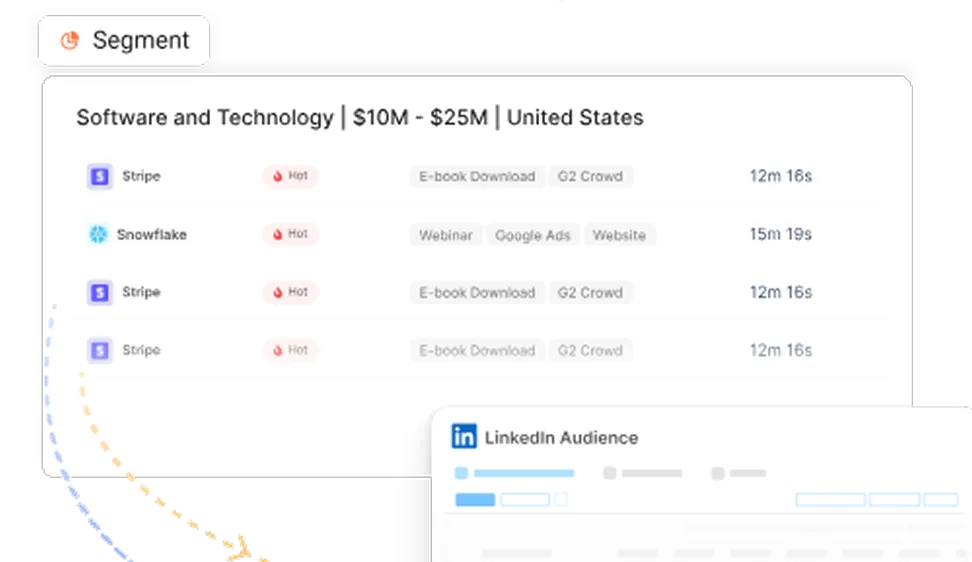
Factors.ai connects your CRM, ad platforms, and website data to give B2B marketing teams account-level attribution without a lengthy data engineering project. You can see which campaigns, channels, and content pieces are appearing in the journeys of your best accounts, filter by deal stage or deal size, and share attribution reports with sales in a format that doesn't require them to learn a new tool.
If your current attribution setup involves a lot of manual spreadsheet work or a lot of "I think LinkedIn is probably working," it's worth seeing what connected data actually looks like.
In a nutshell…
Sales attribution is one of those things that sounds like a measurement problem, but it's really a decision-making problem. The question isn't "how do we prove that marketing contributed to revenue?" The question is "how do we figure out what's actually working well enough to invest more in it, and what's not working well enough to stop?"
The teams that get the most from attribution aren't the ones with the most sophisticated models. They're the ones who pick a model they understand, keep their data clean enough to trust, and actually use the insights to change where they spend money. That last part is rarer than it should be.
Frequently asked questions about sales attribution
Q1. What's the difference between sales attribution and marketing attribution?
They're often used interchangeably, but there's a subtle distinction. Marketing attribution focuses specifically on which marketing touchpoints (ads, content, emails, events) contributed to a conversion. Sales attribution takes a broader view, including both marketing and sales activities (calls, demos, proposals) in the credit model. For B2B teams, where sales and marketing both touch the buyer journey, sales attribution gives you the more complete picture.
Q2. Which attribution model is best for a B2B company with long sales cycles?
Most B2B teams with sales cycles of three months or more get the most value from U-shaped or W-shaped attribution. These models acknowledge the importance of both the discovery phase and the conversion phase, without requiring a massive data infrastructure. If your team tracks pipeline stages carefully and has clean CRM data, W-shaped is worth the additional setup. If you're earlier in your data maturity, U-shaped is a solid starting point.
Q3. How do I handle attribution when multiple people at the same account are engaging with our content?
Move to account-level attribution. Instead of tracking touchpoints per individual contact, group all touchpoints by the account (company). This means a blog visit from the marketing manager, a webinar attendance from the director, and a demo request from the VP all appear in the same buyer journey. Most modern CRMs and attribution tools support this, but it requires clean account data to work reliably.
Q4. Do I need a dedicated attribution tool, or can I do this in my CRM?
You can get meaningful attribution insights from your CRM and marketing automation platform alone, especially for simpler models like first-touch, last-touch, or linear attribution. Dedicated attribution tools become worth the investment when you're trying to track cross-channel journeys at scale, run multiple models simultaneously, or connect data from sources that don't have native CRM integrations. Start with what you have, identify the gaps, and invest in tooling based on the specific data you can't currently capture.
Q5. What's the biggest mistake B2B teams make with attribution?
Trusting a complex model built on messy data. A sophisticated attribution setup is only as reliable as the data feeding it. If your CRM has duplicate accounts, inconsistent campaign tagging, and gaps in contact-to-account linking, a W-shaped model will produce impressively formatted reports that are unreliable. Before investing in model sophistication, invest in data quality. It's less exciting, but the outputs are actually trustworthy.
Q6. How often should we review and update our attribution model?
Quarterly is the right cadence for most teams. Review whether the model still reflects how your buyers actually buy, whether any new channels need to be incorporated, and whether your underlying data is still clean and consistent. If your sales cycle length or buyer mix has changed significantly, your model's assumptions may need updating. Attribution isn't a "set it and forget it" system.
Q7. Can attribution data fully replace intuition and team judgment?
No, and it shouldn't try to. Attribution data is a model of reality, not reality itself. Every model makes assumptions about which touchpoints matter and how credit should be divided. Those assumptions are useful for making better decisions, but they're still assumptions. The best use of attribution data is as one input into a conversation, not as a definitive verdict. Use it to inform judgment, not to replace it.
Q8. What if some of our highest-impact touchpoints are offline and untrackable?
Accept that your attribution model will always be incomplete, and build that assumption into how you interpret the data. For offline touchpoints you can influence (trade shows, events, referral programs), create a process for logging them manually in your CRM. For truly untrackable interactions (word-of-mouth, organic reputation), treat your attributed data as a floor, not a ceiling. The actual impact of your marketing is likely higher than what your model can capture.

Powered by Bombora
Enter your domain and we'll send you a free list of companies showing buying intent in your vertical.
.avif)
Powered by Bombora
Enter your domain and we'll send you a free list of companies showing buying intent in your vertical.
.avif)

See how Factors can 2x your ROI
Boost your LinkedIn ROI in no time using data-driven insights


.avif)

See Factors in action.
Schedule a personalized demo or sign up to get started for free
LinkedIn Marketing Partner
GDPR & SOC2 Type II

.svg)



.avif)

