
What is a customer persona (and how to build one that's actually useful)
Read about what a customer persona is, why it matters for B2B GTM, and how to build a customer persona report that your marketing, sales, and RevOps teams will actually use.
.avif)
Content Marketer



.svg)


TL;DR
- A customer persona is a detailed, research-backed profile of your ideal buyer, built from real data about who they are, what they care about, and how they make decisions.
- A customer persona report is the documented version of that profile, used to align GTM teams around a shared picture of the buyer.
- Good personas include firmographic data, behavioral signals, pain points, goals, objections, and decision-making dynamics.
- Bad personas are fictional people with made-up names and zero insight.
- Building one requires primary research (interviews, sales call notes), secondary research (market data, intent signals), and cross-functional input from marketing, sales, and CS.
- Tools like Factors.ai, HubSpot, LinkedIn Sales Navigator, and Gong are commonly used to enrich persona data with behavioral and intent signals.
You know that feeling when your campaign goes live, and the leads that roll in are... technically people?! They have email addresses. They clicked something. But they have absolutely nothing to do with who you were trying to reach?
Yeah… I’m getting flashbacks from those times too… all my flabbers were gasted.
Most of the time, the root cause is embarrassingly simple: nobody stopped to clearly define who the customer actually is before spending the budget. The ICP doc is either a two-liner from 2021, a copy-paste from a competitor's website, or worse, something that lives only in the CEO's head.
Now, that's where customer personas come in… in fact, they come much earlier. But most people ignore it like the 20th page on Google. That said, customer personas actually make up the foundation of GTM strategy that really works.
This is your full guide to what a customer persona is, what goes inside a customer persona report, and how to build one that your marketing, sales, and RevOps teams will genuinely use (and not just file away with good intentions). Come, come, let’s see.
What is a customer persona?
A customer persona is a semi-fictional representation of your ideal buyer, built using real data from your existing customers, prospects, and market research.
"Semi-fictional" is doing a lot of heavy lifting in that sentence. It means the persona isn't a real person, but everything inside it should be grounded in real patterns. The goals, the pain points, the objections, the daily frustrations, the way they evaluate vendors... all of it comes from actual evidence, not imagination.
In B2B, a customer persona is specifically focused on the buying role. So you're not just describing ‘a marketer’. You're describing a VP of Marketing at a 200-person SaaS company who owns pipeline targets, is held accountable for MQL quality, has tried three attribution tools in two years, and is slightly traumatized by board QBRs.
That level of detail is what separates a persona that changes how your team operates from one that sits in a Notion doc gathering digital dust.
What is a customer persona report?
A customer persona report is the documented output of persona research. It compiles everything your team has learned about a specific buyer type into a structured, shareable reference document that can align marketing, sales, RevOps, product, and CS around a single picture of the customer.
The report format matters. A persona buried in a 40-slide deck nobody opens is a persona that won't be used. A well-built report is scannable, actionable, and updated when new data comes in.
Think of it less like a one-time deliverable and more like a living document. The best persona reports evolve as your product, market, and customer base change
Why do customer personas actually matter?
Here's the honest version: without personas, every team in your company is mentally working with a different version of the customer.
Your content team writes for the person they imagine. Your sales team pitches to the person they've talked to most. Your RevOps team optimizes for whoever converted historically. Your demand gen team targets whoever the LinkedIn algorithm suggests.
Personas solve the coordination problem. When everyone has the same clear picture of the buyer, messaging tightens, channel choices make sense, sales and marketing stop arguing about lead quality, and conversion rates tend to quietly improve.
For B2B specifically, personas do something else too: they help you account for buying committee complexity. Most enterprise deals don't have one buyer. There's the economic buyer (CFO or VP), the end user (the team actually using the product), and the champion (the person pushing for the purchase internally). A good persona framework captures each of these roles separately.
What's the difference between a customer persona and an ICP?
This one comes up constantly, so let's settle it… one and for all.
An ICP (Ideal Customer Profile) is a company-level definition. It describes the type of organization most likely to buy, get value from, and retain your product. It's typically defined by firmographic attributes: industry, company size, ARR, tech stack, growth stage, go-to-market model, and geography.
A customer persona is a people-level definition. It describes the individual within that ideal company who is involved in buying or using your product.
If your ICP is "mid-market SaaS companies between 100 and 500 employees in North America," your personas might be:
- The Marketing Champion: VP of Marketing who owns pipeline and cares deeply about attribution.
- The RevOps Evaluator: Marketing Ops Manager who will live inside the tool daily.
- The Economic Buyer: CMO or CFO who signs off on the contract.
You need both. ICP tells you where to fish. Persona tells you how to fish, what bait to use, and what the fish is scared of.
What goes inside a customer persona report?
A complete customer persona report typically includes the following components:
- Persona overview
A quick summary: the persona's name (yes, give them a name, it makes them feel real to the team), their job title, company type, seniority level, and a one-paragraph description of their professional reality. - Firmographic context
The type of company this persona works in. Industry, size, growth stage, revenue range, and business model. This anchors the persona within your ICP. - Demographics and background
Professional background, years of experience, career trajectory, education where relevant, and any patterns observed across your actual customer base. Don't invent these. Pull them from LinkedIn data, CRM records, or customer interviews. - Goals and success metrics
What does this person actually want to achieve in their role? What does their performance review measure? What keeps them up at night professionally? This is often the most important section because it's where your product's value proposition should connect. - Pain points and frustrations
Specific, named problems this persona regularly faces. "Lack of visibility into pipeline" is okay. "Can't connect LinkedIn ad spend to actual closed-won revenue because the attribution model treats everything as last-touch" is better. The more specific you are, the more useful the persona becomes. - Buying behavior and decision-making process
How does this persona evaluate solutions? Who else is involved in the decision? What does the evaluation process look like from their side? What signals do they look for in vendor credibility? What does a red flag look like to them? - Objections
The specific concerns or hesitations this persona has when evaluating your type of product. These should come directly from sales call recordings, lost deal analysis, and win/loss interviews. - Content and channel preferences
Where does this persona spend their professional attention? LinkedIn? Industry newsletters? Slack communities? Analyst reports? G2 reviews? This informs your distribution strategy. - Influence and research patterns
Who does this persona trust? Whose opinion matters? What does their research process look like before they enter a buying cycle? - Emotional and rational drivers
This sounds like soft stuff, but it isn't. Rational drivers are the business case (ROI, efficiency, revenue impact). Emotional drivers are what makes this person personally invested in solving the problem (career risk, wanting to look smart in front of the board, genuinely caring about the team's success). Both show up in purchasing decisions.
How to build a customer persona report? A step-by-step process
Step 1: Start with what you already know
Before you run a single interview, mine what exists. Pull data from:
- Your CRM (HubSpot, Salesforce): job titles, industries, deal sizes, close rates by segment
- Sales call recordings (Gong, Chorus): what questions do prospects ask, what objections come up, what language do they use about their problems
- Win/loss analysis: why did deals close? Why did they not?
- Customer success notes: what problems are customers solving with your product today?
- LinkedIn: patterns across your closed-won accounts
You're looking for repeating patterns. Not one customer who matched a type, but five, ten, twenty customers who have similar characteristics, similar problems, and similar buying behaviors. That cluster is the beginning of a persona.
Step 2: Talk to real people
Data tells you what. Conversations tell you why.
Customer interviews are non-negotiable for persona research. A minimum of eight to ten interviews per persona type gives you enough pattern recognition to feel confident. More is better.
Who to interview:
- Existing customers who are healthy and getting value (the "success case" pattern)
- Customers who churned (the "failure case" pattern)
- Prospects who evaluated you and didn't buy (the "competitor win" pattern)
- Prospects who are currently in pipeline (the "active buyer" pattern)
Interview questions to always ask:
- "Walk me through what was happening at your company before you started looking for a solution like this."
- "What was the moment you knew the old way wasn't working?"
- "What other options did you consider?"
- "What almost made you not buy?"
- "How did you justify this purchase internally?"
- "What would you tell a peer who was evaluating tools like this?"
The language people use in their answers is gold. When a VP of Marketing says "I needed to stop embarrassing myself in board meetings about channel attribution," you now have a headline.
Step 3: Validate with intent and behavioral data
Interviews give you depth. Data gives you scale.
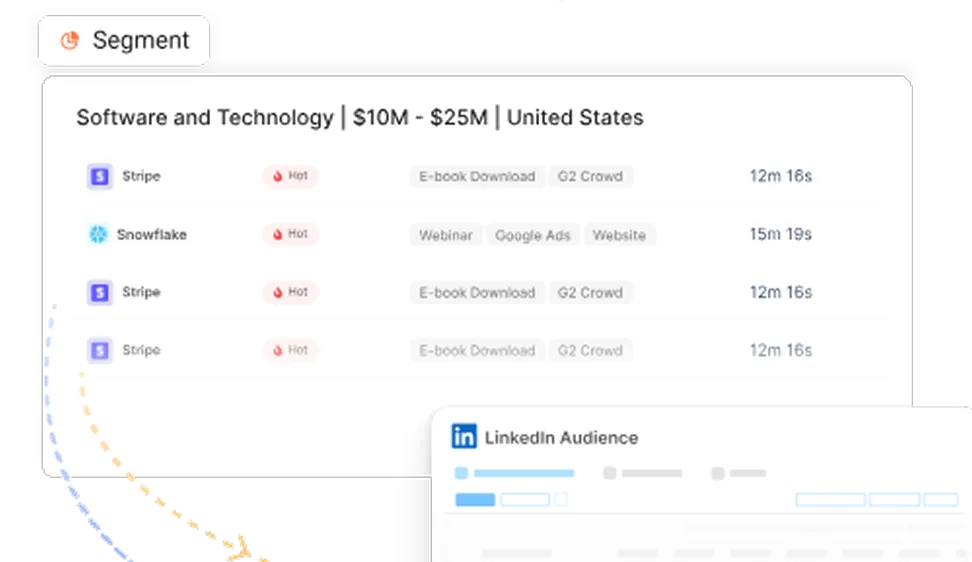
Use behavioral and intent signals to validate whether the patterns you heard in interviews actually hold across a broader population. Tools like Factors.ai help here by surfacing company-level intent signals and tracking how different account types behave across your website and content channels. You can start to see, at scale, whether "VP of Marketing at a Series B SaaS company" behaves the way your interviewees described.
LinkedIn Sales Navigator lets you filter and analyze the actual professional characteristics of people in your pipeline, while 6sense and Bombora offer third-party intent data that can show you what your target personas are researching before they ever land on your website.
Step 4: Loop in sales, CS, and product
Marketing usually builds personas in isolation. This is how you get a beautifully written persona that sales ignores completely.
Persona research should be a cross-functional exercise. Sales sees a version of the buyer that marketing never does. Customer success sees what the buyer actually needs post-sale. Product sees the feature requests and friction points that reveal what buyers value most.
A half-day workshop with reps from each function to review, challenge, and enrich the initial persona draft is worth more than any amount of secondary research.
Step 5: Write the report and make it usable
Structure matters here. A persona report that lives as a Wall of Text in Google Docs will never be read. The format should be:
- One-page visual summary (a "persona card") for quick reference
- Full-detail document for anyone who needs to go deep
- Section for quotes (real, anonymized quotes from interviews that bring the persona to life)
- Section for common objections and how to address them
The language in the report should mirror the language your customers use, not the language your marketing team uses.
Step 6: Pressure test it
Before you roll out the persona, test it against your best and worst customers.
Does your healthiest customer map to this persona? Does your most difficult churn story represent a pattern this persona should have flagged as a mismatch?
A persona that doesn't accurately predict product-market fit for real accounts needs another revision.
Step 7: Activate it across teams
A persona that's built and filed is not a persona that drives revenue.
Activation looks like:
- Sales using persona cards during discovery and qualification
- Marketing referencing personas in campaign briefs, creative direction, and messaging frameworks
- Content teams building editorial calendars around persona-specific pain points
- RevOps using persona data to build better lead scoring models
- CS using persona context to tailor onboarding and expansion conversations
The persona becomes infrastructure (not a document).
Common customer persona mistakes
- Building personas by committee without research.
A two-hour workshop where everyone shares their gut feeling is not persona research. It's… organized bias (at best), you need data, my friend. - Making them too vague to be useful.
"Mid-level marketer at a tech company who wants better results" is not a persona. That describes approximately one million people. - Building one persona when you need three.
Most B2B products have multiple buyers involved in a single deal. A persona strategy that covers only the champion and ignores the economic buyer will leave gaps in your sales enablement and pricing conversations. - Treating them as set-and-forget
Markets shift, products evolve, buyer priorities change… the word changes. A persona built in 2022 may not accurately describe your buyer in 2025. Run a refresh cycle at least once a year, or faster if you launch in a new market or segment. - Confusing the persona with the ICP
Company-level targeting and person-level messaging are both necessary, but they're not the same exercise. Conflating them leads to campaigns that target the right companies with completely wrong messaging.
Where does Factors.ai fit in the persona-building process?
Persona research is only as good as the data behind it. One place teams struggle is connecting what they've heard in interviews to what they're actually seeing in their pipeline, their ad performance, and their website behavior.
Factors.ai helps bridge that gap. With cross-channel attribution and account-level intent tracking, you can validate whether the persona patterns you've identified match actual buyer behavior at scale. If your persona says "VP of Marketing at mid-market SaaS research competitors intensely before contacting sales," you can look at whether that behavioral pattern shows up in your intent data and website analytics.
The Company Intelligence API and LinkedIn AdPilot features also help you target and track the exact persona types you've defined, making it easier to measure whether your campaigns are reaching who they're supposed to reach, and whether those accounts are behaving the way your persona research predicted.
This matters especially when personas move from a strategy document into active demand gen. You need a feedback loop. Behavior data is that feedback loop.
What makes a customer persona report a good one?
A good customer persona report is specific, grounded in evidence, and immediately actionable. It answers questions your team is actively wrestling with. It changes how a sales rep qualifies a call. It shifts what a content writer focuses on. It gives your demand gen team a reason to make a targeting decision.
A bad persona report reads like fiction. The persona has a name (usually something like "Marketing Mary"), a stock photo, a made-up quote, and a list of pain points so generic they could apply to any professional in any industry.
The difference is research. Always research.
In a nutshell…
A customer persona is a semi-fictional, research-backed profile of your ideal buyer, built to give your entire GTM team a shared understanding of who they're trying to reach, why that person cares, and how they make decisions.
A customer persona report is the documented, activatable version of that profile. It should include firmographic context, demographic patterns, goals, pain points, objections, buying behavior, content preferences, and emotional and rational drivers.
Building one takes real work: mining your CRM and sales tools, running customer interviews, looping in sales and CS, validating with behavioral data from platforms like Factors.ai, Gong, and LinkedIn Sales Navigator, and structuring the output so teams will actually use it.
The ROI is boring and also enormous. When your whole GTM team has the same clear picture of who the buyer is, campaigns get sharper, sales cycles get shorter, messaging resonates, and you stop wasting budget reaching the wrong people with the wrong message at the wrong time.
Less marketing trauma… more pipeline… sounds like it’s worth the effort.
Want to see how behavioral data from your actual pipeline can sharpen your persona profiles? Factors.ai gives you account-level visibility into how different buyer types engage with your content, ads, and website before they ever raise their hand. Worth a look.
FAQs: What Is a Customer Persona Report?
Q1. What is a customer persona in simple terms?
A customer persona is a research-based description of your ideal buyer. It captures who they are, what they're trying to achieve, what's frustrating them, and how they make purchasing decisions. It's used to help marketing, sales, and product teams stay aligned around a shared understanding of the customer.
Q2. What is the difference between a customer persona and a buyer persona?
The terms are often used interchangeably in B2B. Some organizations distinguish them by stage: a "buyer persona" focuses specifically on the pre-purchase decision-making process, while a "customer persona" may also include post-purchase behavior and product usage patterns. For practical GTM purposes, they refer to the same type of profile.
Q3. How many customer personas should a B2B company have?
Most B2B companies have between two and five personas. The right number depends on how many distinct buyer types are meaningfully involved in purchasing and using your product. Having too few means missing key stakeholders. Having too many means diluting your focus. Three personas covering the champion, the evaluator, and the economic buyer is a common starting structure for mid-market B2B.
Q4. How often should customer personas be updated?
Personas should be reviewed at least once a year, or whenever your product, market, pricing, or target segment changes significantly. Intent data and sales feedback can surface signs that a persona is becoming outdated before the annual review cycle. Common triggers for a refresh: entering a new vertical, launching a new product tier, or noticing consistent misalignment between persona assumptions and actual buyer behavior.
Q5. What tools are commonly used to build customer personas?
Teams use a combination of tools depending on what stage of research they're in. Gong and Chorus for sales call analysis. HubSpot and Salesforce for CRM pattern mining. LinkedIn Sales Navigator for professional attribute research. Factors.ai for behavioral and intent signal validation at scale. Typeform or SurveyMonkey for structured customer surveys. Dovetail or Notion for organizing qualitative interview data.
Q6. Can you build a customer persona without customer interviews?
You can build something. Whether it's accurate is a different question. Desk research, CRM analysis, and intent data can give you a working hypothesis for what a persona looks like, but interviews are how you verify whether that hypothesis matches reality. Most teams find that their assumptions going into the research are partially right and partly embarrassingly wrong. The interviews are where the useful surprises live.

See how Factors can 2x your ROI
Boost your LinkedIn ROI in no time using data-driven insights


.avif)

See Factors in action.
Schedule a personalized demo or sign up to get started for free
LinkedIn Marketing Partner
GDPR & SOC2 Type II







.svg)



.avif)

