
A Comprehensive Guide to Marketing Attribution
Learn how marketing attribution can help you measure and optimize your campaigns, and maximize your marketing efforts.


Growth Marketer



.svg)


TL;DR
Ever poured budget into campaigns, only to wonder which one drove results? For B2B marketers, this isn’t just a frustration but a roadblock to smarter decisions. With long sales cycles, multiple stakeholders, and countless touchpoints, it’s tough to know what’s really working. That’s where marketing attribution earns its place.
According to a study by Gartner, B2B buyers spent only 17% of their time meeting with potential suppliers and merely 5-6% of the entire time with the sales representative of each vendor. This means that the sellers have little opportunity to influence the buyer's decisions.
Buying decisions in B2B typically involve six or more individuals. And they prefer to do their own research instead of relying on the vendor's sales team. Their research includes industry publications, blogs, case studies, pricing, and customer reviews put out by the vendors. They often engage back and forth, moving from your website to your competitors. They take their time, compare, and decide on the best choice.
Hence, the interaction with the sales rep usually happens late in the buyer's journey. Marketing hence plays a much larger role in influencing the buying group's decision.
The back-and-forth engagement also results in multiple touchpoints across many channels. And by using marketing attribution models, a marketer can determine which touchpoints contribute to the conversion.
Many B2B marketing attribution software has emerged in recent years. But the big question is, how can these help? Why is it important for marketers? And which models should your marketing team be using?
This guide will explore the details of B2B marketing attribution. It will give you the knowledge and tools to handle this complex area. Whether you're new to this or want to improve your current strategies, learning about marketing attribution is key for any B2B marketer who wants to grow and succeed. Let’s get started!
What is Marketing Attribution?
Marketing attribution determines what marketing actions help a business reach its goals, like getting leads or growing revenue.
Suppose you're a marketing manager for a software firm. Your goal is to get more leads and earn more revenue.
To do this, you use various marketing channels such as Google search, organic search, LinkedIn ads, and so on. Meanwhile, the sales team contacts potential customers through emails and calls.
However, it can be challenging to know which channels work best and which need improvement. This is where marketing attribution comes in.
Attribution software acts like a GPS for your marketing efforts, helping you track the performance of every channel and campaign.
For instance, say your LinkedIn ads get the most leads, but your webinars don't perform as well. You can see this with the help of attribution software and change your strategy. Instead of putting more investment into an ineffective channel, you can focus on the channels that bring in leads and revenue.
Attribution shows which channels, messages, and interactions influenced a lead, moved them down the funnel, or closed the deal. The main goal of attribution is not to prove the marketing team's value but to help the team improve their efforts and get better results.
What's the difference between marketing attribution, revenue attribution, and digital marketing attribution?
When it comes to attribution, chances are you've come across a whole range of terms—namely, the following three.
- Marketing attribution
- Revenue attribution
- Digital attribution
Well, be relieved to know that all these terms virtually mean the same things. They simply differ in terms of context.
Marketing attribution refers to the process where you can quantify the influence of your channels on business metrics such as meetings, pipeline, and revenue.
Revenue attribution is identical in essence but has a slightly different perspective. Here, the focus is more on assigning value to channels to estimate their revenue impact.
And finally, digital marketing attribution is centered around attributing digital touchpoints. It exclusively focuses on the digital customer journey.
{{INLINE_TOFU}}
Why is marketing attribution important (and useful)?
Have you ever heard the saying, "you can't manage what you can't measure"? Well, that's exactly what marketing attribution is all about.
Imagine a company, ABC, that sells enterprise software solutions to other businesses. The company has a sales team, a digital marketing team, and a trade show presence to generate leads and close deals. The sales team receives leads from a variety of sources, including:
- The company's website through a contact form
- A trade show where the company had a booth
- An email campaign sent to target prospects
- A referral from a satisfied customer
In this scenario, it's important for ABC to understand which campaigns are driving the most conversions. This way, they can allocate their budget and resources more effectively.
For example, let's say the company's sales team closed a deal with a lead that came from the trade show. It's difficult to determine whether the trade show was solely responsible for the conversion or if other marketing efforts also played a role. This is where B2B marketing attribution comes into play.
With marketing attribution, ABC can identify the marketing touchpoints that drove most conversions. This further allows the company to see which marketing channels are the most effective in driving sales.
The tool helps the company to measure and attribute the success of your campaign and optimize and improve your strategies.
What are the functional benefits of marketing attribution?
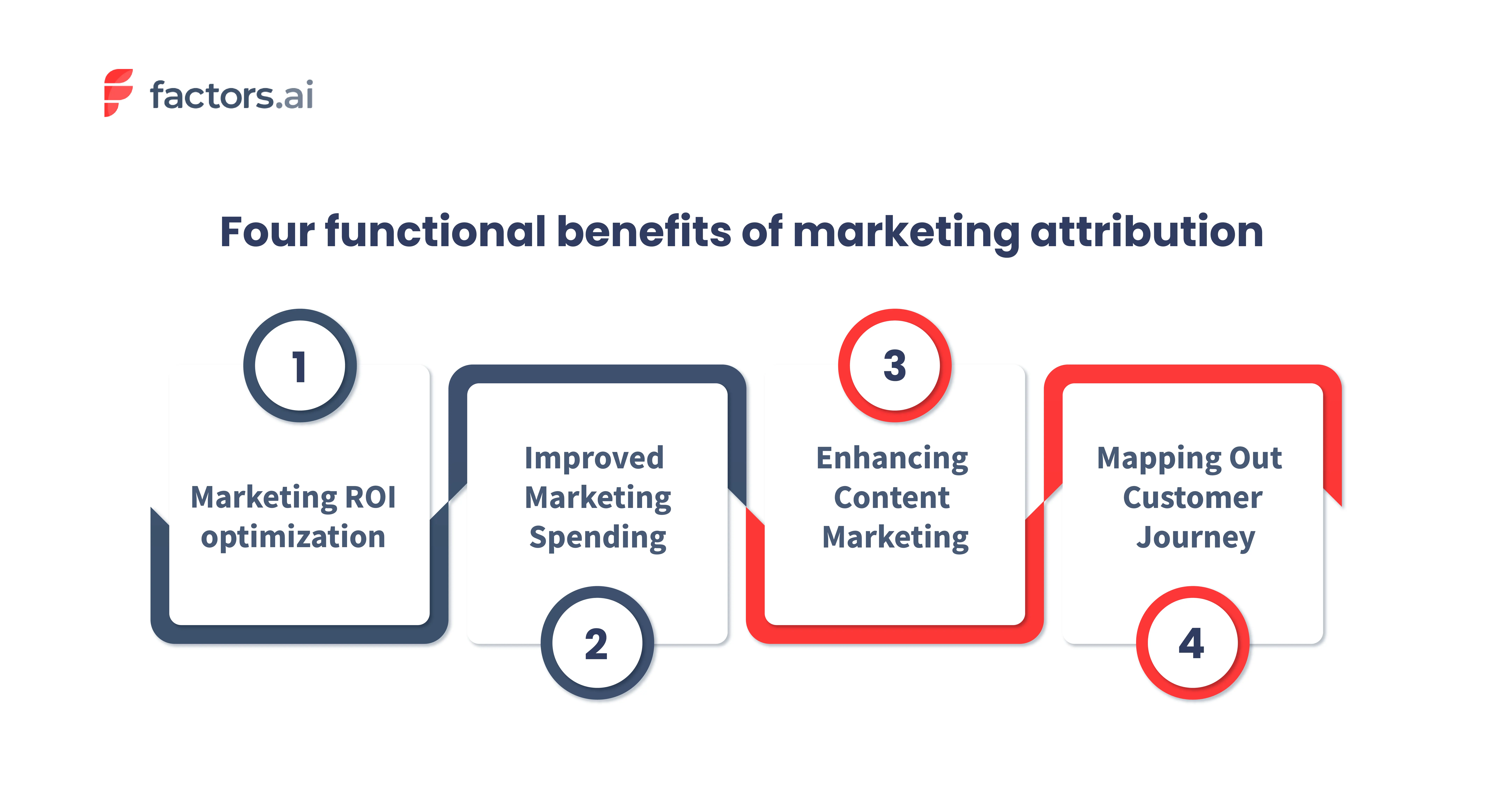
1. Marketing ROI Optimization
With marketing attribution, B2B teams achieve a better and broader picture of each channel's cost-to-revenue ratio or ROI.
By understanding every channel's influence on lead conversion, pipeline, and revenue in relation to their cost, you can effectively quantify marketing performance. Ultimately, this leads to our next point — prudent marketing investment and spending.
2. Improved Marketing Spends
Using marketing attribution can make a significant impact on your marketing investment. This is because it provides crucial information about the performance of different marketing channels and tactics. Armed with this information, you can optimize your spending to achieve the end business objectives. Instead of distributing your investments evenly, you can double down on the channels that are actually performing better.
Consider this example. Imagine you have $10,000 to spend on a marketing campaign. Without attribution, you might split the money evenly between different channels. But with attribution, you might find that Linkedin conversational ads work best and are responsible for 80% of your conversions. So, in this case, you could put 80% of your budget towards Linkedin conversational ads and the rest towards other channels.
In short, marketing attribution helps you make decisions based on data instead of guessing. By knowing what's working, you can spend your money in the best way possible and get the biggest return on your investment.
3. Attribution and Content Marketing
Content marketing remains the best way to communicate effectively with customers and educate them about your offerings. And with the help of marketing attribution, you can take content marketing to the next level.
How?
Your content should engage with the target audience and drive demand for your products/services at every stage of the buying journey. For that, you need to create content that's tailored to your Ideal Customer Profile (ICP).
Marketing attribution plays a crucial role in this process. It provides insight into which content resonates with your audience and leads to more conversions. Traditional CRM and MAP systems credit conversions to content only by a First Touch model (if the content was the first interaction the prospect had), which can be very misleading.
You can also track how different pieces of content contribute to your pipeline and revenue. This allows you to optimize your content strategy.
For example, you may find that a particular blog post is driving a lot of traffic to your website but is not resulting in any conversions. In this case, you can analyze why this is happening and make changes to the content to increase its effectiveness.
Keep reading to learn more about the ROI of B2B content.
4. Mapping Out The Customer Journey
The use of attribution isn't limited to understanding channel influence on conversion. It's also a powerful tool to make sense of marketing's impact across each step of the funnel.
You can use it to identify the relationship between channel interactions, which touchpoints work together, and their relative probability of occurrence down the funnel. All of which help you map out your buyer's typical journey.
Marketing attribution models
Attribution models allow you to understand the different touchpoints in the customer journey and how each of them influenced your prospect to convert. The main goal of attribution models is to help marketers determine their campaigns' performance
For example, consider the following.
A customer reached your website through a LinkedIn ad. Then, the customer further engages with your website content, like blogs and case studies, before becoming a lead. And finally, they are converted (booked a demo) after clicking on a retargeting ad.
Now, depending on your business goals, the attribution model you choose assigns credit to different touchpoints.
If your objective were to create awareness of your brand or product, the credit would be assigned to the first touchpoint. In this case, the LinkedIn ad. But if you were looking at conversion alone, the credit will be given to the last touchpoint, which is the retargeting ads.
There are other scenarios too, where you assign credit to multiple touchpoints. But as we said, it depends on your business objective.
With that said, there are mainly two types of attribution models.
- Single touch models
- Multi-touch model
Types of attribution models
Single-touch
As the name indicates, allocate the credit to a single touchpoint. Some types of single-touch attribution models are;
- First touch
- Last touch
- Last non-direct touch
.webp)
These types of attribution models are used mainly by businesses with a clear and straightforward marketing funnel and want to track the impact of specific touchpoints on conversion
Multi-touch
Again, as the name implies, multi-touch models allocate credit to multiple touchpoints in the customer journey. The main focus of this model is to give a more accurate picture of your marketing channels' impact on conversion.
Some of the types of multi-touch attribution models are:
- Linear attribution model
- Time-decay attribution model
- U-shaped attribution model
- W-shaped attribution model
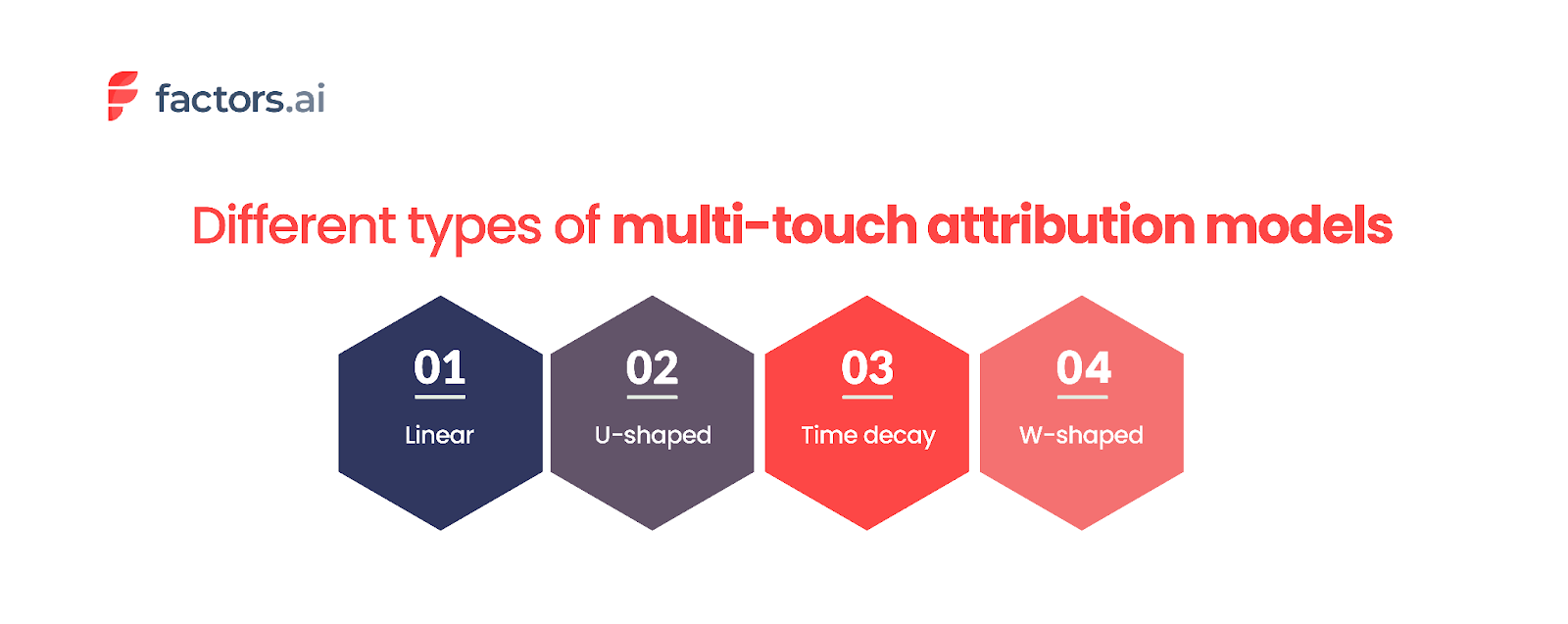
Here, take a look at our take on the seven types of attribution models with examples that can help you understand the attribution models better.
So, how to choose the suitable model for your business?
Choosing the right model for your business can be a challenge. As the saying goes, ‘all models are wrong, but some models are useful. But it's essential to select the one that helps you answer the specific questions you have in mind.
With that said, let's look into the factors that affect choosing the model and how to select the right one for your business.
Some factors that affect the choice of attribution model are as follows.
- The nature of the buyer journey cycle - This includes the length of the sales cycle and the number of decision-makers.
- The nature of the product. Does the product belong to an established category or a new one?
Here are seven steps to help you choose the right attribution model:
- The first and foremost thing to do is to understand your business goal. Ask yourself, "What do I want to achieve with attribution modeling?". The answer can help you select a model that aligns with your business goals.
- Speak with your customer to understand their customer journey and the touchpoints involved. Anecdotal assessments of how each touchpoint contributed to conversion can help you select an appropriate model.
- Evaluate different attribution models. Compare the strengths and weaknesses of each model and see how they align with your business goals.
- Do A/B testing. Test each model and compare the results. This will give you a better understanding of the model that will work best for you.
- Some attribution models require more data than others. So, consider the data you have and select the model that aligns with the data you have.
- Constantly review and adjust the models. It's crucial to ensure that your model is relevant and accurate. So, as your business grows and evolves, you should review the current one and make the necessary changes.
- Evangelize the results of the selected attribution model and get buy-in from relevant teams - field marketing, digital marketing, and sales so that all equally accept the results from the model you select.
Common challenges with marketing attribution
Whilst the benefits of attribution analysis are clear and unquestionable, there are certain challenges and limitations which need to be highlighted. We will briefly discuss a few B2B attribution challenges here. You can follow up on the link to learn more about the B2B attribution challenges and how to overcome them.

Complex customer journey:
B2B customers often go through a lengthy and intricate buying process. There is usually a group of 4-6 people researching and deciding between vendors before moving to purchase. Not to mention the multiple touchpoints across many channels that influence decision-making.
Marketers can't determine which touchpoints are affecting the sales pipeline and revenue without proper attribution. This makes it hard to track the success of their campaigns and make improvements.
However, attribution makes it easier to see all the touchpoints, even if the customer journey is complex. Also, when choosing an attribution software, ensure that it includes the deanonymization feature. This can help track the entire journey of all the buying committee members, even if they browse anonymously.
Longer sales cycle:
B2B purchases require a significant investment. Hence the decision-making process is more rigorous and complex than B2C sales. On top of that, there are contractual agreements, regulations, and budget approvals that further add up the time.
According to Klipfolio, around 75% of B2B companies take an average of 4 months to onboard a new customer. And depending on your sales process, the time can be longer or shorter.
Because the B2B sales cycle is complex and lengthy, it can be difficult to find out which touchpoints influenced the prospect to convert. Moreover, it can take months or years to see the results of your marketing activities. Thus, making it harder to attribute the conversion to a specific campaign.
By using multi-touch attribution models, marketers can understand the impact of their campaigns. This would help them prioritize marketing investments and create a more engaging customer experience.
Multiple touchpoints:
Customers often interact with your company through multiple channels before purchasing. These can be both online and offline interactions. Also, a customer can engage with your company at different stages of the buying journey.
For example, a customer may receive an email about a product. They then visit the company's website for more information, only to later attend a trade show and have a follow-up conversation with a sales representative. Each touchpoint could have a different impact on their decision-making process.
But, determining which touchpoints had the most significant impact can be difficult. One solution is to use an attribution tool that can track all these diverse channels and bring all the interactions together in one place.
Tracking and defining offline touchpoints:
In a B2B sales process, the customer engages with the vendors through both online and offline touchpoints. This makes it difficult to track and attribute conversions accurately, as you now need to stitch data across systems..
For example: consider a set of B2B customers. They attended a trade show and got on a call with your sales team. Afterward, they sign up on your website and complete the purchase. Here, it will be hard to determine credit for a touchpoint if you don't have the right attribution solution.
Marketing analytics software, like Factors, enables tracking of both online and offline touchpoints. Factors has a click-and-select UI through which the offline touchpoints can be set up from your CRM / MAP platform. This ensures that you have a detailed view of the customer journey.
Sales-Marketing alignment:
Alignment between Marketing and Sales teams is essential to maximize returns. However, this is easier said than done. In many B2B companies, there's a lack of communication between the two teams, making it hard to reach potential customers. Fighting for credit can be a reason for this disconnect, as each team believes their efforts to be the reason for closing a deal.
Bridging this alignment divide can be achieved in two ways.
- Emphasize that both teams are not independent but part of a larger go-to-market function.
- Unify the customer journey data across marketing and sales touchpoints.
Sophisticated Marketing Attribution solutions such as Factors can help here by providing a clear and consistent view of the customer journey. On top of the unified data foundation, teams can get answers to questions such as
- How many touchpoints did it take to convert a deal? How many of these were sales vs. marketing touchpoints?
- Were marketing efforts able to drive engagement with the right stakeholders in these accounts?
- When is the right time for sales teams to intervene so as to convert an account?
Furthermore, each team can review and analyze the attribution data to understand which of their strategies are working and which are not. From a sales perspective, such analysis can help in defining the frequency and content of email sequences, calls, and meetings that lead to maximum impact.
Why should CMOs consider marketing attribution?
As a CMO, you are often asked to achieve better results with limited resources. Meanwhile, the buyer's journey has become complex, with more channels, stakeholders, and a longer buying cycle. Attribution Software can be a valuable guide, helping you in the following ways.
Better decision-making
By understanding the customer journey, you can determine the channels to focus on and how to allocate your limited budget.
Improved ROI
Attribution lets you know which channels effectively drive conversions. Therefore, it allows you to allocate expenditures accordingly and generate better results.
Increased accountability
You can unambiguously measure and track your marketing effort's impact. Good or bad, you can hold yourself and your team accountable for the results while continuously finding ways to improve.
Enhanced customer understanding
You can gain a deep understanding of customer behavior and interactions with marketing and sales initiatives. You can know what types of content your customers are seeking, the landing pages they interact with, and more. This enables you to optimize future campaigns to align with the customer's interests.
You can read more about the importance of marketing attribution for CMOs here.
How to Build a B2B Marketing Attribution Model?
Here’s how to build a strong attribution model that delivers actionable insights:
Step 1: Audit Your Existing Marketing Ecosystem
Start by identifying all current marketing channels and touchpoints. From ad impressions and content downloads to email interactions and sales calls, every engagement should be tracked. This initial audit helps uncover gaps in tracking and ensures you’re capturing the complete customer journey.
Step 2: Define Clear Business Objectives
Your attribution model should align with specific goals, whether that’s improving lead quality, shortening the sales cycle, or boosting customer lifetime value. Defining these goals upfront helps you choose the right model and metrics to measure success.
Step 3: Map the Complete Customer Journey
Carefully map each stage of the journey: awareness, consideration, evaluation, and decision. Assign touchpoints to each stage and evaluate their potential influence. Consider using lead scoring systems to highlight which touchpoints contribute most to sales-ready leads.
Step 4: Select the Right Attribution Model
Based on your sales cycle complexity and goals, choose an attribution model that fits. For example:
- First-Touch Attribution can help identify effective top-of-funnel channels.
- W-Shaped or Full-Path Attribution is better suited for tracking engagement across long B2B buying cycles.
- Custom or Data-Driven Models offer flexibility and accuracy for organizations with mature data operations.
Step 5: Leverage the Right Attribution Tools
Use analytics and attribution tools that integrate easily with your CRM, marketing automation, and ad platforms. Tools like HubSpot, Marketo, and Google Analytics (alongside more advanced tools like Factors.ai or Wicked Reports) help track user interactions across multiple platforms.
Step 6: Integrate with Your CRM and Sales Stack
Connect your attribution system with your CRM (like Salesforce or HubSpot) to unify marketing and sales data. This centralization ensures teams are working from the same insights, which improves alignment and leads to handoff efficiency.
Step 7: Customize Reporting and Optimize Over Time
Build dashboards that focus on the KPIs that matter to your business, such as cost per lead, deal velocity, campaign ROI, etc. Attribution is not static: regularly analyze performance, identify patterns, and adjust strategies to stay aligned with changing market dynamics and buyer behavior.
Pro Tip: Start with a simpler model and gradually evolve toward more advanced approaches as your data maturity grows.
By following these steps, you can create an attribution model that improves marketing results.
Key Touchpoints in the B2B Customer Journey
In B2B marketing, understanding and optimizing the key touchpoints throughout the customer journey is essential for driving qualified leads and closing deals. Each touchpoint represents a critical moment of interaction that influences a buyer's path toward becoming a customer. Here's a closer look at the four most important touchpoints in the B2B journey:
1. First Engagement
This is where the journey begins. The first engagement typically happens when a potential buyer interacts with your brand through a blog post, social media ad, webinar invite, or a piece of gated content. This stage is crucial for creating awareness and positioning your brand as a valuable solution to the buyer’s problems. The goal here is to capture interest and drive the user to learn more.
2. Last Marketing Interaction Before Lead Capture
This touchpoint occurs just before a prospect converts into a known lead, often when they fill out a form, request a demo, or download a whitepaper. Identifying this moment helps marketers understand which final nudge (campaign, CTA, content piece) was most effective in prompting conversion. It’s an indicator of what messaging and channels are best at turning interest into action.
3. Opportunity Creation
At this stage, the lead transitions from a Marketing Qualified Lead (MQL) to a Sales Qualified Lead (SQL). It’s the point where marketing hands the lead off to the sales team, often based on engagement metrics, firmographic fit, or behavioral triggers. This handoff is critical: aligning attribution around this milestone helps validate which marketing efforts truly generate sales-ready opportunities.
4. Closed (Won or Lost)
The journey's final and most definitive touchpoint is when a deal is closed. Whether the opportunity results in a win or a loss, this stage reveals which interactions had the most impact on influencing the purchase decision. Attribution here allows you to analyze which marketing strategies contributed to revenue and what might need improvement for future deals.
By tracking and analyzing these key touchpoints, B2B marketers can optimize each stage of the funnel, better allocate budgets, and align more closely with sales teams. This leads to smarter campaigns, higher-quality leads, and ultimately, improved ROI.
Best Practices for Implementing Marketing Attribution
To implement marketing attribution well, follow a clear plan.
1. Centralize Your Data Sources
Start by unifying marketing and sales data into a single system. This ensures consistent tracking across all channels and touchpoints. A centralized data hub often built around a CRM like HubSpot or Salesforce reduces fragmentation, eliminates data silos, and enables deeper insights into the customer journey. Integration with marketing automation tools, ad platforms, and website analytics is also essential.
2. Choose the Right Attribution Model
Select an attribution model that reflects your sales cycle, buyer behavior, and strategic goals. In B2B, where decisions involve multiple stakeholders and longer timeframes, multi-touch attribution models (e.g., Linear, W-Shaped, or Full Path) usually provide the most balanced view. However, start simple if you're new to attribution and evolve your model as your capabilities grow.
3. Continuously Test and Refine
Attribution isn’t a “set it and forget it” system. Buyer journeys shift with new market trends, technologies, and buyer expectations. Regularly review and refine your attribution models to ensure they reflect real user behavior. Use A/B testing, conversion tracking audits, and periodic performance analysis to fine-tune your approach.
4. Foster Cross-Department Collaboration
Effective attribution depends on input from multiple teams. Align marketing, sales, revenue operations, and customer success around shared metrics and definitions of success (e.g., what qualifies as a lead, opportunity, or conversion). This collaboration leads to more accurate attribution reporting and more cohesive strategies across the funnel.
5. Ensure Privacy Compliance
With evolving data privacy regulations (like GDPR, CCPA, and others), it’s crucial to use attribution tools that respect user privacy. Prioritize platforms that offer privacy-friendly tracking (like server-side tagging, consent-based data collection, and anonymized tracking) to stay compliant while still gathering actionable data. This builds trust and protects your brand reputation.
How to choose the right marketing attribution tool?
Choosing a marketing attribution tool requires careful consideration of several factors. Some of the key considerations are
- Data Integration: Ensure the tool integrates easily with your existing data sources. This includes your CRM, marketing automation platform, web analytics, CDPsand advertising platforms.
- User-friendly interface: Make sure the tool is easy to set up, track campaigns, and analyze results.
- Model flexibility: Choose the tool that offers a range of attribution models. This way, you can choose the most appropriate one aligning with your business goals.
- Reporting and analysis: Check whether the tool provides robust reporting and analysis capabilities. This is important for you to understand the impact of your campaigns on lead generation and conversion.
- Customer support: Check the quality of the customer support offered by the vendor. It's best to choose the one who provides good technical support and training.
- Security: Ensure the tool has robust security measures to protect your data.
- Cost: Consider the cost of the tool in relation to the value it can deliver to your business.
Marketing Attribution: Understanding Impact & Optimizing ROI
Marketing attribution is the process of analyzing and assigning credit to marketing touchpoints that contribute to sales or conversions. It helps businesses identify which channels drive the most value, enabling data-driven decision-making.
Key Benefits of Marketing Attribution
- Optimized ROI: Quantifies marketing performance to improve budget allocation.
- Efficient Spending: Identifies high-performing channels for better resource distribution.
- Data-Driven Decisions: Provides insights into customer journeys for smarter marketing strategies.
Common Attribution Models
- First-Touch Attribution: Credits the initial interaction.
- Last-Touch Attribution: Assigns credit to the final touchpoint before conversion.
- Linear Attribution: Distributes credit equally across all interactions.
- Time-Decay Attribution: Gives more weight to touchpoints closer to conversion.
- Position-Based Attribution: Prioritizes the first and last interactions.
Choosing the right attribution model aligns marketing efforts with business objectives, leading to smarter strategies and improved revenue growth.
Ultimately, the right attribution tool for your business will depend on your specific needs and goals. Consider your budget, the data you want to track, and the level of analysis you need.
Factors is one of the leading marketing analytics and attribution tools purpose-built for the B2B segment. It can help businesses make data-driven decisions by accurately attributing conversions to the most influential touchpoints. Some of the highlights of Factors include
- Enables attribution of offline touchpoints such as webinars, field events, and so on.
- You can visualize the customer journey at an Account and User Level.
- Easily integrates with tools like HubSpot, Salesforce, Marketo, 6sense, Segment, and Rudderstack
- Supports Account Level Analytics and Attribution natively
- You can compare attribution models and select the one most aligned with your business objectives
- Provides an extensive set of filters and breakdowns to create rapid, relevant ad hoc reports in seconds.
- AI-fueled insights into performance, anomalies, and fluctuations.
If you’re looking for a marketing analytics tool that facilitates all your attribution needs, look no further than Factors.ai. Sign up for free to learn more about Factors, or book a personalized demo today!

See how Factors can 2x your ROI
Boost your LinkedIn ROI in no time using data-driven insights


.avif)
.avif)

See Factors in action.
Schedule a personalized demo or sign up to get started for free
LinkedIn Marketing Partner
GDPR & SOC2 Type II






.svg)



.avif)

