Why LinkedIn is Becoming the One Platform That Does *Everything*
Read about why B2B marketers are shifting budget and strategy to LinkedIn as it replaces multiple tools, from ABM to brand to demand, in one high-performance platform.

CEO, NeonTrumpet
.avif)
Content Marketer



.svg)


TL;DR
- Marketing stacks are shrinking, and LinkedIn is replacing tools for ABM, brand, demand, and attribution.
- Ad budgets are shifting fast: LinkedIn ad spend rose 31.7% YoY; Google’s grew just 6%.
- Thought Leader Ads and native audience targeting outperform legacy tactics in both reach and ROI.
- LinkedIn isn't everything, but it’s fast becoming the center of gravity for B2B marketing.
Remember when your marketing stack looked like a game of Tetris designed by someone in the midst of a caffeine overdose?
You had one tool for attribution. Another for ads. A third for visitor identification. Something else for account intelligence. A different platform for brand awareness. Yet another for retargeting. And maybe, if you were feeling really spicy, a separate budget line for "thought leadership" that nobody could quite quantify.
Each tool promised to be the missing piece. Each integration required three meetings and a sacrifice to the API gods. And each quarterly business review involved explaining to your CFO why you needed 47 different SaaS subscriptions for marketing.
That era is ending. Not because someone invented a magical all-in-one platform, but because LinkedIn quietly became really, really good at doing multiple jobs that used to require completely separate channels and tools.
The data tells a story that's impossible to ignore. B2B marketers are consolidating spend, strategy, and execution onto LinkedIn at a blistering pace. And it’s for some good, measurable, ROI reasons.
The Facts: A 31.7% Vote of Confidence
LinkedIn advertising budgets grew 31.7% year-over-year. Google Ads? Just 6%.
That's not a trend. That's a stampede.
LinkedIn's share of digital marketing budgets jumped from 31.3% to 37.6%, a 6.3 percentage point shift that represents billions of dollars in reallocation. Google's share dropped from 68.7% to 62.4%.
But here's what makes this consolidation different from typical "hot new channel" hype cycles: marketers aren't just experimenting with LinkedIn. They're systematically moving budget away from other channels because LinkedIn is doing jobs those channels used to own.
Brand awareness? LinkedIn.
Lead generation? LinkedIn.
Account-based targeting? LinkedIn.
Thought leadership distribution? LinkedIn.
Retargeting? LinkedIn.
Pipeline attribution? LinkedIn.
One platform. Multiple jobs. And the performance data backs up why this consolidation is accelerating.
Job #1: Brand Awareness (Your TV Budget)
Brand awareness campaigns on LinkedIn grew from 17.5% to 31.3% of total ad spend. That's nearly doubled in a single year.
Why? Because LinkedIn cracked the code on something that's frustrated B2B marketers forever: how to build brand awareness among your exact ICP without wasting impressions on people who will never, ever buy from you.
Traditional brand advertising required you to buy billboards, sponsor conferences, maybe run some display ads, and hope the right people saw them. You'd spend six figures reaching a million people, knowing that 990,000 of them were completely irrelevant.
LinkedIn flips this equation. You can run brand awareness campaigns that reach exclusively VPs of Marketing at 500-1000 person SaaS companies in North America. Zero waste. Total precision.
And that brand awareness creates a multiplier effect across every other channel. Analysis shows that ICP accounts exposed to LinkedIn ads demonstrate:
- 46% higher paid search conversion rates
- 43% better SDR meeting-to-deal conversion
- 112% lift in content marketing conversion
Your LinkedIn brand investment doesn't just stop at LinkedIn. It makes everything else work better.
{{INLINE_MOFU}}
Job #2: Demand Capture (What Google Used to Own)
LinkedIn isn't replacing Google for bottom-funnel search intent (that said, paid traffic is declining 39%, with an average of 24% increase of spend, do with that what you will). But it's taking a massive share of the "consideration stage" demand capture that used to flow through content syndication, display ads, and mid-funnel nurture.
Lead generation campaigns still represent 39.4% of LinkedIn spend (down from 53.9%, but still substantial). And the quality metrics are crushing it:
- 71.9% of marketers agree that leads from LinkedIn ads align more closely with their ICP
- 52.3% say LinkedIn leads are more likely to be senior-level decision-makers
You're not just capturing demand. You're capturing the right demand, from people who can actually sign contracts.
The cost efficiency tells the story even more clearly. Cost per ICP account engaged on LinkedIn is $257. On Google? $560. LinkedIn costs less than half for higher-quality accounts.
When one platform delivers better targeting, quality, and economics, consolidation just makes sense 🤌.
Job #3: Thought Leadership Distribution (RIP, Your Blog)
Here's where LinkedIn really stands out from every other platform: it's the only place where executive thought leadership actually reaches decision-makers at scale.
42% of marketers now use Thought Leader Ads regularly. Another 31% use them occasionally. That's 73% adoption of a format that barely existed two years ago.
The explosive growth is because Thought Leader Ads solve a problem that used to require an entire content distribution apparatus. You'd write a killer article, publish it on your blog, promote it through email, maybe syndicate it, cross your fingers, and hope the right people saw it. Now it’s simply not happening that way; even the gold standard of proprietary analyst reports are facing declining performance for 75% of organizations. There’s a 26.3% decline in report downloads. Your CEO is yelling into a void.
Now, your CEO writes a post. You put $500 behind it as a Thought Leader Ad. It reaches 10,000 people who match your exact ICP. They see authentic content from a real person (not a corporate page), in their feed, with the credibility that comes from executive bylines.
The engagement rates speak for themselves. According to LinkedIn's platform data, Thought Leader content receives significantly higher engagement than traditional company page posts. It's authentic, it's from a real human, and it builds trust in ways that traditional ads never could.
Static images can still work, but video and document ads allow brands to tell richer stories and build emotional connections faster. Even short videos communicate tone and personality in ways static content can't, whilst document ads help educate and add genuine value.
LinkedIn Ad Formats Comparison Table
| Ad Format | What It Does Well | Why It Works Better Than Static Images |
|---|---|---|
| Static Images | Communicates a single, clear message | Limited in conveying tone, depth, and emotion |
| Video Ads | Tells richer stories quickly | Communicates tone and personality even in short formats |
| Document Ads | Educates and delivers deeper value | Allows users to engage with useful, informative content |
Job #4: Account-Based Targeting (What Used to Require a Whole Stack)
Traditional ABM required you to:
- Identify target accounts (some specialized platform or a massive spreadsheet)
- Enrich those accounts with data (Clearbit, ZoomInfo)
- Track their behavior (your analytics platform)
- Build audiences (your ad platforms)
- Retarget them (separate retargeting tools)
- Measure everything (attribution software)
LinkedIn collapsed that entire stack into native functionality.
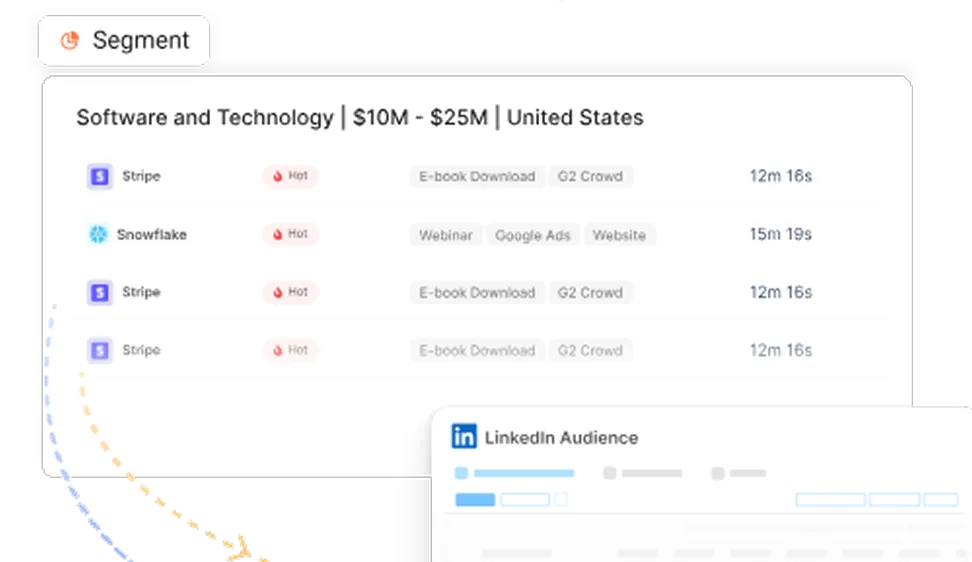
Matched Audiences lets you upload your CRM data directly. Account targeting lets you specify exact companies. Predictive Audiences uses AI to find lookalikes of your best customers. Website retargeting via Insight Tag captures visitors and brings them back.
What’s amazing is that it actually works better than the Frankenstack approach because everything is native. No leaky integrations, data delays, and no "why is this account showing up in one system but not another?" debugging sessions.
The consolidation isn't just about convenience, it's about effectiveness.
Job #5: Multi-Format Creative (Because Buyers Are Humans)
LinkedIn used to be "that place you run text ads and single image ads." Not anymore.
Video ads grew from 11.9% to 16.6% of spend. Document ads grew from 6.4% to 10.7%. Connected TV advertising went from 0.5% to 6.3%. Off-site delivery (reaching LinkedIn's audience across the web) grew from 12.9% to 16.7%.
One platform now supports:
- Single image ads
- Carousel ads
- Video ads
- Document ads
- Thought Leader ads
- Message ads
- Conversation ads
- Event ads
- Connected TV ads
- Off-site display
Oooh, that’s a loooong list!
Each format serves a different job in the buyer journey. Document ads for education. Video for storytelling. Thought Leader for authenticity. Single image for direct response. Connected TV for broad reach among your ICP. Let me just put it in a table for you.
LinkedIn Ad Formats & Use-Cases Comparison Table
| Ad Format | Primary Use Case | Why It Works |
|---|---|---|
| Document Ads | Education | Delivers in-depth, high-value content users can engage with |
| Video Ads | Storytelling | Conveys emotion, tone, and narrative quickly |
| Thought Leader Ads | Authenticity | Feels human, credible, and trust-building |
| Single Image Ads | Direct Response | Simple, focused, and action-oriented |
| Connected TV Ads | Broad ICP Reach | Scales awareness across high-intent, relevant audiences |
You used to need different platforms and vendors for each format. Now it's in the Campaign Managers tabs.
Job #6: The 95%-5% Rule (Why LinkedIn Owns Both Ends)
The LinkedIn B2B Institute's research established a critical insight: only 5% of your target market is actively in-market at any given time. The other 95% are out-of-market but will buy eventually.
Most platforms force you to choose. Brand awareness platforms (display, TV, sponsorships) reach the 95% but can't capture the 5%. Performance platforms (search, intent data) capture the 5% but miss the 95%.
LinkedIn is the only platform that legitimately does both jobs well. And with CRM’s misattributing 14.3% of leads as ‘generated from paid search’ actually originating from LinkedIn, it’s well worth looking a bit harder at your data to find out where your leads are really coming from.
Brand awareness campaigns with broad targeting build mental availability with the 95%. Retargeting and lead generation campaigns capture the 5% showing intent. Same platform and data, with unified measurement… it’s a dream come true (ok maybe notonly for a bunch of weird marketing people).
This isn't theoretical. The budget shifts prove marketers recognize this dual capability as LinkedIn's killer feature.
And Consolidation Only Accelerates From Here
Survey data shows 56.4% of B2B marketers plan to increase their LinkedIn budgets by more than 10% in 2026. The consolidation is speeding up.
Three forces are driving continued acceleration:
- Measurement keeps improving.
LinkedIn CAPI integration enables accurate conversion tracking. Account-level analytics provide visibility into buying committee engagement. Multi-touch attribution actually works when most touchpoints happen on the same platform. - Format innovation continues.
Thought Leader Ads launched and immediately hit 42% regular usage. Document Ads went from nothing to 10.7% of spend. What's next? Whatever it is, it'll be native to the platform and integrated with everything else. - ROI is undeniable.
Median ROAS of 1.8x. Cost per ICP account that's half of Google. LinkedIn-sourced deals closing 28.6% higher ACV. When one platform delivers superior performance across multiple metrics, CFOs stop asking "why are we spending so much on LinkedIn?" and start asking "why are we still spending so much on everything else?"
The Caveat is That LinkedIn Can’t Be Everything
LinkedIn consolidation doesn't mean LinkedIn monopoly. It’s not some magical unicorn.🦄
You still need:
- A website (obviously)
- Email nurture (LinkedIn can't send your drip campaigns)
- CRM (Hubspot isn't going anywhere)
- Analytics infrastructure (like Factors.ai you need to measure cross-channel impact)
- Other channels for specific use cases (events, community, SEO)
The consolidation is NOT about replacing your entire stack. It's about LinkedIn absorbing jobs that used to require 5-10 separate tools and channels.
Instead of: Display network + content syndication + brand awareness campaigns + thought leadership distribution + ABM platform + retargeting tool + intent data provider.
You get: LinkedIn.
That's the consolidation. And it works.
What This Means for Your Strategy Now
If LinkedIn is becoming the platform that does everything, your strategy needs to reflect that reality.
Stop thinking about LinkedIn as "social media" or "just another channel." Start thinking about it as your primary B2B marketing operating system.
That means:
- Consolidating previously separate budgets (brand, demand, ABM) into an integrated LinkedIn strategy
- Using LinkedIn as the hub for both the 95% (brand awareness) and the 5% (demand capture)
- Leveraging multiple formats to engage buyers across the entire journey
- Building measurement that captures LinkedIn's impact on every other channel
- Accepting that the platform doing multiple jobs well is better than multiple platforms each doing one job, adequately
The data shows this consolidation is accelerating, not slowing. The companies winning in 2026 will be the ones who recognized this shift in 2025 and restructured their entire approach accordingly.
The companies still treating LinkedIn as a test budget or a side channel? They'll be the ones wondering why their competitors are running away with market share.
Want to see which accounts are engaging with your LinkedIn campaigns and how that engagement impacts your entire funnel? Factors.ai provides unified visibility across LinkedIn, your website, CRM, and G2 so you can measure the true impact of consolidating your B2B marketing on one platform.
FAQs for
Q1: Why are B2B marketers shifting their budgets to LinkedIn?
Because LinkedIn now provides better ROI, tighter audience precision, and consolidated functionality across brand, demand, and ABM, making it more efficient than fragmented stacks.
Q2: Is LinkedIn replacing platforms like Google Ads or HubSpot?
Not entirely. Google still dominates bottom-funnel intent. LinkedIn complements, not replaces, tools like CRM or SEO platforms. But it does take over many mid-funnel and targeting roles.
Q3: What makes LinkedIn Thought Leader Ads so effective?
They deliver authentic, executive-authored content to exact decision-makers, with higher engagement and credibility than traditional brand content or blog distribution.
Q4: Does consolidating on LinkedIn mean giving up control over strategy?
No. It means streamlining execution while improving visibility, performance tracking, and buyer journey orchestration, all within a unified ecosystem.
Q5: What types of ad formats are working best on LinkedIn right now?
Video ads, document ads, and Thought Leader Ads show strong engagement. Their flexibility supports storytelling, education, and direct conversion, depending on campaign goals.

See how Factors can 2x your ROI
Boost your LinkedIn ROI in no time using data-driven insights


.avif)

See Factors in action.
Schedule a personalized demo or sign up to get started for free
LinkedIn Marketing Partner
GDPR & SOC2 Type II

.svg)



.avif)

