
ABM Content Strategy: How B2B & SaaS Teams Drive Revenue
A practical guide to ABM content strategy for B2B and SaaS teams. Learn what content works, how to activate it, and how to measure real pipeline impact.

Writer



.svg)


TL;DR:
- ABM content strategy is not about creating more content. It’s about delivering the right content to the right accounts based on intent, buying stage, and sales context.
- Inbound content attracts demand. ABM content reorients it by supporting live deals, real objections, and buying-group decisions.
- Effective ABM content is activated by account behavior, not publishing calendars. It is measured by pipeline movement, not engagement metrics.
- SaaS teams excel at ABM when they use product signals (feature interest, docs usage, trials, demos) to deploy business-relevant content.
- Platforms like Factors.ai make ABM executable by mapping content engagement to account intent, sales actions, and revenue impact.
Does this story sound familiar?
Marketing spends weeks creating ‘‘personalized’ content. They tell sales it’s ready. A few emails go out. Nothing happens.
And the conclusion is:
“ABM content doesn’t scale.”
That’s not true. The content wasn’t wrong. The timing, context, and ownership were.
A functional ABM content strategy is more about operational discipline than creative brilliance. You need to know who the content is for, why it exists, when it should be used, and how sales should act on it.
This article breaks down ABM content strategy and what works for B2B SaaS teams IRL.
What Is ABM Content Strategy (Practically Speaking)?
Technically, ABM content strategy refers to the planning, creation, activation, and measurement of content designed to influence specific target accounts and their buying decisions. Unlike search engine optimization, ABM is heavily driven by account intelligence signals, buying stage, and sales context.
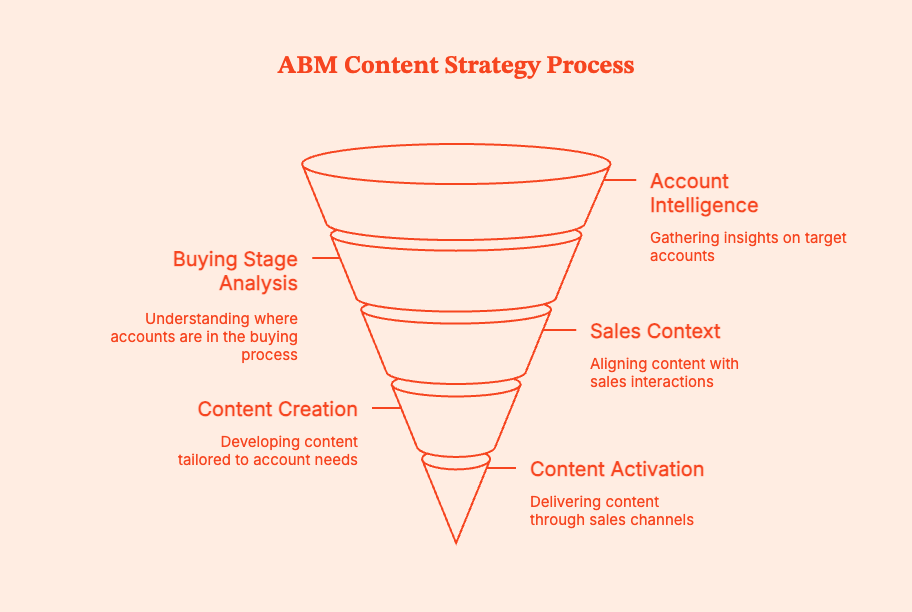
In practice, it means answering three uncomfortable questions:
- Which accounts are we trying to move this quarter?
- What decision are they currently stuck on?
- Who inside that account needs proof, reassurance, or leverage?
ABM content strategy plans, creates, and leverages content around those answers.
Within an inbound marketing content strategy, you publish and wait.
ABM content is:
- Triggered by account behavior
- Used directly in sales motion
- Measured in its impact by deal movement
Pro-Tip: If any content piece does not support a step in the sales funnel, it’s probably not ABM content.
ABM Content vs Inbound Marketing Content Strategy
| Dimension | Inbound Marketing Content Strategy | ABM Content Strategy |
|---|---|---|
| Primary audience | Unknown or loosely defined buyers | Named target accounts and buying groups |
| Core objective | Drive discovery, awareness, and demand | Influence decisions and advance active deals |
| Content trigger | Publishing calendar and SEO opportunities | Account-level intent capture and sales context |
| Messaging scope | Broad, to appeal to many | Specific to industry, role, and account |
| Personalization depth | Light (persona or segment-based) | Moderate to deep (account and buying-group level) |
| Role of sales | Minimal involvement early on | Direct use of content in live conversations |
| Activation channels | Blog, search, social, email nurture | Sales outreach, account-based ads, tailored landing pages |
| Success metrics | Traffic, engagement, MQLs | Account engagement, pipeline impact, deal velocity |
| Common misuse | Rebranded as “ABM” without context | Over-personalized before intent is proven |
| Best use case | Building awareness and educating the market | Moving specific accounts toward a buying decision |
Inbound content is the raw material. ABM content reframes existing assets around real account-related questions that arise at that moment.
{{INLINE_MOFU}}
The Operating Principles Behind ABM Content That Actually Works
ABM content often fails because teams skip the basics under pressure.
But these principles are essential and evidence-based on patterns that show up repeatedly when ABM programs either start influencing pipelines or just stall.
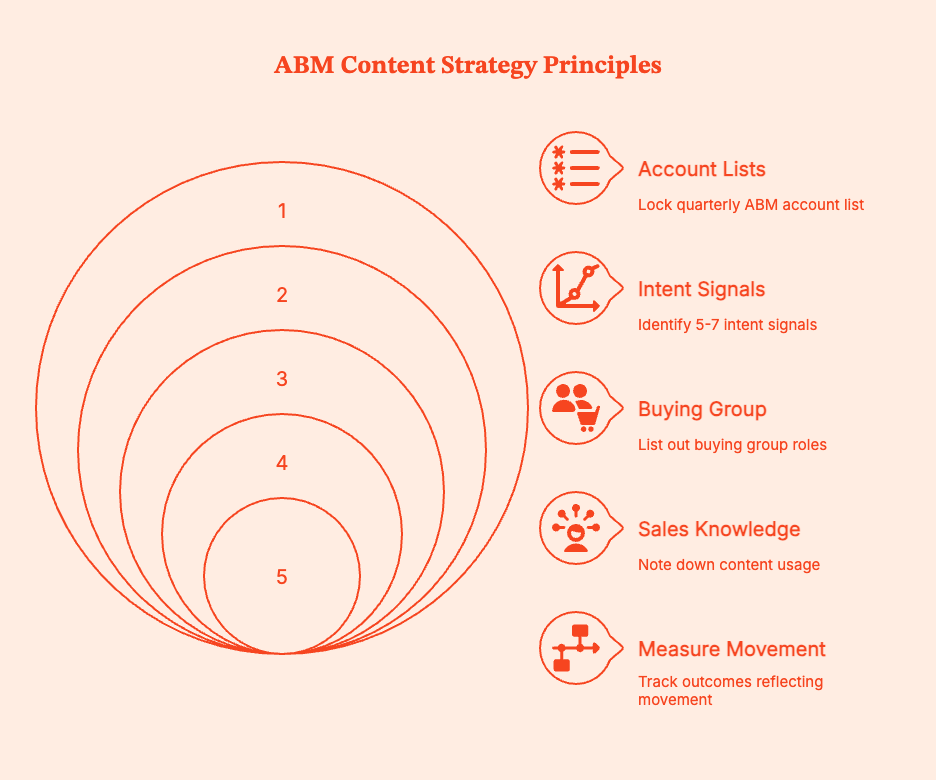
1. Account lists always come before content ideas
Don't ask “What content should we create?” before “Which accounts matter right now?” If you do, you end up with:
- Content that feels generic, truly relevant to no one
- Sales saying, “This does not work for my accounts.”
Instead, do this:
- Lock a quarterly ABM account list with sales
- Group accounts by shared decision blockers like budget approval, security review, and internal consensus. Don't just judge by industry or size.
- Then ask: What proof or clarity is missing for these accounts to move?
2. Intent, not calendars, determines timing
If you serve the right ABM content at the wrong moment, you find that even great content “didn’t work.”
Accounts move in bursts, pauses, and regressions. Your content marketing efforts have to match this momentum. Be timely, not persistent.
Instead, do this:
- Identify 5–7 intent signals indicating real movement: pricing/demo page revisits, competitor comparison views, repeat visits from the same account, direct engagement with sales emails, etc.
- Map one clear content action to each signal
- If an account isn’t showing buyer intent, don't bombard them with content. Consider letting the account rest for a while
Question: Are you counting LinkedIn intent data into your ABM brainstorming?
3. Buying-group coverage > persona perfection
You can refine personas all you want, but deals will get stuck even if one person in the B2B account has unanswered questions. ABM content works best if it is catered to core decisions in the sales pipeline, rather than these personas.
Instead, do this:
For each target account, list out:
- The economic buyer (who approves spending)
- The technical evaluator (who manages risk)
- The day-to-day user or champion (who actually uses the product)
Then ask yourself and your team: Which of these roles seem to currently lack proof or confidence in our product?
Now build ABM content to unblock that decision. Address specific concerns instead of throwing generic assets at them.
4. Sales must know when and how to use content
ABM content can't just live in marketing folders. If sales teams don't know when to use an asset, why it exists, and what it’s meant to achieve, it just won’t get used.
Instead, do this:
For every ABM asset, note down:
- When in the sales funnel, it should be used
- The specific objection or risk each content piece talks to
- The follow-up action that the content is meant to enable
If a salesperson can’t explain any asset’s purpose in one sentence, it's not ABM content, just marketing collateral.
5. Measure movement, not performance
ABM content isn't successful when it ‘performs’, but rather when it moves accounts along the buying pipeline.
Instead, do this:
Track outcomes that reflect movement, such as
- Target audience engaged after exposure
- If opportunities were created or accelerated by the content
- If relevant content has helped sales move conversations forward
Vanity engagement metrics do not matter. Only the ones that correlate with pipeline change do.
Types of ABM Content That Hold Up in Real Sales Cycles
Content for account based marketing works best when it is deployed at the exact moment a deal risks stalling.
Since B2B buying dynamics are mostly predictable, mature ABM pipelines tend to use content in a few repeatable categories.
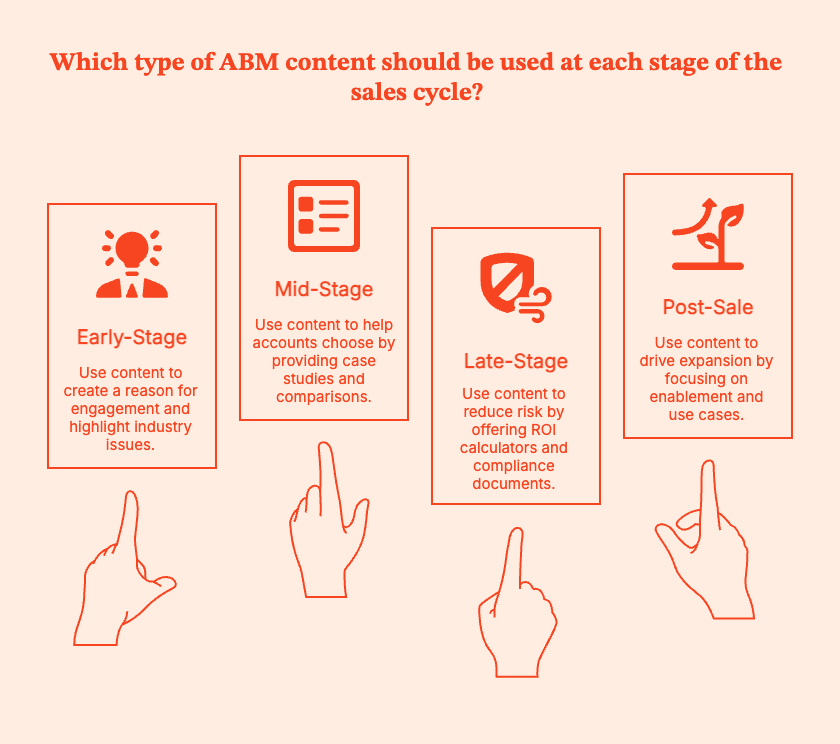
1. Early-Stage: Creating a Reason to Engage
Right now, key accounts are aware of the problem but not yet working on solving it, especially with you. You have to get their attention on said problem.
Try using:
- Industry POV memos talking about issues each account is likely feeling, but hasn’t focused on
- Problem-specific landing pages pointing out operational pain points rather than product features
- Lightly personalized ads speaking to the account’s industry, role, or maturity
Deploy this valuable content when accounts are still researching, or when sales needs a credible reason to start a conversation.
2. Mid-Stage: Helping Accounts Choose, Not Browse
At this stage, multiple stakeholders enter the conversation, internal comparisons begin, and “we need to review options” becomes a frequent reply.
Try using:
- Industry-specific case studies responding to each account’s structure
- Competitive comparison pages that acknowledge tradeoffs
- Webinars or workshops tailored to a narrow segment or buying concern
This content helps you when more than one stakeholder is involved, when deals stall, and when the account is comparing you to competitors.
3. Late-Stage: Reducing Risk, Not Selling Harder
Here, the deal has to be justified. Accounts tend to back off when they perceive some form of risk.
Try using:
- ROI calculators mapped to the account’s scale and cost hierarchy
- Security, legal, and compliance documentation to address specific risk concerns
- Custom decks aligned with the account's internal approval process
These assets are best used when budget, security, or procurement teams are involved as buyer personas.
4. Post-Sale: Expansion
Don't stop thinking about ABM once the deal closes. Instead, work on:
- Creating content around enablement, tied to real usage milestones
- Building expansion use-case playbooks for accounts based on similar growth paths
This content comes into play when sales and marketing teams want ABM to extend beyond acquisition, and when expansion depends on more product adoption and internal advocacy.
The goal of post-sale ABM content is to anticipate the next buying decision before the account explicitly asks for it.
Pro-Tip: The strongest ABM teams don’t create endless new assets but edit ruthlessly.
- Remove generic framing
- Use examples relevant to the account’s reality
- Map each asset to a specific deal moment
Focus on relevance, not novelty.
ABM Content Strategy for SaaS Teams
SaaS buying behavior is quite visible if you know what to look for. You can actually gauge intent way before anyone fills out a form or replies to sales messages.
SaaS teams can operationalize these signals via ABM content. The trick is to stitch together product data, content, and sales insights into ABM assets.
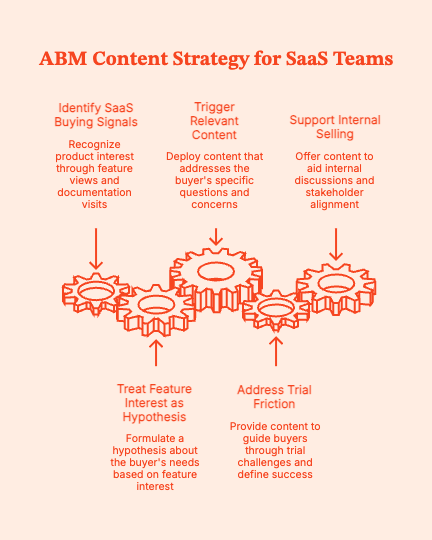
1. SaaS buying is product-informed
Serious SaaS buyers don’t read blog posts to make decisions. They explore feature pages, study product documentation, take free trials, and watch demos multiple times. ABM success comes from responding to signs of product curiosity with business contextual content.
These are the metrics to focus on, rather than engagement, eBook downloads, webinar attendance, and generic site visits.
2. Treat feature interest as a buying hypothesis
If an account repeatedly views a specific feature, they are probably wondering whether it can solve their problem.
Instead of retargeting such accounts with product ads or generic nurture emails, trigger content that explains:
- Why teams like them care about this capability
- What problem it typically solves
- What changes operationally after adoption
3. Pay attention to documentation and help-center visits
Pre-sale documentation page visits are one of the clearest signs of buying intent in SaaS. Such accounts are usually:
- Validating feasibility
- Pressure-testing the product
- Raising and debating internal questions
When you detect such account behavior:
- Flag repeated or deep documentation usage
- Trigger ABM content that anticipates implementation concerns, explains time-to-value, and shows how similar teams have onboarded successfully
4. Trial friction is an ABM content opportunity
When an account stalls inside a trial, don't jump right to blaming onboarding or UX.
It could be that:
- The buyer doesn’t know what “success” should look like
- The wrong stakeholder is judging the product
- The use case isn’t clearly mapped to ROI
Use ABM content to smooth the journey with:
- Role-specific “what success looks like” guides
- Use-case playbooks relevant to the account’s industry or size
- Short internal decision aids
5. Repeated demo views = internal selling (probably)
If an account watches demos multiple times over several days, that's usually a sign of internal sharing. Most probably, someone on the account side is discussing the product internally and trying to get other stakeholders on board.
Deploy high-impact ABM content to help them out. This can include:
- One-page decision summaries
- Stakeholder-specific FAQs (security, finance, ops)
- ROI narratives that can be forwarded without explanation
Note: The biggest ABM content marketing strategy mistake is treating ABM content as gated inbound content (long-form, overproduced assets, no clear instructions for sales use, etc.). ABM needs to be shorter, sharper, and tied to specific moments in the customer journey.
How Factors.ai enables ABM
Most ABM programs stall due to visibility and handoff issues. Marketing creates or curates account-level content, but nobody knows which accounts are engaging, how that engagement helps deals, or when sales should act. Factors.ai fixes those gaps by extracting account signals from raw engagement data.
1. What Factors actually gives you
- Anonymous account identification to match IP and behavioral patterns to companies. Uses firmographics to show who’s visiting even before forms are filled.
- Unified account-level intent to analyze website behavior, intent feeds, ad interactions, and trial/demo signals. Combines this data into a single account engagement profile.
This might help: A Guide to Intent Data Platforms: Features, Benefits & Best Tools
- AI scoring & Milestones that score accounts by fit + intent, detect milestones (e.g., pricing page + repeated docs views), and point out accounts that look ready for conversation.
- Activation & orchestration to notify sales, trigger outbound sequences, and refresh ad audiences automatically (AdPilot/activation features).
- Account-first attribution that connects content and engagement to pipeline and revenue.
In other words, with Factors.ai in your ABM toolkit:
- You stop guessing which content gave a win. You know which account visited which pages, saw which ads, and led to what opportunity.
- You act at the right moment. Factors will trigger content or sales actions (like reaching out, sending a specific deck) when an account shows signals of buying interest.
- You make sales-shareable content for the buyer. When you know which stakeholder is interacting, you can push the right asset that tips the scales in your favor.
2. How to wire Factors.ai into your ABM content operating model
| Step | What You Do | How You Configure It |
|---|---|---|
| 1. Map content → intent taxonomy | Inventory all ABM assets (exec briefs, ROI calculators, security packs, industry case studies) | Tag each asset by Objective (educate, de-risk, justify), Buyer role (finance, security, user), and Buying stage (evaluation, decision) |
| 2. Connect product & marketing signals | Integrate CRM (HubSpot/Salesforce) and product or trial analytics | Ensure feature page views, demo replays, documentation usage, and trial events appear as account-level activity |
| 3. Define high-confidence intent triggers | Identify 5–7 behaviors that strongly indicate buying momentum | Examples: pricing page views ≥ 3 in 7 days, deep docs reads ≥ 2, demo replay by a new stakeholder, trial active ≥ 5 days with usage, competitor comparison visits |
| 4. Map triggers → actions | Decide what happens when each trigger fires | For every trigger, define: asset to surface, sales play, and alert threshold |
| 5. Configure scoring | Combine fit (ICP data) and intent into a single account score | Set a Sales Ready threshold that auto-creates CRM tasks with recommended assets attached |
| 6. Activate ads & outreach automatically | Turn high-intent accounts into live GTM actions | When the threshold is crossed: refresh LinkedIn/Google audiences, deliver stage-appropriate ads, trigger SDR sequences with forwardable assets |
| 7. Close the loop with attribution | Measure what actually moved deals | Attribute pipeline influenced, opportunity velocity, and win rate lift to content + activation paths |
3. Measuring ABM Content Success
| Measurement Area | What to Track | How to Measure It (Practically) | Decisions It Should Drive |
|---|---|---|---|
| Meaningful account engagement | % of target accounts that show sustained, high-intent interaction | Track repeat visits, depth of content consumption, and intent signals aggregated at the account level | Which accounts deserve immediate sales focus vs. continued warming |
| Buying-group coverage | Number of distinct stakeholders engaging per account | Identify unique roles (finance, security, user) interacting with content across channels | Whether to introduce role-specific content or bring new stakeholders into the conversation |
| Opportunities influenced or accelerated | Pipeline $ where ABM content appeared before opportunity creation or stage progression | Use multi-touch, account-level attribution to connect content exposure to opportunities | Which content types and plays actually move revenue |
| Deal velocity impact | Change in time between key deal stages | Compare sales cycle length for engaged vs. non-engaged target accounts | Whether ABM content is removing friction or just creating noise |
| Sales feedback loops | Qualitative usefulness of content in real deals | Collect structured sales input: Was this asset sent? Did it help? Would you reuse it? | Which assets to keep, refine, or kill |
Common ABM Content Strategy Mistakes
Most ABM content failures don’t blow up campaigns or trigger emergency meetings. They drain time, budget, and credibility until teams either mistakenly conclude that “ABM doesn’t work”. Or, they accurately realize that ABM exposes weak operating models.
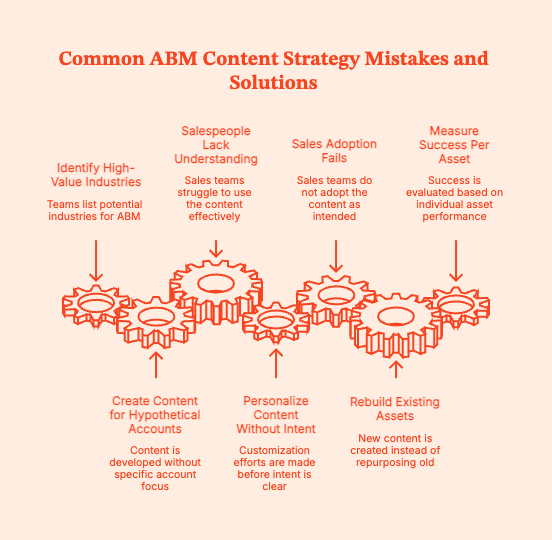
1. Creating content before account prioritization
Often, ABM starts with a quarterly planning meeting, a list of “high-value” industries, and content ideas. The high-value accounts are forgotten, which means:
- Content is designed for hypothetical accounts
- Salespeople don't understand how to use it
Instead, try this:
- Set up a time-bound ABM account list (30–90 days)
- Tie every asset to specific accounts
- If you can’t name the deal a content piece aims to influence, toss it
2. Over-personalizing before intent is clear
In ABM, personalization is not equivalent to effectiveness. Don't spend time creating heavily customized content for accounts that haven’t yet shown buying signals. You just end up with:
- High effort, low response
- Teams burning out trying to scale 1:1 assets
- Leadership questioning ROI
Instead, try this:
- Only personalize content for accounts showing intent
- Start with light contextualization according to industry, role, and problem
- Only offer deep customization to accounts showing high-confidence signals
3. Expecting sales adoption without enablement
Don't just create “ABM-ready” content and wait. Often, sales does not know how to use it. The content also might not map clearly to account objections.
Instead, treat every ABM asset like a sales tool. Define the moment in the sales funnel when it should be used, the specific objection it addresses, and the next step it enables.
Review ABM assets in sales meetings, not just marketing syncs.
4. Rebuilding assets that already exist
Marketing teams assume ABM requires entirely new content libraries, which eats up duplicate effort, pushes longer timelines, and results in inconsistent messaging.
Instead, try this:
- Audit existing content ruthlessly
- Strip away generic pointers
- Rebuild assets around specific account problems, clear account questions, and internal objections
5. Measuring success per asset instead of per account
Often, teams running ABM look at engagement without noticing how the content impacts deals. Content optimization happens in a vacuum, and eventually sales loses trust in marketing data.
Instead, measure this:
- Accounts engaged
- Stakeholders reached
- Deals influenced or accelerated
- Kill or refine assets that don’t move accounts forward
Delete or refine assets that do not move any accounts to
the final purchase. Judge the success of ABM content at the account level, not the asset level.
Summary
ABM content strategy is a structured, account-first approach to planning, activating, and measuring content that influences specific target accounts and buying groups. It does not bother with boosting anonymous traffic. Unlike inbound marketing content strategy, which optimizes for reach and discovery, ABM content strategy optimizes for relevance, timing, and deal progression.
In practice, ABM content works best when teams start with account prioritization, not content ideas. Define which accounts matter in a given window, identify the decisions those accounts are stuck on, and create or repurpose content to unblock those decisions. Content is activated based on account-level intent signals (pricing views, demo replays, documentation usage, or trial behavior) and is used directly in sales interactions.
For SaaS companies, ABM content strategy helps because buying intent is visible early through product behavior. Feature interest, trial friction, repeated demos, and technical validation are signals that directly impact business impact, risk reduction, and internal justification.
ABM content success is evaluated at the account level, using metrics such as buying-group coverage, pipeline influenced, deal velocity, and sales adoption. Vanity metrics such as pageviews or asset-level conversion rates are not important here.
Tools like Factors.ai enable ABM content execution by identifying high-intent accounts (including anonymous visitors), tracking account-level content engagement, activating timely sales actions, and mapping content exposure to pipeline and revenue outcomes.
FAQs for ABM Content Strategy
Q. What is ABM content strategy?
ABM content strategy is a structured approach to planning, delivering, and measuring content for specific target accounts and buying groups. This content is based on account intent, buying stage, and sales context. It aims to move accounts through real deals, not to generate traffic or leads at scale.
Q. How is ABM content strategy different from inbound marketing content strategy?
An inbound marketing content strategy aims to attract unknown buyers through SEO, social, and gated content. ABM content strategy supports known accounts that are already analyzing solutions. It deploys content based on intent signals and aligns directly to sales conversations.
Q. What types of content work best for account-based marketing?
Account based marketing content is best served by content that helps buyers evaluate risk and justify decisions. For example, industry-specific case studies, ROI or cost-impact calculators, competitive comparison pages, security and compliance documentation, and short sales-enablement assets for internal sharing.
Q. Can ABM content strategy scale for SaaS companies?
Yes. ABM content strategy scales for SaaS when teams reuse inbound content and deploy it according to account intent and product signals (such as feature interest, demo replays, or trial behavior).
Q. Do you need to create new content for ABM?
In most cases, no.
Successful ABM teams recontextualize existing inbound and sales content, and anchor it to account-specific context, buying-stage questions, and real objections.
Q. How personalized should ABM content be?
Light personalization (industry, role, problem) works early. Deep, account-specific personalization should be reserved for high-value accounts that show clear buying intent. Increase personalization with intent, not by default.
Q. How do sales teams use ABM content?
Sales teams utilize ABM content to initiate conversations, address objections, facilitate internal decision-making, and expedite deals. If content cannot be used directly in sales outreach or follow-ups, it is not effective ABM content.
Q. What tools are required to execute an ABM content strategy?
Teams need tools for CRM alignment, easy access to sales-ready content, and account-level visibility into engagement and intent. Without account intelligence, ABM content is difficult to scale.
Q. How does Factors.ai support ABM content execution?
Factors.ai supports ABM content execution by identifying high-intent accounts (including anonymous visitors), tracking content engagement at the account level, activating timely sales actions, and connecting content to pipeline and revenue outcomes.
Q. Is ABM content strategy only for enterprise teams?
No. While enterprise teams use ABM, mid-market SaaS teams often see faster results because account lists are shorter, sales cycles are cleaner, and marketing–sales collaboration is easier to achieve.

See how Factors can 2x your ROI
Boost your LinkedIn ROI in no time using data-driven insights


.avif)

.avif)
See Factors in action.
Schedule a personalized demo or sign up to get started for free
LinkedIn Marketing Partner
GDPR & SOC2 Type II

.svg)



.avif)

