
ABM Segmentation: Because "Everyone with a Budget" Isn't Actually a Target Segment
Learn how to build an ABM segmentation strategy using firmographics, intent, behavior, lifecycle data, and a real-world framework from Fingerprint.

Growth Marketer
.avif)
Content Marketer



.svg)


Quick Summary
- ABM segmentation is the process of grouping target accounts based on factors such as fit, behavior, intent, lifecycle stage, and commercial potential.
- Strong ABM segmentation goes beyond basic firmographics like industry and company size. It should help you decide which segments are actually worth pursuing and how much attention they deserve.
- We’ll also draw on an earlier conversation with Alexander Goodwin, Director of Demand Generation at Fingerprint, where he shared how Fingerprint evaluates verticals using customer concentration, average and median ARR, and expansion rate before prioritizing individual accounts.
- Segmentation and tiering are related but different. Segmentation tells you which accounts belong together. Tiering determines how much time, budget, and personalization those accounts receive.
ABM segmentation sounds simple enough. Group similar accounts together, build relevant campaigns, and focus your sales and marketing efforts where they matter most.
In practice, a lot of ABM segmentation still stops at broad filters like industry, company size, and geography. That gives you a cleaner account list, but it doesn’t necessarily tell you which segments are commercially attractive, which accounts within them are worth pursuing, or how you should treat them differently.
This guide breaks down the different layers of ABM segmentation and how to turn them into a practical targeting model. We’ll also use examples from an earlier conversation with Alexander Goodwin, Director of Demand Generation at Fingerprint, including how his team evaluates verticals and narrows a broad market into more focused ABM segments.
What is ABM segmentation?
ABM segmentation is the process of dividing your market into meaningful groups of accounts that share characteristics relevant to how you sell and market.
Those characteristics could include:
- Industry
- Company size
- Geography
- Use case
- Technology stack
- Buying behavior
- Intent
- Lifecycle stage
- Revenue potential
The important part is that the segmentation should change what you do.
If two segments get the same ads, content, outreach, and level of investment, the distinction probably isn't helping much.
Useful segmentation should help you answer:
- Which accounts are worth pursuing?
- What do they have in common?
- What should we say to them?
- How much should we invest?
- What should happen next?
The 4 Layers of ABM Segmentation
Most useful ABM segmentation combines multiple layers rather than relying on one variable.
Layer 1 - Firmographic segmentation
Firmographic segmentation is the most familiar starting point.
It includes information such as:
- Industry
- Company size
- Revenue
- Geography
- Funding stage
- Business model
- Technology stack
These filters help remove accounts that clearly aren't a fit.
The problem is stopping there.
"Mid-market fintech companies in North America" still doesn't tell you whether fintech deserves more of your ABM budget than ecommerce, marketplaces, or another vertical.
Fingerprint faced this problem while building its enterprise ABM program. Its product can apply across several industries, which made choosing where to focus particularly important.
As Alex put it: "When you try to market to everyone, you market to nobody."
Rather than picking verticals based only on TAM or intuition, Fingerprint starts with its existing customer data and looks at three things.
Customer concentration. How many customers do you already have in the vertical? A meaningful concentration can be an early sign of repeatable demand or product-market fit.
Average and median ARR. Customer count tells you where you're winning. ARR helps determine whether those wins are valuable enough to justify further investment. Fingerprint looks at both average and median ARR because a few unusually large contracts can distort the average.
Expansion rate. A strong initial contract is useful. A segment where customers consistently grow after landing may be even more attractive.
Together, these metrics help answer a better question than "Can this industry buy from us?"
Can we repeatedly win valuable customers here and grow them over time?
You can turn that into a simple scorecard.
Fingerprint used a similar approach to decide where to concentrate its own efforts. Fintech became a focus area because the team had developed a strong, repeatable enterprise motion there. Identity and Security stood out for expansion and growth potential. Marketplaces showed promise, but remained a growth bet rather than an established focus segment.
Choosing the vertical is still only the first filter.
Fingerprint then qualifies individual companies based on whether they actually have a problem the product can solve and how large that problem could be. Signals such as public login pages, transaction flows, website traffic, and app downloads help the team move from attractive segment to worthwhile account.
Layer 2: Behavioral Segmentation
An account visiting your homepage once shouldn't necessarily be treated the same as one where several people have repeatedly visited your pricing, integrations, and product pages.
Useful behaviors can include:
- Website visits
- Pages viewed
- Repeat sessions
- Content consumption
- Webinar registrations or attendance
- Ad engagement
- Email engagement
- Product or free-trial activity
- Engagement from multiple people at the same account
One action rarely tells the whole story.
Patterns matter more.
One visitor reading a blog could simply be researching a topic. Several people from the same account returning to product pages, attending a webinar, and looking at integration content paints a very different picture.
Behavior doesn't replace fit.
It helps you understand which of your fitting accounts may deserve more attention.
Layer 3: Intent Segmentation
Intent segmentation looks at signals suggesting that an account may be actively researching a problem, category, or solution.
You can broadly divide intent into three types.
- First-party intent comes from properties you own. Website activity, product usage, webinar attendance, email engagement, and other direct interactions fall into this bucket.
- Second-party intent is another company's first-party data that is made available to you, such as activity on certain review or publisher platforms.
- Third-party intent aggregates activity across external sources to estimate which accounts may be researching relevant topics
Each can be useful, but none should be interpreted alone.
An account surging on a broad topic doesn't automatically mean it wants your product. A pricing-page visit doesn't guarantee a deal either.
Look for combinations of fit, behavior, and intent.
There is another important nuance for high-ACV ABM. Intent doesn't always have to be a gate.
Fingerprint sells into large accounts where buying cycles can run for six to twelve months. Alex explains that a prospect using another tool today can still be worth pursuing because its circumstances may be very different by the time a long enterprise sales process develops.
In those situations, intent can help answer:
How should we approach this account right now?
rather than only:
Should we pursue this account at all?
Layer 4: Lifecycle Segmentation
Two accounts can have similar fit and intent while needing completely different campaigns because they're at different stages of the relationship with you.
Common lifecycle segments include:
- Unaware: Fits your market but has shown little engagement
- Researching: Exploring the problem or relevant content
- Evaluating: Comparing approaches or vendors
- Active opportunity: Sales is already working the account
- Closed-lost: Evaluated you previously but did not buy
- Customer: Focus shifts toward adoption or expansion
- Churned or dormant: Has an older relationship that may be reopened
These groups shouldn't receive the same message.
Someone in an active opportunity probably doesn't need another generic "book a demo" campaign. A closed-lost account needs a new reason to reconsider.
Lifecycle segmentation helps make sure your ABM program reflects the relationship you actually have with the account.
Common ABM Segmentation Mistakes
Treating every enterprise account the same
"Enterprise" isn't a strategy.
Two 5,000-person companies in the same vertical can have completely different use cases, priorities, buying committees, and revenue potential.
Firmographic similarity doesn't automatically mean commercial similarity.
Building segments once and never updating them
Some account attributes change slowly.
Behavior and timing don't.
Companies hire executives, enter new markets, adopt products, change vendors, launch initiatives, and shift priorities.
Your segmentation needs to reflect those changes.
Ignoring the buying committee
ABM happens at the account level, but companies don't make buying decisions as one entity.
A technical evaluator, business leader, economic buyer, and end user may all care about different things.
Finding the right company is only part of the job. You also need to understand who inside it matters.
Confusing your TAM with your target account list
Your TAM tells you how large the opportunity could theoretically be.
Your target account list should be narrower.
It should contain companies you have a real case for pursuing based on fit, commercial potential, strategic importance, and available signals.
A large TAM is useful.
A large undifferentiated account list usually isn't.
Treating segments and tiers as interchangeable
A vertical is a segment.
"Tier 1" isn't.
Tier 1 tells your team how much investment an account deserves. It doesn't explain why those accounts belong together or what message should resonate with them.
Build the segment first. Then assign the appropriate level of investment.
How to build your ABM segments
Step 1: Use your existing customers to find your strongest segments
Don't start by brainstorming industries you think should buy from you. Start with customers that already do.
Break your customer base down by dimensions that could meaningfully affect how you go to market:
- Vertical
- Company size
- Use case
- Business model
- Geography
- Technology environment
Then compare those groups against commercial outcomes.
Fingerprint's framework gives you a useful starting point for vertical segmentation:
- Number of customers
- Average and median ARR
- Expansion rate
Depending on your business, you might also look at:
- Win rate
- Average sales cycle
- Retention
- Customer acquisition cost
- Product adoption
- Average contract value
You don't need a scoring model with dozens of variables.
You need enough evidence to understand where you've already shown that you can repeatedly win and grow valuable customers.
Then look deeper.
What problems were those customers solving? Which use cases kept appearing? Who championed the deals? What made the product important enough to buy?
That is how your ICP becomes more useful than a list of firmographic filters.
Step 2: Qualify the accounts inside those segments
Once you've identified attractive segments, look at individual accounts.
Ask:
- Does the company actually have the problem we solve?
- Can we find evidence of that problem?
- How large could the opportunity be?
- Does the account justify the level of investment we're considering?
The signals should be specific to your business.
This is the step that prevents "good industry" from becoming "every company in that industry."
Step 3: Layer in behavior and intent
Now look at what those accounts are doing.
Which ones are visiting your website? What are they looking at? Are several people engaging? Have they attended events or consumed relevant content? Do you have external intent signals?
Use these signals to understand timing and prioritize activity.
Just don't automatically discard a valuable strategic account because it isn't showing obvious intent this week.
Step 4: Assign account tiers
Once you know who belongs in your program, decide how much investment each account should receive.
Intent shouldn't be the only thing determining the tier.
Potential value, strategic importance, fit, signals, and the amount of effort your team can realistically support all matter.
Step 5: Map the message to the segment
Once your segments are clear, the message should change.
A fintech company dealing with account fraud shouldn't receive the same campaign as a marketplace dealing with fake signups simply because both fit your ICP.
Segmentation can influence:
- Ad creative
- Landing pages
- Content
- Sales outreach
- Events
- Offers
- CTAs
If nothing changes between two segments, ask whether they really need to be separate.
Step 6 - Keep reviewing the model
Segmentation isn't a one-time exercise.
Review which segments are producing opportunities and revenue. Compare actual deal sizes with what you expected. Watch expansion and retention. Look at which accounts are moving between lifecycle stages or tiers.
A growth bet may become one of your strongest segments.
Another market may generate plenty of engagement but very little commercial value.
The goal isn't to prove your original segmentation correct.
It's to keep improving it.
Wrapping Up
ABM segmentation is not a one-time thing. It's not a spreadsheet exercise. And it's definitely not just slapping industries onto a list and calling it a day. It's a living, dynamic system that combines who your best accounts are, what they're doing right now, and what they actually need to hear from you.
Get it right, and ABM stops being a buzzword your CMO loves and starts being the actual engine behind your pipeline.
The choice is delightfully obvious.
FAQs on ABM Segmentation
1. How many accounts should actually be in an ABM segment?
It depends on your "Tier." For 1:1 (Strategic ABM), a segment is usually a single high-value account. For 1: Few (Lite ABM), segments typically range from 10 to 50 accounts, clustered around a very specific problem or industry.
If your "segment" has 1,000+ accounts, you aren't doing ABM, you’re doing traditional demand gen with an expensive name.
2: Can I do ABM segmentation effectively if I don't have a 6-figure budget for tools like 6sense?
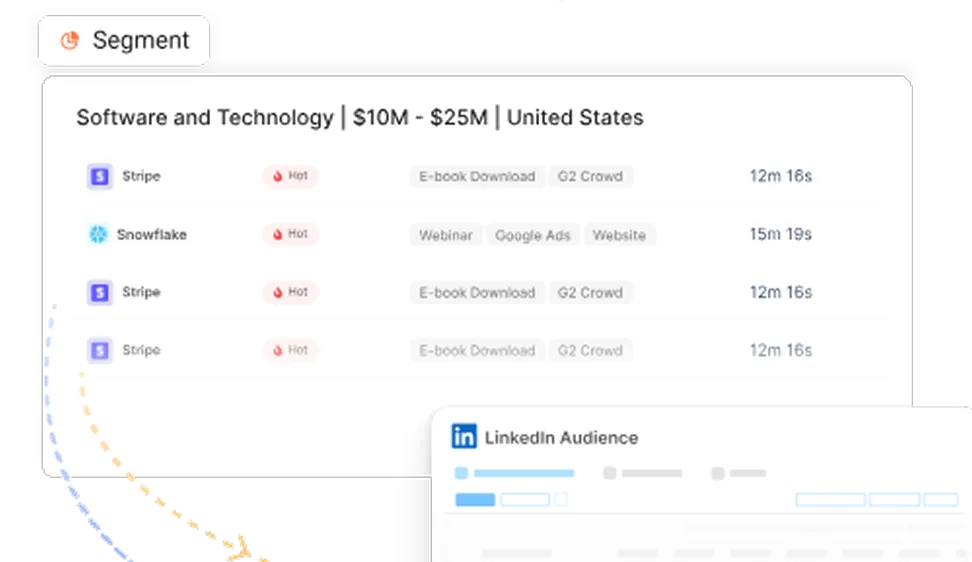
Yes. The "scrappy" community favorite is the CRM + Visitor ID stack. You can build segments manually in HubSpot or Salesforce using firmographic data, then layer in a visitor identification tool and intent data (like Factors.ai) to see which of those accounts are actually hitting your site. You don’t need an "ABM Platform" to segment; you just need a way to connect Who they are (CRM) with What they’re doing (Website).
3: Why do my ABM segments "decay" or stop working after a month?
Because accounts are dynamic, but spreadsheets are static. ABM segmentation fails when it’s treated as a one-time project. Reddit experts suggest that intent signals decay every 30 days.
An account researching "HR software" in January might have signed a contract with a competitor by February. To fix this, use "Active Lists" that automatically add or remove accounts based on real-time behavior and CRM stage.
4: Should I segment by job title or job function in ABM?
At the Enterprise level (1,000+ employees), segment by job title to reach the specific buying committee (e.g., "VP of RevOps"). For Mid-Market or smaller companies, title-based segments often make your audience size too small for ad platforms like LinkedIn to even run. In those cases, segment by Job Function + Seniority (e.g., "Marketing" + "Director level") to ensure your ads actually deliver while staying relevant.
5: What is the biggest mistake when moving from Demand Gen to ABM segmentation?
Confusing your TAM (Total Addressable Market) with your TAL (Target Account List). Your TAM is everyone who could buy; your ABM segments should only be the people who should buy right now, based on fit and intent. Community members frequently warn that "moving everything out of demand gen into ABM" without proven intent signals is a recipe for a "zero-revenue" Q3.

See how Factors can 2x your ROI
Boost your LinkedIn ROI in no time using data-driven insights


.avif)
See Factors in action.
Schedule a personalized demo or sign up to get started for free
LinkedIn Marketing Partner
GDPR & SOC2 Type II






.svg)



.avif)

