
ABX Strategy Explained: What It Is, How It Works, and Why It Matters for B2B Growth
Learn what ABX strategy is, how it aligns sales, marketing & CX, and why B2B companies must embrace it for sustainable growth.

Writer
.avif)
Content Marketer



.svg)


TL;DR
- ABX (Account-Based Experience) focuses on the full B2B customer lifecycle, not just acquisition. It works to connect marketing, sales, and customer success teams into one continuous account journey and shared context.
- ABX goes beyond ABM by prioritizing long-term account value, retention, and expansion instead of only pipeline and deal creation. It uses “experience” to win over high-value accounts.
- Modern B2B buying involves multiple stakeholders, longer decision cycles, and higher expectations. If stakeholders have fragmented experiences with different teams, they are likely to just drop the deal.
- Successful ABX requires unified data, cross-functional alignment, journey mapping, and continuous feedback. Simply better marketing campaigns won’t cut it.
- For B2B SaaS companies, ABX is a sustainable growth model that directly improves win rates, reduces churn, and increases customer lifetime value over time.
Last year, an almost perfect B2B fell apart right in front of me.
Marketing did its job. User intent was high, the account was actively engaged, and they were responsive in all demo meetings. Sales closed it too.
Three months later, the renewal conversation went…not great.
The customer was confused.
They had been promised one thing, onboarded into another, and supported like they were a completely different company. Their interactions with us felt disconnected with new people, context, and explanations at every step.
Essentially, the customer was dealing with a new experience every time our organization changed its priorities or product priorities. We weren’t considering them when making these decisions.
This gap between marketing, sales, and customer experience is where ABX (Account-Based Experience) comes into play.
ABX helps organizations treat their potential customers and existing accounts as long-term relationships rather than short-term transactions. One shared context, narrative, and continuous journey.
In this guide, I’ll detail
- What ABX strategy actually is
- How it goes beyond traditional ABM
- Why it matters for B2B growth
- And how companies can implement ABX and acquire customers without losing their minds
What is ABX (Account-Based Experience)?
ABX (Account-Based Experience) is a market strategy using data, intent, and behavioral insights to enable relevant and trustworthy customer interactions across the B2B customer journey.
It focuses on delivering cohesive experiences across marketing, sales, and customer success. No more isolated campaigns.
ABX treats each account as a “market of one”. Every customer touchpoint (from initial awareness to onboarding to support conversations) merges into a single continuous experience.
This is necessary because B2B buying decisions often involve multiple stakeholders, take months to close, and require significant support even after the deal is closed.
Why ABX Matters for B2B
What I keep seeing is that B2B teams still work with 2018 playbooks. Naturally, pipelines take longer to convert, deals stall, and almost-won accounts continue to churn.
B2B buyers are smarter. Deals now involve large buying committees with 6 to 10 stakeholders. Decision cycles are longer, with more internal reviews, budget scrutiny, and risk evaluation. Expectations for products are also much higher.
This is a high bar, and many B2B teams aren't making the cut.
Traditional Demand Gen is Breaking Down
Generic demand gen has lost its edge.
Every inbox, LinkedIn feed, and ad platform has been bombarded with content, but buyer attention hasn’t increased. Buyers are overwhelmed by content, and most outreach messages are ignored or filtered. When the customer speaks, marketers don't really listen.
Even if marketing teams can generate leads, not many of those accounts actually convert, retain, and expand.
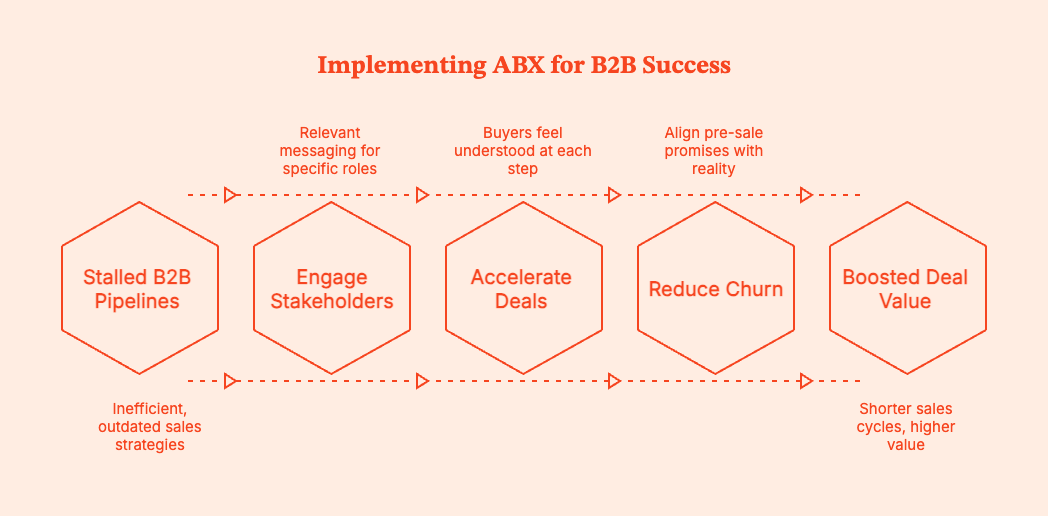
ABX changes the equation
ABX shifts the focus from: “How many leads did we generate?” to “How well did we serve this account across its entire journey?”
It designs product and org growth around customer value. Marketers can use ABX to:
- Engage multiple stakeholders in the same account with messaging relevant to specific roles and concerns
- Move deals forward faster, because buyers feel understood at each step
- Reduce churn by ensuring pre-sale promises match post-sale reality
Account-based strategies have already been shown to increase deal value by 171% and shorten sales cycles by 40%. To keep the gains long-term, you need the ‘Experience’ in ABX.
{{INLINE_MOFU}}
ABX vs ABM: Key Differences
You already know what ABX is.
Account-Based Marketing (ABM) is a B2B strategy that targets high-value accounts as individual markets. It uses personalized campaigns to push for higher rates of acquisition and pipeline.
| Parameter | Account-Based Marketing (ABM) | Account-Based Experience (ABX) |
|---|---|---|
| Primary focus | Acquiring and converting high-value accounts | Supporting the account from initial contact to renewal, and everything that comes after. |
| Core objective | Pipeline generation and deal creation | Long-term account value, retention, and growth |
| Teams involved | Mainly marketing and sales | Everyone involved with the account is finally on the same page |
| View of the account | Target account for campaigns | Ongoing relationship and evolving experience |
| Data & signals used | Firmographics, account lists, historical engagement | Firmographics + intent data + real-time behavioral signals + usage data + feedback |
| Engagement style | Pre-planned campaigns and outreach following a fixed schedule | Relevant interactions that adapt to what the account is doing and what it needs next |
| Personalization depth | Campaign-level and persona-based | Different messages for different roles, delivered at the right stage of the relationship. |
| Journey coverage | Mainly pre-sale stages (awareness → purchase) | Full journey (awareness → onboarding → adoption → renewal → expansion) |
| Success metrics | MQLs, SQLs, pipeline, win rate | Account health, retention, expansion revenue, customer satisfaction, lifetime value |
| Time horizon | Short- to mid-term revenue impact | Long-term, compounding revenue growth |
Bottomline: ABM shows who to focus on. ABX tells you how to treat them.
Core Components of a Successful ABX Strategy
Fundamentally, ABX is a set of very practical disciplines performed consistently that place the account at the center of operations. You're literally changing how a company shows up for customer accounts over time.
Here's how to make it work.
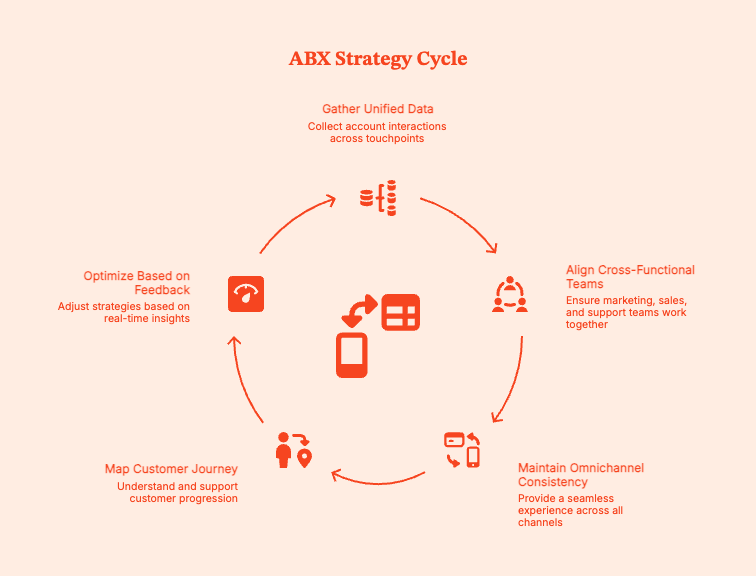
- Unified Data and Intent Signals
The foundation of ABX is account intelligence. Start with getting a unified view of each account interaction across touchpoints:
- Firmographics: industry, size, region, tech stack
- Website and content engagement: who’s visiting, what they’re reading, what they’re ignoring
- Product or trial behavior, where applicable
- Intent data: in-market signals, competitive research, and topic interest
- CRM activity: sales intelligence and conversations, deal stage, objections.
- Customer feedback: support tickets, NPS, qualitative notes
This context allows for data-based personalization rather than educated guesswork. No more assumptions. Only evidence-backed relevance.
- Cross-Functional Alignment
Let's cut to the chase. ABX does not work unless marketing, sales, customer success, and support teams:
- Work from the same account view
- Pursue shared goals, not competing KPIs
- Speak the same data language
If such alignment does not occur, here's what happens:
- Sales promises features that customer support (CS) isn’t ready to support.
- CS inherits accounts without context.
- Marketing optimizes for engagement, but it doesn't convert to revenue.
Omnichannel Consistency
In ABX, your answer to the following question needs to be yes every time.
If a customer read your email, talked to sales, and opened a support ticket in the same week, would it all feel like it came from the same company?
That means emails shouldn't contradict the information in sales calls, ads shouldn't say anything different from live conversations, and support shouldn’t be surprised by what was promised in pre-sale conversations.
Journey Mapping and the Customer Value Journey
ABX is not campaign-led. It is experience-led.
ABX works in cohesion with:
- The customer journey: how accounts discover and evaluate you.
- The customer service journey: how accounts are supported in the pipeline.
- The customer value journey: how they actually realize ROI over time.
Most B2B accounts move through these stages of the customer journey:
- Awareness
- Evaluation
- Purchase
- Onboarding
- Adoption
- Expansion
- Renewal or advocacy
Internal teams, however, often do not make decisions based on where the customer accounts are on the buyer's journey. They mostly consider internal timelines of quarterly campaigns, sales quotas, and renewal dates.
ABX brings account activity into consideration, so that prospective customers get messaging and support around the product journey and evolution.
Feedback and Continuous Optimization
ABX strategy has to keep adjusting based on real-time feedback. You need to keep a hawk’s eye on:
- How accounts respond post-sale.
- Friction in onboarding and support.
- Drops in engagement before churn happens.
- Changes to be made to messaging, plays, and support accordingly.
You learn faster than your competitors and keep tweaking messaging, assets, and support to deliver better experiences, stronger customer relationships, higher retention, and easier expansion.
How ABX Aligns Sales, Marketing and Customer Success
A disjointed customer experience is a B2B team's worst nightmare. And yet it keeps happening because go-to-market teams are structurally set up for failure.
Here's how it usually goes:
- Marketing generates interest
- Sales convert interest into a deal
- Customer success inherits the customer who has expectations that the CS team wasn't part of setting or even knowing (in many cases)
From the customer's POV, the experience resets every time they talk to a new team. They're left asking:
- “We were told onboarding would be lightweight.”
- “This isn’t how sales described the workflow.”
- “Why am I explaining this again?”
The problem isn't product gaps but lost context.
ABX changes the sequence from Marketing → Sales → handoff → CS to one continuous account story, shared across teams that keep evolving with time.
All teams now know:
- What sparked the account’s first interest?
- What content influenced which stakeholders?
- What objections came up in sales conversations?
- What value was promised, and exactly how it was framed?
- What does success look like from the customer’s point of view?
In the real world, this looks like:
- Sales teams knowing what content, webinars, or use cases actually moved the deal forward.
- Customer success teams knowing not just what was sold, but why the customer bought it and with what expectations.
- Marketing teams continuously learning from post-sale behavior, such as what features get adopted, where accounts struggle, and what leads to expansion.
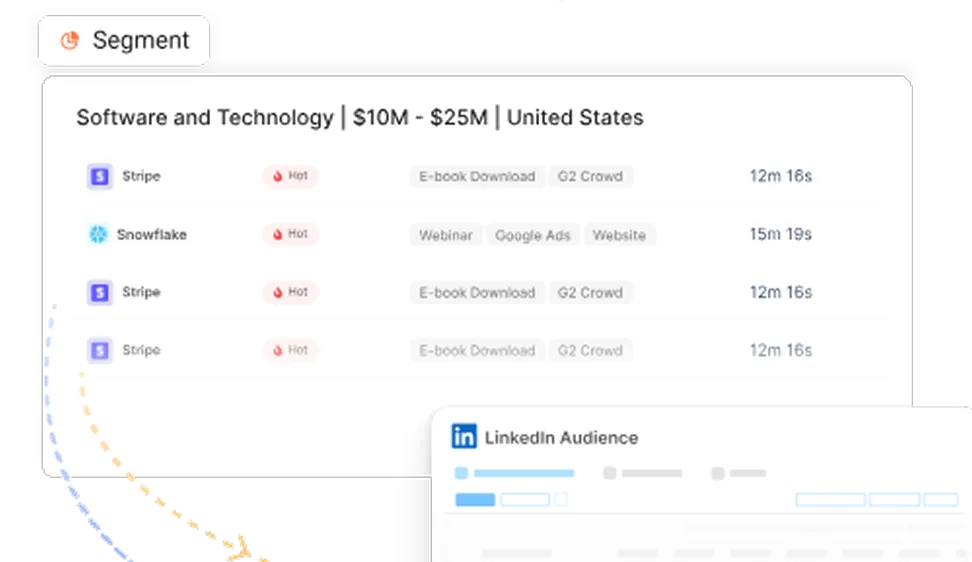
A tool like Factors.ai can provide the shared context alignment needed for cleaner handoffs, better onboarding, smarter upsell timing, and happier customers.
ABX Through the Lens of the Customer Journey & Customer Value Journey
An ‘account’ in B2B is not a single person with a single opinion. Instead, you'll deal with an ecosystem of people, each experiencing your product in a different way, at a different pace.
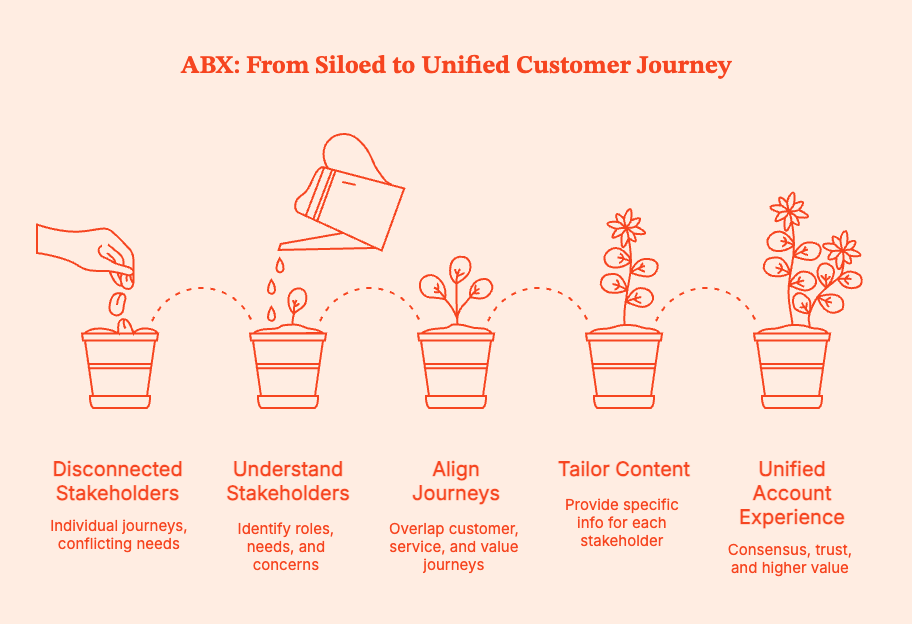
Generally, each account includes:
- A CTO or technical leader analyzing product architecture, security, and scalability.
- A CFO or finance stakeholder evaluating ROI, risk, and total cost of ownership.
- Stakeholders focusing on usability, workflows, and whether this tool makes their day easier.
- Procurement personnel studying compliance, contracts, and vendor risk.
ABX understands that each stakeholder follows their own buyer's journey for the same product in parallel. It overlaps customer journey, customer service journey, and customer value journey, so that every stakeholder gets what they need to be convinced.
For example,
- CTOs get technical deep-dives, architecture diagrams, security documentation, and roadmap clarity.
- CFOs get business cases, ROI models, pricing transparency, and risk mitigation plans.
- End users get enablement info, quick wins, onboarding guides, and workflow best practices.
- Post-sale stakeholders get reassurance about an easy onboarding, progress milestones, and proof that you're just not talking a big game.
Common Challenges & How to Overcome Them
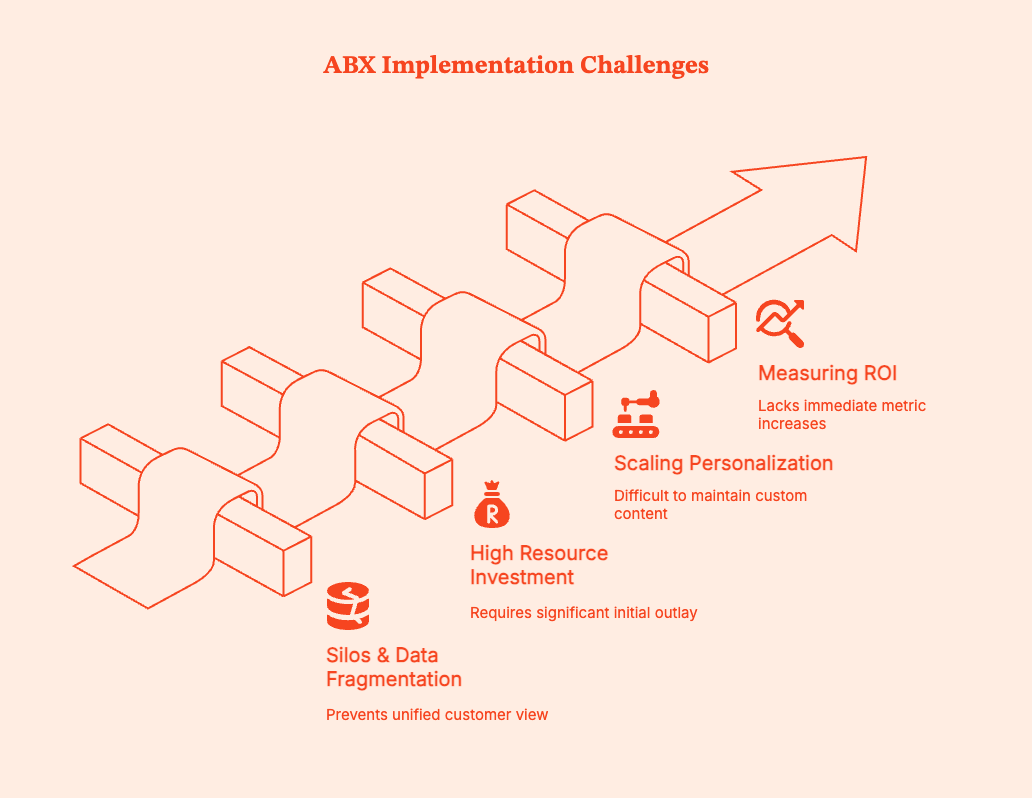
In practice, implementing ABX requires companies to change fundamental processes they have been running for years. You'll inevitably see some friction in the early stages, such as:
- Silos and Data Fragmentation
Most teams lack shared context, even if they have access to the same data. For eg, marketing efforts have engagement metrics, sales teams have deal notes, and customer success teams have support tickets and usage data.
No one team can see the whole picture. This causes major issues with ABX, which depends on all teams working with the exact same understanding of customer accounts.
What Helps:
- Shared account dashboards that show metrics pertinent to all teams.
- Clear ownership and data governance so that the “source of truth” is never in question.
- Regular cross-functional reviews focused on accounts rather than channels or campaigns.
- High Resource Investment
No lies, ABX does require increased resources for granular levels of personalization.
The answer is to:
- Focus on the high-value customers and high-risk accounts
- Prove impact before expanding ABX operations
Don't start by doing more work. Do more intentional work where it will show value.
3. Scaling Personalization Without Burning Out Your Team
Personalization is work.
It's hard to scale one-off messaging and custom decks for every account. You simply cannot personalize everything. Instead, try this:
- Utilize role-based frameworks instead of individual customization.
- Build modular content blocks that can be recombined to become assets for each stage and stakeholder.
- Automate where possible.
4. Measuring ROI
ABX is sometimes viewed as ‘sus’ because it doesn't immediately show increases in traditional marketing metrics, such as lead volume.
The metrics that actually show ABX success are:
- Retention and churn trends.
- Expansion and upsell revenue.
- Account health and product adoption.
- Customer lifetime value (CLV).
You'll have to listen to less short-term noise, more long-term buying signals for B2B sales & marketing teams.
Measuring Success: KPIs and Metrics for ABX
The success of ABX is, ultimately, in how healthy, durable, and expandable your accounts become over time. The metrics you need to watch to track this success are:
| Metric | What to Measure | Why It Matters for ABX |
|---|---|---|
| Account-Level Engagement | Number of engaged stakeholders per account, depth of content consumption, repeat interactions | ABX is designed for multi-stakeholder buying, so narrow engagement indicates low interest. |
| Win Rate | Close rate of ABX-treated accounts vs non-ABX accounts | Helps you see if buyers are feeling more confident and aligned as they move forward in the pipeline. |
| Deal Velocity | Time from first meaningful engagement to close | Shows whether ABX is making the buying process smoother and easier to navigate. |
| Retention & Churn | Renewal rate, logo churn, revenue churn | ABX should prevent post-sale experience breakdowns |
| Expansion Revenue | Upsell, cross-sell, seat growth, usage-based expansion | Higher expansion means ABX is compounding in value. |
| Customer Lifetime Value (CLV) | Revenue per account over its full lifecycle | The ultimate ABX scorecard |
| Account Health Signals | Product adoption, feature usage, support trends | Early indicators of future churn or expansion |
| Customer Satisfaction (NPS / CSAT) | NPS, CSAT, qualitative feedback | Measures experience continuity across the customer acquisition funnel |
| Handoff Quality | Onboarding time, implementation friction, expectation alignment | Shows whether cross-team alignment is working in practice. |
| Revenue Efficiency | Revenue per account vs cost to serve | Ensures ABX scales sustainably |
Summary
Account-Based Experience (ABX) is a strategy that fundamentally changes how modern B2B companies approach growth. Instead of optimizing for short-term wins such as leads or isolated deals, ABX curates cohesive, high-quality experiences for prospective customers throughout the entire account lifecycle, from first touch to renewal and expansion.
ABX treats each account as a long-term relationship rather than a transaction. It unifies marketing, sales, customer success, and support around a shared narrative and context. Account interactions are driven by real-time intent data, behavioral signals, and continuous feedback. Getting multiple teams on the same page eliminates common breakdowns that occur during handoffs. It also ensures that customer expectations set pre-sale are actually met post-sale.
ABX is key to B2B growth because B2B buyers have changed. Purchase decisions now involve multiple stakeholders, longer cycles, and higher scrutiny. Generic demand gen and static account lists don’t work anymore. You have to offer relevance, continuity, and value at every stage of the buyer journey.
For B2B SaaS companies, ABX offers a sustainable growth path. It boosts engagement across buying committees, speeds up deal velocity, lowers churn, and expands revenue by building trust over time. With real-time analytics, AI-driven orchestration, and revenue-aligned teams becoming fixtures in the B2B pipeline, ABX has gone from a competitive advantage to a baseline expectation.
Future of ABX: Trends to Watch
Real-time intent and behavioral analytics will become the standard
B2B teams can no longer be satisfied with static account lists. They must look at live signals to see what accounts are researching and engaging with them in the moment. Buyers increasingly expect companies to anticipate needs based on behavior, not forms. Source
AI-driven orchestration will replace rigid campaigns
AI engines, trained appropriately, will help teams decide when and how to engage accounts based on real-time context. AI-driven personalization stands on precise customer journey mapping, which pushes higher revenue and loyalty in the long run. Source
Revenue teams will replace siloed GTM functions
Marketing, sales, and customer success are getting on board with shared revenue and retention goals. After all, customers experience one company, not multiple departments. RevOps-led orgs are already proving to be more efficient and resilient. Source
Frequently Asked Questions for ABX Strategy
Q. What is ABX vs ABM?
ABM (Account-Based Marketing) prioritizes the acquisition of high-value accounts through targeted campaigns and sales alignment.
ABX (Account-Based Experience) extends the ABM approach across the entire customer lifecycle, including onboarding, adoption, retention, and expansion. Its core goal is to deliver improved customer experience along the buyer journey.
Q. Is ABX just ABM + CX?
Operationally, ABX is more integrated than ABM. It doesn't just layer in customer experience after focusing on marketing and sales. Instead, ABX unifies marketing, sales, customer success, and support around one shared account strategy.
Q. Is ABX only for enterprise companies?
No.
Mid-size B2B companies can benefit notably from ABX when it’s applied specifically to high-value or high-potential accounts.
Q. How long does ABX take to show ROI?
Your ABX implementation may improve pipeline quality and win rates within 6 months, especially if you're applying it to active leads. Over time, these strategies can deliver higher retention, expansion revenue, and increased customer lifetime value (CLV).
Q. Can ABM and ABX be used together?
Yes. Absolutely.
ABM finds and engages the right accounts. ABX ensures that those accounts receive a consistent, valuable experience throughout their entire lifecycle.
Q. How does ABX handle multiple stakeholders in one account?
Primarily, ABX uses role-based journeys to deal with different stakeholders within a single account.
Each stakeholder (technical leaders, finance, end users, procurement personnel) receives messaging and experiences relevant to their role, needs, and stage in the buyer and customer journey.

See how Factors can 2x your ROI
Boost your LinkedIn ROI in no time using data-driven insights


.avif)

See Factors in action.
Schedule a personalized demo or sign up to get started for free
LinkedIn Marketing Partner
GDPR & SOC2 Type II

.svg)



.avif)

