
Account-Based Marketing Personas: How To Build Them and Actually Use Them
Learn what ABM personas are, how they differ from traditional buyer personas, and how to build them step-by-step to run sharper, higher-converting ABM campaigns.

Growth Marketer
.avif)
Content Marketer



.svg)


TL;DR
- ABM personas are role-specific profiles of the stakeholders who influence or make buying decisions inside a target account.
- Unlike traditional buyer personas, ABM personas map to a buying committee, not a single decision-maker.
- A strong ABM persona captures job function, goals, pain points, objections, content preferences, and buying influence.
- Most B2B buying committees include 6 to 10 stakeholders. Each needs a tailored persona.
- Tools like Factors.ai, LinkedIn Sales Navigator, and Gong help you build and activate these personas with real behavioral data.
You've created your Ideal Customer Profile. You know the company size, the industry, the tech stack, and the revenue range. But then, who inside that account do you actually talk to? Teams spend weeks targeting the right companies but blast the same message to every contact they can find, hoping someone replies.
The result? Generic outreach. Ignored emails. And a whole lot of “this doesn't apply to me” vibes from your dream accounts.
You solve these problems using ABM personas. They help you understand not just which companies to target, but who within those companies cares, why they care, and what it takes to earn their attention.
We'll also use examples from an earlier conversation with Alexander Goodwin, Director of Demand Generation at Fingerprint, who shared how his team maps buying committees for high-value accounts and turns that research into more targeted campaigns.
What Are ABM Personas?
ABM personas are role-specific profiles that represent the different stakeholders involved in a purchase decision at your target accounts. Each persona captures who that person is, what they care about professionally, what keeps them up at night, and how they influence the deal.
In B2B sales, especially in mid-market and enterprise deals, no single person buys anything. Research from Gartner puts the average B2B buying group at 6 to 10 stakeholders. So targeting “the decision-maker” as a single persona isn't going to work.
ABM personas give you a map of everyone in the room.
How Are ABM Personas Different from Traditional Buyer Personas?
ABM personas differ from traditional buyer personas in a very important way: traditional personas describe who your ideal customer is as an individual, while ABM personas describe everyone who participates in a buying decision at a specific type of account.
Traditional persona-based marketing works well when a single buyer makes the call. For instance, if a freelance designer buys Figma or a developer signs up for GitHub Copilot, then it is one person buying a tool.
ABM doesn't work that way. You're selling to a company where:
- A VP of Marketing cares about pipeline and brand consistency.
- An IT Manager cares about security, integration, and implementation lift.
- A CFO cares about ROI, contract terms, and whether this thing will actually get used.
- An end user (your actual champion) cares about whether the product makes their day-to-day less painful.
Same product. Same company. Four completely different conversations.
That's what ABM personas solve. They let you tailor messaging, content, and outreach to every person in the room, not just the one with the fancy title.
Who's Actually in a B2B Buying Committee? (And What Do They Want?)
A B2B buying committee is the group of stakeholders at a target account who collectively influence, approve, or block a purchase.
For high-value accounts, Fingerprint - a device intelligence and fraud prevention company - goes beyond job titles to understand who is actually involved in the purchase. The team looks at who is likely to shape the decision, who needs to approve it, who will evaluate the product, and who will be involved in implementation. Sales and marketing can then focus their outreach on the people who matter most.
Watch from 19:19 to 29:15 of our conversation with Alexander Goodwin, where he walks through how Fingerprint identifies the key people inside a large enterprise account and decides how to engage them.
The exact titles will vary from one account to another, but the same types of stakeholders tend to show up across B2B deals. Here’s what each one cares about, starting with the champion.
The Champion
The champion is your internal advocate at the account. They use your product (or will use it most), feel the pain you solve most acutely, and are often the one who brings you into the conversation in the first place.
What they want: a solution that makes them look smart and makes their job easier. They need ammunition to sell to you internally.
What to give them: ROI calculators, case studies, product walk-throughs, and content that helps them pitch upward.
The Economic Buyer
The economic buyer is typically a C-suite or VP-level executive, such as a CFO, CRO, or CMO, who controls the budget and signs off on the deal. They're rarely in the weeds, but they hold the yes-or-no.
What they want: confidence that this investment is worth it. They want numbers, risk mitigation, and reassurance that this won't blow up in their face six months in.
What to give them: executive summaries, business case frameworks, competitive benchmarks, and ROI data.
The Technical Evaluator
The technical evaluator is usually someone from IT, Security, or Engineering. They're not emotionally invested in your product. They're invested in whether it breaks things.
What they want: clean documentation, integration specs, compliance certifications (SOC 2, GDPR, etc.), and an honest answer about implementation complexity.
What to give them: technical docs, security overviews, integration guides, and architecture diagrams.
The End User
End users are the people who will live inside your product every day. They have significant influence even when they don't have budget authority, because if they hate it, they'll kill adoption quietly.
What they want: ease of use, time savings, and clear proof that this isn't just another tool dumped on them by leadership. (You know the type.)
What to give them: product demos, how-to content, customer stories from people in roles like theirs, and onboarding previews.
The Blocker
Every buying committee has one. The blocker is the person who raises objections, slows things down, or simply isn't convinced. This could be Legal, Procurement, a skeptical peer, or an incumbent vendor's internal champion.
What they want: answers to their specific objections. They need to feel heard.
What to give them: targeted responses to their concerns, reassurance on compliance and contracts, and sometimes just a genuinely good conversation.
Once you know the roles you need to reach, map them to the actual people inside each target account.
Fingerprint did this with TD Bank by researching the company's organizational priorities and identifying a cross-functional Platform Protect team spanning product, engineering, identity, and related functions. Instead of broadly targeting anyone with a relevant title, the team could focus on people who were more likely to influence or participate in the buying process.
How to Build ABM Personas: A Step-by-Step Guide
Building ABM personas isn't a one-afternoon activity. But it also doesn't have to be a six-month research project. Here's a practical process you can actually execute.
Step 1: Start with Your Closed-Won Data
Before you build anything from scratch, go into your CRM (Salesforce, HubSpot, or wherever your deals live) and look at the last 20 to 30 closed-won accounts. For each one, answer these questions:
- Who was involved in the buying process?
- Who brought us in?
- Who nearly killed the deal?
- Which titles appeared most often across the buying committee?
- Which stakeholders influenced the final decision, even if they weren't on every call?
This gives you a real-world map of the buying committee you're actually navigating.
Step 2: Talk to Your Sales Team (Seriously, Schedule the Meeting)
Your Account Executives and Sales Development Representatives have pattern recognition most marketers would kill for. They've had hundreds of conversations with the exact people you're trying to build personas for.
Ask them:
- Which roles slow deals down most often?
- What objections come up consistently by title?
- Whose approval is always needed, even when they're not on the kickoff call?
- Which personas are hardest to get a meeting with?
Tools like Gong and Chorus make this even easier by letting you search call recordings by topic, making it possible to pull clips where specific objections or stakeholder types came up.
Step 3: Layer in Intent and Behavioral Data
Job titles and interview notes will only take you so far. Real ABM personas are grounded in behavioral signals: what content your target personas are consuming, which pages they're visiting, and how they engage before they ever fill out a form.
Platforms like Factors.ai surface account-level and individual-level intent data, showing you which job functions at target accounts are engaging with your content and what specifically they're looking at.
If your pricing page is getting traffic from CFO-level contacts at a Tier 1 account, that tells you something about where the economic buyer is in the journey.
LinkedIn Sales Navigator adds another layer here. You can filter by title, seniority, department, and function to understand the typical org structure at your ICP companies. Then cross-reference that with your CRM data to see which roles you've historically converted.
Step 4: Build the Persona Profiles
Now you actually write the personas. Keep each one tight. A good ABM persona profile includes:
- Role and seniority (VP of Marketing, IT Manager, CFO, etc.)
- Primary goals (what are they trying to achieve professionally this quarter?)
- Key pain points (where is your category relevant to their life?)
- Biggest objections (what will they push back on?)
- Content preferences (do they read long-form guides, watch demos, prefer executive decks?)
- Buying influence (champion, economic buyer, technical evaluator, blocker, user?)
- Channels they use (LinkedIn, email, industry communities, G2 reviews?)
Keep each persona to one page. Two pages max. If it's longer than that, you've written a novel, not a persona. (And nobody reads those in a Slack message.)
Step 5: Map Personas to Messaging and Content
A persona profile sitting in a shared doc doesn't do anything. The value comes when you connect each persona to specific messaging pillars, content assets, and outreach plays.
For each persona, answer:
- What's the one thing we want this person to believe after engaging with us?
- What content do we have that speaks directly to their pain point?
- What do we need to create?
For example, your Champion persona needs a detailed product use case library. Your CFO persona needs a two-pager with payback period math. Your IT Evaluator needs your SOC 2 report and an integration checklist. These aren't the same piece of content.
Step 6: Update Personas Quarterly
Personas go stale. Markets shift. Buyer priorities change. New tools enter the stack and change who's involved in decisions.
Set a quarterly review where Sales, Marketing, and RevOps sit together and pressure-test the personas against recent deals:
- Did any new roles appear in the buying committee?
- Is a persona we deprioritized now showing up more often?
- Did any messaging land especially well or fall completely flat?
Iteration here is what separates a living ABM program from a one-time slide deck that collects dust in Google Drive.
How to Use ABM Personas in Actual Campaigns
Here's where persona-based marketing actually shows up in your day-to-day ABM work.
- Personalized outreach by role: Your SDR sequence for a VP of Sales shouldn't look anything like the one going to a Head of IT. Different pain points, different language, different proof points. Persona-mapped sequences in Apollo or Outreach convert significantly better than one-size-fits-all cadences.
- Persona-specific ad creative: LinkedIn's targeting capabilities let you layer company-level targeting (your ABM list) with job function, seniority, and title filters. That means you can show your CFO-specific ROI message to CFOs at your target accounts, and your Champion-specific use case ad to director-level users. At the same time.
- Multi-stakeholder nurture: Tools like HubSpot and Marketo let you build nurture tracks by contact role. A deal stalling because the IT Evaluator isn't convinced? Trigger a technical nurture sequence specifically for them. This is persona-based marketing in action.
- Content mapping on your website: Factors.ai's account-level visitor identification tells you which titles are actively visiting your site and which pages they're landing on. If a CFO-level contact from a target account is repeatedly hitting your ROI calculator but hasn't booked a call, that's a signal. A well-timed, persona-aware outreach from your AE can turn that warm visit into a warm conversation.
The Mistake Most Teams Make with ABM Personas
Most B2B teams build ABM personas once during their program launch and then quietly forget they exist. The personas get referenced in the kickoff deck, maybe show up in an onboarding doc, and then live permanently in a folder nobody opens.
The result? Campaigns that were built for personas your team no longer really uses. Messaging that's six months out of date. Sales reps who've stopped looking at the persona guides because they don't match what they're hearing on calls.
Persona-based marketing only works when it's a living system. The teams running the most effective ABM programs treat personas the way product teams treat roadmaps: always directional, never final, and updated regularly based on what real customers are actually telling you.
How Factors.ai Helps You Build and Activate ABM Personas
Factors.ai is built specifically for the kind of account-level insight ABM personas depend on. Here's where it fits into the persona workflow.
Identifying who's visiting from target accounts
- Factors.ai identifies up to 75% of anonymous website visitors at the account level using a waterfall-enrichment approach across four data sources.
- Beyond the company, it also surfaces likely individual visitors using geo-location and job-title triangulation.
- This means you can see that a Head of Operations from Acme Corp read your integration docs three times this week, which directly informs which persona is most active in the buying journey.
Building persona-level intent signals
- The Account 360 view in Factors.ai pulls together website activity, CRM data, LinkedIn engagement, G2 intent, and SDR touches into a single account timeline.
- You can filter by engagement type and cross-reference against job functions to understand which personas are engaging and at which stage.
Feeding persona insights back to sales
When Factors.ai sends a Slack alert about a high-intent account, it includes the journey context: which pages were visited, how often, and what type of content was consumed. That context maps directly to persona behavior, giving your AE the right talking points before they ever pick up the phone.
To Summarize
Account-based marketing personas are role-specific profiles of the stakeholders who influence or block a purchase inside your target accounts. They go beyond your ICP by answering not just “which company” but “who within the company, what do they care about, and how do we reach them.”
A complete ABM persona program includes profiles for the Champion, the Economic Buyer, the Technical Evaluator, the End User, and the Blocker. Each persona needs tailored messaging, persona-specific content, and channel-appropriate outreach.
Building strong ABM personas starts with closed-won data, sharpens with sales interviews, and deepens with behavioral signals from platforms like Factors.ai, Gong, and LinkedIn Sales Navigator. The most effective ABM teams treat personas as a living system, reviewing and updating them every quarter as deal patterns evolve.
When persona-based marketing is running properly, your target accounts don't just see your brand. They see a version of your message that feels like it was written specifically for them.
Because, in the best ABM programs, it was.
FAQs on ABM Personas
Q1. How many personas do I actually need for a single account?
Typically, you should focus on 3 to 5 core personas per account. While committees can have up to 10 people, targeting the Champion, Economic Buyer, and Technical Evaluator usually covers 80% of the influence. My honest take? Don't over-engineer this. If you try to write 12 personas, you'll end up with Marketing Manager and Growth Marketing Manager, which are usually the same person in different hats.
Q2. What’s the biggest difference between an ICP and an ABM Persona?
An ICP (Ideal Customer Profile) describes the company (revenue, industry, size), while an ABM Persona describes the people inside that company. Think of the ICP as the “building” and the personas as the “people in the office.” You can't sell a software package to a building, no matter how nice the architecture is.
Q3. How do I deal with a "Blocker" who isn't even in the meetings?
Blockers often hide in Legal or Procurement. Provide your Champion with “Internal Selling Kits” pre-written emails and FAQ docs that answer the Blocker's concerns before they even ask. Honestly, the best way to beat a blocker is to make your Champion look like a hero. Give them the answers so they don't have to say “I'll get back to you on that” in a high-stakes meeting.
Q4. Can I use AI tools to generate these personas?
You can use AI to structure the data, but never to invent it. AI can help you summarize interview notes or categorize intent signals, but it won't know that your specific product always gets stuck at the “Security Review” stage. AI is a great sous-chef, but you're the head cook. If you let ChatGPT write your personas from scratch, you’re going to get the same generic advice as your competitors. Boring.
Q5. How often should I update my ABM personas?
You should pressure-test your personas quarterly. Markets change, new stakeholders (like “Head of AI”) emerge, and your product evolves. If your persona doc has a created date from 2022, it belongs in a museum. Set a calendar invite for a 30-minute sync with Sales every 90 days. Trust me.

See how Factors can 2x your ROI
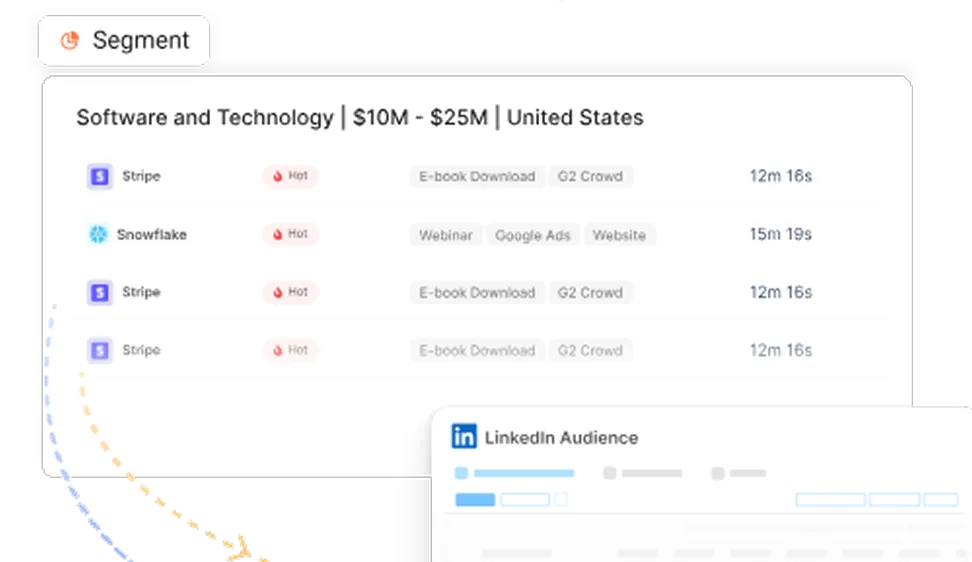
Boost your LinkedIn ROI in no time using data-driven insights


.avif)
See Factors in action.
Schedule a personalized demo or sign up to get started for free
LinkedIn Marketing Partner
GDPR & SOC2 Type II







.svg)



.avif)

