
What is ad campaign management? The complete B2B guide
Learn what ad campaign management actually involves in B2B SaaS. From planning to attribution, this guide covers every stage, metric, and mistake worth knowing about.
.avif)
Content Marketer



.svg)


TL;DR
- Ad campaign management is the full lifecycle of planning, launching, optimizing, and measuring paid ads. In B2B, it gets complicated fast because of long sales cycles, multiple decision-makers, and the joy of proving ROI to your CFO.
- The four core stages are planning (strategy + budget), execution (creative + launch), optimization (bids + audiences + creative refresh), and reporting (connecting spend to pipeline).
- Most B2B teams waste 16–45% of their ad budget on irrelevant accounts. Better targeting, cross-channel attribution, and smarter automation can fix that.
- AI is changing how campaigns get optimized, but human strategy still drives the big wins.
- Metrics that matter: CPL, CAC, ROAS, pipeline velocity, and marketing-sourced revenue.
- If you are only tracking clicks and impressions, you are reading the wrong scoreboard.
If you’ve ever launched a B2B ad campaign, stared at the dashboard for three weeks, and then been asked by leadership to “just show the ROI”... welcome. You’re home🏡.
Ad campaign management sounds like one of those terms that should be straightforward. You plan ads. You run ads. You see what works. You do more of that. Simple, right?
Except in B2B, nothing about this is simple. Your buyer takes SIX months to close. There are THIRTEEN people on the buying committee, and half of them have never seen your ad. Your LinkedIn CPC feels like a luxury handbag purchase. And somewhere between all of this, your CRM, the data just... disappears into the void. (Cue the Stranger Things Upside Down music.)
We’re going to break down what ad campaign management actually means, what each stage looks like in practice, the metrics that matter, the mistakes that quietly eat your budget, and how to build a system that doesn’t make you want to throw your laptop into the ocean.
Lesssgo!
What is ad campaign management?
Ad campaign management is the process of planning, executing, optimizing, and analyzing your paid advertising across every channel you’re running on. That includes Google Ads, LinkedIn Ads, Meta Ads, programmatic display, and whatever else your team has spun up this quarter.
In B2B SaaS, though, this definition needs more weight behind it. Because you’re not selling sneakers. You’re selling a $50K annual contract to a buying committee that needs to align internally, run a security review, loop in procurement, and then ghost you for two weeks before signing.
So ad campaign management in B2B is really about: who are we targeting, where are we reaching them, what message are we delivering at each stage of their (very long) journey, and how do we connect all of that back to revenue?
It spans channel and budget allocation, audience building using firmographic and intent data, creative development and testing, bid management, conversion tracking, cross-channel attribution, and pipeline reporting.
And here’s the part that makes B2B uniquely painful: you have to connect a LinkedIn impression from January to a closed deal in September. That is the measurement challenge. And that’s why most teams feel like they’re flying half-blind.
The four stages of ad campaign management
Every campaign, whether it’s a $500 experiment or a $500K annual program, moves through four stages. The teams that treat each stage with intention are the ones that stop hemorrhaging budget. Let me walk you through each one.
1. Planning: Where strategy meets spreadsheets
Planning is where you figure out the “why” and “who” before you even think about the “where.” Your ICP (ideal customer profile), your budget, your channel mix, your goals... it all gets set here.
A few things to keep in mind:
- Channel selection matters wayyy more than people think. LinkedIn generates roughly 80% of B2B social media leads (LinkedIn Business data). Google captures high-intent search traffic. Microsoft Ads offers CPCs that are about 42% cheaper than Google. Each channel plays a different role in the buyer journey, and your plan should reflect that.
- Budget allocation is getting squeezed. According to Gartner’s 2025 CMO Spend Survey, marketing budgets have plateaued at 7.7% of company revenue. That’s the lowest number Gartner has recorded outside pandemic years. Meanwhile, paid media now commands 30.6% of those budgets, making it the largest single line item. Translation: you have less total budget, and more of it is going to ads. The margin for waste is basically zero.
- KPI selection happens here, too. B2B teams typically track cost per lead (CPL), cost per MQL, cost per SQL, customer acquisition cost (CAC), return on ad spend (ROAS), and pipeline velocity. If you’re only setting campaign-level goals like CTR or CPC, you’re optimizing for the wrong scoreboard. The CFO doesn’t care about your click-through rate. I promise.
2. Execution: Where things actually go live
This is the build phase. Ad creative, copy, landing pages, conversion tracking, UTM parameters, audience uploads... the works.
A few things most marketers have learned the hard way (but you don’t need to, thanks to me):
- B2B creative has a known quality problem. Research shows that 64% of business decision-makers find B2B ads lack humor, and 60% say they lack emotional resonance. So yes, that stock photo of a person pointing at a whiteboard? Everyone is tired of it. Creative that feels human, specific, and slightly unexpected performs better. Your ad doesn’t need to win a Cannes Lion. It just needs to not look like every other SaaS ad in the feed.
- Landing pages are where conversions live or die. The average B2B landing page converts at 2.23%, but the top 10% hit 11.45%+. That’s a 5x gap. Message match between ad and landing page, fast load times, and a clear single CTA are usually what separate the two groups.
- Run 2 to 4 active ad variants per ad group for continuous testing. This isn’t about A/B testing for fun. It’s about learning what resonates with your specific audience fast enough to matter.
3. Optimization: Where the real work happens
I’ll be honest. This is the stage where most teams either level up or just bleed budget for months without realizing it.
Optimization includes bid management, creative refresh, audience refinement, and budget reallocation. It’s the ongoing work of asking: is this actually working, and can we make it work better?
Only 2% of users convert on their first website visit. Which means retargeting is essential, not optional. This is especially true in B2B, where buyers do extensive research before they ever raise their hand. If you’re not retargeting, you’re basically paying for awareness and then hoping people remember you months later. (Narrator: They do not.)
Creative fatigue is real. When frequency exceeds about 3.5 for cold audiences, performance starts to degrade. This is the moment your carefully crafted ad goes from “interesting” to “why is this following me everywhere I go?” My point is, refresh your creatives regularly.
The big tension in optimization right now is manual vs. automated bidding. The consensus from teams running serious B2B spend is that a hybrid approach works best: manual tests give you clean conversion data, and then you feed that data into automated bidding to scale. Going full-auto from day one is like handing your car keys to someone who’s never seen a road before.
4. Reporting: Where you prove (or can’t prove) it worked
This is where most B2B marketing teams silently scream into the void.
The gap between platform metrics (impressions, clicks, CTR) and business outcomes (pipeline created, deals influenced, revenue attributed) is massive. According to the Content Marketing Institute’s latest research, only about 29% of B2B marketers consider their content marketing very effective, highlighting how widespread measurement challenges still are.
Across the industry, proving ROI remains one of the most cited difficulties, especially for technology marketers dealing with long, multi-touch buying journeys.
If you’re reading that and thinking, “Okay, so everyone struggles with this,” you’re right. But that doesn’t mean you should accept messy reporting as inevitable. The teams that build unified dashboards connecting ad platform data, web analytics, marketing automation, and CRM data... those are the teams that walk into board meetings with actual answers instead of “engagement was strong.”
(News flash: No one has ever closed a funding round on “engagement was strong.”)
Why is ad campaign management harder in B2B? (and what to do about it)
I could write an entire book on this section. But I’ll keep it tight and focus on the five challenges I see come up over and over again.
- Budget waste is the biggest silent killer
In many cases, marketers estimate that a substantial percentage of their budget never reaches companies that are actually in-market.
But that’s a very weird assumption. And here’s how you should fix it. Better account-level targeting, intent data, suppression lists for closed-lost accounts, and existing customers. And honestly, just being more ruthless about who you’re spending money on. Not every impression needs to go to every company in your TAM.
- Cross-channel fragmentation makes everything harder
B2B companies typically engage across 10+ marketing channels. But the data from those channels lives in silos. Your Google Ads dashboard, your LinkedIn campaign manager, your HubSpot instance, your Salesforce CRM... they’re all telling you different stories about the same buyer.
LinkedIn says 40 conversions. Email claims 35. Organic says 50. And they’re all potentially claiming credit for the same 25 deals. This is the cross-channel attribution problem, and it’s the reason your team spends Friday afternoons arguing about which channel “actually” works.
- Attribution is genuinely broken for most teams
B2B buying journeys often stretch across months, sometimes even longer. But most ad platforms operate on short attribution windows, which means a large portion of early engagement never gets counted.
The vast majority of B2B website visitors, often upwards of 95%, remain anonymous and never fill out a form.
They research, compare, revisit, and make decisions in ways that most analytics tools simply don’t capture.
This is the ‘dark funnel’ problem. Word of mouth, private communities, podcast mentions, LinkedIn DMs... all of this influences buying decisions, and none of it shows up in your attribution model.
- Sales-marketing alignment is still a work in progress
Sales and marketing alignment is still one of the biggest challenges in B2B. Only a small percentage of teams report being truly aligned. And that could be because marketing is measured on lead volume, sales is measured on revenue, and ‘qualified lead’ turns into a debate no one ever really resolves.
This obviously matters for ad campaign management because misaligned teams optimize for different things. Marketing celebrates a low CPL while sales complains that the leads are junk. Sound familiar? (I bet it does.)
- Manual processes eat time despite AI promises
Here’s a fun stat: Around 70% of marketers are already using generative AI in their work, but only a small fraction have fully integrated it into their day-to-day workflows. Okay, that was a lie… can stats ever be fun?!
Anyhoo, most teams use AI to draft ad copy or brainstorm creative angles. Very few are using it for the heavy operational stuff like automated bid optimization, dynamic budget allocation, or real-time audience testing across channels.
That gap between ‘using AI’ and ‘actually using AI for campaign management’, is where a lot of efficiency gains are sitting, untouched.
B2B vs. B2C ad campaign management: Same sport, different game
I think the fastest way to explain why B2B ad campaign management feels harder is to compare it directly with B2C. The differences are structural, and they affect every decision you make.
- Audience:
B2B targets buying committees are multi-generational with an average of 13 stakeholders. B2C targets individual consumers making personal decisions. That’s why B2B needs account-level targeting, while B2C can rely on broad demographic or interest-based audiences. - Sales cycles:
B2B deals typically take months to close, often stretching across long, multi-touch buying cycles depending on deal size and complexity. This means B2B campaigns need to nurture across multiple stages, while B2C campaigns can push for immediate conversion. - Deal sizes: B2B transactions are typically high-value, often involving significant budgets and long-term commitments, while B2C purchases tend to be lower-value and higher-frequency. This is why B2B can sustain higher CPCs and CPLs, but it also means that wasted spend has a much larger impact on overall ROI.
- Channels:
LinkedIn dominates B2B (as if you didn’t already know that).
89% of B2B marketers use LinkedIn for lead generation, and 62% say it effectively generates leads for them. - Measurement:
This is the biggest gap. B2C can measure ROAS within days. B2B has to track a journey from first impression to closed deal across months and multiple stakeholders. It’s like comparing a sprint to a marathon, except the marathon runner is also blindfolded for the middle ten miles.
The metrics that actually matter for B2B ad campaign management
Let me save you some time: if your reporting dashboard only shows impressions, clicks, and CTR, it’s not telling you anything useful about your business. Those are activity metrics. They’re fine for platform-level troubleshooting, but they won’t tell your CMO whether ad spend is turning into pipeline.
Here are the metrics worth building your reporting around:
- Cost per lead (CPL)
This tells you how efficiently you’re generating interest. But CPL on its own can be misleading. Some channels will give you cheaper leads, but that doesn’t mean those leads are actually worth pursuing. The real question isn’t “how cheap is this lead?” It’s “how likely is this lead to turn into revenue?” - Customer acquisition cost (CAC)
This is where things get real. CAC looks at the full picture, not just marketing, but everything it takes to turn a prospect into a paying customer. If CPL is about efficiency at the top, CAC is about efficiency across the entire journey. When CAC starts creeping up, it’s usually a sign that something deeper in your funnel isn’t working as it should. - Return on ad spend (ROAS)
ROAS tells you what your campaigns are actually returning. But in B2B, this only makes sense if you’re looking at it over the full buying cycle. Short-term ROAS can make good campaigns look bad, simply because the deal hasn’t closed yet. If your reporting window is too narrow, you’re not measuring performance; you’re measuring timing. - Pipeline velocity
This is about movement, not just volume. How quickly are leads progressing from one stage to the next? Where are they slowing down? A healthy pipeline isn’t just full, it’s flowing. If deals are getting stuck, the problem isn’t more leads. It’s friction somewhere in the journey. - Marketing-sourced revenue
This is the closest you get to answering the real question: “Is marketing actually driving business?” Not just generating activity, not just filling the funnel, but contributing to revenue. The more clearly you can connect your efforts to outcomes, the easier it becomes to make better decisions on where to invest.
Where AI and automation actually help (and where they don’t)
I’m going to be real with you: the AI conversation around ad campaign management has gotten noisy. Every tool claims AI-powered… everything. So let me cut through it.
Where AI genuinely helps:
• Bid optimization at scale
Google’s Performance Max and LinkedIn’s automated bidding can process signals across audiences, devices, and placements faster than any human. When you have enough conversion data to train the models, this works.
• Creative testing velocity
AI can generate dozens of ad copy variants and headline combinations, letting you test more aggressively without exhausting your creative team.
• Intent signal detection
Platforms like Demandbase and 6sense use predictive models to identify which accounts are actively in-market, so you can prioritize spend on accounts most likely to buy.
• Cross-channel orchestration
Tools like Factors.ai unify ad data, website behavior, and CRM activity to give you account-level visibility across the full journey. When you can see which accounts are engaging across LinkedIn, Google, and your website simultaneously, you stop optimizing channels in isolation and start optimizing the buyer journey.
Where AI falls short:
• Low-data environments
B2B campaigns generate far fewer conversions than B2C. If your campaign produces 15 conversions a month, there’s not enough signal for machine learning to optimize reliably. You need human judgment.
• Black box budget allocation
Performance Max and Meta’s Advantage+ campaigns are opaque about where your budget actually goes. In B2B, where placement quality matters (you want to show up in professional contexts, not random mobile games), this lack of visibility is a real concern.
• Strategy and positioning
AI can optimize what you give it, but it can’t decide your positioning, your messaging hierarchy, or which segment to prioritize. That’s still a human job. (And honestly, a pretty important one.)
A practical ad campaign management checklist
I wanted to end with something you can actually use tomorrow. Here’s a framework I’ve refined over multiple B2B campaigns. Pin it, bookmark it, screenshot it, I don’t care. Just use it.
Before you launch:
• ICP defined with firmographic + behavioral criteria (not just “SaaS companies in the US”)
• Budget allocated by funnel stage: awareness, consideration, decision
• Channel mix aligned to buyer behavior (LinkedIn for awareness + ABM, Google for high-intent capture)
• KPIs set at both campaign level (CPL, CTR) AND business level (pipeline created, CAC, ROAS)
• Conversion tracking verified end-to-end: ad click to CRM stage change
While it’s running:
• Review creative performance weekly. Refresh anything with a frequency above 3.5.
• Reallocate budget from underperforming channels monthly, based on pipeline metrics, not just CPL.
• Maintain suppression lists: current customers, closed-lost accounts, competitors, disqualified leads.
• Run retargeting for everyone who visited high-intent pages (pricing, demo, comparison) but didn’t convert.
• Sync ad platform data with your CRM at least weekly. The gap between “ad click” and “pipeline” is where insights live.
When you report:
• Lead with pipeline and revenue metrics. Save impressions and CTR for the appendix.
• Use multi-touch attribution. First-touch and last-touch models both lie. (Politely, but they do.)
• Add self-reported attribution (“How did you hear about us?”) to capture dark funnel signals.
• Compare CAC by channel AND by segment. A $200 CPL that converts to a $200K deal is better than a $20 CPL that goes nowhere.
In a nutshell
Ad campaign management in B2B isn’t about mastering one platform or finding one magic audience. It’s about building a system that connects strategy to execution to measurement across multiple channels, multiple stakeholders, and very long buying cycles.
The teams that do this well share a few things in common: they plan with revenue in mind (not just leads), they optimize based on pipeline data (not just platform metrics), they accept that perfect attribution is impossible but build the best measurement stack they can, and they use AI to handle the operational grunt work while keeping strategy firmly in human hands.
B2B digital ad spend is heading toward $23 billion by 2026. Budgets are tight. CPCs are climbing. Your CFO is watching. The question is whether your ad campaign management system is set up to make every dollar count, or whether you’re still stitching together screenshots from four different dashboards and hoping for the best.
If you’ve read this far, I’m guessing you’re ready for the former.
Good. Your budget will thank you.
FAQs for what is ad campaign management
Q1. What is ad campaign management in B2B marketing?
Ad campaign management in B2B refers to the end-to-end process of planning, executing, optimizing, and measuring paid campaigns across channels like Google, LinkedIn, and programmatic platforms. It focuses not just on generating leads, but on driving pipeline and revenue outcomes.
Q2. Why is ad campaign management more complex in B2B than B2C?
B2B campaigns involve longer sales cycles, multiple stakeholders, and higher deal values. This makes targeting, nurturing, and attribution significantly more complex compared to B2C, where decisions are faster and typically made by individuals.
Q3. What are the key stages of ad campaign management?
The four core stages are:
- Planning (strategy, ICP, budget allocation)
- Execution (creative, targeting, launch)
- Optimization (bids, audiences, creative refresh)
- Reporting (attribution, pipeline, revenue impact)
Q4. What metrics should B2B marketers track in ad campaigns?
The most important metrics include:
- Cost per lead (CPL)
- Customer acquisition cost (CAC)
- Return on ad spend (ROAS)
- Pipeline velocity
- Marketing-sourced revenue
These metrics provide a clearer picture of business impact compared to vanity metrics like CTR or impressions.
Q5. Why is attribution challenging in B2B ad campaigns?
Attribution is difficult because B2B buyers interact with multiple touchpoints over months. Traditional models often fail to capture early-stage influence, and much of the buyer journey happens in the “dark funnel” (e.g., word-of-mouth, private communities).
Q6. How can marketers reduce wasted ad spend in B2B campaigns?
Marketers can reduce waste by:
- Using account-level targeting
- Leveraging intent data
- Excluding irrelevant or closed accounts
- Continuously refining audience segments
A significant portion of ad budgets is often spent on accounts that are not actively in-market.
Q7. What role does AI play in ad campaign management?
AI helps with:
- Bid optimization at scale
- Faster creative testing
- Identifying in-market accounts
- Cross-channel data analysis
However, it still requires human oversight for strategy, positioning, and decision-making.
Q8. How often should B2B ad campaigns be optimized?
Campaigns should be reviewed continuously, with:
- Weekly checks for creative performance
- Monthly budget reallocation based on pipeline data
- Ongoing audience refinement
Optimization is not a one-time task but an ongoing process.
Q9. What is the biggest mistake in ad campaign management?
One of the most common mistakes is focusing only on platform metrics like clicks and impressions instead of tracking how campaigns contribute to pipeline and revenue.
Q10. How do you measure the success of a B2B ad campaign?
Success is measured by how effectively campaigns generate and accelerate pipeline, reduce acquisition costs, and contribute to revenue.

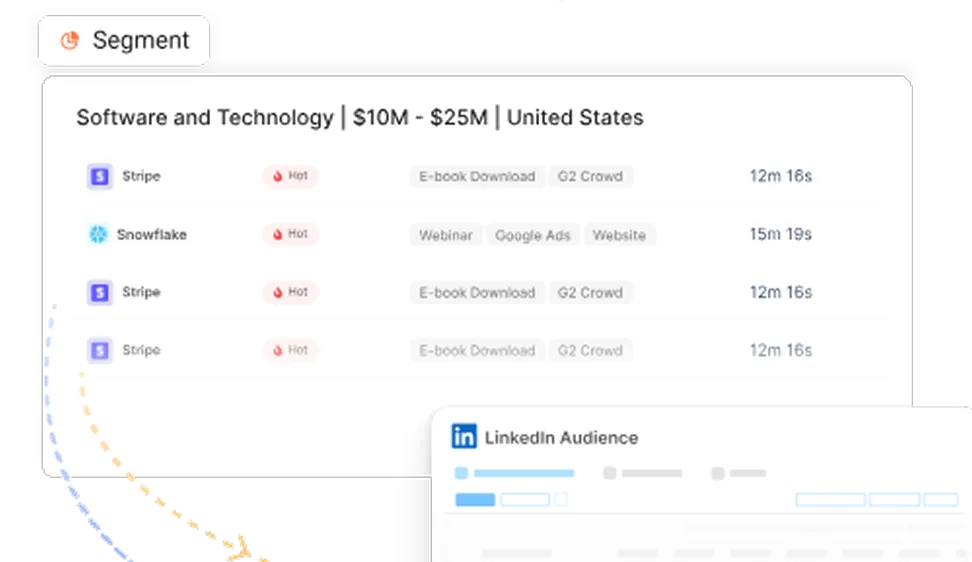
See how Factors can 2x your ROI
Boost your LinkedIn ROI in no time using data-driven insights


.avif)

See Factors in action.
Schedule a personalized demo or sign up to get started for free
LinkedIn Marketing Partner
GDPR & SOC2 Type II







.svg)



.avif)

