
AI in Advertising for B2B: Strategy, Tools & ROI Guide
See how AI in advertising drives B2B revenue. Targeting, attribution, ABM, predictive optimization, and real-world AI marketing examples.
.avif)
Content Marketer

Growth Marketer



.svg)


TL;DR
- AI in advertising helps B2B teams move from lead generation to revenue orchestration by connecting ad data, CRM stages, website behavior, and third-party intent signals at the account level.
- Modern AI-driven digital marketing improves targeting precision through behavioral segmentation, real-time audience updates, and intent-based activation rather than static demographic lists.
- The biggest impact of AI in B2B marketing shows up in pipeline progression, including faster deal velocity, stronger MQL-to-SQL conversion, and clearer multi-touch revenue attribution.
- AI works best when integrated across systems, syncing ad platforms, CRM, analytics, and sales workflows to enable predictive budget allocation and next-best-action recommendations.
- When treated as revenue infrastructure instead of a campaign feature, AI in advertising becomes a strategic advantage that improves efficiency, forecasting accuracy, and executive confidence.
If you work in B2B marketing today, you’ve been through it all… budgets feeling tighter than the jeans you wore in college, CFOs wanting revenue to pour in, sales wanting better accounts, and founders want pipeline faster than you want your pizza.
And somewhere in every meeting, someone says, “Can we use AI for this?”
Now, the problem is that most conversations about AI in advertising float at the surface; they talk about tools, or creative automation, or Chatgipity (ChatGPT) writing ads.

Unfortunately, the world is spinning too damn fast, and the AI revolution is really getting the better of us… AND the above use-cases are not where the real shift is happening.
In fact, the real shift is structural… AI is changing how we target, orchestrate, measure, and activate revenue across the entire buyer journey.
This ✨practical✨ guide breaks it down clearly, practically, and from a B2B lens.
What is AI in advertising?
When most people hear AI in advertising, they picture one of three things.
- ChatGPT writing ad copy
- An algorithm automatically adjusting bids
- Or some mysterious black box deciding who sees what
All of that is part of it, but none of that explains it properly.
Here’s the simple definition of AI in advertising:
AI in advertising is the use of machine learning and predictive models to analyze data, identify patterns, and make optimization decisions that improve targeting, personalization, and revenue outcomes.
Now let’s break that down in plain English.
Automation vs Machine Learning vs Predictive AI
This distinction matters more than people think.
Automation follows rules:
If someone downloads a whitepaper, send them an email.
If cost per click exceeds X, pause the ad.
The system does what you told it to do.
Machine learning looks at historical data and finds patterns you did not manually define.
For example, it may detect that cybersecurity buyers from mid-market companies convert faster when they engage with comparison pages before booking a demo.
You did not hard-code that rule. The model learned it.
Predictive AI goes one step further, it forecasts what is likely to happen next.
- Which accounts are most likely to convert this quarter?
- Which deals are at risk of stalling?
- Which audiences are most likely to respond to a specific message?
That predictive layer is where modern AI in marketing and advertising is heading.
So, where does AI fit inside marketing?
Advertising is not a standalone function in B2B; it’s a part of a larger (revenue) system.
AI can sit inside:
- Audience targeting
- Creative optimization
- Bid management
- Attribution modeling
- Revenue forecasting
- Account scoring
But its real impact shows up when those systems talk to each other… if your ad platform optimizes for clicks but your CRM tracks revenue, and those systems never connect, you are optimizing for the wrong outcome.
AI becomes powerful when:
Ad data + CRM data + website data + product data + third-party intent signals are unified.
Now the model understands the entire buyer journey, not just a single channel.
Why does this matter in B2B?
In B2C, the journey is often short… you see it, you buy it (after sending your partner a picture, and them saying “do you really need this?”), but in B2B, it is layered because then… your CMO, CFO, CS team, Sales, and a 14 more people will ask “do you really need this?”
That’s not it… there are multiple decision-makers, six-month buying cycles, and dozens of touchpoints. (I’m tired of typing that, imagine going through it ALL).
I remember working with a US SaaS client targeting enterprise IT teams. Their Google Ads dashboard looked noice, LinkedIn Ads showed healthy-ish engagement, but the pipeline was inconsistent. When we mapped it properly, we realized that the deals closed had:
- At least three stakeholders engaging
- A competitor comparison page visit
- A webinar registration
- Follow-up ad retargeting within two weeks
No single channel caused the conversion… the journey caused it.
That is where AI in B2B marketing changes the game… it identifies cross-touchpoint patterns at the account level instead of over-crediting the last click.
Does AI replace marketers?
No, no, and no. AI can surface signals, identify patterns, and suggests optimizations.
Humans still:
- Define strategy
- Set positioning
- Control messaging
- Validate insights
- Govern data integrity
The smartest teams treat AI as augmentation, as something that reduces manual analysis, highlights opportunities, and increases decision confidence.
But it DOES NOT (yes, I’m screaming) replace strategic thinking. Don’t believe me? Here, read this blog that answers the million-dollar question: Will AI replace replace Digital Marketers?
(Also, why don’t you believe me?! That’s just sad. :(
The transition into B2B complexity
As ad budgets grow and sales cycles lengthen, the margin for error shrinks.
When a CFO asks which $200,000 in ad spend influenced $5 million in pipeline, “engagement was strong” is not an answer.
AI in advertising gives B2B marketers something better:
- Connected visibility
- Predictive prioritization
- Revenue-level measurement
And once that foundation is clear, the next question becomes more interesting: how exactly is AI reshaping the structure of B2B marketing and advertising?
How is AI changing B2B marketing and advertising?
If you zoom out over the last ten years, B2B advertising has evolved in waves.
First wave: demographic targeting
Second wave: automation and retargeting
Now we are in the ‘orchestration wave’ (Is that a thing? Well, now it is).
And that is where AI in advertising becomes très important.
1. From Demographic Targeting to Intent-Based Targeting
For years, B2B targeting meant selecting:
- Job title
- Industry
- Company size
- Geography
That worked when competition was lighter, and budgets were looser.
Today, if you are a US-based SaaS company targeting mid-market CFOs, you are competing with ten other vendors showing up in the same feed.
Demographics tell you who someone is, and intent tells you what they are doing right now.
AI analyzes:
- Website engagement patterns
- Content consumption depth
- Repeat visits
- Third-party research spikes
- CRM lifecycle stage
- Ad engagement across stakeholders
Now, instead of targeting all CFOs in fintech, you can prioritize fintech CFOs whose accounts:
- Visited pricing twice
- Researched competitor alternatives
- Showed a 3rd-party intent spike in the last 14 days
This is the backbone of modern AI-targeted marketing.
And it dramatically reduces wasted impressions.
2. From channel-level optimization to journey-level orchestration
Most B2B teams still optimize in silos.
The Google Ads team improves CPA, the LinkedIn team improves CTR, and the content team tracks downloads.
Each dashboard looks a-ok in isolation, but AI changes the frame. It asks:
What combination of touchpoints actually drives account progression?
Instead of optimizing a single campaign, AI models analyze cross-channel sequences.
For example:
- Account sees LinkedIn thought leadership ad
- Visits blog
- Downloads gated guide
- Engages with retargeting ad
- Books demo
AI detects that this sequence converts 2.3x higher than random exposure.
Now optimization shifts from individual ad performance to journey orchestration.
This is where AI-driven digital marketing becomes strategic infrastructure rather than a feature.
3. From lead-based measurement to account-level revenue tracking
Lead-based measurement made sense when marketing owned top-of-funnel and sales owned the rest. Yeah… unfortunately, that world no longer exists.
In B2B:
- Multiple stakeholders engage
- Sales and marketing overlap
- Revenue accountability spans both team
AI aggregates signals at the account level.
Instead of tracking one email address, it tracks engagement across:
- Multiple users
- Multiple sessions
- Multiple channels
- Multiple timeframes
This shift is SO important in AI B2B marketing, because it allows marketers to answer questions like:
- Which accounts are heating up?
- Which campaigns influence opportunity creation?
- Which channels accelerate deal velocity?
And all this in measurable terms.
4. Moving to predictive next-best action
Traditional reporting tells you what happened last month.
AI tells you what is likely to happen next.
Predictive models can identify:
- Accounts with rising engagement velocity
- Deals showing early-stage stalling signals
- Campaign fatigue patterns
- Budget inefficiencies
Imagine logging into your dashboard and seeing:
These 27 accounts show multi-stakeholder engagement and strong intent signals, driving spend and alerting sales. That is predictive orchestration.
This is where AI in marketing and advertising becomes proactive rather than descriptive.
5. From fragmented data to unified revenue intelligence
One of the biggest structural shifts is data unification.
In many B2B teams, data lives in:
- CRM
- Ad platforms
- Website analytics
- Product analytics
- Third-party intent tools
Without AI stitching it together, teams rely on manual exports and spreadsheet patchwork.
Once unified, AI can:
- Detect patterns across systems
- Surface hidden correlations
- Align targeting with revenue outcomes
- Forecast pipeline impact
And suddenly marketing conversations change.
Instead of discussing impressions and form fills, teams discuss:
- Pipeline velocity
- Opportunity influence
- Revenue attribution clarity
That shift changes how marketing is perceived at the executive level.
AI is redefining how B2B marketing connects activity to revenue, and now that we understand the structural change, let’s get tactical.
What are some core use-cases of AI in advertising (with B2B examples)
If you’re running B2B campaigns right now, firstly, God bless you, and secondly… these are the areas where AI in advertising is actively driving impact.
So let’s break this into the four areas where AI in advertising actually changes outcomes for B2B teams:
- Targeting
- Creative
- Budget and bidding
- Attribution and analytics
Each one works alone… but together, they become ‘orchestration’ (I told you… it’s a thing now).
A. AI-targeted marketing
If you strip everything down, targeting is where money is won or wasted. In B2B, broad targeting is expensive. Especially in US markets, where LinkedIn CPCs can cross $15 to $25 for competitive segments. AI improves targeting in four practical ways.
- Behavioral targeting
Instead of building audiences only by job title or industry, AI builds segments based on behavior patterns.
For example:
- Accounts that visited pricing more than twice
- Companies where multiple stakeholders engaged within 30 days
- Users who consumed competitor comparison content
Behavior is a stronger buying signal than static attributes; this is the foundation of effective AI-targeted marketing.
- Account-based ad activation
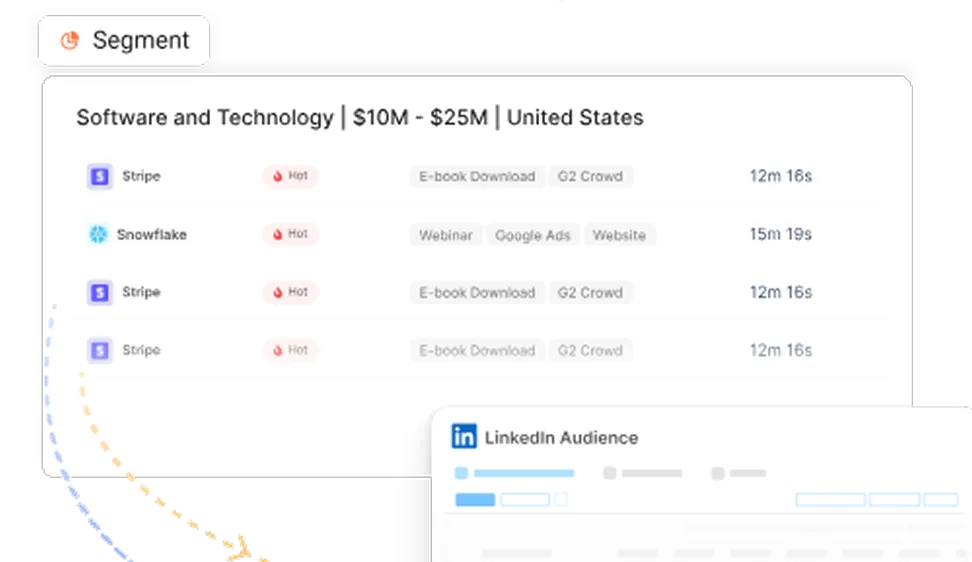
In account-based strategies, timing is everything… imagine you are targeting 500 enterprise accounts. AI monitors intent signals from:
- Website activity
- CRM lifecycle stage
- 3rd-party intent platforms like Bombora
- Ad engagement trends
If an account suddenly shows an intent spike in your category and three people from that company visit your product pages in one week, AI can automatically:
- Increase bid aggressiveness
- Trigger LinkedIn Sponsored Content
- Activate retargeting sequences
- Alert sales
That shift from manual activation to signal-based activation reduces response lag dramatically.
- Lookalike modeling using intent signals
Traditional lookalikes copy demographic traits, but AI-driven lookalikes replicate high-performing account patterns.
For example, instead of saying, find more companies with 500 to 1000 employees in fintech. The model says, find companies that behave like the accounts that reached the opportunity stage within 45 days. That is a stronger signal set.
- Dynamic audience updates
Static audience lists decay fast in B2B.
AI updates audiences in real time:
- Moves accounts from cold to warm when engagement increases
- Removes converted customers from acquisition campaigns
- Suppresses low-fit accounts
This reduces waste and improves efficiency across the board.
B. Creative optimization
Most people assume AI in ads means copy generation. That is the shallow layer. The deeper value is performance modeling.
- A/B testing at scale
Humans can test five variations at once.
AI can evaluate hundreds of micro-variations across:
- Headlines
- CTAs
- Industry-specific messaging
- Social proof angles
The model identifies which creative patterns perform best for specific verticals or deal sizes.
- Predictive creative scoring
AI analyzes historical campaign performance and predicts which messaging themes are likely to resonate with:
- CFOs versus CMOs
- Enterprise versus mid-market
- Healthcare versus fintech
Instead of testing randomly, teams test strategically.
- AI-generated variations with guardrails
Creative teams define tone, positioning, and compliance constraints. AI produces variations within those boundaries.
This accelerates production without sacrificing brand integrity, and in highly regulated industries like fintech or healthcare, guardrails make a huge difference.
C. Bid and budget optimization
Ad spend in B2B is almost always in thousands of dollars, and AI improves financial efficiency in these three key ways.
- Smart bidding
Machine learning models adjust bids based on conversion likelihood rather than just click probability, ensuring high-intent accounts receive stronger exposure.
- Budget allocation based on pipeline impact
Instead of optimizing for cost per lead, AI optimizes for:
- Opportunity creation
- Pipeline velocity
- Revenue influence
I worked with a SaaS company that shifted 25% of its LinkedIn budget toward accounts showing faster deal progression. Within one quarter, opportunity-to-close velocity improved noticeably.
That decision came from an AI modeling pipeline progression data, not gut instinct.
- Channel performance forecasting
AI can project the expected pipeline impact by channel based on historical data, allowing marketers to justify budget shifts with predictive confidence.
When a CFO asks why LinkedIn deserves more budget next quarter, data-backed forecasts change the conversation.
D. Attribution and analytics
This is where AI delivers executive-level clarity.
- Multi-touch attribution
AI distributes credit across touchpoints such as:
- Awareness ads
- Retargeting
- Content downloads
- Demo reminders
This provides a more realistic picture of influence.
- View-through attribution
In many B2B scenarios, stakeholders see ads without clicking. They return later through direct or branded search. AI connects impression data to downstream pipeline events. And without this layer, awareness campaigns look ineffective on paper.
- Revenue influence modeling
This is the layer boards care about.
AI models connect ad exposure and engagement patterns to:
- MQL to SQL progression
- Opportunity creation
- Closed-won revenue
For example, a SaaS company may discover that accounts exposed to a specific industry-focused campaign progress to SQL 1.8x faster.
That insight changes budget allocation immediately.
Let’s look at some AI marketing examples across the funnel
One mistake I see often is treating AI as a top-of-funnel tool. In B2B, that leaves revenue on the table.
The real power of AI in advertising shows up when it operates across the full buyer journey. Awareness to closed-won. Here is what that actually looks like in practice.
TOFU: Awareness
At the top of the funnel, AI improves precision and reduces wasted spend.
- Predictive audience targeting on LinkedIn and Google
Instead of targeting every VP of Marketing in SaaS, AI narrows to those whose accounts show rising category intent signals, recent site visits, or engagement with competitor content. - AI-driven content recommendations
Landing pages adapt dynamically based on visitor industry, company size, or prior engagement. A healthcare prospect sees healthcare proof. A fintech visitor sees fintech use cases. - Lookalike modeling based on high-velocity accounts
AI builds new prospect lists from accounts that progressed to opportunity within a defined time frame, rather than generic customer traits.
These are practical AI marketing examples that improve awareness efficiency without increasing budget.
MOFU: Consideration
This is where many B2B funnels leak. AI helps close the gap between interest and serious evaluation.
- Dynamic retargeting sequences
If an account downloads a pricing guide but does not book a demo, AI triggers tailored retargeting messaging focused on ROI, case studies, or security documentation. - AI-scored accounts for mid-funnel prioritization
Accounts are scored based on multi-stakeholder engagement and depth of interaction. Ad spend is concentrated where evaluation behavior is strong. - Industry-personalized messaging
Creative changes automatically based on firmographic data. Enterprise healthcare messaging differs from mid-market SaaS messaging without manual campaign rebuilds.
These are real AI in marketing examples that push qualified accounts deeper into the funnel.
BOFU: Conversion
At the bottom of the funnel, AI shifts from engagement optimization to revenue acceleration.
- Predictive deal scoring
AI analyzes engagement trends across stakeholders to forecast which opportunities are most likely to close this quarter. Marketing can increase exposure around high-probability accounts. - CRM-stage-based ad activation
When a deal enters the proposal stage, ad messaging shifts to social proof, security validation, and executive testimonials. - Budget intensification for high-intent accounts
Instead of evenly distributing spend, AI concentrates the budget on accounts showing strong purchase signals, improving close velocity.
This is where AI-powered digital marketing moves from generating leads to influencing revenue timing.
Tools powering AI in marketing and advertising
When people talk about AI in advertising, they often think about one tool, but AI really operates across a stack. And, understanding that stack is important because most limitations in B2B marketing do not come from a lack of AI. They come from fragmentation.
Let’s break this down into the four main categories powering modern AI in marketing and advertising.
1. Native AI inside ad platforms
Most major ad platforms already use machine learning.
Google Ads uses predictive bidding models to optimize for conversions and revenue. LinkedIn uses AI for audience expansion, delivery optimization, and engagement prediction.
These tools are strong at optimizing within their own ecosystems.
However, they are limited to the data available inside that platform. Google optimizes Google. LinkedIn optimizes LinkedIn. Neither sees your full CRM journey unless you integrate it properly.
For many teams, this is where AI adoption begins (not ends).
2. AI content and creative tools
This category includes tools that:
- Generate ad copy variations
- Suggest headline improvements
- Analyze creative performance patterns
- Produce visual assets at scale
These tools accelerate production and testing. They reduce bottlenecks for lean marketing teams. However, creative AI alone does not solve targeting precision or attribution clarity. It improves efficiency, not orchestration. In B2B, where messaging nuance and compliance matter, human oversight remains critical.
3. AI analytics and attribution platforms
These tools focus on measurement.
They handle:
- Multi-touch attribution modeling
- Channel contribution analysis
- Revenue influence reporting
- Funnel progression tracking
This layer is crucial because it connects advertising activity to pipeline. Without attribution intelligence, budget decisions rely on surface metrics. However, analytics platforms often describe performance rather than activate change. They tell you what happened. They do not always execute the next step.
4. ABM and orchestration platforms
This is where AI becomes strategic.
Orchestration platforms unify:
- 1st-party CRM and website data
- 2nd-party ecosystem data
- 3rd-party intent signals
- Ad platform engagement
- Sales workflows
Instead of optimizing one campaign, these systems optimize account journeys.
They can dynamically:
- Update audiences
- Trigger account-based campaigns
- Sync CRM stage changes with ad messaging
- Alert sales teams
- Allocate budget based on pipeline signals
This is where AI-powered digital marketing shifts from channel optimization to revenue orchestration.
Are your AI tools talking to each other (or are they like the Mean Girls)?
Most B2B teams use at least five to seven tools across advertising, CRM, analytics, and intent. Now, each tool uses AI in isolation.
The challenge is whether those systems communicate with each other… if Google optimizes for conversions, but your CRM defines success differently, you create misalignment.
If attribution data never feeds back into targeting logic, learning loops break.
True maturity in using AI for B2B marketing happens when:
Insights inform targeting ▶️ Targeting informs spend ▶️ Spend informs revenue ▶️
Revenue informs optimization
That loop requires lots of integration.
Benefits (and ROI) of AI in advertising
AI sounds exciting, but unfortunately, CFOs are not impressed by exciting… they care about all the boring but important stuff… efficiency, predictability, and revenue impact.
But the good news is… when implemented correctly, AI in advertising delivers value in ways that are measurable and financially meaningful.
Let’s break this down in terms that executives understand.
1. Higher targeting precision
AI reduces wasted spend by prioritizing high-intent accounts over broad demographic segments.
Instead of showing ads to every VP in SaaS, campaigns focus on accounts that show real buying signals such as pricing page revisits, stakeholder engagement, or third-party intent spikes.
The result is:
- Lower impression waste
- Stronger engagement quality
- Better pipeline fit
Precision matters more in competitive US B2B markets where CPCs are high and budgets are closely scrutinized.
2. Lower customer acquisition cost
When targeting improves and the budget is allocated to accounts with higher conversion rates, cost efficiency naturally improves.
This does not always mean cheaper clicks. It often means better downstream conversion rates.
AI optimizes for accounts that progress to SQL and opportunity rather than just generating top-of-funnel leads.
Over time, this improves the effectiveness of CAC because spend aligns more closely with revenue outcomes.
3. Faster pipeline velocity
One of the most overlooked benefits of AI-powered digital marketing is acceleration. When AI identifies high-engagement accounts and increases exposure during active buying windows, deals move faster.
For example:
- Increasing ad intensity during the proposal stage
- Triggering industry-specific case studies during evaluation
- Alerting sales when competitor research spikes
Small timing improvements can reduce sales cycle length, which directly impacts quarterly revenue predictability.
4. Improved attribution clarity
Many B2B teams struggle to justify ad budgets because attribution remains unclear.
AI-driven multi-touch models connect:
- Ad exposure
- Website engagement
- CRM stage movement
- Closed-won revenue
When marketing can demonstrate which campaigns influenced $2 million in pipeline rather than reporting on lead volume alone, executive confidence increases.
Attribution clarity changes budget conversations.
5. Better MQL to SQL progression
AI surfaces behavioral signals that indicate qualification strength.
Instead of treating all MQLs equally, marketing and sales can prioritize accounts showing deeper engagement and multi-stakeholder activity.
This improves:
- SQL conversion rates
- Opportunity creation
- Sales productivity
It also reduces friction between marketing and sales teams.
6. Reduced manual campaign management
Behind the scenes, AI eliminates a surprising amount of manual work.
No more:
- Constant CSV exports
- Manual audience rebuilding
- Static suppression lists
- Spreadsheet stitching
Real-time audience updates and automated orchestration reduce operational drag.
That time savings compounds across teams.
The compounding effect
Individually, these benefits look incremental, but together, they create compounding gains:
- Better targeting improves pipeline quality
- Improved pipeline quality strengthens forecasting
- Stronger forecasting increases executive trust
- Increased trust stabilizes budget allocation
That loop is where AI in B2B marketing becomes a strategic advantage rather than a tactical upgrade.
Challenges and risks of AI-powered digital marketing
AI is powerful, but it is not self-correcting. In B2B environments, where budgets are high and sales cycles are long, poor implementation can create expensive blind spots. If you are investing in AI in advertising, you need to understand the risks as clearly as the benefits.
1. Data quality dependency
AI models are only as strong as the data feeding them. In many B2B organizations, CRM fields are incomplete, lifecycle stages are inconsistent, and attribution tracking is fragmented. If your foundational data is messy, AI will amplify it. Before layering advanced AI-driven digital marketing systems, teams must ensure CRM hygiene, consistent lifecycle definitions, and clean event tracking.
2. Over-automation without any real strategy
Automation can create a false sense of sophistication. It is easy to activate smart bidding, audience expansion, and automated targeting without aligning those systems to revenue goals. When optimization focuses on surface metrics such as clicks or leads instead of pipeline progression, efficiency improves while revenue impact stagnates. AI must be guided by strategic objectives, not left to optimize blindly.
3. Black-box algorithms and limited transparency
Many ad platforms operate as closed ecosystems. Marketers often cannot see exactly why certain targeting or bidding decisions are made. This lack of transparency can create challenges in executive reporting and compliance-heavy industries such as fintech, healthcare, and cybersecurity. Governance and performance validation become critical.
4. Privacy and compliance risks
With increasing regulations across the United States and globally, including state-level privacy laws, improper data usage can create legal and reputational exposure. AI systems that layer first-party, second-party, and third-party data must operate within strict compliance boundaries. Data governance policies need to evolve alongside AI adoption.
5. Creative hallucination and brand risk
AI-generated creative can accelerate production, but it can also introduce inaccuracies or messaging misalignment. In B2B, where positioning and credibility matter deeply, unsupervised AI copy can damage trust. Human oversight, brand guidelines, and approval workflows remain essential.
6. Misaligned success metrics
One of the most common risks of using AI in B2B marketing adoption is optimizing for the wrong outcome. If marketing success is defined as lead volume while finance measures revenue efficiency, AI systems will amplify the misalignment. Clear definitions of pipeline influence, opportunity progression, and revenue attribution must be established before scaling automation.
So, how does Factors.ai use AI to power B2B advertising?
To understand how AI in advertising works in practice, it helps to examine how orchestration occurs within a unified system.
Factors.ai was built around one core B2B reality: revenue happens at the account level, not the lead level. Advertising, website engagement, CRM stages, product signals, and third-party intent data all contribute to that journey. When these signals live in isolation, marketing teams rely on manual exports and disconnected dashboards. When they are unified, AI can act on them.
- Unified first-, second-, and third-party data ingestion
Factors.ai ingests first-party data, including CRM lifecycle stages, website behavior, and campaign engagement. It also integrates second-party ecosystem signals and third-party intent data sources, including platforms like Bombora.
This unified data model allows AI to evaluate accounts holistically rather than based on a single channel interaction.
For example, an account that revisits pricing pages, shows rising third-party research intent, and has multiple stakeholders engaging can be identified as high-priority automatically.
- Account-level journey visibility
One of the layers inside Factors.ai is journey tracking. Instead of reporting on isolated clicks or form fills, it visualizes engagement chronologically at the account level.
Marketing teams can see how:
- LinkedIn ads influenced website visits
- Organic engagement supported paid campaigns
- Multiple stakeholders interacted over time
- CRM stages progressed after specific campaign exposure
This visibility helps answer executive-level questions about influence and progression.
- LinkedIn ads attribution: Paid and organic
In B2B, LinkedIn often plays a major role across awareness, retargeting, and thought leadership. Factors.ai connects LinkedIn’s paid campaigns and organic engagement signals to account journeys.
This means marketing teams can evaluate:
- How sponsored content influenced the downstream pipeline
- Whether organic posts contributed to account engagement
- Which audiences progressed from engagement to opportunity
Attribution moves beyond last-click logic and connects LinkedIn exposure to revenue influence.
- AI-driven audience updates and lifecycle sync
Because Factors.ai integrates with CRM systems, audiences are updated dynamically as lifecycle stages change, for example:
- If an account progresses from MQL to SQL, messaging can shift.
- If a deal enters the opportunity stage, ad sequencing can adapt.
- If an account becomes a customer, acquisition campaigns are suppressed automatically.
This is practical AI-targeted marketing, grounded in real-time account behavior rather than static list management.
- Next-best-Action recommendations
AI models inside Factors.ai analyze engagement velocity, multi-stakeholder depth, and intent signals to surface recommended actions.
For example:
- Increase spend on accounts showing rising engagement intensity
- Trigger ABM campaigns when competitor research spikes
- Alert sales when multiple stakeholders return within a defined window
Instead of manually monitoring dashboards, teams receive signal-based prioritization.
- Ad activation synced with revenue stages
One of the most powerful aspects of orchestration is stage-based activation.
Campaign logic can align with CRM progression. Awareness messaging at early stages shifts toward proof points and validation as accounts move deeper into evaluation.
This reduces generic messaging and strengthens contextual relevance across long B2B sales cycles.
The outcome: Less manual glue work, more pipeline clarity
At its core, Factors.ai applies AI-powered digital marketing principles to unify targeting, attribution, and activation within a single revenue framework.
The outcome is not simply better click performance.
It is:
- Account-level visibility across touchpoints
- Revenue-connected attribution
- Dynamic audience management
- Sales and marketing alignment through shared signals
- Reduced manual operational work
In B2B environments where buying cycles are complex and budgets are scrutinized, that level of orchestration creates clarity.
And clarity is what turns AI from a buzzword into a measurable advantage.
The future of AI in advertising for B2B
The future of AI in B2B advertising is not about more tools; it is about connected systems.
- Budget allocation will become predictive rather than reactive, with AI forecasting where the pipeline is likely to emerge before performance drops.
- Account-based marketing will become dynamic, expanding and contracting target lists in real time based on engagement velocity and third-party intent signals.
- Real-time activation will shorten response windows when buying signals spike, giving faster-moving teams a competitive edge in crowded US markets.
- Most importantly, AI will operate as a revenue co-pilot across CRM, ads, and sales workflows, surfacing next-best actions while humans retain strategic control.
The shift is from isolated campaign optimization to unified revenue orchestration, and the teams that build for that system-level intelligence will outperform those that layer AI as a feature.
Final thoughts: AI in advertising is a revenue decision (not something you do because ‘everyone’s doing it’)
If you’ve made it this far, one thing should be clear.
AI in advertising is not about writing better ad copy or automating bids… but it IS 100% about building a system that connects engagement to revenue in a way that is measurable and defensible.
As we saw above, complexity in the B2B space is unavoidable, and without connected intelligence, marketing activity fragments across tools and dashboards. But when implemented thoughtfully, AI in advertising becomes the connective tissue… identifying high-intent accounts, prioritizing timing, aligning targeting with CRM stages, linking campaigns to opportunity progression, strengthening forecasting, and reducing operational friction.
You stop optimizing for surface metrics… and start optimizing for revenue.
For B2B teams to thrive in competitive markets… amid rising acquisition costs and executive scrutiny, AI feels like strategic infrastructure they absolutely must invest in.
The real question is this tho: Is your AI connected to revenue? Because isolated intelligence can improve efficiency, but connected intelligence improves growth, and in B2B, growth is what keeps the lights on.
FAQs for AI in Advertising for B2B
Q1. What is AI in advertising?
AI in advertising refers to the use of machine learning and predictive algorithms to improve how ads are targeted, optimized, personalized, and measured. In B2B marketing, AI analyzes signals from CRM systems, website activity, ad platforms, and third-party intent data to prioritize high-value accounts and connect advertising performance directly to pipeline and revenue outcomes.
Q2. How is AI used in B2B marketing?
AI in B2B marketing is used to score accounts, detect buying intent, optimize ad targeting, automate budget allocation, personalize messaging, and improve attribution modeling. Unlike B2C, B2B marketing involves longer sales cycles and multiple stakeholders, so AI evaluates engagement at the account level rather than focusing only on individual leads.
Q3. What are real examples of AI in marketing?
Common AI marketing examples in B2B include predictive deal scoring, dynamic retargeting based on website behavior, smart bidding tied to revenue outcomes, multi-touch attribution modeling, and account-based campaign activation triggered by third-party intent spikes. These examples of AI in marketing help reduce wasted spend and improve pipeline velocity.
Q4. How does AI improve ad targeting?
AI improves ad targeting by analyzing behavioral data instead of relying solely on demographics. It identifies accounts that show high-intent signals such as pricing page revisits, competitor research activity, or multi-stakeholder engagement. AI then dynamically updates audiences in real time, allowing marketers to focus budget on accounts most likely to convert.
Q5. What is the difference between AI marketing and marketing automation?
Marketing automation follows predefined rules, such as sending an email after a form fill. AI marketing uses predictive modeling and machine learning to identify patterns and forecast future behavior. In AI-driven digital marketing, systems continuously learn from data and adapt targeting, bidding, and personalization strategies based on performance trends.
Q6. How does AI help with marketing attribution?
AI improves marketing attribution by using multi-touch models that distribute credit across multiple interactions rather than overvaluing the last click. In B2B environments, AI connects ad exposure, website engagement, CRM progression, and closed-won revenue to show how campaigns influence pipeline and deal velocity.
Q7. Is AI-driven digital marketing suitable for small B2B companies?
Yes. AI-driven digital marketing can benefit small and mid-sized B2B companies by reducing wasted ad spend and improving targeting precision. Even with limited budgets, AI can prioritize high-intent accounts, automate audience updates, and provide clearer attribution insights, making marketing investments more efficient.
Q8. What are the risks of using AI in advertising?
Risks of using AI in advertising include poor data quality, over-automation without strategic oversight, black-box algorithm limitations, privacy compliance concerns, and inaccurate AI-generated creative. To mitigate these risks, B2B teams should ensure strong CRM hygiene, governance frameworks, and human validation of AI outputs.
Q9. How does AI support account-based marketing?
AI supports account-based marketing by continuously analyzing engagement and intent signals to prioritize target accounts dynamically. It can trigger account-specific ad campaigns, update audience lists in real time, and align advertising activity with CRM lifecycle stages. This makes AI B2B marketing more responsive and less dependent on static account lists.
Q10. How can AI in advertising improve revenue outcomes?
AI in advertising improves revenue outcomes by connecting targeting, personalization, and attribution directly to pipeline progression. It helps marketers allocate budget toward high-converting accounts, accelerate deal velocity, improve MQL to SQL conversion rates, and provide clearer revenue attribution. When integrated properly, AI becomes a revenue orchestration system rather than just a campaign optimization tool

See how Factors can 2x your ROI
Boost your LinkedIn ROI in no time using data-driven insights


.avif)
See Factors in action.
Schedule a personalized demo or sign up to get started for free
LinkedIn Marketing Partner
GDPR & SOC2 Type II

.svg)



.avif)

