
Will AI Replace Digital Marketers? What’s Actually Changing (and What Isn’t)
AI is automating marketing tasks—but not replacing marketers. Learn which roles are most affected, what AI can’t do, and how digital marketers stay relevant in an AI-driven future.

Writer
.avif)
Content Marketer



.svg)


TL;DR:
- AI is great at doing the work. Humans still need to decide what work is worth doing in the first place.
- The pressure from AI is highest on execution-heavy roles, while marketers who own strategy and results are much harder to replace.
- Using AI isn’t the edge; having the judgment to challenge or ignore it when necessary is.
- Marketing is shifting priorities from channel management to systems, impact, and revenue responsibility.
- The marketers who win use AI to cut busywork and spend more time making decisions that actually move the business.
At some point last year, AI went from ‘interesting experiment’ to ‘coworker who never sleeps.’
Now, my colleagues and even friends outside of work are asking me, “Will AI replace digital marketers?”
The right AI tools can now write blog posts, create ad copy, study campaign performance, and suggest optimization tactics….faster than it would take most humans to make their morning coffee.
So, it’s natural to wonder if you’re still employed. After all, what does your company need you for, if it has AI? This question plagues marketing Slack groups, Reddit threads, conference side conversations, and early-career marketers asking me if they should pivot now before it’s too late.
Let’s answer this question, then.
This piece will take a grounded look at what AI can actually do, what it can’t do, and how digital marketing jobs are evolving rather than disappearing with AI engines popping up everywhere.
Why AI feels threatening to digital marketers
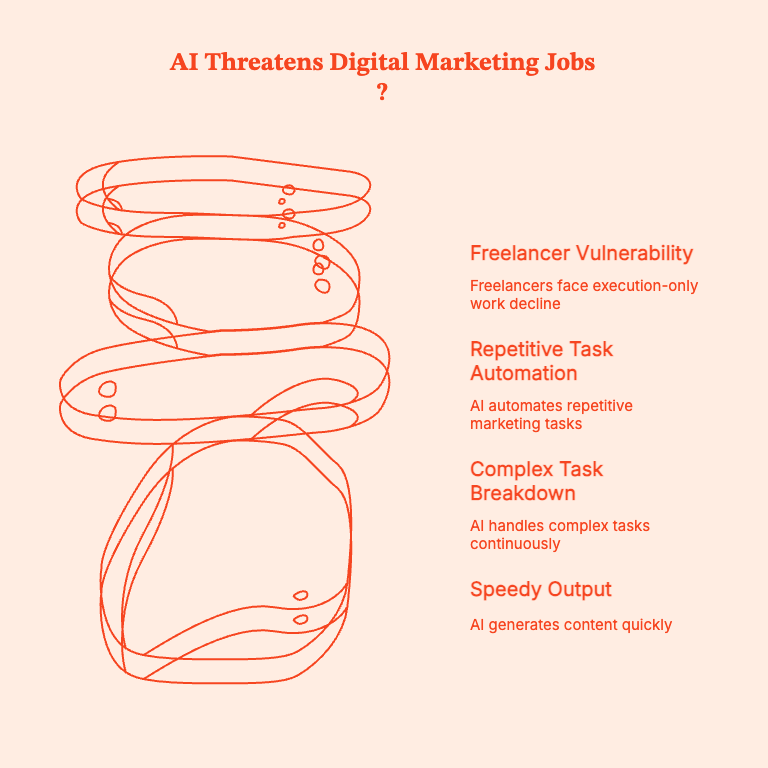
The fear around AI-generated content and marketing tasks, especially via generative AI, is not entirely irrational.
After all, digital marketing rewards speed in output and execution. The more content you publish, the more campaigns you launch, the cleaner your reports for the next person, the more value you bring to the table.
AI engines operate in seconds, work without rest, and if trained appropriately, can break down complex tasks.
Marketers are bound to feel insecure about their jobs when an AI tool can generate 30 ad variations, draft a blog post, cluster keywords, and summarize performance. If you look at Reddit communities like r/marketing, r/SEO, and r/PPC, you'll see that early-career marketers feel the most exposed.
Freelancers doing execution-only work are worried, and roles involving ‘set it and forget it’ workflows are dwindling.
So, if your job involves pulling unimportant reports, setting up garden-variety campaigns, and repetitive SEO/paid media tasks, you might have to worry about AI.
If not, you're fine. You're not obsolete. You're just going to work with AI since you certainly can't outdo it on its own turf.
What AI tools cannot replace in your digital marketing job
Let's go beyond vague arguments (“humans are creative!”) and dramatic exclamations (“AI will never understand emotion!”).
The truth is far more practical.
AI struggles with judgment under uncertainty, and this is a skill without which no business value can exist. You can leverage AI tools to create options for ad campaigns, data analysis, and get rid of repetitive tasks.
But it is the human's job to choose the right option and tell AI specifically what it needs to do.
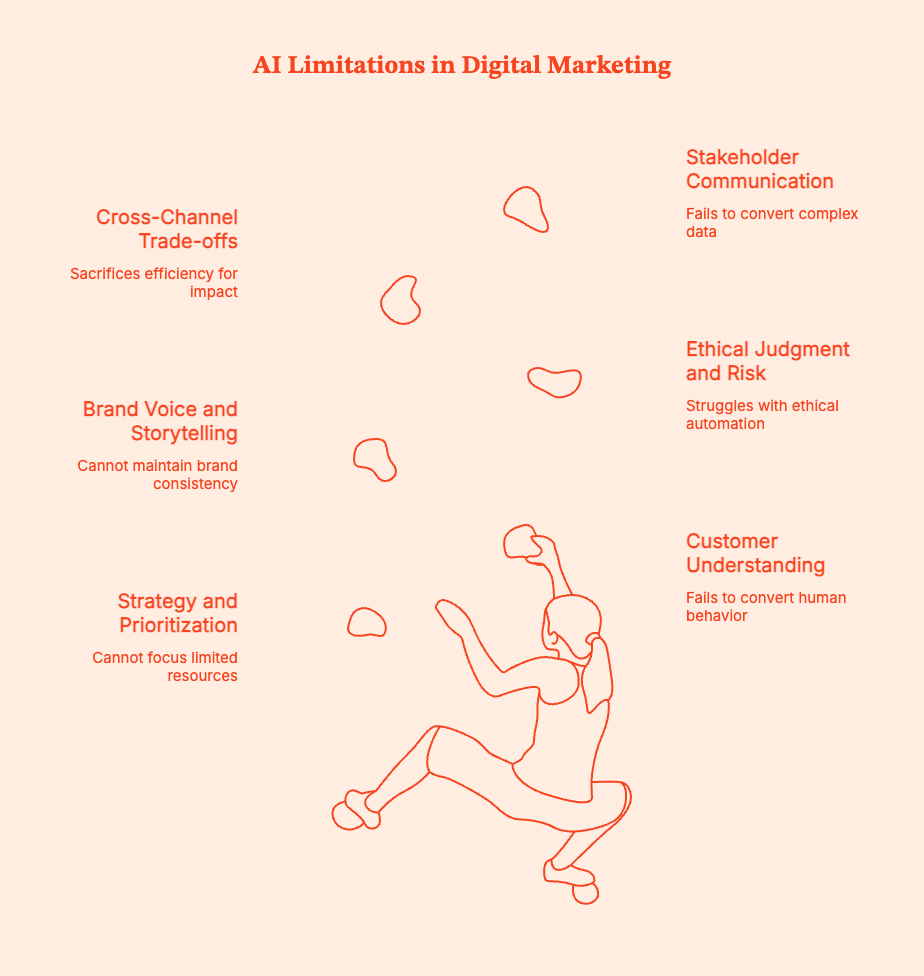
Here's what you can't expect AI to do, and what humans in marketing teams will always do:
Also read: AI Market Research Tools: From Hype Threads to 10 Tools Worth Using
- Strategy and prioritization: Where do you focus your limited time, budget, and brain power?
- Customer understanding: How do you convert messy, qualitative human behavior into meaningful action?
- Brand voice and storytelling: How do you know what strategy/content/communication fits, what feels off, and what erodes customer trust?
- Ethical judgment and risk management: How does AI decide what actions are ethical when automation moves faster than oversight?
- Cross-channel trade-offs: When do you sacrifice efficiency for long-term impact?
- Stakeholder communication: How do you convert complex performance data into decisions people will actually support?
AI can tell you what is happening, but it can't tell you which decisions are actually right. It can't, for instance:
- Decide which market is worth betting on.
- What not to automate to avoid putting the budget and teams under unnecessary pressure.
- Gauge when technically correct data is still contextually misleading.
- Explain results to a stakeholder who wants to see real trade-offs instead of dashboards they don't understand.
- Understand why a campaign might have delivered numbers on paper but damaged customer trust.
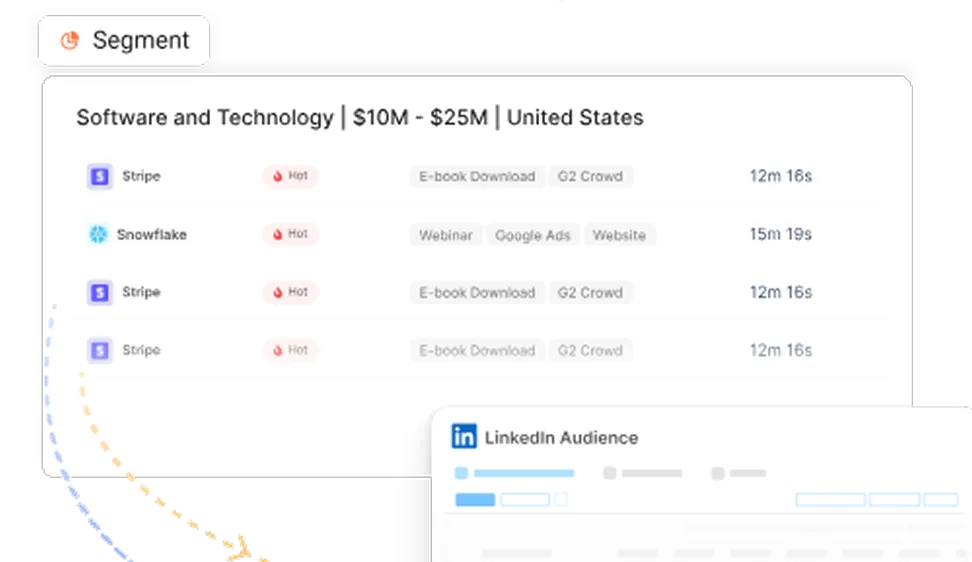
AI can give you a list of events, but it isn't great at telling you which accounts are warming up or where to double down. Factors.ai will bridge that gap by showing account-level intent and engagement across the buyer journey. Using these signals, marketers can prioritize, align with sales, and defend decisions with evidence instead of "gut feel".
{{INLINE_TOFU}}
Which digital marketing roles are most affected by Artificial Intelligence?
AI can replace task profiles, rather than entire jobs. However, any roles built on tasks that are easy to automate are at stake.

Roles under the most pressure
The following roles are shrinking or at least being redefined:
- Junior content writers focused on volume: If your value = how many words you publish, AI will turn that equation on its head. We don't need more first drafts; we need judgment.
- Basic SEO execution roles: AI can take over keyword research, clustering, on-page checks, and audits. You have to decide what it should do and when.
- Media buyers running setup and optimization tweaks: AI platforms can handle bids, budgets, and targeting better than most humans.
- Analysts who only pull reports: AI can create dashboards, but not provide insights. If your job ends at ‘here’s the data,’ AI has you beat.
Roles that are evolving
As certain roles shrink, others are gaining leverage:
- SEO strategists who map content to user intent and business goals.
- Performance and growth marketers who focus on experiments and innovations.
- Content leads and editors who shape narratives and standards to maintain user trust.
- Marketing ops and RevOps professionals who build systems, attribution, and data flows.
- Demand gen leaders who deal with pipeline velocity and pressure without compromising long-term growth.
What's changing is the need for manual execution. AI can take over that, but it cannot be trusted with system and process design. It also cannot hold itself accountable for business outcomes; that's on you.
Will digital marketing be replaced or reshaped by AI?
No, digital marketing will not be replaced by AI. But it will be fundamentally reshaped.
Spreadsheets didn’t eliminate finance teams, marketing automation didn’t kill email marketers, and Google Analytics didn’t replace analysts.
Technology just raised the bar.
AI is in the same vein. It is becoming a fixture in marketing stacks because it removes friction around execution.
It’s becoming a baseline capability, not a differentiator. Not because it replaces thinking, but because it removes friction around execution. It replaces manual effort, slow iteration, and useless busywork.
AI does not replace judgment, strategy, taste, and accountability.
AI will make digital marketing more strategic, more technical, and more outcome-driven. That's an upgrade.
How digital marketers can stay relevant in an AI-driven future
Let's be clear: AI doesn't create winners and losers on its own. It amplifies what you're already bringing.
So, if your value lies in your judgment, AI makes you better at your job. But if your primary task is manual execution, AI will replace you.
Also read: AI marketing vs traditional marketing: What actually drives growth?
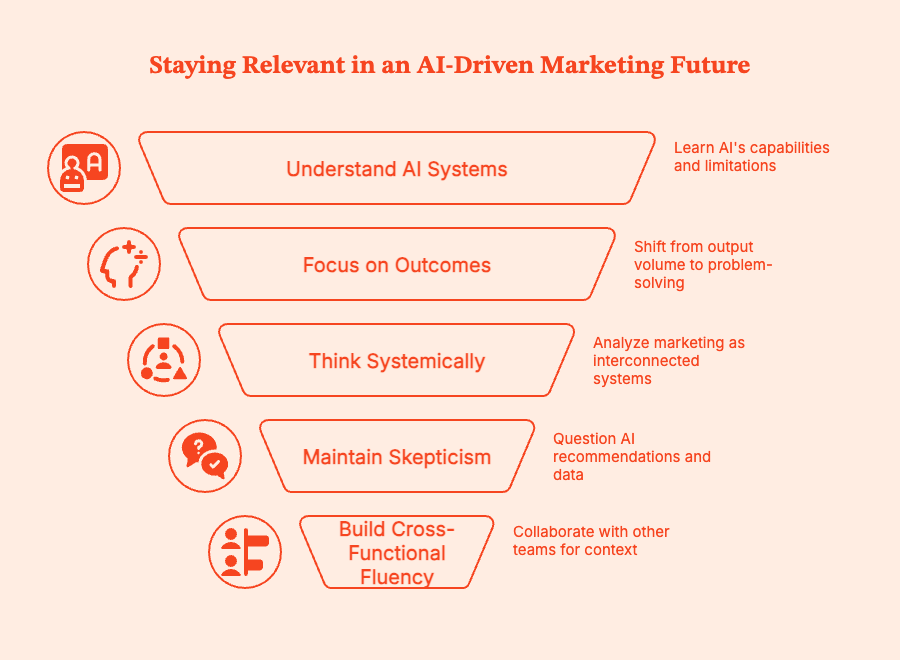
Here's how marketers can improve their tasks with AI:
- Go beyond prompts; understand the system
How well you can use AI depends on:
- The data on which the AI tool has been trained.
- Whether the AI engine hallucinates or oversimplifies its responses.
- Which specific problems is it good at solving, and which it fails at.
- Shift focus from outputs to outcomes
AI can generate content variations, dashboards, and recommendations. It can analyze data and recommend tactics to future-proof campaigns and the marketing industry.
But AI technology cannot decide how to take the business forward.
To stay relevant, consider focusing less on the volume of output and more on:
- What problem are you solving
- What trade-offs are you making to solve the problem at hand
- Think in systems, not channels
AI fundamentally accelerates and reduces the cost of execution. System-first thinking helps make better decisions.
To stay resilient in an AI-heavy job market, take the time to understand:
- How acquisition maps to retention
- How GTM motion influences each channel's performance
- How attribution models influence account intelligence and behavior
AI can optimize certain components of the machine, but humans still have to design it.
- Maintain some skepticism toward AI outputs
A very important part of your AI expertise is disagreeing with your AI systems and tools. Learn how to frequently:
- Question recommendations that may look right, but clearly aren't answering the question.
- Flag data that is technically accurate but will derail strategy.
- Prioritize context more than technical accuracy (when required).
- Explain decisions to leadership without hiding behind dashboards.
- Build cross-functional fluency
To stay relevant as a marketer who will also embrace AI, stay on top of these:
- Get context on revenue forecasting from sales teams.
- Talk trade-offs with product teams.
- Help design processes and pipelines with Ops teams.
- When explaining decisions to leadership, use your words instead of just fancy dashboards.
AI does not replace judgment, but it does expose those who never had any. Don't be one of them.
What leaders and teams should get right about AI in marketing
Folks managing a marketing agency or team are inevitably reeling (at least a little bit) with the emergence of AI EVERYWHERE (or so it seems).
The questions and decisions are endless: Do you need fewer people? Different people? More tools? Fewer tools? What happens if you automate too fast or not fast enough?
But AI doesn't eliminate employee count overnight. It just reprioritizes where human effort is really needed.
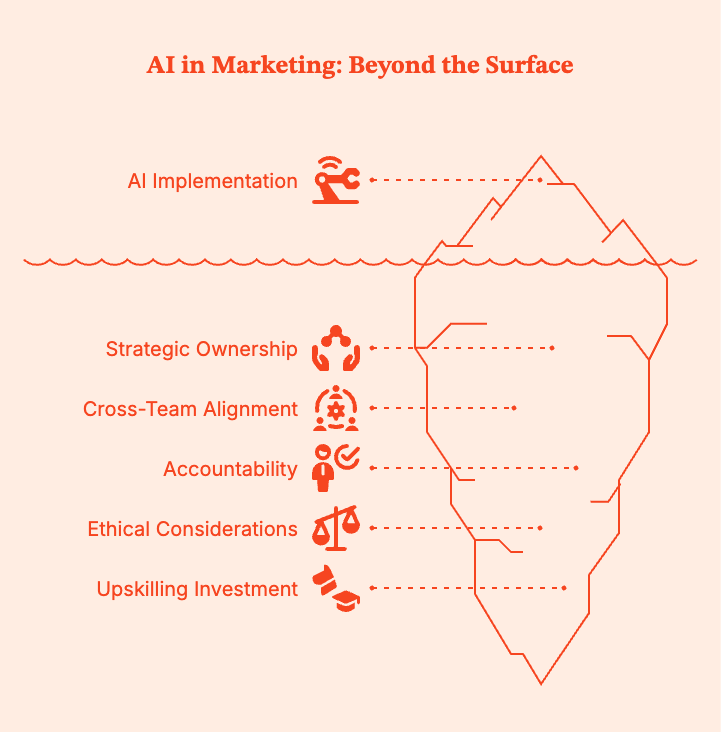
- AI is not a headcount shortcut
AI can reduce manual workload, but it cannot replace strategic ownership, cross-team alignment, and accountability. If you try to ‘do more with less’, you will probably end up:
- Shipping more content, but it might perform terribly.
- Automating processes no one fully understands.
- Losing out on brand credibility and customer trust.
- Burning out the few people who are still there to manage the system.
- The downsides of over-automation
AI can certainly optimize the metrics it has been given, but it won't do too well at understanding what you actually mean when you say ‘get a sense of what people really want based on these conversations’. It'll give you bullet points, but it cannot make educated judgments based on vocal cadence, commonly used regional phrases, and so on.
If you over-automate with AI programs and treat AI as a substitute for the real human mind, expect that:
- Your brand voice will be diluted.
- You'll see hikes in short-term, volume-based metrics and then a steep drop in long-term quality.
- You won't have real explanations for why something worked or failed, because AI decisions are not visible from the backend.
All digital tools should only support judgment, not replace it.
- Human ownership is irreplaceable
No tool, however advanced, will replace the human insight needed for decision making, risk, and accountability. Only humans can:
- Decide what success looks like.
- Where to focus limited efforts and budget.
- Understand ethical and compliance pressures.
- Own outcomes without using tools or models as excuses.
- Invest in upskilling
Don't panic. Just figure out how to get AI to work for you.
Some quick ideas:
- Train your teams to gauge the veracity of AI outputs. No blind trust.
- Redesign the role around system building and strategy, not just output volume.
- Make AI literacy a part of performance KPIs.
- Give people time to learn. No one learns overnight.
- Assign clear ownership
AI without ownership is a massive risk. With failure, every AI-driven workflow should have a clear human owner, established and non-negotiable guardrails, and a human decision maker who is also accountable for all outcomes.
"The tool did it" is not an acceptable answer to stakeholders, customers, or regulators.
Note: Evaluating AI utility requires examining multiple metrics across various channels. You can't be spending time manually gathering all that data (and also keep your job). Instead, a tool like Factors.ai can help by pulling website engagement, ad interactions, CRM data, and third-party intent into a single view. That means you can stop guessing which activities are meaningful and start acting on signals that directly drive revenue.
The Future is AI-powered marketers, not AI replacing marketers
Set aside the hype and scare tactics. The truth is that AI will absolutely change how marketing tasks are done.
Some roles will narrow in scope or disappear. Others will expand and become more valued.
Entirely new roles will emerge.
But digital marketers will not disappear. They will become (if they want to keep their job and grow) more strategic, technical, and accountable.
They will own decision-making while AI reduces the distance between insight and action.
Teams have to (and already are) recalibrating by pushing marketers to think in terms of systems and strategy. Less “optimize this channel,” more “explain how this contributes to pipeline, revenue, and growth."
To see how AI can actually make you a better digital marketer, consider booking a demo for Factors.ai.
The tool will clearly show you which accounts are engaging, what signals actually matter, and how marketing influences revenue, so you can stay ahead by shifting the conversation from output to outcomes.
Summary
AI isn’t replacing digital marketers.
It is replacing the parts of the job that were always closer to execution than strategy. AI tools can write content, optimize ads, analyze performance, and automate workflows.
Basically AI is reshaping digital marketing.
AI is set to take over speed, scale, and pattern recognition. It will be drafting, testing, forecasting, and surfacing insights across massive datasets. But it cannot decide what matters, what to prioritize, or what trade-offs to make. That lies on humans.
Task-heavy roles focused on execution feel the pressure of AI first. Strategic roles are gaining leverage. Junior marketers, freelancers, and “set-it-and-forget-it” positions are evolving, while marketers who prioritize systems, outcomes, and revenue impact are gaining value.
To stay relevant, marketers have to go beyond prompts and tools. They have to learn how AI works, question its outputs, think cross-functionally, and focus on judgment over volume. Managers need to resist panic, avoid over-automation, invest in upskilling, and maintain clear human ownership over direction, risk, and accountability.
AI isn’t replacing digital marketers. It’s giving us AI-powered marketers. These are the folks people who use to eliminate busywork and focus on the decisions that actually move the business forward.
Make no mistake, that is an upgrade.
Frequently Asked Questions about AI and Digital Marketing
Q.Will AI replace digital marketers completely?
Absolutely not. AI will replace specific marketing tasks, but cannot take over end-to-end marketing roles. Human marketers still have to set strategy, make trade-offs, understand customers, and take accountability for outcomes.
Q. Which marketing jobs are most at risk from AI?
The roles most at risk from AI are built around setup, repetitive execution, and low or no judgment. For instance, roles around junior content production, basic SEO execution, manual reporting, and media buying.
Q. Is digital marketing still a good career in the age of AI?
Yes, it is. But your digital marketing job will become more strategic and less execution-centered. Marketers will now need to focus on judgment, systems, and business impact.
Q. Will AI replace SEO specialists and content marketers?
AI can handle first drafts and data analysis. But it cannot replace strategic SEO or editorial evaluation. Human marketers still need to decide what to create, how it fits the brand, and how it supports business goals.
Q. Can one marketer with AI replace an entire team?
Only if they are okay with short-term gains at the cost of long-term quality and customer trust. AI can initially increase individual output...by a lot. But, over time, humans need to step in for strategy, quality control, cross-functional coordination, and accountability.
Q. What skills should digital marketers learn to stay relevant?
Take the time to invest in strategic and systems thinking, analytics interpretation, AI literacy, and cross-functional communication. These matter more than mastering any single tool. Your skill lies in the ability to evaluate and apply AI outputs critically.
Q. Is AI more of a threat to junior or senior marketers?
Junior marketers will feel the impact first because many entry-level tasks they do are easier to automate. Senior marketers who don’t adapt will also struggle as workflows and technical requirements change.
Q. How are companies actually using AI in marketing today?
Most marketing teams use AI to draft content, create copy variations, analyze performance, predict trends, and automate reporting. Not many organizations allow AI to make final decisions without human oversight.
Q. Will AI reduce marketing salaries or increase expectations?
In the short term, expectations are hiking faster than salaries. Over time, however, marketers skilled in pushing strategic impact and revenue clarity will command higher compensation.
Q. Is AI better suited for B2B or B2C marketing?
AI works great for both, but B2B teams will get more value faster because AI can excel in intent analysis, attribution, and revenue alignment. B2C teams can use AI for personalization, creative testing, and lifecycle optimization.
Q. What’s the biggest misconception about AI replacing marketing jobs?
That AI will take your job.
What it will take are the repetitive parts of your job. You still need to handle judgment, context, and accountability.

See how Factors can 2x your ROI
Boost your LinkedIn ROI in no time using data-driven insights


.avif)

See Factors in action.
Schedule a personalized demo or sign up to get started for free
LinkedIn Marketing Partner
GDPR & SOC2 Type II

.svg)



.avif)

