
AI in Marketing and Sales: Marketing Automation Examples
Discover how AI in marketing and sales boosts efficiency, automates workflows, and drives conversions. Find real examples, tools & strategies inside.
.avif)
Content Marketer

Growth Marketer



.svg)


TL;DR
- AI now predicts intent, personalizes outreach, and adapts to campaigns in real time.
- It connects every stage of the buyer journey, so no one falls into the abyss between MQL and SQL.
- Platforms like Factors.ai, HubSpot, Marketo, Salesforce, and ActiveCampaign unify data and intelligence.
- Predictive analytics and cross-channel visibility will shape the next wave.
- Teams using AI-powered automation move faster, waste less, and convert more.
Ever looked at your old marketing tools and wished they would just grow a brain?
Good news... they did. And then they grew a personality, a memory, and an oddly accurate sense of buyer intent.
What used to be simple ‘send email at 9am’ automation has turned into systems that pull in signals from everywhere, personalize every touchpoint, and basically run half your GTM motion while you’re still opening your laptop.
And obviously, it’s all because of AI. It helps teams think ahead and ties awareness, engagement, and revenue together into one continuous story. And it finally gives us marketers something we rarely get ✨clarity✨.
Okay, enough talk, now let’s get into how automation actually works, what AI is enabling, and where platforms like Factors.ai fit into this whole glow-up.
How is AI reshaping modern marketing strategies?
AI has flipped automation from reactive to proactive.
It’s the difference between ‘someone downloaded an ebook, send email 2’ and ‘someone’s showing intent across paid, organic, and your website, here’s the next best action.’
Think Netflix recommending a show you didn’t even know you wanted to binge. Same vibe, just with B2B buyers who aren’t as cute as baby Yoda but behave just as predictably.
Some of the biggest shifts:
- Hyper-personalization: AI analyzes browsing behavior, content engagement, firmographic context, and even historical CRM activity. The result: outreach that feels human, not mass-produced.
- Intent-based engagement: Instead of guessing, marketers respond to clear signals. If an account is researching pain points that map to your product, AI helps push the right content at the right moment.
- Predictive recommendations: AI identifies the next best step, whether it’s an ad, an email, a conversation, or nothing. Yess… sometimes the best action is ‘calm down, they’re not ready.’
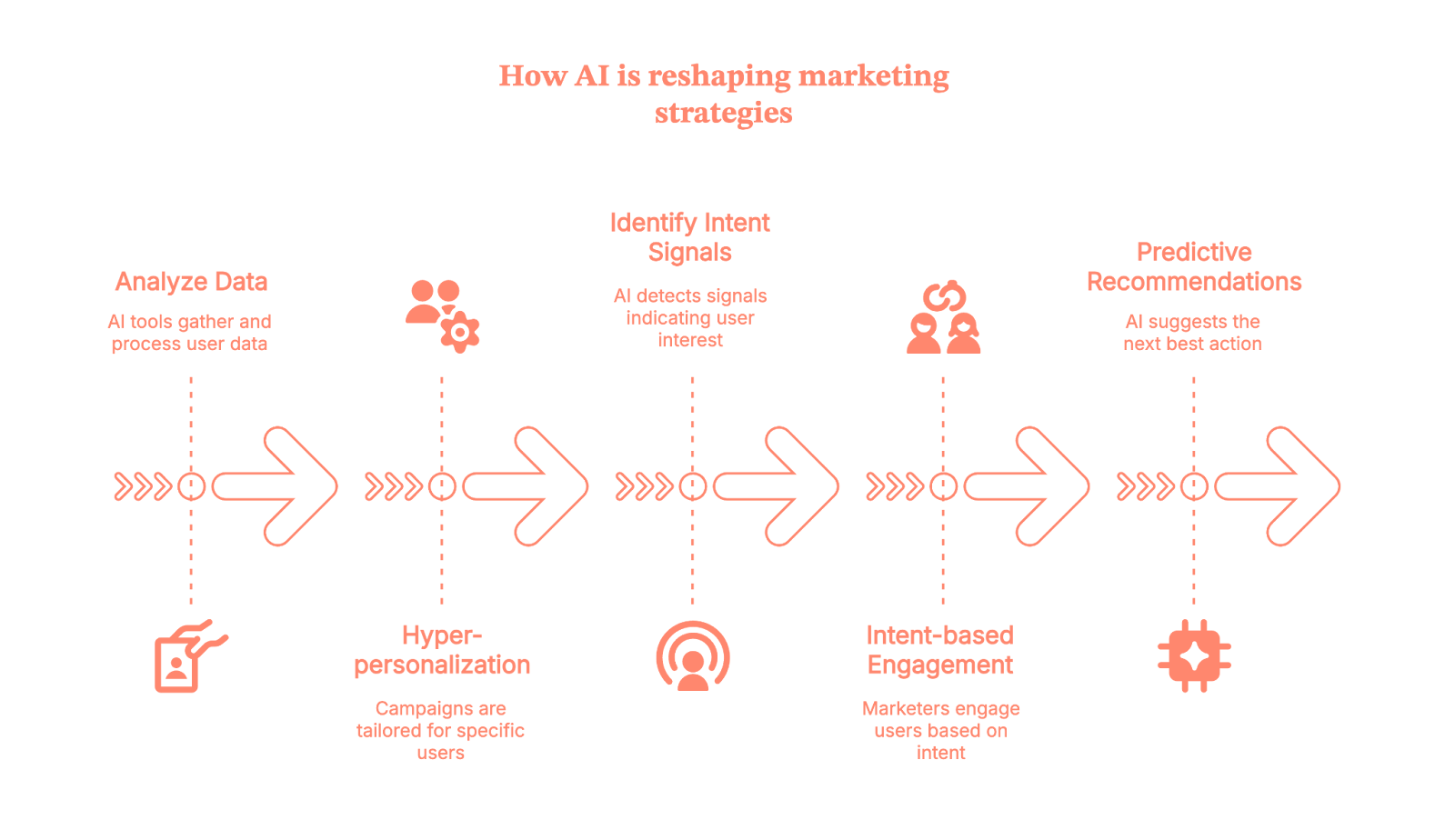
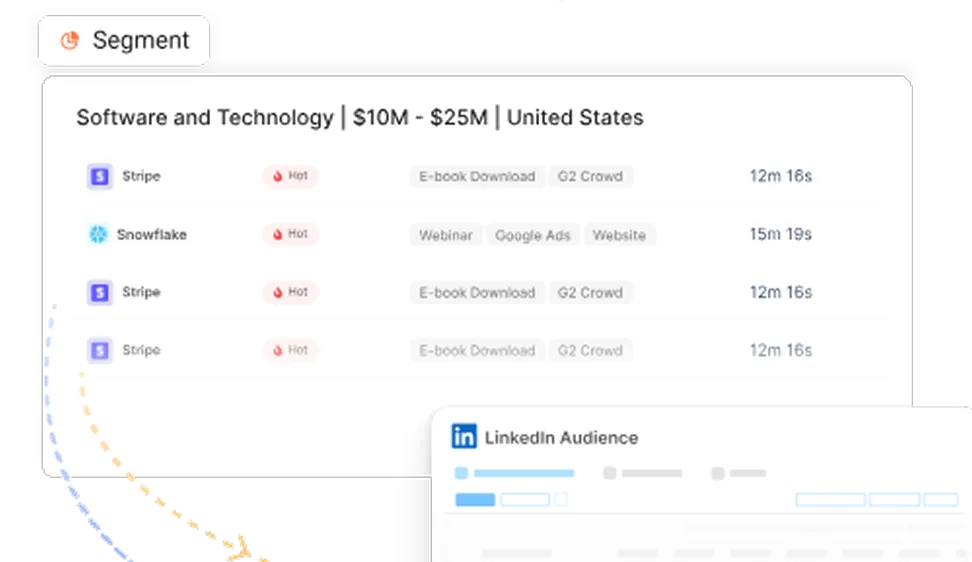
Platforms like Factors.ai help here by combining website behavior, CRM activity, and ad interactions into a unified view of account intent. When teams can see who is active and why, targeting becomes intentional instead of accidental.
Key trends shaping the future of automation
Here’s what every senior marketer should keep an eye on:
- Predictive analytics: AI-powered forecasting helps teams identify which campaigns, audiences, and channels are most likely to convert. This shifts planning from random guesswork to evidence-backed prioritization, so budgets move toward impact instead of noise.
- Full-funnel visibility: Modern tools now connect data across every stage of the journey, showing how accounts progress from awareness to decision. This eliminates blind spots and helps teams understand which touchpoints actually influence revenue.
- Cross-functional automation: Marketing and sales get to operate from the same set of insights. Outreach, follow-ups, and content delivery stay aligned because all teams are responding to the same buyer signals in real time.
- Autonomous campaign execution: AI agents will increasingly adjust budgets, optimize content variations, and trigger outreach based on performance and buyer behavior. This reduces manual intervention and keeps campaigns evolving as conditions change.
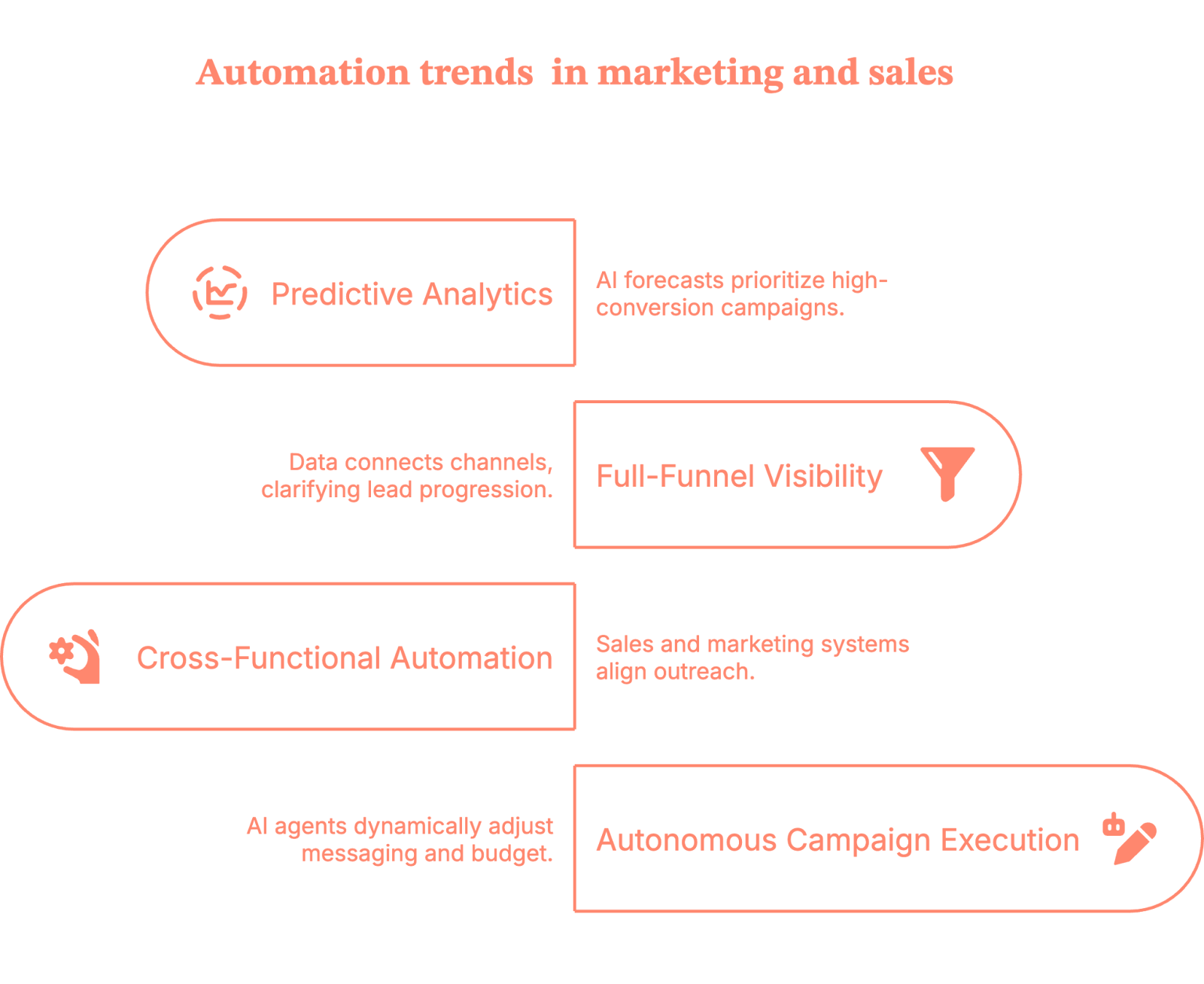
Together, these trends move automation from static rule-based workflows to a dynamic GTM system that continually learns, adapts, and improves results.
Related read: Guide to retention in customer journey
{{INLINE_TOFU}}
Benefits of marketing automation
Marketing automation is all about precision, scale, and making your GTM engine less topsy-turvy.
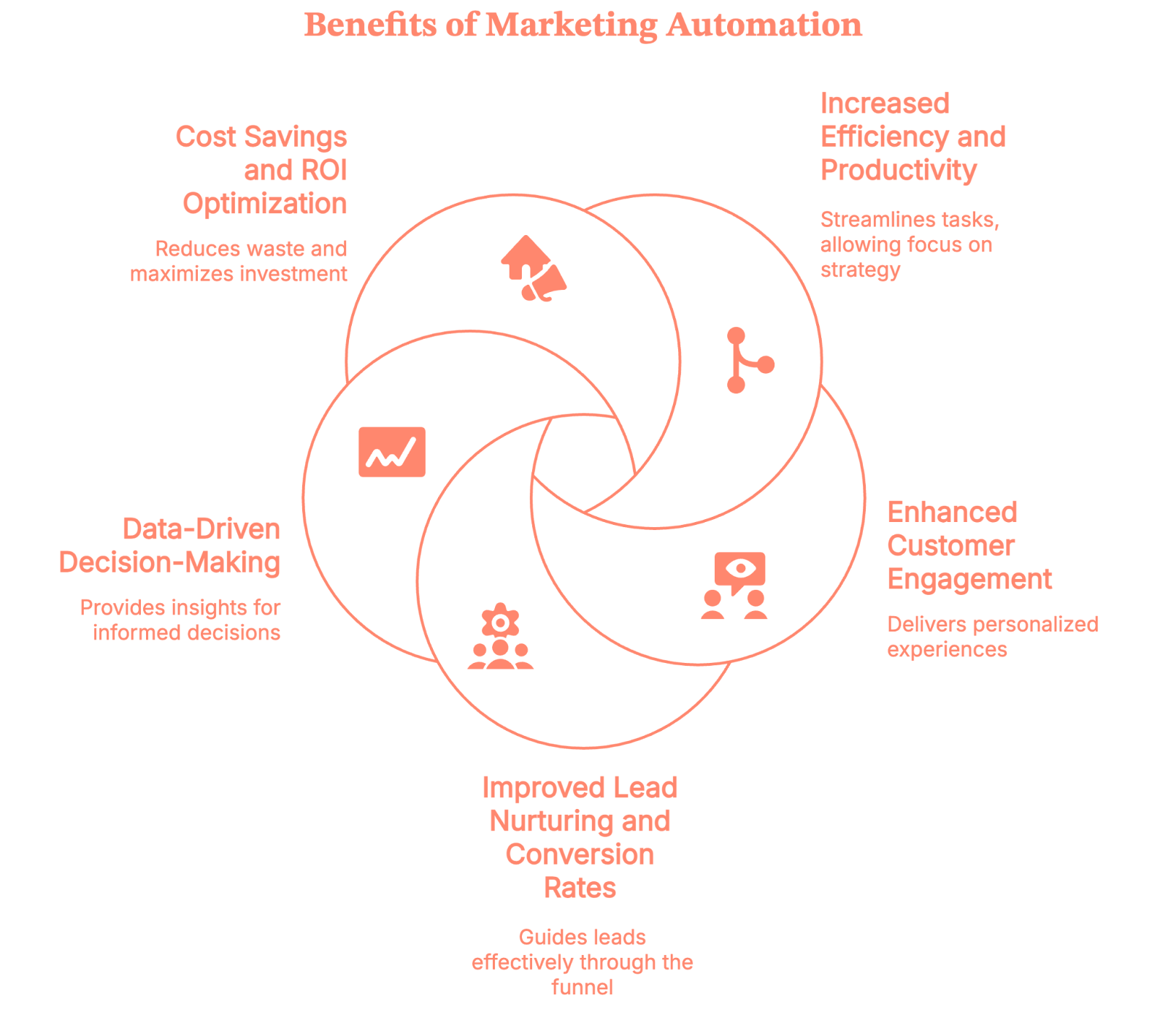
1. Efficiency that actually frees up humans
Repetitive tasks disappear so marketing can finally focus on creativity, messaging, and strategy. Workflows fire automatically in response to triggers, data updates, or buyer behavior. (So no more anxiety driven by thoughts like “did the sequence go out?”)
2. Personalization that doesn’t feel robotic
AI uses real interaction patterns to shape email content, ads, website experiences, and nurture flows. With that, prospects get experiences that feel relevant to their buyer journey, which is great because no one wants to feel like Contact #34298.
3. Decisions powered by real data
Modern tools analyze cross-channel signals at a scale humans humanly can’t. Real-time dashboards and AI recommendations show what’s working, what’s not, and where to double down. Factors.ai goes deeper with attribution, journey mapping, and account-level intent.
4. Lead nurturing that converts
Behavior-based automation pushes the right content at the right moment, guiding buyers through the funnel without manual effort. This tightens sales cycles and reduces the need to ask, “where did this lead even come from?”
5. Cost savings and ROI you can defend
When you target high-intent audiences and personalize at scale, wasted spend drops quickly. And your ROI obviously climbs because your budget finally follows the data rather than wishful thinking.
| Benefit | Outcome |
|---|---|
| Efficiency | Fewer manual tasks, more team bandwidth |
| Personalization | Better engagement and higher relevance |
| Lead nurturing | Faster movement through the funnel |
| Data insights | Clearer decisions, fewer surprises |
| ROI | More pipeline from the same budget |
Examples of Automation (that are actually working right now)
Note: This is where the ‘grow a brain’ part comes in.
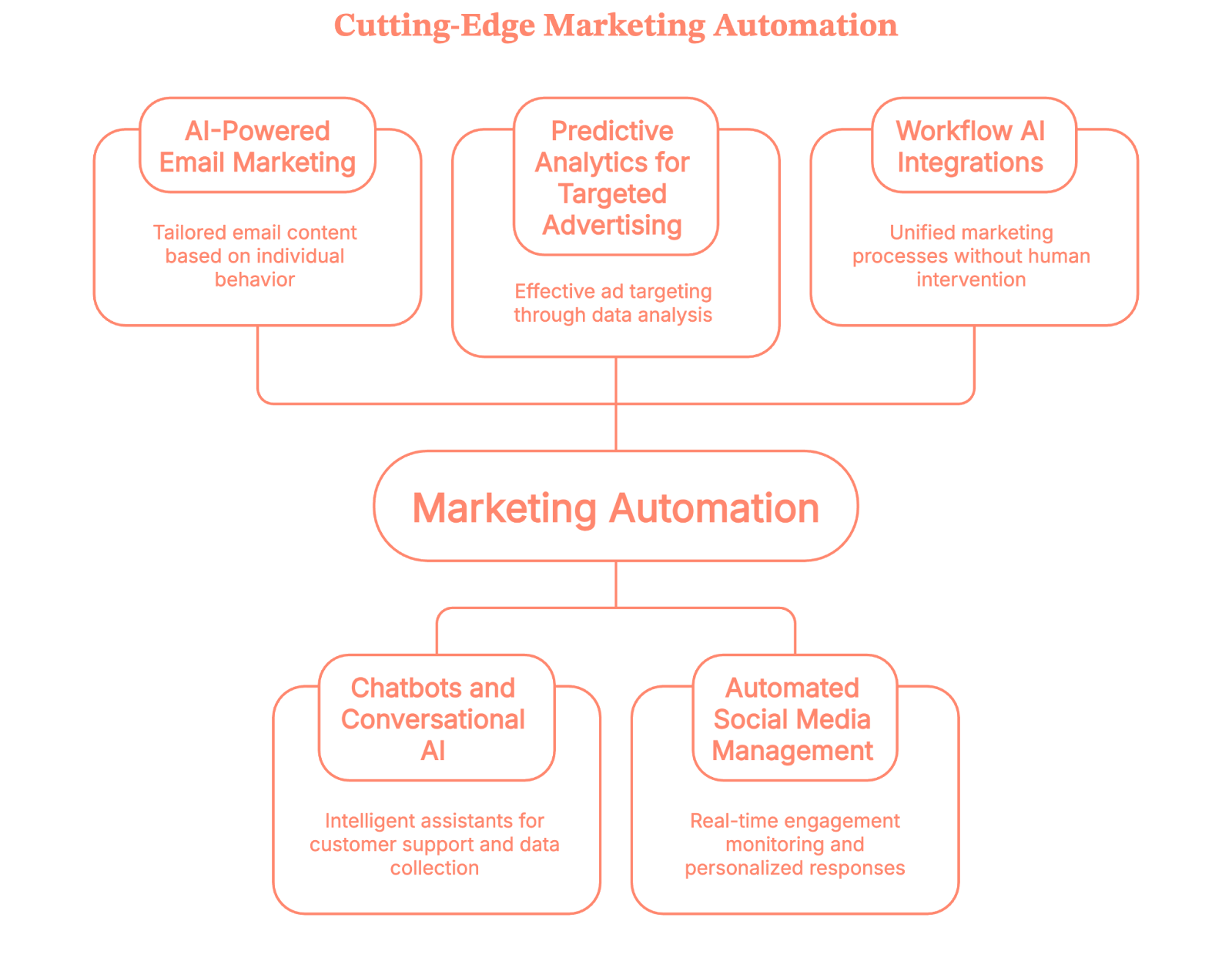
1. AI-powered email sequences
Emails now adapt based on buyer behavior.
- Subject lines adjust in real time
- Content blocks shift based on interest
- Send time optimizes per individual
For example, if someone downloads a pricing guide, they’ll get pointed to a relevant webinar, case study, or product comparison.
2. Chatbots and conversational AI
Chatbots aren’t FAQ parrots anymore (thank the Lord). They qualify leads, offer recommendations, and collect data that refines future campaigns.
Also, they work 24/7, no PTO, and 30-minute smoke breaks.
3. Predictive analytics for ads
Predictive targeting helps ads land in front of high-potential accounts instead of low-intent audiences. AI models evaluate firmographics, engagement patterns, and intent signals to map out who’s most likely to convert.
Factors.ai builds on this with account scoring powered by website behavior, campaign activity, and third-party intent, giving teams a clear path for targeted spend.
4. Automated social media management
Tools optimize posting times, monitor engagement, and even recommend responses in real time. Some can also detect trending topics before they take off, so your brand doesn’t look like it's late to the party.
5. Workflow AI for seamless GTM
This is where it gets fun.
Let me give you an example:
An account shows high intent on your website.
Automation triggers a warm LinkedIn sequence, emails, and alerts the right rep.
All synced across CRM, ad platforms, and analytics.
With Factors.ai’s GTM engineering workflows, teams can unify visitor data, intent signals, and outreach so everything moves in sync instead of feeling like a disjointed group project.
Top Marketing Automation Platforms (and what they do)
There are lots of tools in martech, but a few players consistently show up in B2B stacks, here they are:
- Factors.ai (obviously!)
Built for B2B teams that need ABM, intent capture, attribution, and targeted advertising with LinkedIn AdPilotg and Google AdPilot, powered by unified account-level insights. - HubSpot
Great for inbound. HubSpot offers user-friendly automation, CRM, and reporting tools that help growing teams manage campaigns without complexity. - Marketo Engage
A favorite among enterprise power users. Marketo excels in segmentation, lead scoring, and large-scale cross-channel orchestration. - Salesforce Marketing Cloud
Strongest for teams deeply tied to the Salesforce ecosystem. It delivers robust automation across email, mobile, and CRM-integrated journeys. - ActiveCampaign
Ideal for SMBs that want advanced automation without enterprise overhead. ActiveCampaign stands out for journey mapping and email intelligence at a friendly price point.
Key capabilities these tools usually offer
| Feature | Tool Name | Description |
|---|---|---|
| Intent detection | Factors.ai | Identifies high-intent accounts across website, ads, and CRM data. Factors.ai stands out with unified account-level intent from multiple sources. |
| Personalization | HubSpot, ActiveCampaign | Dynamic messaging and content variations built around audience segments, behaviors, and lifecycle stages. |
| Lead scoring | Marketo Engage, Factors.ai | AI models that prioritize accounts based on engagement patterns, fit, and intent signals. Helps teams focus on high-probability buyers. |
| Omnichannel orchestration | Salesforce Marketing Cloud, Marketo Engage, Factors.ai | Coordinates experiences across email, ads, mobile, and website to deliver consistent journeys across the funnel. |
| Attribution | Factors.ai | Provides clear visibility into what influences pipeline and revenue with multi-touch attribution across paid, organic, and sales interactions. |
How to optimize sales workflows with AI?
Sales teams live under SO much pressure, almost like they’re inside a pressure cooker… getting ready to get cooked (Get it? Get it?). So, they’d obviously kill for shorter cycles, more deals, and less time to achieve ALL of this. *cue to Paradise by Coldplay*.
Now, this is where automation becomes a bridge to the said paradise.
- Designing efficient workflows
AI handles the grunt work:- Lead routing
- Task scheduling
- Stage updates
- Meeting reminders
Everything stays timely and consistent.
- Smart lead scoring
AI looks beyond job titles or company size. It studies behavior, intent, and engagement patterns to decide who’s worth a rep’s time.
- Automating follow-ups
Triggers fire automatically when a lead shows interest.- Viewed pricing page?
- Downloaded a case study?
- Watched 50% of a webinar?
The system knows what to do next.
Oh and Factors.ai helps identify which accounts actually deserve this level of energy so reps stop chasing leads that aren’t ready.
- Better revenue outcomes
Teams that combine automation and AI typically see:- Shorter sales cycles
- Higher conversions
- Better forecasting
- Less time wasted
- Better sleep
I mean… it’s literally the definition of working smarter.
Workflows: The superglue that sticks the GTM motion together
Workflow AI is the connective tissue that ties marketing and sales activities together.
It ensures:
- Tools talk to each other
- Data flows correctly
- Actions fire at the right time
- Teams stay aligned
Where workflow apps shine (bright like diamonds)
| Tool Type | Use Case | Impact |
|---|---|---|
| CRM automation | Updates records, assigns tasks | Better accuracy |
| Marketing automation | Triggered campaigns | Higher engagement |
| Sales enablement | Next-step recommendations | Faster deal velocity |
| Analytics automation | Performance insights | Smarter decisions |
Factors.ai pulls several of these pieces into one system by unifying intent data, outreach triggers, and revenue analytics.
In A Nutshell
AI has fundamentally redefined marketing and sales automation, from static workflows to intelligent, responsive systems that fuel pipeline progression. Today, tools observe, interpret, and act. Platforms like Factors.ai integrate CRM activity, web behavior, and ad signals to offer precision targeting and real-time personalization that mirrors buyer behavior with uncanny accuracy.
Rather than reacting to form fills, AI-enabled platforms anticipate needs, recommend actions, and sync marketing and sales with shared intelligence. Campaigns adapt on their own, creative shifts in-flight, and intent signals guide next steps across the entire funnel. Predictive analytics shape budgets and messaging, while workflow automation eliminates lag between buyer action and team response.
And brands that lean into automation:
- Engage smarter
- Convert faster
- Waste less budget
- Understand their buyer journeys clearly
Sales teams gain clarity on who to pursue and when, while marketers can scale relevance without feeling robotic. Tools like HubSpot, Salesforce Marketing Cloud, and ActiveCampaign bring this automation to teams of all sizes, while Factors.ai anchors deeper use cases with unified account intelligence.
The future isn’t AI replacing marketers… it’s AI doing the repetitive tasks so humans can do what they were always meant to do… strategic thinking.
FAQs for AI in marketing and sales: Marketing automation examples
Q1. How does AI in marketing and sales improve collaboration between teams?
AI bridges the gap between marketing and sales by providing shared insights into buyer intent, engagement, and readiness. Instead of working from separate data sets, both teams operate from a unified view of the customer journey. This alignment helps marketing hand off better-qualified leads and enables sales to prioritize accounts more effectively.
Q2. What’s the difference between traditional automation and AI-powered automation?
Traditional automation executes predefined rules, like sending an email when someone fills out a form. AI-powered automation, on the other hand, learns from behavior and context. It predicts what action should happen next, adapts in real time, and continuously optimizes results based on new data.
Q3. Can small and mid-sized businesses benefit from AI-driven marketing automation?
Absolutely. AI in marketing and sales isn’t just for enterprises anymore. Modern tools are scalable and easy to integrate, helping smaller teams personalize outreach, score leads, and manage campaigns more efficiently. Even a few well-implemented automations can save hours of manual effort and lead to measurable growth.
Q4. How does AI ensure better customer experiences through automation?
AI makes automation more human by using data to understand what customers actually care about. It tailors content, timing, and communication channels to each user’s preferences, so interactions feel relevant instead of repetitive. This creates smoother experiences that build trust and brand loyalty over time.
Q5. What kind of data fuels AI in marketing and sales automation?
AI relies on a mix of behavioral, demographic, and firmographic data, things like website visits, ad interactions, purchase history, and CRM records. The richer and cleaner the data, the smarter the automation becomes. That’s why modern platforms emphasize unified data pipelines that connect marketing, sales, and analytics.
Q6. Are there any challenges in adopting AI for marketing and sales automation?
Yes, while the benefits are significant, challenges include data silos, integration complexity, and the learning curve for teams new to AI tools. Success depends on aligning strategy with technology, ensuring clean data, and training teams to interpret and act on AI insights effectively.

See how Factors can 2x your ROI
Boost your LinkedIn ROI in no time using data-driven insights


.avif)
See Factors in action.
Schedule a personalized demo or sign up to get started for free
LinkedIn Marketing Partner
GDPR & SOC2 Type II

.svg)



.avif)

