
Marketing Optimization Solutions: AI Strategies That Drive Real ROI
See how AI-driven marketing optimization helps B2B teams make faster, smarter decisions that align with pipeline impact.
.avif)
Content Marketer



.svg)


TL;DR
- Most marketing ‘optimization’ focuses on activity, not outcomes, leading to performance that looks good on dashboards but fails to drive the pipeline.
- AI enables real-time decision-making, pattern detection, and signal prioritization that human teams can’t scale, transforming optimization from reactive to predictive.
- True optimization happens at the system level, across channels, funnel stages, and regions, not in isolation or post-mortem analysis.
- The strongest results come from operationalizing AI, using it to inform decisions, shift budgets dynamically, and align marketing with revenue, without adding tool sprawl.
Most marketing teams aren’t short on optimization… in fact, they’re drowning in it.
Ads are optimized. Emails are optimized. Landing pages are optimized. There’s even a dashboard somewhere proving that everything has been optimized veryyyy efficiently.
And yet, the same questions… that refuse to go away.
Why did this campaign get attention but not pipeline?
Why is one region printing results while another is doing absolutely nothing?
Why does every quarter cost more but feel less predictable?
Why? Why? WHY?
I’ve lived this (for the lack of a better word… nightmare). The dashboards look good, everyone sounds confident in meetings, and still… no one is fully sure which decisions actually moved revenue.
That’s because most marketing optimization focuses on activity rather than outcomes. We improve channels in isolation, lock budgets early, and analyze results after the window to act has already closed. By the time insights show up… they raise interest but remain useless.
This is where marketing optimization solutions actually matter. Not as another tool or report (nooo… please), but as a way to make better decisions while money is still being spent. Decisions are tied to pipeline, regions, and real buying behavior.
In this guide, I’ll break down what marketing optimization solutions really mean in B2B, how AI is changing things, and how teams move from reactive tweaks to consistent ROI. If optimization has ever felt busy but not effective… you’re in the right place.
First up… why does optimization in marketing feel ‘broken’ today?
Let me paint a very familiar picture.
Monday morning. Someone shares a dashboard. CTR is up. CPC is down. Open rates look healthy. There is a brief, polite nodding ceremony in the meeting. Someone says, “Good numbers this week.”
Then someone else asks the most annoying question of the century...“So… did this actually move the pipeline?”
Silence. Awkward scrolling. Someone promises to check and circle back.
This is not because marketers are bad at their jobs. It is because marketing optimization has gone off track.
- The first crack in the system is our obsession with channel-level metrics.
Clicks, impressions, opens, and engagement are easy to measure and as comforting as chicken soup when you have the flu. They make us feel ✨productive ✨. But in B2B, these metrics are often faaar away from revenue. A campaign can look like an absolute rockstar on LinkedIn and still attract accounts that were never going to buy.
- The second issue is the way our marketing tools are set up.
Each tool does its own job well, but none of them talk to each other the way B2B teams think. CRM tells one story. Ad platforms tell another. Website analytics sits somewhere in the middle like a confused mediator. When insights are fragmented, optimization decisions become educated guesses dressed up as strategy (and Chinese whispers).
- At number three, there’s timing.
Most optimization happens after the damage is done. We launch campaigns, spend dollars, wait for reports, and then optimize in hindsight. By the time we learn what worked, the quarter is over, and the learnings go into a slide deck that no one opens again.
- And finally, there is the blind faith in ‘best practices.’
What works for a simple, transactional funnel does not survive a long (non-linear) B2B buying journey. Multiple stakeholders, regional differences, non-linear paths, and sales cycles that stretch forever do not care about your neatly packaged playbook.
The result is a strange paradox. Marketing teams are working harder than ever, tracking more data than ever, and still feeling less confident about their decisions.
This is why marketing optimization solutions cannot be about fixing one channel or improving one metric. The problem is structural. Optimization needs to happen at the system level, while money is being spent, and with revenue as the anchor.⚓
Before we get into marketing optimization solutions, we need to first see what we really mean by optimization in a B2B context.
What does ‘marketing optimization solutions’ actually mean in B2B?
Look, this phrase gets thrown around a lot, and half the time everyone in the room is picturing something different… as different as apples and New York baked cheesecake. (I’d prefer the latter, just saying.)
When most teams say ‘optimization,’ they usually mean small tweaks.
Like… changing the headline… pausing the underperforming ad… increasing the budget on what worked last week… and making the logo a little bigger.
That is not wrong… but it’s incomplete.
In B2B, marketing optimization solutions are about continuous decision-making, not one-time improvements (systems… remember?). The goal is NOT to make a channel look better. The goal is to make revenue more predictable. Techniques like marketing mix modeling and predictive analytics play an important role in supporting ongoing campaign optimization by enabling data-driven adjustments, forecasting outcomes, and optimizing budget allocation across channels.
Optimization is not one thing. It happens at three levels.
- Channel optimization
This is where most teams start and often stop.
Examples:
- Lowering CPC on paid ads
- Improving email open or reply rates
- Increasing landing page conversion
Optimizing across different marketing channels, such as digital, social, email, and offline platforms, can significantly improve overall effectiveness by allowing strategic allocation of budgets and more personalized engagement for each channel.
Useful, but limited. Channel optimization answers the question:
Is this tactic working in isolation?
- Funnel optimization
This looks at how buyers move across stages.
Examples:
- Are the right accounts entering the funnel?
- Are engaged accounts actually progressing?
- Are we retargeting based on behavior or just time?
This level starts connecting dots, but it still does not guarantee revenue impact.
- Revenue optimization
This is where marketing optimization solutions earn their name.
Examples:
- Which accounts are most likely to convert right now?
- Where should the budget shift this week to influence pipeline?
- Which signals should sales act on immediately?
Revenue optimization answers the only question that really matters:
Are our marketing decisions helping deals move forward?
Why does this matter specifically in B2B?
Multiple stakeholders enter and exit B2B buying journeys. Research happens across days, levels, and buyers often oscillate between stages. Intent spikes and cools down. Regional behavior varies wildly.
Trying to optimize this manually, or with channel-level metrics alone, is like steering a ship by watching just one compass needle.
This is why modern marketing optimization solutions are inseparable from AI.
Not because AI is trendy, but because continuous, revenue-tied decision-making at scale is not humanly possible without it.
Once we understand what optimization actually means, the next question becomes obvious.
What role does AI realistically play in making this work?
{{INLINE_MOFU}}
The role of AI in modern marketing optimization
Let’s address the elephant in the room before it starts knocking things over.
For the 100th time… AI is not here to replace marketers. It is also not your strategy team, your brand brain, or your customer whisperer. If anyone sold it to you like that, I’m sorry. You were lied to.
But… AI is very good at the boring, overwhelming, impossible-to-scale parts of optimization that humans avoid (or mess up). For example, machine learning algorithms can analyze customer behavior across multiple channels, using historical data to generate predictive insights that help marketers optimize campaigns and anticipate future trends for more effective marketing optimization solutions.
Here is where AI actually earns its seat at the table.
What AI does well in marketin optimization
- Pattern detection at scale
B2B marketing data is noisy. Thousands of data points across ads, web behavior, CRM activity, intent signals, and regions. Humans tend to cherry-pick patterns that confirm their gut. AI does not get emotionally attached to a campaign you worked hard on. Analyzing performance data is crucial for identifying trends and opportunities that drive more effective marketing optimization solutions. - Signal prioritization
Not every click, visit, or account is weighted similarly. AI helps separate weak signals from strong buying signals, so teams stop chasing activity and start focusing on intent. - Real-time decision making
This is the BIG shift. Instead of waiting for weekly or monthly reports, AI enables optimization while campaigns are live. Budgets, audiences, and priorities can change based on what is happening now, not what already happened.
What AI does not do (and should not be asked to)
AI does not understand context on its own. It does not know your ICP nuances, your sales motion, your market politics, or why a deal stalled for reasons that never show up in data.
Strategy, positioning, and judgment still need humans.
Think of AI as a very fast and honest analyst who never gets tired and never pretends to know more than the data allows.
How AI changes optimization in marketing
Before AI, optimization was mostly reactive, and looked like this: Launch. Measure. Analyze. Fix.
- With AI, optimization has become proactive, and looks like this: Detect. Predict. Adjust. Learn.
Real-time analysis of campaign data enables marketers to track key performance indicators (KPIs) across campaigns, allowing for faster adjustments and better alignment with business objectives, which leads to improved outcomes.
This shift matters because B2B windows are short and expensive. Missing the moment when an account is actively researching is far more costly than improving CTR by 0.5%.
| A quick word on older optimization tools Many older tools rely on rules. If X happens, do Y. These systems work until behavior changes, which it always does. Marketing automation tools can support marketing optimization solutions by automating personalized messages and leveraging customer data, but they often lack the adaptability and learning capabilities of AI-driven solutions. AI adapts. It learns from outcomes and updates decisions based on new patterns. That is why it is better suited for complex, long-cycle B2B journeys. |
Once AI’s role is clear, the next logical step is to build a tech stack that leverages it effectively without making your setup expensive.
How to build an AI tech stack that optimizes for revenue?
This is usually where the question comes up: “So… what tools do we need?” And suddenly, everyone is five minutes away from adding another platform to the stack.
Most teams respond to optimization problems by buying more tools (NOOO 😭). One for attribution. One for intent. One for analytics. One more because someone saw a LinkedIn post about it. Suddenly, your stack looks impressive (but you still can’t answer basic revenue questions).
Reminder: A strong AI tech stack is not about volume. It is about flow.
Marketing automation platforms play a key role here by centralizing and integrating first-party data from sources such as CRMs and website analytics, making it easier to activate targeted, personalized marketing campaigns.
The three layers every revenue-first AI tech stack needs
I want to keep this skimmable because I know you’re a busy 🐝, so let’s think about this in layers.
- Data ingestion
This is the non-negotiable foundation.
You need clean, consistent inputs from:
- CRM data
- Ad platforms
- Website behavior
- Intent sources
To enable effective marketing optimization solutions, it’s crucial to collect all the data needed for accurate optimization and decision-making. If your data is scattered or inconsistent here, no amount of AI will fix it later.
- Signal unification
This is where most stacks fall apart.
Signals need to be connected at the account level, not just at the user or session level. AI helps unify these signals and surface what actually matters. Not everything deserves attention. Some signals are just noise wearing a fancy chart.
- Activation and optimization loops
Insights are useless if they do not change behavior.
This layer is about:
- Shifting budgets while campaigns are live
- Prioritizing accounts for sales follow-up
- Adjusting messaging and targeting based on intent
If insights live only in dashboards, you don’t have an optimization stack. You have a RePoRtiNg stack.
One more reminder: More tools ≠ better optimization
I know I’ve already said this BUT this is worth repeating because it is VERY expensive to learn the hard way.
Adding tools increases complexity. Complexity slows decisions. Slow decisions kill optimization. And the WHOLE point of this article is to help you… optimize.
A common mistake is confusing automation with optimization. NO… automation follows rules, but optimization learns and adapts.
| Where platforms like Factors.ai fit in Factors.ai focuses on unifying signals, connecting them to pipeline, and enabling action. The value is not in hogging more data, but in helping teams make faster, better decisions. That is the difference between an AI tech stack that looks smart and one that actually drives ROI. Once the stack is in place, the real work begins. Note: Optimization has to happen across the funnel, not in isolated pockets. |
Let’s look at optimization strategies across the B2B funnel
One of the fastest ways to sabotage optimization is to treat the entire funnel like one big blob.
I have seen teams celebrate ‘overall performance improvements’ while ignoring the fact that top-of-funnel is attracting the wrong accounts, mid-funnel is leaking intent, and bottom-of-funnel is starved of sales-ready signals.
To drive results, you need to monitor campaign performance at each funnel stage. This helps identify and address bottlenecks, ensuring that optimization efforts are targeted and effective.
Optimization works only when it respects how B2B funnels actually act…
- Top-of-funnel: Optimize for who, not how many
At this stage, volume is tempting… but it is also misleading.
What actually matters here:
- Are we reaching accounts that match our ICP?
- Are certain regions showing early research behavior?
- Are we spending money in markets that are not ready yet?
AI helps here by analyzing audience quality, early intent, and geo-relevance, rather than just reach and impressions. Fewer, better accounts entering the funnel beat more traffic every single time.
- Mid-funnel: Optimize for intent (not just engagement)
This is where most funnels break.
Content gets consumed. Pages get visited. Retargeting runs on autopilot. But no one asks whether this engagement signals buying intent or casual curiosity.
Optimization strategies at this stage should focus on:
- Depth of engagement across assets
- Repeat behavior from the same accounts
- Smarter retargeting based on intent strength
AI helps separate meaningful signals from polite browsing, so teams stop overvaluing activity that never converts.
- Bottom-of-funnel: optimize for momentum
At this stage, optimization has very little to do with marketing vanity metrics.
What matters:
- Which accounts are showing late-stage behavior?
- Are sales teams seeing these signals in time?
- Is follow-up happening when intent is still hot?
AI helps connect marketing signals with sales action, improving time-to-deal and reducing stalled opportunities.
So, why does funnel-specific optimization matter?
One-size-fits-all optimization strategies break down in B2B environments. Each stage has different goals, signals, and decision criteria.
When optimization is clearly mapped to funnel stages, teams stop arguing over metrics and start aligning on outcomes.
Geo search, Geo-ranking data, and regional performance optimization
Sometimes, a campaign performs brilliantly in one region and flops in another. Same creatives. Same budgets. Same targeting logic. The post-mortem usually ends with vague conclusions such as ‘market maturity’ or ‘sales execution issues’... then everyone closes the tabs and moves on.
Understanding market trends can reveal why certain regions respond differently, informing more effective regional marketing optimization solutions.
What does geo search actually mean in B2B?
Geo search in B2B has very little to do with local SEO or office locations.
It’s about understanding where demand is forming, how intent manifests differently by region, and which markets are ready to convert now.
In some regions, buyers research for months. In others, intent spikes fast and drops just as quickly. In some markets, competitors dominate mindshare. In other cases, education is still required before conversion is possible.
Treating all regions the same is one of the fastest ways to… waste budget.
How does geo-ranking data change optimization decisions?
Geo-ranking data helps answer questions most dashboards never surface:
- Which regions are showing early-stage intent before pipeline appears?
- Where are high-intent accounts currently concentrated?
- Which geographies deserve more budget this week, not next quarter?
- Where does messaging need to change because market maturity is different?
Instead of allocating spend evenly or based on last quarter’s performance, teams can optimize dynamically based on real demand signals.
Why do identical campaigns behave differently across regions?
Regional performance varies because:
- Buying committees differ by market
- Awareness levels vary wildly
- Competitive pressure is not evenly distributed
- Economic and regulatory contexts shape urgency
AI helps surface these patterns quickly. Without it, most teams notice regional differences only after revenue misses targets.
Where does AI make the biggest difference?
Manual geo analysis is slow and biased because people often look only where they expect problems.
AI continuously monitors regional signals and highlights changes early. That allows marketing teams to:
- Shift budget before performance drops
- Prioritize sales outreach by region
- Adjust messaging without restarting campaigns
PS: Geo-driven optimization is not a ‘nice to have.’ It is one of the clearest ways marketing optimization solutions drive measurable ROI.
The five marketing strategies AI optimizes best
Not every marketing strategy needs AI. Some things still benefit from human instinct, creativity, and good old-fashioned common sense.
But there are a few strategies where AI does what humans simply cannot do consistently. These are the areas where I have seen the most repeatable ROI from marketing optimization solutions. AI-driven optimization enhances digital advertising, online advertising, and social media marketing strategies by enabling smarter targeting, better budget allocation, and continuous performance improvement.
Let’s break them down without overcomplicating things:
- Account-based targeting and prioritization
In B2B, even if all accounts look similar on paper (which they rarely do), they are 100% not equal.
AI helps identify which accounts are actively researching, which ones are warming up, and which ones are unlikely to move anytime soon. This allows marketing teams to focus their spend and effort where it matters most, rather than spreading attention too thin.
The relief this brings to sales teams is very real.
- Budget reallocation across channels in real time
Most budgets are still locked in monthly or quarterly cycles. By the time teams realize something is underperforming, the money is already gone.
AI enables dynamic budget shifts based on live signals. If a channel or region shows stronger intent, spend can be moved there immediately. If performance cools off, budgets pull back before waste piles up.
This is one of the fastest ways to improve ROI without increasing spend.
- Content and message performance optimization
Content optimization usually stops at engagement metrics and sounds like:
Which post got more clicks?
Which asset had better completion rates?
AI connects content performance to downstream behavior, changing it to:
Which messages correlate with intent spikes?
Which narratives show up repeatedly in deals that convert?
Using SEO tools like Ahrefs and Semrush, along with Google Ads, teams can improve visibility, track keyword performance, and optimize campaigns for better results.
This helps teams make each content piece work harder.
- Retargeting and frequency optimization
Retargeting is where good intentions go to hibernate.
Without AI, teams rely on time-based rules and gut feel. Some accounts get spammed. Others disappear from view just as interest peaks.
AI adjusts frequency and sequencing based on behavior. The result is relevance without fatigue and persistence without annoyance.
- Sales and marketing alignment through shared signals
This one is underrated.
When marketing and sales operate from different data sets, alignment meetings become philosophical debates. AI creates a shared view of account behavior, intent, and priority.
Instead of arguing about lead quality, teams focus on timing and action.
| Why do these strategies benefit most from AI? Each of these strategies involves:
|
Now that we know what to optimize, the next question is… which tools actually help, and which ones make things worse?
Marketing tools: What to keep (and what to replace)?
This is your cue sigh a little before reading on….
Because if I’m being honest, a lot of us are tired. Tired of logins and passwords. Tired of dashboards. Tired of tools that promised clarity and delivered… another weekly report. BO-oops-I’m-yawning-RING!
While marketing software and marketing automation tools can streamline processes, automate repetitive tasks, and improve efficiency, the problem is not that marketing teams lack tools (let’s not even get started on that). We rarely ask what each tool actually helps us decide.
- Audit before you acquire
Most teams operate in acquisition mode. New problem? New tool. New metric? New platform.
Optimization requires an audit mindset.
For every tool in your stack, there are only two questions that matter:
- Does this tool influence a real decision?
- Does it help us move revenue forward faster?
If the answer is no, it is not part of your optimization system. It is just noise.
- Marketing tools still matter
Some tools are foundational… they are not exciting, but they are important.
- CRM tools
This remains the system of record. Without clean CRM data, revenue optimization collapses quickly. - Ad platforms
These are execution engines. They will not optimize for you, but they are where decisions get applied. - Core marketing automation
Email, workflows, and basic lifecycle logic still matter. They support motion, not insight.
While these tools are necessary, they cannot optimize on their own.
⚠️Caution: Tools that break optimization
This includes tools that:
- Generate lots of charts, but no actions
- Track metrics disconnected from pipeline
- Create more alerts than decisions
If a tool increases reporting time without improving decision quality, it is actively working against optimization.
The role of AI and marketing automation in the tools conversation
AI should not become another silo. Its job is to connect systems, unify signals, and guide action. Think of AI as the layer that enables your existing tools to operate as a system rather than a collection.
| When does a search optimization agency make sense? There are moments when external help is valuable. Execution-heavy SEO work, large-scale audits, or specialized projects can benefit from a search optimization agency. What should stay internal is the optimization strategy. Decisions about where to invest, what to prioritize, and how to align with revenue should be driven by your data and your team. Once the tools are right-sized, the real challenge appears… people and process. |
How do marketing teams operationalize optimization? (people + process)
This is the unglamorous part of it all. (Also, the part that decides whether everything we have talked about so far actually works or dies out in a shared folder.)
A key factor in successful marketing optimization solutions is data transparency, which ensures effective collaboration and trust within marketing teams.
Most optimization initiatives fail here. Not because the strategy is wrong or the tools are bad, but because no one truly owns optimization as a function.
Why does optimization collapse without ownership?
Across many teams, optimization is everyone’s job and therefore… no one’s job.
Campaign managers optimize creatives. Demand gen optimizes channels. RevOps looks at pipeline. Analytics builds reports. Sales has opinions. Leadership wants results.
Without a clear owner, optimization turns into a game of passing insights and praying to the Heavens that someone acts on them.
Revenue optimization needs a single accountable owner or a very clearly defined shared ownership model.
Here are some roles marketing teams need to rethink
You don’t always need new hires, just new mandates.
- RevOps
Not just reporting and hygiene. RevOps should own signal integrity and how marketing and sales decisions connect to pipeline. - Growth Marketing
This role works best when it owns experimentation and learning velocity, not just acquisition targets. - Analytics
Analytics should enable decisions, not just explain past performance. If insights do not change behavior, something is broken.
The key shift is moving these roles from support functions to decision drivers.
What do optimization workflows look like?
- Weekly workflows
- Review account-level signals and intent changes
- Adjust budgets, audiences, and priorities while campaigns are live
- Surface high-intent accounts for sales immediately
- Monthly workflows
- Evaluate funnel movement and drop-offs
- Review regional performance shifts
- Refine optimization strategies based on outcomes, not opinions
The goal is to make optimization a routine… not something you do as a reaction.
How does AI change day-to-day marketing work?
AI removes the busywork that’s been draining your team. (Can you hear your team popping champagne at the back? Because I can.)
Less time:
- Pulling reports
- Explaining why numbers changed
- Defending channel performance
More time:
- Deciding where to invest next
- Collaborating with sales on timing
- Improving strategy based on real signals
When optimization is operationalized well, marketing teams stop feeling like they are constantly ‘catching up’ and start feeling in control.
There is one final piece left. Proving that all of this actually drives ROI.
Measuring real ROI and Customer Lifetime Value from optimization efforts (because that’s all that you care about, I know)
This is where all the clever strategy, AI-powered decisions, and beautifully aligned workflows either hold up (or fall apart).
Measuring marketing performance is crucial to ensure your marketing optimization solutions effectively drive results and help you achieve business goals.
Because at some point, someone is going to ask the most dreaded question… “Is this actually working?”
And if your answer relies on twenty slides of charts followed by ‘it’s complicated,’ you’ve already lost.
Why isn’t attribution enough?
Let’s get this out of the way NOW.
Attribution tells you who touched what; it does not tell you what to do next.
In B2B, attribution models struggle because:
- Multiple stakeholders engage at different times
- Deals stretch across months
- Offline influence and sales effort matter more than clicks
Attribution is a useful context, but not proof of optimization success.
Here are some metrics that actually indicate optimization is working
When marketing optimization solutions are doing their job, the signal shows up in a few very specific places.
- Pipeline influenced
Not just leads created, but accounts that meaningfully moved forward because marketing activity aligned with intent. - Cost per qualified account
This is far more honest than cost-per-lead. It forces teams to prioritize quality over volume. Ongoing campaign optimization through continuous data analysis and strategic adjustments improves pipeline efficiency and reduces costs by ensuring campaigns are consistently aligned with business objectives and performance metrics. - Time-to-deal
Shorter sales cycles are one of the clearest signs that marketing and sales are aligned around timing and relevance.
These metrics answer a far more important question than “Did this campaign perform?” They answer, “Did our decisions improve outcomes?”
Moving from reporting ROI to driving ROI
Reporting ROI looks backward, but driving ROI looks forward.
Good optimization dashboards do not just summarize performance.
They highlight:
- Where intent is increasing
- Which regions are heating up
- Which accounts need immediate action
- Where budget should move next
If your dashboard does not change your plans for tomorrow, it is not an optimization tool. It is a history lesson.
Here’s what strong optimization measurement actually feels like
This part is hard to quantify, but teams know it when they feel it.
- Fewer debates about lead quality
- Faster agreement on where to focus
- More confidence in budget decisions
- Less scrambling at the end of the quarter
That is what real ROI looks like before it ever shows up in revenue numbers.
Marketing optimization solutions work when they help teams make better decisions earlier. Effective optimization provides a competitive edge by enabling faster, more informed decisions that keep you ahead of the competition. Revenue follows clarity. Not the other way around.
In a nutshell…
If there is one thing I hope this guide has made clear, it is this.
Marketing optimization solutions are not about doing more. They are about deciding better. Effective marketing optimization is the process of making data-driven decisions that maximize ROI and business impact.
Better about where to spend. better about which accounts deserve attention… better about when to act and when to wait.
In B2B, optimization breaks down when teams chase activity instead of outcomes. When tools multiply but decisions slow down. When insights arrive after the moment to act has already passed.
AI changes this not by being clever, but by being consistent. It helps teams see patterns earlier, prioritize with confidence, and adjust while it still matters. Used well, it turns optimization from a post-mortem exercise into a daily advantage.
The winning teams are not the ones with the biggest budgets or the most tools. They are the ones who treat optimization as a system. One that connects data, people, and process around revenue, not vanity metrics.
If you are just starting out, start small. Clean up your signals. Question your metrics. Tie every optimization decision back to pipeline movement.
If you are already deep in the weeds, pause and audit. Look at what actually influences decisions today and what just fills slides.
Real optimization begins when marketing stops asking, “How did this perform?” and starts asking, “What should we do next?”
FAQs for Marketing Optimization Solutions: AI Strategies That Drive ROI
Q. What are marketing optimization solutions in B2B?
Marketing optimization solutions in B2B are systems, tools, and processes that help teams continuously make better decisions across channels, regions, and funnel stages with pipeline and revenue as the end goal. They go beyond improving individual metrics and focus on aligning spend, messaging, and prioritization to real buying behavior.
If a solution only tells you what happened but does not help you decide what to do next, it is not an optimization solution. It is reporting.
Q. How does AI improve optimization in marketing?
AI improves optimization by doing three things humans struggle with at scale.
First, it detects patterns across large, fragmented datasets without bias.
Second, it prioritizes signals so teams focus on accounts and actions that actually matter.
Third, it enables real-time decisioning instead of post-campaign analysis.
AI does not replace strategy. It strengthens execution by making optimization faster, more consistent, and more closely tied to outcomes.
Q. Which optimization strategies deliver the highest ROI?
In B2B, the highest ROI comes from optimization strategies that reduce wasted effort and improve timing.
These include:
- Account-based targeting and prioritization
- Dynamic budget reallocation across channels and regions
- Content and messaging optimization tied to intent
- Smarter retargeting and frequency control
- Sales and marketing alignment through shared signals
These strategies work because they directly influence who you engage, when you engage them, and how relevant that engagement is.
Q. What should a modern AI tech stack for marketing include?
A modern AI tech stack should be built around decision flow, not tool count.
At a minimum, it should include:
- Unified data ingestion from CRM, ads, web, and intent sources
- Signal unification at the account level
- Activation loops that turn insights into budget shifts, prioritization, and sales action
The goal of the stack is not visibility… it is velocity.
Q. How do marketing teams measure optimization success beyond attribution?
Teams should look beyond attribution models and focus on metrics that reflect movement and momentum.
The most reliable indicators include:
- Pipeline influenced by marketing activity
- Cost per qualified account instead of cost per lead
- Time-to-deal and deal progression speed
When optimization is working, teams spend less time defending numbers and more time acting on them. That shift is often the earliest sign of success.

See how Factors can 2x your ROI
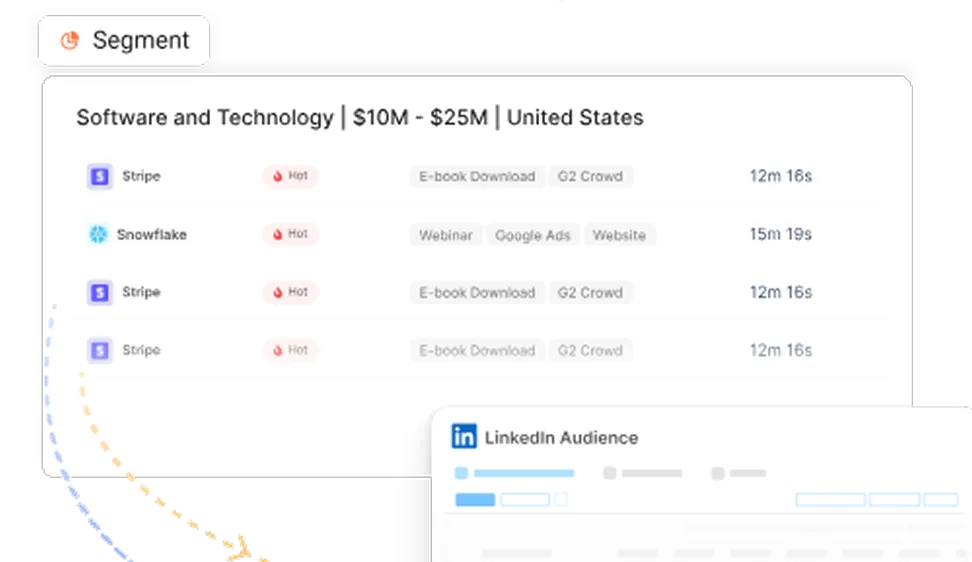
Boost your LinkedIn ROI in no time using data-driven insights


.avif)


See Factors in action.
Schedule a personalized demo or sign up to get started for free
LinkedIn Marketing Partner
GDPR & SOC2 Type II







.svg)



.avif)

