
15 Best B2B demand gen agencies(and how to pick the right one)
Struggling to turn marketing into pipeline? Explore 15 top B2B demand gen and inbound agencies, how they differ, and how to pick the right partner.

Writer



.svg)


TL;DR:
- A B2B demand generation agency builds full funnel programs that create demand, capture it, and turn it into real, sustainable revenue.
- Before you hire anyone, make sure you have the basics: clear ICP and positioning, a CRM that tracks MQL to SQL to opportunity, enough sales capacity, and a budget you can commit to for 6 to 12 months.
- Decide what you truly need help with: inbound heavy, outbound heavy, ABM for big buying groups, or an integrated demand gen setup across content, paid, outbound, and lifecycle.
- This guide lists 15 B2B demand gen agencies by use case. Shortlist only 3 to 5. Judge them on fit, ideas, the people you will actually work with, and how well they think in terms of pipeline and CAC.
- No agency can repair broken product market fit, vague positioning, or bad data. Pair the right model (inbound, full demand gen, or hybrid in-house plus freelancers) with a revenue analytics platform like Factors.ai to see which accounts are in market and which programs really drive closed won deals.
Earlier this year, we hired a ‘top-rated’ B2B demand generation agency only to realize, nine months later, that the pipeline chart looks the same. I suppose I should be thankful it didn't get worse.
:-/
You’ve almost certainly heard this before: A SaaS CMO signs a 6-month retainer with an agency that promises ‘100+ MQLs a month.’
Then come the weekly dashboards and Slack pings, lots of traffic, lots of leads.
…and nothing for sales to actually close.
No lies, 61% of B2B marketers say their biggest challenge is converting leads into pipeline. I’m one of them. As experience has taught me (and my peers), it’s not the volume of marketing that counts, it’s the quality.
Most B2B demand generation agencies can’t make that cut.
Here are the 15 that can. If you're looking for a marketing agency, start with these.
What a B2B demand generation agency actually does
Contrary to popular ideas, demand gen isn't just lead generation. It’s full-fledged growth:
awareness → education → demand creation → demand capture → pipeline → revenue.
Demand gen agency vs digital marketing agency vs lead gen shop
Lead gen collects emails. Demand gen turns prospects into buyers.
Core services to expect from your B2B marketing agency
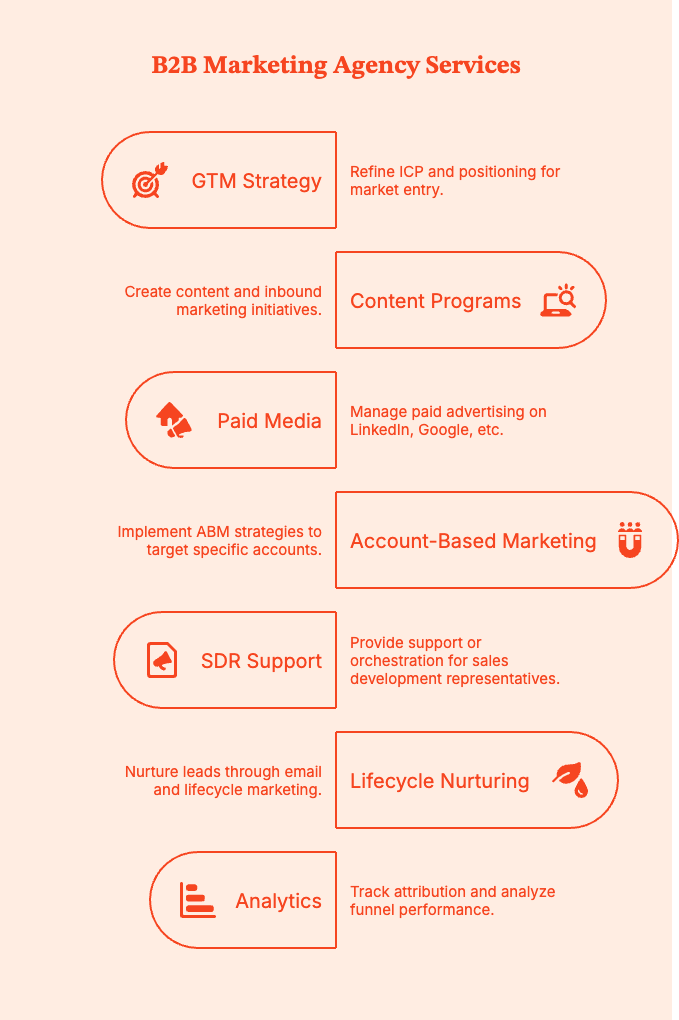
Your chosen marketing agency should provide:
- GTM strategy, ICP refinement, positioning
- Content + inbound programs
- Paid media (LinkedIn, Google, programmatic)
- Account-based marketing (ABM)
- SDR support or orchestration
- Lifecycle + email nurturing
- Attribution & funnel analytics
Where inbound marketing agencies fit
Inbound-first shops (content, SEO, automation) work best for teams where organic and content are the primary growth levers.
Some inbound agencies also handle full-funnel demand gen, so judge based on the KPIs they own.
Where B2B inbound marketing agencies fit
A B2B inbound marketing agency facilitates this engine: content → organic discovery → lead capture → nurture.
Think SEO + blogs + gated assets + webinars + marketing automation
Also read: ZoomInfo Alternatives: Top 6 ZoomInfo Competitors In 2026
Inbound marketing agencies are your best bet when:
- Your ICP actively searches for what you do.
- You have a solid, unique point of view; a true differentiator.
- You can afford the longer payoff period of organic growth.
- Your sales team has a history of converting educated, self-directed buyers.
- You want sustainable, compounding organic growth.
Are you actually ready to hire a B2B demand generation agency?
Any good agency will tell you this in the first meeting, but in case one doesn't, here's saving you a $30k “we should’ve waited” lesson.
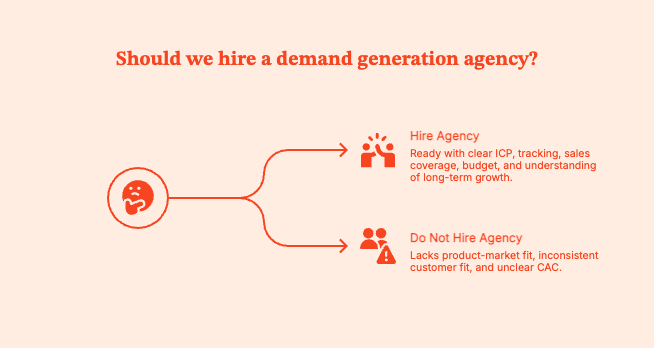
You’re ready to hire an agency and run demand generation campaigns if:
- You have a clear ICP + positioning. Doesn't have to be perfect, but needs to have some clarity.
- You’re already tracking the basics: MQL → SQL → Opportunity → Closed-Won in a CRM.
- You have sales coverage for all promising leads.
- You have $12k–$30k/month (approx) to spare for 6–12 months.
- Your leadership understands that demand gen compounds over quarters, not weeks. It can't be rushed.
When hiring an agency makes more sense than hiring in-house
- Your team is drowning in tasks. They can't add “learn ABM + paid social + attribution” to the plate anytime soon.
- You need to enter a market faster than it takes to hire a full growth team.
- You want ABM + paid + outbound + lifecycle working together instead of trying to sync five different vendors.
- You need speed + cross-channel orchestration, especially for teams stuck in “random acts of marketing.”
When you should not hire an agency yet
- You're not sure about product market fit.
- Customer and stakeholder fit is inconsistent.
- CAC is all over the place, and you don't know why.
- The CEO expects “400 leads in 40 days” instead of sustainable growth in 2–3 quarters.
Agencies aren't a "Hail Mary". They are operational accelerators for teams who already know who they sell to, why they win, and what a qualified opportunity looks like.
{{INLINE_MOFU}}
How we evaluated these B2B demand generation agencies
I didn't pull from a "top 15" list on Google. Every agency fits a particular type of B2B go-to-market and has proven that they can drive pipeline, not just activity.
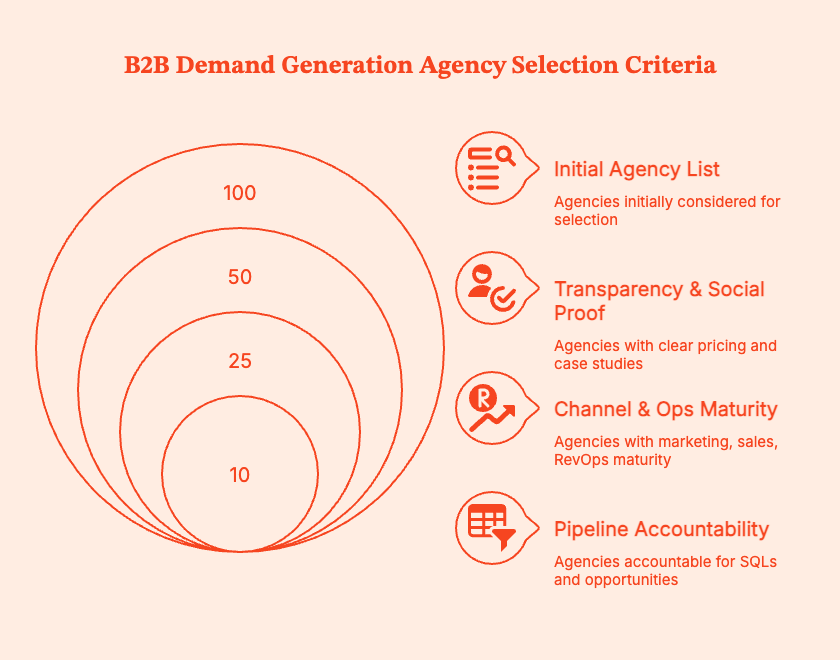
Here’s the criteria for my selection:
- ICP & industry fit: Certain agencies are the perfect fit for mid-market SaaS selling $25k+ ACV. Others work best with IT, cybersecurity, manufacturing, or pro services. I closely looked at whether an agency actually understands the buyer, the sales cycle, and the internal politics of the industry.
- Primary go-to-market motion: Demand generation agencies come in all shapes, sizes, and priorities
- Inbound-heavy = content + SEO + marketing automation
- Outbound-heavy = SDR/BDR orchestration and appointment setting
- ABM = multi-channel engagement across buying committees
- Integrated = paid + ABM + outbound + lifecycle + content
One agency will excel at outbound/SDR execution, while others will lean into content-led demand creation and paid activation. I matched specialization to use case.
- Pipeline accountability: When choosing an agency, I've asked:
Do they talk about SQLs, opportunities, CAC, and payback?
Or do they hide behind CPMs, CTRs, and marketing-influenced revenue?
In other words, can the agency articulate how its work translates to revenue?
- Channel + ops maturity: It's much easier to launch ads than to run attribution, lead scoring, lifecycle email, CRM hygiene, and conversion optimization across channels. I prioritized agencies that can work at the intersection of marketing, sales, and RevOps.
- Transparency and social proof: I won't even look at agencies that don't present real case studies, pricing clarity, and minimum engagement info on their site. In my eyes, anyone who doesn't provide this data doesn't respect the buyer's money. If I have to sit through six discovery calls to learn pricing, I'm out.
Pro-Tip: This ABM Platform Pricing Guide: Compare Costs & Features can help.
The 15 best B2B demand gen agencies
For high-growth B2B SaaS with complex deals
For outbound-heavy pipelines and appointment setting
For inbound-first, content-heavy demand generation
For ABM and enterprise buying groups
For scrappy teams that want a lighter model
The Best Option: Factors.ai Also Runs Demand Gen and ABM, Not Just the Analytics
Throughout this guide, Factors.ai has come up as the ABM and analytics layer, the tool that shows which agency activity actually turned into pipeline. That's still true. But it's worth knowing that Factors.ai isn't only a measurement platform. It also runs demand generation and ABM directly, for teams that want execution and analytics from the same partner instead of stitching an agency together with a separate reporting tool.
That matters for a specific failure mode this guide covered earlier: agencies optimizing for MQL volume while you're trying to track SQLs and pipeline. That gap exists because the execution team and the measurement team are usually two different vendors, with two different incentives. When the same partner runs the campaigns and owns the attribution, there's no gap left for that misalignment to hide in.
Where does this fit relative to the 15 agencies above?
If you're already leaning toward a hybrid model, the "strategy plus ops plus creative plus channel experts in one place" profile this guide describes, Factors' combined services-plus-platform approach is worth evaluating alongside a dedicated agency. Not instead of the readiness check earlier in this guide. The same rules still apply: know your ICP, have CRM tracking in place, and don't expect any partner, us included, to fix a broken product-market fit.
B2B demand gen vs B2B inbound marketing agency: which do you actually need?
If you shop around, you’ll see that a lot of agencies that call themselves a “B2B demand generation agency” are actually just doing classic inbound: blogs, ebooks, SEO, a bit of nurture…and leaving it at that.
That’s not the worst, but given your sales movements, is an inbound-only partner enough, or do you need a full-funnel demand gen agency that also handles outbound, ABM, and lifecycle?
First, let’s get clear on the difference between the two:
Also read: Factors.ai vs Clearbit (Breeze Intelligence): which is the better GTM platform?
And then, there are agencies that sit between the two.
The overlap: inbound agencies that grew into demand gen
It’s common for some agencies to start with inbound operations and then evolve into full-funnel demand generation. For instance,
- Ironpaper combines inbound, ABM, and sales enablement. They’ll write blogs and create video content, while also designing ABM plays and sales enablement for sustained buying cycles.
- Similarly, Lean Labs deploys SaaS growth and inbound strategies, using websites and inbound tactics to drive revenue growth (not just blog traffic) over the long term.
These “best of both worlds” agencies are the best fit for teams where:
- Organic + content are the primary levers.
- It’s acceptable to layer outbound or SDR in-house.
- The aim is to achieve compound growth more than immediate volume.
So how do you choose between inbound, demand gen, or a hybrid model?
Checklist: inbound vs demand gen vs hybrid
You want an inbound agency if…
- [ ] Our sales cycles are moderate to long (not one-call closes).
- [ ] Our buyers like to research on their own before talking to sales.
- [ ] Our ACV is mid-range (roughly $5k–$40k).
- [ ] We’re okay with results compounding over quarters, not weeks.
- [ ] We already have some pipeline, but it’s inconsistent or too outbound-heavy.
- [ ] We want a more sustainable baseline of opportunities from content + SEO.
- [ ] We have at least one marketer who can brief content, own a calendar, and work with sales.
- [ ] We don’t have strong in-house SEO/content/marketing automation skills and want a partner to “run the engine.”
You want a demand gen agency if…
- [ ] We have long, complex sales cycles with multiple stakeholders.
- [ ] We’re stuck in “we have leads, not pipeline.”
- [ ] We need coordinated plays across paid, outbound, ABM, events, and nurture.
- [ ] Our ACV is higher (>$20k–$25k), so bigger, multi-touch programs make sense.
- [ ] Our pipeline is lumpy or overly dependent on hero AEs/SDRs.
- [ ] We need a structural fix, not just more demo requests.
- [ ] We want a partner who can design around pipeline coverage, CAC, and revenue targets.
- [ ] Our team is maxed out or too junior to build a full-funnel engine on its own.
- [ ] We’d benefit from a team that brings strategy, ops, creative, and channel specialists under one roof.
You want a Hybrid (in-house + freelancers) shop if…
- [ ] We have (or are hiring) a strong Head/Director of Demand/Growth.
- [ ] That person knows what to do, but needs extra hands more than another “strategy” layer.
- [ ] Our sales velocity is mixed – some quick deals, some long ones.
- [ ] We want to experiment across channels without committing to a big agency retainer.
- [ ] We’re still figuring out ACV and packaging (PLG vs sales-led vs hybrid).
- [ ] We’d rather fund experiments than pay a large, fixed retainer.
- [ ] Our pipeline is early but promising, and we’re testing what actually moves opps.
- [ ] We’re happy to keep strategy in-house and rent execution (content, paid, ops, design).
Common risks & gotchas
The B2B demand gen agency you choose will factor directly into the company’s revenue growth (or fall). Often, agencies aren’t “bad”, they simply are not a good fit for the use-case and buyer's journey at hand.
So be sure to avoid these pitfalls when making your choice:
- Do not expect an agency to fix a broken product or positioning
Your churn is high. Win rates are low. Every deal needs discounts to close. Both the CEO and marketing decide “we just need more qualified leads”. So, you hire a demand gen agency and hope that great campaigns will compensate for weak product-market fit or weak positioning.
Even if the agency launches solid campaigns, builds content, drives traffic, and gets more demos, the close rate doesn’t move, or CAC gets worse.
Demand gen is an accelerant. It won’t get you more sales if your customers don’t love what you’re offering.
- Do not try to see attribution with data and reporting gaps in place
You execute campaigns. Sales is taking calls. But ask basic questions like…
- What’s our MQL → SQL → opportunity conversion by channel?
- Which campaigns are actually generating pipeline, not just leads?
- How many deals last quarter were influenced by paid vs organic, vs outbound?
… and nobody has answers.
B2B agencies simply cannot succeed without clean CRM data, basic funnel tracking, and defined lifecycle stages. With fuzzy data, you get:
- beautiful dashboards… that don’t match reality in Salesforce.
- marketing and sales arguing over whose numbers are “right.”
- agencies optimizing for form-fills because they can’t see revenue.
- Get your incentives in line: MQLs vs SQLs vs revenue
Here’s how many demand gen engagements still work:
- The agency is paid and gets bonuses on MQL volume.
- The client cares about SQLs, opportunities, and revenue.
- SDRs quietly ignore half the leads because they lead nowhere.
If you’re compensating agencies on MQL volume, they’ll naturally optimize for cheap form-fills. They double down on gated content, low-intent ebooks, and giveaway leads, even if none of these push business growth.
Pro-Tip: Consider this checklist to de-risk your B2B demand gen agency engagement
Before you sign, check that:
- [ ] We have a clear ICP, offer, and positioning (or we’re paying the agency to help us define it explicitly).
- [ ] Our CRM stages and lifecycle are defined and actually used by sales.
- [ ] Success is framed around SQLs, opportunities, pipeline, CAC, and payback, not just “leads.”
- [ ] We’ve assigned an internal owner (name, role) who will steward the relationship.
- [ ] The initial scope is focused (one ICP, one core motion) for 90 days before we expand.
During the first 90 days:
- [ ] We’ve agreed on a weekly report (leading metrics) and a monthly review (pipeline metrics).
- [ ] We can see campaign → account → opportunity journeys, not just clicks.
- [ ] We’ve killed at least one thing that isn’t working and doubled down on one that is.
Final Thoughts: How to pick your short list and what to do next
I know, this is a lot of information so far, so here’s a quick list of what to do on Monday.
Forget being "overwhelmed by options". Get "three solid candidates and a clear plan.
Are you really ready?
Before jumping on discovery calls, make sure that:
- you know who you sell to. ICP, segment, rough deal size.
- your CRM can trace a clean path from MQL to SQL to opportunity to revenue.
- you have budget and leadership support for at least 6 to 12 months.
Choose your main motion
Ask:
- Are we mostly inbound right now: Content, SEO, events, webinars, email?
- Are we mostly outbound: SDRs, sequences, cold programs, partner outreach?
- Are we selling into bigger buying groups with long cycles?
- Do we need an integrated partner covering content, paid, outbound, and lifecycle at once?
Shortlist 3 to 5 agencies + 1 or 2 lean alternatives
- Pick 2 or 3 agencies that match exactly what you need: high growth SaaS, outbound heavy, inbound first, or ABM and enterprise.
- Add 1 or 2 boutiques or small collectives that focus on senior attention, speed, or tighter budgets.
Three to five serious candidates. That’s all.
Align your own team before choosing agencies
Talk to your team:
- Agree on the metrics that actually show revenue growth: SQLs, opportunities created, pipeline dollars, CAC, payback period.
- Get clear on what "good" looks like after three or four quarters.
- List your non-negotiables: "must know HubSpot", "must have experience in our industry", "must work well with our SDR team”, etc.
Use a scorecard
Score each agency call on the following:
- Do they really understand our ICP, motion, and deal size?
- Do you trust the agency to work on your account?
- Does the agency prioritize pipeline growth, CAC, and payback, or do they keep talking about clicks and "brand lift”?
A tool like Factors.ai can help you see which companies are actively researching you, which channels they’re touching (paid, organic, events, outbound, partner, etc.), and how those touchpoints progress into real opportunities and pipeline.
Look at the Factors dashboard, you’ll go much farther with answering:
- “Which accounts that our agency targeted actually moved to opportunity or closed-won?”
- “Which campaigns, creatives, or channels consistently show up in the journeys of accounts that end up in late-stage pipeline?”
- “When we pause or change agency activity in a channel, does the pipeline from those accounts slow down, stay flat, or grow?”
In a nutshell
Are you considering a B2B demand generation agency and do not want to waste another six-figure budget on empty MQLs? This piece can help.
It explains what a real B2B demand gen agency does across the full funnel, and contrasts it with a digital marketing agency and a lead generation agency, so you know what to pick.
Check your readiness for hiring an agency by verifying your ICP clarity, CRM tracking, sales coverage, budget, and leadership expectations.
Then, pick from 15 of the best B2B demand gen and inbound agencies listed in the article. Slotted by use case, the list includes SaaS focused demand engines, outbound and SDR providers, inbound heavy content partners, ABM specialists, and founder-led boutiques or hybrid setups.
The piece also compares B2B inbound marketing agencies with full funnel demand gen shops and outlines when a hybrid model makes more sense.
It highlights common errors, like attempting to fix broken product market fit with ads, poor data hygiene, and misaligned incentives tied to MQL volume.
You’ll also know how to pick a short list, align internal stakeholders, test agency fitness, and combine the right agency with analytics tools like Factors.ai, so as to connect spend to pipeline growth and revenue.
Frequently Asked Questions for 15 Best B2B Demand Generation Agencies
Q. What does a B2B demand generation agency do?
A B2B demand generation agency ideates and executes full funnel programs across content, paid media, outbound, and lifecycle campaigns. The intent is to create demand, capture it, and turn it into qualified leads and revenue, with a clear focus on measurable growth.
Q. How is a B2B demand gen agency different from a lead generation agency?
Demand gen agencies build long-term systems to push awareness, inform buyers, and nurture them across channels until they are ready to get a demo/talk to sales. Lead generation agencies generally end with delivering contacts or meetings, generally through outbound or content syndication. They don't own the full journey to opportunity.
Q. When should a B2B company hire a demand generation agency?
B2B companies should hire a demand generation agency if:
- they have a product that fits the market.
- a crystal-clear ICP.
- functional monitoring mechanisms in their CRM.
- they need to scale to go to market faster than they can hire an in-house team.
A great demand gen agency often works as a long-term partner for building a sustainable pipeline rather than a quick fix.
Q. How much do B2B demand generation agencies charge?
Retainers for good agencies can start in the high four-figure to low five-figure range per month. Outbound and SDR-focused programs often begin around nine thousand dollars monthly, and integrated full funnel programs cost more.
Pricing is determined by scope, channel mix, and how much you are paying for: strategy only or a full execution team.
Q. How long does it take to see results from a demand gen agency?
You might see some movement in the first few months, but many specialists will tell you that it realistically takes three to four quarters to deliver efficient, repeatable pipeline growth. This time is needed to put in the work to test plays, refine targeting, and set up brand identity and education in complex B2B cycles.
Q. What KPIs should I use to measure a B2B demand gen agency?
The most important metrics connect clearly to revenue. These are:
- sales qualified leads
- opportunities created
- pipeline value
- customer acquisition cost
- payback period.
Treat clicks and raw lead volume as diagnostic tools rather than success metrics. Depending on your pipeline, some agencies might want to track pipeline velocity and lead to close rates as well.
Q. Can an inbound marketing agency handle B2B demand generation?
Only if they have evolved into full funnel partners that combine content, SEO, marketing automation, ABM or paid media. If an agency is focused mainly on content and organic acquisition, it should have a clear plan for paid, outbound, and lifecycle programs.
Q. Is Google’s Demand Gen campaign type the same as hiring a demand generation agency?
No. Demand Gen in Google Ads is a specific campaign type that runs visual ads across YouTube, Discover, Gmail, and the Display Network.
Demand generation in B2B is a comprehensive strategy across multiple channels and stages. It's best to treat Google Demand Gen as one tactic inside a larger demand gen plan. One is not a replacement for another.

Powered by Bombora
Enter your domain and we'll send you a free list of companies showing buying intent in your vertical.
.avif)
Powered by Bombora
Enter your domain and we'll send you a free list of companies showing buying intent in your vertical.
.avif)

See how Factors can 2x your ROI
Boost your LinkedIn ROI in no time using data-driven insights


.avif)

.avif)
See Factors in action.
Schedule a personalized demo or sign up to get started for free
LinkedIn Marketing Partner
GDPR & SOC2 Type II

.svg)



.avif)

