
Brand Persona Examples: The B2B, B2C, and ABM library you actually need
Explore 20+ real brand persona and buyer persona examples across B2B SaaS, B2C, and ABM. Learn how to build personas that actually drive pipeline and revenue.
.avif)
Content Marketer



.svg)


TL;DR
- A brand persona is your brand imagined as a human being with a voice, personality, and values. A buyer persona is a research-based profile of your ideal customer. They work together, not against each other.
- Strong brand personas like Mailchimp (quirky sidekick) and HubSpot (helpful educator) shape every content, campaign, and copy decision the team makes.
- B2B buyer personas go deeper than job title and require role-specific pain points, decision-making authority, preferred channels, and buying committee position.
- ABM changes the rules: you are not targeting one persona per account. You are mapping Champion, Economic Buyer, Technical Evaluator, End User, and Blocker across 14 to 23 stakeholders per deal (Gartner).
- Most personas fail because they are built on assumptions, updated never, and shared with exactly no one outside marketing.
- Modern GTM platforms like Factors.ai, 6sense, and Bombora turn static persona documents into live, intent-driven targeting systems.
If you have ever sat in a marketing kickoff meeting and heard someone say 'let's build our buyer persona,' then watched the team spend 45 minutes debating whether the fictional character should be named 'Marketing Mary' or 'Growth Gary,' you have lived a very specific kind of trauma.

The thing is, personas are genuinely one of the most powerful frameworks in B2B marketing. When they are built correctly (on real data), and actually used beyond slide deck number four.
Companies that hit their revenue goals aren’t just ‘creating personas,’ they’re actually using them.
Cintell’s benchmark study found that high-performing teams are 2.4× more likely to actively use personas in demand generation and decision-making.
And yet most marketing teams are still building personas on gut feeling, updating them never, and letting them collect dust somewhere in a shared Google Drive folder titled 'Strategy 2022.'
This guide is the library version. Real brand persona examples from Apple, Mailchimp, Salesforce, and Slack. Actual B2B SaaS buyer personas with job-level specificity. B2C archetypes that go beyond 'Millennial, likes coffee.' And a full ABM buying committee breakdown that would make your demand gen team feel seen.
Let's get into it.
What is a brand persona?
A brand persona is your brand imagined as a person. Tone, voice, values, quirks, the way it talks at a dinner party. It is the answer to: if our brand walked into a room, who would it be?
The Product Marketing Alliance defines it clearly: 'While buyer personas outline hypothetical people who would be interacting with your company, a brand persona is the personification of your actual brand.'
Brand Master Academy adds: 'The buyer persona personifies the buyer while the brand persona personifies the brand. Once the buyer persona is developed and understood, a brand persona can be developed to appeal to them.'
In practice, your brand persona shows up in every headline you write, every email subject line, every 'Thanks for signing up' confirmation page. It is what makes Mailchimp's copy feel like a witty friend and Salesforce's copy feel like a reliable advisor. Same product category, completely different human energies.
What is a buyer persona?
A buyer persona is a semi-fictional, research-based profile of your ideal customer. HubSpot defines it as 'a detailed character sketch of your ideal customer, complete with demographics, behaviors, motivations, goals, and pain points that influence their buying decisions.'
Gartner frames it as 'archetypal representations of existing subsets of your customer base who share similar goals, needs, expectations, behaviors, and motivation factors.'
The word 'research-based' is doing a lot of heavy lifting there. A buyer persona built from 30 customer interviews, CRM data, and win/loss analysis is a strategic tool. A buyer persona built from what the founding team thinks the customer looks like is expensive fan fiction.
B2B vs B2C buyer personas are not the same thing at all. In B2C, you are mostly targeting one person making one decision, often driven by emotion and convenience. In B2B, you are navigating a committee. Plezi puts it plainly: 'In B2C, purchases are most often based on an individual decision. In B2B, the decision to buy is generally collective.'
Which is why in B2B SaaS, you also need an ICP (Ideal Customer Profile) sitting alongside your personas. The ICP tells you which companies to target. The buyer persona tells you which humans inside those companies to talk to, and how.
Brand persona vs buyer persona: the actual difference
Think of it this way: your brand persona is who YOU are when you speak. Your buyer persona is who you are speaking TO.
They should be built in that order. Understand your buyer deeply first. Then craft a brand voice that resonates with that specific human.
Real-world brand persona examples that are actually useful
These are not made-up marketing exercises. These brands built their personas intentionally, documented them (in some cases publicly), and enforced them at scale.
- Mailchimp: The quirky, witty sidekick
Personality archetype: The Jester/The Friend
Mailchimp's content style guide is one of the most-cited brand voice documents in the industry, and for good reason. It establishes four pillars explicitly: plainspoken, genuine, translator, and dry humor.
Their official documentation says: 'Our sense of humor is straight-faced, subtle, and a touch eccentric. We're weird but not inappropriate, smart but not snobbish.' And their guiding principle is brilliant in its clarity: 'It's always more important to be clear than entertaining.'
Even their mascot Freddie follows brand persona rules. 'He smiles, winks, and sometimes high-fives, but he does not talk.' Because Mailchimp's voice IS the brand persona. Freddie just shows up for the vibe.
Tone cues: Fun without being silly. Smart without being arrogant. Clear above all else. The friend who explains things without making you feel dumb.
- HubSpot: The helpful educator
Personality archetype: The Sage/The Mentor
HubSpot's community voice guide says it directly: 'Think of voice as a constant, a personality that doesn't change. For us, that means always being humble and empathetic.' And: 'Leave egos at the door.'
HubSpot's brand persona is the knowledgeable friend who helps you grow your business. The entire free resource library, the blog, the Academy certifications, the templates, they are not just marketing strategy. They are the brand persona in action.
Tone cues: Warm, educational, never condescending. The brand gives things away freely because that is what a truly helpful person does.
- Salesforce: The trustworthy Ohana leader
Personality archetype: The Caregiver/The Ruler
Salesforce built its entire brand identity around the Hawaiian concept of Ohana (family), extending it to employees, customers, partners, and communities. Its five official values are Trust (#1, always), Customer Success, Innovation, Equality, and Sustainability.
The numbers back it up. The #SalesforceOhana hashtag has been used over 15,000 times in a single quarter. Dreamforce is marketed as a family reunion, not a tech conference. The 1-1-1 philanthropy model (1% equity, 1% product, 1% employee time donated) reinforces the identity.
Worth noting: the 2023 layoffs tested this persona's authenticity. Which is a reminder that brand personas only work when corporate actions match them. The persona is a promise, not just a positioning statement.
Tone cues: Community-oriented, warm, enterprise-authoritative. Balances the scale of a $30B company with the intimacy of a close-knit culture.
- Slack: The friendly, smart coworker
Personality archetype: The Regular Guy / The Sage
Slack's brand guidelines describe the voice as 'clear, concise, and human, like a friendly, intelligent coworker.' Anna Pickard, Slack's editorial director and the person credited with building Slack's playful brand personality, established five copy principles: don't make me think, make it memorable, be compelling, be approachable, and respect our readers.
Slack invested in training 650+ marketing team members on voice consistency and made senior executives write mock marketing copy to internalize the persona. Their release notes became famous for being entertaining. That is remarkable for enterprise B2B software.
Tone cues: Confident but never cocky. Conversational but always appropriate. The persona that makes work feel slightly less miserable.
B2B SaaS buyer persona examples (with real depth)
These are not 'Marketing Mary, 32, enjoys hiking.' These are the real profiles that drive GTM decisions at B2B SaaS companies. Each one includes the details that actually matter for targeting, messaging, and sales enablement.
Persona 1: The Marketing Manager
Persona 2: The VP of Sales
Persona 3: The RevOps Lead
Persona 4: The CMO
Persona 5: The Demand Generation Manager
Persona 6: The IT Buyer / CTO
Persona 7: The Product Manager
ABM persona examples: when you are selling to a committee, not a contact
Account-based marketing completely reframes how personas work. You are not picking one persona and targeting them across all companies. You are identifying high-value accounts that match your ICP, then mapping every decision-maker, influencer, and blocker within those accounts.
Additionally, ABM is not persona-based marketing with better targeting. It is persona-based marketing multiplied across an entire committee, with coordinated messaging for each role.
Here is the buying committee map you actually need:
- The Champion
The internal advocate who drives momentum. Usually a director or senior practitioner who believes in the solution and needs material to sell it internally. If you do not arm the Champion, the deal stalls because they cannot rally the committee.
What they need from you: Business case toolkits, ROI calculators, internal pitch decks, comparison tables they can share in Slack. They are selling you to their boss. Make that easy.
- The Economic Buyer
Controls the budget. Usually a CFO, COO, or VP Finance. Cares about ROI, total cost of ownership, and payback period. They appear on pricing pages and ROI calculator landing pages, so watch for those behavioral signals.
What they need from you: Financial impact first. Feature lists last. If your first email to a CFO leads with 'seamless integration,' you have already lost them.
- The Technical Evaluator
Usually a CTO, IT Director, or Security Manager. Evaluates integration capability, security certifications, and implementation complexity. Holds veto power.
What they need from you: Technical specs, API documentation, SOC 2 / GDPR compliance whitepapers, and honest answers about implementation timelines. Their core question is: 'Will this break anything?' Answer it before they ask.
- The End User
Individual contributors and practitioners who will use the product daily. They care about ease of use, time savings, and how steep the learning curve is. If they hate the product, adoption collapses and the contract gets cut at renewal.
What they need from you: Demos, free trials, onboarding guides, and community resources. They are the ones who will either become your biggest fans or your most vocal internal critics.
- The Blocker
Procurement, legal, compliance, or a skeptical senior executive. They show up late in the process with objections about contract terms, data privacy, and disruption risk. Ignoring them until they surface is how deals die in legal review for six weeks.
What they need from you: Proactive compliance documentation, master service agreements ready to share, risk mitigation frameworks, and responses to their objections before they formally raise them.
ABM persona sequencing tip (the T2D3 framework):
Start with P1 (End User) to validate messaging. Move to P2 (Champion / Decision-Maker) who needs to sell internally. Close with P3 (Executive / Economic Buyer) who approves based on ROI and risk. Do not lead with the executive. Let the Champion warm the room first.
Modern ABM teams also use account-level scoring rather than individual lead scoring. As The Smarketers notes: 'An account where one person clicked 40 emails is less ready than an account where four different stakeholders each engaged twice.' Engagement breadth across the buying committee matters more than depth from a single contact.
How many personas do you actually need?
Most teams don’t have a persona problem. They have a too many personas that no one actually uses problem.
Across most frameworks, the guidance is surprisingly consistent: start small, focus on your core buyers, and only expand when there’s a real difference in how people evaluate or buy.
Because in practice, a handful of well-defined personas tends to drive the majority of revenue.
Everything beyond that usually lives in a slide deck somewhere… quietly untouched since 2022.
Adele Revella, who has spent years studying how buyers actually make decisions, puts it best: the right number of personas is almost always fewer than you think.
Start with 2 to 3 personas for your highest-value segments, then expand deliberately. The failure mode in both directions:
- Too many personas: resources stretch thin, messaging gets diluted, teams cannot remember them, personas start overlapping.
- Too few personas: you miss key segments or target too broadly, which means your messaging is relevant to no one in particular.
- No negative personas: these exclusion profiles represent people you should actively not target.
The persona mistakes that make the whole exercise pointless
I want to say most teams get this right. I cannot. The most common persona mistakes are so widespread they have become industry habits.
- Building on assumptions instead of data
The most pervasive error. Internal brainstorming produces fictional characters, not useful tools. Cintell found that 70% of companies missing revenue goals did not conduct qualitative customer interviews. That means their personas are a team's best guess. Which is another way of saying they are marketing to themselves.
- Over-indexing on demographics, under-indexing on motivations
'Sarah is 32, lives in Portland, and drives a Prius' tells you exactly nothing about how she buys enterprise software. Demographics help with targeting. Pain points and decision criteria drive messaging. Knowing someone is a VP of Marketing matters less than knowing what keeps them up at night.
- Treating personas as a one-time project
Markets evolve. Buyer behavior shifts. The persona your team built in 2022 may be describing a customer cohort that no longer exists. High-performing companies are 7.4 times more likely to have updated their personas in the last six months than underperformers, per Cintell's research.
- Not sharing personas beyond marketing
Personas locked in a marketing folder do not help sales, product, or customer success. High-performing companies embed personas across training, lead scoring, product roadmaps, and executive decisions. If the CS team has never seen your personas, your retention strategy is flying blind.
- Describing aspirational customers instead of real ones
Building personas around who you wish your customers were, rather than who they actually are, leads to a fundamental disconnect between messaging and market reality. The hardest part of good persona research is accepting that your ideal customer might be different from who you imagined.
How to build a persona that does not gather dust?
Adele Revella's 5 Rings of Buying Insight is the most respected persona-building framework in B2B. It goes beyond demographics to uncover what actually drives purchase decisions.
Ring 1: Priority Initiatives
What triggers the buying journey? What events or pain points cause buyers to invest time and money rather than staying with the status quo? This is not 'they want to improve efficiency.' This is 'the CMO just told them they need to prove pipeline contribution to the board by Q2.'
Ring 2: Success Factors
What tangible outcomes do buyers expect? Not generic 'save time.' Specific: 'reduce lead response time from 4 hours to 15 minutes' or 'cut attribution reporting cycles from 2 weeks to real-time.
Ring 3: Perceived Barriers
What reasons do buyers have to question your solution? Previous negative experiences with similar tools. Concerns about implementation complexity. Skepticism about your company's size or maturity. If you do not surface these in research, they will surface in the sales call at the worst possible moment.
Ring 4: Buyer's Journey
Who influences the buyer? What information sources do they trust? Which communities do they engage in? When does the buying committee expand? Understanding the journey prevents you from sending CTO-level content to a practitioner, or practitioner-level content to a CFO.
Ring 5: Decision Criteria
What specific attributes do buyers evaluate when comparing alternatives? Not 'easy to use.' Rather: 'how much training is required before my team can use it independently?' The more specific you can get here, the more targeted your competitive positioning becomes.
How do modern GTM platforms turn personas into live targeting systems?
The biggest shift in persona strategy over the last five years is the move from static documents to intent-driven targeting. Your persona profile tells you who to target. Intent data tells you which of those people are actively researching right now.
- Research and enrichment tools
SparkToro crawls tens of millions of social profiles to reveal what your personas actually read, follow, and share, invaluable for understanding channel preferences. ZoomInfo provides 235M+ professional profiles with technographic data and org charts. Clearbit (now Breeze Intelligence within HubSpot) enriches records with 100+ attributes from 250+ data sources. Clay automates multi-source enrichment workflows using AI.
- Intent data platforms
Bombora's Company Surge draws from a co-op of 5,000+ B2B publisher websites. Their newer B2B Personas product layers functional area and seniority data onto intent signals, revealing which specific persona types within target accounts are driving the research activity. That is a meaningful leap from knowing a company is researching to knowing exactly which role is leading the charge.
6sense processes over 1 trillion daily intent signals through AI models trained on 10+ years of B2B buying behavior. Their predictive buying-stage models identify whether accounts are in awareness, consideration, decision, or purchase stages, then coordinate persona-matched messaging across channels accordingly. According to 6sense, 61% of B2B buyer research happens in the dark funnel before any vendor contact, which means identifying and responding to persona-matched intent signals before the buyer raises their hand is increasingly the whole game.
Where does Factors.ai fit in?
Factors.ai is an AI ABM platform trusted by 1,000+ GTM teams, including Freshworks and Sprinklr. It identifies 75%+ of anonymous companies visiting your website via reverse IP lookup (industry average is 40-64%), then maps every click and page view to build account-level interest profiles that match your buyer personas.
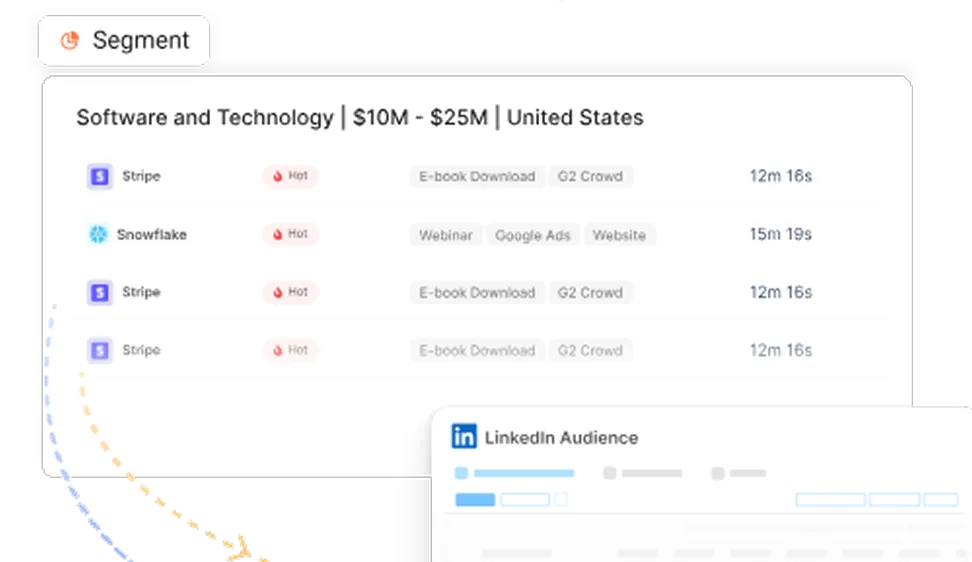
The platform consolidates intent signals from website behavior, G2 reviews, ad interactions, CRM data, and third-party sources. Then AI scores and ranks accounts against your ICP and persona criteria. Its LinkedIn AdPilot and Google AdPilot tools activate the highest-intent accounts directly through ad platforms, auto-syncing matched audiences so your persona-matched targeting is always current.
The practical implication: personas are no longer something you build in a workshop, present to leadership, and revisit annually. With platforms like Factors.ai, Demandbase, 6sense, and Bombora, personas become the input layer for a live, always-on targeting system that scores, prioritizes, and activates accounts in real time.
In a nutshell…
A brand persona defines who you are when you speak. A buyer persona defines who you are speaking to. Both are built from research, not imagination. And both only deliver value when they are shared, activated, and regularly updated.
The data is consistent: companies that document buyer personas, build them from real interviews, update them every six months, and embed them across the entire organization are dramatically more likely to hit and exceed revenue goals. The gap between companies that treat personas as a one-time exercise and those that treat them as living infrastructure is a 2.4x revenue outperformance gap, per Cintell's research.
For B2B SaaS, the table stakes persona set includes 3 to 5 role-specific profiles grounded in Revella's 5 Rings framework. For ABM, expand those profiles into a full buying committee map covering Champion, Economic Buyer, Technical Evaluator, End User, and Blocker. Then connect them to an intent data layer using platforms like Factors.ai, 6sense, or Bombora so that your personas stop living in a slide deck and start driving actual pipeline.
The companies winning in B2B right now are not the ones with the most creative personas. They are the ones whose personas are connected to live intent signals, activated across channels, and aligned from marketing through to sales and customer success.
Build the persona. Share it. Connect it. And please, update it more than once every three years.
FAQs for brand persona
Q1. What is a brand persona?
A brand persona is the personification of a brand as a human being. It defines the brand's voice, tone, personality traits, values, and communication style. Rather than describing what a company sells, a brand persona describes how the company speaks and behaves across every customer touchpoint. For example, Mailchimp's brand persona is quirky, witty, and plainspoken; HubSpot's is warm, educational, and humble. Brand personas are used to guide content, campaigns, design, and communications so every piece of output feels consistent and human.
Q2. What is a buyer persona?
A buyer persona is a semi-fictional, research-based representation of an ideal customer. It is built from a combination of qualitative interviews, CRM data, behavioral patterns, and market research. A strong buyer persona includes demographic data (age, job title, seniority, company size), psychographic data (motivations, goals, fears, values), behavioral data (preferred channels, content consumption habits, how they evaluate vendors), and role-specific data (their position in the buying committee, their common objections, their KPIs). Buyer personas are used across marketing, sales, product, and customer success to align messaging, targeting, and experience design around real customer needs.
Q3. What is the difference between a brand persona and a buyer persona?
A brand persona personifies the brand itself, defining how it communicates. A buyer persona personifies the ideal customer, defining who the brand is communicating with. The two work in sequence: you build an accurate buyer persona first by researching your actual customers, then you develop a brand persona that is designed to resonate with that specific type of person. Brand personas guide tone and voice decisions. Buyer personas guide targeting, content strategy, and offer design. Both are tools for alignment, but they answer different questions: the brand persona answers 'who are we?' and the buyer persona answers 'who are we talking to?'
Q4. How many buyer personas should a B2B SaaS company have?
Most B2B SaaS companies perform best with 3 to 5 documented buyer personas. SiriusDecisions found that top-performing companies average 4.2 active personas. Starting with 2 to 3 personas covering your highest-value customer segments is the right approach for most teams, expanding deliberately as you gather more data. Having too many personas dilutes focus and makes consistent execution difficult. Only 8.2% of companies in Cintell's research reported that 75%+ of their organization could confidently name their personas, which suggests most teams already have more personas than they can effectively operationalize. The goal is not comprehensiveness. It is usefulness.
Q5. What is an ABM persona?
An ABM persona is a role-specific buyer profile used within account-based marketing to map the full buying committee of a target account. ABM personas go beyond identifying one ideal customer type because in B2B, purchasing decisions involve multiple stakeholders with different priorities and veto points. The standard ABM buying committee includes five persona types: the Champion (internal advocate), the Economic Buyer (budget controller), the Technical Evaluator (integration and security gatekeeper), the End User (daily practitioner), and the Blocker (procurement, legal, or skeptical executive). Gartner reports that typical B2B technology purchases involve 14 to 23 stakeholders, which means ABM success depends on engaging and converting multiple personas within each target account simultaneously.
Q6. What are examples of customer personas in B2C?
B2C customer personas are built around individual consumer psychology rather than organizational buying dynamics. Common examples include the Budget-Conscious Parent, who compares prices extensively and responds to reviews and loyalty programs (brands like Target and HelloFresh); the Outdoor Enthusiast, who values sustainability and premium quality and follows influencers on YouTube and Instagram (brands like Patagonia and REI); the Wellness-Driven Professional, who wants convenient healthy options and responds to subscription models (brands like Peloton and Sweetgreen); and the Research-Driven High-Stakes Buyer, who takes weeks to evaluate major purchases and trusts third-party validation over brand claims (brands like Toyota and USAA). Effective B2C personas include purchase triggers, channel preferences, emotional drivers, and the specific language that resonates with each archetype.
Q7. How do you build a buyer persona?
Building a buyer persona that is useful rather than decorative requires five steps. First, conduct qualitative interviews: Adele Revella of the Buyer Persona Institute recommends starting with 30 interviews of 30 minutes each, covering existing customers, prospects who didn't convert, and people outside your database. Second, analyze CRM and behavioral data to identify purchase patterns, deal sizes, and lifecycle stages. Third, enrich your research using tools like ZoomInfo, Clearbit, or SparkToro to understand firmographics, technographics, and channel preferences. Fourth, apply Revella's 5 Rings framework to uncover Priority Initiatives, Success Factors, Perceived Barriers, Buyer's Journey, and Decision Criteria. Fifth, validate your personas against real customer behavior and update them every 6 to 12 months. High-performing companies are 7.4 times more likely to have updated their personas within the last 6 months than underperformers, per Cintell's 2016 benchmark study.
Q8. What makes a buyer persona effective?
An effective buyer persona is built from real research rather than internal assumptions, contains specific pain points and decision criteria rather than generic demographics, is shared across marketing, sales, product, and customer success rather than kept in a marketing folder, and is updated regularly to reflect current market conditions. Effective personas also account for the full buying committee in B2B contexts, include negative personas that define who you should not target, and are connected to live targeting systems through intent data platforms so they drive action rather than just strategy decks. Companies exceeding revenue goals are 4 times as likely to use personas for demand generation, and 82% of high-performing companies in ITSMA's research reported that personas improved their value proposition development.
Q9. How do brand personas like Apple and Mailchimp influence marketing?
Brand personas like Apple's Visionary Minimalist and Mailchimp's Quirky Sidekick function as the operating system behind every marketing decision the team makes. Apple's brand persona dictates that copy is minimal, visual metaphors replace feature lists, and the user is always positioned as the hero. The result is 'Shot on iPhone,' a campaign with no traditional advertising claims. Mailchimp's brand persona, documented in their widely cited content style guide, dictates four voice pillars: plainspoken, genuine, translator, and dry humor. It also establishes their guiding principle that clarity is always more important than entertainment. These persona documents mean every writer, designer, and campaign manager at those companies is making decisions from the same personality blueprint, which produces the consistency that makes strong brands feel like distinct, recognizable people rather than corporate entities.

See how Factors can 2x your ROI
Boost your LinkedIn ROI in no time using data-driven insights


.avif)

See Factors in action.
Schedule a personalized demo or sign up to get started for free
LinkedIn Marketing Partner
GDPR & SOC2 Type II







.svg)



.avif)

