
Customer & Client Avatars: Turn Insights into Messaging
Learn what a customer avatar is, how to build one with real research, and how to turn avatar insights into messaging that converts. Includes B2B SaaS client avatar examples, a step-by-step creation process, and copywriting frameworks.
.avif)
Content Marketer



.svg)


TL;DR
- A customer avatar is a detailed, research-backed profile of your ideal customer that covers psychographics, pain points, buying triggers, objections, and preferred channels.
- Customer avatars, buyer personas, and ICPs are related but distinct: your ICP defines the target company, personas define individuals within it, avatars add psychographic depth and narrative specificity.
- Building a useful avatar requires real research: customer interviews, CRM data, sales call recordings (Gong, Chorus), win/loss analysis, and voice-of-customer mining from G2, Capterra, and Reddit.
- Most B2B SaaS companies need 3–5 avatars covering the core buying committee: the champion/user, the decision-maker, and the gatekeeper/blocker.
- Avatar insights translate into messaging through frameworks like PAS (Problem-Agitate-Solution), Before-After-Bridge, and the messaging matrix, each matched to a specific funnel stage.
- Companies that document, use, and update personas are 2.2x more likely to exceed revenue goals, per the 2016 Cintell benchmark study of 137 B2B organizations.
Every marketer I know has a deck somewhere with bullet points about their target audience. 32-45 years old. Decision-maker. Cares about ROI. Blah. Bli. Blu.
And that's... basically it.
We’ve named them things like ‘Marketing Mary’ or ‘Tech Tim.’ Given them stock photos. Written a paragraph about how they ‘value ✨efficiency✨. Then filed the whole thing somewhere and proceeded to write ads targeting ‘B2B decision-makers, 25–54.’
I’ve seen this happen. You’ve probably seen or done this, too. But your previous agency definitely did this.
The problem is that ‘Marketing Mary, who values efficiency,’ tells you nothing. It doesn’t tell you what she’s stressed about at 9 AM on a Monday. It doesn’t tell you why she’s Googling your category at 11 PM. It doesn’t tell you which objection she’s going to raise on the first sales call, or which competitor she already has an open tab for.
A customer avatar is what fixes this. A real one, built from actual humans.
This guide is for every B2B marketer, RevOps leader, CMO, and founder who wants to build avatars that do real work, and then use them to write messaging that converts. We’ll cover what a customer avatar actually is, how it differs from a buyer persona and an ICP, how to build one without just making things up, and how to translate the research into copy that sounds like you know who you’re talking to. Because you will.
What is a customer avatar?
A customer avatar is a detailed, semi-fictional profile of your ideal customer built on real data and research. It goes beyond demographics (age, job title, company size) into the psychographic layer: what this person fears, wants, believes, reads, and does when they’re trying to solve the problem your product addresses.
Ryan Deiss and DigitalMarketer, who are most closely credited with popularizing the term, describe it as a “snapshot of a person in time.” Every field in a customer avatar serves a specific marketing function: copy angles, ad targeting parameters, content topics, email subject lines, or sales scripts.
In practice, a customer avatar is less of a profile and more of a character study. It answers questions that demographic data never gets near:
- What is this person’s actual day-to-day problem? Not the category problem, their specific, frustrating, Monday-morning version of it.
- What are they Googling at 11 PM?
- What objection are they going to raise in the first 10 minutes of a sales call?
- What would make them forward your email to their VP?
- What is making them hesitate that has nothing to do with your product and everything to do with their internal politics?
A client avatar is the same concept. The term ‘client’ is more common in service businesses, agencies, and consulting firms, where relationships are more personalized. The methodology is identical.
What is the difference between a customer avatar, a buyer persona, and an ICP?
These three terms get used interchangeably constantly. They shouldn’t be. They operate at different levels, serve different functions, and require different data to build.
- Ideal Customer Profile (ICP)
An ICP describes the ideal target company. It’s firmographic: industry, employee count, annual revenue, geographic region, growth stage, tech stack, funding status. ICP is account-level targeting. You use it to decide which companies belong in your pipeline and which do not.
Per Gartner: the ICP describes characteristics of a prospective company most likely to buy what you’re selling. Per ZoomInfo: “Your ICP tells you which companies to pursue; personas tell you how to talk to individuals within those companies.”
- Buyer Persona
A buyer persona is a research-based profile of an individual buyer within your ICP-matching companies. It covers demographics, behavior patterns, goals, pain points, and the buying journey. Adele Revella of the Buyer Persona Institute defines the key differentiator as ‘buying insights’, not just who someone is, but how they actually make purchasing decisions, what triggers them to start looking, and what almost stops them from committing.
- Customer Avatar
A customer avatar covers the same territory as a persona but goes deeper into the psychographic and emotional layer. Where a persona is a profile, an avatar is a character study. It’s more narrative, more emotionally specific, and maps more directly to copywriting and ad creative. The term is most common in digital marketing and direct response communities.
Here’s how all three relate in a typical B2B SaaS context:
| Dimension | ICP | Buyer Persona | Customer Avatar |
|---|---|---|---|
| Level | Company / Account | Individual | Individual |
| Primary use | Account targeting, ABM | Messaging, content, enablement | Ad creative, copy, campaigns |
| Data type | Firmographic, technographic | Demographic, behavioral, psychographic | Psychographic, narrative, emotional |
| Based on | Quantitative CRM analysis | Research + data synthesis | Research + interview depth |
| Origin community | B2B sales, ABM | Enterprise marketing, UX | Digital marketing, direct response |
In B2B SaaS, all three work in sequence: the ICP tells you which companies to target, personas tell you which people within those companies to engage, and avatars tell you how to talk to those people so they actually respond. Since B2B buying decisions involve 6–10 stakeholders on average (Gartner), a single ICP typically requires 3–5 distinct avatars to cover the full buying committee.
What does a customer avatar actually include?
Customer avatars are organized around five core components.
Also read: How to build your ideal customer profile in 15 steps
Here’s what each one means in a B2B SaaS context, and why each field earns its place in the document.
- Demographics and professional information
Name, job title, seniority, department, years of experience, reporting structure. For B2B SaaS, also include: company size, industry, revenue range, growth stage, funding status, and tech stack. These are baseline fields that inform targeting parameters on LinkedIn and in outbound.
- Goals and KPIs
What does this person need to achieve at work? What metrics are they measured on? What does success in their role look like to their manager? This is where the avatar starts doing real work. “Increase pipeline” is vague. “Hit the MQL target the VP of Sales agreed to in Q1 without blowing the ad budget on LinkedIn CPCs that feel like a luxury purchase” is the kind of specificity that produces good copy.
- Pain points and challenges at three layers
Surface-level symptoms (what they’d describe out loud), emotional frustration (how the problem makes them feel), and strategic consequence (what’s actually at stake professionally). Most avatars capture only the first layer. The third is where the best B2B copy comes from.
- Buying triggers
What forces someone into the market? A new funding round. A leadership change. A board presentation that exposed a reporting gap. A competitor win on a metric you’re losing. Knowing these lets you reach people at precisely the right moment, and build campaigns around trigger events rather than generic awareness.
- Objections and buying committee role
What specific concerns will this person raise? Who else needs to sign off? Adele Revella’s 5 Rings of Buying Insight maps this comprehensively: the Priority Initiative (the trigger), Success Factors (expected outcomes), Perceived Barriers (what almost stopped them), the Buyer’s Journey (how they evaluated), and Decision Criteria (what they used to choose).
- Preferred channels and information sources
Where does this person spend their professional attention? Which LinkedIn thought leaders, Substacks, Slack communities, and podcasts? This informs content distribution and paid targeting. DigitalMarketer’s “but no one else would” technique is useful here: identify the niche references only your specific avatar would recognize. It’s a credibility signal that makes your content feel like it was written for them specifically.
What does a real customer avatar look like? Three B2B SaaS examples
Here are three complete B2B SaaS client avatar examples covering the core buying committee roles. Notice that every field connects to a specific marketing action.
Avatar 1: Demand Gen Dana
| Role | Demand Generation Manager, Series B B2B SaaS, 150–400 employees |
|---|---|
| KPIs | MQL volume, marketing-sourced pipeline, cost per MQL |
| Pain points | Leadership wants more pipeline on the same budget. The CRM is a mess, so attribution is always a debate. LinkedIn CPCs have nearly tripled. Half the content she produces never gets used by sales. |
| Buying trigger | Quarterly board review showed marketing-sourced pipeline at 28%. Leadership wants 40% by end of year. |
| Objections | “We already use HubSpot, can this integrate?” “I need to show ROI within one quarter or this won’t get renewed.” “My VP needs to see this before I move forward.” |
| Information sources | LinkedIn, G2 peer reviews, Exit Five community, Demand Gen Live podcast, Forrester and Gartner benchmarks |
| Messaging angle | Speed to proving marketing ROI without ripping out the stack she already has |
Avatar 2: RevOps Rob
| Role | VP of Revenue Operations, 300–800 employees, SaaS |
|---|---|
| KPIs | Pipeline velocity, CRM data quality, sales cycle length, forecast accuracy |
| Pain points | Every team has its own definition of a qualified lead. Sales blames marketing data. The stack has accumulated 14 tools in four years. Executive dashboards take a full day to build every Friday. |
| Buying trigger | Sales missed quota two consecutive quarters. The CEO asked RevOps for a root cause analysis. |
| Objections | “We’ve had bad experiences with tools that promised integrations and didn’t deliver.” “My SDR team is already overwhelmed.” “I need adoption, not just a purchase.” |
| Information sources | RevOps Co-op Slack, Pavilion, Salesforce Trailhead, ZoomInfo content, TOPO/Gartner analyst reports |
| Messaging angle | Data reliability and exec-level visibility without adding to stack complexity |
Avatar 3: CMO Claire
| Role | CMO at a B2B SaaS company, Series C, $15M–$30M ARR |
|---|---|
| KPIs | Revenue contribution from marketing, brand share of voice, pipeline coverage ratio, CAC payback period |
| Pain points | The board wants marketing to drive more predictable revenue. She knows brand matters long-term but can’t prove it to a growth-stage leadership team obsessed with quarter-over-quarter numbers. Attribution fights with the CRO happen monthly. |
| Buying trigger | Series C pressure to scale pipeline while maintaining CAC efficiency heading into IPO planning. |
| Objections | “We’ve tried attribution tools before. They only measure what they can track.” “I need something that helps me tell the story to the board, not just the marketing team.” |
| Information sources | CMO Club, CXO Community, Harvard Business Review, Marketing Against the Grain podcast, Pavilion |
| Messaging angle | Board-ready pipeline narrative and attribution credibility with the CRO |
Notice what makes these avatars useful: every field connects to something actionable. Dana’s HubSpot integration objection becomes a compatibility FAQ on your onboarding page. Rob’s trigger event, missed quota, becomes a paid search campaign targeting “sales attribution analysis.” Claire’s board storytelling need becomes a product use case page and an executive ROI report template.
The goal is not to build a persona document. It’s to build a reference that makes every downstream marketing decision faster and more accurate.
How do you actually build a customer avatar?
Most teams skip directly to the template and fill it in with assumptions. That’s the polite way to say they’re making things up.
A 2016 Cintell benchmark study of 137 B2B organizations found that companies exceeding revenue goals were 7.4x more likely to have updated personas in the last six months, and 82% of those companies used qualitative interviews in their research, compared to 30% of companies that missed their goals. The research gap is the work.
Step 1: Start with your CRM
Segment your customer base by deal size, win rate, industry, company size, and close velocity. Look for patterns in your best customers, not just who they are, but which combinations of attributes correlate with the fastest sales cycles and lowest churn. This is your first signal for ICP refinement before persona research begins. Tools like HubSpot, Salesforce, and Factors.ai’s Company Intelligence can surface these patterns from existing account data.
Step 2: Mine voice-of-customer (VOC) data
Before writing a single interview question, collect existing evidence. Pull from: G2 and Capterra reviews (including competitor reviews), Gong or Chorus call recordings, support tickets, NPS verbatims, LinkedIn comments, Reddit threads, and community forums. Look for the exact language people use to describe their problems. This is your copy bank.
CopyHackers’ Joanna Wiebe tested a headline pulled verbatim from customer language against a control. The voice-of-customer headline generated more than 400% more clicks on the main CTA. Using their own words, not marketing words.
Step 3: Conduct customer interviews
The Buyer Persona Institute recommends 20 in-depth interviews per segment for maximum insight depth. In practice, 5–7 well-structured conversations will surface repeating patterns. Interview your best customers, recently churned accounts, lost deals, and prospects who evaluated but didn’t buy. Thirty to forty-five minutes each, recorded with permission.
The questions that actually produce useful avatar data:
• Trigger: “What was happening at the company that made you start looking for something like this?”
• Process: “Walk me through how you made the final decision. Who else was involved?”
• Barriers: “What almost stopped you from moving forward?”
• Criteria: “What would have made you choose a competitor instead?”
• Language: “How would you describe what we do to a colleague who’d never heard of us?”
That last one is gold. The answer to it is often exactly what your homepage headline should say, in real human language rather than the jargon you’ve been defaulting to.
Step 4: Talk to your sales and CS teams
Sales reps hear objections every day. Customer success knows what causes churn. Build a structured session capturing: the three most common questions before a deal closes, the three most common objections, the events that accelerate deals, and the patterns in churned accounts. This is qualitative data you’re sitting on that most companies never organize.
Step 5: Use tools to validate at scale
LinkedIn Sales Navigator’s Lead Persona feature lets you filter a 900M+ member database by the exact title, seniority, industry, and company size you’ve hypothesized, validating that your avatar actually maps to a real audience. SparkToro shows which websites, YouTube channels, podcasts, and subreddits your target audience pays attention to. HubSpot’s Make My Persona tool and Typeform surveys help structure the ongoing research. Hotjar session recordings reveal behavioral patterns on your own site that supplement interview data.
Step 6: Document, distribute, and use
Build a single-page avatar reference, not a 12-slide deck. Distribute to marketing, sales, product, and customer success. Reference it in every campaign brief, content plan, and ad targeting decision. Review and update at minimum once per year, and sooner after product launches, market expansions, or significant shifts in buyer behavior.
How do you turn customer avatar insights into messaging?
This is the part where most teams have the research, declare the avatar done, and then write exactly the same generic copy they were writing before. The avatar sits in a Google Drive folder. The ads still say “powerful, flexible, easy to use.”
Here’s a framework for making the data do its actual job.
The pain-to-message translation
For each pain point in your avatar, write three versions:
• Symptom version:
“You’re spending three hours every Friday building a dashboard nobody agrees with.”
• Emotional version:
“You already know the data story. You just can’t get anyone in the room to believe you.”
• Consequence version:
“Another quarter of misaligned attribution and marketing loses credibility with the CRO.”
Each version addresses a different buyer’s state of awareness. Someone just starting to feel the problem responds to symptom language. Someone deeply frustrated responds to emotional language. Someone in active evaluation responds to consequence language. Matching the right version to the right funnel stage is where campaigns start to actually work.
Copywriting frameworks matched to avatar insights
- PAS (Problem-Agitate-Solution) is the workhorse for B2B demand gen. Lead with exact pain point language from your VOC research. Agitate by articulating the consequence of the problem. Then introduce the solution. It works because B2B decisions are driven by risk mitigation, people are motivated more by what they want to stop experiencing than by what they want to gain.
- Before-After-Bridge (BAB) is effective for email marketing and product announcements. Before: the current painful reality. After: the better future state. Bridge: your product, explained as the mechanism connecting them. Keeps copy grounded in transformation, not features.
- StoryBrand (Donald Miller) is the right framework for brand-level website copy. Your customer is the hero. Your product is the guide. Every feature is positioned as relief for a specific struggle. It forces you to stop writing about yourself and start writing about their journey.
The messaging matrix
A messaging matrix puts your avatars on one axis and your messaging components on the other. Each cell contains the specific value proposition, key message, and proof points for that avatar at that funnel stage. For a B2B SaaS company with three personas across three funnel stages, that’s nine distinct message sets, but the research to fill them correctly is the avatar work you’ve already done. The Cintell study found that companies using personas for demand generation are 2.4x more likely to exceed their goals. That gap exists because persona-informed campaigns speak to a specific person’s specific moment in a specific stage of awareness.
Matching avatar insights to funnel stages
- Top of funnel (awareness):
Use the “sleepless night” pain points. Problem-aware content that names the challenge without pitching a solution. Blog posts, LinkedIn thought leadership, and SEO content targeting the exact search terms your avatar uses to describe their problem, not internal jargon. - Middle of funnel (consideration):
Shift to solution-educated content. Case studies written from the avatar’s POV. Comparison guides addressing the competitors your avatar already has in mind. Webinars structured around the avatar’s top three objections. - Bottom of funnel (decision):
Address the Perceived Barriers from your avatar research. ROI calculators. Implementation guides. Security documentation for the IT Director. Executive summary templates for the CMO who needs to present to the board. This is the content that closes the deal the champion has already decided to make internally.
How does Factors.ai connect to customer avatar strategy?
Factors.ai sits at the intersection of avatar research and real buyer behavior.
As an official LinkedIn B2B Attribution & Analytics Marketing Partner, Factors now bridges the gap between paid and organic engagement, giving marketers a complete, unified view of buyer behavior on LinkedIn.
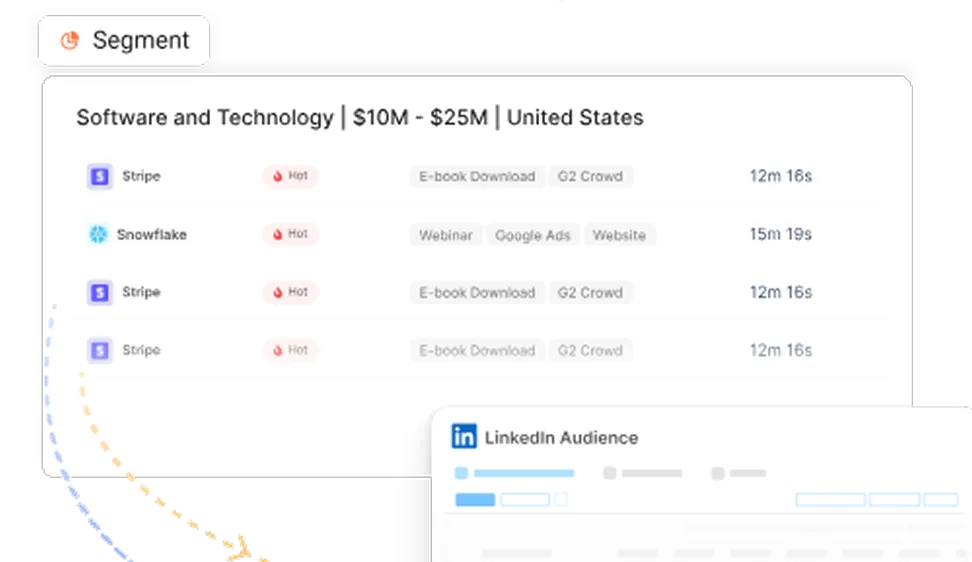
In simpler words, that means… it surfaces account-level intent signals, which companies are actively researching your category, which pages they’re visiting, and how frequently they’re returning. This means you can see when real-world behavior aligns with your avatar’s buying triggers and prioritize outreach to the accounts that are actually in-market.
For teams running LinkedIn and Google ads, the LinkedIn AdPilot and Google AdPilot features include avatar-informed targeting, frequency pacing, and built-in cross-channel attribution. That means you can test whether your avatar hypotheses are accurate by seeing which persona-level targeting combinations actually generate pipeline, not just clicks.
Cross-channel attribution connects the complete buyer journey from first touch through closed-won, so you know which pieces of avatar-matched content actually move deals forward. The Ad Controls feature lets you adjust spend in real time based on what’s converting, so when one avatar segment performs significantly better than another, you can act on it without waiting for a quarterly review.
What are the most common customer avatar mistakes?
- Building them from assumptions instead of research
This is where 99% of avatars fail. Personas built from internal brainstorming sessions are essentially fictional characters that feel real enough to satisfy a stakeholder presentation but don’t reflect actual buyer behavior. The Cintell data is clear: companies that exceed revenue goals are 82% more likely to use qualitative customer interviews in their persona research.
- Having too many avatars
Eight avatars mean eight content tracks, eight ad targeting strategies, and eight sets of landing pages. In practice, each avatar beyond three gets progressively less attention and becomes progressively less useful. Start with one. Build a maximum of three for your core buying committee.
- Never updating them
Markets shift. Buyer priorities change. New competitors emerge and old ones disappear. The Cintell benchmark is unambiguous: companies exceeding goals are 7.4x more likely to have refreshed their personas within the last six months. A quarterly review is the minimum viable maintenance schedule.
- Too much demographic detail, not enough psychographic depth
Knowing that your avatar drives a Toyota Camry and drinks craft beer (these appear in actual persona documents) does not help you write a single word of B2B copy. Knowing that they are terrified of presenting wrong attribution numbers to the CFO does.
- Building avatars in isolation from sales and CS
Marketing creates personas in a brainstorm. Sales rolls their eyes. Customer success has never seen them. Product ignores them entirely. The research needs to involve every customer-facing team to be accurate. The final document needs to be actively referenced by all of them. Otherwise, it’s a decoration (not a tool).
- Forgetting negative avatars
A negative customer avatar defines who you specifically do not want, the company too small to get value, the buyer whose problem your product doesn’t actually solve, the stakeholder who will derail every deal. Building these and using them in ad targeting and lead scoring saves meaningful budget and sales time. Per HubSpot, negative personas reduce unqualified leads and help marketing teams focus resources on accounts worth converting.
In a nutshell...
A customer avatar is a research-backed character study of the person who buys from you, built so that every marketing decision downstream gets sharper. The ICP defines which companies to target. The avatar defines who within those companies to reach and how to speak to them so they actually respond.
Good avatars are built from customer interviews, CRM analysis, voice-of-customer research from G2 and Capterra, and sales call recordings in tools like Gong. They include pain points at multiple emotional layers, named buying triggers, specific objections, and the exact language your buyers use to describe their own problems, not the category language you’ve been defaulting to.
The translation from avatar to messaging runs through copywriting frameworks like PAS, Before-After-Bridge, and StoryBrand, and is organized via a messaging matrix that maps persona-specific messages to funnel stages. Every piece of copy, every ad creative, every email subject line should trace back to a specific field in a specific avatar. If it can’t, it’s generic, and generic does not convert in B2B.
Companies that document, use, and regularly update their personas are 2.2x more likely to exceed revenue goals, per the Cintell benchmark. That gap shows up in CPL, pipeline quality, close rates, and sales cycle length. The research is the work that makes everything downstream faster and more accurate.
FAQs for customer and client avatars
Q1. What is a customer avatar?
A customer avatar is a detailed, semi-fictional representation of your ideal customer built from real data and research. It includes psychographic information, fears, motivations, daily frustrations, buying triggers, objections, and preferred information channels, in addition to standard demographic and professional details.
Popularized by Ryan Deiss and DigitalMarketer, the customer avatar is designed so that every field informs a specific marketing action: a copy angle, an ad targeting parameter, an email subject line, or a content topic. In B2B SaaS, avatars are typically built for multiple individuals in the buying committee and used across marketing, sales, product, and customer success teams.
Q2. What is the difference between a customer avatar and a buyer persona?
A buyer persona is a research-based profile of an individual buyer that covers demographic information, behavior patterns, goals, challenges, and buying journey insights. A customer avatar covers the same territory but goes deeper into the psychographic and narrative laye: fears, emotional motivations, day-to-day frustrations, and what the buyer’s internal monologue sounds like during evaluation.
The avatar is more character study, less data profile. The term is most common in digital marketing and direct response communities; persona is more common in enterprise B2B, UX, and analyst communities. The underlying methodology overlaps significantly, and teams often use both terms interchangeably.
Q3. What is the difference between a customer avatar and an ideal customer profile (ICP)?
An ICP describes the ideal target company using firmographic data: industry, employee count, annual revenue, growth stage, geographic region, and tech stack. A customer avatar describes the ideal individual within ICP-matching companies. ICP is used for account selection and territory planning. Avatars are used for messaging, content creation, ad targeting, and sales enablement at the individual level. In B2B SaaS, you need both: the ICP determines which accounts to pursue, and avatars define how to engage the people inside those accounts.
Q4. What does a complete customer avatar include?
A complete customer avatar includes professional demographics (job title, seniority, reporting structure, years of experience), firmographics (company size, industry, revenue range, growth stage, tech stack), goals and KPIs, pain points at multiple layers (surface frustration, emotional consequence, strategic risk), buying triggers (the events that bring them to market), objections (what would stop them from buying), buying committee role (decision-maker, champion, evaluator, or blocker), preferred information channels and communities, a representative quote capturing their mindset, and a day-in-the-life narrative for context. High-quality B2B avatars also include negative indicators: who this person is not, and what signals suggest they will not convert.
Q5. How many customer avatars does a B2B SaaS company need?
Most B2B SaaS companies need 3–5 avatars to cover the core buying committee. T2D3, a B2B SaaS growth advisory, recommends three foundational personas: the P1 User (day-to-day operator), the P2 Decision-Maker or Champion (budget owner driving internal alignment), and the P3 Gatekeeper or Blocker (IT, legal, finance, or procurement).
The Buyer Persona Institute recommends starting with fewer avatars than you think you need and adding new ones only when you can define clearly how the messaging to that avatar differs from an existing one. More than five avatars in practice means each one receives progressively less attention, resulting in generic execution across the board.
Q6. How do you create a customer avatar?
Creating a customer avatar requires both quantitative and qualitative research.
The process includes: analyzing CRM data for patterns among best-fit customers (deal size, win rates, close velocity, churn rates); mining voice-of-customer data from G2 and Capterra reviews, Gong call recordings, support tickets, and NPS survey verbatims; conducting 5–15 in-depth interviews per persona segment focused on buying triggers, decision criteria, and objections; structured sessions with sales and customer success teams to capture frontline knowledge; and using tools like LinkedIn Sales Navigator, SparkToro, HubSpot, and Factors.ai to validate hypotheses at scale.
Q7. What is a client avatar?
A client avatar is functionally identical to a customer avatar. The term “client” is more commonly used in service businesses (consulting firms, agencies, coaches, and professional services) where relationships are more personalized. An ideal client avatar (ICA) describes the service provider’s ideal client: the problems they bring, the outcomes they’re seeking, how they make decisions, their engagement style, and what would cause them to refer the service to others.
The research process, template components, and translation to messaging are the same as for a customer avatar in a product context.
Q8. What does a client description example look like in B2B SaaS?
A client description example in a B2B SaaS context looks like this: “Series B fintech company, 150-400 employees, $8M–$20M ARR, using Salesforce and HubSpot. VP of Revenue Operations with 8+ years experience, responsible for pipeline operations, reporting, and CRM data quality. Primary concern is forecast accuracy and executive-level visibility into pipeline health. In the market because sales missed quota for two consecutive quarters and the CEO is demanding root cause analysis. Evaluating multiple attribution and analytics platforms; main competitor being considered is a point solution already in the stack.
Key objections: implementation complexity, data migration risk, and adoption resistance from a skeptical sales team.”
This level of specificity makes every downstream marketing decision, targeting parameters, content topics, ad copy, sales email templates, faster and more accurate to produce.
Q9. How do you turn customer avatar insights into messaging?
Turning avatar insights into messaging involves three translation steps.
- First, convert each pain point into three copy versions: a surface-level symptom version, an emotional frustration version, and a strategic consequence version, then match each to the appropriate funnel stage.
- Second, apply a copywriting framework: PAS (Problem-Agitate-Solution) for demand generation and paid ads; Before-After-Bridge for email and product announcements; StoryBrand for brand-level website copy.
- Third, build a messaging matrix with avatars on one axis and funnel stages on the other, filling each cell with the specific value proposition, key message, and proof points for that combination.
Voice-of-customer language, the exact phrases buyers use in interviews, reviews, and sales calls, should appear directly in headlines, subject lines, and ad creative.
Q10. Why do customer avatars fail to produce results?
Customer avatars fail for six common reasons.
- First, they are built from internal assumptions rather than actual customer research.
- Second, teams create too many avatars and execute none of them well. Third, the avatars are never updated after initial creation, making them stale within a year.
- Fourth, they focus on demographic detail rather than psychographic depth, persona data points like hobbies, car preferences, and TV shows provide no usable input for B2B marketing decisions.
- Fifth, they are created by marketing in isolation, without input from sales, customer success, or product, missing the objections and language patterns that matter most in actual buying conversations.
- Sixth, they are documented and then filed, never referenced in campaign briefs, content calendars, or ad targeting decisions.
A persona that exists in a Google Drive folder but never appears in a creative brief is a decoration.
Q11. How do customer avatars improve B2B advertising performance?
Customer avatars translate directly into advertising parameters on LinkedIn Ads and Google Ads. On LinkedIn, avatar fields like job title, seniority, company size, industry, and professional skills map to the platform’s targeting options.
The preferred communities and information sources field maps to LinkedIn Groups and Member Interests. On Google Ads, avatar pain points inform keyword lists organized by problem awareness stage, and buying triggers map to high-intent search queries. Customer Match audiences built from CRM lists of avatar-matching contacts allow for retargeting across Google’s display and search networks.
Persona-specific creative, ads that speak to a VP of Marketing’s specific concerns, rather than generic B2B decision-makers, consistently delivers higher CTR and lower cost per lead.
Q12. How often should customer avatars be updated?
Customer avatars should be reviewed and updated at a minimum once per year, and more frequently after major product changes, market expansions, significant pricing shifts, or changes in the competitive environment.
Quarterly reviews are the recommended practice for high-growth B2B SaaS companies. Each review should incorporate new customer interview data, updated CRM patterns, recent sales call themes from tools like Gong, and any shifts in the VOC data surfaced from G2 and Capterra reviews.

See how Factors can 2x your ROI
Boost your LinkedIn ROI in no time using data-driven insights


.avif)

See Factors in action.
Schedule a personalized demo or sign up to get started for free
LinkedIn Marketing Partner
GDPR & SOC2 Type II







.svg)



.avif)

