
Customer Profiling and Segmentation: The B2B SaaS GTM guide
Learn how B2B SaaS GTM teams build customer profiles, run segmentation, activate intent-based audiences, and measure what actually works. A practical, no-fluff guide.
.avif)
Content Marketer



.svg)


TL;DR
- Customer profiling is the process of building data-backed portraits of your best customers. Customer segmentation is grouping your market using those portraits. Profiling comes first. Segmentation is what you do with it.
- In B2B SaaS, firmographic data alone is a starting point, not a strategy. The real edge comes from layering technographic, behavioral, and intent data on top of it.
- Segmentation only matters if it changes how you go to market. If the segment doesn’t change the playbook, it’s not a real segment.
- The full workflow: profile your best customers, extract your ICP, build segments from that ICP, then activate across ads, outbound, ABM, and nurture.
- Measurement closes the loop. Track conversion rate, pipeline velocity, and win rate by segment. Then reallocate toward what actually works.
Here’s a situation I’ve lived through more times than I’d like to admit.
A well-funded B2B SaaS company with A marketing team that absolutely knows what they’re doing. A product that genuinely solves a real problem. And a GTM strategy that targets ‘mid-market companies in North America with a sales team.’
Yes, that’s the segment.
The LinkedIn ads? Running to ‘VP of Sales, 200 to 1,000 employees,’ outbound sequences? Same email going to a Series A fintech startup and a 700-person logistics company. The website? Generic. The content? Written for everyone, which, in other words… is written for no one.
And you already know the results. High CPCs, low conversion, a confused sales team, a CFO asking pointed questions at the next QBR… and you? Sweating bullets.

The frustrating part is that the problem is rarely the product, the budget, or the team (and also that everyone can see the sweat patches on you). AND it’s also that no one took the time to actually figure out who they’re selling to. Shocking, I know.
Customer profiling and segmentation builds that foundation. Your ads, your sequences, your ABM plays, your content: all of it sits on top of it. When the foundation is vague, everything above it wobbles.
This guide is for B2B SaaS GTM teams who want to do this properly. We’re covering what profiling and segmentation actually are, how they differ, the six segmentation types that matter in B2B SaaS, a step-by-step process, how to activate segments across your GTM, and how to measure whether any of it is working.
Customer profiling vs. customer segmentation vs. ICP vs. buyer persona: Let’s finally clear this up
These four terms get used interchangeably in planning meetings and they really shouldn’t be. They’re related, but distinct. Confusing them leads to strategy built on mismatched definitions.
Customer profiling
Customer profiling is the process of collecting and analyzing data about your existing customers to build a detailed, structured portrait of who they are. Firmographic attributes (industry, size, revenue, geography), technographic data (what tools they run), behavioral patterns (how they engage with your product and content), and qualitative insights (why they bought, what almost made them say no).
Profiling is a data collection and analysis process. Its output is a rich, multidimensional picture of your customer base.
Customer segmentation
Customer segmentation is grouping your customer base or target market into distinct subsets based on shared characteristics. The goal is operational: to enable tailored campaigns, personalized outreach, and smarter resource allocation.
The relationship that matters: Profiling comes first. You build profiles from data, then use those profiles to define your segmentation criteria. Without solid profiling, your segments are just guesses with filters applied.
Customer profile vs. ICP vs. buyer persona
These three things live at different levels and serve different purposes. Here’s the table that will save you from a lot of misaligned planning conversations:
In B2B SaaS, the ICP identifies the right companies. Buyer personas identify the right people within those companies. Customer profiling is the data process that generates raw material for both.
The order matters: Profile first, then define your ICP, then layer on personas, then segment your market using those criteria.
The 6 Types of B2B Customer Segmentation (With SaaS-Specific Examples)
Quick Reference: B2B Segmentation Type Matrix
Most segmentation frameworks list four types, stop at firmographic and behavioral, and call it a day. That works fine if you’re selling consumer goods in 2009. For B2B SaaS teams dealing with complex buying committees, long sales cycles, and deals that stall for reasons your CRM will never capture, you need to go further.
1. Firmographic segmentation
This is your foundation. Industry, company size (headcount or revenue), geography, growth stage, and ownership type. Every B2B team starts here.
SaaS example: A marketing analytics platform segments its TAM into SMB (under 50 employees), mid-market (50 to 500 employees), and enterprise (500+ employees). Each tier gets different pricing, different onboarding, and different messaging.
The honest limitation: Firmographic data is the most accessible segmentation type, which means everyone has it. Two companies with identical industry, size, and geography can have completely different buying timelines, risk appetites, and decision-making structures. Firmographics tell you who they are on paper. Use it to filter. Not to personalize.
2. Technographic segmentation
Technographic segmentation groups accounts by the technology they currently use. One of the most underutilized types in B2B SaaS, and one of the most powerful.
SaaS example: A sales engagement platform prioritizes outbound to accounts already running Salesforce or HubSpot because native integrations exist. A cybersecurity company filters by cloud provider and existing EDR stack. A RevOps tool quietly disqualifies any prospect not running a CRM.
The real play here is competitive displacement. If you know an account runs your competitor’s tool, that’s a segment. Build a campaign specifically for them. “You’re already paying for X, here’s what you’re not getting” lands very differently than a cold product introduction.
3. Behavioral segmentation
Behavioral segmentation groups accounts and contacts by how they interact with your brand and product. This is where your first-party data becomes a real competitive advantage.
SaaS example: A product analytics company identifies three cohorts from their trial users: Power Explorers (activate three or more features in week one), Passive Lurkers (signed up, barely returned), and Integration-First accounts (connect their CRM on day one). Each cohort gets a different nurture sequence and CS handoff protocol.
The RFM lens: For existing customer segmentation, Recency, Frequency, and Monetary value still holds up well. Champions look very different from At-Risk accounts even when their firmographics are identical.
4. Intent-based segmentation
Uncomfortable stat: only about 5% of your total addressable market is actively in-market at any given time. The other 95% are not ready to buy yet. Running the same campaign to both groups is expensive and largely ineffective.
Intent-based segmentation fixes this. It groups accounts by signals indicating they’re actively researching, comparing, or evaluating solutions like yours, before they ever fill out a form.
SaaS example: A B2B data platform identifies accounts spiking on “sales intelligence” topics across the web. A separate segment includes accounts that visited pricing more than twice this week and engaged with a LinkedIn ad. These are not the same audience, and they should not receive the same outreach.
First-party intent comes from your own website. Third-party intent comes from providers like Bombora, G2, and TechTarget, which aggregate research behavior across their publisher networks. Intent data is the closest thing B2B marketing has to knowing who is actually shopping.
5. Psychographic segmentation
Psychographic segmentation captures attitudes, values, culture, and motivations at the organizational and individual level. The hardest to quantify and the easiest to skip, which is exactly why teams that do it well have a significant messaging advantage.
SaaS example: Two mid-market B2B SaaS companies, identical firmographics, same tech stack. One is a move-fast culture led by a technical founder who hates sales calls. The other is a cautious, process-driven team that needs three approvals before any purchase. These accounts need completely different experiences. Self-serve evaluation and developer docs for the first. ROI calculators, executive briefings, and risk framing for the second.
This insight rarely lives in a dashboard. It lives in what customers say when you ask them why they almost didn’t buy.
6. Account-based (tier) segmentation
This is how firmographic, technographic, behavioral, and intent data all converge into one operating model. Account-based segmentation assigns every target account to a tier based on ICP fit combined with current engagement signals.
Tier 1 (1:1): Your highest-fit, highest-intent accounts. Custom landing pages, direct exec outreach, dedicated AE attention. Usually 50 to 150 accounts.
Tier 2 (1:Few): Strong ICP fit, moderate engagement. Clustered by shared vertical or use case. Semi-customized campaigns, vertical-specific content, SDR sequences with light personalization.
Tier 3 (1:Many): Broad programmatic plays to surface intent and move accounts up tiers. Scaled advertising, general awareness content, automated nurture. The goal here is to find which accounts start heating up.
Case study context: Clarabridge segmented by vertical (retail banking, healthcare insurance), then by buying committee role within each vertical, and influenced 96 deals worth approximately $24 million in pipeline. The segmentation framework was the campaign.
How to build a B2B customer profile: Data sources and the process
Customer profiling is only as good as the data feeding it. Across most B2B SaaS companies, that data is scattered across seven or eight systems that were never designed to talk to each other. Your first job is knowing where to look.
The data sources that matter
CRM (Salesforce, HubSpot): Firmographics, deal history, stage progression, close and loss reasons, pipeline velocity, revenue by account.
- Website analytics (GA4, Mixpanel):
Which pages accounts visit, how often, where they drop off, what content they consume before converting. - Product analytics (Amplitude, Pendo):
Feature adoption, login frequency, activation milestones, churn precursor signals. - Enrichment tools (ZoomInfo, Clearbit, Cognism):
Firmographic and technographic enrichment at scale. Fill the gaps your CRM leaves behind. - Sales intelligence (Gong, Chorus, call notes):
The qualitative goldmine. What objections come up repeatedly? What was the trigger that started the search? What almost killed the deal? - Customer success and support (Zendesk, Intercom):
What do customers complain about? Who renews? Who churns and why? - Billing systems:
ARR, expansion history, plan tier movement. - Third-party intent data (Bombora, G2, TechTarget):
Which topics are accounts researching across the web? Which competitors are they evaluating?
The data hierarchy: Zero-party data (things customers voluntarily tell you in surveys and onboarding questionnaires) is the most accurate. First-party data (everything you collect as a byproduct of interactions) is your most reliable operational layer. Third-party data fills the gaps at scale but should be treated as directional, not definitive.
The profiling process
1. Audit what you have. Map every data source across CRM, analytics, billing, and support. Identify what’s consistently populated versus what’s missing. Most CRMs are haunted by incomplete fields and records filled with N/A.
2. Focus on your best customers first. Pull the top 20% by revenue, LTV, or NRR. Analyze what they have in common: firmographic traits, how they found you, which features they adopted, how long they took to close.
3. Cross-reference with closed-lost data. The accounts you lost but probably shouldn’t have are equally instructive. Look for patterns: wrong size, wrong stage, wrong champion, wrong use case.
4. Add the qualitative layer. Customer interviews, call recordings, CS handoff notes. Ask: what triggered the search? What almost made them choose someone else? What would have made them say no?
5. Build your profile dimensions. For each customer segment: firmographic snapshot, technographic context, behavioral fingerprint, psychographic signals, primary pain point, buying committee structure, and typical sales cycle.
6. Validate with sales and CS. If your sales team looks at your profile and says, “That’s not really who we’re closing,” that’s important information. Build with them, not around them.
The 7-step segmentation process
There’s a version of this that lives in a framework document and never makes it into the CRM. Then there’s the version that actually changes how your team runs campaigns. The difference is usually how operationalized it is.
7. Define the business goal first. Before picking segmentation criteria, ask: what are you trying to improve? Reduce churn in a specific vertical? Increase expansion from a use case segment? Improve paid conversion for a new ICP tier? The goal determines the right variables. If you don’t start here, you end up with segments that are interesting but not actionable.
8. Audit your data. Using the sources listed above, establish what’s available, enriched, and missing. You cannot segment on data you don’t have. If firmographic data is spotty in your CRM, clean and enrich before proceeding.
9. Run your best customer analysis. Profile the top 20 to 30% of customers by revenue, retention, and product adoption. What firmographic, technographic, and behavioral traits do they share? Primer ran this analysis and found 80% of their opportunities came from companies with 11 to 2,000 employees. That’s not a coincidence. That’s a segment.
10. Define your segment criteria. Choose 3 to 5 criteria with the strongest correlation to customer success in your data. Start with firmographic filters, then add one behavioral or intent dimension. Resist the temptation to add every possible variable. Segments you can’t confidently act on are not useful.
11. Build your segments and tier your target account list. Apply criteria across your full TAM. Layer the ICP fit score with engagement and intent score to assign tiers. Aim for 3 to 8 distinct, actionable groups. Too many small segments and your LinkedIn campaigns will flag “audience too narrow.” Too few and you’re back to writing for everyone.
12. Validate with sales and CS. The best segmentation frameworks are built collaboratively. If marketing creates segments and sales ignores them, the entire exercise was academic.
13. Activate, measure, and iterate. Push segments into your CRM, ad platforms, and marketing automation. Set segment-specific KPIs. Review quarterly at a minimum. Accounts move. Markets shift. Buying behaviors change. Your segments should too.
Activating segments across your GTM: Where the work pays off
Segmentation sitting in a spreadsheet is just organized data. Segmentation activated across LinkedIn, Google, outbound, ABM, and nurture is a revenue strategy.
- LinkedIn and Google Ad targeting
The most direct translation of a customer profile into a campaign is to build a matched audience on LinkedIn from your highest-fit accounts, then layer in job function and seniority targeting. Job function plus seniority typically outperforms job title targeting because it’s more stable and has a broader reach.
The problem most teams run into: the same 10% of accounts absorb 80% of ad impressions. Your best-fit accounts see your ads on repeat, while the rest of your segment barely registers you exist. Ad fatigue on your most important accounts while the broader segment goes dark.
This is exactly the problem Factors.ai’s LinkedIn AdPilot was built to solve. The Smart Reach feature controls impression frequency at the account level, distributing budget more evenly across your entire target segment rather than concentrating it on the noisiest few.
When Descope, a B2B identity and security platform, used Factors’ Audience Sync to automatically push intent-based segments directly to LinkedIn Campaign Manager (no manual CSV exports, no stale lists), they redistributed roughly 140,000 impressions more evenly. The impression share of the top 100 accounts dropped from 38% to 24%. Their LinkedIn Ads ROI increased 25%. The segments did not change. The activation did.
For Google, the same logic applies. Segmented Customer Match lists (Tier 1 accounts, competitive displacement targets, late-stage re-engagement) let you bid more aggressively for high-fit accounts while using informational content to pull mid-funnel accounts into consideration.
- Account-level intelligence as the profiling layer
Before you can segment and activate, you need to know who is actually showing up. Factors.ai’s Account Identification layer reverse-identifies anonymous website visitors at the company level, enriching each visit automatically with firmographic context: industry, headcount, revenue range, geography, tech stack.
This is the practical bridge between “we got 500 visitors this week” and “we got 12 accounts from mid-market fintech, 3 from enterprise logistics, and 47 from verticals outside our ICP.” The second version is actionable.
Factors’ Company Intelligence API (launched late 2025) adds another layer: it surfaces company-level engagement from both paid and organic LinkedIn in a single view. Build a segment of accounts that engaged with your organic thought leadership, your sponsored content, and your pricing page, then auto-sync that segment to Campaign Manager for retargeting. Early beta results showed up to 96% more SQLs influenced when this cross-channel company-level view was activated.
- Intent-based segment activation
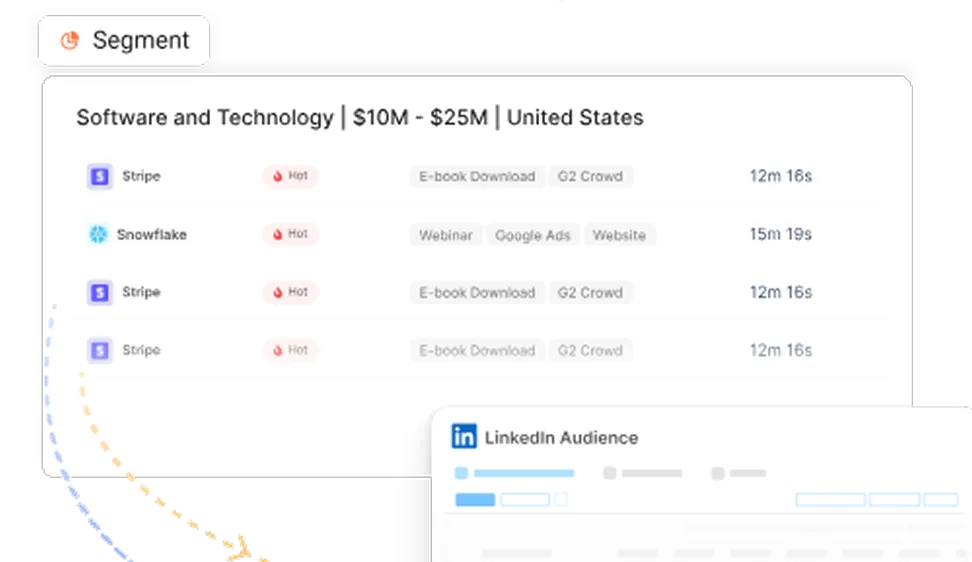
Factors aggregates intent signals from multiple sources: first-party website behavior, LinkedIn engagement, G2 activity, CRM deal stage, and third-party providers. It surfaces these as a unified, ranked priority list of accounts by buying stage.
In practice, this means your team can build a segment of high-intent evaluators defined as accounts that have visited pricing more than twice, engaged with a comparison-focused ad, and showed a G2 intent spike in the last 14 days. This is a very different audience from accounts that signed up for the newsletter.
That intent-based segment auto-syncs to LinkedIn Audience Manager and triggers a Tier 1 sales alert simultaneously. One signal, multiple activations, zero manual work.
- Outbound and ABM
Segmented outbound is where personalization becomes a conversion driver. When your SDRs know an account is running Marketo and attended a webinar on pipeline attribution last week, that’s a very different opening line than a cold introduction.
Build segment-specific playbooks: different email sequences, different call scripts, different case studies for each segment. Firmographic data tells the SDR which industry angle to lead with. Technographic data determines which integration story to tell. Intent signals tell them how urgently to follow up.
For ABM, your Tier 1 segment gets 1:1 personalized experiences. Your Tier 2 gets vertical-specific content and semi-customized sequences. Tier 3 gets programmatic awareness plays. Segmented email campaigns drive 760% more revenue than non-segmented sends according to DMA data. The multiplier is not because segmented emails are magic. It’s because relevant content to the right audience at the right time is the entire point of marketing.
How to know if your segmentation is actually working
This is the section most segmentation guides skip. Which is genuinely confusing, because measurement is how you justify the investment and improve it over time. Track these metrics by segment, not just in aggregate.
- Conversion rate by segment
Break down your funnel at every stage for each segment: visitor to lead, lead to MQL, MQL to SQL, SQL to opportunity, opportunity to closed-won. A segment with great top-of-funnel numbers but poor SQL-to-opportunity conversion is probably targeting the wrong intent or seniority level.
- Pipeline velocity by segment
Formula: (Opportunities x Win Rate x Average Deal Size) / Sales Cycle Length. A smaller segment with high velocity is often more worth investing in than a large segment full of stuck, slow-moving deals.
- Win rate by segment
Companies with strong ICP alignment achieve 68% higher account win rates according to research from TOPO (now part of Gartner). Win rate by segment is the most direct measure of ICP accuracy. If you’re winning 40% in one vertical and 12% in another, that’s not a sales problem. That’s a segmentation signal.
- CAC and LTV by segment
Total marketing plus sales spend divided by new customers per segment gives you CAC. When you know CAC by segment, you stop averaging across segments that perform completely differently. Pair it with LTV by segment (ARPA x Gross Margin % / Churn Rate) and you have the clearest possible picture of where to concentrate resources.
- Revenue contribution and expansion rate
What percentage of the total pipeline and NRR comes from each segment? If 20% of your accounts contribute 70% of your net revenue retention, that is not just a segmentation insight. That is your GTM strategy.
Factors.ai’s cross-channel attribution models (nine in total, including first-touch, last-touch, time-decay, position-based, and custom weighted) let you see which channels and campaigns influenced pipeline for each segment specifically. This closes the loop between segmentation and media investment: you stop guessing which ad drove pipeline from your enterprise segment and start knowing.
Segmentation mistakes that are hurting your pipeline
- Using only firmographic data
Industry and company size are the starting point, not the strategy. Two companies with identical firmographics can have completely different buyers, buying timelines, and purchase priorities. Stopping at firmographics is like describing your best friend by their height and zip code.
- Over-segmenting into paralysis
More segments are not always better. When you have 22 sub-segments and none have sufficient account volume for a meaningful LinkedIn campaign, you have created complexity without capability. Start with 3 to 8 actionable segments. Add layers as you validate.
- Building segments no one acts on differently
If your sales team treats every segment with the same outreach template and your ads run to the same audience regardless of segment score, the segmentation did not fail. It just never existed outside of a presentation slide. Build segments that force different behavior from the team.
- Never updating the segments
Markets shift. Accounts move stages. Intent signals expire. A segment that was accurate eight months ago may be sending your team after accounts that have already bought from a competitor. Review segmentation criteria quarterly. Refresh enrichment data continuously.
- Misaligned definitions between marketing and sales
Marketing defines an enterprise as one with 500 or more employees. Sales defines an enterprise as one with 1,000 or more employees with a dedicated IT team. Your scoring model says an account is Tier 1. The AE says it is not in their territory. These misalignments cause real revenue loss. Build segmentation definitions collaboratively with RevOps as the connective tissue. Get sign-off from sales and marketing together and make shared definitions part of the CRM.
In a nutshell...
Customer profiling and segmentation are not marketing tactics. It is the operating layer that every tactic runs on. Your ads, outbound, ABM plays, content, and sales playbooks all perform better when the underlying segments are accurate, data-backed, and actually being used.
The process itself is not complicated. Profile your best customers using the data you already have. Extract your ICP from those profiles. Build segments that reflect both fit and intent. Activate those segments across every channel where your buyers spend time. Measure by segment, not just in aggregate. Iterate.
The teams that do this well do not just have cleaner CRMs. They have shorter sales cycles, higher win rates, and marketing spend that the CFO can justify with actual numbers. That is not a coincidence. That is what happens when you stop treating your entire TAM as one audience.
McKinsey research found that faster-growing companies derive 40% more revenue from personalization than slower-growing counterparts. Personalization starts with knowing who you are talking to. And knowing who you are talking to starts with profiling and segmentation done right.
If you are a B2B SaaS GTM team that wants to go from vague segments to intent-driven account prioritization with automatic activation to LinkedIn and Google, Factors.ai connects account identification, multi-source intent capture, account scoring, and ad platform sync in one platform. Start with the free plan and see which companies are on your site today.
FAQs for Customer Profiling and Segmentation
Q1. What is the difference between customer profiling and customer segmentation?
Customer profiling and customer segmentation are two parts of the same process, but they serve different functions. Customer profiling is the research and data-collection phase. It involves gathering firmographic, technographic, behavioral, and qualitative information about your existing customers to build detailed, structured portraits of who they are and why they buy. The output of profiling is a rich understanding of your customer base.
Customer segmentation is what you do with that understanding. It is the process of grouping your target market or existing customer base into distinct subsets based on shared characteristics identified through profiling. Segmentation is operational: its goal is to enable tailored campaigns, personalized outreach, and smarter allocation of sales and marketing resources.
The simplest way to think about the relationship: profiling is the analysis, segmentation is the action. Profiling tells you who your customers are. Segmentation sorts them into groups so you can treat each group differently. In B2B SaaS, profiling should always come first. Without it, your segments are just filters applied to incomplete data.
Q2. What are the main types of customer segmentation for B2B companies?
B2B customer segmentation typically spans six core types, each capturing a different dimension of your customer and prospect base.
- Firmographic segmentation groups accounts by company-level attributes: industry, company size, revenue range, geography, growth stage, and ownership type. It is the most accessible type and the standard starting point for any B2B segmentation exercise.
- Technographic segmentation groups accounts by the technologies they use, such as their CRM, marketing automation platform, cloud infrastructure, or security tools. It is particularly valuable for identifying integration fit and running competitive displacement campaigns.
- Behavioral segmentation groups accounts by how they interact with your brand and product: pages visited, content consumed, product features adopted, email engagement, support activity. This type relies on first-party data and is one of the highest-signal segmentation inputs available.
- Intent-based segmentation groups accounts by signals indicating active buying behavior, such as topic surges on third-party networks like Bombora, G2 product page views, pricing page visits, and competitor research activity. It identifies which accounts in your TAM are actually in-market right now.
- Psychographic segmentation groups accounts by organizational values, culture, risk tolerance, and decision-making style. It is the hardest to quantify but often produces the most differentiated messaging strategies.
- Account-based (tier) segmentation combines fit score and intent score to tier accounts into groups like Tier 1 (1:1 ABM), Tier 2 (1:Few), and Tier 3 (1:Many). This is the operational framework that connects profiling and segmentation to your actual GTM execution model.
Q3. How does customer profiling relate to building an Ideal Customer Profile (ICP)?
An Ideal Customer Profile is a direct output of customer profiling. The ICP is not a theoretical exercise or a document someone writes in a strategy offsite. It is a data-driven description of the companies that deliver the most value to your business: fastest to close, highest retention, strongest expansion, best product adoption.
The process works like this: you profile your entire existing customer base using firmographic, technographic, behavioral, and qualitative data. You then isolate the top 20 to 30% of customers by revenue, net revenue retention, or lifetime value. You analyze what those best customers have in common. The patterns you find across company size, industry, technology stack, buying trigger, and product usage form the foundation of your ICP.
The ICP is essentially a crystallized version of your customer profile, filtered to reflect only your ideal outcomes. Where a customer profile describes who buys from you today, the ICP describes who you should be actively pursuing. Research from TOPO (now part of Gartner) found that companies with strong ICP alignment achieve 68% higher account win rates. That gap is the value of the profiling exercise.
Q4. How do you use customer segmentation in B2B demand generation campaigns?
Customer segmentation is the upstream input that determines whether your demand generation campaigns reach the right accounts, with the right message, at the right stage in their buying journey. Without it, demand gen is essentially broadcasting. With it, it becomes targeted activation.
In practice, segmentation shapes demand gen in several direct ways. For paid advertising on LinkedIn, segments become matched audience lists that are pushed directly to Campaign Manager, allowing you to target specific account clusters with job function and seniority filters. High-intent segments get more aggressive bidding and bottom-of-funnel creative. Early-stage segments get awareness and educational content.
For outbound, segments determine which sequence a prospect enters, which case study the SDR references, which integration angle gets highlighted, and how urgently to follow up based on intent score. For ABM, segments define the tier structure: Tier 1 accounts get 1:1 personalized experiences while Tier 3 gets programmatic plays designed to surface intent and move accounts up.
For nurture, segmentation determines which content stream an account enters and when behavioral triggers move them to a higher-intent sequence. Segmented email campaigns consistently drive significantly higher click-through rates and revenue than non-segmented sends because relevance is the variable that matters most.
Q5. What data do you need to build effective B2B customer segments?
Effective B2B customer segments require data from multiple sources, covering both what accounts look like on paper and how they actually behave. Relying on any single data type almost always produces segments that are either too broad to personalize or too narrow to activate.
The core data types are firmographic data (industry, headcount, revenue, geography, growth stage), which lives in your CRM and can be enriched via tools like ZoomInfo or Clearbit; technographic data (current tech stack, integrations used), available from BuiltWith, HG Insights, and job posting analysis; behavioral data (website visits, content downloads, product feature usage, email engagement), drawn from your analytics and product platforms; and intent data (topic research spikes, G2 activity, competitor evaluation signals), sourced from both your own first-party tracking and third-party providers like Bombora.
The data hierarchy matters. Zero-party data, which is information customers voluntarily provide in surveys and onboarding forms, is the most accurate because there is no inference involved. First-party behavioral data from your own systems is your most reliable operational layer. Third-party data fills the gaps at scale but should be treated as directional signal rather than confirmed fact.
For most B2B SaaS teams, the biggest data quality problem is not a lack of sources but inconsistent CRM hygiene. Before building segments, audit what is actually populated in your CRM versus what is technically a field. Segments built on incomplete data produce misleading outputs.
Q6. How often should you update your customer segments?
Customer segments should be reviewed on a defined cadence and updated whenever meaningful signals indicate the underlying assumptions have shifted. For most B2B SaaS teams, a formal quarterly review is the minimum. In fast-moving markets or during periods of significant product or positioning change, monthly reviews are more appropriate.
The key trigger for a segment refresh is performance divergence: when a segment that historically performed well starts showing declining conversion rates, longer sales cycles, or lower win rates, that is a signal that either the market has shifted or your segment criteria no longer accurately describe the accounts most likely to buy.
Firmographic data decays quickly. Employees change jobs, companies get acquired, headcount fluctuates, and tech stacks evolve. Enrichment data from providers like ZoomInfo and Clearbit should be refreshed continuously, not just at the time of initial import. Intent data has an even shorter shelf life: an account showing a buying signal today may have already made a purchase decision within 30 days if not engaged promptly.
Beyond scheduled reviews, segment criteria should also be revisited when you launch a new product tier, enter a new vertical, change your pricing model, or identify a new use case driving meaningful pipeline. The ICP that served you well at $2M ARR may not be the right ICP at $20M ARR.
Q7. What is the difference between an ICP and a buyer persona in B2B?
An Ideal Customer Profile (ICP) and a buyer persona are complementary but distinct concepts that operate at different levels of your go-to-market strategy. Confusing them or using them interchangeably is one of the most common sources of misaligned GTM execution in B2B SaaS.
The ICP operates at the company level. It describes the characteristics of the organizations most likely to buy from you, benefit from your product, stay as customers, and expand over time. ICP dimensions include firmographics (industry, company size, revenue range), technographics (existing tech stack), buying behavior patterns, and operational characteristics like growth stage, funding status, and team structure. The ICP is primarily used for account selection, lead scoring, territory planning, and qualifying inbound interest.
The buyer persona operates at the individual level. It describes the specific people within your ICP companies who are involved in evaluating and purchasing your product. B2B buying committees typically include multiple stakeholders: an economic buyer (holds the budget), a technical evaluator (assesses implementation), an end user champion (will use the product daily), and an executive sponsor (signs off on strategic fit). Each role has different motivations, different concerns, and different criteria for success. Buyer personas capture these differences and inform messaging, content strategy, outreach scripts, and objection handling.
In practice, you use the ICP first to identify and qualify which companies to target. You then use buyer personas to determine which people at those companies to engage, with what message, through which channels. A strong ICP without persona depth produces great account lists and generic messaging. Strong personas without a disciplined ICP produces personalized outreach sent to the wrong companies.
Q8. How do you measure whether your customer segmentation is working?
Measuring segmentation effectiveness requires tracking a defined set of metrics by segment rather than in aggregate. When you average across all segments, high-performing and low-performing groups cancel each other out and the signal disappears. Here are the metrics that matter most.
- Conversion rate by segment tracks how accounts in each segment move through your funnel, from first visit to closed-won. Breakdowns at each stage (visitor to lead, MQL to SQL, opportunity to closed-won) reveal where specific segments are converting and where they are stalling.
- Pipeline velocity by segment is calculated as (Opportunities x Win Rate x Average Deal Size) divided by Sales Cycle Length. It tells you how efficiently revenue is flowing through each segment. A smaller, faster-moving segment is often more valuable than a larger, slower one.
- Win rate by segment is the most direct measure of ICP accuracy. Companies with strong ICP alignment achieve 68% higher win rates according to TOPO research. If your win rate varies significantly across segments, that variance is telling you something important about fit.
- Customer acquisition cost (CAC) by segment reveals which segments are efficient to acquire. When combined with LTV by segment, it shows you where the LTV:CAC ratio is favorable and where you are overinvesting relative to lifetime value.
- Net revenue retention (NRR) by segment tracks expansion and churn behavior per segment. Your highest-NRR segment should receive your highest-quality customer success investment. If a segment shows consistently lower NRR, it may indicate an ICP fit problem rather than a product or CS problem.
Practically, segment-level attribution (tracking which campaigns influenced which segments) is what connects your media investment to segment performance. Cross-channel attribution models that unify ad data, CRM data, and website behavior at the account level give you the clearest picture of what is driving outcomes in each segment, and where to reallocate budget as a result.
Q9. What are the most common mistakes B2B companies make with customer segmentation?
The most common and consequential mistakes in B2B customer segmentation tend to cluster around three themes: over-reliance on shallow data, poor operationalization, and failure to maintain segments over time.
The most widespread mistake is treating firmographic data as a complete segmentation strategy. Industry and company size establish who your audience is on paper. They do not tell you who is actively evaluating solutions, which accounts have the right technology context for your product, or which stakeholders hold the budget. Stopping at firmographics produces segments that look logical but do not reflect actual buying behavior.
The second major mistake is building segments that never change team behavior. If your SDRs use the same outreach template for every segment, your ads run to the same audience regardless of intent score, and your content is not mapped to specific segment needs, the segmentation exists only in a document. A segment only has value when it produces a different action.
The third common failure is treating segments as static. Customer data decays. Firmographic enrichment from providers like ZoomInfo or Clearbit typically degrades meaningfully within 6 to 12 months. Intent signals have an even shorter shelf life. Markets shift, tech stacks change, and the accounts that were your best ICP fit 12 months ago may have already bought from a competitor. Building a quarterly segment review into your marketing operations calendar is not optional; it is maintenance.
Two additional mistakes worth calling out: over-segmenting into too many granular groups that individually lack the account volume for meaningful activation, and misaligning segment definitions between marketing, sales, and RevOps. When marketing defines enterprise as 500 employees and sales defines it as 1,000, the scoring model, the CRM routing, and the campaign targeting all diverge. That divergence costs real pipeline.
Q10. How does intent data improve customer segmentation in B2B SaaS?
Intent data improves customer segmentation by adding a timing dimension that firmographic, technographic, and behavioral data cannot provide on their own. Knowing that an account fits your ICP tells you they could buy from you. Intent data tells you which of those accounts are actually looking to buy right now.
At any given time, roughly 5% of your total addressable market is actively in-market for a solution like yours. Without intent data, your campaigns treat the in-market 5% and the not-yet-ready 95% identically: same messaging, same cadence, same bid strategy. This is both inefficient and expensive.
Intent data enables what is sometimes called timing-based segmentation: grouping accounts not just by who they are but by where they are in their buying journey. A high-fit account spiking on intent topics related to your category, visiting your pricing page multiple times, and actively viewing competitor profiles on G2 in the same week is in a fundamentally different segment from a high-fit account with no active signals. They require different treatment: different message urgency, different sales priority, different ad creative, different outreach timing.
First-party intent (your own website behavior, content engagement, demo request signals) is the highest-quality input because it reflects direct engagement with your brand. Third-party intent from providers like Bombora, G2, and TechTarget captures research behavior happening outside your owned channels, giving you visibility into accounts that are in active evaluation mode before they ever come to your site.
For B2B SaaS GTM teams, the most effective intent-based segmentation layers first-party and third-party signals together into a unified intent score per account. Platforms like Factors.ai aggregate signals from website behavior, LinkedIn engagement, G2 activity, CRM data, and third-party providers into a single ranked account list, making it possible to build live, auto-updating segments based on current buying intent rather than static historical attributes.

See how Factors can 2x your ROI
Boost your LinkedIn ROI in no time using data-driven insights


.avif)

See Factors in action.
Schedule a personalized demo or sign up to get started for free
LinkedIn Marketing Partner
GDPR & SOC2 Type II






.svg)



.avif)

