
Factors.ai vs Visitor Queue: Which Visitor Identification Tool Fits Your B2B Team?
Explore Factors.ai as a Visitor Queue alternative. Compare them across capabilities, pricing, support, GTM readiness, scoring, automation, and visitor insight.
.avif)
Content Marketer



.svg)


Here’s the uncomfortable truth: GTM teams have plenty of data, but not enough clarity.
Visits happen, intent trickles in, and yet decisions still feel reactive because no one’s sure which signals actually mean something.
Tools like Visitor Queue and Factors.ai step in at this exact moment… after the visit, before the chaos (thankfully). While both surface buyer signals, they’re designed for very different ways of running GTM.
Visitor Queue focuses on identification. It tells you which companies showed up.
Factors.ai goes a step further. It helps teams identify intent and activate it… turning those signals into alerts, workflows, audiences, and follow-ups that actually move deals forward.
This guide breaks down where each platform shines, where each one stops short, and how to tell which one actually fits your GTM motion, not just your curiosity about website traffic.
Factors vs Visitor Queue: Functionality and Core Capabilities
| Feature | Factors.ai | Visitor Queue |
|---|---|---|
| Core Purpose | Full-funnel GTM orchestration with account identification, journey mapping, scoring, alerts, and AI-driven automation. | Website visitor identification with firmographics, contact data, and website personalization software. |
| Identification Type | IP-based company identification from website traffic (75%+ coverage), enriched and activated using CRM, ad, and engagement signals | IP-based company identification with key contact details. |
| Journey Depth | Factors.ai captures account-level intent across multiple channels (not just your website).Factors.ai brings together website activity, ad engagement (LinkedIn, Google), CRM signals, and downstream funnel events into a single account view. | Visitor Queue’s intent is limited to website visits alone. |
| Scoring | Built-in account and predictive account scoring. | No native scoring. |
| Automation | AI Agents and GTM engineering support. | Not available. |
| Sales Alerts | Real-time AI-based, contextual alerts. | Real-time alerts for new website visitors. |
Factors.ai Functionality and Core Capabilities
Factors.ai is designed to connect different parts of the revenue engine, enabling GTM teams to work from a single, consistent view. It identifies more than 75% accounts visiting your websites, enabling you to identify high-intent accounts, capture activity across channels, and turn that data into actions that help both sales and marketing teams stay aligned.
Key strengths include:
- Identifies accounts the website, so you can tie in intent across channels
- Combines website, ad, product, and CRM touchpoints
- Generates account scores using intent and ICP fit
- Sends alerts when an account shows meaningful movement
- Supports teams with AI Agents for research, buyer discovery, and follow-ups
- Creates complete journey timelines that show how accounts progress
- LinkedIn AdPilot connects LinkedIn Ads data with account-level engagement and CRM outcomes.Account-level ad visibility
See which companies viewed, clicked, or engaged with LinkedIn ads. - View-through attribution
Track accounts influenced by ads even if they didn’t click. - Account-based reporting
Measure pipeline and revenue influenced by LinkedIn Ads. - Audience performance insights
Understand which audiences actually move deals forward. - Ad exposure control
Reduce wasted impressions on low-intent or already-converted accounts.
- LinkedIn AdPilot connects LinkedIn Ads data with account-level engagement and CRM outcomes.Account-level ad visibility
- Google AdPilot ties Google Ads engagement to accounts and downstream funnel events something standard Google Ads reporting can’t do on its own.
- Account-level attribution for Google Ads
See which companies engaged with search or display ads. - Keyword-to-pipeline visibility
Understand which keywords drive qualified accounts, not just traffic. - Cross-channel attribution
Measure how Google Ads assist conversions alongside LinkedIn, website, and CRM signals. - Spend efficiency insights
Identify keywords and campaigns driving low-quality or irrelevant accounts.
- Account-level attribution for Google Ads
This structure helps teams that want a single place to track and act on GTM activity.
Visitor Queue Functionality and Core Capabilities
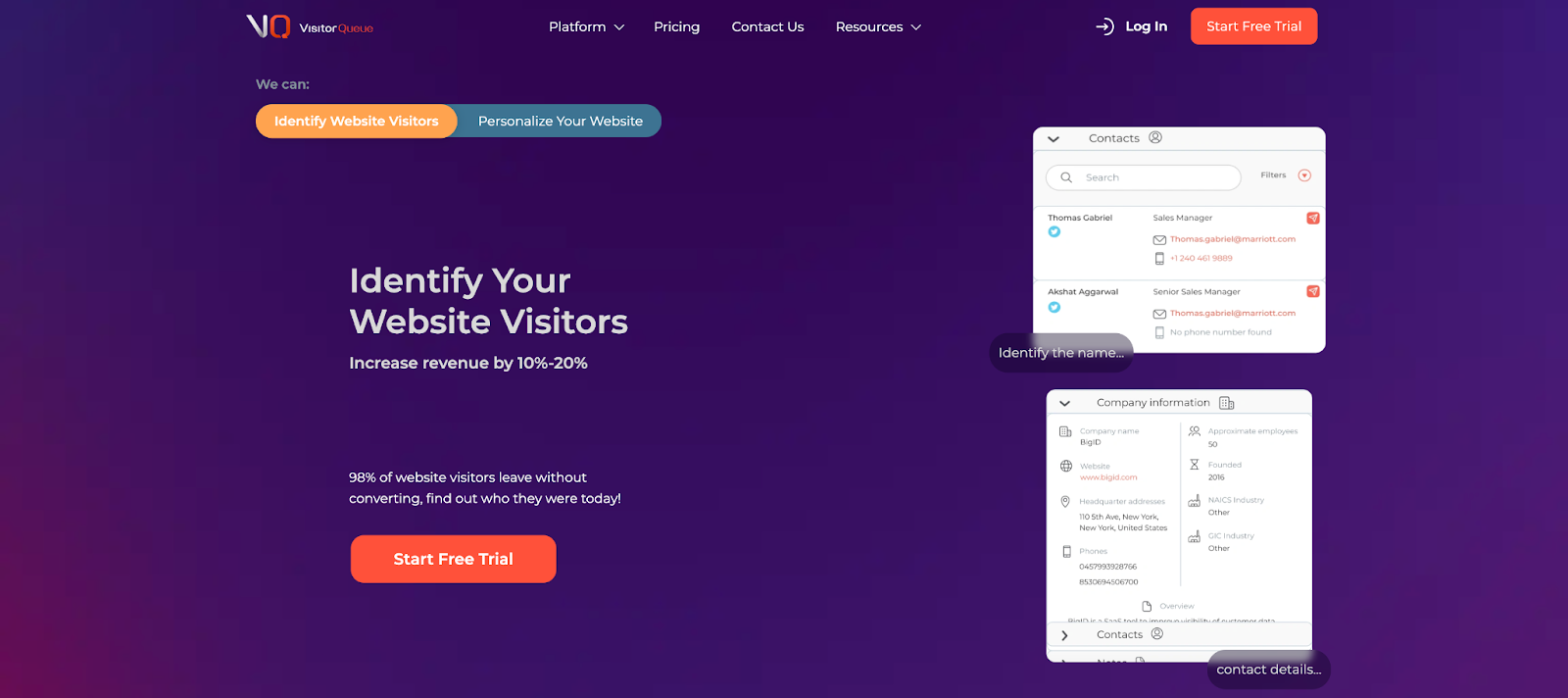
Visitor Queue concentrates on showing which companies are landing on a website.
It is built to give fast visibility without complicating the setup. Teams can quickly see firmographic information, pages viewed, engagement time, and available contacts.
Its main strengths include:
- Tracks companies using IP-based identification
- Shows pages visited and on-site behavior in real time
- Surfaces key contacts from each visiting company
- Sends alerts when new companies appear
- Keeps configuration simple with a tracking snippet
- Works well for smaller teams looking for quick insights
This makes Visitor Queue suitable for teams that want immediate clarity on website visitors without requiring a larger GTM framework.
Factors.ai vs Visitor Queue: Verdict on Functionality and Core Capabilities
Both platforms help teams understand who is engaging with their website.
Factors.ai expands this into a full GTM system with cross-channel visibility, scoring, alerts, and automation.
Visitor Queue stays lightweight, giving teams an easy way to see who is landing on their site and personalize accordingly.
Both approaches are valid.
Teams simply choose based on whether they need basic visitor clarity or full-funnel GTM insight and activation.
Curious how account journeys look in practice? Read our Account Scoring Guide to see scoring and timeline examples that drive prioritization.
Factors vs Visitor Queue: Pricing & Plans
| Feature | Factors.ai | Visitor Queue |
|---|---|---|
| Pricing Model | Usage and seat based | Volume based (lead count) |
| Entry-Level Access | Free tier (200 identified accounts, 3 seats) | Paid plans only |
| Plan Structure | Four tiers: Free, Basic, Growth, Enterprise | Tiered pricing from $39 to $2,299 per month |
| What Scales the Price | Identified companies, seats, features, integrations | Number of identified leads |
| Advanced Features | Available in Growth + Enterprise (CSM, scoring, AdPilot tools, automation) | Personalization, alerts, contact data |
| Support Level | Includes CSM, onboarding, Slack channel in higher tiers | Email and basic support, unlimited users |
Factors.ai Pricing

Factors.ai structures its pricing around usage and team size, which helps companies adopt it at their own pace.
The platform offers four clearly defined tiers that scale in capability:
- Free for early teams that want to validate their GTM visibility
- Basic for teams that need intent signals, dashboards, and simple workflows
- Growth with deeper analytics, scoring, G2 intent, advanced integrations, and a dedicated CSM
- Enterprise with predictive scoring, AdPilot tools, Milestones, white-glove onboarding, and higher limits
Pricing varies based on the number of accounts identified each month and the number of seats required.
Teams also have the option to add GTM engineering support if they need operational help running automations, building segments, or optimizing journeys.
This structure gives companies room to start small and expand gradually as their GTM operations mature.
Visitor Queue Pricing

Visitor Queue keeps its pricing simple.
Plans increase based on how many leads a team expects to receive each month, ranging from $31 to $1000/month.
The structure is easy to understand and works well for smaller teams that want predictable monthly costs tied to visitor volume.
Key points about their model:
- All tiers include unlimited users
- Pricing is tied directly to the number of identified leads
- Higher tiers include more leads and contact data
- No complex onboarding or multi-tier support layers
It’s built for teams that want clear, predictable pricing without additional components like automations or advanced analytics.
Factors vs Visitor Queue: Verdict on Pricing
Both platforms keep their models transparent, but they are designed for different needs.
Visitor Queue is suitable for teams that only require visitor identification and want a predictable monthly price tied to lead volume.
Factors.ai fits teams that want pricing tied to business growth, features, and deeper GTM operations, with the option to expand into advanced analytics, scoring, and activation as needed.
Both pricing models make sense for the audiences they serve.
Want to compare pricing approaches across vendors? Our ABM Platform Pricing Guide breaks down common models and what you actually get at each tier.
{{INLINE_BOFU}}
Factors vs Visitor Queue: Account Identification and Customer Journey Visibility
| Feature | Factors.ai | Visitor Queue |
|---|---|---|
| What it identifies | Account-related contacts using multiple signals (web, CRM, ads, product) | Companies visiting the website using IP data and firmographic enrichment |
| Level of view | Account-level journey across channels | Session-level website journey for each visiting company |
| Journey details | Shows every touchpoint in order: ads, pages, forms, CRM activity, product events | Shows pages viewed, time on site, source, and company/contact details |
| Context depth | Connects website behavior with campaign data, sales activity, and product usage | Focused on on-site behavior with basic enrichment |
| Prioritization layer | Uses intent and engagement to score accounts and place them into GTM stages (early research, high-intent, sales-ready, reactivated). | No native scoring; lists are used as-is |
Factors.ai Account Identification and Customer Journey Visibility
For identification and journeys, Factors.ai is built for GTM teams that need more than just “who visited.” With over 75% account identification coverage from website traffic, it enables teams to reliably map engagement across channels and understand how accounts progress over time.
It focuses on:
- Website-based account identification with multi-signal enrichment
- Website visits
- CRM records
- Ad platform activity
- Product usage
- Account 360 view
- All key interactions stacked into a single timeline for each account
- Includes marketing, sales, and product touchpoints
- Customer Journey Timelines
- Shows the order of events: ad view → website visit → form fill → demo → renewal or expansion
- Shows the order of events: ad view → website visit → form fill → demo → renewal or expansion
- Contextual depth
- Helps sales and marketing see not just who visited, but what they did before and after
- Helps sales and marketing see not just who visited, but what they did before and after
- Built-in prioritization
- Identification feeds directly into scoring and funnel stage, so teams know which accounts are further along
This makes Factors.ai suitable when you want to see how accounts move across channels, not just on your website.
Visitor Queue Account Identification and Customer Journey Visibility
Visitor Queue keeps things focused on website traffic.
It focuses on:
- Real-time company identification
- Uses IP-based tracking to match companies
- Adds firmographic data like size, industry, and location
- On-site journey view
- Pages visited
- Time spent on each page
- Referral source
- Contact enrichment
- Surfaces key contacts and social profiles where available
- Surfaces key contacts and social profiles where available
- Simple journey context
- Lets teams see what a visiting company did during a visit, in one place
- Lets teams see what a visiting company did during a visit, in one place
- Easy starting point
- Good for teams that mainly want to know “who was on the site today?” and “what did they look at?”
It is a practical fit for smaller teams or those who only care about website session insight rather than cross-channel journeys.
Factors.ai vs Visitor Queue: Verdict on Account Identification and Customer Journey Visibility
Both tools help you move beyond anonymous traffic.
- Visitor Queue gives a clear, simple view of which companies visited your site and what they did during that visit. It does that one job well, with minimal setup.
- Factors.ai goes deeper, connecting website visits with campaigns, CRM activity, and product usage, then arranging all of it into account-level journeys that can feed scoring and GTM workflows.
It is not about better or worse here, but about scope:
- Choose Visitor Queue if you mainly want website visitor identification and quick lead lists.
- Choose Factors.ai if you want account journeys that stretch across web, ads, CRM, and product, and plan to use that view to drive GTM decisions.
Factors.ai vs Visitor Queue: Account Scoring and Prioritization
| Feature | Factors.ai | Visitor Queue |
|---|---|---|
| Scoring System | Built-in account and contact scoring based on ICP fit, funnel stage, and intent signals | No native scoring system |
| Prioritization Method | Scores are used to prioritize accounts for sales and marketing actions | Users manually analyze visitor data or export it for scoring elsewhere |
| Signals Used | Website interactions, ad engagement, CRM activity, product usage, and third-party intent | Website visit data + basic firmographic enrichment |
| Use Case | Helps GTM teams quickly decide who to act on and why | Works as an intelligence layer that teams use to manually prioritize leads |
Factors.ai Account Scoring and Prioritization
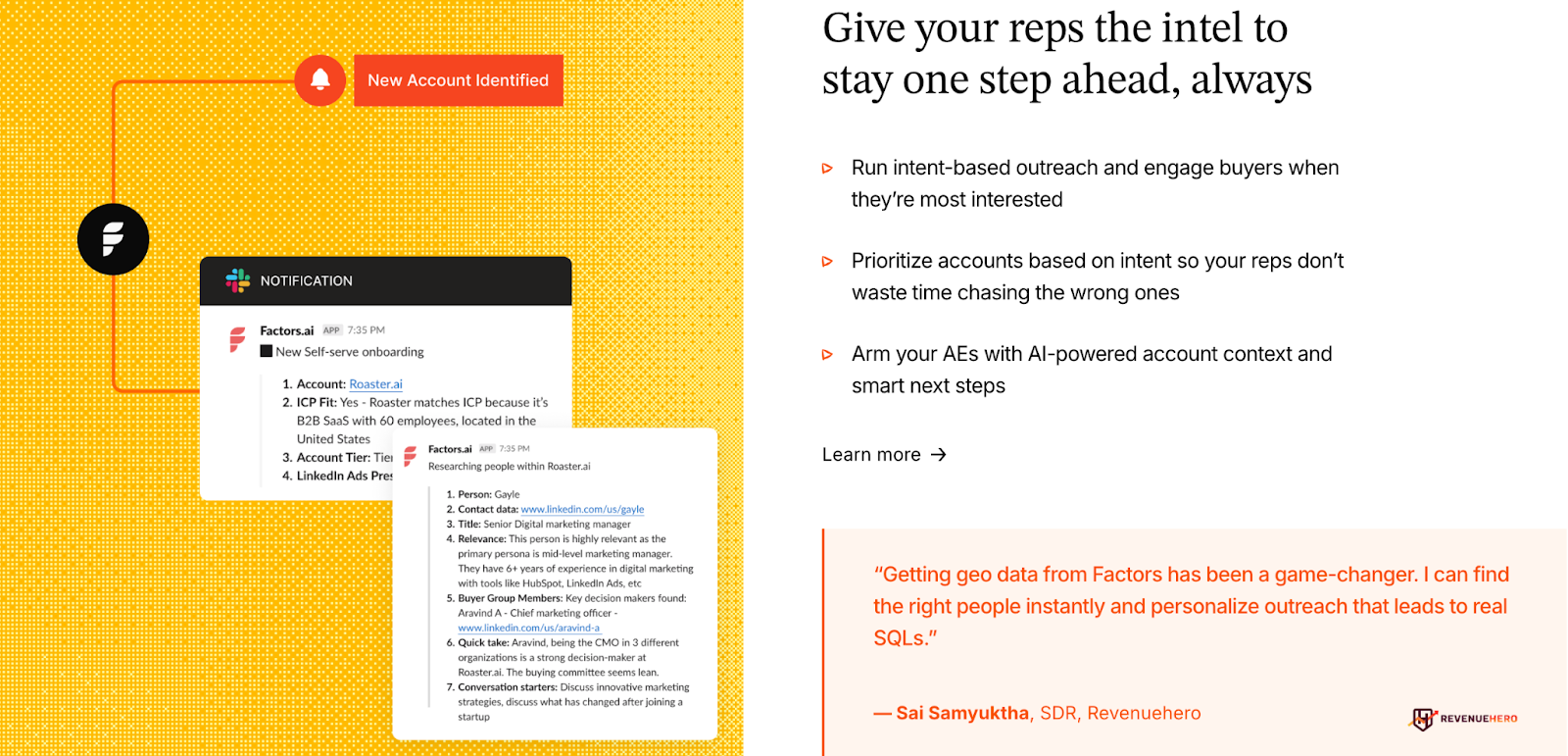
Factors.ai uses predictive account scoring and contact scoring to help teams focus on the right companies at the right time.
Scoring sits directly on top of identification and journey data, so it reflects real movement across the funnel.
Scoring is driven by:
- ICP matching (firmographic fit)
- Website and product behaviors
- Ad views and clicks
- CRM interactions
- Funnel progression
- Third-party intent (e.g., G2, Bombora)
This system maps into:
- Alerts when a score crosses a threshold
- Prioritized account lists for SDRs and sellers
- Workflow triggers to nurture or follow upfollow-up at key moments
Teams using Factors.ai don’t have to build scoring rules from scratch. They get a prioritized pipeline view automatically that aligns with their GTM motion.
Visitor Queue Account Scoring and Prioritization
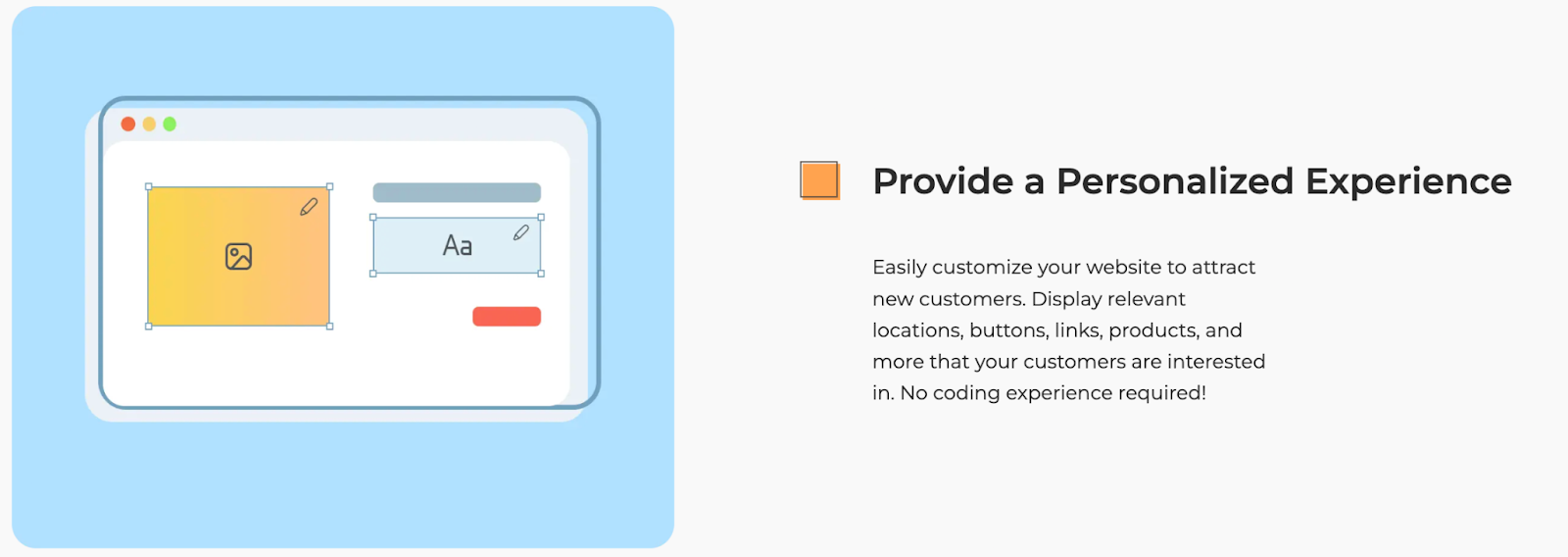
Visitor Queue does not include a built-in scoring layer.
It surfaces:
- Companies that visited your website
- Firmographic data
- Key contacts and available identifiers
- On-site behavior like pages visited and time spent
Teams can export this data or connect it to tools like Salesforce or HubSpot to assign lead scores manually.
For small teams, this can be enough. For growing operations, it usually requires an added layer of scoring logic somewhere else.
Factors.ai vs Visitor Queue: Verdict on Scoring and Prioritization
Factors.ai puts prioritization at the heart of its GTM workflow.
It collects multi-touch signals, uses them to calculate scores, then drives action across marketing automation and sales outreach.
Visitor Queue keeps things simple and leaves scoring decisions to the user.
It offers useful intelligence but no baked-in way to turn it into a prioritized pipeline without extra work.
Your choice depends on how quickly and efficiently your GTM team needs to move from "insight" to "action."
Factors.ai vs Visitor Queue: Alerts, Signals and Sales Enablement
| Feature | Factors.ai | Visitor Queue |
|---|---|---|
| Alert Triggers | Based on score changes, buyer signals, journey milestones, deal activity | Triggered by new sessions from identified companies |
| Context Provided | Includes reason for alert (e.g. post-demo activity, form interactions, closed-lost reactivation) | Provides company info, website behavior, and available contacts |
| Delivery Channels | Slack and Microsoft Teams with structured account context | Slack notifications with basic visit details |
| Sales Enablement | Alerts include explanation of why the time is right to engage and what changed | Alerts indicate that a visitor arrived but don’t suggest why or what to do next |
| Automation Potential | Alerts feed into playbooks and workflows | Manual follow-up needed unless built externally |
Factors.ai Alerts, Signals and Sales Enablement
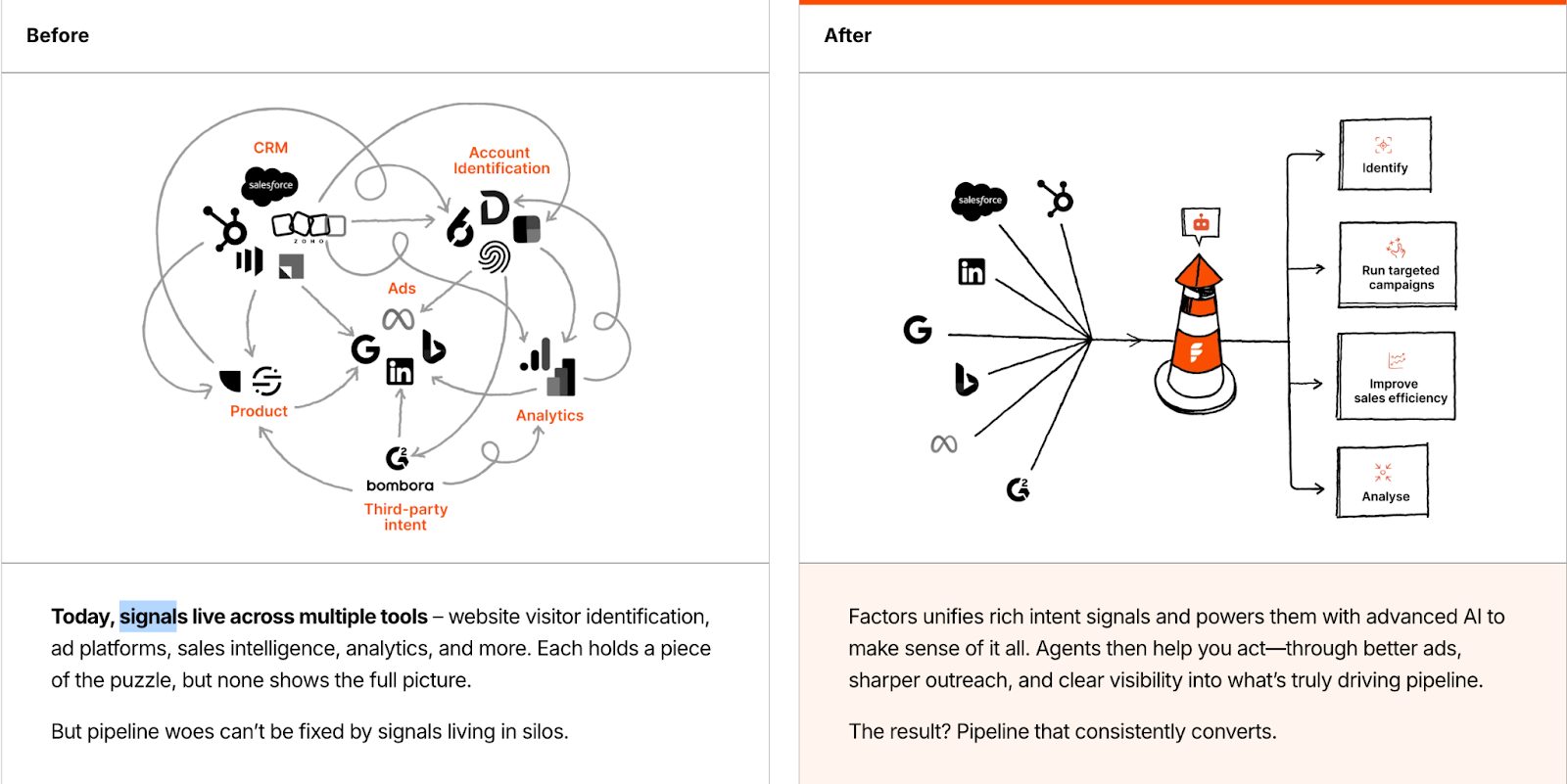
Factors.ai sends context-rich signals that help sales and marketing take the right next step, instead of sending just alerts.
Teams use alert styles like:
- Post-demo browsing: an account continues researching after the meeting
- Closed-lost activity: buyers revisiting after a paused deal
- Form-drop-offs: users who started but did not complete a conversion
- High-intent movement: sudden score increases or stage progression
Each alert contains:
- What happened
- Why it matters
- Account and contact details
- A path to take next
Delivered via Slack or Teams, these signals prompt action across teams with clarity and timing in mind.
Visitor Queue Alerts, Signals and Sales Enablement

Visitor Queue alerts are straightforward and helpful for smaller sales or marketing teams.
- Alerts trigger when a new company visits the site and matches the criteria
- Teams receive company profiles and contact details (where available)
- Delivered directly into Slack for quick awareness
This approach works well when teams want to instantly know which companies were on the site that day.
While there's no context beyond the visit itself, it offers a fast way to mobilize manual outreach.
Factors.ai vs Visitor Queue: Verdict on Alerts & Enablement
Both platforms help teams spot buying interest.
Visitor Queue alerts show who came to the site, what pages they viewed, and how to reach them. They function as early signals for manual outreach.
Factors.ai builds alerts into the broader GTM motion, using scores and intent milestones to detect meaningful buyer activity across channels, not just the website.
Choosing between them depends on your motion:
- If you just need to catch visitors and act fast, Visitor Queue alerts get the job done.
- If you need a reasoned signal that says what's happening, why it matters, and what you should do next, Factors.ai brings more depth to the table.
Factors.ai vs Visitor Queue: AI Agents and Automation
| Feature | Factors.ai | Visitor Queue |
|---|---|---|
| Automation Capabilities | AI Agents that support research, buying group mapping, alerts, meeting follow-ups, and deal revival | No built-in automation features |
| GTM Engineering | Offers done-for-you automation setup, workflow configuration, and ongoing support | Not available |
| Type of Work Automated | Reps get automatically enriched insights, pipeline nudges, and data-driven guidance | Manual work required for enrichment, prioritization, and outreach |
| Operational Lift | Reduces time spent in CRM and research tools | Teams handle analysis and action manually |
| Ideal Team Fit | GTM teams needing operational leverage and process automation | Teams that are okay with basic lead visibility without automated next steps |
Factors.ai AI Agents and Automation
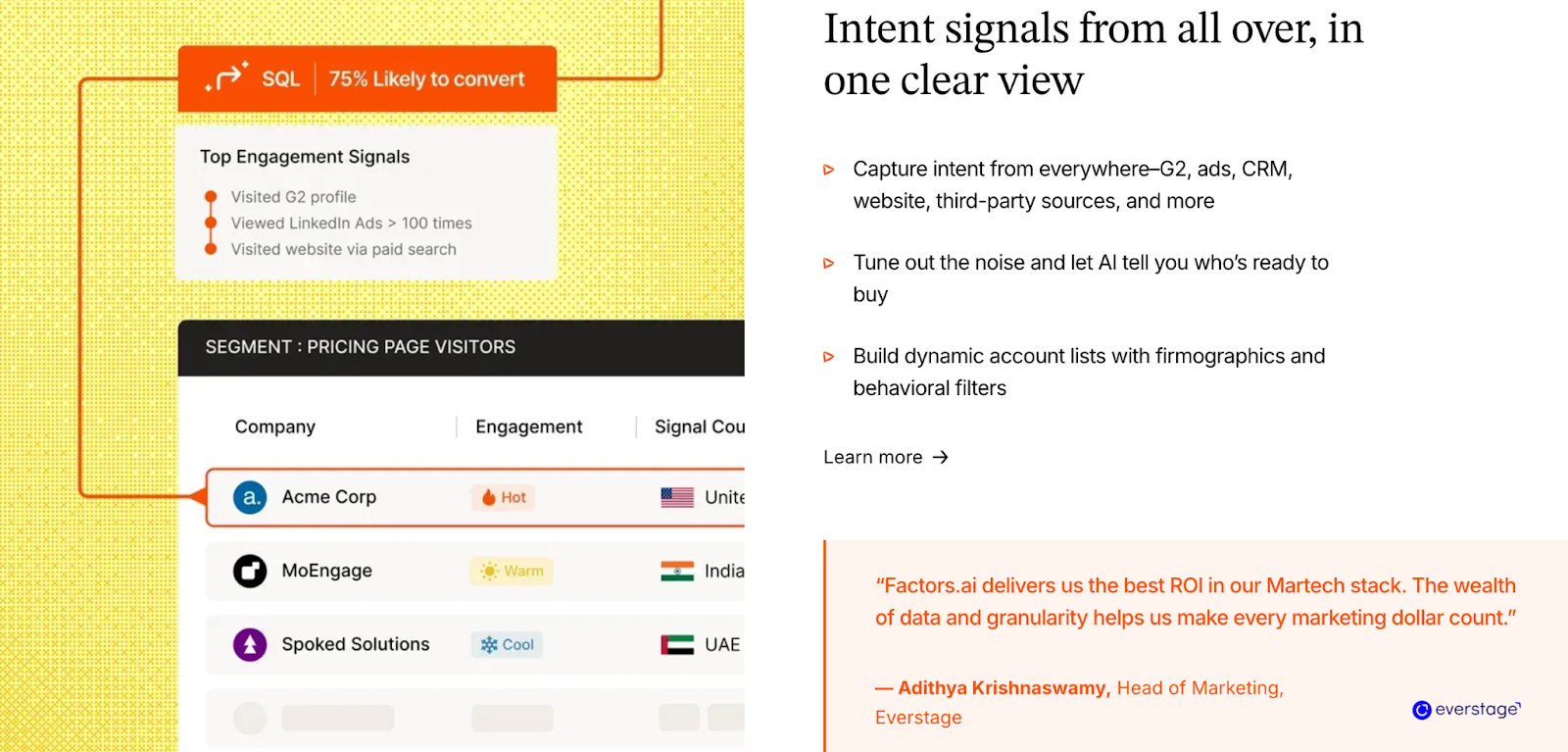
Factors.ai adds AI automation to traditional revenue intelligence.
It offers AI Agents and GTM engineering services that help your team:
- Enrich account and contact data instantly
- Discover active buyers within an account
- Surface post-meeting activity that signals next-step readiness
- Revive closed-lost opportunities when intent resurfaces
- Stay ahead of activity without checking multiple systems
GTM Engineering ensures that workflows, scoring, alerts, and playbooks are all implemented correctly and optimized over time, without additional internal setup.
Visitor Queue AI Agents and Automation
Visitor Queue does not include automation.
It surfaces:
- New companies visiting the site
- Firmographic and contact info
- Browsing behavior
From there, teams must:
- Transfer insights into their CRM
- Determine who is worth follow-up
- Research decision-makers
- Build workflows manually if they want repeatable motion
It suits teams with a simple motion or those already relying on manual or separate tools to automate processes.
Factors.ai vs Visitor Queue: Verdict on AI Agents and Automation
This chapter highlights the clearest difference between the two tools.
Visitor Queue offers fast visibility, leaving decisions and execution to the user. It's lightweight and works best in simpler setups.
Factors.ai combines intelligence with action. AI Agents automatically surface insights, run follow-ups, and remove operational friction which is all supported by a team that helps with implementation.
If your revenue operation needs to scale without adding headcount, Factors.ai delivers that leverage.
If your motion is more basic and you’re fine with manual next steps, Visitor Queue meets that need well.
Factors.ai vs Visitor Queue: Integrations and GTM Fit
| Feature | Factors.ai | Visitor Queue |
|---|---|---|
| CRM Integrations | Salesforce, HubSpot (full), Marketo, Microsoft Dynamics, and more | Salesforce, HubSpot, via native and Zapier |
| Ad Platform Integrations | LinkedIn, Google Ads, Facebook, Bing, G2 | None (natively), exports can be used to build lists manually |
| Data & CDP Integrations | Segment, Rudderstack, Reverse ETL tools | API and Zapier-based custom workflows |
| Workflow & G2 Support | Webhooks, Zapier, Make, Slack, Teams automation | Slack alerts and usage through Zapier |
| Depth of Sync | Bidirectional, with real-time updates and multi-touch data movement | Mostly one-way export, with data available for CRM or CSV download |
Factors.ai Integrations and GTM Fit
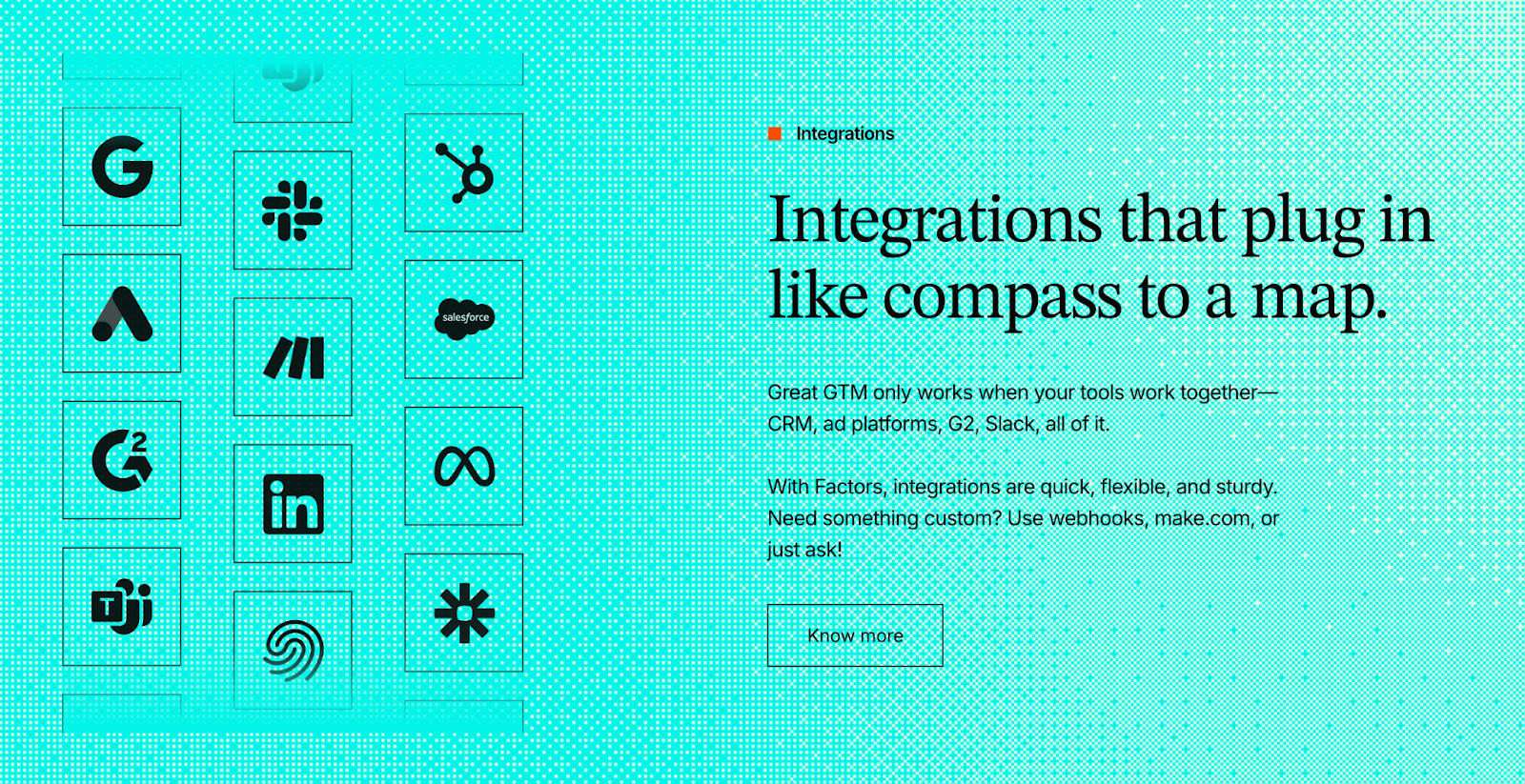
Factors.ai supports deep, bidirectional integrations that connect your CRM, MAP, ad platforms, and engagement tools.
This system-level integration ensures your GTM team always sees the latest activity in the context of their role.
Notable integration points include:
- CRM sync that pulls and pushes account, opportunity, and campaign data
- Ad platform connectivity for audience activation, suppression, and attribution
- CDP and reverse ETL support for unified data pipelines
- Workflow integration via webhooks, Zapier, Make, and Slack
- G2, Marketo, HubSpot, Drift, and Snowflake support in higher tiers
This setup helps your GTM stack act like it’s connected by default, without heavy internal plumbing.
Visitor Queue Integrations and GTM Fit
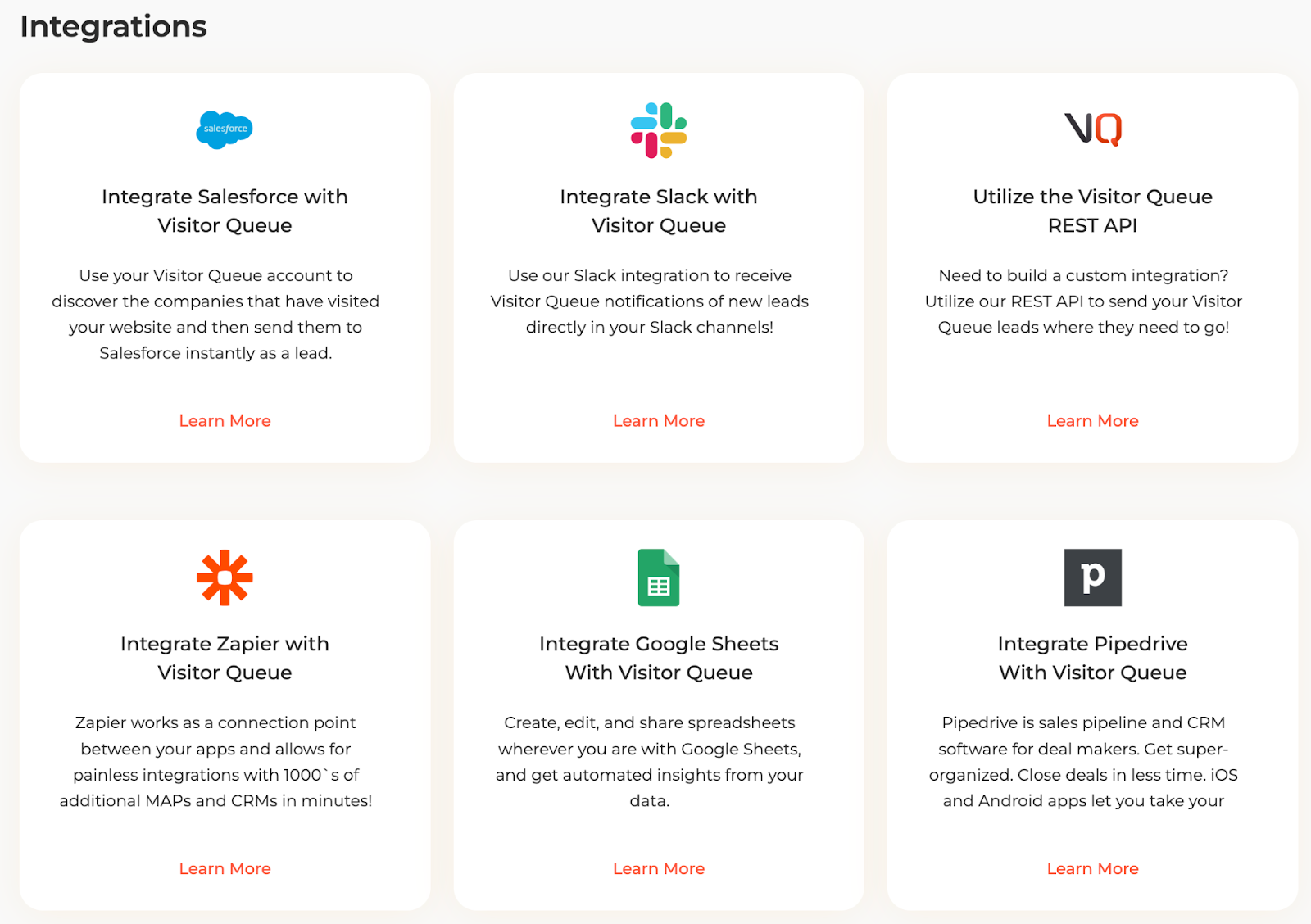
Visitor Queue keeps things focused on essential connections.
It offers:
- Out-of-the-box data sync with Salesforce and HubSpot
- A Zapier integration that supports pushing data into hundreds of tools
- API access for custom workflows
- Slack notifications for alerts on new leads
It supports enough integration depth for teams that only need visitor detail and lead enrichment inside their CRM or outbound motion.
That makes it effective for smaller GTM teams that don’t run connected multi-channel motions yet.
Factors.ai vs Visitor Queue: Verdict on Integrations and GTM Fit
Visitor Queue integrates where it counts, CRM, Slack, Zapier, and avoids scope creep.
It’s practical and quick to connect when all you need is identification data in your CRM.
Factors.ai connects deeply across all major GTM tools and pushes updates both ways.
That makes it better suited for teams that want unified account visibility, automated activation in ad platforms, and scoring frameworks that depend on real-time data sync.
If your revenue workflows span multiple tools and channels, Factors.ai builds the connective tissue for you.
If your GTM team only needs insights from website visitors in CRM, Visitor Queue keeps it simple and efficient.
Factors.ai vs Visitor Queue: Onboarding and Support
| Feature | Factors.ai | Visitor Queue |
|---|---|---|
| Setup Time | Guided onboarding with platform specialists | Simple setup through a tracking script |
| Team Enablement | Dedicated Customer Success Manager (CSM), weekly alignment calls | Email support with access to a knowledge base |
| Collaboration Channels | Private Slack group, ongoing strategy and workflow support | Slack alert integrations but no dedicated Slack workspace |
| Service Layer | GTM Engineering Services available for advanced setup and operations | No services layer offered |
| Learning & Follow-up | Structured onboarding + ongoing GTM check-ins | Self-guided setup after initial install |
Factors.ai Onboarding and Support
Factors.ai puts a service layer behind the software.
Every customer gets onboarding support from a dedicated CSM team, which includes:
- Account configuration
- Data pipeline setup
- Scoring rules and workflows aligned with their GTM motion
- Weekly checkpoints to measure ROI and optimize processes
- Slack support for direct troubleshooting and campaign guidance
For teams that want someone to own the operational lift, GTM Engineering Services can also handle advanced workflows, data flows, automation setup, and intent-based campaign routing.
This level of support is designed for teams seeking a mix of platform ownership and strategic alignment.
Visitor Queue Onboarding and Support
Visitor Queue is built with simplicity in mind, and the support model reflects that.
After signing up, teams:
- Install a tracking script on their website
- Connect their CRM (if needed)
- Start seeing identified companies immediately
Support is available via email, help documentation, and dedicated customer support.
Teams manage their own setup and workflows, which works well when the goal is visibility, not multi-channel GTM orchestration.
Visitor Queue also scales to unlimited users across all plans, making it easy to share with sales and marketing without extra cost or complexity.
Factors.ai vs Visitor Queue: Verdict on Onboarding and Support
Factors.ai delivers a high-touch experience for GTM teams that expect strategic and technical guidance alongside the platform.
That includes full CRM and scoring setup, ongoing sync checks, and direct access to the support team.
Visitor Queue is lightweight: install, integrate, and go.
It asks less upfront and keeps the path light, but also offer additional support beyond setup assistance.
If you want quick visibility without heavy lifting, Visitor Queue fits well.
If your GTM strategy needs more than a tool and you benefit from expert support to run it, Factors.ai carries that weight for you.
Factors.ai vs Visitor Queue: Security and Compliance
| Feature | Factors.ai | Visitor Queue |
|---|---|---|
| Data Standards | SOC II Type 2, ISO 27001, GDPR, CCPA compliant | GDPR and CCPA compliant |
| Data Storage | Hosted on secure cloud infrastructure (GCP) with encryption at rest and in transit | Data stored securely with IP-based visitor data enriched for firmographics |
| Certifications | Independent audits support enterprise security posture | No certifications beyond compliance claims visible |
| Data Risk Posture | Full logical isolation and access control across multi-tenant infrastructure | Visitor-level tracking, no behavioral aggregation beyond session scope |
| Compliance Fit | Suitable for enterprise customers with high-security procurement checks | Best suited for teams with lightweight data and limited regulatory risk |
Factors.ai Security and Compliance

Security in Factors.ai draws from globally recognized compliance frameworks.
Platform practices include:
- SOC II Type 2 and ISO 27001 certification
- Secure data hosting through Google Cloud Platform
- AES-256 encryption at rest and enforced encryption in transit
- Role-based access control, multi-factor authentication, and internal logging
- Strict access provisioning for production environments
- Regular audits and incident management processes
- Long-term secure retention and backup policies
For enterprise GTM teams, this means procurement and infosec checks can be passed confidently and quickly.
Visitor Queue Security and Compliance

Visitor Queue is designed to process firmographic and session data. It follows:
- GDPR and CCPA compliance guidelines
- Standard cloud-based infrastructure protections
- Encrypted transfer and secure storage of visitor activity
- No processing of personal PII beyond available contact enrichment
It works well for teams with limited compliance exposure or those building early-stage GTM programs where regulatory requirements aren’t as stringent.
Factors.ai vs Visitor Queue: Verdict on Security and Compliance
Both platforms take security seriously, but the depth differs.
Visitor Queue maintains core compliance practices suited to small and mid-sized teams that mostly enrich visitor data and want peace of mind.
Factors.ai extends this into enterprise-grade territory. Certifications, strict access policies, log management, and full lifecycle data protection make it suitable for larger GTM teams with serious audit requirements.
If your organization demands SOC II/ISO validation and thorough data protections, Factors.ai covers that standard.
For simpler compliance needs, Visitor Queue offers enough to stay aligned without adding complexity.
If compliance matters to procurement, learn more about best practices for visitor data and privacy in Website Visitor Identification Privacy.
Factors.ai vs Visitor Queue: What to choose when?
| Feature | Factors.ai | Visitor Queue |
|---|---|---|
| Platform Scope | Full GTM orchestration: identification, journey mapping, scoring, alerts, automation, reporting | Visitor-level identification and website behavior insights |
| Who It Suits | GTM teams with multi-channel motions and automation needs | Teams wanting quick clarity on who visited their website |
| Depth of Insights | Cross-channel touchpoints and actionable signals tied to funnel progression | Website-only insights with basic enrichment |
| Operational Assist | AI Agents + GTM Engineering for ongoing setup and guidance | Self-serve setup, manual operational work |
| Pricing Fit | Scales based on usage and maturity, backed by onboarding and support layers | Predictable lead-count pricing for lightweight needs |
Factors.ai vs Visitor Queue: Final Verdict
Both platforms help marketing and sales teams understand who’s showing interest, but they serve different motions and maturity levels.
Visitor Queue helps you uncover the companies already on your website.
It delivers fast visibility and basic personalization with minimal friction.
If your focus right now is identifying visitors and passing that information along to sales, it’s a clean and accessible match.
Factors.ai builds on that foundation and extends into full-funnel GTM orchestration.
It identifies accounts, scores them based on real behavior and ICP match, surfaces buying signals, activates campaigns, and provides guided insights, supported by AI and real human assistance.
Teams that want clarity and action, built into one system, will find Factors.ai offers more room to scale as the GTM motion matures.
FAQs for Factors.ai vs Visitor Queue
Q. What is the main difference between Visitor Queue and Factors.ai?
The biggest difference is scope.
Visitor Queue focuses on identifying companies that visit your website and showing basic on-site behaviour.
Factors.ai goes beyond identification and connects website activity with ads, CRM data, product usage, scoring, alerts, and automation across the full GTM funnel.
If you only want to know who visited, Visitor Queue does that well. If you want to know what that visit means and what to do next, Factors.ai is built for that.
Q. Is Factors.ai a good alternative to Visitor Queue?
Yes, Factors.ai is a strong alternative to Visitor Queue, especially for teams whose GTM motion goes beyond basic website visitor visibility.
If you’ve outgrown simply knowing which companies visited your site and want to understand how that interest connects to ads, CRM activity, product usage, and pipeline movement, Factors.ai offers that broader context. It brings scoring, prioritisation, alerts, and workflows into one system, reducing the need to manually stitch insights together across tools.
Visitor Queue works well for teams that only need quick visitor identification. Factors.ai is better suited for teams that want to turn those visits into coordinated GTM action across channels.
Q. Is Visitor Queue a good alternative to Factors.ai?
Visitor Queue can be a good alternative for teams with simpler GTM needs.
If your main goal is visibility into website visitors and you’re comfortable handling prioritisation and follow-ups manually, Visitor Queue is often sufficient.
Factors.ai is better suited when your GTM motion spans multiple channels and you want signals, scoring, and workflows handled inside one system rather than stitched together manually.
Q. Which tool is better for small or early-stage teams?
For early-stage teams that want fast setup and quick answers, Visitor Queue is often the easier starting point. It requires minimal configuration and delivers immediate visibility into website visitors.
Factors.ai also offers a free tier, but it’s typically more valuable once a team starts running ads, managing a CRM actively, or coordinating between marketing and sales.
Q. Does Visitor Queue offer account scoring or prioritisation?
No. Visitor Queue does not include built-in account or contact scoring.
Teams usually review visitor data manually or export it into a CRM or another tool to apply scoring logic.
Factors.ai includes native scoring based on ICP fit, intent signals, funnel stage, and multi-channel activity, helping teams prioritise accounts automatically.
Q. Can Factors.ai replace multiple GTM tools?
For many teams, yes.
Factors.ai can reduce reliance on separate tools for visitor identification, intent tracking, scoring, alerting, and basic GTM workflows by consolidating those functions into one platform.
That said, it’s designed to connect with your existing CRM, ad platforms, and CDP rather than replace them entirely.
Q. How do alerts differ between Visitor Queue and Factors.ai?
Visitor Queue alerts notify teams when a new company visits the website and share basic visit details.
Factors.ai alerts are contextual. They explain why an alert triggered, such as post-demo activity, score changes, closed-lost reactivation, or funnel movement, and often suggest the next best action.
Q. Does Visitor Queue support automation or AI agents?
No. Visitor Queue does not include automation or AI-driven workflows.
All enrichment, prioritisation, and follow-up actions are handled manually or through external tools.
Factors.ai includes AI Agents and GTM Engineering support to automate research, buyer mapping, alerts, follow-ups, and deal revival workflows.
Q. Which platform is better for sales teams?
It depends on how sales works in your organisation.
If sales wants daily visibility into who visited the site, Visitor Queue does the job.
If sales wants clear signals on who to call, when, and why, Factors.ai provides more guidance through scoring, alerts, and journey context.
Q. How do the pricing models compare?
Visitor Queue uses a volume-based pricing model, where costs increase based on the number of identified leads. It’s predictable and easy to understand.
Factors.ai pricing scales based on usage, features, and team size, with options to grow into advanced analytics, automation, and support as GTM complexity increases.
Q. Which tool is more suitable for enterprise teams?
Factors.ai is generally more suitable for enterprise GTM teams due to its:
- SOC II and ISO certifications
- Multi-channel data integration
- Scoring and automation capabilities
- Dedicated onboarding and support layers
Visitor Queue is better suited for SMBs or teams with lighter compliance and operational requirements.
Q. Can I use Visitor Queue and Factors.ai together?
Technically, yes. But for most teams, it’s unnecessary overlap.
Factors.ai already includes visitor identification as part of a broader GTM system, so teams usually choose one or the other based on how much orchestration they need.
Q. How do I decide which platform is right for my team?
Ask yourself three questions:
- Do we only need to know who visited, or do we need to know what to do next?
- Are we running multi-channel campaigns that need shared context?
- Do we want manual control or automated GTM workflows?
Your answers will usually make the choice clear.

See how Factors can 2x your ROI
Boost your LinkedIn ROI in no time using data-driven insights
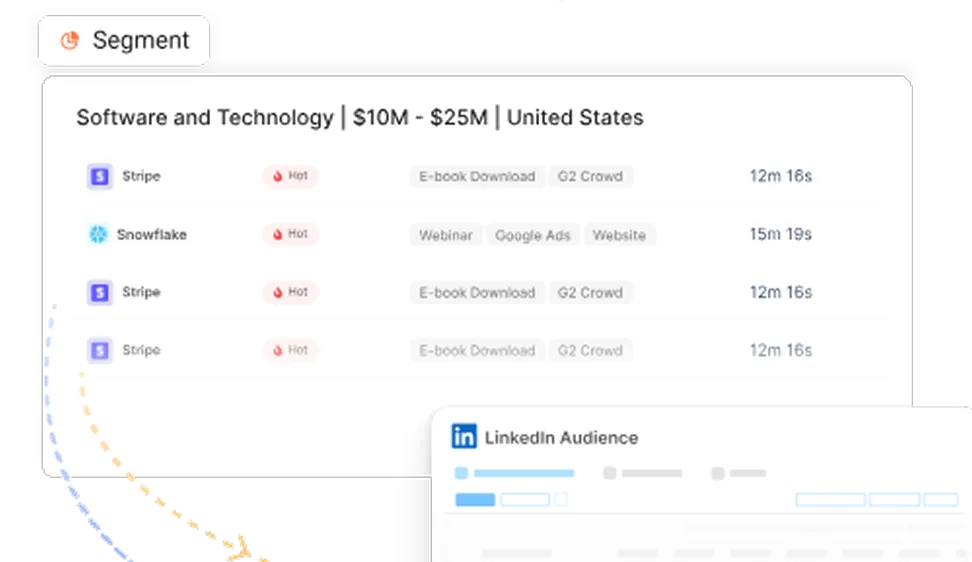


.avif)


See Factors in action.
Schedule a personalized demo or sign up to get started for free
LinkedIn Marketing Partner
GDPR & SOC2 Type II


.svg)



.avif)

