
B2B Account Scoring Guide: Models, Process & Best Practices (2026)
Account scoring is a B2B data-driven methodology that ranks organizations based on ICP fit and intent. Learn how to score intent and close target accounts. Master B2B account scoring with proven models, step-by-step processes, and scoring frameworks. Learn ICP-based fit scoring, intent signals, and tier systems to prioritize high-value accounts.


Growth Marketer



.svg)


TL;DR
- Account scoring is a B2B data-driven methodology that assigns numerical values to companies based on their fit, engagement, and intent to rank their likelihood to purchase
- A well-defined ideal customer profile (ICP) is the backbone of effective account scoring, without it, you're scoring blind
- Unlike lead scoring (individual contacts), account scoring evaluates entire organizations, making it ideal for complex B2B buying committees
- Four scoring models to choose from: point-based, weighted formula, tiered, and predictive ML-based
- Combine three scoring dimensions: ICP fit (firmographics), engagement (behavioral data), and intent signals (1st and 3rd party)
- Traditional lead scoring tracks individual clicks; account scoring evaluates entire buying committees. If you are selling into enterprise or mid-market spaces, treating a company like a single isolated human is an easy way to miss the deal entirely.
- A good scoring system must combine three critical dimensions: ICP fit (firmographics), engagement (behavioral data), and intent signals (first-party and third-party web footprints).
- Most models fail because of score decay, buyer behavior cools off, but the static score stays high. The best-performing growth teams audit and recalibrate their thresholds at least once a quarter.
- Tools like Factors.ai completely eliminate manual RevOps overhead by unifying your CRM data, website traffic, G2 intent spikes, and LinkedIn ad engagement into a single automated scoring canvas.
Picture this: You're standing in a room full of potential customers, but you only have the resources to engage a few. How do you decide who to approach? You identify those with the highest conversion and revenue potential for your business.
That's account scoring.
Account scoring is a B2B data-driven methodology that assigns numerical values to potential customer accounts based on their firmographic fit, behavioral engagement, and purchase intent — ranking them by likelihood to convert and deliver revenue.
Account scoring, a part of account-based marketing, helps you rank potential customers from the most to the least valuable. It's like a compass that helps you navigate the complex world of B2B sales and marketing, guiding you to accounts with the highest potential.
Businesses that use lead and account scoring models, see a 77% boost in lead generation ROI compared to those that do not.
In this article, we'll delve deep into account scoring, help you understand its importance, how it differs from lead scoring, and how to do it right.
What is account scoring?
Account scoring is a process of ranking potential customer accounts based on their estimated value. This value is determined by the account's proximity to the ideal customer profile (ICP) — which represents the perfect-fit persona for a company's product or service.
Account scoring is not just a fancy term in ABM—it guides you toward the most promising opportunities.
But why is account scoring so integral to ABM?
Well, ABM focuses marketing efforts on a select few high-value accounts. And to identify these accounts, you need a reliable scoring system.
Account scoring helps you sift through a sea of potential customers and zero in on those that are most likely to convert and bring the highest value.
In the following sections, we'll delve deeper into the intricacies of account scoring, including how to nail your ICP for effective scoring, the difference between account scoring and lead scoring, and a step-by-step guide to the account scoring process. So, stay tuned and get ready to become an account-scoring pro!
Why do you need to nail your ICP for effective account scoring?
The Ideal Customer Profile (ICP) serves as a blueprint for sales targeting. It represents the type of customer who derives the most value from your product or service, making them highly likely to convert and bring the highest value.
Scoring accounts without a well-defined ICP is like trying to hit a target with your eyes closed
Your ICP is a detailed description of who uses and buys your product, and who needs your product, dialed in by firmographic data (company size, geography, revenue, industry).
Here are some key reasons and benefits of nailing the ICP for effective account scoring:
- Focused approach: Knowing your ICP keeps your marketing and sales teams focused. Instead of wasting resources on accounts that are unlikely to convert, you can concentrate your efforts on those that align with your ICP.
- Consistent messaging: An ICP helps you create a persona in the minds of your marketing and sales team. Every piece of content that's created is talking to that one person—so the message you convey starts becoming consistent across your content.
- Personalization: When the entirety of your marketing team understands the ICP, it becomes easier to identify where your target audience is most likely to hang out, and the problems they experience, and then reach them through highly personalized and relevant content.
- Revenue: Accounts that match your ICP are not just more likely to convert—they're also more likely to bring in higher revenue. These are the accounts that will see the most value in your offering and be willing to pay for it.
To put this in perspective, suppose you're a B2B SaaS company offering project management software. Your ICP could be mid-sized tech companies with a remote workforce. If you focus your marketing and sales efforts on these companies, you're likely to see a higher conversion rate than if you were targeting small brick-and-mortar retailers.
{{INLINE_TOFU}}
What's the difference between account scoring and lead scoring?
Account scoring and lead scoring are both used to prioritize potential customers but there's a slight difference in the approach for both.
Lead scoring is used to rank individual leads based on their perceived value to the company. This value is typically determined by a lead's behavior, such as their interactions with your website or email campaigns, and demographic information. The goal of lead scoring is to identify the leads that are most likely to convert into customers.
Also read: 5 Customer Journey Stages Explained (2026 Guide)
Account scoring takes a more holistic approach. Instead of focusing on individual leads, it considers the potential value of entire organizations. This value is determined by various factors, including the organization's size, industry, and fit with your Ideal Customer Profile (ICP). A powerful analytics tool like Factors can help you de-anonymize website traffic at an account-level.
Here's a quick comparison:
| Lead Scoring | Account Scoring | |
|---|---|---|
| Focus | Individual leads | Entire organizations |
| Purpose | Identify leads most likely to convert | Identify accounts likely to bring the highest value |
| Scoring Criteria | Interactions with your website or email campaigns, demographic information | Proximity to the ideal customer profile (ICP), organizational attributes like size, industry, revenue, etc. |
| Outcome | Prioritize leads for individual follow-ups | Prioritize accounts for targeted marketing and sales strategies |
| Best Used For | Businesses with a high volume of leads, B2C businesses | B2B businesses, especially those with long sales cycles or high-value contracts |
When to Use Both Lead Scoring and Account Scoring Together
In practice, the most effective B2B teams don't choose one over the other — they use both. Account scoring identifies which companies to prioritize, while lead scoring identifies which people within those companies to engage first.
Here's how they work together:
- Account scoring first: Score and tier all accounts based on ICP fit, engagement, and intent
- Lead scoring within top accounts: For Tier A and B accounts, score individual contacts based on their role (decision-maker vs. influencer), engagement level, and buying signals
- Prioritize outreach: Your SDRs contact the highest-scored leads within the highest-scored accounts — maximizing both account potential and contact receptivity
This combined approach is especially powerful for enterprise B2B sales where buying committees typically involve 6-10 stakeholders.
Let's now dive into the process of scoring accounts for your business.
A step-by-step guide to account scoring
Account scoring is not a one-size-fits-all process. It varies based on your business model, target audience, and the tools you use. But, there are some common steps that most businesses follow when scoring accounts.
1. Define your Ideal Customer Profile (ICP)
Your ICP is a description of the company that's a perfect fit for your product or service. This could include factors like industry, company size, and revenue. For example, your ICP might be a mid-sized tech company in the SaaS industry with a revenue of over $5 million.
To define your ICP, you need to:
- conduct interviews, surveys, etc.(primary research)
- read reviews for your and your competitor's products, watch customer interviews, etc. (secondary research)
Segment your target audience based on their motivations, frustrations, and needs. Identify their goals and assess where their needs/motivations and the benefits of your product/service intersect.
2. Identify key account attributes
Key account attributes are the characteristics that make an account valuable to your business. They could include factors like the account's potential to purchase, its lifetime value, or its strategic importance to your business.
For instance, a key attribute might be a company's use of a competitor's product, indicating a potential to switch to your product.
The key attributes of an account can be identified by understanding your customer's journey and touchpoints in your funnel. Ask questions like:
- How do your customers find you?
- How do you generate leads?
- Which channels do you use?
- What is the first interaction point?
- How long does it take to convert leads?
- What are the channels that bring the highest number of closed deals?
These will help you add more detail and personality to your ICP.
3. Collect data on the identified attributes
Once you have a well-defined ICP, it's time to move to data collection. This is where a tool like Factors.ai can come in handy.
Factors unifies data across marketing, sales, and social media platforms under one roof, allowing you to collect holistic data on your accounts.
This could include your CRM data, third-party data (social, advertisements, website), and intent data from platforms like G2 and LinkedIn.
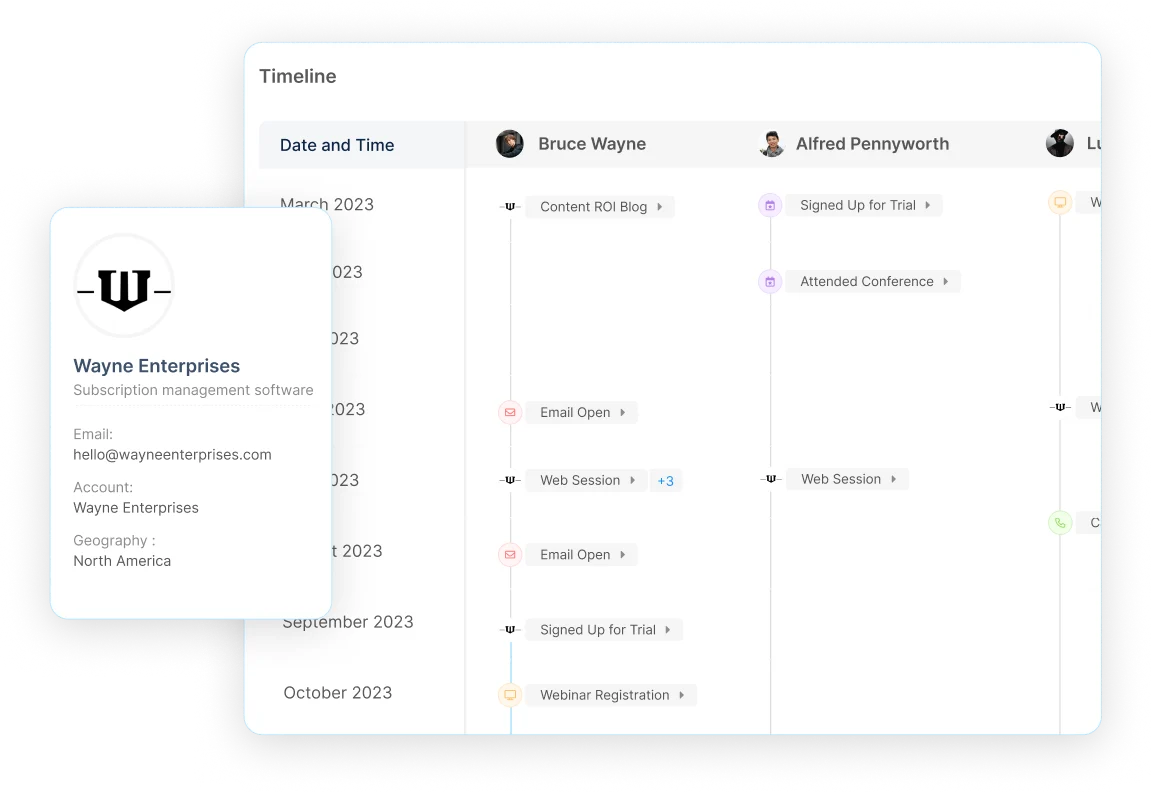
When it all comes together, you see a clear picture of how accounts that closely resemble your ICP behave across platforms and what type of messaging resonates with them.
To improve further, keep track of your ICP accounts and the conversion rates. You need to determine what are the common attributes of your highest converting accounts.
3b. Incorporate Intent Data Signals
Intent data reveals which accounts are actively researching solutions like yours — even before they visit your website. There are two types to leverage:
First-party intent signals come from your own channels:
- Repeated visits to pricing or product pages
- Downloading bottom-of-funnel content (case studies, ROI calculators)
- Attending webinars or requesting demos
- Engaging with sales emails (opens, replies, link clicks)
Third-party intent signals come from external sources:
- Researching your product category on review sites like G2 or TrustRadius
- Consuming content related to your solution on industry publications
- Hiring for roles that indicate a need for your product (e.g., hiring a RevOps lead)
- Surges in keyword searches related to your solution area
Why this matters: An account with strong ICP fit but no intent signals may not be ready to buy. Conversely, a moderate-fit account showing strong intent signals might convert faster. Tools like Factors combine first-party website data with G2 intent data and LinkedIn engagement to give you a unified view of account intent.
4. Assign a score to each attribute
Based on the data you collected and the attributes you identify as high-value, begin assigning an importance score.

If mid-size companies convert better for you, the company size attribute should be given a high score. Assign the scores for each of your ICP's attributes between 1-10 or 1-100 as preferred. Then, when the total score for an attribute goes beyond a set threshold, the account can be considered sales-ready.
Let's consider an example:
Let's assume you identify that mid-size companies with $5+ million in revenue convert best for you, after their 5th interaction with your content.
The important attributes here are company size, revenue, and engagements.
Based on this, here's how we can score the attributes on a scale of 1-10, 10 being the highest importance:
- Company revenue - 10
- Company size - 8
- Number of engagements - 7
Now, if another one of your accounts has an annual revenue of $7 million, is small-to-midsize, and has interacted with more than 5 of your content pieces, the score will be 25.
This means that account meets all the criteria. In fact, since the account exceeds the $5 million revenue mark, you can assign a higher score to it.
For simplicity, we'll set the sales-ready threshold to 25.
Whenever an account reaches this score, your sales team can be automatically notified to reach out and make contact.
5. Prioritize accounts based on their scores
Once you've scored your accounts, you can prioritize them based on their scores. Accounts with higher scores are more likely to convert and should be given priority for outreach or ABM targeting.
Factors offers AI-fueled insights that can help you prioritize accounts by understanding what interactions they've had with your website and across different platforms. It can help you visualize the user timeline giving you a view of how a specific account has interacted with your content since the first touchpoint.
Remember, this is a basic process of account scoring. But it isn't the whole picture. Account scoring needs to be customized according to your sales cycle, ICP, and approach.
Account Scoring Models and Methodologies
There are several approaches to account scoring, each with different levels of complexity and accuracy. The right model depends on your data maturity, team resources, and sales cycle.
1. Point-Based (Additive) Scoring
The simplest approach: assign fixed point values to each attribute and sum them up. For example, +10 for matching industry, +8 for company size fit, +5 for each content download. Easy to implement but doesn't capture how signals interact.
2. Weighted Formula Scoring
Similar to point-based but applies multipliers to different scoring dimensions. For example: Total Score = (Fit Score × 0.4) + (Engagement Score × 0.3) + (Intent Score × 0.3). This lets you emphasize the dimensions that matter most for your business.
3. Tiered Scoring
Assigns accounts to tiers (A, B, C, D) based on combined scores across dimensions. Tier A accounts get immediate sales outreach, Tier B enters targeted nurture campaigns, and Tier C/D are monitored for future engagement spikes.
4. Predictive (ML-Based) Scoring
Uses machine learning to analyze historical win/loss data and identify patterns humans might miss. Predictive models continuously learn and adjust, making them ideal for teams with large datasets and longer sales cycles. Tools like Factors use AI to surface scoring signals across website, CRM, and intent data.
Setting Scoring Thresholds: The Tier System
A scoring model is only useful if it drives action. Define clear thresholds that trigger specific responses from your sales and marketing teams:
| Tier | Score Range | Criteria | Action |
|---|---|---|---|
| Tier A (Hot) | 80-100 | Strong ICP fit + high engagement + active intent signals | Immediate sales outreach within 24 hours |
| Tier B (Warm) | 50-79 | Good ICP fit + moderate engagement OR strong intent | Targeted ABM campaign + SDR sequence |
| Tier C (Nurture) | 25-49 | Partial ICP fit + low engagement | Add to nurture program, monitor for score changes |
| Tier D (Monitor) | 0-24 | Poor fit OR no engagement | Passive monitoring only, no active outreach |
Pro tip: Align your tiers with your CRM stages. When an account crosses from Tier C to Tier B, automatically create a task for your SDR team. This removes guesswork and ensures no high-potential account slips through the cracks.
Score Decay: Why Your Scoring Model Needs Regular Maintenance
Score decay is the gradual loss of scoring accuracy over time as market conditions, buyer behaviors, and your product evolve. A scoring model built 6 months ago may already be misdirecting your sales team.
Common signs your scoring model has decayed:
- Tier A accounts are converting at the same rate as Tier B
- Sales teams are ignoring scores because they don't match reality
- Win rates haven't improved despite scoring implementation
- High-scoring accounts churn shortly after closing
How to prevent score decay:
- Quarterly reviews: Compare scoring predictions against actual outcomes (wins, losses, deal size)
- Time-based weighting: Recent engagement signals should carry more weight than actions from 90+ days ago. A website visit last week is more predictive than one from 6 months ago
- Feedback loops: Collect input from sales on whether scores align with their pipeline experience
- Recalibrate thresholds: If 70% of your accounts are Tier A, your thresholds are too generous — tighten them
Bottom line: Treat your scoring model like a living system, not a set-and-forget tool. The best-performing teams review and adjust their models at least once per quarter.
How to Measure Account Scoring Effectiveness
Implementing a scoring model is only half the battle. You need to track whether it's actually improving your sales and marketing outcomes. Here are the key metrics to monitor:
- Win rate by tier: Tier A accounts should close at a significantly higher rate than Tier B or C. If they don't, your scoring criteria need adjustment
- Average contract value (ACV) by tier: Higher-tier accounts should correlate with larger deal sizes
- Sales cycle length: Properly scored accounts should move through the pipeline faster because sales is engaging the right accounts at the right time
- Pipeline contribution by tier: What percentage of your pipeline comes from each tier? Ideally, Tier A accounts should represent the majority of qualified pipeline
- Score-to-close correlation: Track whether accounts that closed-won actually had higher scores at the time of first sales engagement
- Sales adoption rate: Are reps actually using scores to prioritize? Low adoption signals a trust problem — revisit your model accuracy
Bottom line: Review these metrics monthly for the first quarter after implementation, then quarterly once your model stabilizes. If win rates for Tier A accounts aren't at least 2x higher than Tier C, your scoring model needs recalibration.
5 Common Account Scoring Mistakes to Avoid
Even well-intentioned scoring models can fail. Here are the most common pitfalls and how to sidestep them:
- Over-relying on firmographic data alone: Company size and industry are important, but they don't tell you if an account is actively looking to buy. Always combine fit data with engagement and intent signals
- Making the model too complex: A model with 50+ scoring attributes is hard to maintain and difficult for sales to trust. Start with 8-12 high-impact attributes and expand gradually
- Ignoring negative scoring: Not all actions indicate buying intent. Visiting your careers page, unsubscribing from emails, or having a competitor domain should reduce an account's score
- Setting it and forgetting it: Markets shift, buyer behaviors evolve, and your product changes. A scoring model that isn't reviewed quarterly will degrade (see Score Decay section above)
- Not involving sales in the process: If your sales team doesn't trust the scores, they won't use them. Include sales leaders in defining scoring criteria and share win/loss data that validates the model
Important questions to ask for effective account scoring
Account scoring requires constant evaluation and refinement to ensure that it remains effective. Here are some additional questions you should ask to make your account scoring more effective:
1. What is the potential revenue from this account?
If an account can bring in more revenue due to its size, assign a higher score. These will offer higher ROI for the same amount of marketing and sales effort.
For instance, an enterprise account requesting a custom plan might have a higher potential deal size than a small business account.
2. How engaged is this account with our brand?
Engagement is a strong indicator of an account's interest in your product or service.
Accounts that visit your website frequently or engage with your emails can be assigned higher scores. You should also determine the type of engagement before assigning higher scores.
3. What is the account's purchase intent?
Purchase intent is essentially little signals that tell if a visitor is interested in your products or services or not.
For instance, if a visitor goes and downloads one of your industry-focused resources like a trends report, or an ebook, they show higher purchase intent than someone who only reads your blog content.
4. How well does this account fit into our long-term strategic plans?
An account's fit with your strategic plans can also influence its score.
Suppose you plan to target the martech industry—an account from that industry should receive a higher score than an equally qualified account from another industry.
That's because it aligns with your long-term strategic plans and represents a potential growth opportunity.
5. What is the level of competition for this account?
With ABM and account scoring, you're prioritizing accounts that show the highest potential for conversions and ROI with lower effort.
If you're going after an account that's already targeted by your competitors, it might be more challenging to win. In such a case, you need to decide if it is worth pursuing the account or does it make more sense to prioritize another one with lower competition.
Frequently Asked Questions About Account Scoring
What is account scoring?
Account scoring is a B2B data-driven methodology that assigns numerical values to potential customer accounts based on their fit with your ideal customer profile (ICP), engagement with your brand, and purchase intent signals. It helps sales and marketing teams prioritize accounts most likely to convert and deliver the highest revenue.
What is the difference between account scoring and lead scoring?
Lead scoring evaluates individual contacts based on their behavior and demographics. Account scoring evaluates entire organizations by combining signals from multiple contacts, firmographic data, and intent indicators. Account scoring is better suited for B2B companies with complex buying committees where multiple stakeholders influence the purchase decision.
What are the different types of account scoring models?
The four main types are: (1) Point-based/additive scoring, which assigns fixed values to attributes; (2) Weighted formula scoring, which applies multipliers to different dimensions; (3) Tiered scoring, which groups accounts into action-based tiers (A/B/C/D); and (4) Predictive ML-based scoring, which uses machine learning to identify patterns from historical data.
How often should you update your account scoring model?
Review your scoring model at least once per quarter. Compare scoring predictions against actual outcomes (win rates, deal sizes, sales cycle length) and adjust criteria and thresholds accordingly. More frequent reviews are recommended during the first 3 months after implementation.
What is the Einstein account score?
Einstein Account Score is Salesforce's AI-powered scoring feature within their Account-Based Marketing tools. It uses machine learning to analyze account data and predict which accounts are most likely to convert based on historical patterns in your Salesforce CRM data.
Leverage account scoring, the secret sauce to successful ABM
Account scoring is not just a tool, it's a game-changer. It's the secret sauce that guides your ABM efforts toward the accounts that are likely to convert and can bring in significant revenue.
It demands precision, understanding, and constant refinement — all of which may seem time-consuming. But when done right, account scoring can make your marketing more targeted, efficient, and ultimately, successful.
What if there was an easy way? What if a tool could help you identify accounts with ease and give you a holistic view of your audience — across all platforms?
That's Factors.
Factors helps you discover anonymous companies visiting your website and brings together data from social media, website analytics, G2, and advertising platforms giving you all the information on a single convenient dashboard.
So, as you venture into account scoring, remember this: account scoring is more than assigning numbers; it's about understanding value.
And with Factors, you're always one step ahead in this game. Get ready to use this secret sauce for your ABM campaigns. Because with Factors, the game is always in your favor.
Account Scoring: The Key to Smarter B2B Targeting
Account scoring helps B2B companies prioritize the right potential customers by ranking accounts based on their revenue potential and alignment with business goals. It is a data-driven approach that enables marketing and sales teams to focus their efforts on accounts most likely to convert and drive high returns.
The foundation of effective account scoring is a well-defined Ideal Customer Profile (ICP). This profile captures company traits like size, industry, and revenue, ensuring that resources are directed toward accounts that best match business objectives. Unlike lead scoring, which evaluates individual prospects, account scoring evaluates entire organizations, making it ideal for account-based marketing (ABM) strategies.
The process involves defining the ICP, identifying key account attributes, collecting data on those attributes, assigning scores based on importance, and ranking accounts. This system enables teams to streamline their outreach, improve marketing precision, and increase revenue potential.
Continuous refinement is essential. Businesses must adjust their scoring models as markets shift and customer behaviors evolve. Implementing a robust account scoring framework positions companies to pursue the right accounts with confidence, maximizing both efficiency and ROI.

See how Factors can 2x your ROI
Boost your LinkedIn ROI in no time using data-driven insights


.avif)
.avif)
See Factors in action.
Schedule a personalized demo or sign up to get started for free
LinkedIn Marketing Partner
GDPR & SOC2 Type II






.svg)



.avif)

