
Factors.ai vs Metadata.io: Which demand generation platform scales your pipeline?
Compare Factors.ai and Metadata.io across features, pricing, CRM integration, analytics, and support. Find the right demand generation and GTM platform for your team.
.avif)
Content Marketer



.svg)


You're probably here because both platforms landed in your ‘mayyyyybe’ pile, and your team's split on which one actually moves the needle.
One's built to handle the full funnel, website to revenue, treating your ABM as a living system that learns and adjusts. The other focuses on what it does best: running paid campaigns at a velocity that makes manual management look… quaint.
Both use AI. Both promise to reduce busywork. Both claim they'll turn your ad spend into pipeline… but the resemblance ends there.
This guide walks through where each platform excels, where they stumble, and what actually matters for your GTM motion.
TL;DR
- Factors.ai is a full-funnel ABM platform combining intent data, account identification, ad activation, and revenue attribution in one system. Built for teams managing complex, multi-channel buyer journeys.
- Metadata.io is an AI-powered demand generation and campaign orchestration platform. It automates paid campaign execution, creative testing, and budget optimization across LinkedIn, Google, Meta, and other channels. Built for teams that want campaigns managed by AI agents instead of people.
- Factors excels at connecting every touchpoint to revenue, providing unified analytics across web, CRM, and paid activity. Best for RevOps-driven organizations that need end-to-end visibility.
- Metadata excels at campaign velocity and experimentation, running thousands of campaign variations simultaneously. Best for demand gen teams that prioritize speed and want native platform knowledge baked in.
- Pricing differs significantly: Factors scales with company identification volume; Metadata scales with ad spend and AI Agent capabilities.
Factors.ai vs Metadata.io: Functionality and features
At first glance, both platforms talk about AI, automation, and turning ad spend into revenue. But their DNA is fundamentally different.
Factors treats your GTM as an ecosystem. Every signal, from your website to your CRM to your ad impressions, flows into one unified account view. The platform identifies who's visiting, scores them based on intent, activates them across LinkedIn and Google, and ties everything back to closed deals. It's orchestration thinking.
Metadata treats your GTM as a campaign machine. The platform takes your paid media channels, feeds them your audience data, and runs continuous experimentation. AI agents handle bidding, creative testing, budget allocation, and reporting across LinkedIn, Google, Meta, Facebook, Instagram, and Reddit. It's execution thinking.
Factors.ai vs Metadata.io: Feature comparison
Factors.ai: How it works
Factors start with identification. The platform figures out who's visiting your website and maps them to companies using enrichment across six data providers. This covers 75% of your traffic, a significant advantage if you're running ABM and need account-level clarity.
Once accounts are identified, the platform layers on intent signals. It combines first-party data (website behavior, form interactions, CRM updates) with second-party data (LinkedIn Ads, paid search, campaign engagement) and third-party signals (Bombora, competitor tracking, G2 intent). This multi-source approach means you're scoring accounts on actual buying behavior, not guesswork.
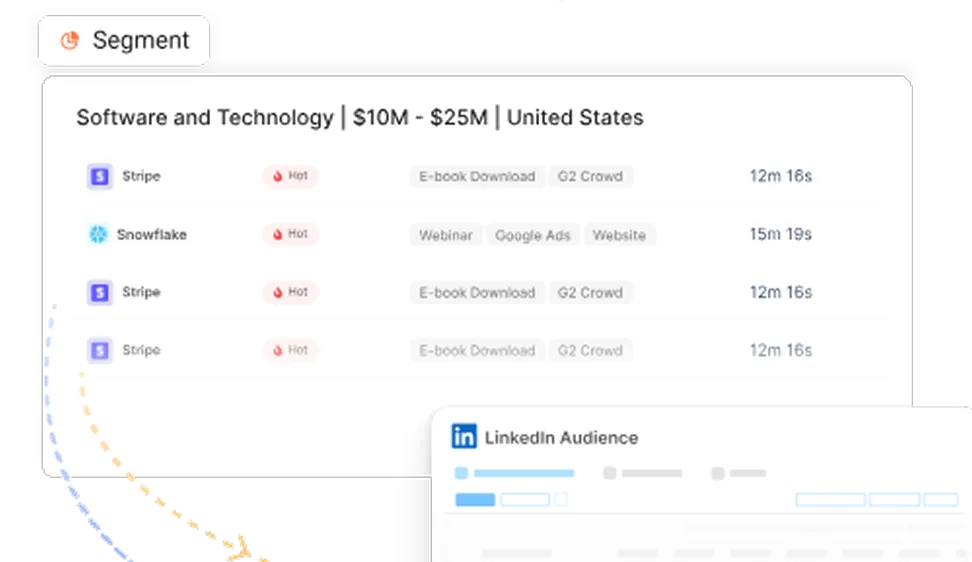
The activation layer is where Factors gets clever. It automatically syncs high-intent accounts to LinkedIn and Google, manages impression frequency at the account level, and updates audiences daily based on engagement changes. If a prospect goes cold, they're suppressed. If a new decision-maker engages, they're added. Audiences stay live and responsive.
Finally, analytics connect the dots. You can see which accounts saw your ads, visited your site, moved through your CRM, and eventually closed. The platform attributes each opportunity back to the touchpoints that influenced it, answering the question every CFO asks: "Which campaigns actually moved pipeline?"
Key strengths:
- Account-centric thinking. Everything revolves around the buying account, not individual leads. This matters if your sales cycle involves multiple stakeholders.
- Visitor identification. 75% coverage means you capture most of your anonymous traffic, not just people who filled out forms.
- Full-funnel visibility. You see how a prospect moves from first ad impression to closed deal, with attribution clarity at each stage.
- Multi-source intent. The platform doesn't rely solely on your data or any single external source. It blends five different signal types for more confident scoring.
Metadata.io: How it works
Metadata starts with a different assumption: your team doesn't have time to manage campaigns manually. The platform takes your target account lists (or builds them), connects to your CRM for pipeline data, and unleashes AI agents to handle the rest.
The Bid Agent automates bidding across channels based on pipeline impact, not engagement metrics. If LinkedIn conversions are flowing to real opportunities faster than Meta, it reallocates budget accordingly. The Creative Agent tests hundreds of ad variations, different copy, images, audiences, simultaneously, something humanly impossible at scale. The Budget Agent decides how to split spend across channels and experiments. The Analyst Agent surfaces insights and recommendations across your dashboards.
The platform runs on what Metadata calls "revenue-driven optimization." Instead of optimizing toward clicks or form fills, it pulls actual CRM data, sees which accounts turned into opportunities and deals, and reverse-engineers what made those campaigns work. Budget gets concentrated on the campaigns, audiences, and creative that drive real pipeline.
Metadata also includes multivariate testing as a core feature. Traditional A/B testing compares two versions. Metadata runs thousands of variations across creative, copy, audience segments, and campaign parameters simultaneously. Over weeks, patterns emerge. The platform identifies which combinations win and doubles down on winners.
Key strengths:
- Campaign velocity. The platform can launch, test, and optimize campaigns faster than any manual process. For teams running high volumes of demand gen campaigns, this is table stakes.
- Multi-channel native support. It handles LinkedIn, Google, Meta, Facebook, Instagram, Reddit, and X from one interface. Most platforms force you to manage each channel separately or offer surface-level orchestration.
- Revenue-based optimization. It's one of the few platforms that can directly optimize campaigns toward actual pipeline and closed deals via CRM integration, not vanity metrics.
- Experimentation at scale. Running thousands of multivariate tests means you find winners faster. Most teams test maybe 10-20 variations. Metadata tests thousands.
Factors.ai vs Metadata.io: The feature verdict
Both platforms are ambitious, but they're solving different problems.
Choose Factors if your team needs to see the entire buyer journey. You care about which accounts are engaged, why they're engaged, and exactly how that engagement maps to your pipeline. You're managing ABM campaigns, retargeting, and paid strategies, and you want one system that connects all the dots.
Choose Metadata if your team's primary motion is demand generation at scale. You're running lots of campaigns across multiple channels, you want to test continuously, and you need AI to handle the technical execution so your team can focus on strategy and creative. Revenue optimization through CRM data is important, but campaign velocity and testing speed matter most.
In short:
- Factors.ai = Full-funnel account visibility and attribution
- Metadata.io = Campaign orchestration and experimentation at scale
Factors.ai vs Metadata.io: Pricing
Both platforms price differently because they solve different parts of the stack.
Factors charges based on usage, specifically, how many companies you want to identify per month, plus seats. More companies identified = higher tier. Metadata charges based on AI Agent capability and ad spend volume. The more channels and the higher your spend, the more you're accessing premium features.
Factors.ai vs Metadata.io: Pricing comparison
Factors.ai Pricing explained
Factors' model is straightforward: you pay for volume and team size. Each tier unlocks more companies identified per month, more seats, and additional features.
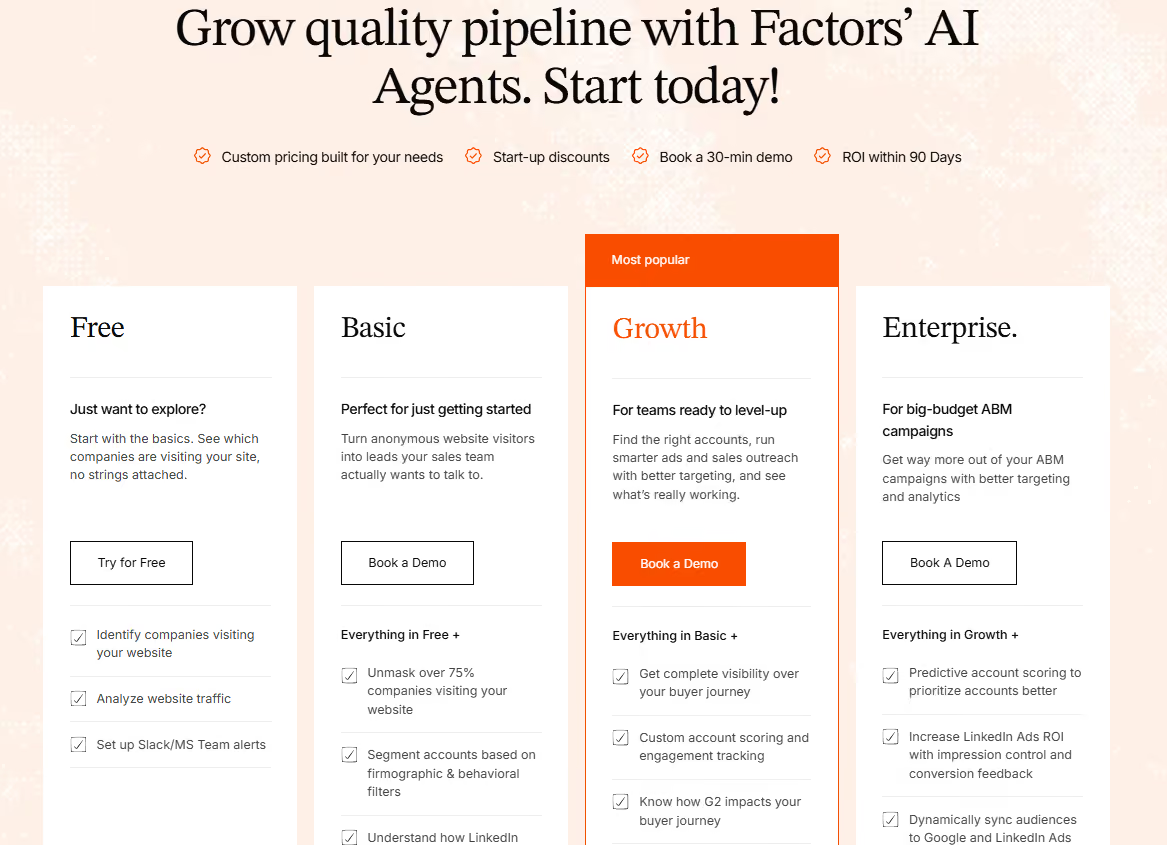
- The Free Plan (200 companies/month) is genuine. You get visitor tracking, Slack integration, and basic dashboards. It's enough to test the platform if you're early stage.
- Growth Plan (8,000 companies/month, 10 seats) is the most popular tier. It includes ABM analytics, account scoring, LinkedIn attribution, G2 intent signals, and 100 custom reports. A dedicated Customer Success Manager comes standard.
- Enterprise ($unlimited companies, 25 seats) unlocks predictive scoring, Google AdPilot, LinkedIn AdPilot, Milestones reporting, and white-glove onboarding. You also get access to GTM Engineering Services, which is valuable if you don't have RevOps bandwidth in-house.
What makes this pricing model work:
- Consolidates multiple tools (visitor ID, intent data, enrichment, ad activation, analytics) into one system. Most teams cobble together 5-8 point tools. Factors replaces several, reducing total cost of ownership.
- Scales naturally with growth. As your pipeline grows, you identify more accounts and add seats. The cost grows predictably.
- Transparency. No hidden seat surcharges or per-campaign fees. You know exactly what you're paying.
GTM Engineering Services, while optional, add real value if you don't have a dedicated RevOps person. They'll help you build ICP models, automate alert workflows, set up buying group mapping, and ensure your entire team knows how to use the platform for maximum impact.
Metadata.io Pricing explained
Metadata's pricing is oriented around AI Agents and capability. Each tier unlocks different agents and handles different volumes of ad spend.
- MetaMatch ($295/month) is lead enrichment only. It's useful if you already have a demand gen platform and just want better data on your audiences.
- Metadata Spotlight ($20,000/year) gives you basic campaign orchestration, multivariate testing, audience management, and CRM integration. It's designed for growing demand gen teams.
- Metadata Campaigns ($43,200/year) is the full platform. You get all AI Agents (Bid, Creative, Budget, Analyst), unlimited users, unlimited audiences, and support for campaigns across all six channels. This is where you get the full experimentation and revenue optimization.
The pricing scales with your ad spend. Metadata recommends a minimum daily spend of $20K+ across channels to justify the platform's cost. If you're spending less, the platform's sophisticated optimization doesn't pay for itself. If you're spending $50K+ daily, the ROI is typically strong.
What makes this pricing model work:
- Simplicity. You pick an agent level, not a per-user, per-campaign rate. Unlimited users and audiences mean adding team members doesn't trigger new costs.
- Aligns with value. Higher spend = more complex optimization = higher tier. The platform's value scales with your investment in paid media.
- Transparency on spend requirements. Metadata is upfront: you need sufficient ad spend to make the platform work. This prevents misalignment with early-stage teams.
Factors.ai vs Metadata.io: Pricing Verdict
Factors is lower entry cost but scales with volume. If you're running ABM across multiple channels and need full-funnel visibility, you're looking at Growth Plan (~$8K-12K/month depending on add-ons).
Metadata is higher entry cost but focuses on campaign efficiency. If you're running high-volume demand gen with $20K+/month ad spend, you're looking at $43K+ annually, which often pays for itself through better ROAS.
The real comparison: use Factors if you want a unified GTM system. Use Metadata if you want campaign execution automation and you have meaningful ad spend to optimize.
In short:
- Factors.ai = Lower starting point; scales with account volume and team size
- Metadata.io = Higher entry cost; best ROI for teams with $20K+ monthly ad spend
Factors.ai vs Metadata.io: CRM integration and pipeline mapping
Your CRM is the source of truth for pipeline. A GTM platform is only useful if it connects tightly to that truth.
Both Factors and Metadata integrate with HubSpot and Salesforce, but they pull different directions.
Factors.ai vs Metadata.io: CRM Integration Comparison
Factors.ai: CRM integration
Factors treats your CRM as a two-way conversation partner. It reads your pipeline stage data (where opportunities are in the funnel, which are likely to close) and uses that to inform audience targeting. If an account is in an advanced sales stage, Factors knows to suppress ads (no point spending on an account already in closing talks). If an account just moved to MQL, it gets added to a nurture campaign.
On the other side, Factors pushes enrichment signals back into your CRM. Every engagement (website visit, ad click, form fill) gets logged on the account record. Sales reps see a unified activity log showing exactly what happened before they picked up the phone.
The attribution piece is critical. Factors can show you the exact accounts that closed, which touchpoints they encountered before closing, and how much influence each touchpoint had. This isn't vanity metric attribution. It's actual pipeline traceability.
Real example of the value: A rep closes a $50K deal. Factors shows that the account saw three LinkedIn ads over six weeks, visited your pricing page twice, then filled out a demo form. The platform attributes a portion of that win to each touchpoint and quantifies the campaign's revenue impact. PS: This is data a CFO actually believes.
Metadata.io: CRM Integration
Metadata's integration is purpose-built for campaign optimization. It reads your CRM data, existing customers, pipeline status, and closed deals and uses it to identify patterns.
The platform asks: "Which companies in our target account list are now in an opportunity stage? Which ones closed in the last 30 days? What did their customer journey look like?" Then it reverse-engineers which campaigns, audiences, and creative played a role.
The optimization happens continuously. If accounts moving to SQL tend to have seen Meta ads more than LinkedIn ads, the platform reallocates budget toward Meta for that audience segment. If a creative variant correlates with higher deal values, the Bid Agent increases spend behind it.
One important distinction: Metadata doesn't directly update your CRM with engagement signals. It reads from your CRM (opportunities, deals, account data) but doesn't write back engagement logs. The focus is purely on campaign optimization, not enriching your sales data.
Real example of the value: Your demand gen team ran 47 campaign variations last month. Metadata's Analyst Agent surfaces: "Accounts that saw Variant 12 (the one with the problem-focused headline) and then converted are 23% more likely to close above target deal size. Budget allocation toward that variant increased ROAS by 17%." This kind of insight is how you tune your campaigns faster than anyone else.
Factors.ai vs Metadata.io: CRM Integration Verdict
Factors is better if you need your CRM fully aligned with your GTM system. Every signal flows in and out. Your sales team has unprecedented visibility into why an account is engagement, and your marketing team optimizes based on actual pipeline progression.
Metadata is better if your focus is purely on campaign performance and revenue optimization. It reads your CRM deeply enough to optimize, but doesn't clutter your CRM with engagement logs.
In short:
- Factors.ai = Bi-directional CRM sync for full GTM alignment
- Metadata.io = CRM data read for campaign optimization and revenue targeting
Factors.ai vs Metadata.io: Intent signals and ad activation
Where a platform captures intent and how it activates that intent are the core of demand generation.
Factors pulls intent from multiple sources but activates primarily on LinkedIn and Google. Metadata activates across six channels but pulls intent signals more narrowly.
Factors.ai vs Metadata.io: Intent and activation comparison
Factors.ai: Intent and activation
Factors' approach is "identify, score, activate." The platform figures out who's in-market, scores them heavily if they're showing buying signals, then activates them.
The identification part is unique. Factors identifies 75% of your website visitors, both at account and person level. This is a significant competitive advantage because most intent platforms only work with form-fill data or require you to already know who someone is. Factors surfaces anonymous visitors and matches them to companies.
Scoring is where the sophistication shows. The platform doesn't just ask "Did this person visit the pricing page?" It asks: "Is this account a good fit for our product (ICP)? How many signals are they showing? Are they coming from a direction that suggests they're further in the buying cycle? What's the timing window?" An account that shows three signals in one week scores differently than an account showing three signals spread over two months.
Activation happens on LinkedIn and Google. Factors automatically adds high-intent accounts to LinkedIn audiences daily, manages impression frequency to avoid ad fatigue, and sends conversion data back to both platforms so they optimize better. If an account engaged with a campaign and moved to opportunity in your CRM, that signal flows back to LinkedIn, helping it recognize similar in-market accounts.
Key activation differentiation: Account-level impression capping. If you're running ABM, you don't want the same prospect seeing your ad 47 times in a month. Factors prevents this by managing impressions at the account level across all campaigns, not just within a single campaign.
Metadata.io: Intent and activation
Metadata's approach is "activate and experiment." You provide a target account list, it activates campaigns across six channels simultaneously, and AI agents run continuous multivariate testing.
The intent signals are broad but shallow. Metadata uses LinkedIn behavior, website activity, and competitor tracking to understand who's engaged, but it doesn't do account identification the way Factors does. You typically start with your own account list or build one using third-party enrichment.
The real power is in activation and optimization. Metadata launches campaigns across LinkedIn, Google, Meta, Facebook, Instagram, Reddit, and X from one interface. Most teams manage each channel separately or use a platform that offers surface-level orchestration. Metadata gives each channel native knowledge.
Multivariate testing is Metadata's secret weapon. Instead of A/B testing two ad variations, Metadata tests combinations. Different copy for software engineers vs. finance buyers. Different images for high-intent vs. awareness audiences. Different CTAs for mobile vs. desktop. The platform generates hundreds of permutations and runs them simultaneously. Over time, winner patterns emerge.
Budget reallocation happens automatically. If Facebook audiences are driving accounts that close faster than LinkedIn audiences, the Budget Agent shifts spend. If a creative variant correlates with higher deal velocity, the Bid Agent increases bids for that combination. This happens 24/7, without manual intervention.
Key activation differentiation: Multi-channel native support. Each channel has unique mechanics (LinkedIn's audience targeting, Google's search context, Meta's lookalike audiences). Metadata builds channel expertise into the platform. Most competitors offer one "harmonized" interface that loses nuance. Metadata respects channel differences while still orchestrating centrally.
Factors.ai vs Metadata.io: Intent and activation verdict
Factors wins if you need identification, scoring, and ABM-specific activation. If you're running account-based campaigns and you want to identify who's engaging from minimal signals, this is stronger.
Metadata wins if you're running demand generation at scale across multiple channels and you want AI to handle experimentation and budget optimization. If you have a clear target account list and you want to test creative and targeting continuously, this is stronger.
In short:
- Factors.ai = Account identification + multi-source intent + ABM-specific activation
- Metadata.io = Multi-channel activation + experimentation at scale + revenue-driven optimization
Factors.ai vs Metadata.io: Analytics and Reporting
At the end of the month, your CFO will ask one question: "What did we spend, and what did we get?"
Both platforms answer this, but from different angles.
Factors.ai vs Metadata.io: Analytics Comparison
Factors.ai: Analytics
Factors' analytics answer the question: "Which account behaviors are most likely to lead to revenue?"
The platform shows you full-funnel journeys. Account X came from a LinkedIn ad on Week 1, visited your pricing page on Week 3, filled out a demo form on Week 6, and closed on Week 12. The system attributes a portion of that win to the LinkedIn ad, the website engagement, and the form fill. It can show you the sequence of touchpoints most likely to result in closed deals.
Funnel analytics visualize where prospects drop off. If 1,000 accounts see your LinkedIn ads but only 100 move to MQL, that funnel visualization flags it immediately. If those 100 then drop to 15 opportunities, you see exactly where the leak is.
Custom dashboards let you segment by any dimension, geography, persona, company size, industry. You can answer: "How do our ABM campaigns perform with accounts in technology vs. healthcare? Are there differences in conversion velocity?" These segment-level insights drive strategy changes.
One powerful feature: AI-driven insights. Factors' AI agents scan your data and surface patterns you might miss manually. "Accounts that engage with your product education content before demo requests are 3x more likely to close" or "Buying committees with 4+ decision-makers engaged close 40% faster than committees with just two." These insights come automatically, without you building queries.
Metadata.io: Analytics
Metadata's analytics answer the question: "Which campaign elements drive pipeline and revenue?"
Campaign-level reporting is detailed. For each campaign running across LinkedIn, Google, Meta, etc., you see impressions, clicks, conversions, pipeline outcomes, and revenue impact. The platform shows not just "Campaign X spent $10K" but "Campaign X spent $10K and drove 42 accounts into opportunity status, 8 of which closed, totaling $240K in ACV."
Multivariate test reporting is sophisticated. Metadata runs hundreds of tests simultaneously. The platform identifies winning combinations and explains why. "Headline variant A, image variant 2, and audience segment D outperformed other combinations by 23% on cost-per-qualified-opportunity." This level of precision helps you refine creative and targeting faster.
Channel comparison puts all your channels side by side. LinkedIn drove 120 accounts into opportunity. Google drove 140. Meta drove 65. Revenue per account varied: LinkedIn $45K average, Google $52K average, Meta $38K average. These insights drive budget reallocation.
The Analyst Agent flags anomalies and opportunities in real time. "Your highest-performing audience segment is oversaturated (37% of budget, only 12% of accounts). Consider expanding to adjacent segments."
Factors.ai vs Metadata.io: Analytics verdict
Factors is better if you need to understand full-funnel account behavior and attribute revenue to specific early-stage touchpoints. If you're running ABM and you need to understand which campaigns move accounts through the pipeline fastest, this is stronger.
Metadata is better if you need to optimize campaign elements, creative, messaging, channel mix, budget allocation, and you want the data to suggest specific optimizations. If you're running demand gen and you want to tune your experimentation results, this is stronger.
In short:
- Factors.ai = Full-funnel account journeys and attribution
- Metadata.io = Campaign optimization and experimentation insights
Factors.ai vs Metadata.io: Onboarding and support
A platform is only as useful as your team's ability to actually use it.
Factors.ai vs Metadata.io: Onboarding comparison
Factors.ai: Onboarding and Support
Factors treats onboarding as a partnership. The company assigns a Customer Success Manager who works with you from day one.
The process starts with discovery. Your CSM asks about your ICP, your sales cycles, your current GTM stack, and your team's bottlenecks. Then, instead of handing you a generic setup guide, Factors configures the platform around your specific motion.
You define your scoring rules (what makes an account high-intent?), set up your audience syncs (which signals trigger which campaigns?), and establish your reporting dashboards (what do you need to report to your leadership?). This isn't theoretical, it's built on how your GTM actually operates.
Training happens in live sessions. Your team learns not just where buttons are, but how to think about visitor identification, intent scoring, and account orchestration in the context of your specific business.
The optional GTM Engineering Services tier adds real depth. If you don't have a dedicated RevOps person, Factors' engineers will design your automation workflows, help you set up buying group mapping, build custom alert rules for your SDRs, and ensure the whole team knows how to extract maximum value from the platform.
Ongoing support happens via a dedicated Slack channel where you can ask questions in real time. Weekly calls or check-ins (depending on your tier) ensure the platform stays aligned with your business as it evolves.
Metadata.io: Onboarding and support
Metadata prioritizes speed. You can go from signup to running campaigns in 48 hours.
The process is self-service. You connect your ad accounts (LinkedIn, Google, Meta, etc.), upload your target account list, define your KPIs (pipeline, revenue, whatever matters to you), and Metadata starts building and testing campaigns.
Documentation is thorough and feature-focused. Video tutorials walk through each capability. Support is available via email and Slack for technical questions.
The gap is on strategy. Metadata doesn't come with a dedicated strategist to help you think through your motion or optimize your approach over time. You're expected to own the strategy and use the platform to execute it.
There's a Managed Services option if you want agency-style support. Metadata's team takes over campaign management, testing, and optimization. They act like an extension of your demand gen team. This adds cost but removes execution burden.
Factors.ai vs Metadata.io: Onboarding verdict
Choose Factors if your team needs structured guidance on how to think about ABM and GTM orchestration. If you have gaps in RevOps capability, the white-glove support and optional engineering services are valuable.
Choose Metadata if your team is experienced with demand gen and you just need a tool to execute faster. If you prefer independence and don't want a vendor hand-holding you, the quick setup and self-serve model works.
In short:
- Factors.ai = Structured onboarding with dedicated support and optional engineering services
- Metadata.io = Quick setup with self-serve learning and optional managed services
Factors.ai vs Metadata.io: Compliance and security
Data security isn't a feature, it's a requirement. Both platforms take compliance seriously, but they've approached it differently.
Factors.ai vs Metadata.io: Compliance comparison
Factors.ai: Compliance and security
Factors runs on Google Cloud Platform (GCP) in the us-west-1b region. This gives the platform Google's security infrastructure at scale, and GCP itself maintains SOC 2, SOC 3, and ISO 27001 certifications.
On top of that, Factors has earned SOC 2 Type II certification, meaning an independent auditor has verified that security controls are effective over time, not just in theory. The company also maintains ISO 27001 (information security management).
GDPR compliance is handled through Standard Contractual Clauses and supplementary safeguards for EU-US data transfers. This matters if you're processing data from European prospects.
Data is isolated logically, each customer's data is separate from others through authentication tokens and API keys. An employee can't accidentally access another customer's account intelligence without explicit permissions.
The company has a Data Protection Officer and formal incident response policies. If a breach occurs, there's a documented plan for notification and remediation.
Metadata.io: Compliance and security
Metadata's security posture is comparatively new but comprehensive. The platform recently completed a Praetorian security assessment in June 2024 (focused on authentication, cross-tenant authorization, and injection attacks) with zero critical or high-risk findings.
The company has ISO 27001 (information security management) and SOC 2 Type II certifications. Recently, Metadata achieved ISO 27701 certification, which specifically validates GDPR compliance and privacy-by-design implementation. This is valuable because it shows the company has built privacy controls into the product itself, not added them as an afterthought.
GDPR compliance is strong. Metadata operates data centers in both EU and US regions, giving customers flexibility on data residency. The company provides a Data Processing Addendum (DPA) that clearly outlines how it handles data as a processor.
Data isolation happens through unique customer accounts, encrypted databases, and IP whitelisting for database access. All database connections are logged and audited.
Factors.ai vs Metadata.io: Compliance verdict
Both platforms meet enterprise security and privacy standards. The meaningful differences are subtle.
Factors has more mature enterprise controls (established track record with SOC 2, incident response procedures, DPO). Best if you're in a regulated industry or your customers require extensive vendor vetting.
Metadata has newer, more privacy-focused certifications (ISO 27701 shows privacy-by-design thinking). Best if you're processing EU data and you want explicit privacy governance. The recent Praetorian assessment also demonstrates the current security posture.
Neither platform will fail the compliance review. The choice is whether you prioritize established enterprise controls (Factors) or demonstrated privacy-first architecture (Metadata).
In short:
- Factors.ai = Mature enterprise security; established compliance track record
- Metadata.io = Privacy-first design; recent third-party validation
When to choose which platform?
Both platforms move needle. They're just moving it in different directions.
Choose Factors.ai if:
- You're running ABM and you need to identify who's in-market. The 75% visitor identification capability is unique and matters if you're not just nurturing known leads but discovering anonymous accounts.
- You need full-funnel visibility and attribution. If your GTM motion is complex (multiple channels, multiple stakeholders, long sales cycles), the ability to see which touchpoint led to which opportunity is invaluable.
- Your team lacks RevOps expertise. The white-glove onboarding and optional GTM Engineering Services let you build best practices even without senior RevOps hires.
- You have $20K+ annual ad spend on LinkedIn and Google and you want that spend optimized by a system that understands your full GTM motion, not just channel metrics.
- You're reporting to executives who care about pipeline influence, not just leads. Factors gives you the attribution data to answer "How much did this campaign influence our closed revenue?"
Choose Metadata.io if:
- You're running high-volume demand generation. If you're running 50+ campaigns monthly, manual optimization is unsustainable. AI agents handling execution is the differentiator.
- You have significant paid media spend ($50K+/month across channels). Metadata's ROI comes from optimizing large budgets continuously. Below that spend level, the savings don't justify the cost.
- You want campaigns orchestrated across six channels from one interface. LinkedIn, Google, Meta, Facebook, Instagram, Reddit; Metadata gives each native support.
- Your team is comfortable with self-service tools and doesn't need hand-holding. If you prefer independence and quick deployment over structured onboarding, Metadata's model works.
- You care about experimentation velocity. If testing creative, copy, and targeting combinations is core to your demand gen strategy, multivariate testing at Metadata's scale is rare.
- You want revenue-based optimization without a complex data integration project. Metadata reads your CRM and immediately starts optimizing toward pipeline and revenue.
Factors.ai vs Metadata.io: Decision matrix
In a nutshell…
Factors.ai and Metadata.io are built for different problems.
Factors solves the "How do I see and move the entire buyer journey?" problem. It identifies accounts from thin signals, scores them, activates them, and ties everything to revenue. It's a system that grows with your GTM maturity.
Metadata solves the "How do I run campaigns faster and smarter?" problem. It automates campaign execution, tests continuously, and optimizes toward revenue. It's a system for teams that have campaigns to run and need AI to handle the operational burden.
Pick Factors if your competitive advantage comes from understanding your buyers better than competitors do. You'll spend more time on strategy and decision-making because the platform handles the mechanics.
Pick Metadata if your competitive advantage comes from moving faster and testing more aggressively. You'll push creative, channel mix, and targeting faster because the platform automates the grunt work.
Both approaches win. The question is which one aligns with how your team actually works and what you actually need to move pipeline.
FAQs for Factors.ai vs Metadata.io
Q1. Can I use both platforms together?
Yes. Some teams use Factors for account identification and ABM strategy, then feed that audience into Metadata for campaign execution across multiple channels. It's a more expensive stack but gives you both benefits. Other teams use one or the other based on motion, Factors for ABM campaigns, Metadata for demand gen campaigns.
Q2. Which platform is better for small teams?
Factors. If you don't have a dedicated demand gen team, Factors' identification and automation reduce manual work. Metadata requires more volume and expertise to justify its cost.
Q3. Does Factors have any native campaign creation features?
Factors automates audience creation and sync to LinkedIn and Google but doesn't build ad creative or copy. You handle creative strategy; Factors handles audience orchestration and activation.
Q4. Does Metadata do account identification?
Not the way Factors does. Metadata starts with your target account list or uses the MetaMatch identity graph (which matches individuals to accounts). But it doesn't identify anonymous visitors from your website the way Factors does.
Q5. Which platform integrates better with HubSpot?
Both integrate with HubSpot natively. Factors has bi-directional sync (reads and writes data). Metadata reads HubSpot data for optimization but doesn't update lead records. For HubSpot users, Factors offers more integration depth.
Q6. What's the minimum ad spend needed for each platform?
Factors works at any spend level (free tier is available). Metadata recommends $20K+ monthly ad spend for the platform to be cost-effective.
Q7. If I use Factors, do I still need a demand gen platform?
Not necessarily. Factors handles audience creation, ad activation on LinkedIn and Google, and analytics. If you only run LinkedIn and Google campaigns, Factors is sufficient. If you run Meta, Facebook, Instagram, or other channels, you'll need another platform or Metadata for orchestration.
Q8. Can Metadata help me identify buying intent?
Yes, but differently than Factors. Metadata uses LinkedIn signals, website activity, and competitor tracking. Factors uses those plus Bombora 3rd-party intent, product usage, and form interaction signals. Factors has more signal depth.
Q9. Which platform has better customer support?
Factors includes a dedicated CSM with every paid plan. Metadata offers self-serve support and optional managed services. If support is critical to your decision, Factors is more structured. If you prefer independence, Metadata is faster.
Q10. Do either platforms offer free trials?
Yes. Factors offers 14-day paid trials. Metadata offers 30-day free trials. Both let you test before committing.
Q11. Which platform is easier to implement?
Metadata is faster (48 hours to campaigns). Factors is more thorough (2-4 weeks with strategy built in). Depends whether you prioritize speed or strategic foundation.
Q12. Can I switch from one platform to another later?
Yes. Neither platform owns your data. You can export audience lists, campaign data, and analytics. Switching will require rebuilding configurations, but it's not locked in.

See how Factors can 2x your ROI
Boost your LinkedIn ROI in no time using data-driven insights


.avif)

See Factors in action.
Schedule a personalized demo or sign up to get started for free
LinkedIn Marketing Partner
GDPR & SOC2 Type II






.svg)



.avif)

